REVIEW 3 major objections 3 minor 3 cited by
Boundary conformal data—including the Affleck–Ludwig g-factor—can be extracted from periodic non-Hermitian critical chains alone, using paired overlaps whose dual implements the nonunitary CFT's bilinear pairing; the resulting coefficients
Reviewed by Pith at T0; open to challenge. T0 means a machine referee read the full paper against a public rubric. the ladder, T0–T4 →
T0 review · deepseek-v4-flash
2026-08-03 02:04 UTC pith:YHZNTLCX
load-bearing objection A genuinely new periodic-chain route to nonunitary boundary data with strong Yang-Lee and fixed/free Potts numerics, held back only by an unproven—though plausible—identification of the lattice dual pairing with the CFT bilinear pairing. the 3 major comments →
Extracting Boundary Conformal Data from Periodic Non-Hermitian Critical Chains
The pith
A machine-rendered reading of the paper's core claim, the machinery that carries it, and where it could break.
Core claim
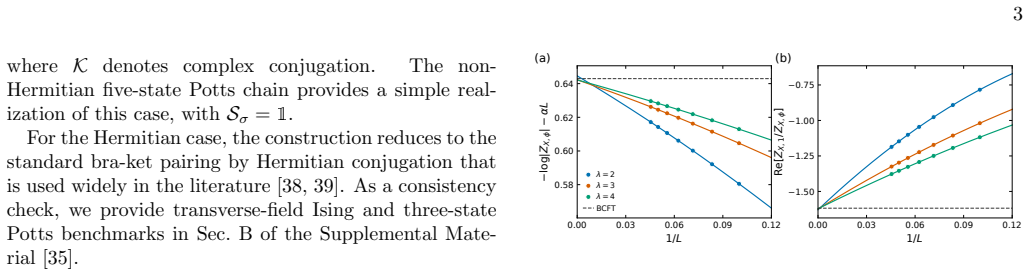
The paper claims that the finite-size scaling of paired projected overlaps Z_{Φ,i}(L) = ⟨eΦ|Ψ_i,R⟩⟨Ψ_i,L|Φ⟩ / ⟨Ψ_i,L|Ψ_i,R⟩ yields, up to a nonuniversal exponential factor, the squared boundary-state coefficients G_{a,i} = (B_i^a)^2, where B_i^a is the coefficient of the Ishibashi state |i⟩⟩ in the Cardy boundary state |a⟩. In nonunitary and complex fixed-point theories, the usual Hermitian conjugation is replaced by the infrared CFT's bilinear (BPZ) pairing, so the extracted coefficients may be negative or complex. The method is demonstrated for the Yang-Lee CFT, where the excited-to-ground ratio equals -(1+√5)/2, a sign impossible in unitary theories, and for the non-Hermitian five-state P
What carries the argument
Projected-partition-function spectroscopy: for a periodic bulk-critical Hamiltonian H, one takes a short-range-entangled state |Φ⟩ representing a boundary condition a and a compatible dual ⟨eΦ| defined either by η-pseudo-Hermiticity (Eq. 10) or by a complex-symmetric bilinear pairing (Eq. 12). The paired amplitude Z_{Φ,i}(L) = ⟨eΦ|Ψ_i,R⟩⟨Ψ_i,L|Φ⟩ / ⟨Ψ_i,L|Ψ_i,R⟩ projects onto the low-energy sector i via the biorthogonal projector; in the scaling limit it gives exp(-α_Φ L) G_{a,i} with G_{a,i} = (B_i^a)^2. The dual pairing is the load-bearing piece: it implements the BPZ bilinear form of the nonunitary theory, which can make the coefficients negative or complex.
Load-bearing premise
The dual preparation chosen by Eq. (10) or (12) exactly reproduces the BPZ bilinear pairing of the infrared nonunitary CFT; if this lattice-to-infrared identification fails, the extracted G_{a,i}—especially their signs and phases—are not the true BCFT coefficients, and the paper verifies it only by numerical agreement for Yang-Lee and fixed/free Potts, with visible mismatches for k=3,4.
What would settle it
Compute the projected overlap ratio R_{Φ,1} = Z_{Φ,1}/Z_{Φ,ϕ} in the Yang-Lee chain at larger L with the η-inserted dual; if the negative sign flips or the magnitude drifts from (1+√5)/2 beyond the reported sub-percent precision, the claim of a universal negative sector ratio fails. For the Potts case, re-derive the analytic continuation with the opposite γ branch and compare the fixed and free coefficients; only one branch can match them, and a mismatch would signal that the method selects the wrong branch or that the dual-pairing assumption is incorrect.
If this is right
- Boundary universal data (g-factors, boundary coefficients, signs and phases) become accessible in non-Hermitian systems without engineering open boundaries, avoiding the skin effect and other open-boundary pathologies.
- A negative excited-to-ground sector ratio is a universal signature of nonunitarity: no unitary CFT can produce it, so observing a similar ratio in another critical non-Hermitian chain would indicate a nonunitary infrared fixed point.
- For complex fixed points, the method resolves intrinsically complex boundary coefficients and verifies Kramers-Wannier duality; the finite-size fits select the correct analytic-continuation branch of the boundary state.
- The sector-resolved nature of the extracted G_{a,i} enables consistency checks beyond a single g-factor, including first-excited-multiplet projections that constrain which boundary conditions actually describe the lattice model.
- Applying the method to other non-Hermitian critical models could map out boundary RG flows without ever needing a microscopic open-boundary Hamiltonian.
Where Pith is reading between the lines
- The same paired-overlap principle could be extended to extract bulk-to-boundary OPE coefficients and mixed-boundary amplitudes, or to diagnose boundary RG flow by tracking how different preparations approach fixed points.
- The visible ground- and excited-sector discrepancies for the k=3,4 Potts preparations suggest those intermediate blob boundaries may actually flow to the free or fixed boundary condition in the infrared; our method provides a direct test by comparing full sector-resolved coefficients across preparations.
- If the negative Yang-Lee ratio persists in larger systems and in other real nonunitary CFTs, it could serve as a 'nonunitarity detector' analogous to how entanglement scaling detects complex criticality.
- A natural stress test would be to apply the method to a non-Hermitian chain with an exactly known boundary-state expansion (e.g., a free-fermion model with an explicit open-boundary solution) to isolate whether the η-pairing or the analytic continuation is the source of any residual mismatch.
Editorial analysis
A structured set of objections, weighed in public.
Referee Report
Summary. The paper proposes a periodic-chain projected-partition-function spectroscopy to extract boundary conformal data from non-Hermitian critical chains. For a bulk-critical periodic Hamiltonian and a short-range-entangled preparation |Φ⟩, the authors define the paired projected amplitude Z_{Φ,i}(L) in Eq. (2) and argue that it scales as e^{-α_Φ L}(G_{a(Φ),i}+o(1)), where G_{a,i}=(B_i^a)^2 is a boundary-state coefficient. The dual preparation is chosen through an η-pseudo-Hermitian pairing, Eq. (10), or through a complex-symmetric bilinear form, Eq. (12). The method is tested on a PT-symmetric Yang-Lee realization, where the g-factor and a negative excited-to-ground ratio are recovered, and on the non-Hermitian five-state Potts chain, where complex fixed/free boundary coefficients are extracted and the Kramers-Wannier duality G_free/G_fixed=5 is reproduced. The paper also includes Hermitian benchmarks and openly reports discrepancies for the k=2,3,4 intermediate Potts preparations.
Significance. If the central claim holds, the paper establishes a genuinely new route to nonunitary boundary universal data without engineering open-boundary Hamiltonians, which is especially valuable in non-Hermitian systems where open boundaries are subtle. The Yang-Lee negative projected ratio and the complex Potts coefficients are concrete, falsifiable predictions that go beyond standard unitary BCFT. Strengths of the paper include the transparent finite-size extrapolation protocols, the independent Hermitian benchmarks in Supplemental Sec. B, the explicit disclosure of the k=2,3,4 mismatches in Tables II and S3, and the use of independent analytically continued 2BTL predictions for comparison. The main risk is that the microscopic-to-infrared identification of the bilinear pairing is assumed rather than derived, and the quantities that most depend on it—signs and complex phases—are exactly the headline results.
major comments (3)
- [Appendix A / Eqs. (10)-(12)] The identification of the lattice dual with the BPZ pairing is the central premise of Eq. (3), but it is assumed rather than derived. Appendix A postulates in Eq. (A5) that |Φ⟩ and ⟨Φ̃| realize regularized boundary states in the same CFT, and then Eqs. (10) and (12) are asserted to supply the correct dual. No argument is given that the η-inner product or the complex-symmetric transpose reproduces the BPZ bilinear pairing, including its normalization and sign. The numerical agreement in Yang-Lee and in the fixed/free Potts sectors is encouraging, but it involves only one real nonunitary fixed point with all preparations flowing to the same minimal-g boundary condition. Because the headline outputs—the negative Yang-Lee ratio and the complex phases of the Potts coefficients—are precisely pairing-dependent, the manuscript should either provide a derivation from the microscopic-to-continuum
- [Tables II and S3] The intermediate preparations do not match the analytically continued 2BTL predictions. In the ground sector, k=3 and k=4 deviate by about 6% in Table II; in the excited sector, the k=2 extrapolated ratio 1.842(6)+0.025(6)i is incompatible with the 2BTL value 1.4464+0.1256i in Table S3. The manuscript attributes this to a limitation of the analytic-continuation assignment rather than to the extraction. This may be correct, but it means that the method does not, by itself, identify when the infrared pairing has been implemented correctly for an arbitrary preparation. The fixed/free agreement and Eq. (17) are strong, but the general claim that the full family in Eq. (16) yields reliably extracted boundary data is not yet supported.
- [Tables I, II, and S3; Figs. S2-S3] The quoted numerical uncertainties are propagated fitting uncertainties only; the deviation between the two fit ansatzes shown in Figs. S2 and S3 (1/L versus 1/L+1/L^2) is not propagated into the quoted error bars. For several Potts intercepts, the ansatz shift is comparable to or larger than the stated uncertainty. Since Eq. (A.12) contains many possible correction powers and the accessible L range is small, the systematic error from the fit-form choice should be either quantified in the quoted values or used to define the central estimates; otherwise the stated precision overstates the reliability of the extracted coefficients.
minor comments (3)
- [Main text vs. Sec. D] The main text quotes the Potts fixed-point coupling as λ_c=0.079+0.060i, while Supplemental Sec. D states λ=0.0788+0.0603i. These should be aligned.
- [Appendix C, Eq. (C15)] The branch selection from the multivalued relation (C14) is central to the analytic continuation. The statement 'continuously connected to the Potts blob boundary conditions' should be made more explicit, e.g., by specifying the continuation path or the choice of logarithm branch in the complex plane.
- [Summary and discussion] The possible generalized g-theorem for complex BCFT, Eq. (18), is framed as speculation and supported only by the fitted magnitudes. This is clearly labeled, but it might be separated more explicitly from the extracted data to avoid giving it the same status as the fixed/free benchmark.
Circularity Check
No significant circularity: the universal coefficients are extrapolated intercepts compared against independent BCFT/2BTL data; the lattice-to-CFT pairing is an explicit ansatz, not a fitted input.
full rationale
The central extraction is not circular by construction. Eq. (2) defines Z_{Phi,i}(L) from fixed microscopic preparation states and the biorthogonal eigenstates; Eq. (3) is the scaling form whose intercept gives G_{a,i}. The universal coefficient is not used as input: Eqs. (7)-(8) fit only nonuniversal extensive and 1/L corrections, while the target G is the extrapolated constant, and ratios cancel the nuisance terms. The dual preparations in Eqs. (10) and (12) are prescribed by lattice symmetries (eta-pseudo-Hermiticity for Yang-Lee and complex-symmetric transpose for the Potts chain), not chosen to reproduce the BCFT coefficients being tested. Appendix A does rest on the Calabrese-Cardy regularized-boundary-state ansatz and assumes that the lattice dual realizes the BPZ pairing (Eq. A5); this is a genuine unproven load-bearing premise. But it is a hypothesis with falsifiable content: the extracted Yang-Lee value g_1 and negative ratio, and the fixed/free Potts complex coefficients, agree with independent Cardy and analytically continued 2BTL predictions, while the k=2 excited sector and k=3,4 sectors show discrepancies that the paper reports rather than hides. Thus the method could have failed, and did partially fail for intermediate sectors; it is not an identity between input and output. Self-citations enter only in finite-size-correction power counting (Ref. [48]) and in a speculative RG-flow interpretation of the k=3,4 mismatches (Ref. [43]); neither is a uniqueness theorem and neither is needed to obtain the headline fixed/free and Yang-Lee results. The unproven pairing identification is a correctness risk, not a circularity.
Axiom & Free-Parameter Ledger
free parameters (4)
- alpha_Phi (per-preparation extensive exponent) =
fitted; not tabulated
- beta_Phi and B_Phi (Yang-Lee 1/L and 1/L^2 amplitudes) =
fitted; not tabulated
- A_k (Potts 1/L amplitude) =
fitted; not tabulated
- h_c^infinity extrapolation coefficients (A,B,C in Eq. C.1) =
e.g., h_c^inf=0.8834983(1) at lambda=3; 1.55872195(5) at lambda=4
axioms (5)
- domain assumption Short-range-entangled preparation states flow to smeared Cardy boundary states of the infrared CFT (Calabrese-Cardy regularized-boundary-state ansatz), also in non-Hermitian systems.
- ad hoc to paper The lattice bilinear pairing encoded by eta (pseudo-Hermitian) or by the complex-symmetric transpose S_sigma reproduces the BPZ pairing of the nonunitary CFT; therefore the left dual in Eqs. (10)/(12) is the correct dual.
- domain assumption The biorthogonal projector onto low-energy periodic eigenstates corresponds to the CFT projector onto a single conformal sector i.
- domain assumption The finite-size correction powers appearing in the fits (1/L, 1/L^2, L^-2.4, etc.) are the leading corrections from boundary and bulk irrelevant operators.
- domain assumption The analytic continuation of the two-boundary Temperley-Lieb loop model to Q=5 with branch gamma = -i log phi describes the complex fixed point of the non-Hermitian five-state Potts chain.
read the original abstract
Boundary conformal field theory (BCFT) contains universal data that are usually accessed microscopically by imposing spatial boundaries on the lattice. In non-Hermitian many-body systems, however, changing boundary conditions can qualitatively reorganize spectra and eigenstates, and their boundary criticality remains elusive. Here, we introduce a periodic-chain spectroscopy to extract universal boundary quantities, such as the Affleck-Ludwig $g$-factor, directly from non-Hermitian bulk-critical quantum chains, avoiding the need to engineer microscopic open boundaries and circumventing subtle boundary effects in non-Hermitian systems. We illustrate our method with a $\mathcal{PT}$-symmetric Ising realization of the real nonunitary Yang-Lee CFT and reveal a universal negative excited-to-ground ratio, which has no counterpart in unitary critical theories and provides a microscopic signature of nonunitarity. For the genuinely complex fixed points of the non-Hermitian five-state Potts chain, we extract intrinsically complex boundary coefficients, verify the exact Kramers-Wannier duality relation, and select the consistent analytic-continuation branch of the boundary states. Our results establish a route to nonunitary BCFT universal data using only knowledge of the bulk critical system, opening a window into non-Hermitian boundary criticality.
Figures

Forward citations
Cited by 3 Pith papers
-
Exactly solvable non-unitary conformal interfaces in unitary CFTs
An SL(2,C)-parametrized family of exactly solvable non-unitary conformal interfaces is constructed on the lattice in unitary CFTs via analytic continuation, leading to a non-unitary Cardy condition and logarithmic ent...
-
Complex Conformal Manifolds
Analytic continuation of marginal couplings produces complex CFTs, with no genuinely complex rational CFTs existing, and exact defect results verified in non-Hermitian Ising and fermion chains.
-
Complex Conformal Manifolds
Complexified exactly-marginal couplings produce solvable complex CFTs, with the Ising defect verified numerically in non-Hermitian chains.
Reference graph
Works this paper leans on
-
[1]
C. N. Yang and T. D. Lee, Statistical theory of equations of state and phase transitions. i. theory of condensation, Physical Review87, 404 (1952); T. D. Lee and C. N. Yang, Statistical theory of equations of state and phase transitions. II. lattice gas and Ising model, Physical Re- view87, 410 (1952)
1952
-
[2]
M. E. Fisher, Yang-lee edge singularity andϕ 3 field the- ory, Physical Review Letters40, 1610 (1978)
1978
-
[3]
J. L. Cardy, Conformal invariance and the Yang–Lee edge singularity in two dimensions, Physical Review Letters 54, 1354 (1985)
1985
-
[4]
D. B. Kaplan, J.-W. Lee, D. T. Son, and M. A. Stephanov, Conformality lost, Physical Review D80, 125005 (2009), arXiv:0905.4752 [hep-th]
Pith/arXiv arXiv 2009
-
[5]
V. Gorbenko, S. Rychkov, and B. Zan, Walking, weak first-order transitions, and complex CFTs, Journal of High Energy Physics2018, 108 (2018), arXiv:1807.11512 [hep-th]
Pith/arXiv arXiv 2018
-
[6]
V. Gorbenko, S. Rychkov, and B. Zan, Walking, weak first-order transitions, and complex CFTs ii. two- dimensional Potts model atq >4, SciPost Physics5, 050 (2018), arXiv:1808.04380 [hep-th]
Pith/arXiv arXiv 2018
-
[7]
H. Ma and Y.-C. He, Shadow of complex fixed point: Approximate conformality ofq >4 Potts model, Physi- cal Review B99, 195130 (2019), arXiv:1811.11189 [cond- mat.str-el]
Pith/arXiv arXiv 2019
-
[8]
A. Haldar, O. Tavakol, H. Ma, and T. Scaffidi, Hid- den critical points in the two-dimensional O(n >2) model: Exact numerical study of a complex conformal field theory, Physical Review Letters131, 131601 (2023), arXiv:2303.02171 [cond-mat.stat-mech]
Pith/arXiv arXiv 2023
-
[9]
J. L. Jacobsen and K. J. Wiese, Lattice realization of complex conformal field theories: Two-dimensional Potts model withq >4 states, Physical Review Letters133, 077101 (2024), arXiv:2402.10732 [hep-th]
Pith/arXiv arXiv 2024
-
[10]
Y. Tang, H. Ma, Q. Tang, Y.-C. He, and W. Zhu, Re- claiming the lost conformality in a Non-Hermitian quan- tum 5-State Potts model, Physical Review Letters133, 076504 (2024), arXiv:2403.00852 [cond-mat.stat-mech]
arXiv 2024
-
[11]
H. Shimizu and K. Kawabata, Complex entanglement en- tropy for complex conformal field theory, Physical Review B112, 085112 (2025), arXiv:2502.02001 [cond-mat.stat- mech]
Pith/arXiv arXiv 2025
-
[12]
V. Vander Linden, B. De Vos, K. Vervoort, F. Verstraete, and A. Ueda, Spiral renormalization group flow and universal entanglement spectrum of the non-Hermitian five-state Potts model, Physical Review B113, 205106 (2026), arXiv:2507.14732 [cond-mat.str-el]
Pith/arXiv arXiv 2026
-
[13]
J. L. Cardy, Boundary conditions, fusion rules and the Verlinde formula, Nuclear Physics B324, 581 (1989)
1989
-
[14]
ground-state degeneracy
I. Affleck and A. W. W. Ludwig, Universal noninteger “ground-state degeneracy” in critical quantum systems, Physical Review Letters67, 161 (1991)
1991
-
[15]
J. Cardy, Boundary conformal field theory, inEncyclope- dia of Mathematical Physics(Elsevier, 2006) arXiv:hep- th/0411189
arXiv 2006
-
[16]
D. Friedan and A. Konechny, Boundary entropy of one-dimensional quantum systems at low temperature, Physical Review Letters93, 030402 (2004), arXiv:hep- th/0312197
arXiv 2004
-
[17]
T. E. Lee, Anomalous edge state in a Non-Hermitian lattice, Physical Review Letters116, 133903 (2016), arXiv:1603.05312 [quant-ph]
Pith/arXiv arXiv 2016
-
[18]
S. Yao and Z. Wang, Edge states and topological invari- ants of Non-Hermitian systems, Physical Review Letters 121, 086803 (2018), arXiv:1803.01876 [cond-mat.mes- hall]
Pith/arXiv arXiv 2018
-
[19]
F. K. Kunst, E. Edvardsson, J. C. Budich, and E. J. Bergholtz, Biorthogonal bulk-boundary correspondence in Non-Hermitian systems, Physical Review Letters121, 026808 (2018), arXiv:1805.06492 [cond-mat.mes-hall]
Pith/arXiv arXiv 2018
-
[20]
C. H. Lee and R. Thomale, Anatomy of skin modes and topology in non-Hermitian systems, Physical Re- view B99, 201103(R) (2019), arXiv:1809.02125 [cond- mat.other]
Pith/arXiv arXiv 2019
-
[21]
K. Yokomizo and S. Murakami, Non-bloch band theory of Non-Hermitian systems, Physical Review Letters123, 066404 (2019), arXiv:1902.10958 [cond-mat.mes-hall]
Pith/arXiv arXiv 2019
-
[22]
K. Zhang, Z. Yang, and C. Fang, Correspondence between winding numbers and skin modes in Non- Hermitian systems, Physical Review Letters125, 126402 (2020), arXiv:1910.01131 [cond-mat.mes-hall]
Pith/arXiv arXiv 2020
-
[23]
N. Okuma, K. Kawabata, K. Shiozaki, and M. Sato, 6 Topological origin of Non-Hermitian skin effects, Physi- cal Review Letters124, 086801 (2020), arXiv:1910.02878 [cond-mat.mes-hall]
Pith/arXiv arXiv 2020
-
[24]
P.-Y. Chang, J.-S. You, X. Wen, and S. Ryu, Entangle- ment spectrum and entropy in topological non-Hermitian systems and nonunitary conformal field theory, Physi- cal Review Research2, 033069 (2020), arXiv:1909.01346 [cond-mat.str-el]
Pith/arXiv arXiv 2020
-
[25]
F. C. Alcaraz and M. T. Batchelor, Anomalous bulk be- havior in the free parafermionz(n) spin chain, Physi- cal Review E97, 062118 (2018), arXiv:1802.04453 [cond- mat.stat-mech]
Pith/arXiv arXiv 2018
-
[26]
Y. Tang, Q. Liu, Q. Tang, and W. Zhu, Boundary criti- cality of complex conformal field theory: A case study in the non-Hermitian 5-state Potts model, SciPost Physics 19, 164 (2025), arXiv:2512.07625 [cond-mat.stat-mech]
arXiv 2025
- [27]
-
[28]
G. Tak´ acs and G. M. T. Watts, Excited-stateg-functions from the truncated conformal space, Journal of High En- ergy Physics2012, 082 (2012), arXiv:1112.2906 [hep-th]
Pith/arXiv arXiv 2012
-
[29]
Z. Bajnok and T. L. Tompa, TCSA and the finite volume boundary state, Nuclear Physics B964, 115330 (2021), arXiv:2008.01979 [hep-th]
Pith/arXiv arXiv 2021
-
[30]
J. L. Jacobsen and H. Saleur, Conformal boundary loop models, Nuclear Physics B788, 137 (2008), arXiv:math- ph/0611078
arXiv 2008
-
[31]
J. Dubail, J. L. Jacobsen, and H. Saleur, Conformal two- boundary loop model on the annulus, Nuclear Physics B 813, 430 (2009), arXiv:0812.2746 [math-ph]
Pith/arXiv arXiv 2009
-
[32]
N. F. Robertson, J. L. Jacobsen, and H. Saleur, Con- formally invariant boundary conditions in the antifer- romagnetic Potts model and the SL(2,R)/U(1) sigma model, Journal of High Energy Physics2019, 254 (2019), arXiv:1906.07565 [cond-mat.stat-mech]
Pith/arXiv arXiv 2019
-
[33]
An example is provided for the first excited state of the non-Hermitian five-state Potts model
If the energies are degenerate, one can alternatively de- fine the projected amplitude to the subspace spanned by these degenerate eigenstates. An example is provided for the first excited state of the non-Hermitian five-state Potts model
-
[34]
Ishibashi, The boundary and crosscap states in con- formal field theories, Modern Physics Letters A4, 251 (1989)
N. Ishibashi, The boundary and crosscap states in con- formal field theories, Modern Physics Letters A4, 251 (1989)
1989
-
[35]
See the Supplemental Material for the analysis of the finite-size corrections to the projected amplitudes, Her- mitian benchmark, and numerical details of the Yang– Lee and non-Hermitian five-state Potts models
-
[36]
C. M. Bender and S. Boettcher, Real spectra in Non- Hermitian hamiltonians havingPTsymmetry, Physical Review Letters80, 5243 (1998), arXiv:physics/9712001
Pith/arXiv arXiv 1998
-
[37]
A. Mostafazadeh, Pseudo-hermiticity versus pt symme- try: The necessary condition for the reality of the spec- trum of a non-Hermitian hamiltonian, Journal of Mathe- matical Physics43, 205 (2002), arXiv:math-ph/0107001
Pith/arXiv arXiv 2002
-
[38]
J.-M. St´ ephan, G. Misguich, and F. Alet, Geometric entanglement and Affleck–Ludwig boundary entropies in critical XXZ and Ising chains, Physical Review B 82, 180406(R) (2010), arXiv:1007.4161 [cond-mat.stat- mech]
Pith/arXiv arXiv 2010
-
[39]
M. Brockmann and J.-M. St´ ephan, Universal terms in the overlap of the ground state of the spin-1/2 XXZ chain with the N´ eel state, Journal of Physics A: Mathemati- cal and Theoretical50, 354001 (2017), arXiv:1705.08505 [cond-mat.stat-mech]
Pith/arXiv arXiv 2017
-
[40]
von Gehlen, Critical and off-critical conformal analysis of the Ising quantum chain in an imaginary field, Journal of Physics A: Mathematical and General24, 5371 (1991)
G. von Gehlen, Critical and off-critical conformal analysis of the Ising quantum chain in an imaginary field, Journal of Physics A: Mathematical and General24, 5371 (1991)
1991
-
[41]
Di Francesco, P
P. Di Francesco, P. Mathieu, and D. S´ en´ echal,Conformal Field Theory, Graduate Texts in Contemporary Physics (Springer, New York, 1997)
1997
-
[42]
I. Affleck, M. Oshikawa, and H. Saleur, Boundary critical phenomena in the three-state Potts model, Journal of Physics A: Mathematical and General31, 5827 (1998), arXiv:cond-mat/9804117
Pith/arXiv arXiv 1998
-
[43]
Y. Liu, N. Chepiga, Y. Fukusumi, and M. Os- hikawa, Boundary critical phenomena in the quantum Ashkin-Teller model, SciPost Physics20, 130 (2026), arXiv:2601.16951 [cond-mat.str-el]
Pith/arXiv arXiv 2026
-
[44]
P. Calabrese and J. Cardy, Time dependence of cor- relation functions following a quantum quench, Phys- ical Review Letters96, 136801 (2006), arXiv:cond- mat/0601225
arXiv 2006
-
[45]
W. Tang, L. Chen, W. Li, X. C. Xie, H.-H. Tu, and L. Wang, Universal boundary entropies in conformal field theory: A quantum Monte Carlo study, Physical Review B96, 115136 (2017), arXiv:1708.04022 [cond-mat.str-el]
Pith/arXiv arXiv 2017
-
[46]
A. A. Belavin, A. M. Polyakov, and A. B. Zamolodchikov, Infinite conformal symmetry in two-dimensional quan- tum field theory, Nuclear Physics B241, 333 (1984)
1984
-
[47]
Y. Fukusumi and T. Kawamoto, Generalizing quan- tum dimensions: Symmetry-based classification of local pseudo-Hermitian systems and the corresponding domain walls (2025), arXiv:2511.11059 [hep-th]
Pith/arXiv arXiv 2025
-
[48]
Y. Liu, H. Shimizu, A. Ueda, and M. Oshikawa, Finite- size corrections to the energy spectra of gapless one- dimensional systems in the presence of boundaries, Sci- Post Physics17, 099 (2024), arXiv:2405.06891 [cond- mat.str-el]
Pith/arXiv arXiv 2024
-
[49]
H.-L. Xu and A. Zamolodchikov, 2d Ising field theory in a magnetic field: the Yang–Lee singularity, Journal of High Energy Physics2022, 57 (2022), arXiv:2203.11262 [hep-th]
Pith/arXiv arXiv 2022
-
[50]
N. Chepiga, Critical properties of quantum three- and four-state Potts models with boundaries polarized along the transverse field, SciPost Physics Core5, 031 (2022), arXiv:2107.08899 [cond-mat.str-el]
Pith/arXiv arXiv 2022
-
[51]
Extracting Boundary Conformal Data from Periodic Non-Hermitian Critical Chains
N. Chepiga and F. Mila, Excitation spectrum and density matrix renormalization group iterations, Physical Review B96, 054425 (2017), arXiv:1705.05423 [cond-mat.str-el]. END MATTER APPENDIX A: CONTINUUM INTERPRET A TION OF PROJECTED COEFFICIENTS Here, we demonstrate how the lattice projected am- plitude used in the main text is related to the universal bou...
Pith/arXiv arXiv 2017
discussion (0)
Sign in with ORCID, Apple, or X to comment. Anyone can read and Pith papers without signing in.