Reduced Effective Viscosity from Anisotropic Transport and Plasma Instabilities in the Sloshing Cores of Galaxy Clusters
Pith reviewed 2026-06-27 00:31 UTC · model grok-4.3
The pith
Pressure anisotropy limited by plasma instabilities reduces effective viscosity in galaxy cluster cores well below the isotropic Spitzer value.
A machine-rendered reading of the paper's core claim, the machinery that carries it, and where it could break.
Core claim
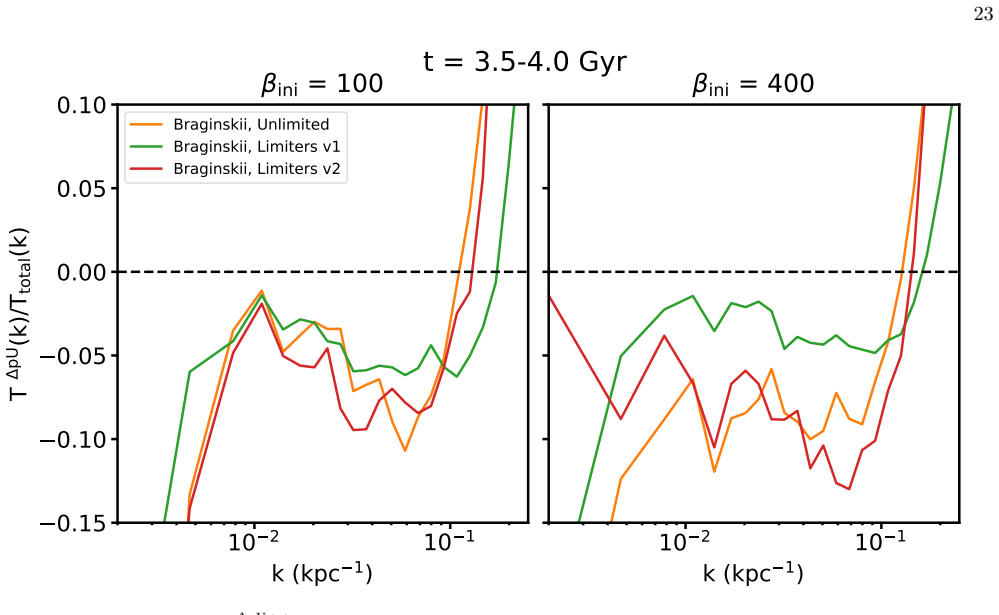
In simulations of sloshing cluster cores, the combination of pressure-anisotropy limiters and the turbulent magnetic field structure causes the effective viscosity to fall much below the isotropic Spitzer value over a substantial fraction of the core. This reduced viscosity steepens the velocity-amplitude spectrum and converts a small portion of the turbulent kinetic energy into heat. The runs also exhibit magneto-immutable dynamics.
What carries the argument
Anisotropic viscous stress from Braginskii-MHD with pressure anisotropy capped at instability thresholds, acting on sloshing-induced flows and turbulence.
If this is right
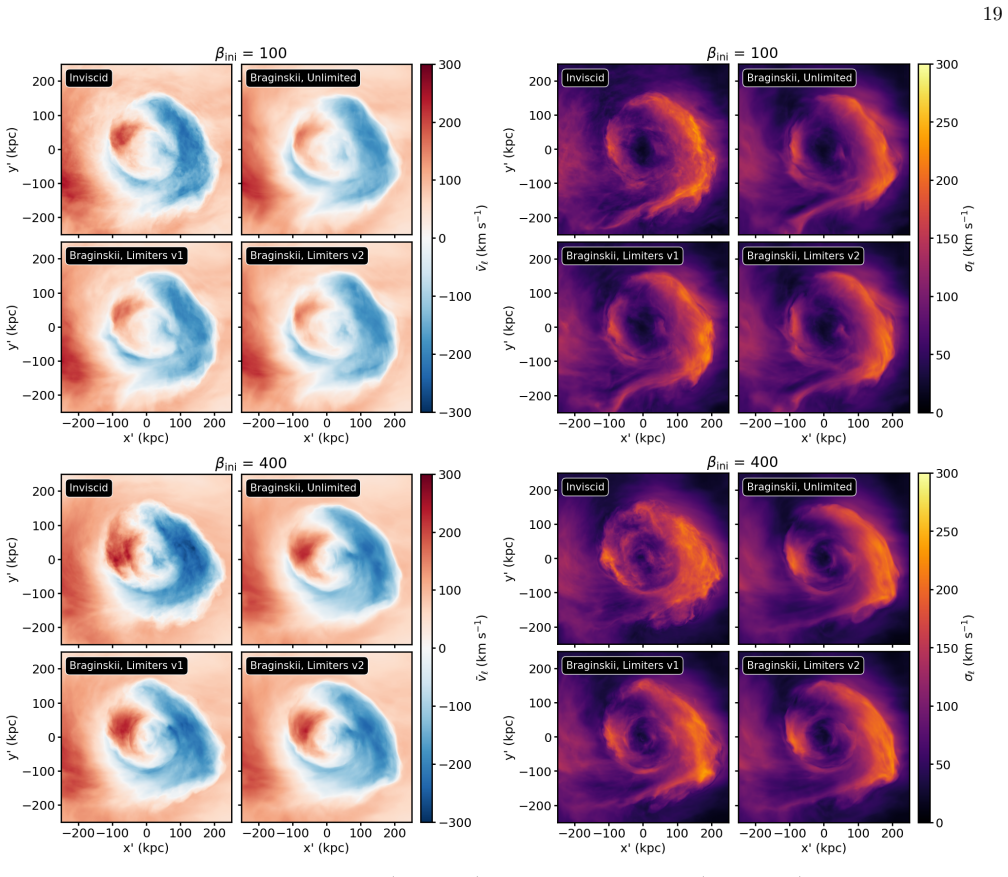
- Braginskii viscosity produces a modest suppression of Kelvin-Helmholtz instabilities at sloshing cold front surfaces.
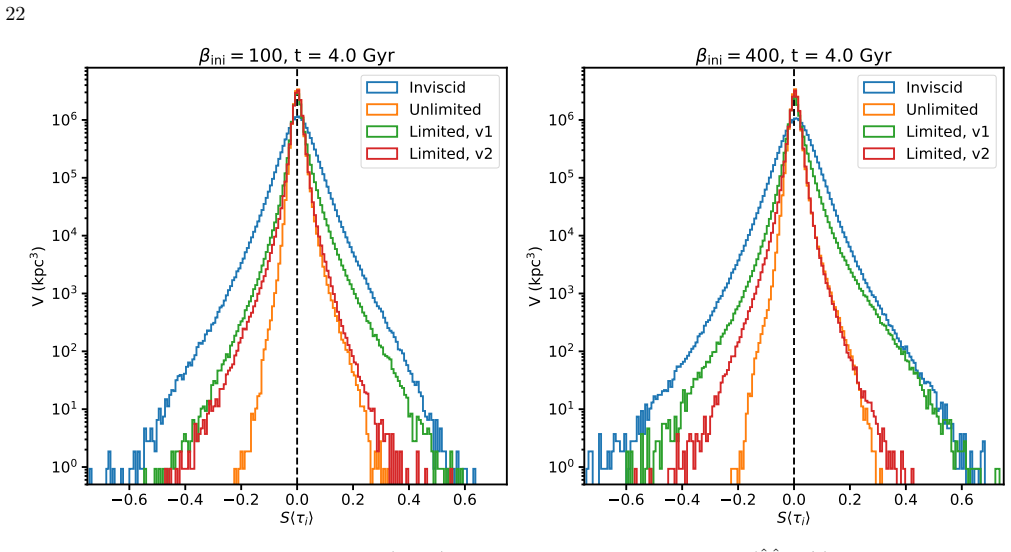
- The effective viscosity falls much below the isotropic Spitzer value across a significant fraction of the core region.
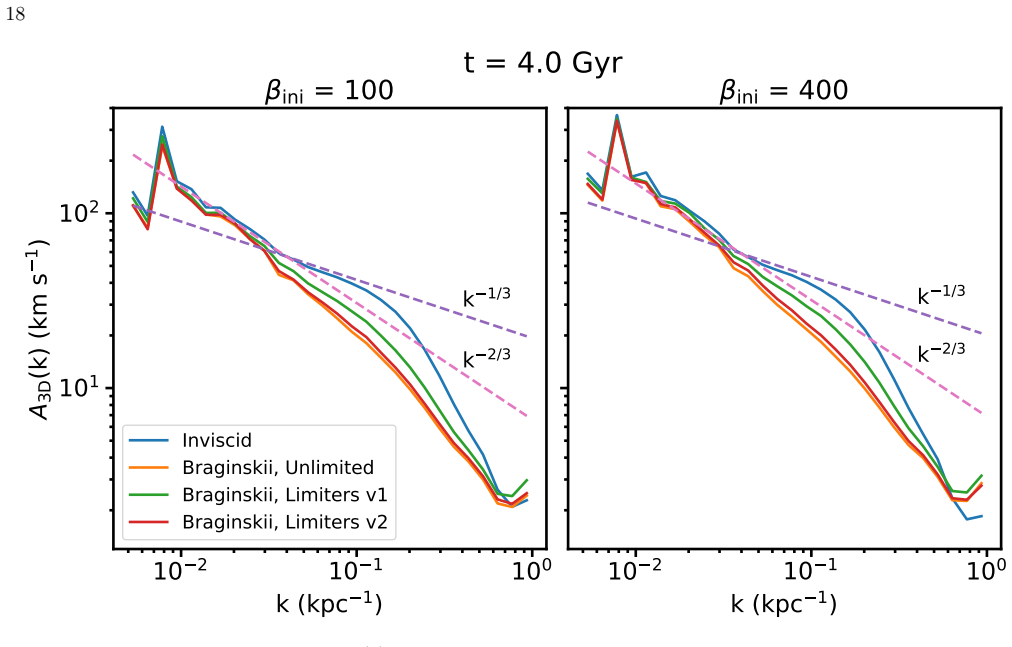
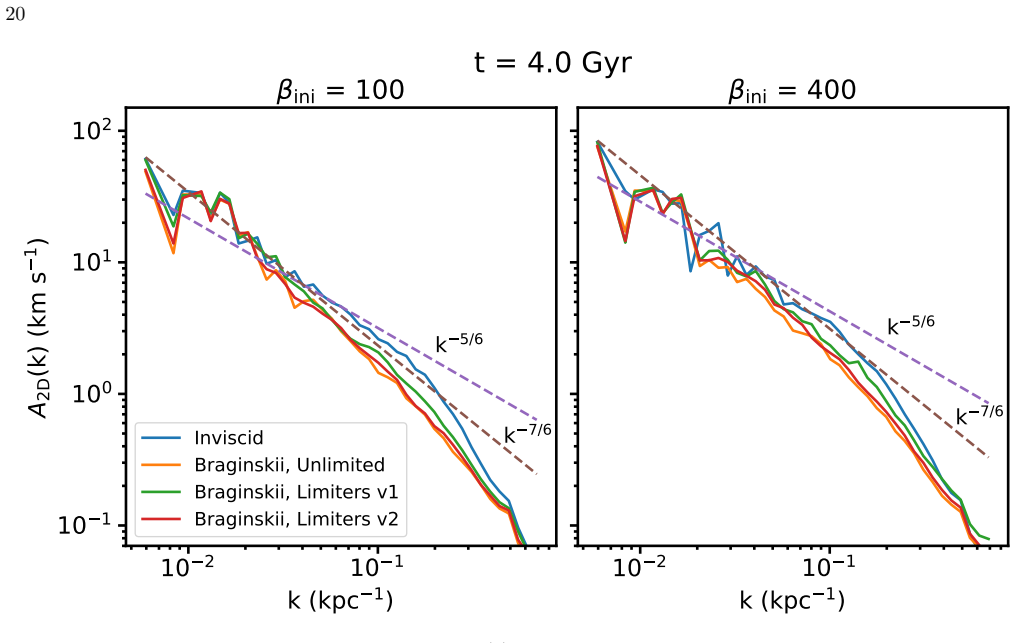
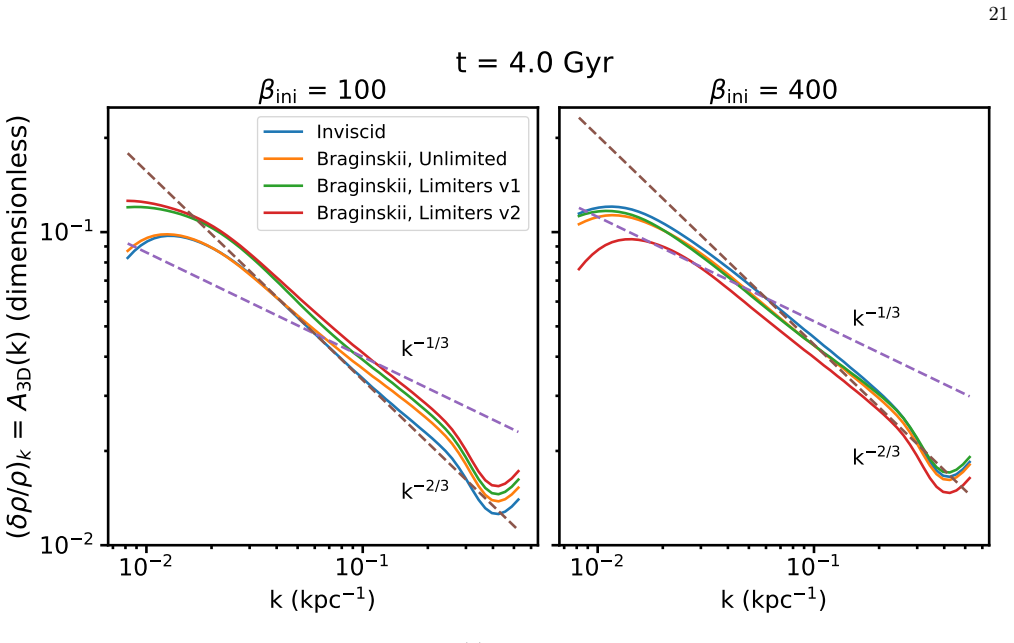
- The reduced viscosity steepens the velocity-amplitude spectrum of the turbulence.
- A small fraction of the turbulent kinetic energy is transferred into heat.
Where Pith is reading between the lines
- The lowered effective viscosity may change how turbulent energy cascades through cluster cores and therefore alter standard heating prescriptions.
- Similar reductions in transport could appear in other magnetized astrophysical flows that combine shear and tangled fields.
- X-ray line broadening or velocity mapping of real clusters could be compared directly against the simulated spectra to test the predicted steepening.
Load-bearing premise
The simple prescriptions used to limit pressure anisotropy accurately capture the saturation behavior of the relevant plasma instabilities in the ICM conditions realized by the simulations.
What would settle it
A measurement of the velocity power spectrum in an observed sloshing cluster core that shows no steepening relative to isotropic-viscosity expectations despite the presence of strong magnetic fields.
Figures
read the original abstract
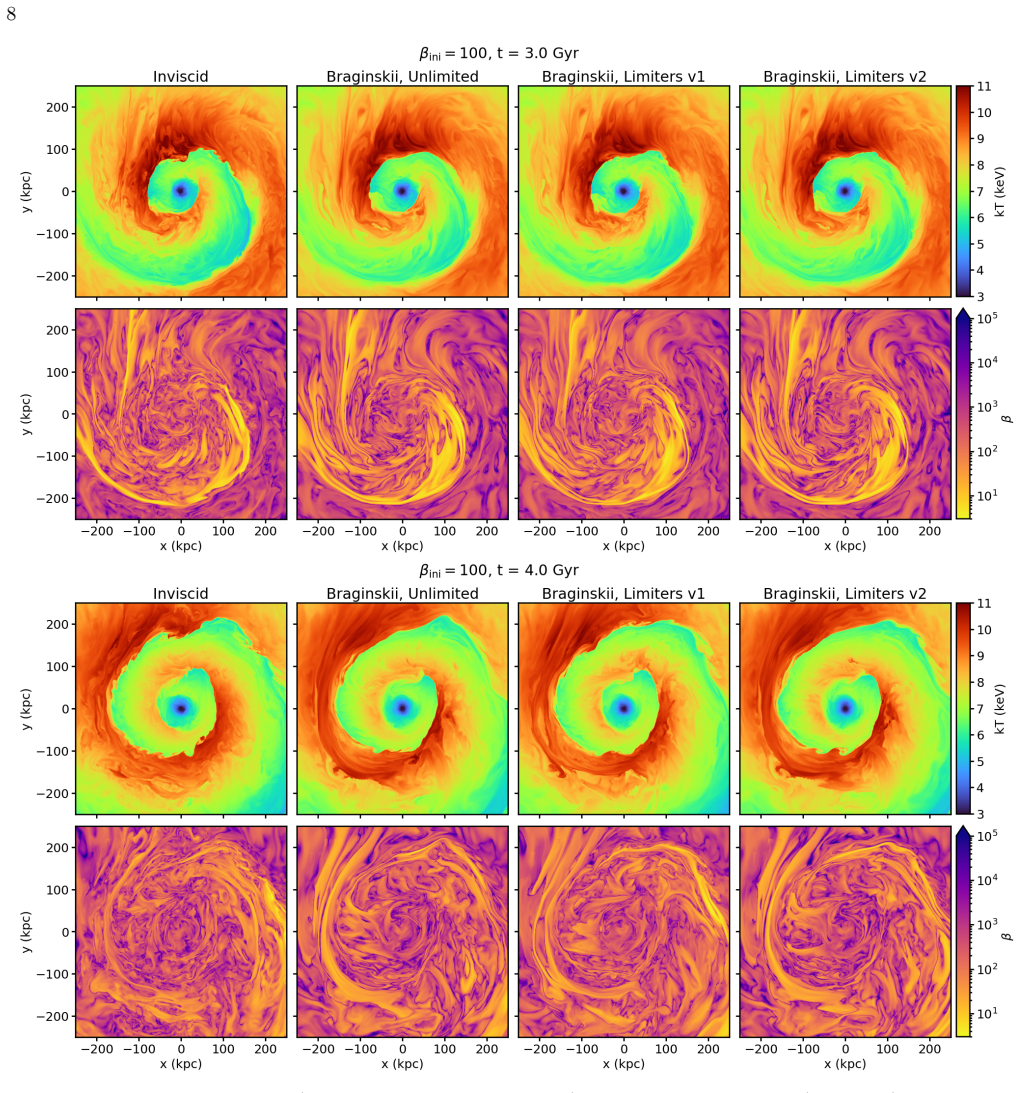
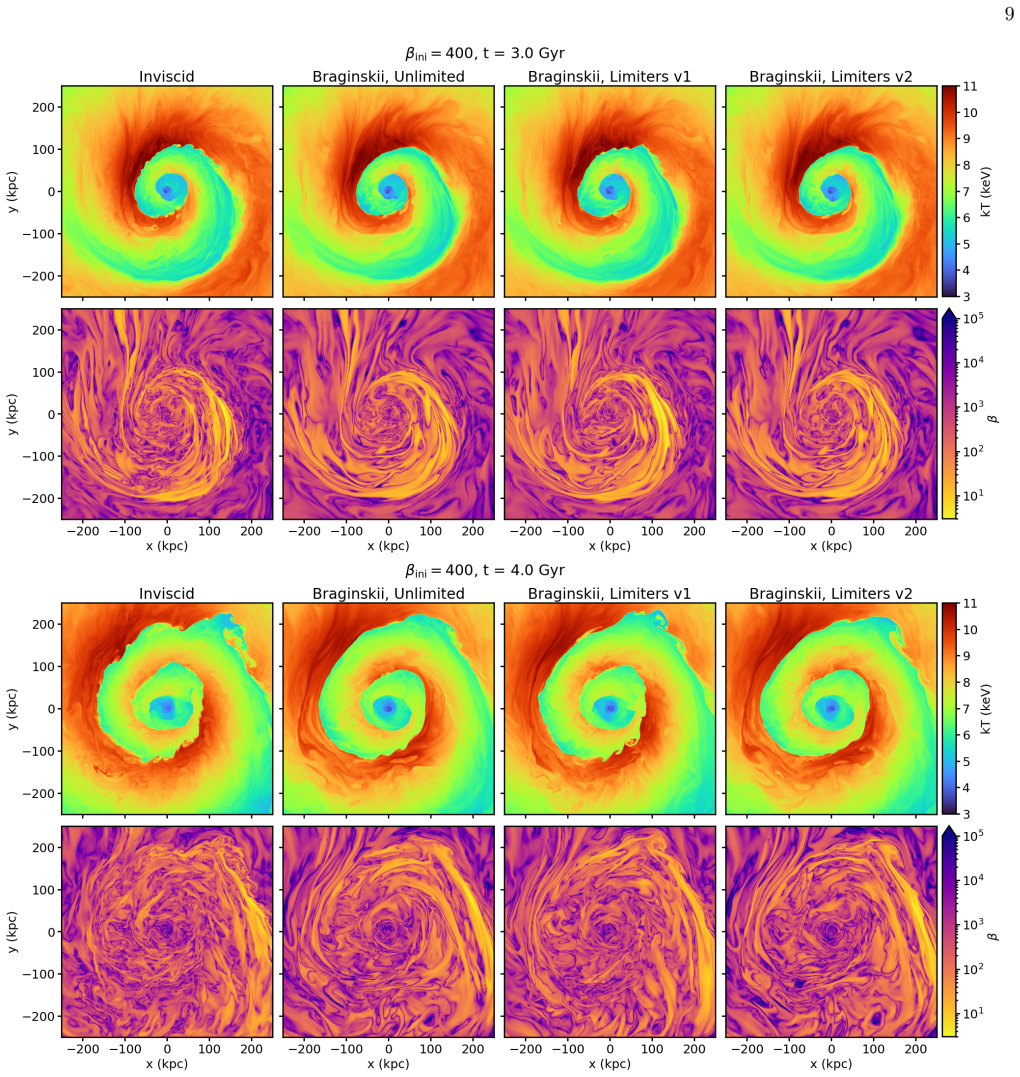
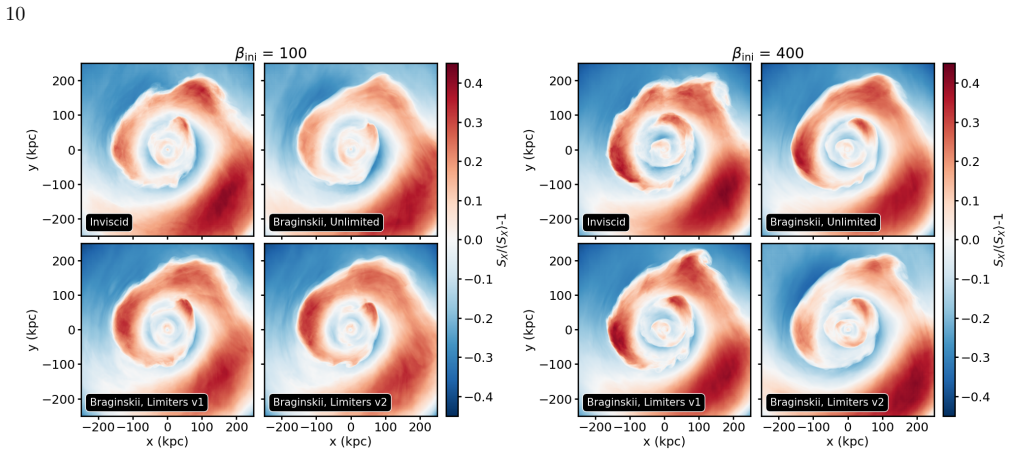
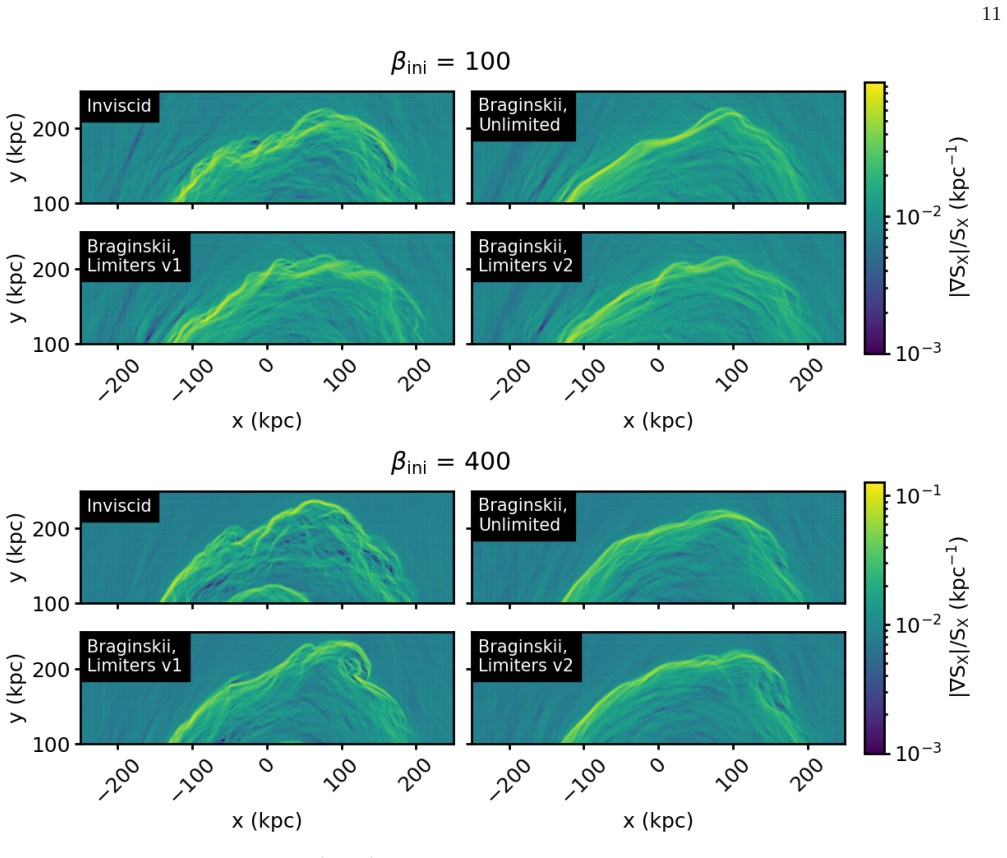
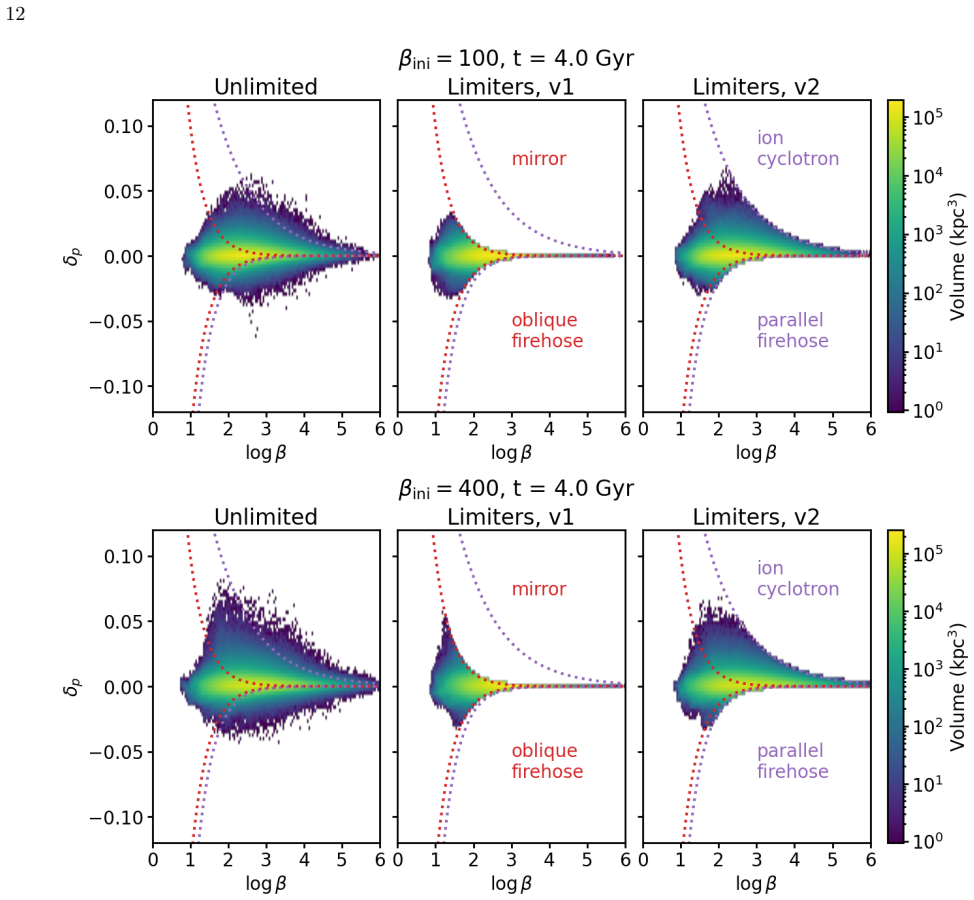
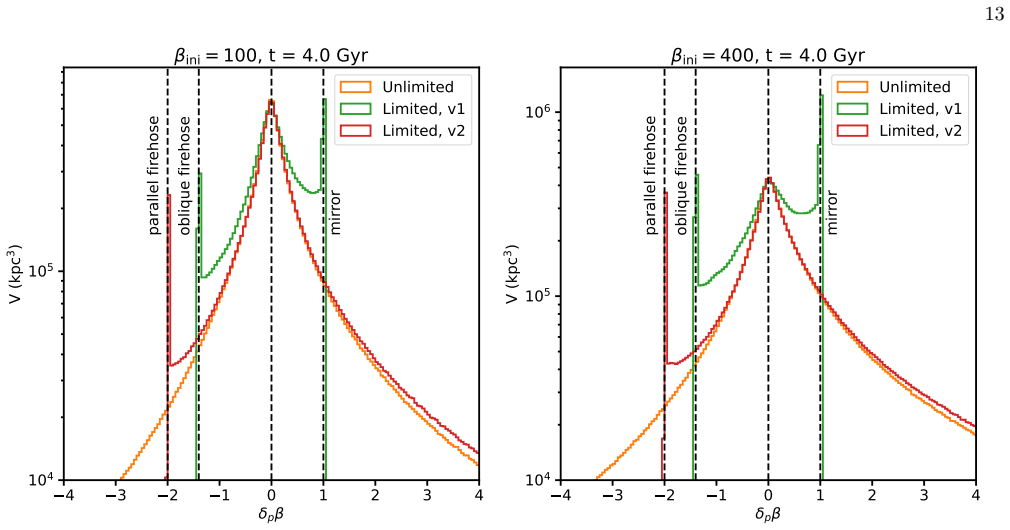
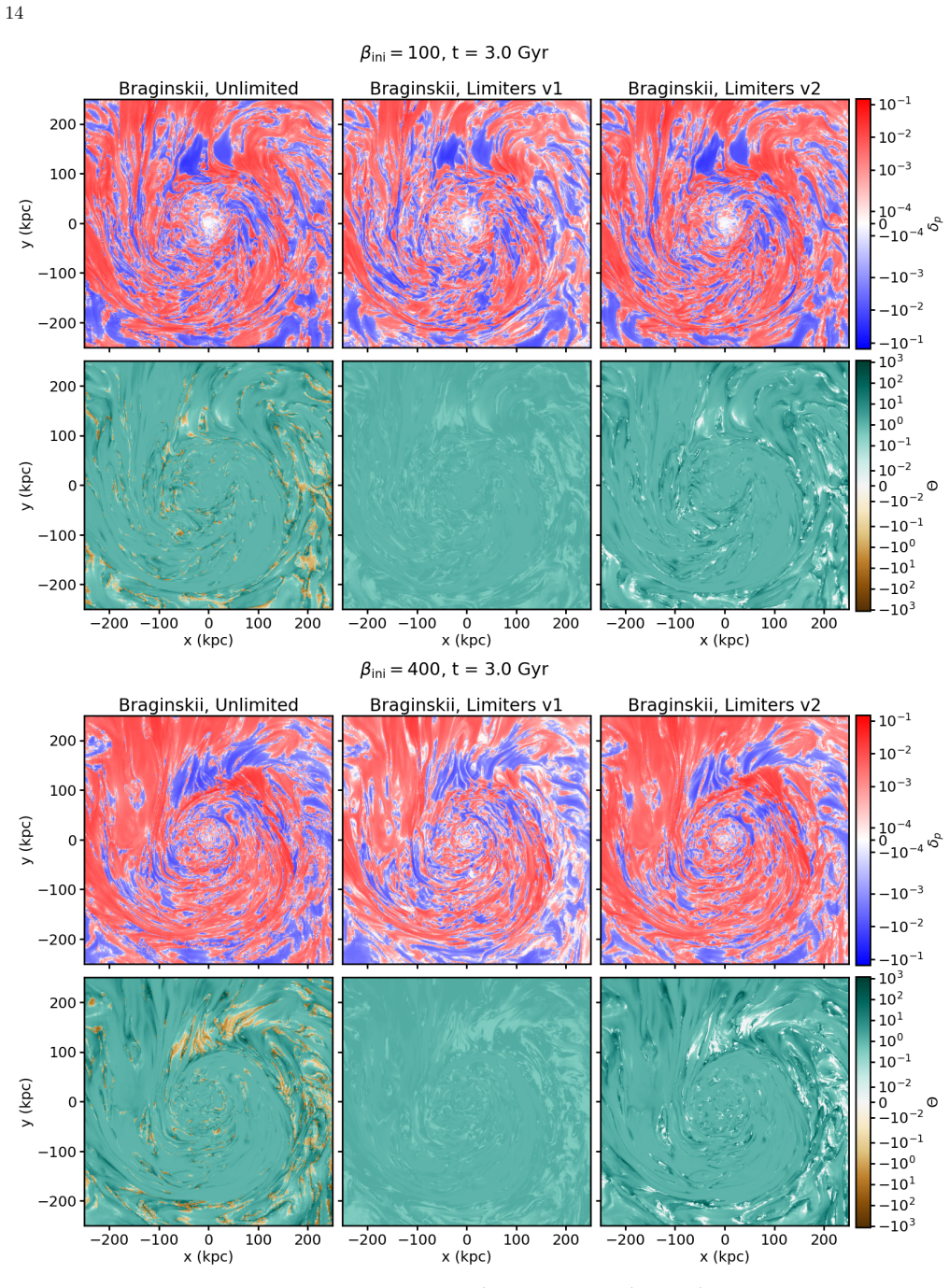
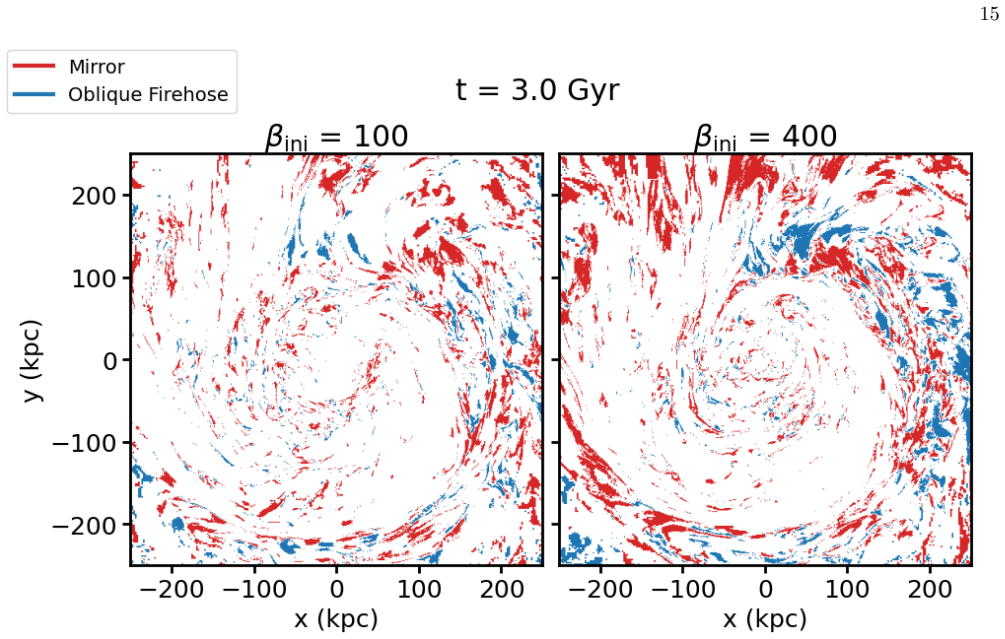
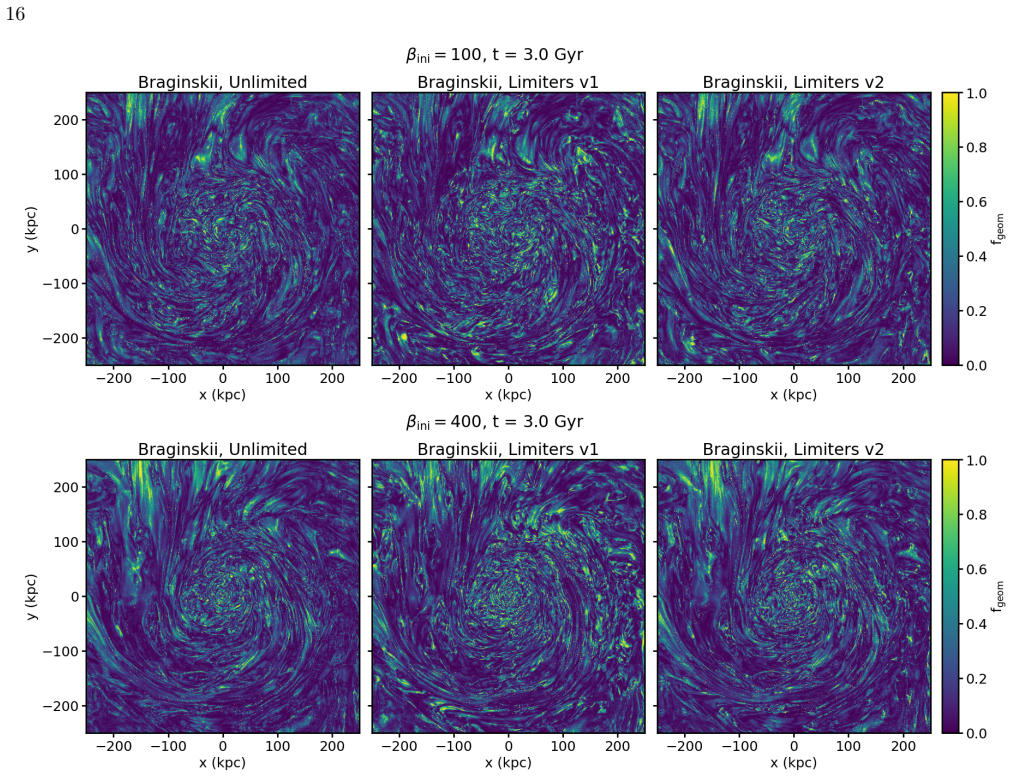
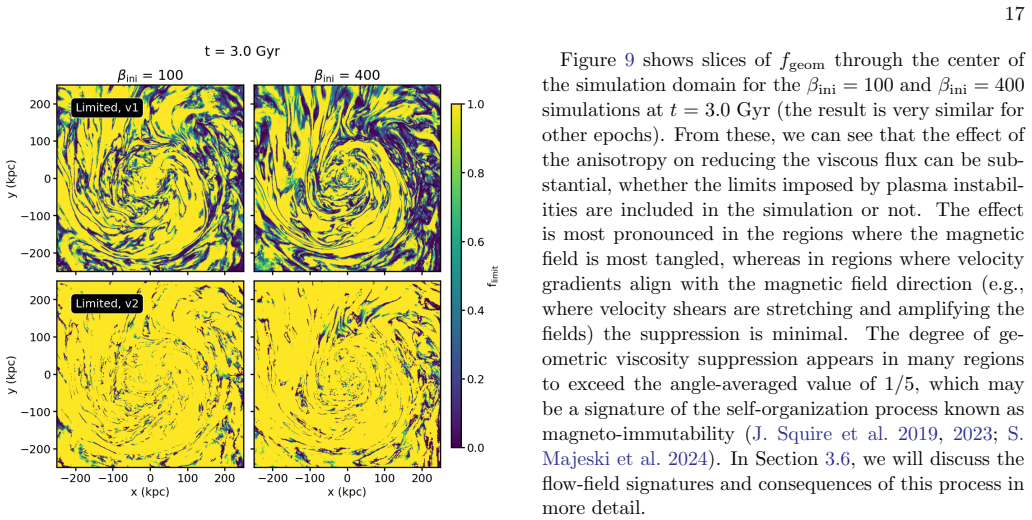
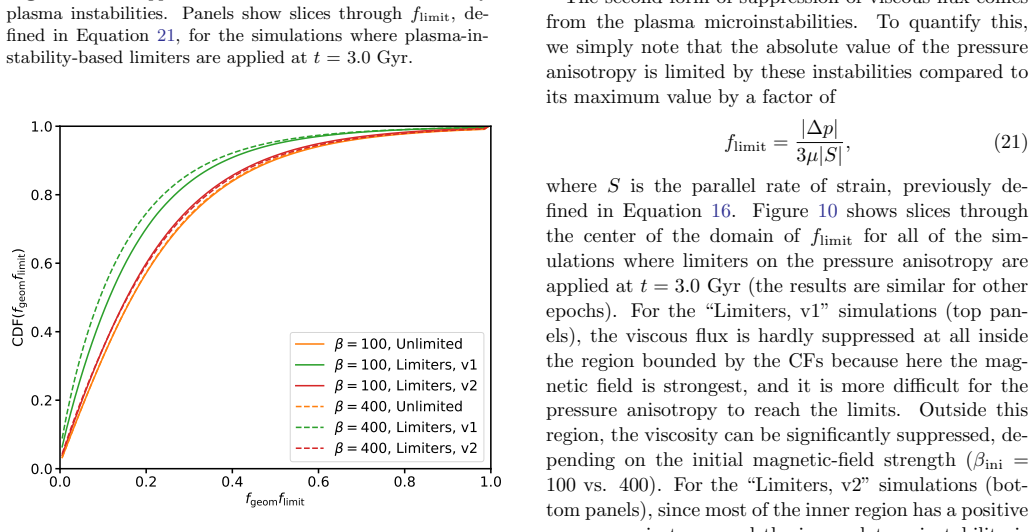
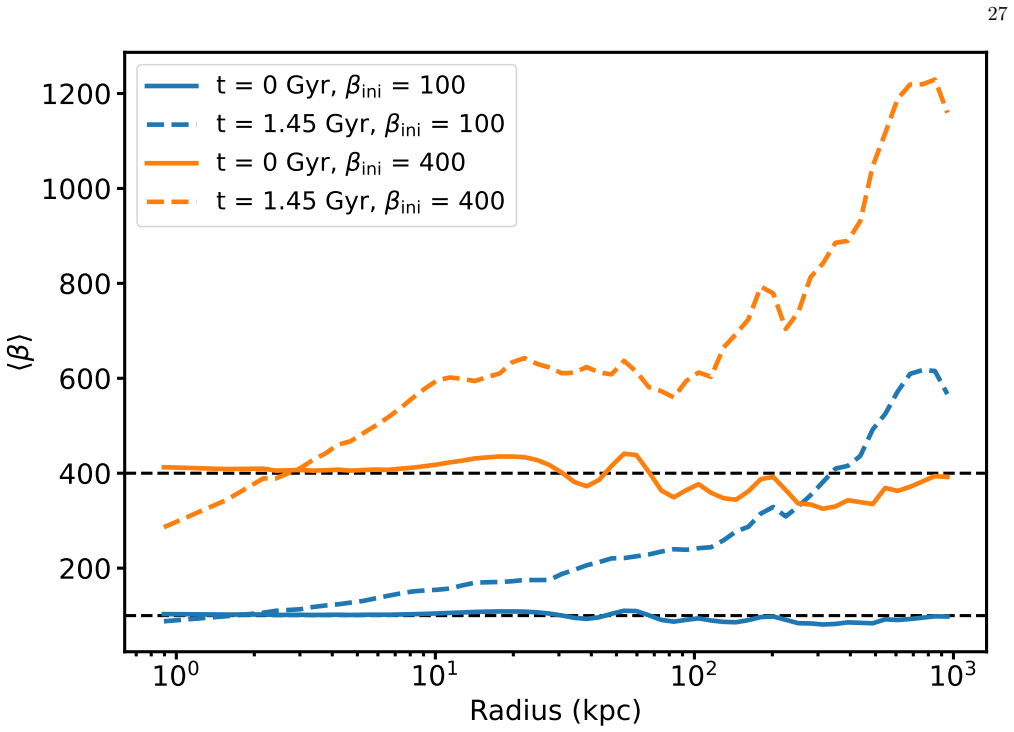
The $\sim \mu$G magnetic field in the intracluster medium (ICM) introduces a pressure anisotropy with respect to the magnetic field's direction that manifests as an anisotropic viscous stress. Plasma instabilities arising from the pressure anisotropy crossing certain thresholds force it to marginally stable values, reducing viscous transport. Additionally, the feedback of this anisotropic pressure on the velocity field has been predicted to lead to a form of self-organization that also can reduce viscous dissipation without affecting the collisionality. In this work, we present high-resolution Braginskii-MHD simulations of a galaxy cluster core with sloshing gas motions and turbulence, including the effects of anisotropic viscous stress and different simple prescriptions for limiting the pressure anisotropy due to plasma instabilities. Braginskii viscosity has an expected, though modest, effect on suppressing Kelvin-Helmholtz instabilities at sloshing cold front surfaces, dependent on how the pressure anisotropy is limited. Due to the sloshing motions, the magnetic field's strength can become high enough in places that the pressure anisotropy need not be limited. Nevertheless, the combined effect of the limiters and the turbulent structure of the magnetic field in all simulations is that the effective viscosity is much lower than the isotropic Spitzer value in a significant fraction of the core region. However, we find that this reduced viscosity is capable of steepening the velocity-amplitude spectrum and transferring a small fraction of the turbulent kinetic energy into heat. Finally, we present evidence for magneto-immutable dynamics in our simulations.
Editorial analysis
A structured set of objections, weighed in public.
Referee Report
Summary. The paper presents high-resolution Braginskii-MHD simulations of sloshing motions and turbulence in galaxy cluster cores, incorporating anisotropic viscous stress and multiple simple prescriptions for limiting pressure anisotropy once plasma instability thresholds are crossed. The central claims are that the combined action of these limiters and the turbulent magnetic-field geometry reduces the effective viscosity well below the isotropic Spitzer value over a significant fraction of the core volume, that this reduced viscosity nevertheless steepens the velocity-amplitude spectrum and dissipates a small fraction of turbulent kinetic energy into heat, and that the runs exhibit magneto-immutable dynamics.
Significance. If the limiter prescriptions are shown to faithfully represent instability saturation, the results would be significant for ICM transport modeling: they provide direct numerical evidence that anisotropic effects and instabilities can self-consistently suppress effective viscosity while still permitting measurable dynamical consequences for turbulence and heating. The work is strengthened by its use of full Braginskii-MHD evolution in a realistic sloshing geometry rather than idealized setups.
major comments (2)
- [Methods (pressure anisotropy limiters)] The headline result on reduced effective viscosity (abstract and results sections) is obtained by applying the chosen pressure-anisotropy limiters. No resolution study, convergence test, or comparison to kinetic benchmarks is reported that verifies these simple caps reproduce the correct saturation amplitudes, growth rates, or effective scattering rates of the mirror and firehose instabilities at the plasma-β and anisotropy values realized in the runs. This leaves the physical robustness of the viscosity reduction unsecured.
- [Results (velocity spectrum and energy dissipation)] The claim that the reduced viscosity steepens the velocity-amplitude spectrum and transfers a small fraction of turbulent kinetic energy into heat (results section) is load-bearing for the conclusion that the viscosity reduction remains dynamically relevant. No quantitative comparison (e.g., spectral index difference or dissipated-energy fraction) to control runs with isotropic viscosity or without limiters is supplied, preventing assessment of the effect size.
minor comments (2)
- [Abstract] The abstract supplies no numerical values for grid resolution, the precise fraction of the core volume with reduced viscosity, or the magnitude of the viscosity reduction factor, all of which would aid evaluation of the claims.
- [Notation and definitions] Notation for the effective viscosity and the various limiter prescriptions should be defined once in a dedicated subsection and used consistently thereafter.
Simulated Author's Rebuttal
We thank the referee for their constructive comments, which help clarify the scope and limitations of our work. We address each major comment below.
read point-by-point responses
-
Referee: [Methods (pressure anisotropy limiters)] The headline result on reduced effective viscosity (abstract and results sections) is obtained by applying the chosen pressure-anisotropy limiters. No resolution study, convergence test, or comparison to kinetic benchmarks is reported that verifies these simple caps reproduce the correct saturation amplitudes, growth rates, or effective scattering rates of the mirror and firehose instabilities at the plasma-β and anisotropy values realized in the runs. This leaves the physical robustness of the viscosity reduction unsecured.
Authors: We agree that the simple limiter prescriptions lack direct validation against kinetic benchmarks within this study. These caps are standard approximations in Braginskii-MHD ICM simulations, and our primary result concerns the additional suppression arising from the turbulent magnetic geometry. We will add a dedicated paragraph in the Methods section discussing the limitations of the limiters, citing relevant kinetic literature on mirror/firehose saturation, and noting that full kinetic validation lies beyond the scope of the present fluid study. revision: partial
-
Referee: [Results (velocity spectrum and energy dissipation)] The claim that the reduced viscosity steepens the velocity-amplitude spectrum and transfers a small fraction of turbulent kinetic energy into heat (results section) is load-bearing for the conclusion that the viscosity reduction remains dynamically relevant. No quantitative comparison (e.g., spectral index difference or dissipated-energy fraction) to control runs with isotropic viscosity or without limiters is supplied, preventing assessment of the effect size.
Authors: The manuscript already compares results across different limiter prescriptions, but we acknowledge the absence of explicit control runs with isotropic Spitzer viscosity. We will add quantitative comparisons—including measured spectral indices and the fraction of turbulent kinetic energy dissipated—in a revised Results section, using an additional control simulation without anisotropy limiters to quantify the effect size of the viscosity reduction. revision: yes
Circularity Check
No significant circularity in simulation-based results
full rationale
The paper reports outcomes from direct numerical integration of Braginskii-MHD equations augmented with simple pressure-anisotropy limiters. The claimed reduction in effective viscosity relative to the isotropic Spitzer value is an emergent property of the simulated velocity field, magnetic geometry, and limiter action; it is not obtained by fitting a parameter to the target quantity and then relabeling the fit as a prediction. No self-definitional equations, fitted-input predictions, or load-bearing self-citations appear in the derivation chain. The central result therefore remains independent of the reported outputs and is self-contained against external benchmarks.
Axiom & Free-Parameter Ledger
free parameters (1)
- pressure anisotropy limiter prescriptions
axioms (2)
- domain assumption Braginskii-MHD equations govern the dynamics of the ICM
- domain assumption Plasma instabilities limit pressure anisotropy to marginal stability
Reference graph
Works this paper leans on
-
[1]
, archivePrefix = "arXiv", eprint =
Churazov, E. and Vikhlinin, A. and Zhuravleva, I. and Schekochihin, A. and Parrish, I. and Sunyaev, R. and Forman, W. and Boehringer, H. and Randall, S. , year =. X-. , volume =. doi:10.1111/j.1365-2966.2011.20372.x , urldate =. arXiv , keywords =:1110.5875 , pages =
-
[2]
, archivePrefix = "arXiv", eprint =
Arevalo, P. and Churazov, E. and Zhuravleva, I. and. A. 2012 , month = nov, journal =. doi:10.1111/j.1365-2966.2012.21789.x , urldate =. arXiv , keywords =:1207.5825 , pages =
-
[3]
Stirring Up the Pot: Can Cooling Flows in Galaxy Clusters be Quenched by Gas Sloshing?. , keywords =. doi:10.1088/0004-637X/717/2/908 , adsurl =
-
[4]
Simulating Astro-H Observations of Sloshing Gas Motions in the Cores of Galaxy Clusters
Simulating Astro-H Observations of Sloshing Gas Motions in the Cores of Galaxy Clusters. , keywords =. doi:10.3847/0004-637X/821/1/6 , archivePrefix =. 1508.04426 , primaryClass =
work page internal anchor Pith review Pith/arXiv arXiv doi:10.3847/0004-637x/821/1/6
-
[5]
What Do the Hitomi Observations Tell Us About the Turbulent Velocities in the Perseus Cluster? Probing the Velocity Field with Mock Observations. , keywords =. doi:10.3847/1538-4357/aaa4b3 , archivePrefix =. 1708.07206 , primaryClass =
work page internal anchor Pith review Pith/arXiv arXiv doi:10.3847/1538-4357/aaa4b3
-
[6]
A Parameter Space Exploration of Galaxy Cluster Mergers. I. Gas Mixing and the Generation of Cluster Entropy. , keywords =. doi:10.1088/0004-637X/728/1/54 , archivePrefix =. 1004.3820 , primaryClass =
work page internal anchor Pith review Pith/arXiv arXiv doi:10.1088/0004-637x/728/1/54
-
[7]
Sloshing of the Magnetized Cool Gas in the Cores of Galaxy Clusters. , keywords =. doi:10.1088/0004-637X/743/1/16 , adsurl =
-
[8]
The Effect of Anisotropic Viscosity on Cold Fronts in Galaxy Clusters. , keywords =. doi:10.1088/0004-637X/798/2/90 , adsurl =
-
[9]
Simulations of small-scale turbulent dynamo
Simulations of the Small-Scale Turbulent Dynamo. , keywords =. doi:10.1086/422547 , archivePrefix =. astro-ph/0312046 , primaryClass =
work page internal anchor Pith review Pith/arXiv arXiv doi:10.1086/422547
-
[10]
As a Matter of Tension: Kinetic Energy Spectra in MHD Turbulence. , keywords =. doi:10.3847/1538-4357/abdd22 , archivePrefix =. 2009.03342 , primaryClass =
-
[11]
Effects of Viscosity on Sloshing Cold Fronts in Galaxy Clusters. arXiv e-prints , keywords =. doi:10.48550/arXiv.2602.07661 , archivePrefix =. 2602.07661 , primaryClass =
-
[12]
A case for the large-scale global eigenmodes in unmagnetized and weakly magnetized cluster core
Cold fronts in galaxy clusters - I. A case for the large-scale global eigenmodes in unmagnetized and weakly magnetized cluster core. , keywords =. doi:10.1093/mnras/staf184 , archivePrefix =. 2408.03988 , primaryClass =
-
[13]
A toy model for gas sloshing in galaxy clusters. , keywords =. doi:10.1093/mnras/stae493 , archivePrefix =. 2402.18632 , primaryClass =
-
[14]
Stripped Elliptical Galaxies as Probes of ICM Physics: I. Tails, Wakes, and Flow Patterns in and Around Stripped Ellipticals. , keywords =. doi:10.1088/0004-637X/806/1/103 , archivePrefix =. 1409.6300 , primaryClass =
work page internal anchor Pith review Pith/arXiv arXiv doi:10.1088/0004-637x/806/1/103
-
[15]
Stripped Elliptical Galaxies as Probes of ICM Physics: II. Stirred, but Mixed? Viscous and Inviscid Gas Stripping of the Virgo Elliptical M89. , keywords =. doi:10.1088/0004-637X/806/1/104 , archivePrefix =. 1409.6312 , primaryClass =
work page internal anchor Pith review Pith/arXiv arXiv doi:10.1088/0004-637x/806/1/104
-
[16]
Turbulence in the tail of a jellyfish galaxy. , keywords =. doi:10.1093/mnras/stad874 , archivePrefix =. 2303.15500 , primaryClass =
-
[17]
Turbulence in the ICM from mergers, cool-core sloshing, and jets: results from a new multi-scale filtering approach. , keywords =. doi:10.1051/0004-6361/201118688 , archivePrefix =. 1202.5882 , primaryClass =
work page internal anchor Pith review Pith/arXiv arXiv doi:10.1051/0004-6361/201118688
-
[18]
Velocity fields and turbulence from cosmic filaments to galaxy clusters. arXiv e-prints , keywords =. doi:10.48550/arXiv.2501.09573 , archivePrefix =. 2501.09573 , primaryClass =
-
[19]
Exploring the relation between turbulent velocity and density fluctuations in the stratified intracluster medium. , keywords =. doi:10.1051/0004-6361/202141703 , archivePrefix =. 2112.00774 , primaryClass =
-
[20]
Turbulence and Radio Mini-halos in the Sloshing Cores of Galaxy Clusters
Turbulence and Radio Mini-halos in the Sloshing Cores of Galaxy Clusters. , keywords =. doi:10.1088/0004-637X/762/2/78 , archivePrefix =. 1203.2994 , primaryClass =
work page internal anchor Pith review Pith/arXiv arXiv doi:10.1088/0004-637x/762/2/78
-
[21]
A multifiltering study of turbulence in a large sample of simulated galaxy clusters
A Multifiltering Study of Turbulence in a Large Sample of Simulated Galaxy Clusters. , keywords =. doi:10.3847/1538-4357/ab0964 , archivePrefix =. 1902.07291 , primaryClass =
work page internal anchor Pith review Pith/arXiv arXiv doi:10.3847/1538-4357/ab0964 1902
-
[22]
Turbulence and Vorticity in Galaxy Clusters Generated by Structure Formation
Turbulence and vorticity in Galaxy clusters generated by structure formation. , keywords =. doi:10.1093/mnras/stw2351 , archivePrefix =. 1609.03558 , primaryClass =
work page internal anchor Pith review Pith/arXiv arXiv doi:10.1093/mnras/stw2351
-
[23]
High-Resolution Simulations of Compressible Convection Using the Piecewise-parabolic Method. , keywords =. doi:10.1086/192057 , adsurl =
-
[24]
A solution accurate, efficient and stable unsplit staggered mesh scheme for three dimensional magnetohydrodynamics. Journal of Computational Physics , keywords =. doi:10.1016/j.jcp.2013.02.049 , archivePrefix =. 1303.6988 , primaryClass =
work page internal anchor Pith review Pith/arXiv arXiv doi:10.1016/j.jcp.2013.02.049 2013
-
[25]
Anshu Dubey and Katie Antypas and Murali K. Ganapathy and Lynn B. Reid and Katherine Riley and Dan Sheeler and Andrew Siegel and Klaus Weide. Extensible component-based architecture for FLASH, a massively parallel, multiphysics simulation code. Parallel Computing. 2009. doi:https://doi.org/10.1016/j.parco.2009.08.001
-
[26]
FLASH: An Adaptive Mesh Hydrodynamics Code for Modeling Astrophysical Thermonuclear Flashes. , keywords =. doi:10.1086/317361 , adsurl =
-
[27]
, archivePrefix = "arXiv", eprint =
Constraints on the ICM velocity power spectrum from the X-ray lines width and shift. , keywords =. doi:10.1111/j.1365-2966.2012.20844.x , archivePrefix =. 1203.1057 , primaryClass =
-
[28]
Kelvin-Helmholtz Instabilities at the Sloshing Cold Fronts in the Virgo Cluster as a Measure for the Effective Intracluster Medium Viscosity. , keywords =. doi:10.1088/0004-637X/764/1/60 , archivePrefix =. 1211.4874 , primaryClass =
work page internal anchor Pith review Pith/arXiv arXiv doi:10.1088/0004-637x/764/1/60
-
[29]
Updated Atomic Data and Calculations for X-ray Spectroscopy
Updated Atomic Data and Calculations for X-Ray Spectroscopy. , keywords =. doi:10.1088/0004-637X/756/2/128 , archivePrefix =. 1207.0576 , primaryClass =
work page internal anchor Pith review Pith/arXiv arXiv doi:10.1088/0004-637x/756/2/128
-
[30]
Suppressed effective viscosity in the bulk intergalactic plasma
Suppressed effective viscosity in the bulk intergalactic plasma. Nature Astronomy , keywords =. doi:10.1038/s41550-019-0794-z , archivePrefix =. 1906.06346 , primaryClass =
work page internal anchor Pith review Pith/arXiv arXiv doi:10.1038/s41550-019-0794-z 1906
-
[31]
Physics of Fully Ionized Gases
-
[32]
X-ray emission from clusters of galaxies
-
[33]
Reviews of Plasma Physics , year = 1965, month = jan, volume =
Transport Processes in a Plasma. Reviews of Plasma Physics , year = 1965, month = jan, volume =
1965
-
[34]
Deep Chandra observation and numerical studies of the nearest cluster cold front in the sky
Deep Chandra observation and numerical studies of the nearest cluster cold front in the sky. , keywords =. doi:10.1093/mnras/stv2358 , archivePrefix =. 1506.06429 , primaryClass =
work page internal anchor Pith review Pith/arXiv arXiv doi:10.1093/mnras/stv2358
-
[35]
Deep Chandra Observations of NGC 1404: Cluster Plasma Physics Revealed by an Infalling Early-type Galaxy. , keywords =. doi:10.3847/1538-4357/834/1/74 , archivePrefix =. 1612.00535 , primaryClass =
work page internal anchor Pith review Pith/arXiv arXiv doi:10.3847/1538-4357/834/1/74
-
[36]
A Deep X-Ray Look at Abell 2142 Viscosity Constraints From Kelvin-Helmholtz Eddies, a Displaced Cool Peak That Makes a Warm Core, and A Possible Plasma Depletion Layer. , keywords =. doi:10.3847/1538-4357/aae921 , archivePrefix =. 1810.02813 , primaryClass =
work page internal anchor Pith review Pith/arXiv arXiv doi:10.3847/1538-4357/aae921
-
[37]
The origin of cold fronts in the cores of relaxed galaxy clusters
The Origin of Cold Fronts in the Cores of Relaxed Galaxy Clusters. , keywords =. doi:10.1086/506508 , archivePrefix =. astro-ph/0603246 , primaryClass =
work page internal anchor Pith review Pith/arXiv arXiv doi:10.1086/506508
-
[38]
Density Fluctuations in the Intracluster Medium: An Attempt to Constrain Viscosity with Cosmological Simulations. , keywords =. doi:10.3847/1538-4357/ad8127 , archivePrefix =. 2406.11973 , primaryClass =
-
[39]
The Quiescent Intracluster Medium in the Core of the Perseus Cluster
The quiescent intracluster medium in the core of the Perseus cluster. , keywords =. doi:10.1038/nature18627 , archivePrefix =. 1607.04487 , primaryClass =
work page internal anchor Pith review Pith/arXiv arXiv doi:10.1038/nature18627
-
[40]
Atmospheric gas dynamics in the Perseus cluster observed with Hitomi
Atmospheric gas dynamics in the Perseus cluster observed with Hitomi. , keywords =. doi:10.1093/pasj/psx138 , archivePrefix =. 1711.00240 , primaryClass =
work page internal anchor Pith review Pith/arXiv arXiv doi:10.1093/pasj/psx138
-
[41]
A Multi-Code Analysis Toolkit for Astrophysical Simulation Data
yt: A Multi-code Analysis Toolkit for Astrophysical Simulation Data. , keywords =. doi:10.1088/0067-0049/192/1/9 , archivePrefix =. 1011.3514 , primaryClass =
work page internal anchor Pith review Pith/arXiv arXiv doi:10.1088/0067-0049/192/1/9
-
[42]
X-ray-inferred kinematics of the core intracluster medium in Perseus-like clusters: Insights from the TNG-Cluster simulation. , keywords =. doi:10.1051/0004-6361/202348562 , archivePrefix =. 2311.06334 , primaryClass =
-
[43]
Connecting turbulent velocities and magnetic fields in galaxy cluster simulations with active galactic nuclei jets. , keywords =. doi:10.1093/mnras/stab551 , archivePrefix =. 2011.13964 , primaryClass =
-
[44]
AGN jet feedback on a moving mesh: cocoon inflation, gas flows and turbulence
AGN jet feedback on a moving mesh: cocoon inflation, gas flows and turbulence. , keywords =. doi:10.1093/mnras/stx2269 , archivePrefix =. 1705.07900 , primaryClass =
work page internal anchor Pith review Pith/arXiv arXiv doi:10.1093/mnras/stx2269
-
[45]
Physical Origins of Gas Motions in Galaxy Cluster Cores: Interpreting Hitomi Observations of the Perseus Cluster. , keywords =. doi:10.3847/1538-4357/aa8c00 , archivePrefix =. 1705.06280 , primaryClass =
work page internal anchor Pith review Pith/arXiv arXiv doi:10.3847/1538-4357/aa8c00
-
[46]
Non-Kolmogorov turbulence in multiphase intracluster medium driven by cold gas precipitation and AGN jets. , keywords =. doi:10.1093/mnras/stab966 , archivePrefix =. 2012.11085 , primaryClass =
-
[47]
Magnetohydrodynamic Simulations of the Formation of Cold Fronts in Clusters of Galaxies: Effects of Anisotropic Viscosity. , keywords =. doi:10.1088/0004-637X/768/2/175 , adsurl =
-
[48]
On the Kelvin-Helmholtz instability with smooth initial conditions -- Linear theory and simulations
On the Kelvin-Helmholtz instability with smooth initial conditions - linear theory and simulations. , keywords =. doi:10.1093/mnras/stz379 , archivePrefix =. 1902.01403 , primaryClass =
work page internal anchor Pith review Pith/arXiv arXiv doi:10.1093/mnras/stz379 1902
-
[49]
Braginskii viscosity on an unstructured, moving mesh accelerated with super-time-stepping. , keywords =. doi:10.1093/mnras/stz3115 , archivePrefix =. 1911.05694 , primaryClass =
-
[50]
Buoyant Bubbles in Intracluster Gas: Effects of Magnetic Fields and Anisotropic Viscosity
Buoyant Bubbles in Intracluster Gas: Effects of Magnetic Fields and Anisotropic Viscosity. , keywords =. doi:10.1088/0004-637X/704/2/1309 , archivePrefix =. 0909.3864 , primaryClass =
work page internal anchor Pith review Pith/arXiv arXiv doi:10.1088/0004-637x/704/2/1309
-
[51]
Feedback first: the surprisingly weak effects of magnetic fields, viscosity, conduction and metal diffusion on sub-L* galaxy formation. , keywords =. doi:10.1093/mnras/stx1463 , archivePrefix =. 1607.05274 , primaryClass =
work page internal anchor Pith review Pith/arXiv arXiv doi:10.1093/mnras/stx1463
-
[52]
Effects of Anisotropic Viscosity on the Evolution of Active Galactic Nuclei Bubbles in Galaxy Clusters. , keywords =. doi:10.3847/2041-8213/ab40be , archivePrefix =. 1909.01339 , primaryClass =
-
[53]
Journal of Computational Physics , keywords =
The Piecewise Parabolic Method (PPM) for Gas-Dynamical Simulations. Journal of Computational Physics , keywords =. doi:10.1016/0021-9991(84)90143-8 , adsurl =
-
[54]
Proceedings of the Royal Society of London Series A , year = 1956, month = jul, volume =
The Boltzmann Equation and the One-Fluid Hydromagnetic Equations in the Absence of Particle Collisions. Proceedings of the Royal Society of London Series A , year = 1956, month = jul, volume =. doi:10.1098/rspa.1956.0116 , adsurl =
-
[55]
Plasma instabilities and magnetic-field growth in clusters of galaxies
Plasma Instabilities and Magnetic Field Growth in Clusters of Galaxies. , keywords =. doi:10.1086/431202 , archivePrefix =. astro-ph/0501362 , primaryClass =
work page internal anchor Pith review Pith/arXiv arXiv doi:10.1086/431202
-
[56]
Observations of extended radio emission in clusters
Observations of Extended Radio Emission in Clusters. , keywords =. doi:10.1007/s11214-008-9311-x , archivePrefix =. 0801.0985 , primaryClass =
work page internal anchor Pith review Pith/arXiv arXiv doi:10.1007/s11214-008-9311-x
-
[57]
Cluster Magnetic Fields. , keywords =. doi:10.1146/annurev.astro.40.060401.093852 , archivePrefix =. astro-ph/0110655 , primaryClass =
-
[58]
Detecting edges in the X-ray surface brightness of galaxy clusters
Detecting edges in the X-ray surface brightness of galaxy clusters. , keywords =. doi:10.1093/mnras/stw1119 , archivePrefix =. 1605.02911 , primaryClass =
work page internal anchor Pith review Pith/arXiv arXiv doi:10.1093/mnras/stw1119
-
[59]
, archivePrefix = "arXiv", eprint =
Fast simulations of gas sloshing and cold front formation. , keywords =. doi:10.1111/j.1365-2966.2011.19794.x , archivePrefix =. 1109.2593 , primaryClass =
-
[60]
, archivePrefix = "arXiv", eprint =
Gas sloshing, cold front formation and metal redistribution: the Virgo cluster as a quantitative test case. , keywords =. doi:10.1111/j.1365-2966.2011.18279.x , archivePrefix =. 1007.4209 , primaryClass =
-
[61]
Handbook of X-ray and Gamma-ray Astrophysics , year = 2022, editor =
Plasma Physics of the Intracluster Medium. Handbook of X-ray and Gamma-ray Astrophysics , year = 2022, editor =. doi:10.1007/978-981-16-4544-0_125-1 , adsurl =
-
[62]
Preserving Monotonicity in Anisotropic Diffusion
Preserving monotonicity in anisotropic diffusion. Journal of Computational Physics , keywords =. doi:10.1016/j.jcp.2007.07.026 , archivePrefix =. 0707.2616 , primaryClass =
work page internal anchor Pith review Pith/arXiv arXiv doi:10.1016/j.jcp.2007.07.026 2007
-
[63]
Buoyancy Instabilities in a Weakly Collisional Intracluster Medium
Buoyancy Instabilities in a Weakly Collisional Intracluster Medium. , keywords =. doi:10.1088/0004-637X/754/2/122 , archivePrefix =. 1202.3442 , primaryClass =
work page internal anchor Pith review Pith/arXiv arXiv doi:10.1088/0004-637x/754/2/122
-
[64]
, archivePrefix = "arXiv", eprint =
The effects of anisotropic viscosity on turbulence and heat transport in the intracluster medium. , keywords =. doi:10.1111/j.1365-2966.2012.20650.x , archivePrefix =. 1201.0754 , primaryClass =
-
[65]
Journal of Plasma Physics , keywords =
Fluctuation dynamo in a weakly collisional plasma. Journal of Plasma Physics , keywords =. doi:10.1017/S0022377820000860 , archivePrefix =. 2003.09760 , primaryClass =
-
[66]
Physics of Plasmas , keywords =
Comment on the linear mirror instability near the threshold. Physics of Plasmas , keywords =. doi:10.1063/1.2768318 , adsurl =
-
[67]
1956 , month =
Rosenbluth, M , title =. 1956 , month =
1956
-
[68]
Physics of Fluids , year = 1969, month = jan, volume =
Drift mirror instability of the magnetosphere. Physics of Fluids , year = 1969, month = jan, volume =. doi:10.1063/1.1692407 , adsurl =
-
[69]
The Astropy Project: Sustaining and Growing a Community-oriented Open-source Project and the Latest Major Release (v5.0) of the Core Package. , keywords =. doi:10.3847/1538-4357/ac7c74 , archivePrefix =. 2206.14220 , primaryClass =
work page internal anchor Pith review Pith/arXiv arXiv doi:10.3847/1538-4357/ac7c74
-
[70]
The Astropy Project: Building an inclusive, open-science project and status of the v2.0 core package
The Astropy Project: Building an Open-science Project and Status of the v2.0 Core Package. , keywords =. doi:10.3847/1538-3881/aabc4f , archivePrefix =. 1801.02634 , primaryClass =
work page internal anchor Pith review Pith/arXiv arXiv doi:10.3847/1538-3881/aabc4f
-
[71]
Astropy: A Community Python Package for Astronomy
Astropy: A community Python package for astronomy. , keywords =. doi:10.1051/0004-6361/201322068 , archivePrefix =. 1307.6212 , primaryClass =
work page internal anchor Pith review Pith/arXiv arXiv doi:10.1051/0004-6361/201322068
-
[72]
Galaxies , VOLUME =
Vacca, Valentina and Murgia, Matteo and Govoni, Federica and EnÃlin, Torsten and Oppermann, Niels and Feretti, Luigina and Giovannini, Gabriele and Loi, Francesca , TITLE =. Galaxies , VOLUME =. 2018 , NUMBER =
2018
-
[73]
Br\"uggen, M. , title =. Astronomische Nachrichten , volume =. doi:https://doi.org/10.1002/asna.201311895 , url =. https://onlinelibrary.wiley.com/doi/pdf/10.1002/asna.201311895 , year =
-
[74]
Charles R. Harris and K. Jarrod Millman and St. Array programming with. 2020 , month = sep, journal =. doi:10.1038/s41586-020-2649-2 , publisher =
-
[75]
SciPy 1.0--Fundamental Algorithms for Scientific Computing in Python
SciPy 1.0: fundamental algorithms for scientific computing in Python. Nature Methods , keywords =. doi:10.1038/s41592-019-0686-2 , archivePrefix =. 1907.10121 , primaryClass =
work page internal anchor Pith review Pith/arXiv arXiv doi:10.1038/s41592-019-0686-2 1907
-
[76]
I - Physical mechanism of linear instability
Mirror instability. I - Physical mechanism of linear instability. , keywords =. doi:10.1029/92JA02837 , adsurl =
-
[77]
Computing in Science and Engineering , keywords =
Matplotlib: A 2D Graphics Environment. Computing in Science and Engineering , keywords =. doi:10.1109/MCSE.2007.55 , adsurl =
-
[78]
Proceedings of the Royal Society of London Series A , year = 1958, month = jul, volume =
The Stability of the Pinch. Proceedings of the Royal Society of London Series A , year = 1958, month = jul, volume =. doi:10.1098/rspa.1958.0094 , adsurl =
-
[79]
Physics of Fluids , year = 1966, month = aug, volume =
Collisionless Damping of Hydromagnetic Waves. Physics of Fluids , year = 1966, month = aug, volume =. doi:10.1063/1.1761882 , adsurl =
-
[80]
Physical Review , year = 1958, month = mar, volume =
Dynamical Instability in an Anisotropic Ionized Gas of Low Density. Physical Review , year = 1958, month = mar, volume =. doi:10.1103/PhysRev.109.1874 , adsurl =
discussion (0)
Sign in with ORCID, Apple, or X to comment. Anyone can read and Pith papers without signing in.