REVIEW 2 major objections 1 minor 15 references
Bosonic pairing opens a second chiral current channel on kagome lattices absent from particle-conserving models.
Reviewed by Pith at T0; open to challenge. T0 means a machine referee read the full paper against a public rubric. the ladder, T0–T4 →
T0 review · grok-4.3
2026-06-26 23:23 UTC pith:4335W7IB
load-bearing objection The paper claims bosonic pairing opens a second chiral current channel on the kagome lattice derived from the continuity equation, but source terms from the pairing terms may prevent a clean separation. the 2 major comments →
Anomalous Pairing Currents and a Second Topological Edge Channel in Bosonic Lattices
The pith
A machine-rendered reading of the paper's core claim, the machinery that carries it, and where it could break.
Core claim
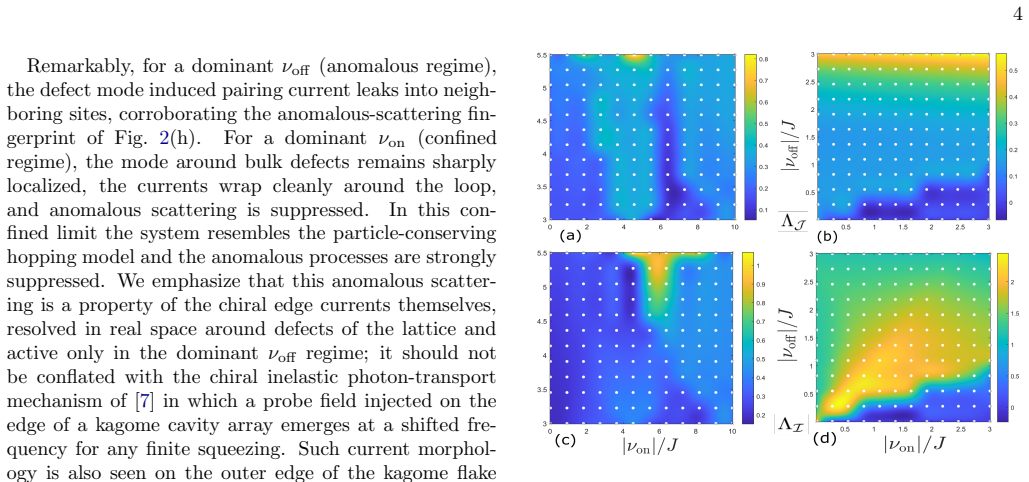
Bosonic pairing on a 2D kagome lattice opens a second chiral current channel. From the continuity equation both a hopping current sourced by on-bond single-particle coherence and an anomalous pairing current sourced by off-site anomalous coherence are derived. The pairing current has a spatial range governed by the BdG pairing gap, produces chiral circulation in bulk-gapped phases with integer para-unitary Chern numbers, and exhibits a phase-sensitive leakage ratio around defects that can be tuned from confined to strongly anomalous regimes at fixed topology.
What carries the argument
The anomalous pairing current sourced by off-site anomalous coherence, with spatial range set by the BdG pairing gap rather than the single-particle gap, derived via the continuity equation.
Load-bearing premise
The continuity equation can be applied to derive both a hopping current from on-bond single-particle coherence and an anomalous pairing current from off-site anomalous coherence in bulk-gapped phases.
What would settle it
Direct measurement of a phase-tunable leakage ratio for the pairing current around a defect in a kagome lattice realization that varies independently of the para-unitary Chern number.
If this is right
- Chiral circulation of both currents appears in bulk-gapped phases with integer para-unitary Chern numbers.
- The leakage ratio for the pairing current around a defect can be tuned from confined to strongly anomalous regimes at fixed topology.
- Distinct defect-induced signatures in real space arise because the two currents are sourced by different coherences with different spatial ranges.
- Bulk topology coexists with an anomalous edge response that has no analogue in particle-conserving matter.
Where Pith is reading between the lines
- The separation of current channels may allow independent control of edge transport via the phase of the pairing term in driven photonic lattices.
- Similar anomalous pairing currents could appear in other bosonic platforms such as magnon or phonon systems with engineered pairing.
- Transport measurements around defects could serve as a direct probe of the spatial extent of anomalous coherence.
Editorial analysis
A structured set of objections, weighed in public.
Referee Report
Summary. The manuscript claims that bosonic pairing on a 2D kagome lattice opens a second chiral current channel (anomalous pairing current) absent from particle-conserving models. From the continuity equation it derives both a conventional hopping current (sourced by on-bond single-particle coherence) and an anomalous pairing current (sourced by off-site anomalous coherence whose range is set by the BdG pairing gap), predicts chiral circulation in bulk-gapped phases with integer para-unitary Chern numbers, and introduces a tunable phase-sensitive leakage ratio Λ_I for the pairing current around defects that can be varied from confined to strongly anomalous regimes at fixed topology.
Significance. If the derivations are valid, the work identifies a novel topological edge response unique to paired bosonic systems that coexists with bulk topology and has no direct analogue in particle-conserving matter; the two microscopically distinct channels and the defect signatures would be directly testable in driven photonic lattices and superconducting-circuit arrays.
major comments (2)
- [section deriving currents from the continuity equation] The central derivation applies the continuity equation to obtain a clean microscopic separation into hopping and anomalous pairing currents without residual source terms. In a bosonic BdG Hamiltonian the Heisenberg equation for local density generally produces ∇·J + S where S arises from anomalous averages; the manuscript must explicitly demonstrate that S vanishes (or is exactly absorbed into the pairing-current definition) in the bulk-gapped para-unitary Chern phase, otherwise the claimed topological interpretation of Λ_I and the separation of the two channels lose their direct justification.
- [section on topological invariants and Chern numbers] The prediction of chiral circulation is tied to integer para-unitary Chern numbers, yet the manuscript supplies no explicit computation or reference to the para-unitary formalism used to obtain these integers; without this step the link between bulk topology and the two edge channels remains unverified.
minor comments (1)
- The abstract states that the derivation is performed but contains no equations; the main text should include the explicit expressions for the two currents and for Λ_I to allow immediate verification.
Simulated Author's Rebuttal
We thank the referee for the careful reading and constructive comments. We address the two major points below.
read point-by-point responses
-
Referee: [section deriving currents from the continuity equation] The central derivation applies the continuity equation to obtain a clean microscopic separation into hopping and anomalous pairing currents without residual source terms. In a bosonic BdG Hamiltonian the Heisenberg equation for local density generally produces ∇·J + S where S arises from anomalous averages; the manuscript must explicitly demonstrate that S vanishes (or is exactly absorbed into the pairing-current definition) in the bulk-gapped para-unitary Chern phase, otherwise the claimed topological interpretation of Λ_I and the separation of the two channels lose their direct justification.
Authors: We agree that an explicit demonstration of the fate of the source term S is necessary for full rigor. In the revised manuscript we will expand the continuity-equation section with a direct calculation from the Heisenberg equation, showing that S is exactly absorbed into the definition of the anomalous pairing current throughout the bulk-gapped para-unitary Chern phase, leaving a clean continuity equation with no residual source. This addition will also clarify the microscopic distinction between the two current channels and the topological status of Λ_I. revision: yes
-
Referee: [section on topological invariants and Chern numbers] The prediction of chiral circulation is tied to integer para-unitary Chern numbers, yet the manuscript supplies no explicit computation or reference to the para-unitary formalism used to obtain these integers; without this step the link between bulk topology and the two edge channels remains unverified.
Authors: We accept that an explicit reference and computation are required to make the link between bulk topology and the edge channels fully transparent. In the revision we will cite the standard para-unitary BdG Chern-number formalism and add a concise but explicit evaluation of the para-unitary Chern numbers for the kagome-lattice model in the relevant gapped phases, confirming that they are integers and directly account for the observed chiral circulation of both current channels. revision: yes
Circularity Check
Derivation from continuity equation and para-unitary Chern numbers is self-contained with no reduction to inputs by construction
full rationale
The paper applies the continuity equation to a bosonic BdG Hamiltonian to obtain hopping current (sourced by on-bond single-particle coherence) and anomalous pairing current (sourced by off-site anomalous coherence), then associates chiral circulation with integer para-unitary Chern numbers and a tunable leakage ratio Λ_I. No quoted step equates a claimed prediction to a fitted parameter, renames a known result, or relies on a load-bearing self-citation whose content is itself unverified. The separation of currents follows directly from the Heisenberg equation on the density operator and the structure of the pairing terms; the topological link is to standard invariants rather than an internal definition. This satisfies the criteria for a self-contained derivation against external benchmarks.
Axiom & Free-Parameter Ledger
axioms (2)
- domain assumption The continuity equation applies to derive both hopping and pairing currents in the bosonic system with pairing.
- domain assumption Bulk-gapped phases with integer para-unitary Chern numbers exist and support chiral circulation.
invented entities (1)
-
anomalous pairing current
no independent evidence
read the original abstract
We show that bosonic pairing opens a second chiral current channel on a 2D kagome lattice, absent from any particle-conserving model. From the continuity equation, we derive both a hopping current and an anomalous pairing current on the lattice, and predict chiral circulation in bulk-gapped phases with integer para-unitary Chern numbers, as well as a phase-sensitive leakage ratio, $\Lambda_{\cal I}$, for the pairing current around a defect. This ratio can be tuned from confined to strongly anomalous regimes at fixed topology. The two channels differ microscopically: the hopping current is sourced by the on-bond single-particle coherence, whereas the pairing current is sourced by the off-site anomalous coherence, whose spatial range is governed by the BdG pairing gap rather than by the single-particle gap. This separation produces distinct defect-induced signatures in real space, identifies a regime in which bulk topology and anomalous edge response coexist with no analogue in particle-conserving matter, and is directly testable in driven photonic lattices and superconducting-circuit arrays.
Figures


Reference graph
Works this paper leans on
-
[1]
M. Z. Hasan and C. L. Kane, Rev. Mod. Phys.82, 3045 (2010)
2010
-
[2]
Qi and S.-C
X.-L. Qi and S.-C. Zhang, Rev. Mod. Phys.83, 1057 (2011)
2011
-
[3]
C.-K. Chiu, J. C. Y. Teo, A. P. Schnyder, and S. Ryu, Rev. Mod. Phys.88, 035005 (2016)
2016
-
[4]
J. H. P. Colpa, Physica A93, 327 (1978)
1978
-
[5]
Shindou, R
R. Shindou, R. Matsumoto, S. Murakami, and J.-I. Ohe, Phys. Rev. B87, 174427 (2013)
2013
-
[6]
See Supplemental Material for the para-unitary diagonal- isation, the explicit definition of the three phase configu- rations, the derivation of the two current operators, the perturbative argument for BP-driven anomalous scatter- ing, the Chern-number and ribbon-spectrum data, and the extended experimental outlook
-
[7]
Peano, M
V. Peano, M. Houde, C. Brendel, F. Marquardt, and A. A. Clerk, Nat. Commun.7, 10779 (2016)
2016
-
[8]
Chaudhary, M
S. Chaudhary, M. Levin, and A. A. Clerk, Phys. Rev. B 103, 214306 (2021)
2021
-
[9]
Rivas and M
A. Rivas and M. A. Mart´ ın-Delgado, Sci. Rep.7, 6350 (2017)
2017
-
[10]
M. T. Mitchison, A. Rivas, and M. A. Mart´ ın-Delgado, Phys. Rev. Lett.128, 120403 (2022)
2022
-
[11]
Pocklington, Y.-X
A. Pocklington, Y.-X. Wang, and A. A. Clerk, Phys. Rev. Lett.130, 123602 (2023)
2023
-
[12]
Hafezi, S
M. Hafezi, S. Mittal, J. Fan, A. Migdall, and J. M. Taylor, Nat. Photonics7, 1001 (2013)
2013
-
[13]
Ozawa, H
T. Ozawa, H. M. Price, A. Amo, N. Goldman, M. Hafezi, L. Lu, M. C. Rechtsman, D. Schuster, J. Simon, O. Zil- berberg, and I. Carusotto, Rev. Mod. Phys.91, 015006 (2019)
2019
-
[14]
D. R. Gulevich, D. Yudin, D. V. Skryabin, I. V. Iorsh, and I. A. Shelykh, Sci. Rep.7, 1780 (2017). 1 Supplemental Material: Anomalous Pairing Currents and a Second Topological Edge Channel in Bosonic Lattices Chitrak Bhadra,1 ´Angel Rivas,1,2 and Miguel A. Mart´ ın-Delgado1,2 1Departamento de F´ ısica Te´ orica, Universidad Complutense de Madrid, 28040 Ma...
2017
-
[15]
Kagome edge states under lattice termination, spin-orbit coupling, and magnetic order
It is nonetheless a legitimate local lattice current in the BdG formalism: it is the unique bond-resolved operator whose divergence reproduces the pairing contribution tod⟨a † j,saj,s⟩/dtvia Heisenberg’s equation, i.e. it tracks the local rate at which the pairing term injects or removes particle pairs through the bond (j, s)↔(j ′, s′). The total energy V...
work page internal anchor Pith review arXiv 1978
discussion (0)
Sign in with ORCID, Apple, or X to comment. Anyone can read and Pith papers without signing in.