AC-flux-driven SQUID diode spectroscopy as a probe of current-phase relations
Pith reviewed 2026-06-26 22:26 UTC · model grok-4.3
The pith
Ac flux modulation in asymmetric SQUIDs dresses each CPR harmonic with a distinct Bessel function, producing unique signatures in diode efficiency.
A machine-rendered reading of the paper's core claim, the machinery that carries it, and where it could break.
Core claim
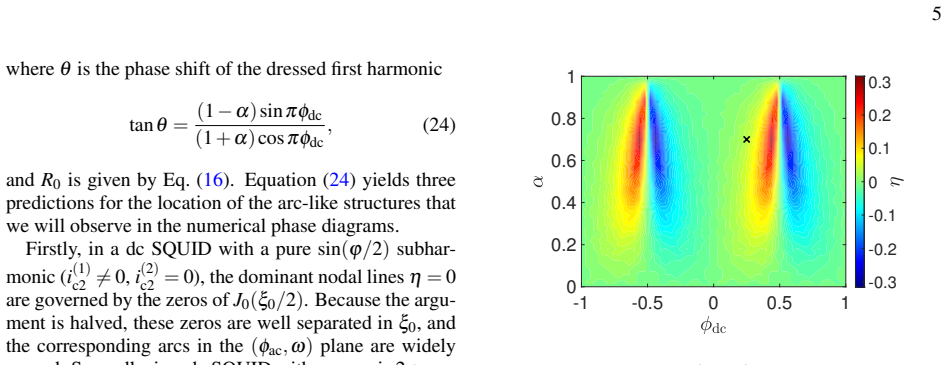
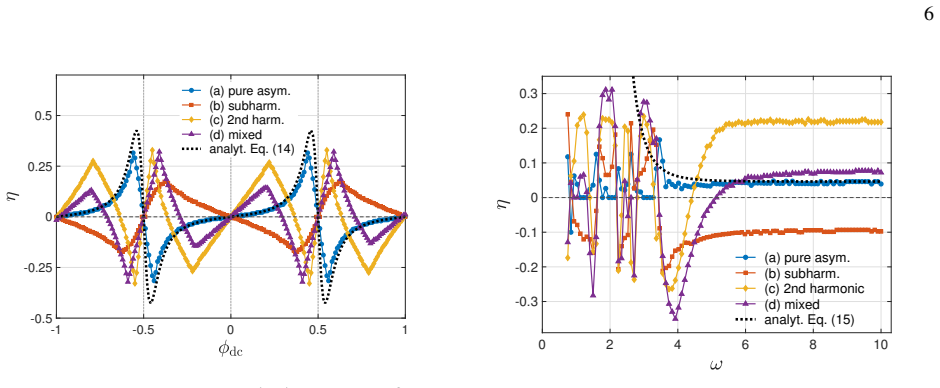
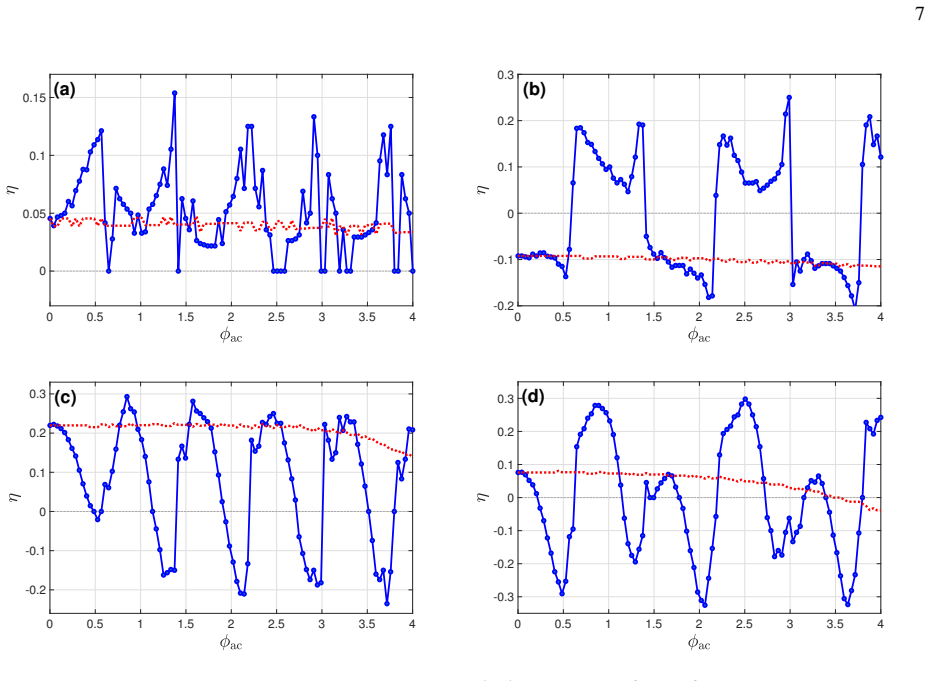
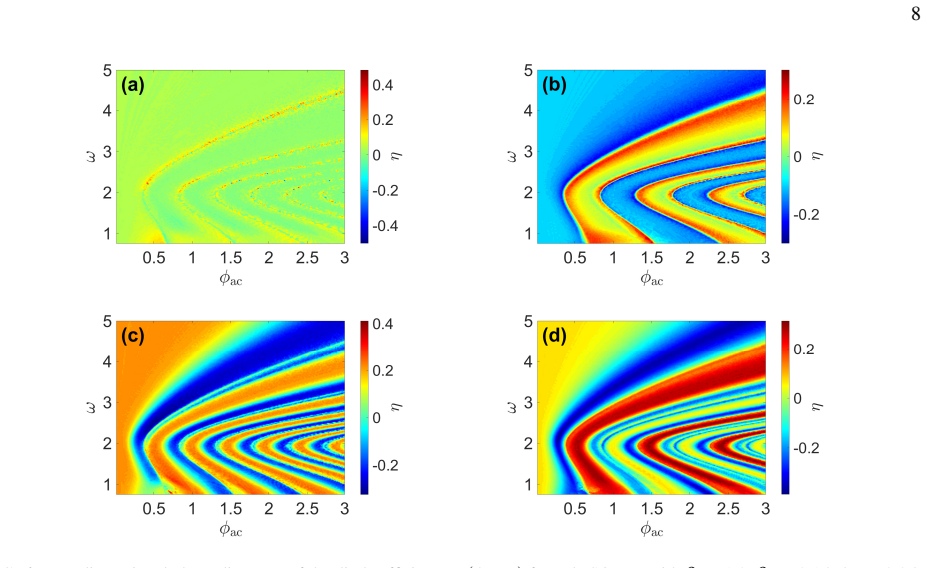
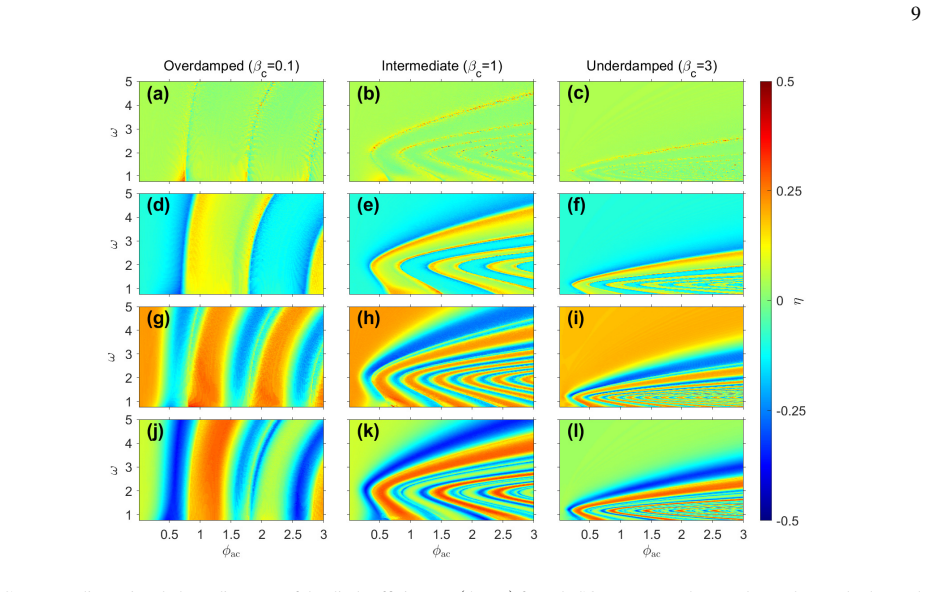
Ac flux modulation dresses each harmonic with a distinct Bessel function, yielding characteristic signatures in the diode efficiency η(φ_ac,ω) as a function of ac flux amplitude φ_ac and frequency ω. Using Kapitza-type perturbation theory for conventional junctions and Jacobi-Anger averaging for a general CPR, the approach is verified by numerical solutions of the coupled dynamical equations, which produce robust arc patterns in η(φ_ac,ω) phase diagrams for CPRs containing sinφ, sin(φ/2), and sin2φ terms that remain distinct across damping regimes.
What carries the argument
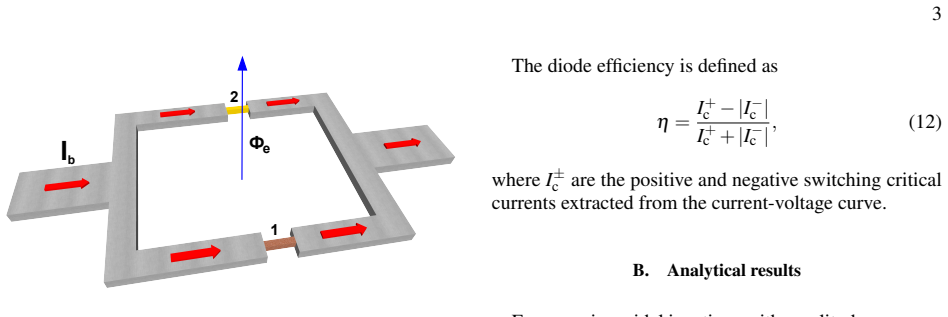
The ac-flux-driven diode effect in asymmetric dc SQUIDs with unequal junction critical currents, where the diode efficiency η(φ_ac,ω) encodes the Bessel-modulated signatures of individual CPR harmonics.
Load-bearing premise
The Kapitza-type perturbation theory and Jacobi-Anger averaging accurately reduce the fast-driven dynamics while preserving distinct harmonic signatures without being obscured by device asymmetries or dynamical effects.
What would settle it
An experiment measuring diode efficiency versus ac flux amplitude and frequency in SQUIDs with controlled CPRs that fails to produce the predicted distinct arc patterns would falsify the claim that ac driving separates the harmonics via Bessel functions.
Figures
read the original abstract
The current-phase relation (CPR) of a Josephson junction encodes microscopic information on superconducting states through higher-order and fractional harmonics. However, their unambiguous extraction is challenging, as different CPR components produce nearly identical static interference patterns that are further obscured by device asymmetries, damping, and dynamical effects. Here, we propose probing individual CPR harmonics via the ac magnetic-flux-driven diode effect in asymmetric dc SQUIDs with unequal junction critical currents. Using two complementary reductions of the fast-driven dynamics -- a Kapitza-type perturbation theory for the conventional junction and a Jacobi--Anger averaging for a general CPR -- we show that ac flux modulation dresses each harmonic with a distinct Bessel function, yielding characteristic signatures in the diode efficiency $\eta(\phi_{\rm ac},\omega)$ as a function of ac flux amplitude $\phi_{\rm ac}$ and frequency $\omega$. We verify and extend these predictions by numerical solutions of the coupled dynamical equations for CPRs containing $\sin\varphi$, $\sin(\varphi/2)$, and $\sin 2\varphi$ terms ($\varphi$: superconducting phase difference), and construct phase diagrams of $\eta(\phi_{\rm ac},\omega)$. Distinct CPR components are revealed to produce characteristic weak, sparse, dense, or intermodulated arc patterns that remain robust in both overdamped and underdamped regimes. This suggests ac-flux-driven SQUID diode spectroscopy as a probe of current-phase relations in topological materials, multiband systems, and other unconventional superconductors.
Editorial analysis
A structured set of objections, weighed in public.
Referee Report
Summary. The manuscript proposes AC-flux-driven SQUID diode spectroscopy to extract individual current-phase relation (CPR) harmonics. Using a Kapitza-type perturbation reduction for the conventional junction and Jacobi-Anger averaging for general CPRs, it shows that AC flux dresses each harmonic with a distinct Bessel function, producing characteristic signatures in the diode efficiency η(φ_ac, ω). These predictions are verified and extended by direct numerical integration of the coupled RSJ equations for three explicit CPRs (sin φ, sin(φ/2), sin 2φ), yielding distinct weak/sparse/dense/intermodulated arc patterns in η(φ_ac, ω) phase diagrams that persist in both overdamped and underdamped regimes.
Significance. If the signatures remain distinct, the method supplies a dynamical probe capable of distinguishing higher-order and fractional CPR components that are otherwise degenerate in static interference patterns. The manuscript supplies both analytical reductions and direct numerical solutions of the RSJ equations across damping regimes; this combination of complementary derivations and explicit verification for multiple CPRs strengthens the central claim.
minor comments (3)
- [Abstract] Abstract: the diode efficiency η is introduced without an explicit formula; stating its definition (e.g., the normalized difference of critical currents) would clarify the central observable from the outset.
- [Abstract] Abstract: 'Kapitza-type perturbation theory' is invoked without a one-sentence description or citation; a brief gloss would assist readers outside the immediate subfield.
- The manuscript refers to 'phase diagrams of η(φ_ac,ω)' but does not specify the precise range or sampling of ω relative to the plasma frequency; adding this detail would make the robustness claims easier to assess.
Simulated Author's Rebuttal
We thank the referee for the positive summary, significance assessment, and recommendation of minor revision. No major comments were raised in the report.
Circularity Check
No significant circularity in derivation chain
full rationale
The manuscript derives the diode efficiency signatures from the standard resistively shunted junction (RSJ) equations using established Kapitza-type perturbation theory and Jacobi-Anger averaging. These reductions are applied to explicit CPR forms (sin φ, sin(φ/2), sin 2φ) and the resulting predictions are cross-checked against independent numerical solutions of the dynamical equations in both overdamped and underdamped regimes. No parameters are fitted to the target η(φ_ac, ω) data, no self-citations form the load-bearing justification, and the Bessel dressing follows directly from the averaging identities rather than being defined into the result. The derivation chain is therefore self-contained against external mathematical benchmarks.
Axiom & Free-Parameter Ledger
axioms (2)
- domain assumption Standard resistively shunted junction model governs the SQUID dynamics
- domain assumption Kapitza-type perturbation theory and Jacobi-Anger averaging validly reduce the fast AC-driven regime
Reference graph
Works this paper leans on
-
[1]
Nadeem, M
M. Nadeem, M. S. Fuhrer, and X. Wang, The supercon- ducting diode effect, Nat. Rev. Phys.5, 558 (2023)
2023
-
[2]
J. Ma, R. Zhan, and X. Lin, Superconducting diode effects: Mechanisms, materials and applications, Adv. Phys. Res.4, 2400180 (2025)
2025
-
[3]
Ingla-Ayn ´es, Y
J. Ingla-Ayn ´es, Y . Hou, S. Wang, E.-D. Chu, O. A. Mukhanov, P. Wei, and J. S. Moodera, Efficient supercon- ducting diodes and rectifiers for quantum circuitry, Nat. Electron.8, 411 (2025)
2025
-
[4]
Golod and V
T. Golod and V . M. Krasnov, Demonstration of a super- conducting diode-with-memory, operational at zero mag- netic field with switchable nonreciprocity, Nat. Commun. 13, 3658 (2022)
2022
-
[5]
Wakatsuki, Y
R. Wakatsuki, Y . Saito, S. Hoshino, Y . M. Itahashi, T. Ideue, M. Ezawa, Y . Iwasa, and N. Nagaosa, Nonrecip- rocal charge transport in noncentrosymmetric supercon- ductors, Sci. Adv.3, e1602390 (2017)
2017
-
[6]
Zhang, X
E. Zhang, X. Xu, Y . C. Zou, L. Ai, X. Dong, C. Huang, P. Leng, S. Liu, Y . Zhang, Z. Jia, X. Peng, M. Zhao, Y . Yang, Z. Li, H. Guo, S. J. Haigh, N. Nagaosa, J. Shen, and F. Xiu, Nonreciprocal superconducting NbSe 2 an- tenna, Nat. Commun.11, 5634 (2020)
2020
-
[7]
Y . M. Itahashi, T. Ideue, Y . Saito, S. Shimizu, T. Ouchi, T. Nojima, and Y . Iwasa, Nonreciprocal transport in gate-induced polar superconductor srtio 3, Sci. Adv.6, eaay9120 (2020)
2020
-
[8]
Y . Y . Lyu, J. Jiang, Y . L. Wang, Z. L. Xiao, S. Dong, Q. H. Chen, M. V . Milosevi´c, H. Wang, R. Divan, J. E. Pearson, P. Wu, F. M. Peeters, and W.-K. Kwok, Superconducting diode effect via conformal-mapped nanoholes, Nat. Com- mun.12, 2703 (2021)
2021
-
[9]
Narita, J
H. Narita, J. Ishizuka, R. Kawarazaki, D. Kan, Y . Sh- iota, T. Moriyama, Y . Shimakawa, A. V . Ognev, A. S. Samardak, Y . Yanase, and T. Ono, Field-free supercon- ducting diode effect in noncentrosymmetric superconduc- tor/ferromagnet multilayers, Nat. Nanotechnol.17, 823 (2022)
2022
-
[10]
Ghosh, V
S. Ghosh, V . Patil, A. Basu, Kuldeep, A. Dutta, D. A. Jan- gade, R. Kulkarni, A. Thamizhavel, J. F. Steiner, F. von Oppen, and M. M. Deshmukh, High-temperature Joseph- son diode, Nat. Mater.23, 612 (2024)
2024
-
[11]
Soori, Josephson diode effect in junctions of supercon- ductors with band asymmetric metals, J
A. Soori, Josephson diode effect in junctions of supercon- ductors with band asymmetric metals, J. Phys.: Condens. Matter36, 335303 (2024)
2024
-
[12]
Soori, Josephson diode effect in one-dimensional quantum wires connected to superconductors with mixed singlet-triplet pairing, J
A. Soori, Josephson diode effect in one-dimensional quantum wires connected to superconductors with mixed singlet-triplet pairing, J. Phys.: Condens. Matter37, 10LT02 (2025)
2025
-
[13]
H. Wu, Y . Wang, Y . Xu, P. K. Sivakumar, C. Pasco, U. Fil- ippozzi, S. S. P. Parkin, Y . J. Zeng, T. McQueen, and M. N. Ali, The field-free Josephson diode in a van der Waals het- erostructure, Nature604, 653 (2022)
2022
-
[14]
J. X. Lin, P. Siriviboon, H. D. Scammell, S. Liu, D. Rhodes, K. Watanabe, T. Taniguchi, J. Hone, M. S. Scheurer, and J. I. A. Li, Zero-field superconducting diode effect in small-twist-angle trilayer graphene, Nat. Phys. 18, 1221 (2022)
2022
-
[15]
D. Margineda, D. Caldevilla-Asenjo, Y . Yerin, C.´Alvarez Garc´ıa, A. Mazanik, M. Ilyn, C. Rogero, L. E. Hueso, F. S. Bergeret, and M. Gobbi, Signatures of time- reversal-symmetry breaking in multiband 2H-TaS2 re- vealed by zero-field Josephson nonreciprocity (2026), arXiv:2605.00477
Pith/arXiv arXiv 2026
-
[16]
Turini, S
B. Turini, S. Salimian, M. Carrega, A. Iorio, E. Strambini, F. Giazotto, V . Zannier, L. Sorba, and S. Heun, Josephson diode effect in high-mobility insb nanoflags, Nano Lett. 22, 8502 (2022)
2022
-
[17]
B. Pal, A. Chakraborty, P. K. Sivakumar, M. Davydova, A. K. Gopi, A. K. Pandeya, J. A. Krieger, Y . Zhang, M. Date, S. Ju, N. Yuan, N. B. M. Schr ¨oter, L. Fu, and S. S. P. Parkin, Josephson diode effect from Cooper pair momentum in a topological semimetal, Nat. Phy.18, 1228 (2022)
2022
-
[18]
Debnath and P
D. Debnath and P. Dutta, Gate-tunable Josephson diode effect in rashba spin-orbit coupled quantum dot junctions, Phys. Rev. B109, 174511 (2024)
2024
-
[19]
Debnath and P
D. Debnath and P. Dutta, Field-free Josephson diode ef- fect in interacting chiral quantum dot junctions, J. Phys.: Condens. Matter37, 175301 (2025)
2025
-
[20]
Z. Wei, Y . Qiao, Y . Y . Lyu, D. Wang, T. Li, L. R. Cadorim, P. Zhang, W. C. Yue, D. Li, Z. Song, Z. Wang, Y . Wang, M. V . Milosevic, Y .-L. Wang, H. Wang, and P. Wu, Scal- able high-temperature superconducting diodes in intrinsic Josephson junctions, arXiv (2025), arXiv:2508.06083
arXiv 2025
-
[21]
Tokura and N
Y . Tokura and N. Nagaosa, Nonreciprocal responses from non-centrosymmetric quantum materials, Nat. Commun. 9, 3740 (2018)
2018
-
[22]
Ilic and F
S. Ilic and F. S. Bergeret, Theory of the supercurrent diode effect in Rashba superconductors with arbitrary disorder, Phys. Rev. Lett.128, 177001 (2022)
2022
-
[23]
V . M. Edelstein, Magnetoelectric Effect in Polar Super- conductors, Phys. Rev. Lett.75, 2004 (1995)
2004
-
[24]
V . M. Edelstein, The Ginzburg–Landau equation for su- perconductors of polar symmetry, J. Phys.: Condens. Mat- ter8, 339 (1996)
1996
-
[25]
N. F. Q. Yuan and L. Fu, Supercurrent diode effect and finite-momentum superconductors, Proc. Natl. Acad. Sci. 119, e2119548119 (2022)
2022
-
[26]
D. F. Agterberg, Novel magnetic field effects in uncon- ventional superconductors, Physica C387, 13 (2003), pro- ceedings of the 3rd Polish-US Workshop on Superconduc- tivity and Magnetism of Advanced Materials
2003
-
[27]
D. F. Agterberg, Magnetoelectric effects, helical phases, and fflo phases in superconductors without inversion sym- 13 metry (2011), arXiv:1106.0352
Pith/arXiv arXiv 2011
-
[28]
Buzdin, Direct coupling between magnetism and su- perconducting current in the Josephsonϕ 0 junction, Phys
A. Buzdin, Direct coupling between magnetism and su- perconducting current in the Josephsonϕ 0 junction, Phys. Rev. Lett.101, 107005 (2008)
2008
-
[29]
M. E. Roig, P. Kotetes, and B. M. Andersen, Supercon- ducting diodes from magnetization gradients, Phys. Rev. B109, 144503 (2024)
2024
-
[30]
Zinkl, K
B. Zinkl, K. Hamamoto, and M. Sigrist, Symmetry condi- tions for the superconducting diode effect in chiral super- conductors, Phys. Rev. Res.4, 033167 (2022)
2022
-
[31]
Tanaka, B
Y . Tanaka, B. Lu, and N. Nagaosa, Theory of giant diode effect ind-wave superconductor junctions on the sur- face of a topological insulator, Phys. Rev. B106, 214524 (2022)
2022
-
[32]
B. Lu, S. Ikegaya, P. Burset, Y . Tanaka, and N. Nagaosa, Tunable Josephson diode effect on the surface of topolog- ical insulators, Phys. Rev. Lett.131, 096001 (2023)
2023
-
[33]
Cayao, N
J. Cayao, N. Nagaosa, and Y . Tanaka, Enhancing the Josephson diode effect with Majorana bound states, Phys. Rev. B109, L081405 (2024)
2024
-
[34]
Y . Yerin and I. Askerzade, Superconducting diode effect in fractal superconductors: fractional-order Ginzburg–Landau theory for Josephson junctions (2026), arXiv:2601.02187
arXiv 2026
-
[35]
J. J. He, Y . Tanaka, and N. Nagaosa, A phenomenological theory of superconductor diodes, New J. Phys.24, 053014 (2022)
2022
-
[36]
Daido and Y
A. Daido and Y . Yanase, Superconducting diode effect and nonreciprocal transition lines, Phys. Rev. B106, 205206 (2022)
2022
-
[37]
Hasan, D
J. Hasan, D. Shaffer, M. Khodas, and A. Levchenko, Su- percurrent diode effect in helical superconductors, Phys. Rev. B110, 024508 (2024)
2024
-
[38]
L. R. Cadorim, E. Sardella, and C. C. de Souza Silva, Har- nessing the superconducting diode effect through inho- mogeneous magnetic fields, Phys. Rev. Appl.21, 054040 (2024)
2024
-
[39]
Sundaresh, J
A. Sundaresh, J. I. V ¨ayrynen, Y . Lyanda-Geller, and L. P. Rokhinson, Diamagnetic mechanism of critical current non-reciprocity in multilayered superconductors, Nat. Commun.14, 1628 (2023)
2023
-
[40]
Yerin, S
Y . Yerin, S. L. Drechsler, A. A. Varlamov, M. Cuoco, and F. Giazotto, Supercurrent rectification with time-reversal symmetry broken multiband superconductors, Phys. Rev. B110, 054501 (2024)
2024
-
[41]
Yerin, S
Y . Yerin, S. L. Drechsler, A. A. Varlamov, F. Giazotto, and M. Cuoco, Supercurrent diode effect in Josephson in- terferometers with multiband superconductors, Commun. Phys.12, 356 (2025)
2025
-
[42]
Y . S. Yerin and A. N. Omelyanchouk, Frustration phe- nomena in Josephson point contacts between single-band and three-band superconductors, Low Temp. Phys.40, 943 (2014)
2014
-
[43]
Yerin and A
Y . Yerin and A. N. Omelyanchouk, Proximity and Joseph- son effects in microstructures based on multiband super- conductors (review article), Low Temp. Phys.43, 1013 (2017)
2017
-
[44]
Y . S. Yerin, A. S. Kiyko, A. N. Omelyanchouk, and E. Il’ichev, Josephson systems based on ballistic point contacts between single-band and multi-band supercon- ductors, Low Temp. Phys.41, 885 (2015)
2015
-
[45]
Tanaka, Multicomponent superconductivity based on multiband superconductors, Superconductor Science and Technology28, 034002 (2015)
Y . Tanaka, Multicomponent superconductivity based on multiband superconductors, Superconductor Science and Technology28, 034002 (2015)
2015
-
[46]
Askerzade,Unconventional superconductors
I. Askerzade,Unconventional superconductors. Anisotropy and multiband effects, V ol. 153 (Springer, 2012)
2012
-
[47]
Askerzade, A
I. Askerzade, A. Bozbey, and M. Cant ¨urk,Modern As- pects of Josephson Dynamics and Superconductivity Elec- tronics, Mathematical Engineering, V ol. 6074 (Springer International Publishing, 2017)
2017
-
[48]
I. N. Askerzade, Effects of anharmonicity of current- phase relation in Josephson junctions (review article), Low Temp. Phys.41, 241 (2015)
2015
-
[49]
A. A. Golubov, M. Y . Kupriyanov, and E. Il’ichev, The current-phase relation in Josephson junctions, Rev. Mod. Phys.76, 411 (2004)
2004
-
[50]
Mondal, P.-H
S. Mondal, P.-H. Fu, and J. Cayao, Josephson diode ef- fect with andreev and majorana bound states, Phys. Rev. B112, 144506 (2025)
2025
-
[51]
Wiedenmann, E
J. Wiedenmann, E. Bocquillon, R. S. Deacon, S. Hartinger, O. Herrmann, T. M. Klapwijk, L. Maier, C. Ames, C. Br ¨une, C. Gould, A. Oiwa, K. Ishibashi, S. Tarucha, H. Buhmann, and L. W. Molenkamp, 4π-periodic Josephson supercurrent in HgTe-based topological Josephson junctions, Nat. Commun.7, 10303 (2016)
2016
-
[52]
M. C. Dartiailh, J. J. Cuozzo, B. H. Elfeky, W. Mayer, J. Yuan, K. S. Wickramasinghe, E. Rossi, and J. Shabani, Missing Shapiro steps in topologically trivial Josephson junction on InAs quantum well, Nat. Commun.12, 78 (2021)
2021
-
[53]
I. T. Rosen, C. J. Trimble, M. P. Andersen, E. Mikheev, Y . Li, Y . Liu, L. Tai, P. Zhang, K. L. Wang, Y . Cui, M. A. Kastner, J. R. Williams, and D. Goldhaber-Gordon, Frac- tional ac Josephson effect in a topological insulator prox- imitized by a self-formed superconductor, Phys. Rev. B 110, 064511 (2024)
2024
-
[54]
X. Wu, J. Y . Wang, H. Su, S. Yan, D. Pan, J. Zhao, P. Zhang, and H. Q. Xu, Tunable superconducting diode effect in higher-harmonic InSb nanosheet interferometers, New J. Phys.27, 023031 (2025)
2025
-
[55]
Zhang, S
P. Zhang, S. Mudi, M. Pendharkar, J. S. Lee, C. P. Dempsey, A. P. McFadden, S. D. Harrington, J. T. Dong, H. Wu, A. H. Chen, M. Hocevar, C. J. Palmstrøm, and S. M. Frolov, Missing odd-order Shapiro steps do not uniquely indicate fractional Josephson effect, SciPost Phys.18, 203 (2025)
2025
-
[56]
J. J. Cuozzo, W. Pan, J. Shabani, and E. Rossi, Microwave-tunable diode effect in asymmetric squids with topological Josephson junctions, Phys. Rev. Res.6, 023011 (2024)
2024
-
[57]
Matsuo, R
S. Matsuo, R. S. Deacon, S. Kobayashi, Y . Sato, T. Yokoyama, T. Lindemann, S. Gronin, G. C. Gardner, K. Ishibashi, M. J. Manfra, and S. Tarucha, Shapiro re- sponse of superconducting diode effect derived from an- dreev molecules, Phys. Rev. B111, 094512 (2025)
2025
- [58]
-
[59]
See Supplemental Material at [URL will be inserted by publisher] for the detailed analytical derivations (the 14 Kapitza-type perturbation theory, its non-perturbative ex- tension, and the full Jacobi–Anger reduction of the diode efficiency) together with the numerical protocol
-
[60]
Barone and G
A. Barone and G. Patern`o,Physics and Applications of the Josephson Effect(Wiley, New York, 1982)
1982
-
[61]
V . J. de Waal, P. Schrijner, and R. Llurba, Simulation and optimization of a dc SQUID with finite capacitance, J. Low Temp. Phys.54, 215 (1984)
1984
-
[62]
Ambegaokar and A
V . Ambegaokar and A. Baratoff, Tunneling between su- perconductors, Phys. Rev. Lett.10, 486 (1963)
1963
-
[63]
Abramowitz and I
M. Abramowitz and I. A. Stegun,Handbook of Mathe- matical Functions(Dover, 1964)
1964
-
[64]
V . A. Shklovskij and O. V . Dobrovolskiy, Frequency- dependent ratchet effect in superconducting films with a tilted washboard pinning potential, Phys. Rev. B84, 054515 (2011)
2011
-
[65]
J. Ge, P. Wang, Y . Xing, Q. Yin, A. Wang, J. Shen, H. Lei, Z. Wang, and J. Wang, Charge-4eand charge- 6eflux quantization and higher charge superconductivity in kagome superconductor ring devices, Phys. Rev. X14, 021025 (2024)
2024
-
[66]
Sterck, R
A. Sterck, R. Kleiner, and D. Koelle, Three-junction SQUID rocking ratchet, Phys. Rev. Lett.95, 177006 (2005)
2005
-
[67]
O. V . Dobrovolskiy, E. Begun, V . M. Bevz, R. Sachser, and M. Huth, Upper frequency limits for vortex guiding and ratchet effects, Phys. Rev. Appl.13, 024012 (2020)
2020
-
[68]
Dobrovolskiy, H
O. Dobrovolskiy, H. Suderow, F. Tafuri, A. M. Black- Schaffer, J. L. Lado, A. Sudbø, D. Stornaioulo, C. Li, A. E. B ¨ohmer, L. M. Tran, A. J. Zaleski, A. Crisan, M. Polichetti, A. Galluzzi, A. Gencer, B. Aichner, N. Bari ´si´c, W. Lang, T. Samuely, M. Gmitra, T. Cren, M. Calandra, P. Samuely, J. Custers, R. C ´ordoba, V . M. Fomin, N. Poccia, P. Szab ´o, ...
2026
-
[69]
D. Yin, X. Cai, T. Xu, R. Sun, Y . Han, Y . Zhang, Y . Wang, and Z. Gan, Half-integer shapiro steps in MgB2 focused He ion beam Josephson junctions, Chin. Phys. B33, 087404 (2024)
2024
-
[70]
J. J. Chen, H. X. Lou, X. G. Ye, Z. B. Tan, A. Q. Wang, Z. T. Zhang, Y . X. Wang, X. Liao, Z. S. Zhang, Z. M. Liao, and D. P. Yu, Magnetic-flux tuning of second har- monic content in intrinsic CsV 3Sb5 Josephson junction, Phys. Rev. Lett.136, 096301 (2026)
2026
-
[71]
A. Eyal and G. Koren, Experimental evidence of Tc enhancement above 50 K and diode and paramagnetic- Meissner effects, in nickelate films on highly reduced srtio3, arXiv (2025), arXiv:2502.17892
Pith/arXiv arXiv 2025
-
[72]
Hecker and J
M. Hecker and J. Schmalian, Vestigial nematic order and superconductivity in the doped topological insulator cuxbi2se3, npj Quant. Mater.3, 26 (2018). 15 Supplemental Material: AC-flux-driven SQUID diode spectroscopy as a probe of current-phase relations SI. ANALYTICAL DERIV ATION OF THE DIODE EFFICIENCY We consider pure sinusoidal junctions with amplitud...
2018
discussion (0)
Sign in with ORCID, Apple, or X to comment. Anyone can read and Pith papers without signing in.