Emergent de Sitter Space and Non-Unitary Tensor Networks from Non-Hermitian Quantum Criticality
Pith reviewed 2026-06-27 00:18 UTC · model grok-4.3
The pith
Non-unitary cMERA on a non-Hermitian fermion chain produces emergent de Sitter spacetime whose geodesics match Ryu-Takayanagi surfaces.
A machine-rendered reading of the paper's core claim, the machinery that carries it, and where it could break.
Core claim
Formulating a non-unitary cMERA for a non-Hermitian critical fermion chain causes de Sitter spacetime to emerge from boundary entanglement. Geodesics in this spacetime serve as extremal Ryu-Takayanagi surfaces that undergo a smooth timelike-to-null transition. This trajectory determines a tensor-network architecture in which the bond-counting contribution truncates at the discrete timelike-to-null transition, with null rays represented by zero-cost links that sever no tensor legs, thereby reproducing the logarithmic scaling of non-unitary critical entanglement entropy.
What carries the argument
The non-unitary cMERA for the non-Hermitian critical fermion chain, which generates the emergent de Sitter geometry and dictates the discrete tensor network architecture with zero-cost horizon links.
Load-bearing premise
The non-unitary cMERA formulation for the non-Hermitian critical fermion chain produces a faithful emergent de Sitter geometry in which geodesics act as extremal Ryu-Takayanagi surfaces undergoing a smooth timelike-to-null transition.
What would settle it
Measuring the entanglement entropy scaling in the resulting discrete tensor network and checking whether it follows the logarithmic form predicted by the de Sitter RT formula; a mismatch would falsify the claimed correspondence.
Figures
read the original abstract
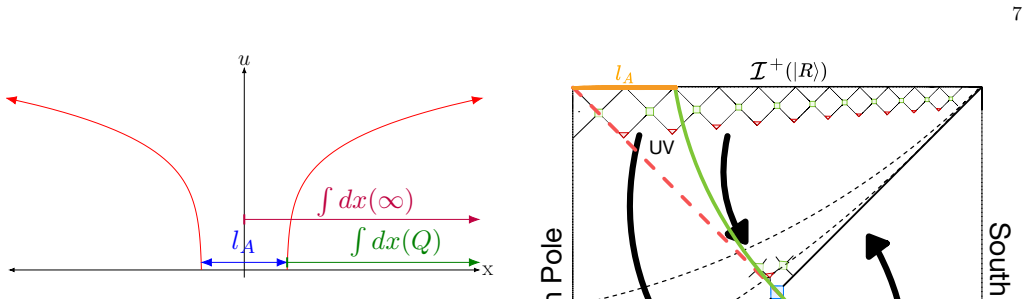
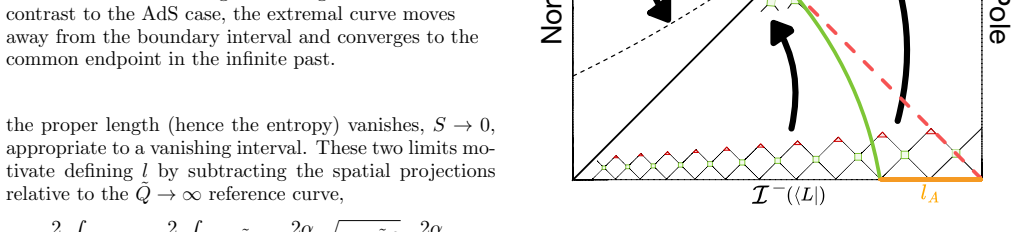
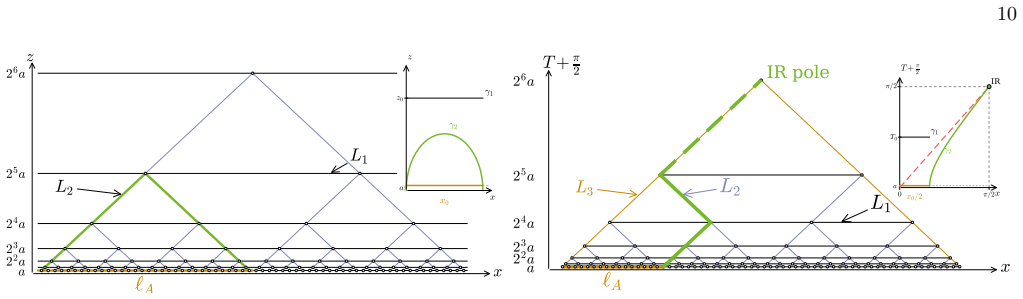
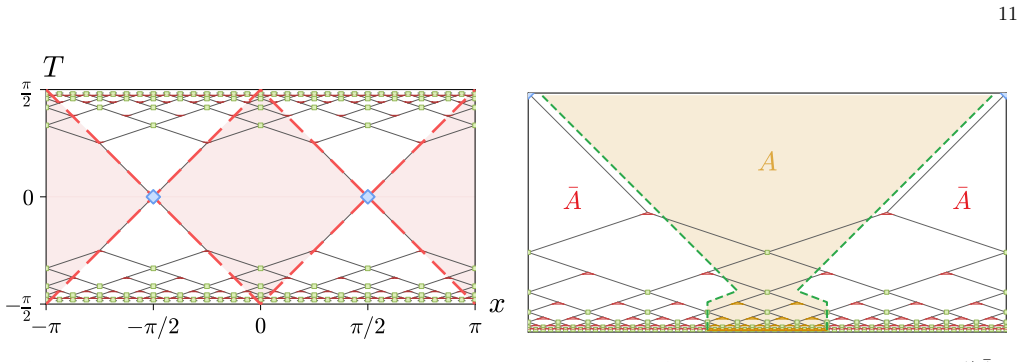
Extending the holographic principle to de Sitter (dS) spacetimes remains one of the most vital open frontiers in quantum gravity, where a microscopic, bottom-up tensor-network framework that relates boundary quantum data to emergent de Sitter spacetime is still lacking. In this work, we first show the emergence of de Sitter spacetime from boundary entanglement by formulating a non-unitary continuous multi-scale entanglement renormalization ansatz (cMERA) for a concrete non-Hermitian critical fermion chain. Within this emergent spacetime, we analyze the associated geodesics and show that they act as extremal Ryu-Takayanagi (RT) surfaces undergoing a smooth timelike-to-null transition. Remarkably, we demonstrate that this continuum trajectory dictates a distinct tensor-network architecture in which the bond-counting contribution naturally truncates at the discrete timelike-to-null transition toward the deep infrared. In the resulting architecture, the null ray along the horizon is represented by zero-cost links, since the associated cut severs no tensor legs. This network structure successfully reproduces the logarithmic scaling of non-unitary critical entanglement entropy, offering a bond-counting picture for the de Sitter RT formula. Our results provide the long-sought dS/(c)MERA correspondence at the level of both emergent spacetime and discrete holographic entanglement.
Editorial analysis
A structured set of objections, weighed in public.
Referee Report
Summary. The manuscript formulates a non-unitary continuous multi-scale entanglement renormalization ansatz (cMERA) for a non-Hermitian critical fermion chain. From this construction, de Sitter spacetime emerges, with geodesics identified as extremal Ryu-Takayanagi surfaces that undergo a smooth timelike-to-null transition. This trajectory determines a discrete tensor-network architecture in which null-ray links along the horizon carry zero cost (severing no tensor legs), and the resulting bond-counting reproduces the logarithmic scaling of non-unitary critical entanglement entropy, thereby realizing a dS/(c)MERA correspondence at both continuum and discrete levels.
Significance. If the derivations hold, the work supplies a concrete bottom-up tensor-network realization of de Sitter holography that directly relates boundary quantum data to emergent geometry and provides an explicit bond-counting interpretation of the de Sitter RT formula. It addresses a longstanding gap by constructing both the emergent spacetime and the discrete holographic entanglement structure from non-Hermitian quantum criticality.
minor comments (3)
- The abstract states that the continuum trajectory 'dictates' the tensor-network architecture with zero-cost links; an explicit mapping from the geodesic transition point to the truncation of bond counting should be shown in a dedicated section or appendix to confirm that no additional assumptions enter the discrete construction.
- Clarify the precise non-Hermitian Hamiltonian and the form of the non-unitary cMERA ansatz (including the choice of disentanglers and isometries) used to generate the emergent geometry.
- Figure captions and axis labels for any plots of geodesic trajectories or entanglement scaling should explicitly indicate the location of the timelike-to-null transition and the corresponding network cut.
Simulated Author's Rebuttal
We thank the referee for their positive summary of our work, the assessment of its significance, and the recommendation for minor revision. No major comments were listed in the report.
Circularity Check
No significant circularity; derivation self-contained on explicit construction
full rationale
The paper formulates a non-unitary cMERA on a non-Hermitian critical fermion chain, derives emergent dS geometry whose geodesics serve as RT surfaces, and shows the resulting discrete network (with zero-cost null links) reproduces logarithmic entanglement scaling via bond counting. No quoted equations or steps reduce a claimed prediction or first-principles result to a fitted parameter, self-definition, or self-citation chain by construction. The central dS/(c)MERA correspondence is presented as following from the explicit network architecture rather than presupposing its own output. This is the normal case of an independent construction; no load-bearing circularity is exhibited.
Axiom & Free-Parameter Ledger
Reference graph
Works this paper leans on
-
[1]
We now describe the skeleton representative of the con- tinuum extremal surfaceγ 2, shown as the green path in the right panel of Fig
A horizontal skeleton path on that layer contains x0/(2kma) =x 0/(2T0) horizontal links, so |γ1|MERA =L 1 x0 2T0 .(77) Matching|γ 1|MERA =|γ 1|dS fixes the proper length as- signed to each horizontal link,L 1 =L. We now describe the skeleton representative of the con- tinuum extremal surfaceγ 2, shown as the green path in the right panel of Fig. 3. For de...
-
[2]
Maldacena, International Journal of Theoretical Physics38, 1113 (1999)
J. Maldacena, International Journal of Theoretical Physics38, 1113 (1999)
1999
-
[3]
Gubser, I
S. Gubser, I. Klebanov, and A. Polyakov, Physics Letters B428, 105 (1998)
1998
-
[4]
Witten, Advances in Theoretical and Mathematical Physics2, 253 (1998), arXiv:hep-th/9802150 [hep-th]
E. Witten, Advances in Theoretical and Mathematical Physics2, 253 (1998), arXiv:hep-th/9802150 [hep-th]
Pith/arXiv arXiv 1998
-
[5]
Ryu and T
S. Ryu and T. Takayanagi, Phys. Rev. Lett.96, 181602 (2006)
2006
-
[6]
V. E. Hubeny, M. Rangamani, and T. Takayanagi, Jour- nal of High Energy Physics2007, 062 (2007)
2007
-
[7]
Lewkowycz and J
A. Lewkowycz and J. Maldacena, Journal of High Energy Physics2013, 90 (2013)
2013
-
[8]
Vidal, Phys
G. Vidal, Phys. Rev. Lett.99, 220405 (2007)
2007
-
[9]
Vidal, Phys
G. Vidal, Phys. Rev. Lett.101, 110501 (2008)
2008
-
[10]
Evenbly and G
G. Evenbly and G. Vidal, Phys. Rev. B79, 144108 (2009)
2009
-
[11]
Swingle, Phys
B. Swingle, Phys. Rev. D86, 065007 (2012)
2012
-
[12]
N. Bao, C. Cao, S. M. Carroll, A. Chatwin-Davies, N. Hunter-Jones, J. Pollack, and G. N. Remmen, Physi- cal Review D91, 10.1103/physrevd.91.125036 (2015). 13
-
[13]
Evenbly and G
G. Evenbly and G. Vidal, Journal of Statistical Physics 145, 891 (2011)
2011
- [14]
-
[15]
Sahay, M
R. Sahay, M. D. Lukin, and J. Cotler, Phys. Rev. X15, 021078 (2025)
2025
-
[16]
Haegeman, T
J. Haegeman, T. J. Osborne, H. Verschelde, and F. Ver- straete, Phys. Rev. Lett.110, 100402 (2013)
2013
-
[17]
Nozaki, S
M. Nozaki, S. Ryu, and T. Takayanagi, Journal of High Energy Physics2012, 193 (2012)
2012
-
[18]
Pastawski, B
F. Pastawski, B. Yoshida, D. Harlow, and J. Preskill, Journal of High Energy Physics2015, 149 (2015)
2015
-
[19]
Hayden, S
P. Hayden, S. Nezami, X.-L. Qi, N. Thomas, M. Walter, and Z. Yang, Journal of High Energy Physics2016, 9 (2016)
2016
-
[20]
Almheiri, X
A. Almheiri, X. Dong, and D. Harlow, Journal of High Energy Physics2015, 163 (2015)
2015
-
[21]
Harlow, Communications in Mathematical Physics 354, 865 (2017)
D. Harlow, Communications in Mathematical Physics 354, 865 (2017)
2017
-
[22]
Qi, Exact holographic mapping and emergent space-time geometry (2013), arXiv:1309.6282 [hep-th]
X.-L. Qi, Exact holographic mapping and emergent space-time geometry (2013), arXiv:1309.6282 [hep-th]
Pith/arXiv arXiv 2013
-
[23]
Z. Yang, P. Hayden, and X.-L. Qi, Journal of High Energy Physics2016, 175 (2016)
2016
-
[24]
Steinberg, S
M. Steinberg, S. Feld, and A. Jahn, Nature Communica- tions14, 7314 (2023)
2023
-
[25]
X. Dong, S. McBride, and W. W. Weng, Journal of High Energy Physics2024, 222 (2024)
2024
-
[26]
C. Cao, J. Pollack, and Y. Wang, Phys. Rev. D105, 026018 (2022)
2022
-
[27]
Witten, Quantum gravity in de sitter space (2001), arXiv:hep-th/0106109 [hep-th]
E. Witten, Quantum gravity in de sitter space (2001), arXiv:hep-th/0106109 [hep-th]
Pith/arXiv arXiv 2001
-
[28]
Strominger, Journal of High Energy Physics2001, 034 (2001)
A. Strominger, Journal of High Energy Physics2001, 034 (2001)
2001
-
[29]
Anninos, T
D. Anninos, T. Hartman, and A. Strominger, Classical and Quantum Gravity34, 015009 (2016)
2016
-
[30]
Hikida, T
Y. Hikida, T. Nishioka, T. Takayanagi, and Y. Taki, Jour- nal of High Energy Physics2022, 129 (2022)
2022
-
[31]
K. Doi, N. Ogawa, K. Shinmyo, Y.-k. Suzuki, and T. Takayanagi, Journal of High Energy Physics2025, 93 (2025)
2025
-
[32]
N. Bao, C. Cao, S. M. Carroll, and A. Chatwin-Davies, Physical Review D96, 10.1103/physrevd.96.123536 (2017)
-
[33]
Niermann and T
L. Niermann and T. J. Osborne, Phys. Rev. D105, 125009 (2022)
2022
-
[34]
C. Cao, W. Chemissany, A. Jahn, and Z. Zimbor´ as, Na- ture Communications16, 163 (2025)
2025
-
[35]
K. Doi, J. Harper, A. Mollabashi, T. Takayanagi, and Y. Taki, Phys. Rev. Lett.130, 031601 (2023)
2023
- [36]
-
[37]
Anastasiou, I
G. Anastasiou, I. J. Araya, A. Das, and J. Moreno, Jour- nal of High Energy Physics2026, 239 (2026)
2026
-
[38]
Chang, J.-S
P.-Y. Chang, J.-S. You, X. Wen, and S. Ryu, Phys. Rev. Res.2, 033069 (2020)
2020
-
[39]
Tu, Y.-C
Y.-T. Tu, Y.-C. Tzeng, and P.-Y. Chang, SciPost Phys. 12, 194 (2022)
2022
-
[40]
K.-H. Chou, X.-J. Yu, and P.-Y. Chang, Pt symmetry- enriched non-unitary criticality (2026), arXiv:2509.09587 [quant-ph]
Pith/arXiv arXiv 2026
-
[41]
X.-C. Zhou and K. Wang, Universal non-hermitian flow in one-dimensional pt-symmetric quantum criticalities (2024), arXiv:2405.01640 [cond-mat.stat-mech]
arXiv 2024
-
[42]
I.-F. Io, F.-H. Huang, and C.-T. Hsieh, Non-hermitian free-fermion critical systems and logarithmic conformal field theory (2026), arXiv:2602.02649 [cond-mat.str-el]
Pith/arXiv arXiv 2026
-
[43]
H. Shimizu and K. Kawabata, Phys. Rev. B112, 085112 (2025), arXiv:2502.02001 [cond-mat.stat-mech]
arXiv 2025
-
[44]
Fossati, F
M. Fossati, F. Ares, and P. Calabrese, Phys. Rev. B107, 205153 (2023)
2023
-
[45]
F. Rottoli, M. Fossati, and P. Calabrese, Entangle- ment hamiltonian in the non-hermitian ssh model (2024), arXiv:2402.04776 [quant-ph]
arXiv 2024
-
[46]
Klett, H
M. Klett, H. Cartarius, D. Dast, J. Main, and G. Wunner, Phys. Rev. A95, 053626 (2017)
2017
-
[47]
Lieu, Phys
S. Lieu, Phys. Rev. B97, 045106 (2018)
2018
-
[48]
Fubini, Atti Inst
G. Fubini, Atti Inst. Veneto Sci. Lett. Arti63, 501 (1904)
1904
-
[49]
Study, Mathematische Annalen60, 321 (1905)
E. Study, Mathematische Annalen60, 321 (1905)
1905
-
[50]
Nakata, T
Y. Nakata, T. Takayanagi, Y. Taki, K. Tamaoka, and Z. Wei, Phys. Rev. D103, 026005 (2021)
2021
-
[51]
See App for a brief review of biorthogonal non-Hermitian physics and the non-Hermitian SSH model
-
[52]
Narayan, Phys
K. Narayan, Phys. Rev. D109, 086009 (2024)
2024
discussion (0)
Sign in with ORCID, Apple, or X to comment. Anyone can read and Pith papers without signing in.