Cavity-enhanced superconducting response in an underdoped cuprate
Pith reviewed 2026-06-26 21:58 UTC · model grok-4.3
The pith
Placing an underdoped cuprate in a tunable terahertz cavity increases its superfluid weight and raises the superconducting onset temperature.
A machine-rendered reading of the paper's core claim, the machinery that carries it, and where it could break.
Core claim
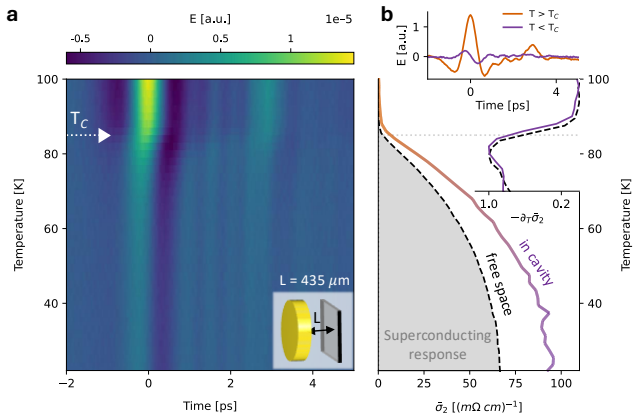
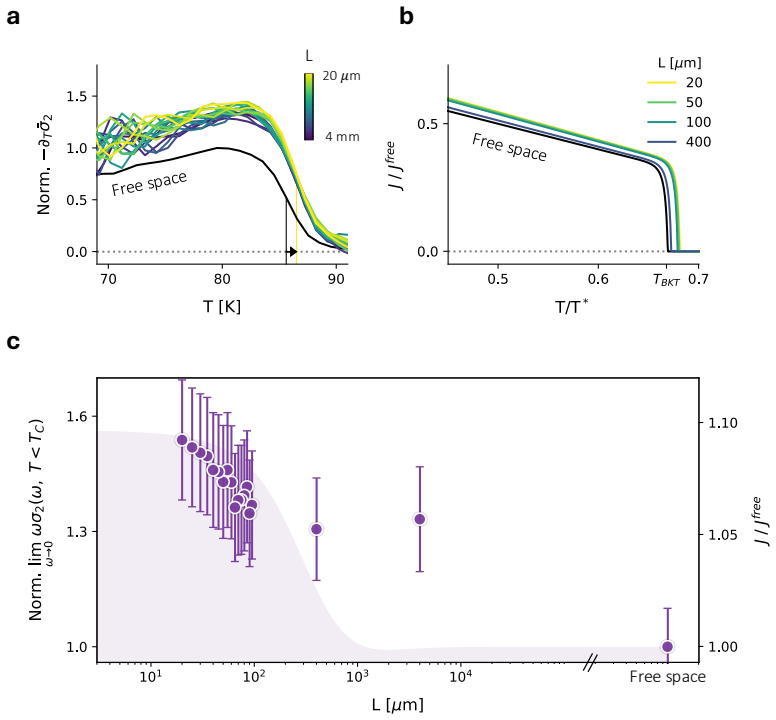
From temperature-dependent terahertz transmission measurements, the cavity enhances the superconducting response below the critical temperature, with an increase of the inferred superfluid weight. The effect becomes more pronounced at smaller cavity lengths and is accompanied by an upward shift of the superconducting onset temperature. Calculations based on a cavity-coupled model for phase-fluctuating superconductors capture these trends and support an interpretation in terms of cavity-enhanced phase stiffness.
What carries the argument
Cavity-coupled model for phase-fluctuating superconductors, which modifies the phase stiffness through the electromagnetic environment of the tunable terahertz cavity.
If this is right
- Cavity enhancement of superfluid weight increases as cavity length decreases.
- Superconducting onset temperature shifts upward in the presence of the cavity.
- Cavity engineering can stabilize coherence in systems limited by phase fluctuations.
- These changes arise from modification of the electromagnetic environment rather than changes to the material itself.
Where Pith is reading between the lines
- If the model holds, similar cavity effects could appear in other materials with strong phase fluctuations such as organic superconductors.
- Varying the cavity resonance frequency independently of length could test whether the enhancement depends on matching specific modes.
- Extending to higher doping or different cuprates might reveal how pairing strength interacts with the cavity effect.
Load-bearing premise
The changes in terahertz transmission are due only to the cavity-modified electromagnetic environment and not to any unintended alteration of the film or its interface with the mirror.
What would settle it
If repeating the terahertz measurements on the same film outside the cavity or with a different mirror shows the same increase in superfluid weight, or if the model fails to predict the dependence on cavity length.
Figures
read the original abstract
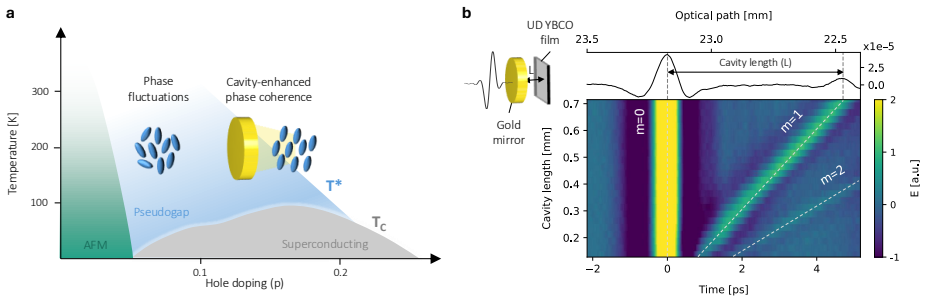
Superconductors carry electrical current without resistance when paired electrons condense into a coherent macroscopic quantum state. In underdoped cuprates, evidence suggests that pairing-related correlations and superconducting fluctuations can survive above the temperature at which global coherence is lost, pointing to phase fluctuations as a key limitation on superconductivity in this regime. Motivated by recent demonstrations of cavity-modified collective states in quantum materials, we investigate whether superconducting coherence can be stabilized by engineering the electromagnetic environment of the superconductor. We study an underdoped YBa$_2$Cu$_3$O$_{7-\delta}$ thin film in a tunable terahertz cavity formed with a semi-transparent gold mirror. From temperature-dependent terahertz transmission measurements, we find that the cavity enhances the superconducting response below the critical temperature, with an increase of the inferred superfluid weight. The effect becomes more pronounced at smaller cavity lengths and is accompanied by an upward shift of the superconducting onset temperature. Calculations based on a cavity-coupled model for phase-fluctuating superconductors capture these trends and support an interpretation in terms of cavity-enhanced phase stiffness. These results showcase the potential of cavity engineering for designing emergent functionalities in correlated systems.
Editorial analysis
A structured set of objections, weighed in public.
Referee Report
Summary. The manuscript reports terahertz transmission measurements on an underdoped YBa₂Cu₃O₇₋δ thin film inside a tunable cavity formed with a semi-transparent gold mirror. It claims that the cavity enhances the superconducting response below Tc, increasing the inferred superfluid weight (more strongly at smaller cavity lengths) and shifting the superconducting onset temperature upward. A cavity-coupled model for phase-fluctuating superconductors is stated to reproduce the trends and to support an interpretation in terms of cavity-enhanced phase stiffness.
Significance. If the central claims are substantiated, the result would be significant for the field of cavity quantum electrodynamics applied to correlated electron systems. It would provide evidence that electromagnetic boundary conditions can stabilize phase coherence in underdoped cuprates, where phase fluctuations are thought to limit global superconductivity, and would extend recent demonstrations of cavity-modified collective states to a technologically relevant material class.
major comments (3)
- [Abstract] Abstract and experimental description: the central claim that superfluid weight increases rests on an unstated conversion from measured transmission to superfluid density; no explicit formulas, error bars, raw spectra, or sample-characterization details are supplied, so the magnitude and statistical significance of the reported enhancement cannot be evaluated.
- [Abstract] Abstract and model-comparison paragraphs: the cavity-coupling strength is listed as a free parameter; without an independent determination (e.g., from geometry or a separate measurement) or a statement of how its value was fixed before comparing to data, the model agreement risks circularity and does not independently corroborate the phase-stiffness interpretation.
- [Abstract] Abstract (weakest-assumption paragraph): the attribution of all observed changes to cavity-modified electromagnetic boundary conditions assumes that mirror placement introduces no mechanical strain, interfacial layer, or oxygen-content alteration to the film; no post-assembly film-integrity checks or large-separation reference measurements are described, leaving open a plausible alternative explanation for the transmission changes.
Simulated Author's Rebuttal
We thank the referee for their careful reading and constructive comments, which have helped clarify several aspects of our work. We address each major comment below and indicate revisions made to the manuscript.
read point-by-point responses
-
Referee: [Abstract] Abstract and experimental description: the central claim that superfluid weight increases rests on an unstated conversion from measured transmission to superfluid density; no explicit formulas, error bars, raw spectra, or sample-characterization details are supplied, so the magnitude and statistical significance of the reported enhancement cannot be evaluated.
Authors: We agree that the data analysis procedure requires more explicit description. In the revised manuscript we have added a dedicated subsection in the Methods that states the thin-film transmission formulas (London-limit conductivity extraction followed by superfluid weight from the imaginary conductivity at the lowest measured frequency), reports the propagated uncertainties, and supplies representative raw spectra. Expanded sample characterization (thickness, oxygen content via c-axis lattice parameter, and transport Tc) is now included in the main text and SI. These changes allow direct evaluation of the enhancement magnitude and significance. revision: yes
-
Referee: [Abstract] Abstract and model-comparison paragraphs: the cavity-coupling strength is listed as a free parameter; without an independent determination (e.g., from geometry or a separate measurement) or a statement of how its value was fixed before comparing to data, the model agreement risks circularity and does not independently corroborate the phase-stiffness interpretation.
Authors: The coupling strength is calculated from the independently known cavity geometry (mirror separation, lateral dimensions) and the measured dielectric function of the YBCO film via standard electromagnetic boundary matching; it is not varied to fit the data. We have revised the model section to state this determination explicitly, give the formula, and confirm that the value was fixed prior to any comparison with the measured trends. The model then reproduces the length-dependent enhancement without further adjustment. revision: yes
-
Referee: [Abstract] Abstract (weakest-assumption paragraph): the attribution of all observed changes to cavity-modified electromagnetic boundary conditions assumes that mirror placement introduces no mechanical strain, interfacial layer, or oxygen-content alteration to the film; no post-assembly film-integrity checks or large-separation reference measurements are described, leaving open a plausible alternative explanation for the transmission changes.
Authors: The cavity is tunable, so the same film-mirror assembly is measured at multiple separations. The observed increase in superfluid weight scales with decreasing cavity length exactly as predicted by the phase-stiffness model, whereas strain or interfacial changes would be separation-independent. We have added a discussion paragraph that presents large-separation reference data (where the enhancement vanishes) and post-assembly optical and resistance checks confirming film integrity. These additions make the alternative explanations less plausible while preserving the cavity-effect interpretation. revision: partial
Circularity Check
No circularity: experimental inference and model comparison remain independent of fitted inputs or self-citation chains
full rationale
The paper reports temperature-dependent THz transmission data on an underdoped YBCO film inside a tunable cavity and infers an increase in superfluid weight from the measured transmission. The model is invoked only to show that a cavity-coupled phase-fluctuation framework reproduces the observed trends in superfluid weight and onset temperature; no equations, parameter tables, or self-citations are presented that would make the reported enhancement equivalent to a fit or a renamed input. Because the central claim rests on direct experimental observables rather than a derivation that reduces to its own assumptions by construction, the chain is self-contained.
Axiom & Free-Parameter Ledger
free parameters (1)
- cavity coupling strength
axioms (2)
- domain assumption Terahertz transmission spectra can be inverted to yield superfluid weight using standard superconducting response formulas.
- domain assumption Phase fluctuations are the dominant limitation on superconductivity in underdoped cuprates.
Reference graph
Works this paper leans on
-
[1]
Manipulating matter by strong coupling to vacuum fields.Science, 373:eabd0336, 7 2021
Francisco J Garcia-Vidal, Cristiano Ciuti, and Thomas W Ebbesen. Manipulating matter by strong coupling to vacuum fields.Science, 373:eabd0336, 7 2021. doi: 10.1126/science.abd0336. URLhttps://www.science.org/doi/10.1126/science.abd0336
-
[2]
Frank Schlawin, Dante M. Kennes, and Michael A. Sentef. Cavity quantum materials.Applied Physics Reviews, 9:11312, 3 2022. doi: 10.1063/5.0083825. URLhttps://aip.scitation. org/doi/10.1063/5.0083825
-
[3]
Bretscher, Lorenzo Graziotto, Marios H
Hope M. Bretscher, Lorenzo Graziotto, Marios H. Michael, Angela Montanaro, I-Te Lu, Andrey Grankin, James W. McIver, Jérôme Faist, Daniele Fausti, Martin Eckstein, Michael Ruggenthaler, Angel Rubio, Dmitri N. Basov, Mohammad Hafezi, Martin Claassen, Dante M. Kennes, and Michael A. Sentef. Fluctuation engineering in cavity quantum materials. 4 2026. URLhtt...
Pith/arXiv arXiv 2026
-
[4]
Yannis Laplace, Stephanie Fernandez-Pena, Stefano Gariglio, Jean-Marc Triscone, and Andrea Cavalleri. Proposed cavity Josephson plasmonics with complex-oxide heterostructures.Physical Review B, 93:075152, 2 2016. ISSN 2469-9950. doi: 10.1103/PhysRevB.93.075152
-
[5]
Sentef, Michael Ruggenthaler, and Angel Rubio
Michael A. Sentef, Michael Ruggenthaler, and Angel Rubio. Cavity quantum-electrodynamical polaritonically enhanced electron-phonon coupling and its influence on superconductivity. Science Advances, 4:eaau6969, 11 2018. doi: 10/gfq32g
2018
-
[6]
Cavity-mediated electron-photon superconductivity.Physical Review Letters, 122:133602, 4 2019
Frank Schlawin, Andrea Cavalleri, and Dieter Jaksch. Cavity-mediated electron-photon superconductivity.Physical Review Letters, 122:133602, 4 2019. doi: 10.1103/physrevlett.122. 133602
-
[7]
Jonathan B. Curtis, Zachary M. Raines, Andrew A. Allocca, Mohammad Hafezi, and Victor M. Galitski. Cavity quantum Eliashberg enhancement of superconductivity.Physical review letters, 122:167002, 2019. doi: 10.1103/PhysRevLett.122.167002
-
[8]
Photoin- duced electron pairing in a driven cavity.Physical Review Letters, 125:053602, 7 2020
Hongmin Gao, Frank Schlawin, Michele Buzzi, Andrea Cavalleri, and Dieter Jaksch. Photoin- duced electron pairing in a driven cavity.Physical Review Letters, 125:053602, 7 2020. ISSN 0031-9007. doi: 10.1103/PhysRevLett.125.053602
-
[9]
Yuto Ashida, Ataç İmamoğlu, Jérôme Faist, Dieter Jaksch, Andrea Cavalleri, and Eugene Demler. Quantum electrodynamic control of matter: Cavity-enhanced ferroelectric phase transition.Physical Review X, 10:41027, 2020. doi: 10.1103/PhysRevX.10.041027. 9
-
[10]
Simone Latini, Dongbin Shin, Shunsuke A Sato, Christian Schäfer, Umberto De Giovannini, Hannes Hübener, and Angel Rubio. The ferroelectric photo ground state of SrTiO3: Cavity materials engineering.Proceedings of the National Academy of Sciences of the United States of America, 118:e2105618118, 2021. ISSN 0027-8424. doi: 10.1073/pnas.2105618118
-
[11]
Cavity-induced quantum spin liquids.Nature Communications, 12:5901, 2021
Alessio Chiocchetta, Dominik Kiese, Carl Philipp Zelle, Francesco Piazza, and Sebastian Diehl. Cavity-induced quantum spin liquids.Nature Communications, 12:5901, 2021. doi: 10.1038/s41467-021-26076-3
-
[12]
Strongly correlated electron–photon systems.Nature, 606:41–48, 6 2022
Jacqueline Bloch, Andrea Cavalleri, Victor Galitski, Mohammad Hafezi, and Angel Rubio. Strongly correlated electron–photon systems.Nature, 606:41–48, 6 2022. ISSN 0028-0836. doi: 10.1038/s41586-022-04726-w
-
[13]
Controlling topo- 18 logical phases of matter with quantum light,
Olesia Dmytruk and Marco Schirò. Controlling topological phases of matter with quantum light. Communications Physics, 5:271, 11 2022. ISSN 2399-3650. doi: 10.1038/s42005-022-01049-0
-
[14]
Emil Viñas Boström, Adithya Sriram, Martin Claassen, and Angel Rubio. Controlling the magnetic state of the proximate quantum spin liquidα-RuCl3 with an optical cavity.npj Computational Materials, 9:1–10, 10 2023. ISSN 2057-3960. doi: 10.1038/s41524-023-01158-6. URLhttps://www.nature.com/articles/s41524-023-01158-6
-
[15]
I-Te Lu, Dongbin Shin, Mark Kamper Svendsen, Hannes Hübener, Umberto De Giovannini, Simone Latini, Michael Ruggenthaler, and Angel Rubio. Cavity-enhanced superconductivity in MgB2 from first-principles quantum electrodynamics (qedft).Proceedings of the National Academy of Sciences, 121, 12 2024. ISSN 0027-8424. doi: 10.1073/pnas.2415061121
-
[16]
Gian Marcello Andolina, Antonella De Pasquale, Francesco Maria Dimitri Pellegrino, Iacopo Torre, Frank H. L. Koppens, and Marco Polini. Amperean superconductivity cannot be induced by deep subwavelength cavities in a two-dimensional material.Physical Review B, 109:104513, 3 2024. ISSN 2469-9950. doi: 10.1103/PhysRevB.109.104513
-
[17]
Controlling radiative heat flow through cavity electrodynamics.Phys
Francesca Fassioli, Jérôme Faist, Martin Eckstein, and Daniele Fausti. Controlling radiative heat flow through cavity electrodynamics.Phys. Rev. B, 111:165425, 4 2025. doi: 10.1103/ PhysRevB.111.165425. URLhttps://link.aps.org/doi/10.1103/PhysRevB.111.165425
-
[18]
Cavity engineering of solid-state materials without external driving.Advances in Optics and Photonics, 17:441, 6 2025
I-Te Lu, Dongbin Shin, Mark Kamper Svendsen, Simone Latini, Hannes Hübener, Michael Ruggenthaler, and Angel Rubio. Cavity engineering of solid-state materials without external driving.Advances in Optics and Photonics, 17:441, 6 2025. ISSN 1943-8206. doi: 10.1364/ AOP.544138
2025
-
[19]
Rafael Flores-Calderón, Md Mursalin Islam, Michele Pini, and Francesco Piazza. Nonthermal electron-photon steady states in open cavity quantum materials.Physical Review Research, 7: 13073, 2025. doi: 10.1103/PhysRevResearch.7.013073
-
[20]
Cavity- induced Eliashberg effect: superconductivity vs charge density wave
Md Mursalin Islam, Michele Pini, Rafael Flores-Calderón, and Francesco Piazza. Cavity- induced Eliashberg effect: superconductivity vs charge density wave. 9 2025. URLhttp: //arxiv.org/abs/2509.07865
arXiv 2025
-
[21]
Kozin, Even Thingstad, Daniel Loss, and Jelena Klinovaja
Valerii K. Kozin, Even Thingstad, Daniel Loss, and Jelena Klinovaja. Cavity-enhanced superconductivity via band engineering.Physical Review B, 111:035410, 1 2025. ISSN 2469-
2025
-
[22]
doi: 10.1103/PhysRevB.111.035410
-
[24]
Anoop Thomas, Eloise Devaux, Kalaivanan Nagarajan, Guillaume Rogez, Marcus Seidel, Fanny Richard, Cyriaque Genet, Marc Drillon, and Thomas W Ebbesen. Large enhancement of ferromagnetism under a collective strong coupling of YBCO nanoparticles.Nano letters, 21: 4365–4370, 2021. doi: 10.1021/acs.nanolett.1c00973
-
[25]
Felice Appugliese, Josefine Enkner, Gian Lorenzo Paravicini-Bagliani, Mattias Beck, Christian Reichl, Werner Wegscheider, Giacomo Scalari, Cristiano Ciuti, and Jérôme Faist. Breakdown of topological protection by cavity vacuum fields in the integer quantum Hall effect.Science, 375:1030–1034, 2022. doi: 10.1126/science.abl5818
-
[26]
Giacomo Jarc, Shahla Yasmin Mathengattil, Angela Montanaro, Francesca Giusti, Enrico Maria Rigoni, Rudi Sergo, Francesca Fassioli, Stephan Winnerl, Simone Dal Zilio, Dragan Mihailovic, Peter Prelovšek, Martin Eckstein, and Daniele Fausti. Cavity-mediated thermal control of metal-to-insulator transition in 1T-TaS2.Nature, 622:487–492, 10 2023. ISSN 0028-08...
-
[27]
Giacomo Jarc, Shahla Yasmin Mathengattil, Angela Montanaro, Enrico Maria Rigoni, Si- mone Dal Zilio, and Daniele Fausti. Multimode vibrational coupling across the insulator-to- metal transition in 1T-TaS2 in thz cavities.The Journal of Chemical Physics, 161, 2024. doi: 10.1063/5.0231533
-
[28]
Exploring superconductivity under strong coupling with the vacuum electromagnetic field
Anoop Thomas, Eloïse Devaux, Kalaivanan Nagarajan, Thibault Chervy, Marcus Seidel, Guillaume Rogez, Jérôme Robert, Marc Drillon, Ting-Ting Ruan, Sören Schlittenhardt, et al. Exploring superconductivity under strong coupling with the vacuum electromagnetic field. The Journal of Chemical Physics, 162(13), 2025
2025
-
[29]
Cavity electrodynamics of van der Waals heterostructures.Nature Physics, 15:1926––1933,
Gunda Kipp, Hope M Bretscher, Benedikt Schulte, Dorothee Herrmann, Kateryna Kusyak, Matthew W Day, Sivasruthi Kesavan, Toru Matsuyama, Xinyu Li, Sara Maria Langner, et al. Cavity electrodynamics of van der Waals heterostructures.Nature Physics, 15:1926––1933,
1926
-
[30]
doi: 10.1038/s41567-025-03064-8
-
[31]
Tunable vacuum-field control of fractional and integer quantum Hall phases.Nature, 641:884, 2025
Josefine Enkner, Lorenzo Graziotto, Dalin Boriçi, Felice Appugliese, Christian Reichl, Giacomo Scalari, Nicolas Regnault, Werner Wegscheider, Cristiano Ciuti, and Jérôme Faist. Tunable vacuum-field control of fractional and integer quantum Hall phases.Nature, 641:884, 2025. doi: 10.1038/s41586-025-08894-3
-
[32]
Curtis, Ethan Koskas, Christian Reichl, Werner Wegscheider, Giacomo Scalari, Eugene Demler, and Jérôme Faist
Lorenzo Graziotto, Josefine Enkner, Sambuddha Chattopadhyay, Jonathan B. Curtis, Ethan Koskas, Christian Reichl, Werner Wegscheider, Giacomo Scalari, Eugene Demler, and Jérôme Faist. Cavity quantum electrodynamics control of quantum Hall stripes.Nature Physics, 5
-
[33]
doi: 10.1038/s41567-026-03287-3
ISSN 1745-2473. doi: 10.1038/s41567-026-03287-3
-
[34]
Adlong, Martin Kroner, Igor Khanonkin, Giacomo Scalari, Jérôme Faist, Atac İmamoğlu, and Tobia F
Felix Helmrich, Haydn S. Adlong, Martin Kroner, Igor Khanonkin, Giacomo Scalari, Jérôme Faist, Atac İmamoğlu, and Tobia F. Nova. Cavity-driven attractive interactions in quantum materials.Nature, 654:361–368, 6 2026. ISSN 0028-0836. doi: 10.1038/s41586-026-10609-1
-
[35]
Webb, Shuai Zhang, Jikai Xu, Dihao Sun, Brian S
Itai Keren, Tatiana A. Webb, Shuai Zhang, Jikai Xu, Dihao Sun, Brian S. Y. Kim, Dongbin Shin, Songtian S. Zhang, Junhe Zhang, Giancarlo Pereira, Juntao Yao, Takuya Okugawa, Marios H. Michael, Emil Viñas Boström, James H. Edgar, Stuart Wolf, Matthew Julian, Rohit P. Prasankumar, Kazuya Miyagawa, Kazushi Kanoda, Genda Gu, Matthew Cothrine, David Mandrus, Mi...
-
[36]
Elijah Kritzell, Jacques Doumani, Dasom Kim, Fuyang Tay, Angel Rubio, and Junichiro Kono
Hongjing Xu, Andrey Baydin, Qinyan Yi, I-Te Lu, Ningxu Zhu, T. Elijah Kritzell, Jacques Doumani, Dasom Kim, Fuyang Tay, Angel Rubio, and Junichiro Kono. Vacuum-dressed 11 superconductivity in nbn observed in a high-q terahertz cavity. 1 2026. URLhttp://arxiv. org/abs/2601.08191
arXiv 2026
-
[37]
Emery and Steven A
Victor J. Emery and Steven A. Kivelson. Importance of phase fluctuations in superconductors with small superfluid density.Nature, 374:434–437, 3 1995. ISSN 0028-0836. doi: 10.1038/ 374434a0
1995
-
[38]
Lee, Naoto Nagaosa, and Xiao-Gang Wen
Patrick A. Lee, Naoto Nagaosa, and Xiao-Gang Wen. Doping a mott insulator: Physics of high-temperature superconductivity.Reviews of Modern Physics, 78:17–85, 1 2006. ISSN 0034-6861. doi: 10.1103/RevModPhys.78.17
-
[39]
Yayu Wang, Lu Li, and N. P. Ong. Nernst effect in high-Tc superconductors.Physical Review B, 73:024510, 1 2006. ISSN 1098-0121. doi: 10.1103/PhysRevB.73.024510
-
[40]
A. G. Loeser, Z.-X. Shen, D. S. Dessau, D. S. Marshall, C. H. Park, P. Fournier, and A. Kapitulnik. Excitation gap in the normal state of underdoped Bi2Sr2CaCu2O8+δ.Science, 273:325–329, 7 1996. ISSN 0036-8075. doi: 10.1126/science.273.5273.325
-
[41]
M. Shi, A. Bendounan, E. Razzoli, S. Rosenkranz, M. R. Norman, J. C. Campuzano, J. Chang, M. Månsson, Y. Sassa, T. Claesson, O. Tjernberg, L. Patthey, N. Momono, M. Oda, M. Ido, S. Guerrero, C. Mudry, and J. Mesot. Spectroscopic evidence for preformed cooper pairs in the pseudogap phase of cuprates.EPL (Europhysics Letters), 88:27008, 10 2009. ISSN 0295-5...
-
[42]
Alex Levchenko, M. R. Norman, and A. A. Varlamov. Nernst effect from fluctuating pairs in the pseudogap phase of the cuprates.Physical Review B, 83:020506, 1 2011. ISSN 1098-0121. doi: 10.1103/PhysRevB.83.020506
-
[43]
F. Boschini, E. H. da Silva Neto, E. Razzoli, M. Zonno, S. Peli, R. P. Day, M. Michiardi, M. Schneider, B. Zwartsenberg, P. Nigge, R. D. Zhong, J. Schneeloch, G. D. Gu, S. Zhdanovich, A. K. Mills, G. Levy, D. J. Jones, C. Giannetti, and A. Damascelli. Collapse of superconductivity in cuprates via ultrafast quenching of phase coherence.Nature Materials, 17...
-
[44]
Bastiaans, Damianos Chatzopoulos, Jian-Feng Ge, Doohee Cho, Willem O
Koen M. Bastiaans, Damianos Chatzopoulos, Jian-Feng Ge, Doohee Cho, Willem O. Tromp, Jan M. van Ruitenbeek, Mark H. Fischer, Pieter J. de Visser, David J. Thoen, Eduard F. C. Driessen, Teunis M. Klapwijk, and Milan P. Allan. Direct evidence for cooper pairing without a spectral gap in a disordered superconductor aboveTc.Science, 374:608–611, 10 2021. ISSN...
-
[45]
Jiasen Niu, Maialen Ortego Larrazabal, Thomas Gozlinski, Yudai Sato, Koen M Bastiaans, TjerkBenschop, Jian-FengGe, YaroslavMBlanter, GendaGu, IngmarSwart, etal. Equivalence of pseudogap and pairing energy in a cuprate high-temperature superconductor.arXiv preprint arXiv:2409.15928, 2024
arXiv 2024
-
[46]
J. Hammer, M. Aprili, and I. Petković. Microwave cooling of josephson plasma oscillations. Physical Review Letters, 107:017001, 6 2011. ISSN 0031-9007. doi: 10.1103/PhysRevLett.107. 017001
-
[47]
Ahana Chakraborty and Francesco Piazza. Long-range photon fluctuations enhance photon- mediated electron pairing and superconductivity.Physical Review Letters, 127:177002, 10 2021. ISSN 0031-9007. doi: 10.1103/PhysRevLett.127.177002
-
[48]
Dmitri N. Basov and Thomas Timusk. Electrodynamics of high-Tc superconductors.Reviews of Modern Physics, 77:721–779, 8 2005. ISSN 0034-6861. doi: 10.1103/RevModPhys.77.721. 12
-
[49]
J. Orenstein, J. Corson, Seongshik Oh, and J. N. Eckstein. Superconducting fluctuations in Bi2Sr2Ca1−xDyxCu2O8+δas seen by terahertz spectroscopy.Annalen der Physik (Leipzig), 15: 596–605, 7 2006. ISSN 00033804. doi: 10.1002/andp.200510202
-
[50]
M. Tinkham. Energy gap interpretation of experiments on infrared transmission through superconducting films.Physical Review, 104:845–846, 11 1956. ISSN 0031-899X. doi: 10.1103/ PhysRev.104.845
1956
-
[51]
The random walk’s guide to anomalous diffusion: A fractional dynamics approach
Vadim M. Loktev, Rachel M. Quick, and Sergei G. Sharapov. Phase fluctuations and pseudogap phenomena.Physics Reports, 349:1–123, 7 2001. ISSN 03701573. doi: 10.1016/S0370-1573(00) 00114-9
-
[53]
Destruction of long-range order in one-dimensional and two-dimensional systems having a continuous symmetry group i
V Berezinskii. Destruction of long-range order in one-dimensional and two-dimensional systems having a continuous symmetry group i. classical systems.Sov. Phys. JETP, 32:493–500, 1971
1971
-
[54]
J M Kosterlitz and D J Thouless. Ordering, metastability and phase transitions in two- dimensional systems.Journal of Physics C: Solid State Physics, 6:1181–1203, 4 1973. ISSN 0022-3719. doi: 10.1088/0022-3719/6/7/010
-
[55]
Petter Minnhagen. The two-dimensional coulomb gas, vortex unbinding, and superfluid- superconducting films.Reviews of Modern Physics, 59:1001–1066, 10 1987. ISSN 0034-6861. doi: 10.1103/RevModPhys.59.1001
-
[56]
L. Benfatto, A. Toschi, and S. Caprara. Low-energy phase-only action in a superconductor: A comparison with theXYmodel.Physical Review B, 69:184510, 5 2004. ISSN 1098-0121. doi: 10.1103/PhysRevB.69.184510
-
[57]
J. Corson, R. Mallozzi, J. Orenstein, J. N. Eckstein, and I. Bozovic. Vanishing of phase coherence in underdoped Bi2Sr2CaCu2O8+x.Nature, 398:221–223, 3 1999. ISSN 0028-0836. doi: 10.1038/18402
-
[58]
Jie Yong, M. J. Hinton, A. McCray, M. Randeria, M. Naamneh, A. Kanigel, and T. R. Lemberger. Evidence of two-dimensional quantum critical behavior in the superfluid density of extremely underdoped Bi2Sr2CaCu2O8+δ.Physical Review B, 85:180507, 5 2012. ISSN 1098-0121. doi: 10.1103/PhysRevB.85.180507
-
[59]
Giacomo Jarc, Shahla Yasmin Mathengattil, Francesca Giusti, Maurizio Barnaba, Abhishek Singh, Angela Montanaro, Filippo Glerean, Enrico Maria Rigoni, Simone Dal Zilio, Stephan Winnerl, et al. Tunable cryogenic terahertz cavity for strong light–matter coupling in complex materials.Review of Scientific Instruments, 93, 2022. doi: 10.1063/5.0080045. 13 Suppl...
-
[60]
Cambridge University Press, Cambridge, 7 edition, 1999
Max Born and Emil Wolf.Principles of Optics: Electromagnetic Theory of Propagation, Interference and Diffraction of Light. Cambridge University Press, Cambridge, 7 edition, 1999. doi: 10.1017/CBO9781139644181
-
[61]
M. Tinkham. Energy Gap Interpretation of Experiments on Infrared Transmission through Superconducting Films.Physical Review, 104(3):845–846, November 1956. doi: 10.1103/ PhysRev.104.845
1956
-
[62]
Cambridge University Press, Cambridge, 2002
Martin Dressel and George Grüner.Electrodynamics of Solids: Optical Properties of Electrons in Matter. Cambridge University Press, Cambridge, 2002. ISBN 978-0-521-59253-6. doi: 10.1017/CBO9780511606168
-
[63]
M. A. Ordal, Robert J. Bell, R. W. Alexander, L. L. Long, and M. R. Querry. Optical properties of fourteen metals in the infrared and far infrared: Al, Co, Cu, Au, Fe, Pb, Mo, Ni, Pd, Pt, Ag, Ti, V, and W.Applied Optics, 24(24):4493–4499, December 1985. ISSN 2155-3165. doi: 10.1364/AO.24.004493
-
[64]
M. Walther, D. G. Cooke, C. Sherstan, M. Hajar, M. R. Freeman, and F. A. Hegmann. Terahertz conductivity of thin gold films at the metal-insulator percolation transition.Physical Review B, 76(12):125408, September 2007. doi: 10.1103/PhysRevB.76.125408
-
[65]
A.Pimenov, A.V.Pronin, B.Schey, B.Stritzker, andA.Loidl. Submillimeter-waveconductivity of YBa2Cu3O7-δfilm.Physica B: Condensed Matter, 244:49–53, January 1998. ISSN 0921-4526. doi: 10.1016/S0921-4526(97)00460-2
-
[66]
Terahertz transmission through a gold mirror or electrode.Materials, 17(16): 3942, 2024
Fabio Novelli. Terahertz transmission through a gold mirror or electrode.Materials, 17(16): 3942, 2024
2024
-
[67]
Temperature-dependent refractive index of quartz at terahertz frequencies.Journal of Infrared, Millimeter, and Terahertz Waves, 39(12):1236–1248, 2018
Christopher L Davies, Jay B Patel, Chelsea Q Xia, Laura M Herz, and Michael B Johnston. Temperature-dependent refractive index of quartz at terahertz frequencies.Journal of Infrared, Millimeter, and Terahertz Waves, 39(12):1236–1248, 2018
2018
-
[68]
Nair, Siew Ann Cheong, Tom Wu, C
Xingquan Zou, Mi He, Daniel Springer, Dongwook Lee, Saritha K. Nair, Siew Ann Cheong, Tom Wu, C. Panagopoulos, D. Talbayev, and Elbert E. M. Chia. Effect of annealing on the temperature-dependent dielectric properties of LaAlO3 at terahertz frequencies.AIP Advances, 2(1):012120, January 2012. ISSN 2158-3226. doi: 10.1063/1.3679725
-
[69]
J. Lloyd-Hughes, S. P. P. Jones, E. Castro-Camus, K. I. Doig, and J. L. MacManus-Driscoll. Modifying the polarization state of terahertz radiation using anisotropic twin-domains in LaAlO3.Optics Letters, 39(5):1121–1124, March 2014. ISSN 1539-4794. doi: 10.1364/OL.39. 001121
-
[70]
Time-domain terahertz spectroscopy of (100) mgo and (100) laalo3 substrates.Acta Physica Sinica, 53(6):1772–1776, 2004
Ying Hu, CL Zhang, JL Shen, and XC Zhang. Time-domain terahertz spectroscopy of (100) mgo and (100) laalo3 substrates.Acta Physica Sinica, 53(6):1772–1776, 2004
2004
-
[71]
Cavity-mediated thermal control of metal-to-insulator transition in 1t-tas2.Nature, 622 (7983):487–492, 2023
Giacomo Jarc, Shahla Yasmin Mathengattil, Angela Montanaro, Francesca Giusti, Enrico Maria Rigoni, Rudi Sergo, Francesca Fassioli, Stephan Winnerl, Simone Dal Zilio, Dragan Mihailovic, et al. Cavity-mediated thermal control of metal-to-insulator transition in 1t-tas2.Nature, 622 (7983):487–492, 2023
2023
-
[72]
Anomalous relaxation dynamics of nonequilibrium normal state in yba 2 cu 3 o 7-δbelow t c.Physical Review B, 113(1):014440, 2026
Jinzhong Zhang, Qingming Huang, Zhangqiang Yang, Zhiyuan Sun, and Ye Yang. Anomalous relaxation dynamics of nonequilibrium normal state in yba 2 cu 3 o 7-δbelow t c.Physical Review B, 113(1):014440, 2026
2026
-
[73]
Vanishing of phase coherence in underdoped Bi2Sr2CaCu2O8+δ.Nature, 398(6724):221–223, 1999
John Corson, R Mallozzi, J Orenstein, James N Eckstein, and I Bozovic. Vanishing of phase coherence in underdoped Bi2Sr2CaCu2O8+δ.Nature, 398(6724):221–223, 1999. 37
1999
-
[74]
A. Dubroka, M. Rössle, K. W. Kim, V. K. Malik, D. Munzar, D. N. Basov, A. A. Schafgans, S. J. Moon, C. T. Lin, D. Haug, V. Hinkov, B. Keimer, Th. Wolf, J. G. Storey, J. L. Tallon, and C. Bernhard. Evidence of a Precursor Superconducting Phase at Temperatures as High as 180 K inRBa2Cu3O7−δ(R =Y ,Gd,Eu )Superconducting Crystals from Infrared Spectroscopy.Ph...
-
[75]
Dynamical interplay between superconductivity and pseudogap in cuprates as revealed by terahertz third-harmonic generation spectroscopy.Science Advances, 10(6):eadg9211, 2024
Jiayu Yuan, Liyu Shi, Li Yue, Bohan Li, Zixiao Wang, Shuxiang Xu, Tiequan Xu, Yue Wang, Zizhao Gan, Fucong Chen, et al. Dynamical interplay between superconductivity and pseudogap in cuprates as revealed by terahertz third-harmonic generation spectroscopy.Science Advances, 10(6):eadg9211, 2024
2024
-
[76]
Yayu Wang, Lu Li, M. J. Naughton, G. D. Gu, S. Uchida, and N. P. Ong. Field-enhanced diamagnetism in the pseudogap state of the cupratebi2sr2Cacu2o8+δsuperconductor in an intense magnetic field.Phys. Rev. Lett., 95:247002, Dec 2005. doi: 10.1103/PhysRevLett.95. 247002. URLhttps://link.aps.org/doi/10.1103/PhysRevLett.95.247002
-
[77]
Lu Li, Yayu Wang, Seiki Komiya, Shimpei Ono, Yoichi Ando, G. D. Gu, and N. P. Ong. Diamagnetism and cooper pairing aboveTc in cuprates.Phys. Rev. B, 81:054510, Feb 2010. doi: 10.1103/PhysRevB.81.054510. URL https://link.aps.org/doi/10.1103/PhysRevB. 81.054510
-
[78]
Vortex-like excitations and the onset of superconducting phase fluctuation in underdoped la2-x sr x cuo4.Nature, 406(6795): 486–488, 2000
ZA Xu, NP Ong, Yayu Wang, T Kakeshita, and S-i Uchida. Vortex-like excitations and the onset of superconducting phase fluctuation in underdoped la2-x sr x cuo4.Nature, 406(6795): 486–488, 2000
2000
-
[79]
Nernst effect in high-t c superconductors.Physical Review B—Condensed Matter and Materials Physics, 73(2):024510, 2006
Yayu Wang, Lu Li, and NP Ong. Nernst effect in high-t c superconductors.Physical Review B—Condensed Matter and Materials Physics, 73(2):024510, 2006
2006
-
[80]
Broken rotational symmetry in the pseudogap phase of a high-t c superconductor.Nature, 463(7280):519–522, 2010
R Daou, J Chang, David LeBoeuf, Olivier Cyr-Choiniere, Francis Laliberté, Nicolas Doiron- Leyraud, BJ Ramshaw, Ruixing Liang, DA Bonn, WN Hardy, et al. Broken rotational symmetry in the pseudogap phase of a high-t c superconductor.Nature, 463(7280):519–522, 2010
2010
-
[81]
O. Cyr-Choinière, R. Daou, F. Laliberté, C. Collignon, S. Badoux, D. LeBoeuf, J. Chang, B. J. Ramshaw, D. A. Bonn, W. N. Hardy, R. Liang, J.-Q. Yan, J.-G. Cheng, J.-S. Zhou, J. B. Goodenough, S. Pyon, T. Takayama, H. Takagi, N. Doiron-Leyraud, and Louis Taillefer. Pseudogap temperatureT∗of cuprate superconductors from the nernst effect.Phys. Rev. B, 97:06...
-
[82]
Vortex entropy and superconducting fluctuations in ultrathin underdoped Bi2Sr2CaCu2O8+x superconductor
Shuxu Hu, Jiabin Qiao, Genda Gu, Qi-Kun Xue, and Ding Zhang. Vortex entropy and superconducting fluctuations in ultrathin underdoped Bi2Sr2CaCu2O8+x superconductor. Nature Communications, 15(1):4818, 2024
2024
discussion (0)
Sign in with ORCID, Apple, or X to comment. Anyone can read and Pith papers without signing in.