REVIEW 2 major objections 2 minor 39 references
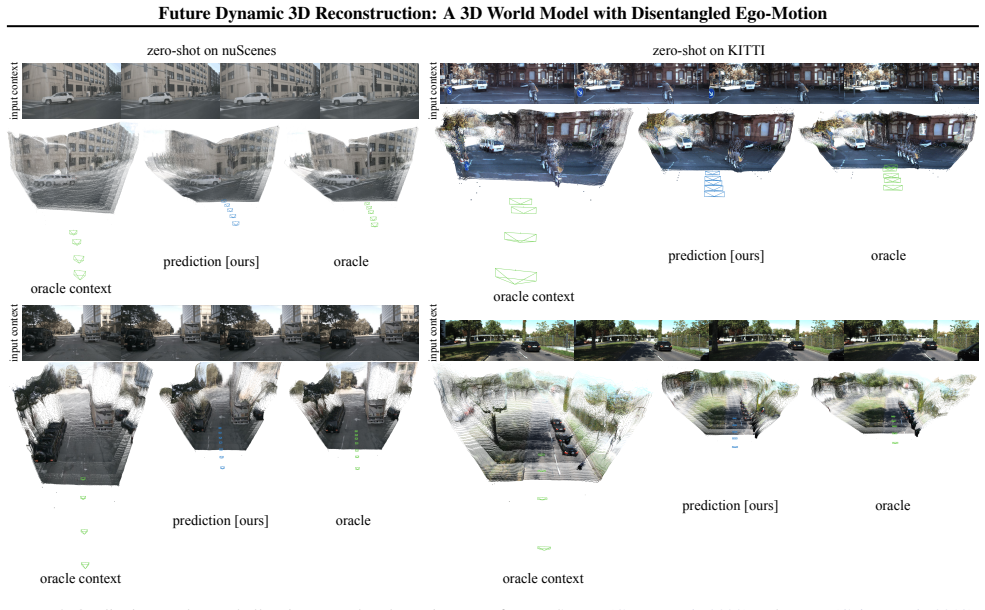
FR3D decouples scene evolution from ego-motion to predict consistent future 3D reconstructions.
Reviewed by Pith at T0; open to challenge. T0 means a machine referee read the full paper against a public rubric. the ladder, T0–T4 →
T0 review · grok-4.3
2026-06-27 01:11 UTC pith:IUZGUN2Y
load-bearing objection FR3D claims 3D disentanglement of ego-motion fixes geometric consistency in future prediction, but the abstract supplies no evidence that the distillation step actually delivers it. the 2 major comments →
Future Dynamic 3D Reconstruction: A 3D World Model with Disentangled Ego-Motion
The pith
A machine-rendered reading of the paper's core claim, the machinery that carries it, and where it could break.
Core claim
FR3D predicts a persistent 3D latent representation for future dynamic 3D reconstruction by explicitly decoupling the 3D evolution of the scene from the agent's trajectory and treating the inferred ego-motion as a latent proxy for action. This disentanglement resolves ambiguities between self-motion and world-motion to ensure geometric consistency into the future, with a teacher-student distillation strategy leveraging off-the-shelf foundation models for robust zero-shot generalization.
What carries the argument
The explicit decoupling of 3D scene evolution from agent trajectory in a persistent 3D latent representation, where ego-motion serves as a latent proxy for action.
Load-bearing premise
The assumption that a teacher-student distillation strategy leveraging off-the-shelf foundation models will produce robust zero-shot generalization for the 3D latent predictions across unseen environments and long time horizons.
What would settle it
Experiments on unseen environments showing morphing objects or loss of geometric consistency in predictions beyond short time horizons would falsify the effectiveness of the disentanglement and distillation approach.
If this is right
- Future dynamic 3D reconstruction remains geometrically consistent even 2 seconds ahead from monocular observations.
- Physical inconsistencies such as morphing or vanishing objects are avoided over long time horizons.
- Robust zero-shot generalization is achieved across multiple datasets and unseen environments.
Where Pith is reading between the lines
- This disentanglement could allow better integration with planning algorithms that reason in 3D space rather than 2D images.
- If the distillation works as claimed, similar techniques might improve other predictive models in robotics.
Editorial analysis
A structured set of objections, weighed in public.
Referee Report
Summary. The paper introduces FR3D, a 3D world model for future dynamic 3D reconstruction from monocular observations. It explicitly decouples 3D scene evolution from the agent's trajectory by treating inferred ego-motion as a latent proxy for action, claiming this resolves self-motion/world-motion ambiguities and ensures geometric consistency over time. A teacher-student distillation strategy leverages off-the-shelf foundation models to inject spatial common sense for robust zero-shot generalization. Experiments are reported to demonstrate strong performance across multiple datasets even 2 seconds into the future.
Significance. If the disentanglement and distillation produce the claimed geometric consistency and generalization, the work would represent a meaningful step beyond 2D generative world models by addressing physical inconsistencies such as object morphing. Treating ego-motion as an explicit latent action proxy offers a clean architectural separation that could benefit downstream planning in robotics and autonomous systems.
major comments (2)
- [§3] §3 (Method), distillation paragraph: the central claim that the teacher-student strategy yields robust zero-shot 3D latent generalization across unseen environments rests on the transfer of 3D spatial priors; however, no ablation isolates whether the student learns 3D geometry versus 2D image features, and no experiments vary camera intrinsics or scene dynamics outside the training distribution.
- [§4] §4 (Experiments), long-horizon results: performance is shown up to 2 s, but without quantitative comparison to strong baselines that also incorporate foundation-model priors, it remains unclear whether the reported geometric consistency stems from the disentanglement or from the distillation component alone.
minor comments (2)
- [Abstract] The abstract states 'extensive experiments' without naming the datasets or metrics; adding these details would improve readability.
- [§2] Notation for the 3D latent representation and ego-motion latent is introduced without an explicit equation reference in the early sections, making the disentanglement description harder to follow on first reading.
Simulated Author's Rebuttal
We thank the referee for the constructive feedback. We address each major comment point by point below.
read point-by-point responses
-
Referee: [§3] §3 (Method), distillation paragraph: the central claim that the teacher-student strategy yields robust zero-shot 3D latent generalization across unseen environments rests on the transfer of 3D spatial priors; however, no ablation isolates whether the student learns 3D geometry versus 2D image features, and no experiments vary camera intrinsics or scene dynamics outside the training distribution.
Authors: We agree that the manuscript lacks an explicit ablation isolating 3D geometry transfer from 2D feature learning during distillation. In the revision we will add this ablation by comparing the full model against a 2D-feature-only distillation variant and reporting the resulting 3D reconstruction metrics. We also acknowledge the absence of controlled tests with varied camera intrinsics or out-of-distribution dynamics; we will include such experiments on modified intrinsics and additional scene variations to strengthen the generalization claim. revision: yes
-
Referee: [§4] §4 (Experiments), long-horizon results: performance is shown up to 2 s, but without quantitative comparison to strong baselines that also incorporate foundation-model priors, it remains unclear whether the reported geometric consistency stems from the disentanglement or from the distillation component alone.
Authors: We accept that direct quantitative comparisons against other foundation-model-augmented baselines are needed to isolate the disentanglement contribution. The revised manuscript will add such comparisons to relevant methods that also leverage foundation priors, allowing clearer attribution of geometric consistency to the explicit ego-motion separation rather than distillation alone. revision: yes
Circularity Check
No circularity detected; no derivation chain or equations present
full rationale
The paper proposes FR3D as an architectural world model that decouples 3D scene evolution from ego-motion (treated as latent action proxy) and applies teacher-student distillation from off-the-shelf foundation models. The provided abstract and description contain no equations, fitted parameters, uniqueness theorems, or derivation steps that could be reduced to inputs by construction. Claims of resolving motion ambiguities and ensuring future geometric consistency are asserted as direct consequences of the proposed disentanglement and distillation strategy rather than derived via self-referential definitions, self-citations, or renamed empirical patterns. No load-bearing self-citation chains or ansatzes smuggled via prior work appear in the text. The result is therefore self-contained as a model proposal without circular reductions.
Axiom & Free-Parameter Ledger
axioms (1)
- domain assumption Off-the-shelf foundation models contain transferable spatial common sense usable via distillation for 3D scene prediction.
read the original abstract
Forecasting the evolution of dynamic environments is crucial for autonomous agents. While generative world models have recently achieved high photorealism in 2D video synthesis by mixing ego-motion and environmental dynamics within the image plane, they exhibit physical inconsistencies, such as morphing or vanishing objects, especially over long time horizons. In this paper, we propose FR3D, a world model that predicts a persistent 3D latent representation for future dynamic 3D reconstruction. Unlike prior works that treat the world as a sequence of image-based features, FR3D explicitly decouples the 3D evolution of the scene from the agent's trajectory, treating the inferred ego-motion as a latent proxy for action. This disentanglement resolves the ambiguities between self-motion and world-motion, ensuring geometric consistency into the future. Furthermore, we introduce a teacher-student distillation strategy that leverages the spatial "common sense" of off-the-shelf foundation models, leading to robust zero-shot generalization. Extensive experiments demonstrate FR3D's strong performance for future dynamic 3D reconstruction from monocular observations across multiple datasets, even 2 seconds into the future. Project page: https://fr3d-wm.github.io.
Figures




Reference graph
Works this paper leans on
-
[1]
Cosmos World Foundation Model Platform for Physical AI
Agarwal, N., Ali, A., Bala, M., Balaji, Y., Barker, E., Cai, T., Chattopadhyay, P., Chen, Y., Cui, Y., Ding, Y., et al. Cosmos world foundation model platform for physical ai. arXiv preprint arXiv:2501.03575, 2025
work page internal anchor Pith review Pith/arXiv arXiv 2025
-
[2]
Back to the features: Dino as a foundation for video world models
Baldassarre, F., Szafraniec, M., Terver, B., Khalidov, V., Massa, F., LeCun, Y., Labatut, P., Seitzer, M., and Bojanowski, P. Back to the features: Dino as a foundation for video world models. arXiv preprint arXiv:2507.19468, 2025
-
[3]
Revisiting feature prediction for learning visual representations from video
Bardes, A., Garrido, Q., Ponce, J., Chen, X., Rabbat, M., LeCun, Y., Assran, M., and Ballas, N. Revisiting feature prediction for learning visual representations from video. Transactions on Machine Learning Research (TMLR), 2024
2024
-
[4]
Besnier, V. and Chen, M. A pytorch reproduction of masked generative image transformer. arXiv preprint arXiv:2310.14400, 2023
-
[5]
Vfmf: World modeling by forecasting vision foundation model features
Boduljak, G., Lan, Y., Rupprecht, C., and Vedaldi, A. Vfmf: World modeling by forecasting vision foundation model features. arXiv preprint arXiv:2512.11225, 2025
-
[6]
Video generation models as world simulators, 2024
Brooks, T., Peebles, B., Connor, C., Smith, M., Misra, I., Aditya, R., Radford, A., Sukthankar, R., Karpathy, A., Russell, B., et al. Video generation models as world simulators, 2024. URL https://openai.com/index/video-generation-models-as-world-simulators. Accessed: 2026-01-13
2024
-
[7]
D., Edwards, A., Parker-Holder, J., Shi, Y., Hughes, E., Lai, M., Mavalankar, A., Steigerwald, R., Apps, C., et al
Bruce, J., Dennis, M. D., Edwards, A., Parker-Holder, J., Shi, Y., Hughes, E., Lai, M., Mavalankar, A., Steigerwald, R., Apps, C., et al. Genie: Generative interactive environments. In International Conference on Machine Learning (ICML), 2024
2024
-
[8]
H., Vora, S., Liong, V
Caesar, H., Bankiti, V., Lang, A. H., Vora, S., Liong, V. E., Xu, Q., Krishnan, A., Pan, Y., Baldan, G., and Beijbom, O. nuscenes: A multimodal dataset for autonomous driving. In Proceedings of the IEEE/CVF Conference on Computer Vision and Pattern Recognition (CVPR), pp.\ 11621--11631, 2020
2020
-
[9]
Wildrayzer: Self-supervised large view synthesis in dynamic environments
Chen, X., Zhou, W., and Cheng, Z. Wildrayzer: Self-supervised large view synthesis in dynamic environments. In Proceedings of the IEEE/CVF Conference on Computer Vision and Pattern Recognition (CVPR), 2026
2026
-
[10]
and LeCun, Y
Dawid, A. and LeCun, Y. Introduction to latent variable energy-based models: a path toward autonomous machine intelligence. Journal of Statistical Mechanics: Theory and Experiment, 2024 0 (10): 0 104011, 2024
2024
-
[11]
and Koltun, V
Dosovitskiy, A. and Koltun, V. Learning to act by predicting the future. In International Conference on Learning Representations (ICLR), 2017
2017
-
[12]
Vista: A generalizable driving world model with high fidelity and versatile controllability
Gao, S., Yang, J., Chen, L., Chitta, K., Qiu, Y., Geiger, A., Zhang, J., and Li, H. Vista: A generalizable driving world model with high fidelity and versatile controllability. Advances in Neural Information Processing Systems (NeurIPS), 37: 0 91560--91596, 2024
2024
-
[13]
Vision meets robotics: The kitti dataset
Geiger, A., Lenz, P., Stiller, C., and Urtasun, R. Vision meets robotics: The kitti dataset. The International Journal of Robotics Research, 32 0 (11): 0 1231--1237, 2013
2013
-
[14]
Veo 3: A state-of-the-art video generation model
Google DeepMind . Veo 3: A state-of-the-art video generation model. https://deepmind.google/models/veo/, 2025. Accessed: 2026-01-13
2025
-
[15]
Dist-4d: Disentangled spatiotemporal diffusion with metric depth for 4d driving scene generation
Guo, J., Ding, Y., Chen, X., Chen, S., Li, B., Zou, Y., Lyu, X., Tan, F., Qi, X., Li, Z., and Zhao, H. Dist-4d: Disentangled spatiotemporal diffusion with metric depth for 4d driving scene generation. Proceedings of the IEEE/CVF International Conference on Computer Vision (ICCV), 2025
2025
-
[16]
and Schmidhuber, J
Ha, D. and Schmidhuber, J. Recurrent world models facilitate policy evolution. Advances in Neural Information Processing systems (NeurIPS), 31, 2018
2018
-
[17]
Mastering Diverse Domains through World Models
Hafner, D., Pasukonis, J., Ba, J., and Lillicrap, T. Mastering diverse domains through world models. arXiv preprint arXiv:2301.04104, 2023
work page internal anchor Pith review Pith/arXiv arXiv 2023
-
[18]
Probabilistic future prediction for video scene understanding
Hu, A., Cotter, F., Mohan, N., Gurau, C., and Kendall, A. Probabilistic future prediction for video scene understanding. In European Conference on Computer Vision (ECCV), pp.\ 767--785. Springer, 2020
2020
-
[19]
Fiery: Future instance prediction in bird's-eye view from surround monocular cameras
Hu, A., Murez, Z., Mohan, N., Dudas, S., Hawke, J., Badrinarayanan, V., Cipolla, R., and Kendall, A. Fiery: Future instance prediction in bird's-eye view from surround monocular cameras. In Proceedings of the IEEE/CVF International Conference on Computer Vision (ICCV), pp.\ 15273--15282, 2021
2021
-
[20]
GAIA-1: A Generative World Model for Autonomous Driving
Hu, A., Russell, L., Yeo, H., Murez, Z., Fedoseev, G., Kendall, A., Shotton, J., and Corrado, G. GAIA-1 : A generative world model for autonomous driving. arXiv preprint arXiv:2309.17080, 2023
work page internal anchor Pith review Pith/arXiv arXiv 2023
-
[21]
Dino-foresight: Looking into the future with dino
Karypidis, E., Kakogeorgiou, I., Gidaris, S., and Komodakis, N. Dino-foresight: Looking into the future with dino. Advances in Neural Information Processing systems (NeurIPS), 39, 2025 a
2025
-
[22]
Advancing semantic future prediction through multimodal visual sequence transformers
Karypidis, E., Kakogeorgiou, I., Gidaris, S., and Komodakis, N. Advancing semantic future prediction through multimodal visual sequence transformers. In Proceedings of the IEEE/CVF Conference on Computer Vision and Pattern Recognition (CVPR), pp.\ 3793--3803, 2025 b
2025
-
[23]
u ller, N., Sch \
Keetha, N., M \"u ller, N., Sch \"o nberger, J., Porzi, L., Zhang, Y., Fischer, T., Knapitsch, A., Zauss, D., Weber, E., Antunes, N., et al. Mapanything: Universal feed-forward metric 3d reconstruction. International Conference on 3D Vision (3DV), 2026
2026
-
[24]
A path towards autonomous machine intelligence, 2022
LeCun, Y. A path towards autonomous machine intelligence, 2022. URL https://openreview.net/pdf?id=BZ5a1r-kVsf. Version 0.9.2, OpenReview
2022
-
[25]
Grounding image matching in 3d with mast3r
Leroy, V., Cabon, Y., and Revaud, J. Grounding image matching in 3d with mast3r. In European Conference on Computer Vision (ECCV), pp.\ 71--91. Springer, 2024
2024
-
[26]
Oquab, M., Darcet, T., Moutakanni, T., Vo, H. V., Szafraniec, M., Khalidov, V., Fernandez, P., HAZIZA, D., Massa, F., El-Nouby, A., Assran, M., Ballas, N., Galuba, W., Howes, R., Huang, P.-Y., Li, S.-W., Misra, I., Rabbat, M., Sharma, V., Synnaeve, G., Xu, H., Jegou, H., Mairal, J., Labatut, P., Joulin, A., and Bojanowski, P. DINO v2: Learning robust visu...
2024
-
[27]
Sch\" o nberger, J. L. and Frahm, J.-M. Structure-from-motion revisited. In Proceedings of the IEEE conference on computer vision and pattern recognition (CVPR), 2016
2016
-
[28]
L., Zheng, E., Pollefeys, M., and Frahm, J.-M
Sch\" o nberger, J. L., Zheng, E., Pollefeys, M., and Frahm, J.-M. Pixelwise view selection for unstructured multi-view stereo. In European Conference on Computer Vision (ECCV), 2016
2016
-
[29]
Scalability in perception for autonomous driving: Waymo open dataset
Sun, P., Kretzschmar, H., Dotiwalla, X., Chouard, A., Patnaik, V., Tsui, P., Guo, J., Zhou, Y., Chai, Y., Caine, B., et al. Scalability in perception for autonomous driving: Waymo open dataset. In Proceedings of the IEEE/CVF Conference on Computer Vision and Pattern Recognition (CVPR), pp.\ 2446--2454, 2020
2020
-
[30]
and Agapito, L
Wang, H. and Agapito, L. 3d reconstruction with spatial memory. In International Conference on 3D Vision (3DV), 2025
2025
-
[31]
Vggt: Visual geometry grounded transformer
Wang, J., Chen, M., Karaev, N., Vedaldi, A., Rupprecht, C., and Novotny, D. Vggt: Visual geometry grounded transformer. In Proceedings of the IEEE/CVF Conference on Computer Vision and Pattern Recognition (CVPR), pp.\ 5294--5306, 2025 a
2025
-
[32]
A., and Kanazawa, A
Wang, Q., Zhang, Y., Holynski, A., Efros, A. A., and Kanazawa, A. Continuous 3d perception model with persistent state. In Proceedings of the IEEE/CVF Conference on Computer Vision and Pattern Recognition (CVPR), pp.\ 10510--10522, 2025 b
2025
-
[33]
Dust3r: Geometric 3d vision made easy
Wang, S., Leroy, V., Cabon, Y., Chidlovskii, B., and Revaud, J. Dust3r: Geometric 3d vision made easy. In Proceedings of the IEEE/CVF Conference on Computer Vision and Pattern Recognition (CVPR), pp.\ 20697--20709, 2024 a
2024
-
[34]
DriveDreamer : Towards real-world-drive world models for autonomous driving
Wang, X., Zhu, Z., Huang, G., Chen, X., Zhu, J., and Lu, J. DriveDreamer : Towards real-world-drive world models for autonomous driving. In European Conference on Computer Vision (ECCV), pp.\ 55--72. Springer, 2024 b
2024
-
[35]
Spatialtracker: Tracking any 2d pixels in 3d space
Xiao, Y., Wang, Q., Zhang, S., Xue, N., Peng, S., Shen, Y., and Zhou, X. Spatialtracker: Tracking any 2d pixels in 3d space. In Proceedings of the IEEE/CVF Conference on Computer Vision and Pattern Recognition (CVPR), pp.\ 20406--20417, 2024
2024
-
[36]
Driving in the occupancy world: Vision-centric 4d occupancy forecasting and planning via world models for autonomous driving
Yang, Y., Mei, J., Ma, Y., Du, S., Chen, W., Qian, Y., Feng, Y., and Liu, Y. Driving in the occupancy world: Vision-centric 4d occupancy forecasting and planning via world models for autonomous driving. In Proceedings of the AAAI Conference on Artificial Intelligence, volume 39, pp.\ 9327--9335, 2025
2025
-
[37]
Copilot4d: Learning unsupervised world models for autonomous driving via discrete diffusion
Zhang, L., Xiong, Y., Yang, Z., Casas, S., Hu, R., and Urtasun, R. Copilot4d: Learning unsupervised world models for autonomous driving via discrete diffusion. In International Conference on Learning Representations (ICLR), 2024
2024
-
[38]
OccWorld : Learning a 3d occupancy world model for autonomous driving
Zheng, W., Chen, W., Huang, Y., Zhang, B., Duan, Y., and Lu, J. OccWorld : Learning a 3d occupancy world model for autonomous driving. In European Conference on Computer Vision (ECCV), pp.\ 55--72. Springer, 2024
2024
-
[39]
Dino-wm: World models on pre-trained visual features enable zero-shot planning
Zhou, G., Pan, H., LeCun, Y., and Pinto, L. Dino-wm: World models on pre-trained visual features enable zero-shot planning. In International Conference on Machine Learning (ICML), 2025
2025
discussion (0)
Sign in with ORCID, Apple, or X to comment. Anyone can read and Pith papers without signing in.