Electromagnetic Characterization of Magnetic Ring: Case of Circular Cross-Section Shape
Pith reviewed 2026-06-27 20:38 UTC · model grok-4.3
The pith
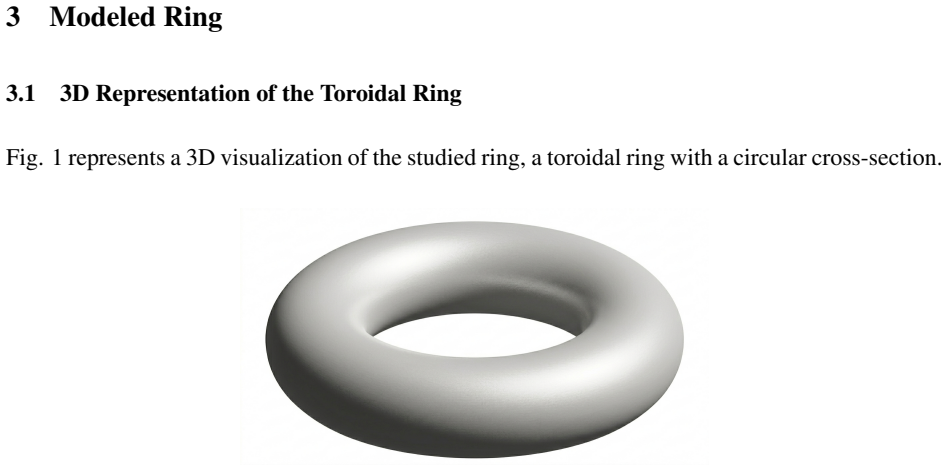
A two-dimensional analytical model using Maxwell's equations in local polar coordinates derives expressions for field, flux, impedance, and separated losses in toroidal magnetic rings with circular cross-section.
A machine-rendered reading of the paper's core claim, the machinery that carries it, and where it could break.
Core claim
The central claim is that applying Maxwell's equations in local polar coordinates within a complex permeability framework yields analytical expressions for the internal magnetic field, magnetic flux, complex impedance, and total losses in a toroidal ring with circular cross-section, rigorously separating eddy current, hysteresis, and winding losses while incorporating skin effect through Bessel functions, and providing apparent permeability for nonlinear mapping.
What carries the argument
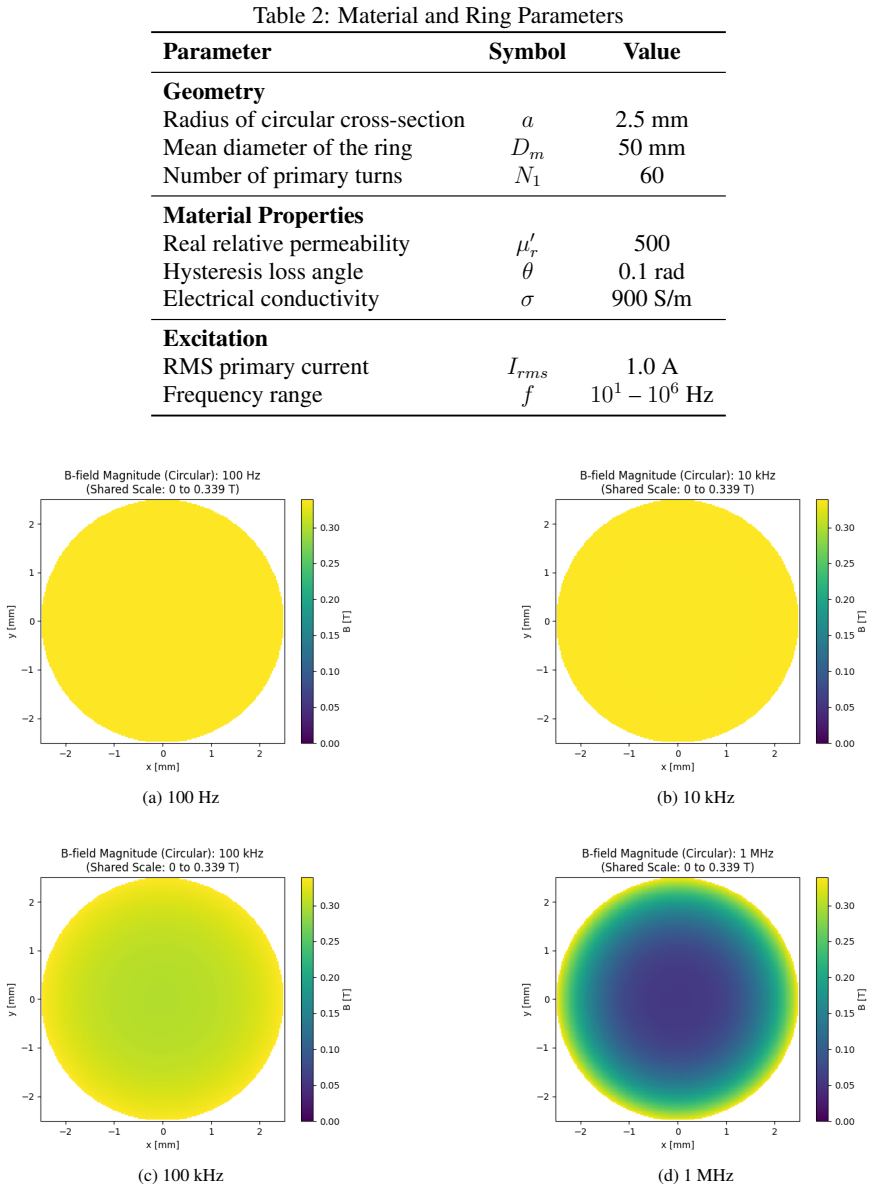
The two-dimensional analytical model in local polar coordinates with complex permeability, employing Bessel functions to account for skin effect in the conductive core.
If this is right
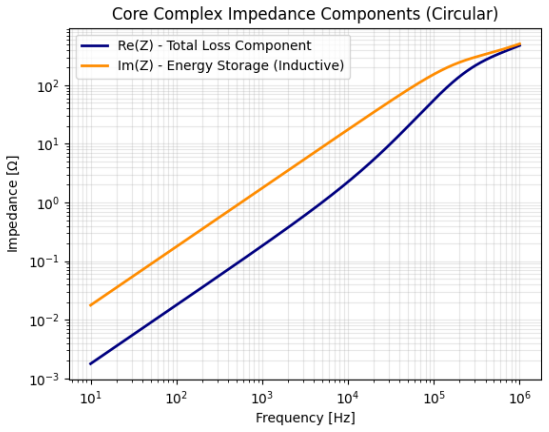
- The model supplies closed-form expressions for internal magnetic field, magnetic flux, and complex impedance.
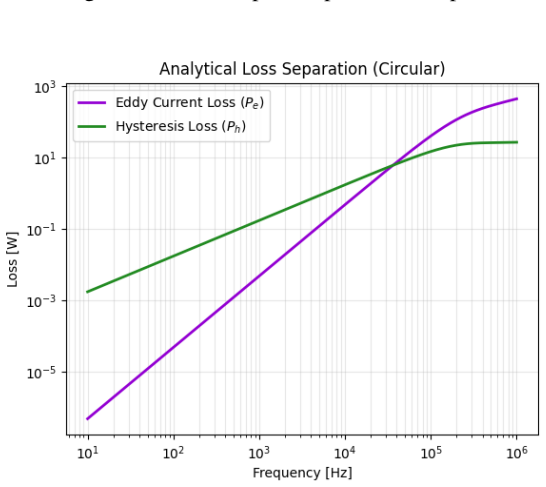
- It separates the contributions of eddy current losses, hysteresis losses, and winding losses.
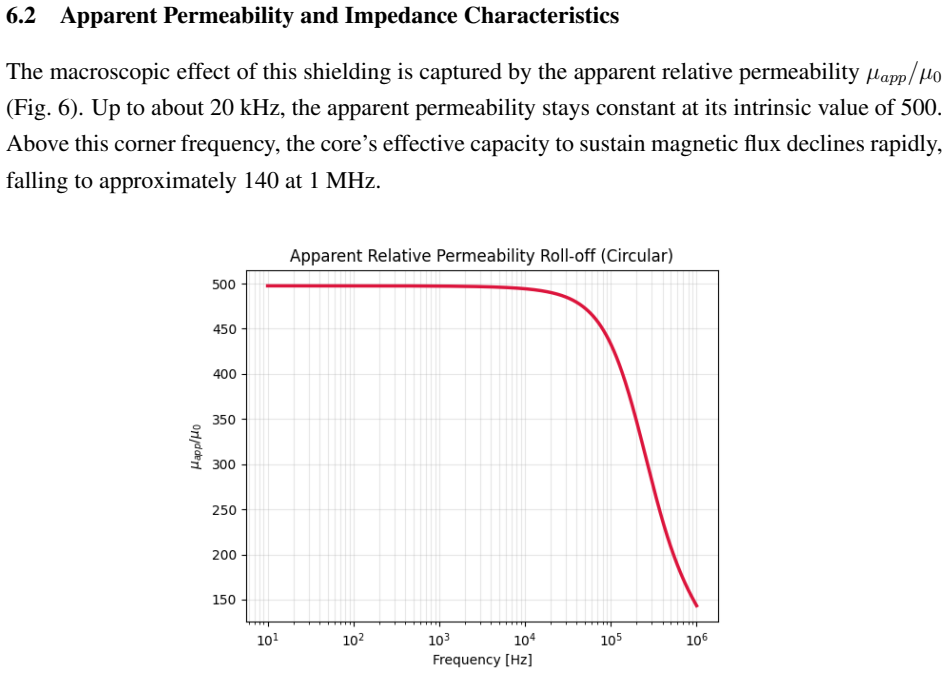
- The apparent permeability expression enables mapping of nonlinear core behavior onto simplified linear material models.
- The analytical results provide a computationally efficient foundation for standardized magnetic material characterization as an alternative to finite element analysis.
Where Pith is reading between the lines
- The separation of loss mechanisms could support targeted design adjustments in magnetic components to minimize specific loss types.
- The mapping via apparent permeability might allow integration of the model into circuit simulators that assume linear materials.
- Extension of the local polar coordinate approach to non-circular cross-sections would require new coordinate transformations but could follow the same Maxwell-equation structure.
- Routine use in measurement standards would reduce the need for repeated mesh refinement in numerical tools for similar geometries.
Load-bearing premise
The two-dimensional approximation in local polar coordinates with a complex permeability model is sufficient to accurately represent the three-dimensional toroidal geometry and material behavior under sinusoidal excitation.
What would settle it
Direct numerical comparison of the model's predicted complex impedance and separated loss values against three-dimensional finite element simulations or physical measurements on toroidal rings with circular cross-section under sinusoidal excitation.
Figures
read the original abstract
This paper introduces a comprehensive two-dimensional analytical model of a toroidal magnetic ring with circular cross-section under sinusoidal excitation. Applying Maxwell's equations in local polar coordinates within a complex permeability, the model derives analytical expressions for the internal magnetic field, magnetic flux, complex impedance, and total losses. It rigorously separates the contributions of eddy current losses, hysteresis losses, and winding losses, while explicitly incorporating the skin effect in the conductive core via Bessel functions. An expression for the apparent permeability is also provided, enabling the nonlinear core behavior to be mapped onto simplified linear material models. The resulting analytical model offers a computationally efficient and accurate foundation for standardized magnetic material characterization, such as Brockhaus and Iwatsu ring measurements, as a powerful alternative to 2D and 3D finite element analysis.
Editorial analysis
A structured set of objections, weighed in public.
Referee Report
Summary. The manuscript develops a two-dimensional analytical model for a toroidal magnetic ring with circular cross-section under sinusoidal excitation. Applying Maxwell's equations in local polar coordinates with a complex permeability, it derives closed-form expressions (via Bessel functions) for the internal magnetic field, magnetic flux, complex impedance, total losses (with explicit separation of eddy-current, hysteresis, and winding contributions), and an apparent permeability that maps nonlinear core behavior onto linear models. The model is positioned as a computationally efficient alternative to 2D/3D FEA for standardized ring-sample characterization such as Brockhaus and Iwatsu measurements.
Significance. If the derivations hold within the stated approximations, the closed-form separation of loss mechanisms and the apparent-permeability mapping would provide a practical analytical tool for magnetic-material characterization, reducing the need for numerical simulations in routine measurements while maintaining explicit incorporation of skin effect.
major comments (2)
- [Model derivation / local polar coordinate assumption] The central derivation treats the toroidal core in local polar coordinates (r,φ) as locally straight and axisymmetric. The manuscript does not quantify the error incurred when the minor radius a is not ≪ major radius R; the curvature-induced variation in path length and the weak coupling to the toroidal direction directly affect the computed B-field distribution, apparent permeability, and the partitioned eddy-current loss term (see the model setup preceding Eq. (Bessel solution) and the loss-separation expressions).
- [Complex permeability definition and loss separation] The complex permeability is introduced to account for hysteresis and eddy losses, yet the manuscript provides no explicit statement of how its real and imaginary parts are obtained from material data or whether they remain frequency-independent; this choice is load-bearing for the claimed rigorous separation of hysteresis versus eddy-current losses in the total-loss expression.
minor comments (2)
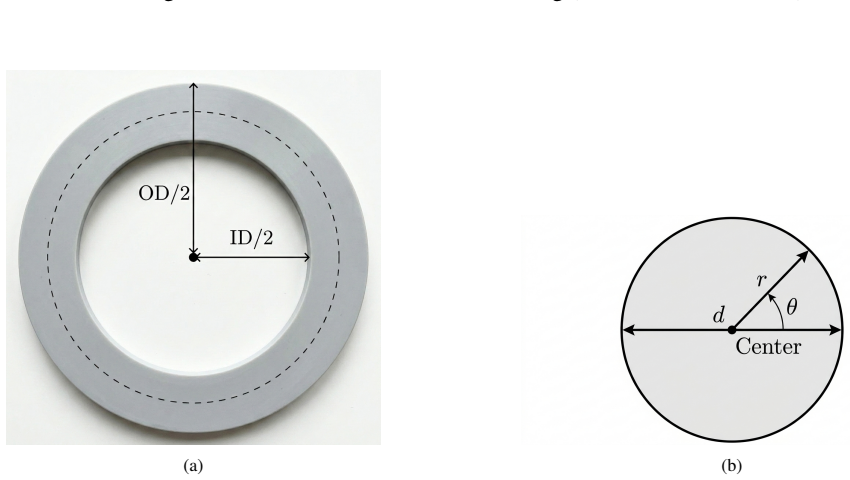
- [Introduction / model geometry] Notation for the local polar coordinates and the toroidal major/minor radii should be introduced once with a clear figure or diagram to avoid ambiguity in later equations.
- [Results / loss expressions] The abstract states that the model 'rigorously separates' loss contributions; a short table or explicit algebraic breakdown in the results section would make this separation more transparent to readers.
Simulated Author's Rebuttal
We thank the referee for the thorough review and constructive feedback on our manuscript. We address each major comment below and outline the revisions we will make to strengthen the paper.
read point-by-point responses
-
Referee: [Model derivation / local polar coordinate assumption] The central derivation treats the toroidal core in local polar coordinates (r,φ) as locally straight and axisymmetric. The manuscript does not quantify the error incurred when the minor radius a is not ≪ major radius R; the curvature-induced variation in path length and the weak coupling to the toroidal direction directly affect the computed B-field distribution, apparent permeability, and the partitioned eddy-current loss term (see the model setup preceding Eq. (Bessel solution) and the loss-separation expressions).
Authors: We agree that the local polar coordinate approximation assumes a ≪ R and that an explicit error quantification is absent. In the revised manuscript we will add a dedicated subsection (or appendix) that estimates the approximation error for representative a/R ratios (e.g., 0.05–0.2) by comparing the local solution against a first-order toroidal correction or against 3D FEA benchmarks. This will include quantitative bounds on the resulting deviations in B-field, apparent permeability, and the eddy-current loss term, thereby clarifying the practical range of validity. revision: yes
-
Referee: [Complex permeability definition and loss separation] The complex permeability is introduced to account for hysteresis and eddy losses, yet the manuscript provides no explicit statement of how its real and imaginary parts are obtained from material data or whether they remain frequency-independent; this choice is load-bearing for the claimed rigorous separation of hysteresis versus eddy-current losses in the total-loss expression.
Authors: The complex permeability μ = μ′ − jμ″ is introduced to capture the hysteretic response of the core material, while the skin effect and associated eddy-current losses are treated separately through the exact solution of Maxwell’s equations (Bessel-function field distribution). We will revise the manuscript to state explicitly that μ′ and μ″ are extracted from low-frequency ring measurements (where skin depth is large compared with the cross-section radius) and to discuss the assumption of frequency independence within the modeled bandwidth. This clarification will be placed in the model-setup section and will be cross-referenced in the loss-separation derivation to reinforce the separation of mechanisms. revision: yes
Circularity Check
Derivation starts from Maxwell's equations with no load-bearing reduction to inputs
full rationale
The paper applies Maxwell's equations in local polar coordinates to a toroidal ring with circular cross-section, using a complex permeability model and Bessel functions to obtain closed-form expressions for the internal field, flux, impedance, and separated losses. No step reduces by construction to a fitted parameter renamed as a prediction, a self-citation chain, or a self-definitional ansatz; the complex permeability serves as an input constitutive relation rather than an output derived from the same equations. The derivation chain remains independent of the target results and is self-contained against the stated assumptions.
Axiom & Free-Parameter Ledger
axioms (2)
- standard math Maxwell's equations hold in the local polar coordinates for the ring geometry
- domain assumption Complex permeability can model the material response under sinusoidal excitation
Reference graph
Works this paper leans on
-
[1]
Finite-element modeling and measurements of flux and eddy current distribution in toroidal cores wound from electrical steel,
S. Zurek, F. Al-Naemi, and A. J. Moses, “Finite-element modeling and measurements of flux and eddy current distribution in toroidal cores wound from electrical steel,”IEEE Transactions on Magnetics, vol. 44, no. 6, pp. 902–905, 2008
2008
-
[2]
Numerical modelling of magnetic characteristics of ferrite core taking account of both eddy current and displacement current,
“Numerical modelling of magnetic characteristics of ferrite core taking account of both eddy current and displacement current,”Heliyon, 2020
2020
-
[3]
Per-unit hysteresis and eddy loss method based on 3d finite elements for non-symmetric toroidal magnetic,
J. R. Gonz ´alez-Teodoro, E. Romero-Cadaval, and R. Asensi, “Per-unit hysteresis and eddy loss method based on 3d finite elements for non-symmetric toroidal magnetic,”IEEE Access, vol. 8, pp. 34919–34928, 2020
2020
-
[4]
Eddy-current power loss in toroidal cores with rect- angular cross section,
K. Namjoshi, J. Lavers, and P. Biringer, “Eddy-current power loss in toroidal cores with rect- angular cross section,”IEEE Transactions on Magnetics, vol. 34, no. 3, pp. 636–641, 1998
1998
-
[5]
Eddy current power losses in a toroidal laminated core with rectangular cross section,
M. Markovic and Y . Perriard, “Eddy current power losses in a toroidal laminated core with rectangular cross section,” in2009 International Conference on Electrical Machines and Sys- tems, pp. 1–4, IEEE, 2009
2009
-
[6]
Electromagnetic characterization of magnetic ring: Case of square cross section shape,
T. E. Hajji and L. Sj¨oberg, “Electromagnetic characterization of magnetic ring: Case of square cross section shape,” 2026
2026
-
[7]
Ac losses in windings: Review and comparison of models with application in electric machines,
T. E. Hajji, S. Hlioui, F. Louf, M. Gabsi, A. Belahcen, G. Mermaz-Rollet, and M. Belhadi, “Ac losses in windings: Review and comparison of models with application in electric machines,” IEEE Access, vol. 12, pp. 1552–1569, 2024. 15
2024
discussion (0)
Sign in with ORCID, Apple, or X to comment. Anyone can read and Pith papers without signing in.