Holographic Dual of PT Symmetric BCFT
Pith reviewed 2026-06-26 20:21 UTC · model grok-4.3
The pith
An imaginary scalar field on an end-of-the-world brane yields a holographic dual for PT-symmetric non-Hermitian boundary conditions in two-dimensional CFT.
A machine-rendered reading of the paper's core claim, the machinery that carries it, and where it could break.
Core claim
Placing an imaginary valued scalar field on the end-of-the-world brane in the AdS/BCFT framework produces a gravity dual to PT-symmetric BCFT; this dual exhibits spontaneous PT symmetry breaking when the interaction strength increases and, after Wick rotation, produces a quantum quench whose entanglement entropy grows larger than the growth obtained from ordinary Cardy states.
What carries the argument
Imaginary valued scalar field localized on the end-of-the-world brane, which encodes the non-Hermitian PT-symmetric boundary conditions of the dual CFT.
If this is right
- PT symmetry breaks spontaneously once the interaction strength exceeds a critical value.
- Entanglement entropy in the Wick-rotated quantum quench exceeds the growth found for standard Cardy states.
- The construction supplies a new family of boundary conditions that can be studied holographically.
- Non-Hermitian effects become accessible within the AdS/BCFT framework.
Where Pith is reading between the lines
- The same imaginary-field mechanism might extend to PT-symmetric boundaries in higher-dimensional CFTs.
- Lattice realizations of PT-symmetric spin chains could be used to test the predicted entanglement growth.
- The spontaneous-breaking transition may correspond to observable signatures in open quantum systems.
- Similar duals could connect to studies of exceptional points in other holographic settings.
Load-bearing premise
The AdS/BCFT duality together with an imaginary scalar on the brane correctly reproduces the PT-symmetric non-Hermitian boundary conditions of the two-dimensional CFT.
What would settle it
An explicit CFT computation of correlation functions or entanglement entropy that fails to show spontaneous PT breaking or faster growth than Cardy states would falsify the proposed duality.
Figures


read the original abstract
We present a holographic dual of a two dimensional conformal field theory with non-hermitian but Parity-Time (PT) symmetric boundary conditions, by applying the AdS/BCFT duality and by introducing an imaginary valued scalar field localized on an end-of-the-world brane. We find that as we increase the strength of the non-hermitian PT symmetric interactions, the system experiences a spontaneous PT symmetry breaking. We also consider its Wick rotated setup as a new quantum quenched state and show that its growth of entanglement entropy can be larger than the standard results obtained from standard Cardy states.
Editorial analysis
A structured set of objections, weighed in public.
Referee Report
Summary. The manuscript proposes a holographic dual for 2D CFTs with PT-symmetric but non-Hermitian boundary conditions by extending AdS/BCFT with an imaginary scalar field localized on the end-of-the-world brane. It reports that increasing the strength of these interactions leads to spontaneous PT symmetry breaking, and that the Wick-rotated setup yields a quench state whose entanglement entropy grows faster than that obtained from standard Cardy boundary states.
Significance. If the bulk-to-boundary dictionary entry is rigorously established, the construction would supply a concrete holographic model for spontaneous PT breaking and for quench dynamics in non-Hermitian BCFTs, potentially allowing quantitative comparison of entanglement growth rates. The work is otherwise incremental on existing AdS/BCFT technology.
major comments (2)
- [Brane action and duality dictionary (likely §2–3)] The central claim that the imaginary scalar on the ETW brane induces PT-symmetric non-Hermitian boundary conditions (including the spontaneous-breaking transition) is introduced by modifying the brane action but is never derived. No explicit computation of the resulting boundary state, no verification that the dual operators satisfy [H,PT]=0 while the spectrum is non-real, and no check that the breaking is spontaneous rather than explicit appear in the text. This mapping is load-bearing for both the breaking statement and the subsequent EE comparison.
- [Entanglement entropy section (likely §4)] The Wick-rotated quench comparison asserts larger EE growth than standard Cardy states, yet the manuscript provides neither the explicit time-dependent metric or brane trajectory after rotation nor a quantitative plot or formula showing the excess growth as a function of the imaginary coupling. Without these, the claim cannot be assessed.
minor comments (2)
- [Notation and conventions] Notation for the imaginary scalar and its coupling constant is introduced without a clear table of symbols or relation to the PT operator.
- [Introduction] The abstract states the results but the introduction does not cite prior holographic work on non-Hermitian or PT-symmetric systems for context.
Simulated Author's Rebuttal
We thank the referee for their careful reading and constructive comments on our manuscript. We address each major comment below and will revise the paper to incorporate the requested clarifications and derivations.
read point-by-point responses
-
Referee: [Brane action and duality dictionary (likely §2–3)] The central claim that the imaginary scalar on the ETW brane induces PT-symmetric non-Hermitian boundary conditions (including the spontaneous-breaking transition) is introduced by modifying the brane action but is never derived. No explicit computation of the resulting boundary state, no verification that the dual operators satisfy [H,PT]=0 while the spectrum is non-real, and no check that the breaking is spontaneous rather than explicit appear in the text. This mapping is load-bearing for both the breaking statement and the subsequent EE comparison.
Authors: We agree that the derivation of the PT-symmetric non-Hermitian boundary conditions from the imaginary scalar on the ETW brane requires explicit computation to rigorously establish the dictionary. In the revised manuscript we will add a dedicated subsection deriving the boundary state from the modified brane action, verifying that the dual operators satisfy [H,PT]=0 with a non-real spectrum, and confirming the breaking is spontaneous (by showing the transition occurs only above a critical coupling strength without explicit PT-breaking terms). revision: yes
-
Referee: [Entanglement entropy section (likely §4)] The Wick-rotated quench comparison asserts larger EE growth than standard Cardy states, yet the manuscript provides neither the explicit time-dependent metric or brane trajectory after rotation nor a quantitative plot or formula showing the excess growth as a function of the imaginary coupling. Without these, the claim cannot be assessed.
Authors: We acknowledge the need for more explicit details in the quench analysis. The revised version will include the explicit time-dependent metric and brane trajectory obtained after Wick rotation, together with quantitative formulas (or plots) for the entanglement entropy growth as a function of the imaginary coupling, demonstrating the excess relative to standard Cardy states. revision: yes
Circularity Check
No significant circularity; proposal is self-contained ansatz within AdS/BCFT
full rationale
The paper introduces an imaginary scalar on the ETW brane as a modeling choice to realize PT-symmetric BCFT via AdS/BCFT. The spontaneous breaking and entanglement growth results follow from solving the bulk equations in this setup. No quoted step reduces a claimed prediction to a fitted parameter, self-citation chain, or definitional loop; the central dictionary entry is presented as an assumption rather than derived from prior self-referential inputs. This is the standard non-circular structure for holographic model-building papers.
Axiom & Free-Parameter Ledger
axioms (1)
- domain assumption AdS/BCFT duality extends to PT-symmetric non-Hermitian boundaries when an imaginary scalar is added to the EOW brane
invented entities (1)
-
imaginary valued scalar field localized on end-of-the-world brane
no independent evidence
Reference graph
Works this paper leans on
-
[1]
Introduction Even though the hermitian property of a given Hamil- tonian guarantees that the energy spectrum is real val- ued, it is known that the opposite is not true. Even if the Hamiltonian is not hermitianH † ̸=H, it can have a real valued spectrum if the Hamiltonian is pseudo hermitian i.e.H † =τ Hτ −1 for a certain hermitian operatorτ. A typical su...
Pith/arXiv arXiv 2026
-
[2]
We also write the width between the two boundaries by ∆x
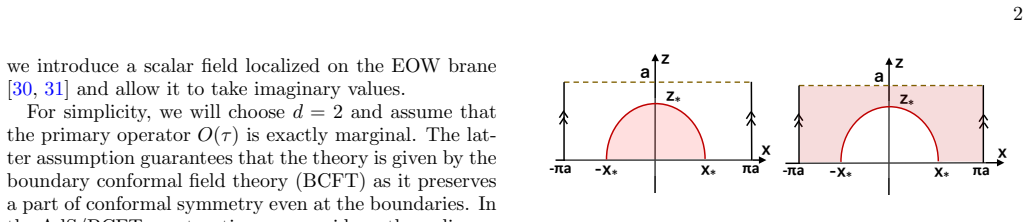
Holographic Model for PT invariant BCFT We consider the two dimensional BCFT (1) at finite temperatureT= 1/βdescribed by the Euclidean flat co- ordinate (τ, x) on a cylinder, whereτis the Euclidean time coordinate. We also write the width between the two boundaries by ∆x. Its gravity model dual is con- structed via the AdS/BCFT [27, 28, 30] as follows. Th...
-
[3]
To makeϕreal valued,η= 1 was chosen in [30], where the gravity dual looks like the left panel of Fig.1
PT-invariant Thermal AdS Phase0≤∆≤φ c In the thermal AdS 3 (5), the equation of motion in AdS/BCFT for a EOW brane with the localized scalar, given by (4), reads (we write the derivative w.r.txas dz dx = ˙z) η· 2h3 −zh 2h′ −3zh ′ ˙z2 + 2h˙z2 + 2hz¨z 2z2h h+ ˙z2 h 3 2 =− h z2 +h 2 ˙ϕ2, η· h q h+ ˙z2 h z2 = ˙ϕ2,(10) whereη=±corresponds to the orientation of...
-
[4]
Our interpretation as a PT symmetric system implies that we will get into the spontaneous breaking of the PT symmetry for ∆φ > φc
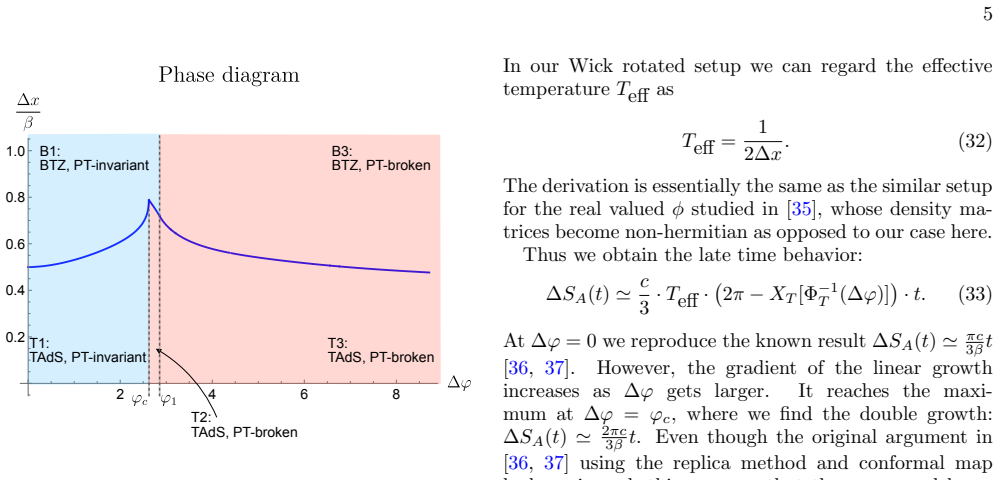
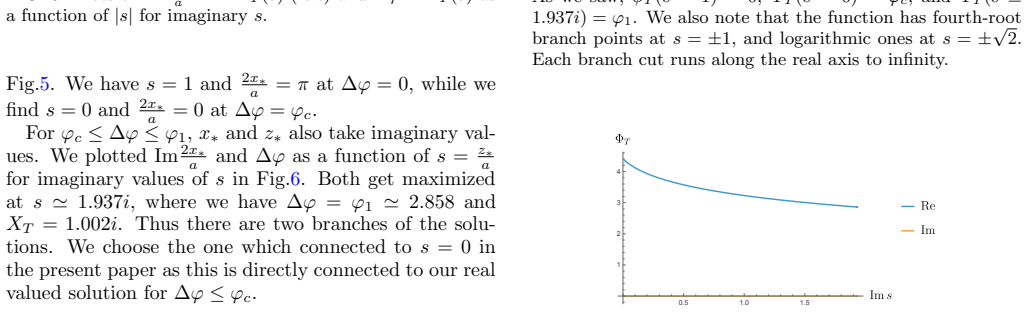
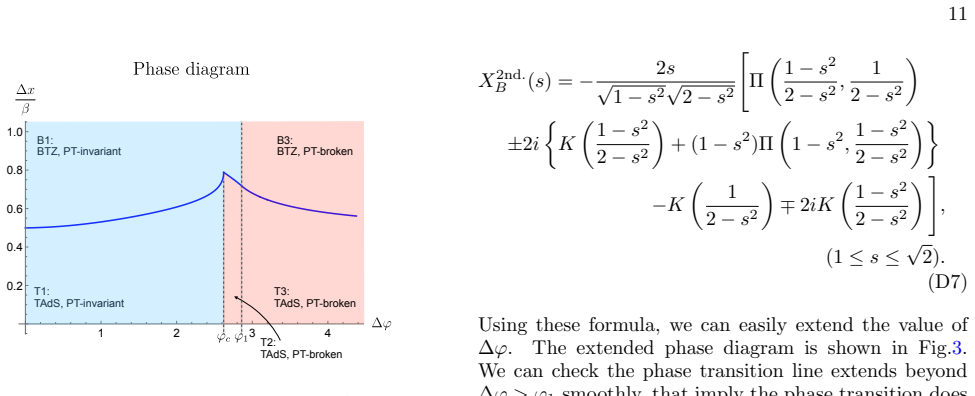
PT-violating TAdS Phaseφ c <∆φ≤φ 1 As we have seen, there is an upper bound ∆φ≤φ c for the connected EOW brane solution. Our interpretation as a PT symmetric system implies that we will get into the spontaneous breaking of the PT symmetry for ∆φ > φc. Indeed for this range, the solution becomes complex 4 valued as we will explain below. For this, let us a...
-
[5]
PT-invariant BTZ Phase0≤∆φ≤φ 1 Now let us move onto to the BTZ phase (6). The Neumann boundary condition (4) for a connected EOW brane leads to ˙z= p h(z) p 2U(z ∗)−2U(z) 3z2 , ˙φ= 1 zh(z) 1 4 1 + 2h 9z4 (U(z ∗)−U(z)) 1 4 ,(25) where the potentialU(z) is identical to (12). By inte- grating these differential equations, we obtainX B(s) and ΦB(s) defined in...
-
[6]
In this region, not only TAdS but BTZ solutions have complex met- rics, which we again interpret as the transition to PT- broken phase
Phases for∆φ > φ 1 We can consider the solution for even larger ∆φby allowingstake general complex values. In this region, not only TAdS but BTZ solutions have complex met- rics, which we again interpret as the transition to PT- broken phase. The detailed computation is shown in Ap- pendix.D, and here we just indicate the basic idea and final results. We ...
-
[7]
We now perform the Wick rotationτ ′ =xandx ′ =τ
Novel Quantum Quenches from BCFT Consider the thermal AdS phase of our set up with the imaginary scalar in the range 0≤∆φ≤φ c. We now perform the Wick rotationτ ′ =xandx ′ =τ. At the timeτ ′ =− ∆x 2 the state is given by the boundary state with the exactly marginal perturbation turned on: |B(∆φ/2)⟩= exp i∆φ 2 Z ∞ −∞ dx′O(x′) |B0⟩,(28) where|B 0⟩is the Car...
-
[8]
for the enhancement of effective temperature for generic quantum states
-
[9]
Extreme Universe
Discussions In this article, we presented an explicit and simple holographic dual of a two dimensional conformal field theory with PT symmetric boundary conditions, by ap- plying the AdS/BCFT duality. We showed that as the strength of the non-hermitian PT symmetric interactions parametrized by ∆φincreases, our system experiences a spontaneous PT symmetry ...
-
[10]
Note that 2x ∗/awas in the range [0, π]
Thermal AdS In the thermal AdS solution, sincexdirection has the periodicity 2πa, the width ∆xis given by ∆x= 2πa− 2x∗. Note that 2x ∗/awas in the range [0, π]. Thus in the current regime, the width of BCFT must satisfyπ≤ ∆x/a≤2π. Now let us evaluate the free energy at a fixed inverse temperatureβ, that is given by the on-shell action (3). The bulk geomet...
-
[11]
Now the bulk region generally includes the horizonz=a, soa is no longer an independent parameter but a function of temperature:a=β/2π
BTZ with connected EOW brane In the BTZ phase with a connected EOW brane, the evaluation of on-shell action slightly changes. Now the bulk region generally includes the horizonz=a, soa is no longer an independent parameter but a function of temperature:a=β/2π. Then it naively seems that we cannot choose ∆x/βand ∆φindependently. However, we have one new pa...
-
[12]
This is obtained by set- tingϕ= const.on each brane, whose difference is iden- tified to ∆ϕ
BTZ black hole with disconnected EOW brane phase Then, let us consider the another solution, which hold two disconnected EOW branes. This is obtained by set- tingϕ= const.on each brane, whose difference is iden- tified to ∆ϕ. The EOW branes extend alongx= const., so the solution is the same as the standard AdS/BCFT without any scalar field with vanishing ...
-
[13]
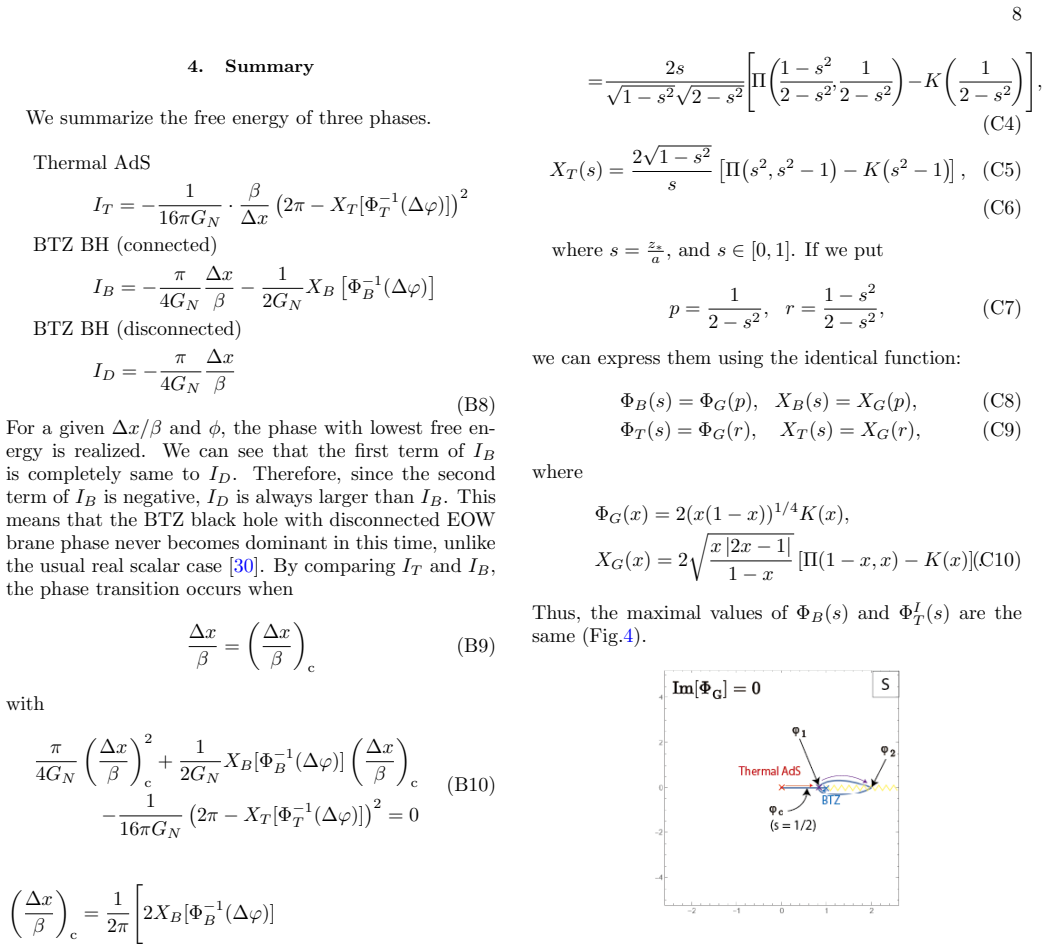
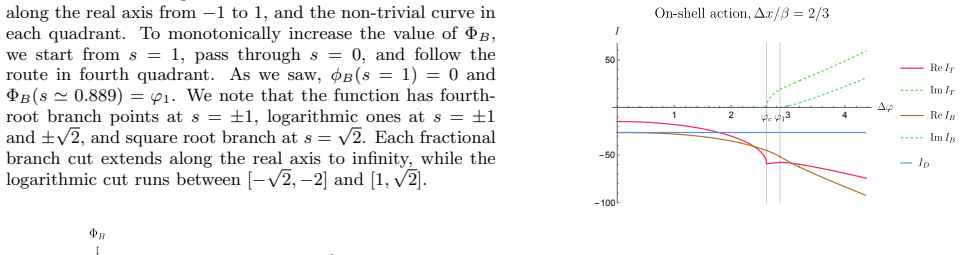
Summary We summarize the free energy of three phases. Thermal AdS IT =− 1 16πGN · β ∆x 2π−X T [Φ−1 T (∆φ)] 2 BTZ BH (connected) IB =− π 4GN ∆x β − 1 2GN XB Φ−1 B (∆φ) BTZ BH (disconnected) ID =− π 4GN ∆x β (B8) For a given ∆x/βandϕ, the phase with lowest free en- ergy is realized. We can see that the first term ofI B is completely same toI D. Therefore, s...
-
[14]
These are the functions explicitly given by (16) and are plotted in 9 0.2 0.4 0.6 0.8 1.0 0.5 1.0 1.5 2.0 2.5 3.0 2x/a s=z/a 0.2 0.4 0.6 0.8 1.0 0.5 1.0 1.5 2.0 2.5 Δφ s=z/a FIG
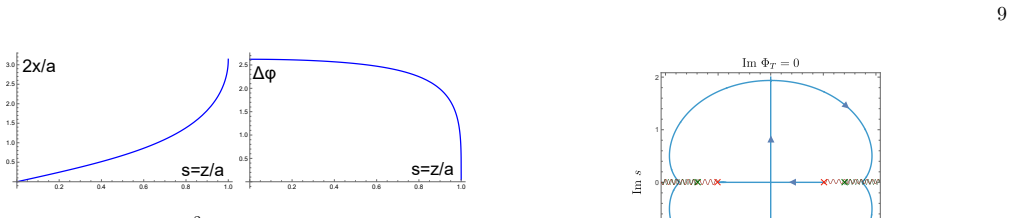
Thermal AdS for0≤∆φ≤φ 1 For 0≤∆φ≤φ c, ∆φandx ∗ take real values where stakes values in the range 0≤s= z∗ a ≤1. These are the functions explicitly given by (16) and are plotted in 9 0.2 0.4 0.6 0.8 1.0 0.5 1.0 1.5 2.0 2.5 3.0 2x/a s=z/a 0.2 0.4 0.6 0.8 1.0 0.5 1.0 1.5 2.0 2.5 Δφ s=z/a FIG. 5. Plots of Plots of 2x∗ a =X T (s) (left) and ∆φ= Φ T (s) as a fun...
-
[15]
They are plotted in Fig.7
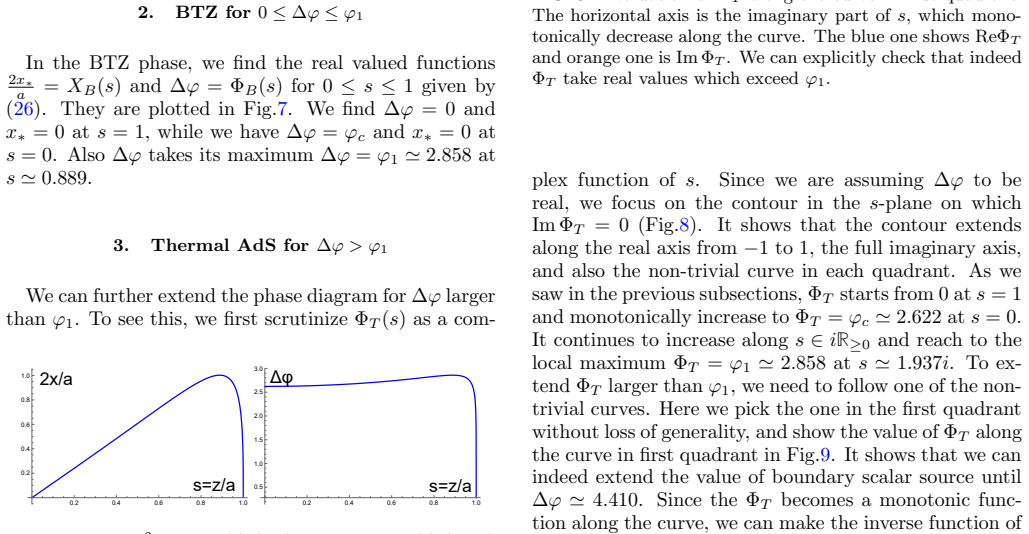
BTZ for0≤∆φ≤φ 1 In the BTZ phase, we find the real valued functions 2x∗ a =X B(s) and ∆φ= Φ B(s) for 0≤s≤1 given by (26). They are plotted in Fig.7. We find ∆φ= 0 and x∗ = 0 ats= 1, while we have ∆φ=φ c andx ∗ = 0 at s= 0. Also ∆φtakes its maximum ∆φ=φ 1 ≃2.858 at s≃0.889
-
[16]
To see this, we first scrutinize Φ T (s) as a com- 0.2 0.4 0.6 0.8 1.0 0.2 0.4 0.6 0.8 1.0 2x/a s=z/a 0.2 0.4 0.6 0.8 1.0 0.5 1.0 1.5 2.0 2.5 3.0 Δφ s=z/a FIG
Thermal AdS for∆φ > φ 1 We can further extend the phase diagram for ∆φlarger thanφ 1. To see this, we first scrutinize Φ T (s) as a com- 0.2 0.4 0.6 0.8 1.0 0.2 0.4 0.6 0.8 1.0 2x/a s=z/a 0.2 0.4 0.6 0.8 1.0 0.5 1.0 1.5 2.0 2.5 3.0 Δφ s=z/a FIG. 7. Plots of 2x∗ a =X B(s) (left) and ∆φ= Φ B(s) (right) as a function ofsfor 0≤s≤1. -2 -1 0 1 2 -2 -1 0 1 2 -2 ...
-
[17]
0.90 0.95 1.00 1.05 1.10 1.15 1.20 1 2 3 4 FIG
Each fractional branch cut extends along the real axis to infinity, while the logarithmic cut runs between [− √ 2,−2] and [1, √ 2]. 0.90 0.95 1.00 1.05 1.10 1.15 1.20 1 2 3 4 FIG. 11. Evaluation of ΦB along the curve in fourth quadrant. The horizontal axis is the real part ofs, which monotonically increase along the curve. The blue one shows ReΦ B and or-...
-
[18]
The contour of Im Φ B = 0 is shown in Fig.10
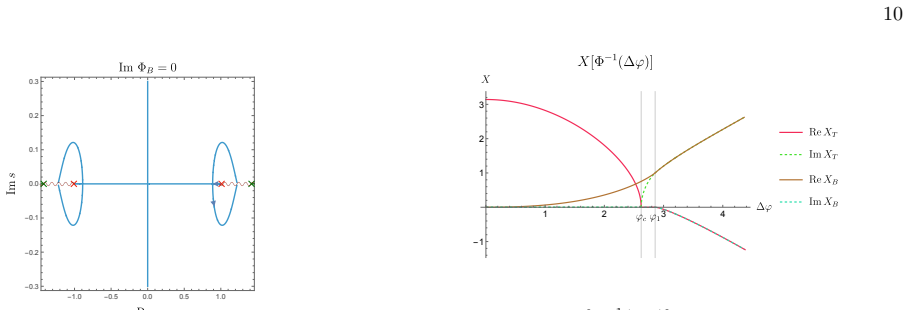
BTZ for∆φ > φ 1 We take the same procedure to Φ B. The contour of Im Φ B = 0 is shown in Fig.10. The new branch to exceed φ1 emerges ats≃0.889. Along the non-trivial curve in the fourth quadrant, Φ B behaves like in Fig.11. It shows that we can indeed extend the value of boundary scalar source until ∆φ≃4.410. Φ B is also a monotonic func- tion along the c...
-
[19]
One may worry that a new phase tran- sition might occur at that point, but it is not the case
F urther extension for∆φ In the previous subsection we extended the value of ∆φ up to∼4.410. One may worry that a new phase tran- sition might occur at that point, but it is not the case. To see that, we will further extend the phase diagram, which demand us to go beyond the branch cuts and con- sider the second Riemann surface. Following monodromy condit...
-
[20]
A linear operatorHis said to be pseudo Hermitian if there exists a Hermitian operatorτsuch that H † =τ Hτ −1.(E1) Theorem E.2(pseudo-Hermiticity and spectrum)
Linear Algebra statement Definition E.1(pseudo-Hermitian). A linear operatorHis said to be pseudo Hermitian if there exists a Hermitian operatorτsuch that H † =τ Hτ −1.(E1) Theorem E.2(pseudo-Hermiticity and spectrum). AssumeHis diagonalizable and has a discrete spectrum. Then, the following two are equivalent: 1.His pseudo-Hermitian
-
[21]
Proof.(1.⇒2.) We denote the eigenvalue asE n and right eigenvector as|n⟩
The eigenvalues ofHare either real or come in complex conjugate pairs. Proof.(1.⇒2.) We denote the eigenvalue asE n and right eigenvector as|n⟩. ApplyingH † toτ|n⟩, we find H †τ|n⟩=τ Hτ −1τ|n⟩=E nτ|n⟩.(E2) Thus,τ|n⟩is a right eigenvector ofH † with eigenvalue En. Since the set of eigenvalues ofH † is the complex conjugate of that ofH, there exists an eige...
-
[22]
Proof.(1.⇒2.) In general, a positive definite linear op- erator can be decomposed into the form Θ =R †Rwhere Ris an invertible matrix
The eigenvalues ofHare all real. Proof.(1.⇒2.) In general, a positive definite linear op- erator can be decomposed into the form Θ =R †Rwhere Ris an invertible matrix. From the definition of quasi- Hermiticity, we have H † =R †RHR −1(R†)−1 ⇔(R †)−1H †R† =RHR −1. (E10) Therefore,RHR −1 is a Hermitian operator, and its eigenvalues are all real. SinceRis an ...
-
[23]
PT-symmetric quantum mechanics We now review the PT-symmetric quantum mechanics [42]. We call the HamiltonianHis PT-invariant if there exists a anti-linear operatorP Tsuch that (P T)H(P T) −1 =H.(E15) In most cases, we also assume that parity oepratorPis linear and unitary, time reversalTis anti-linear and anti- unitary, which commute to each other and in...
-
[24]
This is invariant under the PT transformation with P= 0 1 1 0 ,(E23) andTacts as the complex conjugation
Example: two sites model Consider the Hamiltonian in the two level system H= iγ−W −W−iγ .(E22) Here we assumeγ >0 andW >0. This is invariant under the PT transformation with P= 0 1 1 0 ,(E23) andTacts as the complex conjugation. Two right eigenvalues are 2 |n1⟩= 1√ 2W W iγ+ p W 2 −γ 2 , E 1 =− p W 2 −γ 2 (E24) |n2⟩= 1√ 2W W iγ− p W 2 −γ 2 , E 2 = + p W 2 ...
-
[25]
Path-integral and partition function Consider the Euclidean path-integral in the setup of non-hermitian system. For a scalar fieldϕ, the partition function based the Euclidean path-integral looks like Z(β) = Z dϕ⟨ϕ|e−βH |ϕ⟩.(E36) We can rewrite this by using P n |n⟩⟨˜n|= 1 as Z(β) = X n,m Z dϕ⟨ϕ|n⟩⟨˜n|e−βH |m⟩⟨˜m|ϕ⟩ = X n ⟨˜n|e−βH |n⟩ = X n e−βEn .(E37) T...
-
[26]
C. M. Bender and S. Boettcher, Real spectra in nonHer- mitian Hamiltonians having PT symmetry, Phys. Rev. Lett.80, 5243 (1998), arXiv:physics/9712001
Pith/arXiv arXiv 1998
-
[27]
C. M. Bender, Making sense of non-Hermitian Hamil- tonians, Rept. Prog. Phys.70, 947 (2007), arXiv:hep- th/0703096
arXiv 2007
-
[28]
C. Korff, PT Symmetry of the non-Hermitian XX Spin- Chain: Non-local Bulk Interaction from Complex Bound- ary Fields, J. Phys. A41, 295206 (2008), arXiv:0803.4500 [math-ph]
Pith/arXiv arXiv 2008
-
[29]
Fring, PT-symmetric deformations of integrable mod- els, Phil
A. Fring, PT-symmetric deformations of integrable mod- els, Phil. Trans. Roy. Soc. Lond. A371, 20120046 (2013), arXiv:1204.2291 [hep-th]
Pith/arXiv arXiv 2013
- [30]
- [31]
-
[32]
O. A. Castro-Alvaredo, B. Doyon, and F. Ravanini, Ir- reversibility of the renormalization group flow in non- unitary quantum field theory, J. Phys. A50, 424002 (2017), arXiv:1706.01871 [hep-th]
Pith/arXiv arXiv 2017
-
[33]
Y. Fukusumi and T. Kawamoto, Generalizing fusion rules by shuffle: Symmetry-based classifications of nonlocal systems constructed from similarity transformations, (), arXiv:2512.02139 [hep-th]
-
[34]
Y. Fukusumi and T. Kawamoto, Generalizing quan- tum dimensions: Symmetry-based classification of local pseudo-Hermitian systems and the corresponding domain walls, (), arXiv:2511.11059 [hep-th]
-
[35]
O. Diatlyk, A. Katsevich, and F. K. Popov,PT- symmetric Field Theories at Finite Temperature, arXiv:2604.08459 [hep-th]
-
[36]
Hatano and D
N. Hatano and D. R. Nelson, Localization transitions in non-hermitian quantum mechanics, Physical Review Let- ters77, 570–573 (1996)
1996
- [37]
-
[38]
B. Gardas, S. Deffner, and A. Saxena, Non-hermitian quantum thermodynamics, Sci. Rep.6, 23408 (2016), arXiv:1511.06256 [quant-ph]
Pith/arXiv arXiv 2016
-
[39]
K. Cao and S.-P. Kou, Statistical mechanics for non- Hermitian quantum systems, Phys. Rev. Res.5, 033196 (2023), arXiv:2304.04691 [cond-mat.stat-mech]
arXiv 2023
-
[40]
’t Hooft, Dimensional reduction in quantum gravity, Conf
G. ’t Hooft, Dimensional reduction in quantum gravity, Conf. Proc. C930308, 284 (1993), arXiv:gr-qc/9310026
Pith/arXiv arXiv 1993
-
[41]
Susskind, The World as a hologram, J
L. Susskind, The World as a hologram, J. Math. Phys. 36, 6377 (1995), arXiv:hep-th/9409089
Pith/arXiv arXiv 1995
-
[42]
J. M. Maldacena, The Large N limit of superconformal field theories and supergravity, Adv. Theor. Math. Phys. 2, 231 (1998), arXiv:hep-th/9711200
Pith/arXiv arXiv 1998
-
[43]
S. S. Gubser, I. R. Klebanov, and A. M. Polyakov, Gauge theory correlators from noncritical string theory, Phys. Lett. B428, 105 (1998), arXiv:hep-th/9802109
Pith/arXiv arXiv 1998
-
[44]
Witten, Anti-de Sitter space and holography, Adv
E. Witten, Anti-de Sitter space and holography, Adv. Theor. Math. Phys.2, 253 (1998), arXiv:hep-th/9802150
Pith/arXiv arXiv 1998
-
[45]
D. Are´ an, K. Landsteiner, and I. Salazar Landea, Non- hermitian holography, SciPost Phys.9, 032 (2020), arXiv:1912.06647 [hep-th]
arXiv 2020
- [46]
-
[47]
Z.-Y. Xian, D. Rodr´iguez Fern´ andez, Z. Chen, Y. Liu, and R. Meyer, Electric conductivity in non- Hermitian holography, SciPost Phys.16, 004 (2024), arXiv:2304.11183 [hep-th]
arXiv 2024
-
[48]
A. F. Faedo, C. Hoyos, D. Mateos, and J. G. Subils, Holographic Complex Conformal Field Theories, Phys. Rev. Lett.124, 161601 (2020), arXiv:1909.04008 [hep- th]
arXiv 2020
-
[49]
Ghodrati, Photonic Exceptional Points in Holography and QCD, arXiv:2510.15518 [hep-th]
M. Ghodrati, Photonic Exceptional Points in Holography and QCD, arXiv:2510.15518 [hep-th]
-
[50]
X. Song and K. Murch, Parity-Time Symmetric Holographic Principle, Entropy25, 1523 (2023), arXiv:2210.01128 [quant-ph]
arXiv 2023
-
[51]
J. M. Begines, A. F. Faedo, C. Hoyos, and D. Musso, Su- pergravity flows, wormholes and their pseudo-Hermitian holographic duals, arXiv:2605.16168 [hep-th]
-
[52]
Takayanagi, Holographic Dual of BCFT, Phys
T. Takayanagi, Holographic Dual of BCFT, Phys. Rev. Lett.107, 101602 (2011), arXiv:1105.5165 [hep-th]
Pith/arXiv arXiv 2011
-
[53]
M. Fujita, T. Takayanagi, and E. Tonni, Aspects of AdS/BCFT, JHEP11, 043, arXiv:1108.5152 [hep-th]
-
[54]
A. Karch and L. Randall, Open and closed string in- terpretation of SUSY CFT’s on branes with boundaries, JHEP06, 063, arXiv:hep-th/0105132
- [55]
- [56]
-
[57]
S. W. Hawking and D. N. Page, Thermodynamics of Black Holes in anti-De Sitter Space, Commun. Math. Phys.87, 577 (1983)
1983
-
[58]
J. L. Cardy, Boundary Conditions, Fusion Rules and the Verlinde Formula, Nucl. Phys. B324, 581 (1989)
1989
- [59]
- [60]
-
[61]
P. Calabrese and J. L. Cardy, Evolution of entanglement entropy in one-dimensional systems, J. Stat. Mech.0504, P04010 (2005), arXiv:cond-mat/0503393
Pith/arXiv arXiv 2005
-
[62]
T. Hartman and J. Maldacena, Time Evolution of En- tanglement Entropy from Black Hole Interiors, JHEP05, 014, arXiv:1303.1080 [hep-th]
-
[63]
Hoback, D
S. Hoback, D. Jafferis, and Z. Wei, to appear,
-
[64]
Q. Tang, Z. Wei, and X. Wen, In preparation,
- [65]
-
[66]
Scholtz, H
F. Scholtz, H. Geyer, and F. Hahne, Quasi-hermitian op- erators in quantum mechanics and the variational prin- ciple, Annals of Physics213, 74 (1992)
1992
-
[67]
C. M. Bender, Introduction to PT-Symmetric Quantum Theory, Contemp. Phys.46, 277 (2005), arXiv:quant- ph/0501052
arXiv 2005
-
[68]
A. Mostafazadeh, PseudoHermiticity versus PT symme- try 3: Equivalence of pseudoHermiticity and the presence of antilinear symmetries, J. Math. Phys.43, 3944 (2002), arXiv:math-ph/0203005
Pith/arXiv arXiv 2002
discussion (0)
Sign in with ORCID, Apple, or X to comment. Anyone can read and Pith papers without signing in.