REVIEW 1 major objections 1 minor 23 references
A Controlled Benchmark of Quantum-Latent GAN Augmentation for Brain MRI
T0 review · 1 major / 1 minor · reviewed 2026-06-26 · grok-4.3
Pith's one-line read Neither quantum nor classical latent GANs improve brain MRI classification over real data alone, and the two generators are statistically identical.
desk verdict This controlled benchmark finds quantum and classical latent generators statistically identical for brain MRI augmentation, with neither beating real data alone. read the letter →
The pith
A machine-rendered reading of the paper's core claim, the machinery that carries it, and where it could break.
The reading
What carries the argument
KL-regularized latent space produced by a pretrained encoder-decoder pair, inside which a conditional Wasserstein GAN with gradient penalty is trained using either a variational quantum generator or a parameter-matched classical generator.
What would settle it
A follow-up run in which the quantum generator's decoded samples measurably increase both latent-space coverage and classifier accuracy with p < 0.05 after correction, while the classical generator does not, would falsify the indistinguishability claim.
Extended reading notes
Core claim
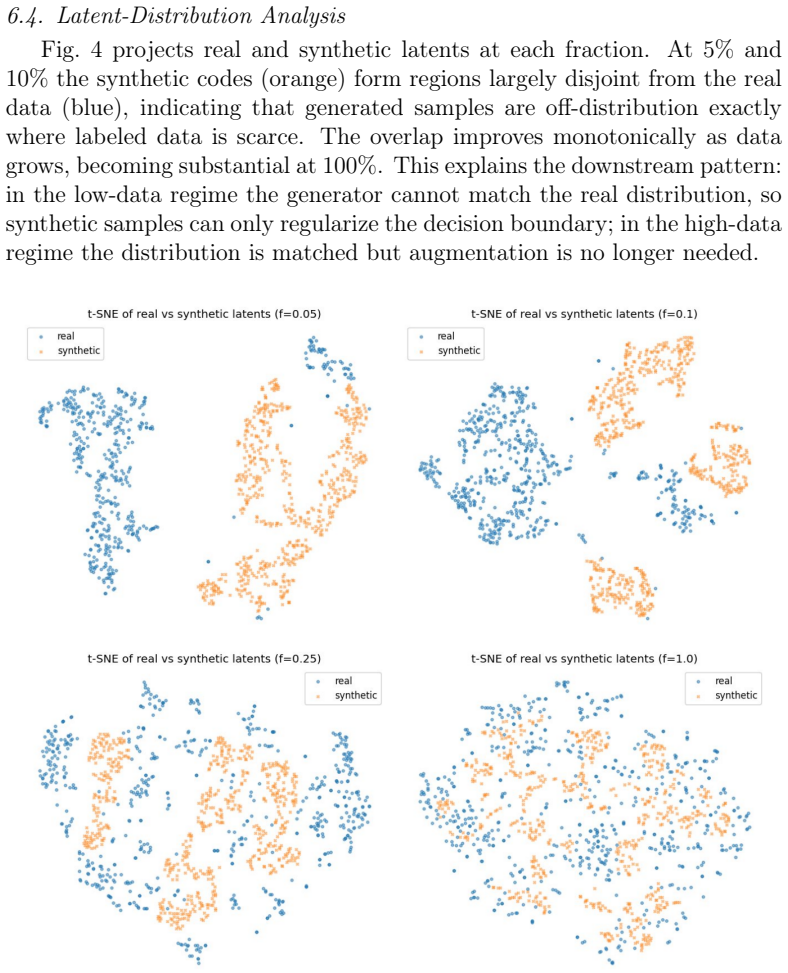
Across all data fractions, augmentation with decoded samples from either generator produces no statistically significant accuracy gain over real-data-only training; the quantum generator (1648 parameters) and classical generator (1632 parameters) remain indistinguishable under paired testing; synthetic images lie outside the real latent distribution and exhibit severe mode collapse exactly where labeled data is scarcest; the quantum generator supplies no measurable diversity advantage over its classical counterpart.
Load-bearing premise
The pretrained encoder-decoder's KL-regularized latent space must preserve all task-relevant information so that generation quality can be compared fairly; if the latent representation itself drops or distorts features needed for classification, the entire quantum-versus-classical comparison becomes uninformative.
Editorial extensions
If this is right
- Synthetic augmentation cannot be treated as faithful data expansion when samples are off-distribution and mode-collapsed.
- Quantum generators must be compared under identical parameter budgets and statistical protocols before advantage claims are accepted.
- Diversity and distribution-shift diagnostics are required to distinguish regularization effects from genuine augmentation.
- Pretrained latent representations may discard information critical to the downstream task regardless of generator type.
Reading between the lines
- The same controlled protocol could be applied to other quantum generative architectures beyond variational circuits to test whether the null result is architecture-specific.
- If the latent space is the dominant bottleneck, replacing the KL-regularized autoencoder with an information-preserving alternative might change whether any generator helps.
- The finding suggests that low-data medical imaging problems may need advances in representation learning or acquisition rather than generator choice alone.
Editorial analysis
A structured set of objections, weighed in public.
Referee Report
Summary. The paper presents a controlled benchmark for brain-MRI classification augmentation using a KL-regularized latent space in which conditional WGAN-GP models are trained with either a variational quantum generator or a near-identical-parameter classical generator (1648 vs 1632 parameters). Synthetic samples are decoded and used to augment a downstream classifier across labeled-data fractions (5–100 %), evaluated over eight seeds with paired significance testing and multiple-comparison correction, plus explicit diversity and distribution-shift metrics. The central result is that no augmentation variant significantly outperforms real-data-only training, the quantum and classical generators are statistically indistinguishable, and any low-data benefit is attributable to regularization rather than faithful data expansion because the synthetics are off-distribution and mode-collapsed.
Significance. If the result holds, the work supplies a rigorously controlled negative finding that challenges earlier reports of quantum advantage in medical-image augmentation. Strengths include the explicit parameter-matched generators, multi-seed paired testing with correction, and the release of the protocol as a reusable testbed. The design isolates the generator contribution and quantifies both accuracy and distributional fidelity, providing a template for future claims in the area.
major comments (1)
- [Abstract / Methods] Abstract and Methods: the entire comparison rests on the assumption that the pretrained KL-regularized encoder-decoder produces a latent space that both supports faithful generation and retains all task-relevant information for the downstream classifier. No quantitative validation is reported (reconstruction FID, linear-probe accuracy on latents, or end-to-end accuracy gap between original and decoded real images). If the latent representation discards class-discriminative features or introduces artifacts, the observed null results and off-distribution behavior could be artifacts of the autoencoder rather than properties of the generators, rendering the quantum-vs-classical comparison uninformative.
minor comments (1)
- [Abstract] Abstract: typographical error 'thanits' should be 'than its'.
Simulated Author's Rebuttal
We thank the referee for the constructive feedback and for recognizing the controlled design of the benchmark. We address the single major comment below and agree that additional validation is warranted.
read point-by-point responses
-
Referee: [Abstract / Methods] Abstract and Methods: the entire comparison rests on the assumption that the pretrained KL-regularized encoder-decoder produces a latent space that both supports faithful generation and retains all task-relevant information for the downstream classifier. No quantitative validation is reported (reconstruction FID, linear-probe accuracy on latents, or end-to-end accuracy gap between original and decoded real images). If the latent representation discards class-discriminative features or introduces artifacts, the observed null results and off-distribution behavior could be artifacts of the autoencoder rather than properties of the generators, rendering the quantum-vs-classical comparison uninformative.
Authors: We agree that the absence of explicit autoencoder validation is a limitation. The manuscript relies on a standard KL-regularized latent space without reporting reconstruction FID, linear-probe accuracy on latents, or the accuracy gap between original and decoded images. In the revised version we will add these metrics (reconstruction FID on the test set, linear-probe accuracy using the latents as features, and end-to-end classification accuracy on reconstructed versus original images) to demonstrate that task-relevant information is retained. Because the quantum and classical generators operate in exactly the same latent space, the relative comparison between them remains internally valid; the added metrics will clarify whether the observed null results and distributional issues are properties of the generators or of the shared encoder-decoder. revision: yes
Circularity Check
No circularity: empirical benchmark derives results directly from experiments
full rationale
The paper reports outcomes from a controlled empirical protocol involving training of encoders, generators (quantum and classical), decoding, augmentation, and statistical evaluation across data fractions and seeds. No derivation chain reduces a claimed prediction or result to its own inputs by construction, fitted parameters renamed as predictions, or load-bearing self-citations. The central claims (no augmentation benefit, quantum-classical indistinguishability) are computed directly from classifier accuracies, diversity metrics, and significance tests on generated samples, making the work self-contained against external benchmarks.
Assumptions & free parameters
assumptions (1)
- domain assumption The pretrained KL-regularized encoder-decoder produces a latent space that preserves classification-relevant information for brain MRI.
Cite this review
Pith. "Pith review of A Controlled Benchmark of Quantum-Latent GAN Augmentation for Brain MRI." pith.science (2026). https://pith.science/paper/JFCVEWQ6
@misc{pith2026260618970,
  author       = {Pith},
  title        = {Pith review of: A Controlled Benchmark of Quantum-Latent GAN Augmentation for Brain MRI},
  year         = {2026},
  howpublished = {\url{https://pith.science/paper/JFCVEWQ6}},
  note         = {Machine review of arXiv:2606.18970}
}
read the original abstract
Medical image classification is often constrained by limited labeled data, motivating generative augmentation; recently, quantum generative models have been proposed for this purpose, frequently reporting accuracy gains. However, such claims are typically based on single training runs, do not match the parameter budgets of the quantum and classical generators, and do not characterize the data regime in which any benefit appears. We present a controlled benchmark that isolates the contribution of a quantum generator to brain-MRI augmentation. Images are encoded into a KL-regularized latent space in which a conditional Wasserstein GAN with gradient penalty is trained using either a variational quantum generator or a classical generator of near-identical parameter count (1648 vs. 1632). Synthetic samples are decoded and used to augment a pretrained classifier across labeled data fractions from 5% to 100%, evaluated over eight random seeds with paired significance testing (with multiple-comparison correction) and with intraset diversity and latent-distribution analyses. Across all fractions, no augmentation variant significantly outperforms real-data-only training, and the quantum and classical generators are statistically indistinguishable. Any low-data benefit behaves as regularization rather than faithful data expansion:synthetic samples are off distribution and severely mode collapsed precisely where data is scarce, and the quantum generator is no more diverse thanits classical counterpart. We release the protocol as a testbed for rigorous evaluation of quantum generative augmentation in medical imaging.
Figures


Figures from the paper (1 more)
Reference graph
Works this paper leans on
-
[1]
Brain tumor recognition from mri using deep learning with data balancing methods and its explainability with ai,
A. Al Noman and A. S. M. Arif, “Brain tumor recognition from mri using deep learning with data balancing methods and its explainability with ai,” inInternational Conference on Image Processing and Capsule Networks, pp. 523–538, Springer, 2023. 14
2023
-
[2]
Medgan: An adaptive gan approach for medical image generation,
K. Guo, J. Chen, T. Qiu, S. Guo, T. Luo, T. Chen, and S. Ren, “Medgan: An adaptive gan approach for medical image generation,”Computers in Biology and Medicine, vol. 163, p. 107119, 2023
2023
-
[3]
The use of generative adversarial networks in medical image augmentation,
A. Makhlouf, M. Maayah, N. Abughanam, and C. Catal, “The use of generative adversarial networks in medical image augmentation,”Neural Computing and Applications, vol. 35, no. 34, pp. 24055–24068, 2023
2023
-
[4]
Latent style-based quantum gan for high-quality image generation,
S. Y. Chang, S. Thanasilp, B. L. Saux, S. Vallecorsa, and M. Grossi, “Latent style-based quantum gan for high-quality image generation,” arXiv preprint arXiv:2406.02668, 2024
-
[5]
Hybridquantum– classical generative adversarial network for high-resolution image gener- ation,
S.L.Tsang, M.T.West, S.M.Erfani, andM.Usman, “Hybridquantum– classical generative adversarial network for high-resolution image gener- ation,”IEEE Transactions on Quantum Engineering, vol. 4, pp. 1–19, 2023
2023
-
[6]
Hi- erarchical amortized gan for 3d high resolution medical image synthe- sis,
L. Sun, J. Chen, Y. Xu, M. Gong, K. Yu, and K. Batmanghelich, “Hi- erarchical amortized gan for 3d high resolution medical image synthe- sis,”IEEE journal of biomedical and health informatics, vol. 26, no. 8, pp. 3966–3975, 2022
2022
-
[7]
U-patch gan: A medical image fusion method based on gan,
C. Fan, H. Lin, and Y. Qiu, “U-patch gan: A medical image fusion method based on gan,”Journal of Digital Imaging, vol. 36, no. 1, pp. 339–355, 2023
2023
-
[8]
Image enhancement for accelerated mri using a joint gan and diffusion model framework,
Q. Zhong, S. Zhu, J. He, H. Wang, and R. Zhong, “Image enhancement for accelerated mri using a joint gan and diffusion model framework,” Medical Physics, vol. 53, no. 1, p. e70242, 2026
2026
Show all 23 references
-
[9]
A multimodal comparison of latent denoising diffusion probabilistic mod- els and generative adversarial networks for medical image synthesis,
G. Müller-Franzes, J. M. Niehues, F. Khader, S. T. Arasteh, C. Haar- burger, C. Kuhl, T. Wang, T. Han, T. Nolte, S. Nebelung,et al., “A multimodal comparison of latent denoising diffusion probabilistic mod- els and generative adversarial networks for medical image synthesis,” ...
2023
-
[10]
A survey of recent advances in quantum generative adversarial networks,
T. A. Ngo, T. Nguyen, and T. C. Thang, “A survey of recent advances in quantum generative adversarial networks,”Electronics, vol. 12, no. 4, p. 856, 2023. 15
2023
-
[11]
Barren plateaus in variational quantum computing,
M. Larocca, S. Thanasilp, S. Wang, K. Sharma, J. Biamonte, P. J. Coles, L. Cincio, J. R. McClean, Z. Holmes, and M. Cerezo, “Barren plateaus in variational quantum computing,”Nature Reviews Physics, vol. 7, no. 4, pp. 174–189, 2025
2025
-
[12]
Quan- tum generative learning for high-resolution medical image generation,
A. Khatun, K. Yeter Aydeniz, Y. S. Weinstein, and M. Usman, “Quan- tum generative learning for high-resolution medical image generation,” Machine Learning: Science and Technology, vol. 6, no. 2, p. 025032, 2025
2025
-
[13]
A quantum-classical gan approach for highfidelity brain mri resolution enhancement,
B. Hanafi and M. Ali, “A quantum-classical gan approach for highfidelity brain mri resolution enhancement,” in2025 12th International Confer- ence on Computing for Sustainable Global Development (INDIACom), pp. 1–7, IEEE, 2025
2025
-
[14]
Image denoising using quantum deep convolutional generative adversarial network for medical images,
P. Nandal, S. Pahal, and G. M. Upadhyay, “Image denoising using quantum deep convolutional generative adversarial network for medical images,”International Journal of Computational Intelligence Systems, vol. 18, no. 1, p. 190, 2025
2025
-
[15]
Fusion-aware quantum variational autoencoder for brain-heart signal modeling in mental health applications,
A. Jabbar, H. Jianjun, M. K. Jabbar, T. Mahmood, and S. M. Haider, “Fusion-aware quantum variational autoencoder for brain-heart signal modeling in mental health applications,”Journal of King Saud Univer- sity Computer and Information Sciences, vol. 37, no. 9, pp. 1–21, 2025
2025
-
[16]
Flwgan: Fed- erated learning with wasserstein generative adversarial network for brain tumor segmentation,
D. Peketi, V. Chalavadi, C. K. Mohan, and Y. W. Chen, “Flwgan: Fed- erated learning with wasserstein generative adversarial network for brain tumor segmentation,” in2023 International Joint Conference on Neural Networks (IJCNN), pp. 1–8, IEEE, 2023
2023
-
[17]
A novel conditional wasserstein deep convolu- tional generative adversarial network,
A. Roy and D. Dasgupta, “A novel conditional wasserstein deep convolu- tional generative adversarial network,”IEEE Transactions on Artificial Intelligence, 2023
2023
-
[18]
Hybrid quantum-classical machine learning with penny- lane: Acomprehensiveguideforcomputationalresearch,
S. Shapiro, “Hybrid quantum-classical machine learning with penny- lane: Acomprehensiveguideforcomputationalresearch,”arXiv preprint arXiv:2511.14786, 2025
2025
-
[19]
Resnet and its application to medical imageprocessing: Researchprogressandchallenges,
W. Xu, Y.-L. Fu, and D. Zhu, “Resnet and its application to medical imageprocessing: Researchprogressandchallenges,”Computer Methods and Programs in Biomedicine, vol. 240, p. 107660, 2023. 16
2023
-
[20]
Feature extraction for generative medical imaging evaluation: New evidence against an evolving trend,
M. Woodland, A. Castelo, M. Al Taie, J. Albuquerque Marques Silva, M. Eltaher, F. Mohn, A. Shieh, S. Kundu, J. P. Yung, A. B. Patel, et al., “Feature extraction for generative medical imaging evaluation: New evidence against an evolving trend,” inInternational Conference on Me...
2024
-
[21]
Theoretical foundations of t-sne for visualiz- ing high-dimensional clustered data,
T. T. Cai and R. Ma, “Theoretical foundations of t-sne for visualiz- ing high-dimensional clustered data,”Journal of Machine Learning Re- search, vol. 23, no. 301, pp. 1–54, 2022
2022
-
[22]
Brain tumor mri dataset (glioma meningioma pituitary no tumor),
M. K. Hira, M. Hossain, M. A. Bithee, U. Sara, M. Hasan, A. Towsif, and M. Ahmed, “Brain tumor mri dataset (glioma meningioma pituitary no tumor),”Mendeley Data, vol. 1, p. 2025, 2025
2025
-
[23]
Quantum- classical-quantum workflow in quantum-hpc middleware with gpu ac- celeration,
K.-C. Chen, X. Li, X. Xu, Y.-Y. Wang, and C.-Y. Liu, “Quantum- classical-quantum workflow in quantum-hpc middleware with gpu ac- celeration,” in2024 International Conference on Quantum Communica- tions, Networking, and Computing (QCNC), pp. 304–311, IEEE, 2024. 17
2024
Reviewed June 26, 2026 · model on record in the stance chip above.
Discussion (0). Sign in to comment.