Controlling magnetic domain walls with supercurrents
Pith reviewed 2026-06-26 18:53 UTC · model grok-4.3
The pith
Supercurrents in a superconductor-magnetic insulator bilayer generate spin accumulation that drives magnetic domain walls via Gilbert damping, producing a detectable local voltage at far lower power than normal currents.
A machine-rendered reading of the paper's core claim, the machinery that carries it, and where it could break.
Core claim
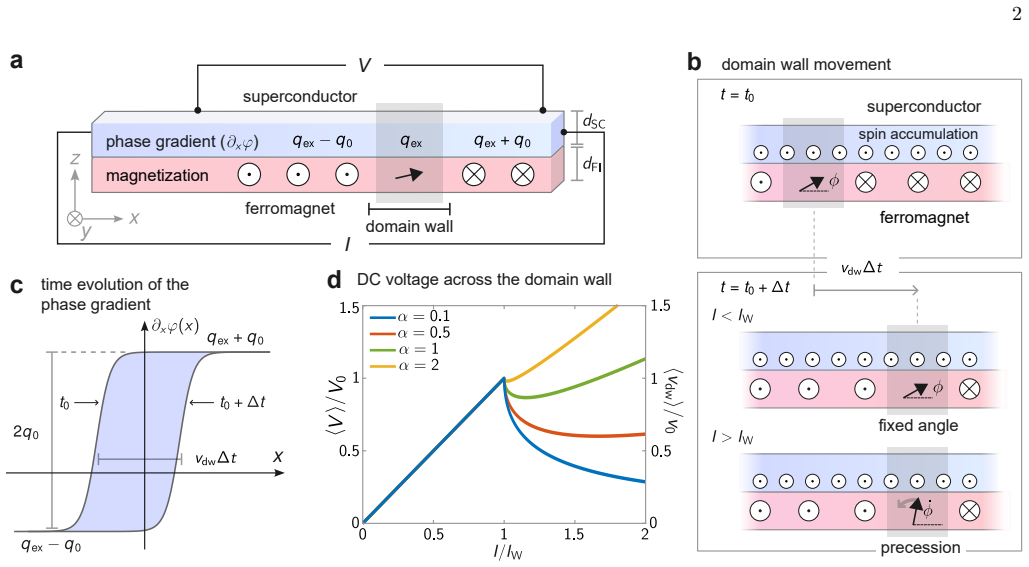
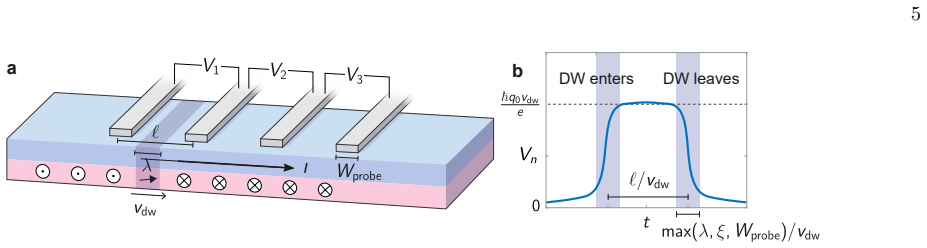
The supercurrent driven generation of spin accumulation in a superconductor/magnetic insulator bilayer, together with Gilbert damping of magnetization lead to a motion of magnetic domain walls. This manifests as a local voltage across the wall, which allows its position to be identified. Associated with this voltage and the current, there is Joule power which is dissipated via the Gilbert damping. The power required to maintain domain wall motion is orders of magnitude smaller than in the normal state, where most of the power is wasted in producing the current.
What carries the argument
Supercurrent-induced spin accumulation at the superconductor/magnetic insulator interface, coupled to magnetization dynamics through Gilbert damping.
If this is right
- Domain-wall position can be read electrically from the local voltage without additional sensors.
- Steady domain-wall motion can be maintained with power dissipation set only by Gilbert damping rather than by normal-state resistance.
- Magnetic insulators become viable for supercurrent-controlled memory elements because the mechanism does not require long spin relaxation lengths inside the magnet.
- The same voltage signal provides a direct electrical signature of domain-wall velocity under supercurrent drive.
Where Pith is reading between the lines
- The voltage readout could serve as a non-volatile memory bit that is compatible with superconducting logic circuits.
- Similar spin-accumulation effects might be tested in bilayers containing other insulating magnets or antiferromagnets to widen the range of usable materials.
- The mechanism suggests that domain-wall velocity could be tuned continuously by small changes in supercurrent density, offering analog control options.
- If the local voltage scales linearly with wall speed, arrays of such bilayers could function as low-power position sensors in cryogenic environments.
Load-bearing premise
The spin accumulation produced by the supercurrent must be large enough and couple effectively to the magnetization to drive domain wall motion against the material's magnetic anisotropy without being suppressed by proximity effects or other superconducting phenomena.
What would settle it
Observe whether a supercurrent below the critical value in an S/MI bilayer produces both measurable domain-wall motion and a local voltage across the wall while the total dissipated power remains orders of magnitude below the normal-state value.
Figures
read the original abstract
Establishing a versatile, fast and reliable magnetic memory technology is a giant bottleneck for cryogenic computing since present-day room-temperature solutions either cease to work or consume too much power. The long-term goal of superconducting spintronics has been to overcome this bottleneck by generating magnetic memories with equal-spin triplet supercurrent driven through them to control their magnetization direction. This path has been hampered by the short spin relaxation length and strong anisotropy in ferromagnets. Here we show how the supercurrent driven generation of spin accumulation in a superconductor/magnetic insulator bilayer, together with Gilbert damping of magnetization lead to a motion of magnetic domain walls. This manifests as a local voltage across the wall, which allows its position to be identified. Associated with this voltage and the current, there is Joule power which is dissipated via the Gilbert damping. The power required to maintain domain wall motion is orders of magnitude smaller than in the normal state, where most of the power is wasted in producing the current.
Editorial analysis
A structured set of objections, weighed in public.
Referee Report
Summary. The manuscript claims that supercurrent-driven spin accumulation in a superconductor/magnetic insulator bilayer, combined with Gilbert damping, induces motion of magnetic domain walls. This motion produces a detectable local voltage across the wall, and the associated Joule power dissipated through damping is orders of magnitude lower than the power required to drive equivalent currents in the normal state.
Significance. If the proposed mechanism is quantitatively validated, it would provide a low-power route to electrically addressable magnetic domain walls at cryogenic temperatures, directly addressing the power bottleneck for magnetic memory in superconducting spintronics and cryogenic computing. The approach sidesteps the short spin-relaxation lengths and strong anisotropy that have limited triplet-supercurrent control in ferromagnets.
major comments (1)
- The central claim of orders-of-magnitude power reduction rests on the magnitude and effectiveness of the supercurrent-induced spin accumulation and its coupling to the magnetization via Gilbert damping; without the explicit model, equations, or numerical estimates for these quantities, the quantitative advantage over the normal state cannot be verified.
Simulated Author's Rebuttal
We thank the referee for their review and for identifying the need to strengthen the quantitative basis of the power-reduction claim. We address the major comment below.
read point-by-point responses
-
Referee: The central claim of orders-of-magnitude power reduction rests on the magnitude and effectiveness of the supercurrent-induced spin accumulation and its coupling to the magnetization via Gilbert damping; without the explicit model, equations, or numerical estimates for these quantities, the quantitative advantage over the normal state cannot be verified.
Authors: We agree that the quantitative advantage cannot be verified without explicit modeling. The present manuscript describes the mechanism at a conceptual level but does not supply the full set of equations or numerical estimates. In the revised manuscript we will add a dedicated section that (i) derives the supercurrent-induced spin accumulation at the superconductor/magnetic-insulator interface, (ii) incorporates the resulting torque into the Landau-Lifshitz-Gilbert equation via the Gilbert damping term, (iii) obtains the domain-wall velocity, and (iv) computes the dissipated power, providing direct numerical comparison with the normal-state case. revision: yes
Circularity Check
No significant circularity detected
full rationale
The provided abstract frames the central claim as a direct physical consequence of supercurrent-driven spin accumulation in a superconductor/magnetic insulator bilayer combined with Gilbert damping, resulting in domain wall motion and associated voltage. No equations, fitted parameters, self-citations, or ansatzes are shown that reduce any prediction or result to the inputs by construction. The derivation chain is presented as independent from external physical mechanisms and does not match any of the enumerated circularity patterns. This aligns with the reader's assessment of no evident circular reasoning in the abstract.
Axiom & Free-Parameter Ledger
Reference graph
Works this paper leans on
-
[1]
Controlling magnetic domain walls with supercurrents
This means that supercurrent-driven domain wall motion is a nonequilibrium effect which requires power P=IVto maintain the current. This power is dissipated through damping in the ferromagnetic insulator. As the resistance is only due to domain wall motion, the heating is orders of magnitude weaker than in corresponding normal-metal setups. Strictly speak...
work page internal anchor Pith review Pith/arXiv arXiv doi:10.13039/501100011033 2026
-
[2]
Bergeret, A
F. Bergeret, A. F. Volkov, and K. Efetov, Phys. Rev. Lett.86, 4096 (2001)
2001
-
[3]
T. S. Khaire, M. A. Khasawneh, W. Pratt Jr, and N. O. Birge, Phys. Rev. Lett.104, 137002 (2010)
2010
-
[4]
Robinson, J
J. Robinson, J. Witt, and M. Blamire, Science329, 59 (2010)
2010
-
[5]
Sprungmann, K
D. Sprungmann, K. Westerholt, H. Zabel, M. Weides, and H. Kohlstedt, Phys. Rev. B82, 060505 (2010)
2010
-
[6]
N. O. Birge, Phil. Trans. R. Soc. A376, 20150150 (2018)
2018
-
[7]
Linder and J
J. Linder and J. W. Robinson, Nat. Phys. , 307 (2015)
2015
-
[8]
G. Yang, C. Ciccarelli, and J. W. Robinson, APL Mater. 9, 050703 (2021)
2021
-
[9]
K.-R. Jeon, X. Montiel, S. Komori, C. Ciccarelli, J. Haigh, H. Kurebayashi, L. F. Cohen, A. K. Chan, K. D. Stenning, C.-M. Lee, M. Eschrig, M. G. Blamire, and J. W. A. Robinson, Phys. Rev. X10, 031020 (2020)
2020
-
[10]
Mart´ ınez, P
I. Mart´ ınez, P. H¨ ogl, C. Gonz´ alez-Ruano, J. P. Cascales, C. Tiusan, Y. Lu, M. Hehn, A. Matos-Abiague, J. Fabian, I. ˇZuti´ c, and F. G. Aliev, Phys. Rev. Appl.13, 014030 (2020)
2020
-
[11]
K.-R. Jeon, K. Cho, A. Chakraborty, J.-C. Jeon, J. Yoon, H. Han, J.-K. Kim, and S. S. Parkin, ACS Nano15, 16819 (2021)
2021
-
[12]
Bhatia, A
E. Bhatia, A. Srivastava, J. Devine-Stoneman, N. A. Stelmashenko, Z. H. Barber, J. W. Robinson, and K. Senapati, Nano Lett.21, 3092 (2021)
2021
-
[13]
K.-R. Jeon, B. K. Hazra, J.-K. Kim, J.-C. Jeon, H. Han, H. L. Meyerheim, T. Kontos, A. Cottet, and S. S. Parkin, Nat. Nanotechnol.18, 747 (2023)
2023
-
[14]
A. K. Chan, M. Cubukcu, X. Montiel, S. Komori, A. Vanstone, J. E. Thompson, G. K. Perkins, C. Kinane, A. Caruana, D. Boldrin,et al., Commun. Phys.6, 287 (2023)
2023
-
[15]
A. T. Bregazzi, J. A. Ouassou, A. Coveney, N. A. Stelmashenko, A. Child, A. T. N’Diaye, J. W. Robinson, F. K. Dejene, J. Linder, and N. Banerjee, Appl. Phys. Lett.124, 162602 (2024)
2024
-
[16]
Mineev and K
V. Mineev and K. Samokhin, Zh. Eksp. Teor. Fiz105, 747 (1994)
1994
-
[17]
V. M. Edelstein, Phys. Rev. Lett.75, 2004 (1995)
2004
-
[18]
Konschelle, I
F. Konschelle, I. V. Tokatly, and F. S. Bergeret, Phys. Rev. B92, 125443 (2015)
2015
-
[19]
S. D. Ganichev, M. Trushin, and J. Schliemann, in Spintronics Handbook, Second Edition: Spin Transport and Magnetism(CRC Press, 2019) pp. 317–338, 7 arXiv:1606.02043 [cond-mat.mes-hall]
arXiv 2019
-
[20]
Abert, Eur
C. Abert, Eur. Phys. J. B92, 120 (2019)
2019
-
[21]
F. S. Bergeret and I. V. Tokatly, Phys. Rev. B94, 180502(R) (2016)
2016
-
[22]
Virtanen, F
P. Virtanen, F. S. Bergeret, and I. V. Tokatly, Phys. Rev. B104, 064515 (2021)
2021
-
[23]
Virtanen, A
P. Virtanen, A. Vargunin, and M. Silaev, Phys. Rev. B 101, 094507 (2020)
2020
-
[24]
Brataas, Y
A. Brataas, Y. V. Nazarov, and G. E. W. Bauer, Phys. Rev. Lett.84, 2481 (2000)
2000
-
[25]
Meservey and P
R. Meservey and P. Tedrow, Phys. Rep.238, 173 (1994)
1994
-
[26]
F. S. Bergeret, M. Silaev, P. Virtanen, and T. T. Heikkil¨ a, Rev. Mod. Phys.90, 041001 (2018)
2018
-
[27]
T. T. Heikkil¨ a, M. Silaev, P. Virtanen, and F. S. Bergeret, Prog. Surf. Sci.94, 100540 (2019)
2019
-
[28]
Hijano, S
A. Hijano, S. Ili´ c, M. Rouco, C. Gonz´ alez-Orellana, M. Ilyn, C. Rogero, P. Virtanen, T. T. Heikkil¨ a, S. Khorshidian, M. Spies, N. Ligato, F. Giazotto, E. Strambini, and F. S. Bergeret, Phys. Rev. Res.3, 023131 (2021)
2021
-
[29]
Kokkeler, F
T. Kokkeler, F. S. Bergeret, and I. V. Tokatly, Phys. Rev. Lett.134, 096001 (2025)
2025
-
[30]
K. M. Hals, Phys. Rev. B93, 115431 (2016)
2016
-
[31]
Gilbert, IEEE Trans
T. Gilbert, IEEE Trans. Magn.40, 3443 (2004)
2004
-
[32]
Thiele, Phys
A. Thiele, Phys. Rev. Lett.30, 230 (1973)
1973
-
[33]
Tatara, H
G. Tatara, H. Kohno, and J. Shibata, Physics Reports 468, 213 (2008)
2008
-
[34]
N. L. Schryer and L. R. Walker, J. Appl. Phys.45, 5406 (1974)
1974
-
[35]
Takashima, S
R. Takashima, S. Fujimoto, and T. Yokoyama, Phys. Rev. B96, 121203 (2017)
2017
-
[36]
Bobkova, A
I. Bobkova, A. Bobkov, and M. Silaev, Phys. Rev. B98, 014521 (2018)
2018
-
[37]
D. S. Rabinovich, I. V. Bobkova, A. M. Bobkov, and M. A. Silaev, Phys. Rev. Lett.123, 207001 (2019)
2019
-
[38]
Sobolev, H
V. Sobolev, H. Huang, and S. Chen, J. Magn. Magn. Mater.147, 284 (1995)
1995
-
[39]
I. V. Tokatly, Y. Lu, and F. S. Bergeret, (2025), arXiv:2512.23536 [cond-mat.supr-con]
arXiv 2025
-
[40]
M. A. Silaev, Phys. Rev. B102, 144521 (2020)
2020
-
[41]
S. S. Parkin, M. Hayashi, and L. Thomas, Science320, 190 (2008)
2008
-
[42]
Xiang, Q
B. Xiang, Q. He, Y. Lin, K. Liang, Z. Li, J. Zhu, B. Chen, Y. Wang, P. Zhang, H. Yao,et al., Nat. Comm.14, 4294 (2026)
2026
-
[43]
E. Derunova, Y. Sun, C. Felser, S. Parkin, B. Yan, and M. Ali, Science Advances5, 10.1126/sciadv.aav8575 (2019)
-
[44]
He and K
W.-Y. He and K. Law, Phys. Rev. Res.2, 012073 (2020)
2020
-
[45]
Mazanik, T
A. Mazanik, T. Kokkeler, I. Tokatly, and F. S. Bergeret, Phys. Rev. B112, 024514 (2025)
2025
-
[46]
E. Andriyakhina, M. Mansouri, M. Breitkreiz, and P. Brouwer, (2026), arXiv:2604.14390 [cond-mat.mes-hall]
Pith/arXiv arXiv 2026
-
[47]
E. T. Swartz and R. O. Pohl, Rev. Mod. Phys.61, 605 (1989)
1989
-
[48]
D. C. McCollum, R. L. Wild, and J. Callaway, Phys. Rev. 136, A426 (1964)
1964
-
[49]
Passenheim, D
B. Passenheim, D. McCollum, and J. Callaway, Physics Letters23, 634 (1966)
1966
-
[50]
Efetov, A
K. Efetov, A. Larkin, and D. Kheml’Nitskiˇ ı, Soviet Journal of Experimental and Theoretical Physics[JETP 52,568]52, 568 (1980)
1980
-
[51]
Wegner, Zeitschrift f¨ ur Physik B Condensed Matter 35, 207 (1979)
F. Wegner, Zeitschrift f¨ ur Physik B Condensed Matter 35, 207 (1979)
1979
-
[52]
Finkelshtein, Zh
A. Finkelshtein, Zh. Eksp. Teor. Fiz.[JETP 57, 97]84, 168 (1983)
1983
-
[53]
Kamenev,Field theory of non-equilibrium systems (Cambridge University Press, 2023)
A. Kamenev,Field theory of non-equilibrium systems (Cambridge University Press, 2023)
2023
-
[54]
Virtanen, F
P. Virtanen, F. S. Bergeret, and I. V. Tokatly, Phys. Rev. B105, 224517 (2022)
2022
-
[55]
H. M. Hurst, V. Galitski, and T. T. Heikkil¨ a, Phys. Rev. B101, 054407 (2020)
2020
-
[56]
Zhang, F
X.-P. Zhang, F. S. Bergeret, and V. N. Golovach, Nano letters19, 6330 (2019)
2019
-
[57]
K. D. Usadel, Phys. Rev. Lett.25, 507 (1970)
1970
-
[58]
Tatara and H
G. Tatara and H. Kohno, Phys. Rev. Lett.92, 086601 (2004)
2004
-
[59]
Kokkeler, I
T. Kokkeler, I. Tokatly, and F. S. Bergeret, SciPost Phys. 16, 055 (2024)
2024
-
[60]
Tinkham,Introduction to Superconductivity, 2nd ed
M. Tinkham,Introduction to Superconductivity, 2nd ed. (McGraw-Hill, New York, 1996). 8 DERIVATION OF COUPLED DYNAMICS FROM THE ACTION We study a bilayer of a superconductor and a ferromagnetic insulator. We assume that the superconductor can be described within the quasiclassical framework and that it is dirty, that is, that the scattering rate 1/τis much...
1996
-
[61]
The potential is defined asµ(r) = R ∞ −∞ dEtrg K(r, E), whereris a coordinate in the normal wire
In this case, the measured voltage can be obtained purely from the chemical potential. The potential is defined asµ(r) = R ∞ −∞ dEtrg K(r, E), whereris a coordinate in the normal wire. This potential however is gauge dependent, the physically relevant quantity to consider isµ N =µ+ Φ, where Φ is the scalar potential. We exploit this gauge dependence by us...
-
[62]
Similarly, there exists a gauge Φ L so that the pair potential on the left is time-independent, and by similarity we findµ N(r− → −∞,Φ = ΦL) = 0. Therefore, we find µN(rR,Φ)−µ N(rL,Φ) = Φ R −Φ L .(M51) We thus need to determine ΦR −Φ L by eliminating the time-dependence of the pair potential, i.e., ΦL −Φ R =i[∂ t∆(x− → −∞)−∂t∆(x− → ∞)].(M52) To determine ...
discussion (0)
Sign in with ORCID, Apple, or X to comment. Anyone can read and Pith papers without signing in.