Bistable by Construction: Wall-Clock-Calibrated State Monitors Have No Moment-Detection Regime at Agent Cadence
Pith reviewed 2026-06-27 02:15 UTC · model grok-4.3
The pith
Wall-clock-calibrated monitors on agent streams enter a saturation trap at every realistic cadence and never detect moments.
A machine-rendered reading of the paper's core claim, the machinery that carries it, and where it could break.
Core claim
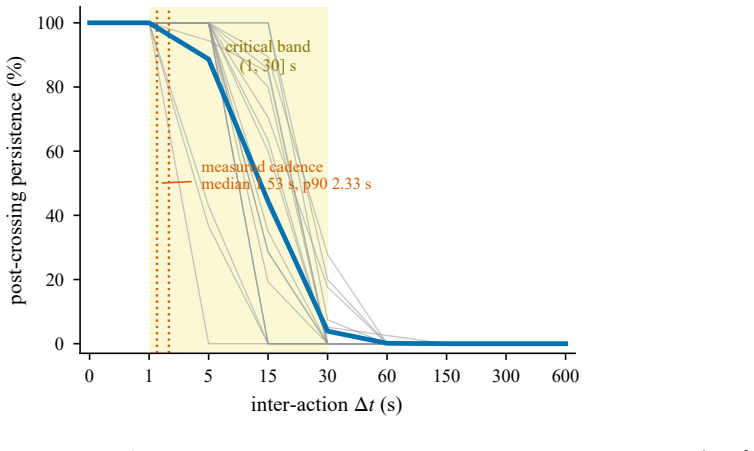
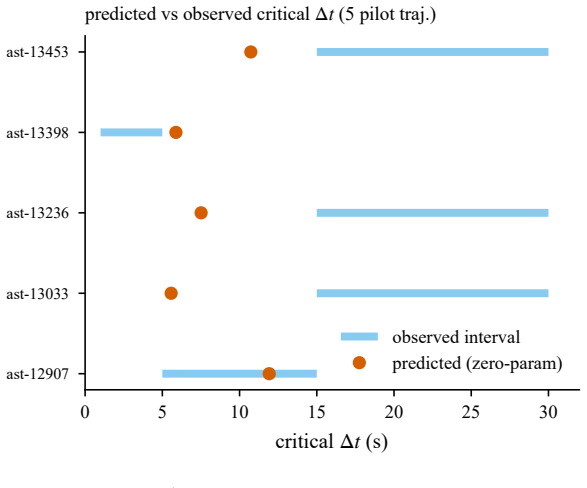
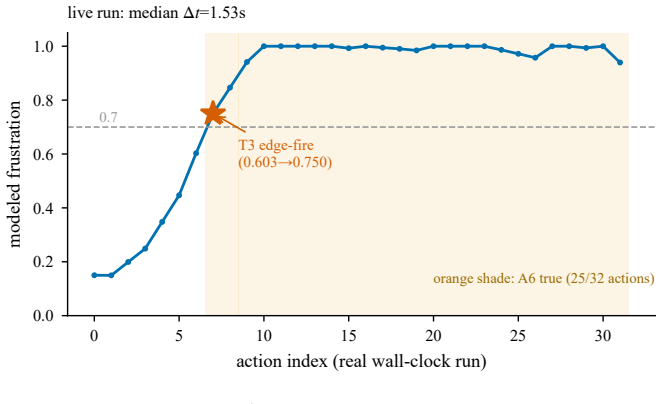
Wall-clock-calibrated leaky-integrator monitors admit no regime in which they act as moment detectors on agent streams; every critical dt lies in (1,30]s and real agent runs measure latency inside the trap regime.
What carries the argument
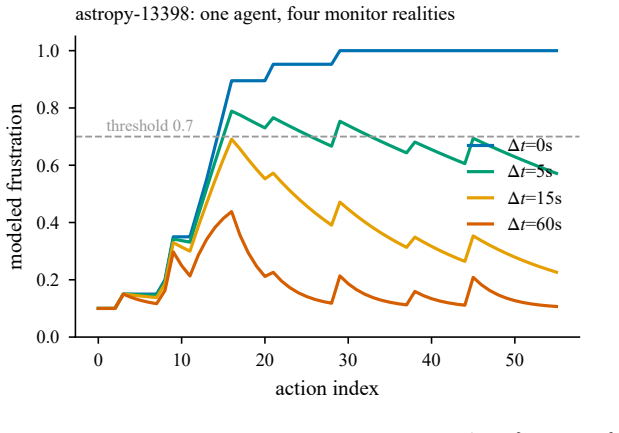
Wall-clock accumulator that integrates error over real seconds rather than sample count, producing a dt-dependent cliff between constant firing at dt<=1s and silence at dt>=60s.
If this is right
- Transition detection with hysteresis produces 0-3 firings per trajectory at every tested cadence.
- A sample-time CUSUM on the same stream remains exactly invariant to dt.
- Any wall-clock half-life or decay constant places the operating point inside the trap for observed agent latencies.
- The published saturation trap on SWE-bench agents is explained by dt=0 inputs rather than the affect engine itself.
Where Pith is reading between the lines
- Designers who need reliable moment detection on irregular streams must either switch to sample-time calibration or add explicit edge detection outside the integrator.
- The same dt cliff will appear in any EMA-style baseline or affective-state monitor whose decay is expressed in seconds.
- Intervention timing recovered by human observers cannot be reproduced by these monitors without additional timing logic.
Load-bearing premise
The uniform-interval sweep on twenty trajectories with a minimal wall-clock accumulator captures the dynamics that matter for absence of a moment-detection regime.
What would settle it
Measure the number of threshold crossings per trajectory when the identical error stream is fed to the wall-clock monitor at fixed dt values spaced through (1,30]s; the count should remain either near-maximal or near-zero in every interval.
Figures

read the original abstract
Runtime monitors for autonomous agents commonly threshold an accumulated internal state - a behavioural baseline, a drift statistic, or, in our prior work, a modelled affective state. We previously reported a State Saturation Trap: threshold-on-state triggers over a continuous affect engine become near-constant alarms on SWE-bench debugging agents (Modgil 2026). A post-release audit found the engine received dt=0 between actions, so its exponential decay never operated: the published trap is a pure-accumulator result. We correct the record (erratum, v2) and treat the flaw as an experiment. The key variable it exposes is whether a monitor's dynamics are calibrated in sample time (per observation, as in CUSUM) or wall-clock time (half-lives in seconds, as in affect models and EMA baselines). On fixed-rate streams these coincide; on agent streams, where inter-action time varies by orders of magnitude, they do not. A pre-registered sweep over uniform intervals (dt in {0..600}s) on 20 trajectories shows the wall-clock level trigger has two regimes: at dt<=1s a constant alarm (20/20; median 18 firings); at dt>=60s silent. Every critical dt lies in (1,30]s. Real agent runs measure latency at median 1.53s (p90 2.33s); real coding cadence sits inside the trap regime, vindicating the empirical finding under a corrected mechanism. The structure is a property of the calibration class, not the engine: a minimal wall-clock accumulator over the raw error stream reproduces the same cliff, while a sample-time CUSUM over the identical stream is exactly dt-invariant (20/20). A rising-edge trigger with hysteresis fires 0-3 times per trajectory in every condition. We conclude that wall-clock-calibrated leaky-integrator monitors admit no regime in which they act as moment detectors on agent streams; transition detection escapes the trap at every cadence, but does not recover human intervention timing.
Editorial analysis
A structured set of objections, weighed in public.
Referee Report
Summary. The paper claims that wall-clock-calibrated leaky-integrator monitors (e.g., affect models) on autonomous agent streams admit no moment-detection regime: a pre-registered uniform-dt sweep on 20 trajectories reveals a sharp cliff (constant alarms at dt≤1s, silence at dt≥60s, all critical values in (1,30]s), real agent median latency 1.53s falls inside the trap, a minimal wall-clock accumulator reproduces the cliff on the error stream, while sample-time CUSUM is exactly dt-invariant and a rising-edge trigger with hysteresis fires only 0-3 times per trajectory in every condition. The structure is a property of calibration class, not the specific engine; the prior saturation-trap report is corrected as a pure-accumulator artifact.
Significance. If the central empirical distinction holds, the result is significant for runtime monitoring in agent systems: it shows that wall-clock calibration (common in EMA and affective baselines) systematically precludes reliable transition detection at realistic cadences, while sample-time methods escape the trap. Strengths include the pre-registered sweep, explicit reproduction of the cliff by a minimal accumulator, and the clean dt-invariance result for CUSUM; these provide falsifiable, reproducible evidence separating calibration classes.
major comments (3)
- [Abstract / empirical sweep] Abstract and empirical sweep section: the claim that wall-clock monitors admit no moment-detection regime on agent streams rests on a uniform fixed-dt sweep (dt ∈ {0..600}s); the manuscript states the minimal accumulator reproduces the cliff but does not report results when the accumulator is driven by the actual variable timestamp sequences of the 20 trajectories, leaving open whether short-dt clusters or long gaps could produce selective crossings absent from the uniform case.
- [Real agent runs] Real-agent latency mapping: the median 1.53s (p90 2.33s) is asserted to place real coding cadence inside the trap, yet no verification is given that the 20 trajectories' inter-action distributions are representative or that the uniform sweep bounds the behavior under the observed variable-dt statistics.
- [Minimal accumulator comparison] CUSUM invariance result: while the paper correctly shows sample-time CUSUM is dt-invariant (20/20), the corresponding wall-clock accumulator is only shown under uniform dt; without the variable-dt exercise, the contrast does not yet fully establish that the absence of a moment-detection regime is a general property of the calibration class under realistic agent timing.
minor comments (2)
- [Abstract] Abstract: no error bars, confidence intervals, or raw per-trajectory firing counts are reported for the 20/20 constant-alarm result, reducing immediate assessability of robustness.
- [Introduction / erratum note] The erratum correction for the prior dt=0 artifact is noted but the manuscript could more explicitly tabulate how the corrected wall-clock decay parameter interacts with the observed latency distribution.
Simulated Author's Rebuttal
We thank the referee for the constructive comments, which correctly identify the need to extend our analysis to variable inter-action timings drawn from the trajectories. We address each major comment below and will revise the manuscript accordingly.
read point-by-point responses
-
Referee: [Abstract / empirical sweep] Abstract and empirical sweep section: the claim that wall-clock monitors admit no moment-detection regime on agent streams rests on a uniform fixed-dt sweep (dt ∈ {0..600}s); the manuscript states the minimal accumulator reproduces the cliff but does not report results when the accumulator is driven by the actual variable timestamp sequences of the 20 trajectories, leaving open whether short-dt clusters or long gaps could produce selective crossings absent from the uniform case.
Authors: We agree that the variable-dt case for the minimal wall-clock accumulator must be reported to close this gap. In the revision we will add results obtained by driving the accumulator with the actual timestamp sequences from each of the 20 trajectories; these will show whether clusters or gaps produce crossings outside the uniform-sweep regimes. revision: yes
-
Referee: [Real agent runs] Real-agent latency mapping: the median 1.53s (p90 2.33s) is asserted to place real coding cadence inside the trap, yet no verification is given that the 20 trajectories' inter-action distributions are representative or that the uniform sweep bounds the behavior under the observed variable-dt statistics.
Authors: The reported latency statistics were computed directly from the same 20 trajectories. To verify that the uniform sweep bounds the observed variable-dt statistics, the revision will include a supplementary comparison of the empirical inter-action distribution against the critical interval (1,30]s, confirming that the bulk of real cadences lie inside the trap regime. revision: yes
-
Referee: [Minimal accumulator comparison] CUSUM invariance result: while the paper correctly shows sample-time CUSUM is dt-invariant (20/20), the corresponding wall-clock accumulator is only shown under uniform dt; without the variable-dt exercise, the contrast does not yet fully establish that the absence of a moment-detection regime is a general property of the calibration class under realistic agent timing.
Authors: We accept that the wall-clock accumulator must also be evaluated on the variable timestamps to complete the calibration-class contrast. The revision will incorporate this analysis (as noted in the response to the first comment), thereby demonstrating that the dt-invariance distinction holds under the trajectories' actual timing. revision: yes
Circularity Check
Minor self-citation for prior mechanism; central empirical claim independent
full rationale
The paper's derivation rests on a pre-registered uniform-dt sweep across 20 trajectories plus real-agent latency measurements (median 1.53 s) that place observed cadences inside the identified trap regime. A minimal wall-clock accumulator is shown to reproduce the same cliff while CUSUM remains invariant. The single self-citation (Modgil 2026) is invoked only to describe the corrected mechanism and the original dt=0 flaw; it does not supply the load-bearing evidence for the new claim that wall-clock monitors admit no moment-detection regime. No fitted parameters are renamed as predictions, no equations reduce by construction to their inputs, and the result is not forced by any uniqueness theorem or ansatz imported from prior work by the same authors.
Axiom & Free-Parameter Ledger
axioms (2)
- standard math Exponential decay operates only when dt > 0
- domain assumption Uniform sampling of dt intervals is representative of agent cadence distributions
Reference graph
Works this paper leans on
-
[2]
and Sun, Jun , booktitle =
Wang, Haoyu and Poskitt, Christopher M. and Sun, Jun , booktitle =. 2026 , eprint =
2026
-
[4]
2025 , eprint =
Andriushchenko, Maksym and Souly, Alexandra and Dziemian, Mateusz and Duenas, Derek and Lin, Maxwell and Wang, Justin and Hendrycks, Dan and Zou, Andy and Kolter, Zico and Fredrikson, Matt and Winsor, Eric and Wynne, Jerome and Gal, Yarin and Davies, Xander , booktitle =. 2025 , eprint =
2025
-
[5]
Biometrika , volume =
Continuous Inspection Schemes , author =. Biometrika , volume =. 1954 , doi =
1954
-
[6]
The Annals of Mathematical Statistics , volume =
Procedures for Reacting to a Change in Distribution , author =. The Annals of Mathematical Statistics , volume =. 1971 , doi =
1971
-
[7]
Signal Processing , volume =
Selective Review of Offline Change Point Detection Methods , author =. Signal Processing , volume =. 2020 , doi =
2020
-
[8]
Journal of Scientific Instruments , volume =
A Thermionic Trigger , author =. Journal of Scientific Instruments , volume =. 1938 , doi =
1938
-
[9]
and Zhang, Hao and Gonzalez, Joseph E
Zheng, Lianmin and Chiang, Wei-Lin and Sheng, Ying and Zhuang, Siyuan and Wu, Zhanghao and Zhuang, Yonghao and Lin, Zi and Li, Zhuohan and Li, Dacheng and Xing, Eric P. and Zhang, Hao and Gonzalez, Joseph E. and Stoica, Ion , booktitle =. Judging. 2023 , eprint =
2023
-
[10]
Proceedings of the 2022 Conference on Empirical Methods in Natural Language Processing (EMNLP) , pages =
The ``Problem'' of Human Label Variation: On Ground Truth in Data, Modeling and Evaluation , author =. Proceedings of the 2022 Conference on Empirical Methods in Natural Language Processing (EMNLP) , pages =. 2022 , doi =
2022
-
[11]
Content Analysis: An Introduction to Its Methodology , author =
-
[12]
AgentHarm : A benchmark for measuring harmfulness of LLM agents
Maksym Andriushchenko, Alexandra Souly, Mateusz Dziemian, Derek Duenas, Maxwell Lin, Justin Wang, Dan Hendrycks, Andy Zou, Zico Kolter, Matt Fredrikson, Eric Winsor, Jerome Wynne, Yarin Gal, and Xander Davies. AgentHarm : A benchmark for measuring harmfulness of LLM agents. In International Conference on Learning Representations (ICLR), 2025. arXiv:2410.09024
Pith/arXiv arXiv 2025
-
[13]
Content Analysis: An Introduction to Its Methodology
Klaus Krippendorff. Content Analysis: An Introduction to Its Methodology. Sage Publications, 2nd edition, 2004
2004
-
[14]
Procedures for reacting to a change in distribution
Gary Lorden. Procedures for reacting to a change in distribution. The Annals of Mathematical Statistics, 42 0 (6): 0 1897--1908, 1971. doi:10.1214/aoms/1177693055
-
[15]
Manvendra Modgil. The saturation trap and the subjectivity of intervention timing: Why affect-based triggers and LLM judges fail to time interventions on autonomous agents, 2026. arXiv:2606.04296
Pith/arXiv arXiv 2026
-
[16]
E. S. Page. Continuous inspection schemes. Biometrika, 41 0 (1/2): 0 100--115, 1954. doi:10.1093/biomet/41.1-2.100
-
[17]
The ``Problem'' of Human Label Variation: On Ground Truth in Data, Modeling and Evaluation
Barbara Plank. The ``problem'' of human label variation: On ground truth in data, modeling and evaluation. In Proceedings of the 2022 Conference on Empirical Methods in Natural Language Processing (EMNLP), pages 10671--10682, Abu Dhabi, United Arab Emirates, 2022. Association for Computational Linguistics. doi:10.18653/v1/2022.emnlp-main.731
-
[18]
Otto H. Schmitt. A thermionic trigger. volume 15, pages 24--26. 1938. doi:10.1088/0950-7671/15/1/305. Origin of the two-threshold (hysteresis) trigger; the bistable primitive our edge trigger implements
-
[19]
Selective review of offline change point detection methods
Charles Truong, Laurent Oudre, and Nicolas Vayatis. Selective review of offline change point detection methods. Signal Processing, 167: 0 107299, 2020. doi:10.1016/j.sigpro.2019.107299
-
[20]
Poskitt, Jiali Wei, and Jun Sun
Haoyu Wang, Christopher M. Poskitt, Jiali Wei, and Jun Sun. ProbGuard : Probabilistic runtime monitoring for LLM agent safety, 2025. arXiv:2508.00500. Note: arXiv:2508.00500 appears under the title ``ProbGuard'' on the abstract page and ``Pro2Guard'' on an earlier PDF version; cite as ProbGuard per the current abstract page
arXiv 2025
-
[21]
Haoyu Wang, Christopher M. Poskitt, and Jun Sun. AgentSpec : Customizable runtime enforcement for safe and reliable LLM agents. In Proceedings of the 48th IEEE/ACM International Conference on Software Engineering (ICSE), 2026. arXiv:2503.18666; accepted to ICSE 2026
Pith/arXiv arXiv 2026
-
[22]
Lianmin Zheng, Wei-Lin Chiang, Ying Sheng, Siyuan Zhuang, Zhanghao Wu, Yonghao Zhuang, Zi Lin, Zhuohan Li, Dacheng Li, Eric P. Xing, Hao Zhang, Joseph E. Gonzalez, and Ion Stoica. Judging LLM -as-a-judge with MT -bench and chatbot arena. In Advances in Neural Information Processing Systems (NeurIPS), 2023. arXiv:2306.05685
Pith/arXiv arXiv 2023
discussion (0)
Sign in with ORCID, Apple, or X to comment. Anyone can read and Pith papers without signing in.