Validation of the Hybrid Bias Expansion model for the galaxy bispectrum
Pith reviewed 2026-06-26 19:37 UTC · model grok-4.3
The pith
The Hybrid Bias Expansion model for the galaxy bispectrum stays self-consistent up to k_max^B of 0.25 h Mpc^{-1}.
A machine-rendered reading of the paper's core claim, the machinery that carries it, and where it could break.
Core claim
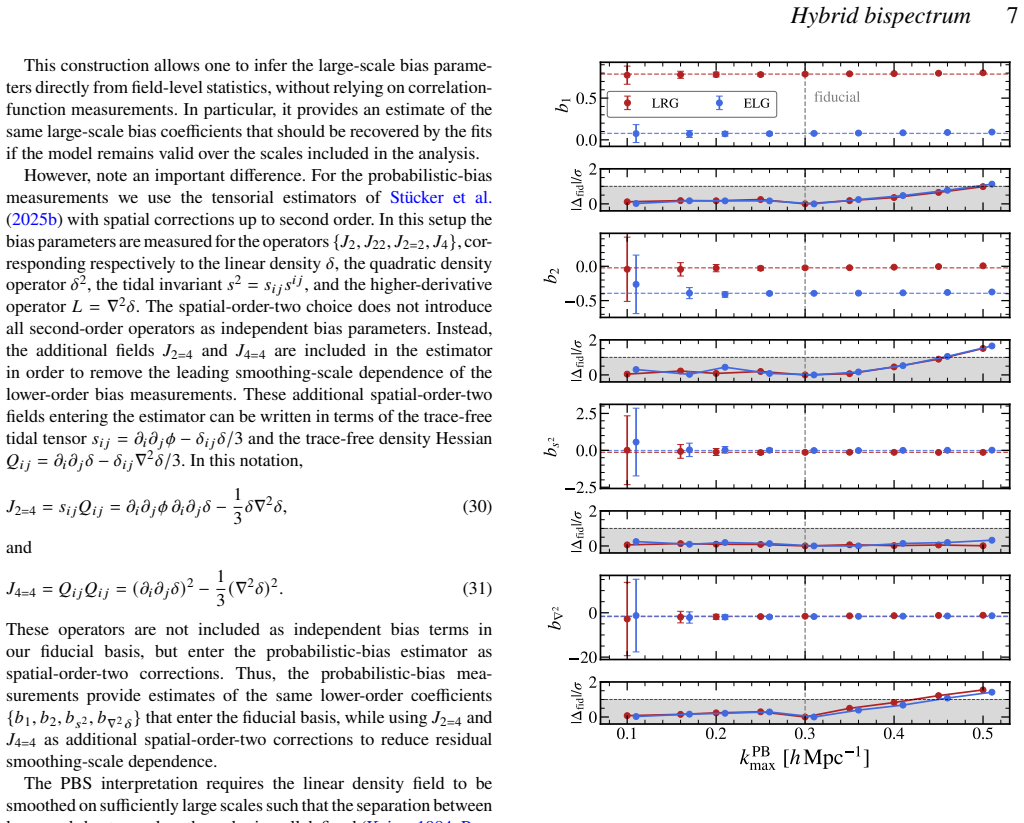
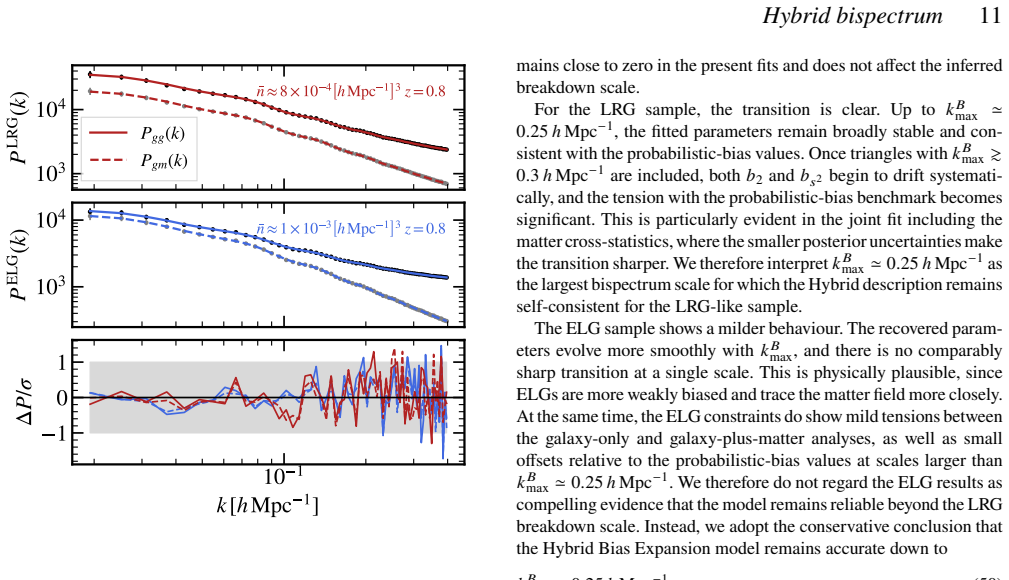
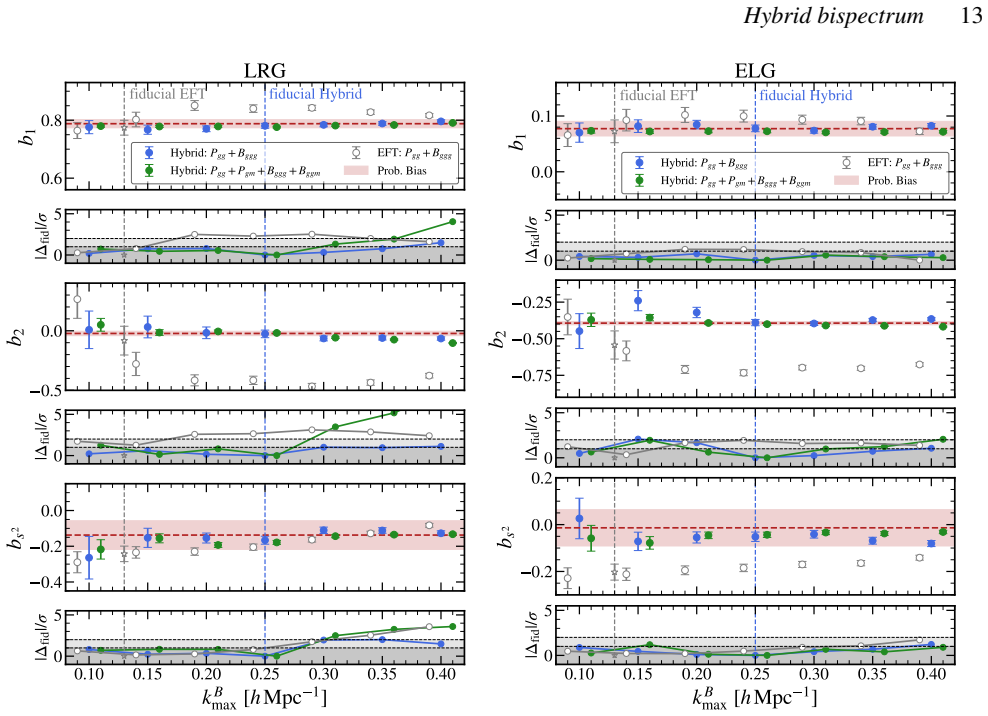
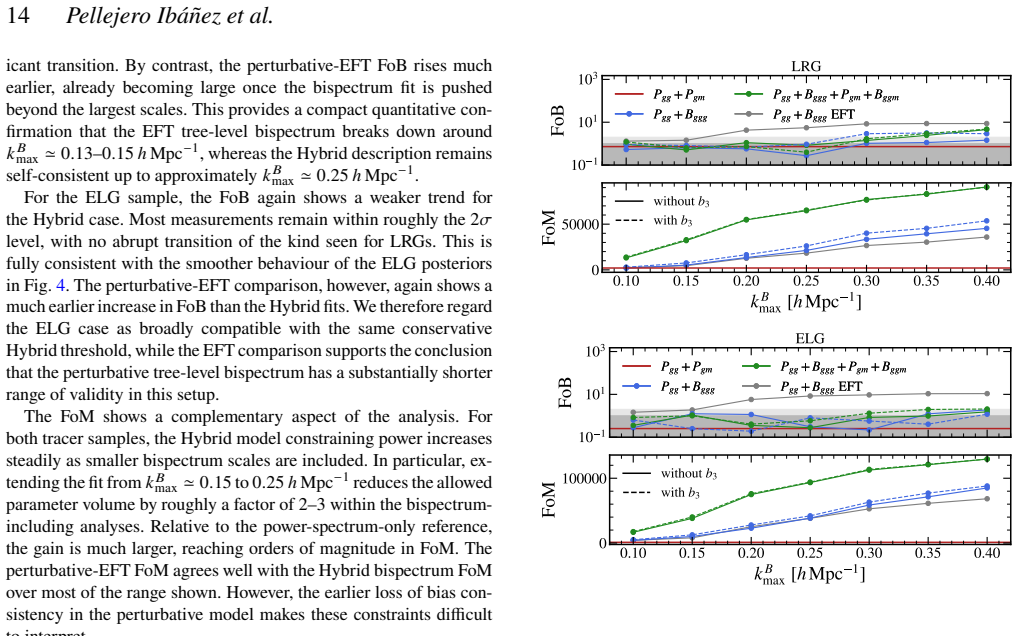
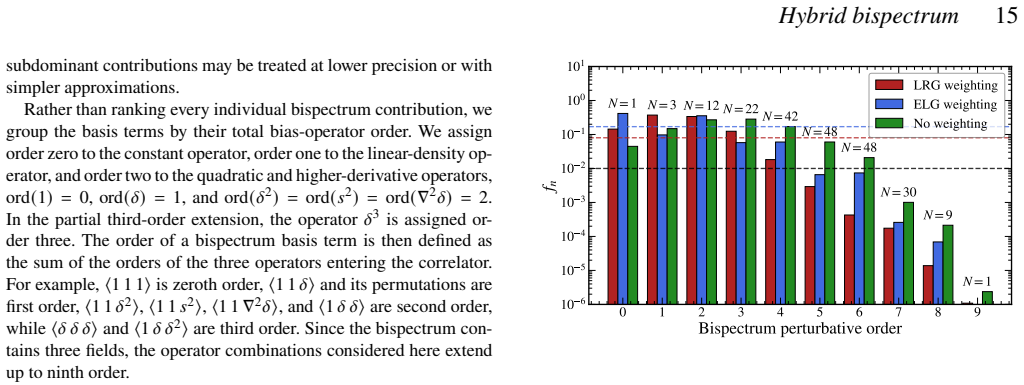
The Hybrid Bias Expansion model remains self-consistent up to k_max^B ≃ 0.25 h Mpc^{-1} when fit to the real-space bispectrum of DESI-like LRG and ELG mocks, while a similar EFT tree-level bispectrum model shows clear breakdown already at k_max^B ≳ 0.13 h Mpc^{-1}. Adding matter cross-statistics improves the precision of recovered bias parameters. A partial third-order extension that adds only the δ^3 operator does not extend the validity range. The bispectrum basis exhibits a strong hierarchy when grouped by total bias-operator order, with the lowest-order sectors dominating the amplitude.
What carries the argument
Hybrid Bias Expansion model (HEFT), which replaces perturbative gravitational evolution with the nonlinear displacement field measured directly from N-body simulations while retaining perturbative bias operators.
If this is right
- The model can be used for bispectrum analyses on scales up to k=0.25 h Mpc^{-1} without immediate breakdown.
- Matter cross-statistics measurably tighten constraints on bias parameters compared to auto-bispectrum alone.
- Extending only the δ^3 operator does not push the validity range to smaller scales.
- Bispectrum contributions are dominated by the lowest total bias-operator order sectors, suggesting focused modeling effort on those terms.
- The hierarchy among basis terms has direct consequences for how the model can be emulated efficiently.
Where Pith is reading between the lines
- Joint power-spectrum and bispectrum analyses could reach smaller scales than either statistic alone if the hybrid model is adopted.
- The observed operator hierarchy implies that emulation efforts can safely allocate fewer resources to higher-order bias sectors.
- Redshift-space validation on the same mocks would be a direct next step to assess applicability to observed clustering.
- The improvement from matter cross-correlations suggests that future surveys could benefit from combining galaxy and weak-lensing fields in the same model.
Load-bearing premise
The DESI-like LRG and ELG mock catalogues at fixed cosmology accurately capture the nonlinear displacement field and galaxy bias without introducing volume or cosmology-dependent systematics.
What would settle it
A clear breakdown in model consistency or bias-parameter recovery when the same fitting procedure is applied to actual DESI survey data at wavenumbers near 0.25 h Mpc^{-1}.
Figures
read the original abstract
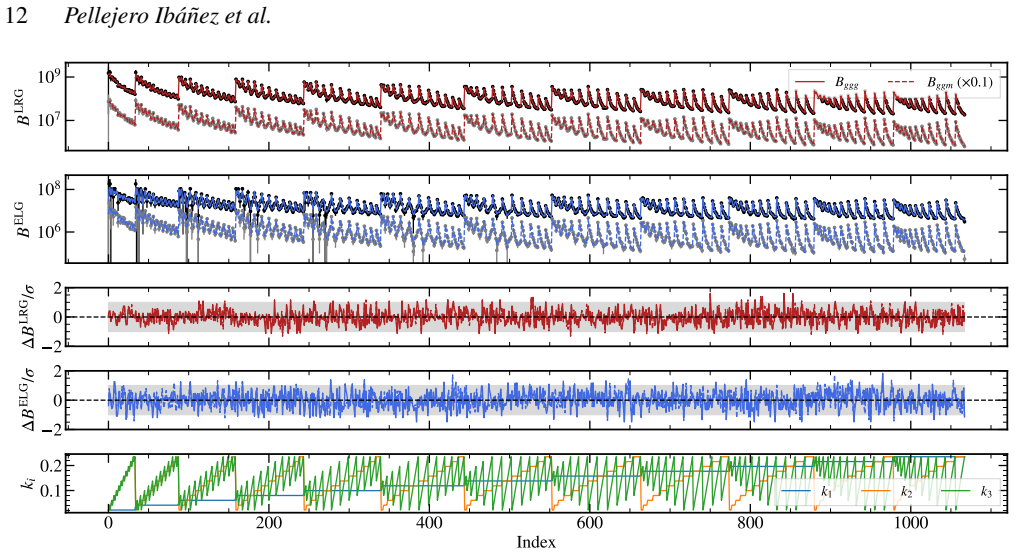
The Hybrid Bias Expansion model (also known as Hybrid Effective Field Theory, HEFT) provides a promising way to extend the range of validity of perturbative large-scale structure modelling by replacing perturbative gravitational evolution with the nonlinear displacement field measured from $N$-body simulations. While this approach has already been shown to improve the modelling of the power spectrum, its validity at the bispectrum level has not yet been established. In this work we perform a first systematic real-space validation of the Hybrid bispectrum model using DESI-like LRG and ELG mock catalogues constructed at fixed cosmology on volumes similar to those of DESI's LRG samples. We find that the model remains self-consistent up to $k_{\rm max}^B \simeq 0.25\,h\,{\rm Mpc}^{-1}$, while clear signs of breakdown appear for a similar EFT tree-level bispectrum approach at $k_{\rm max}^B \gtrsim 0.13\,h\,{\rm Mpc}^{-1}$. We also show that adding matter cross-statistics significantly improves the precision of the recovered bias parameters, while a partial third-order extension including only the $\delta^3$ operator does not extend the validity range. Finally, we find a strong hierarchy among the bispectrum basis terms when grouped by total bias-operator order, with the lowest-order sectors dominating the total amplitude, which has important implications in emulation strategies.
Editorial analysis
A structured set of objections, weighed in public.
Referee Report
Summary. The manuscript validates the Hybrid Bias Expansion (HEFT) model for the real-space galaxy bispectrum against DESI-like LRG and ELG mock catalogues constructed at fixed cosmology on DESI-volume boxes. It claims the Hybrid model remains self-consistent up to k_max^B ≃ 0.25 h Mpc^{-1} while a comparable EFT tree-level bispectrum breaks down at k_max^B ≳ 0.13 h Mpc^{-1}; it further reports that matter cross-statistics improve bias-parameter precision and that a partial third-order extension with only the δ^3 operator does not extend the validity range, together with a strong hierarchy among bispectrum basis terms ordered by total bias-operator order.
Significance. If the reported k_max^B ranges are robust, the work would provide concrete evidence that importing the N-body displacement field extends the perturbative bispectrum range by a factor of ~2 relative to standard EFT, with direct relevance to DESI and Stage-IV analyses. The explicit demonstration of operator hierarchy and the use of realistic mock volumes are strengths that could inform future emulation strategies.
major comments (3)
- [Mock construction and validation sections] The central k_max^B claims rest exclusively on mocks at one fixed cosmology and fixed box volume (§ on mock construction and § on validation procedure). No tests varying cosmology, HOD parameters, or simulation volume are presented, so it remains possible that the quoted thresholds (0.25 vs 0.13 h Mpc^{-1}) are specific to this setup rather than intrinsic to the models.
- [Results on self-consistency] The abstract and results sections state that the Hybrid model 'remains self-consistent' up to k_max^B ≃ 0.25 h Mpc^{-1} and that 'clear signs of breakdown' appear for EFT at ≳ 0.13 h Mpc^{-1}, yet no quantitative definition of self-consistency (e.g., χ² threshold, parameter-shift criterion, or covariance estimation method) or error-bar details are supplied, preventing assessment of the statistical support for these thresholds.
- [Bias-parameter recovery subsection] The statement that adding matter cross-statistics 'significantly improves the precision of the recovered bias parameters' is presented without tabulated uncertainties or covariance matrices before/after inclusion, so the magnitude of the improvement cannot be evaluated against the central claim.
minor comments (2)
- [Abstract] The abstract introduces k_max^B without a preceding definition; a parenthetical clarification on first use would aid readability.
- [Figures and methods] Figure captions and text should explicitly state the number of mocks and the precise k-binning used for the bispectrum measurements.
Simulated Author's Rebuttal
We thank the referee for the careful review and constructive feedback. We agree that several clarifications and additions are needed to strengthen the manuscript and have revised accordingly. Below we respond point-by-point to the major comments.
read point-by-point responses
-
Referee: [Mock construction and validation sections] The central k_max^B claims rest exclusively on mocks at one fixed cosmology and fixed box volume. No tests varying cosmology, HOD parameters, or simulation volume are presented, so it remains possible that the quoted thresholds are specific to this setup rather than intrinsic to the models.
Authors: We agree that the reported k_max^B thresholds are specific to the single cosmology, HOD, and volume used. This is a genuine limitation of the present study, as exploring variations would require new simulation suites. The work is framed as a first systematic validation on DESI-like mocks at fixed cosmology; we will add explicit caveats in the abstract, results, and conclusions stating that the thresholds should not be interpreted as universal and that future work must test robustness across cosmologies and HODs. revision: partial
-
Referee: [Results on self-consistency] The abstract and results sections state that the Hybrid model 'remains self-consistent' up to k_max^B ≃ 0.25 h Mpc^{-1} and that 'clear signs of breakdown' appear for EFT at ≳ 0.13 h Mpc^{-1}, yet no quantitative definition of self-consistency or error-bar details are supplied.
Authors: We accept this criticism. The original manuscript lacked an explicit quantitative criterion. In the revised version we define self-consistency as the largest k_max where the reduced chi^2 remains below 1.5 and recovered bias parameters shift by less than 1 sigma relative to the largest-scale fit; we also specify the covariance estimation procedure (jackknife on the mocks) and will report the chi^2 values and parameter shifts at each k_max in a new table. revision: yes
-
Referee: [Bias-parameter recovery subsection] The statement that adding matter cross-statistics 'significantly improves the precision of the recovered bias parameters' is presented without tabulated uncertainties or covariance matrices before/after inclusion.
Authors: We agree that quantitative evidence is required. The revised manuscript will include a table (or supplementary table) reporting the 1-sigma uncertainties on all bias parameters for the galaxy auto-bispectrum alone versus the combined galaxy-matter analysis, together with the corresponding covariance matrices or correlation coefficients, allowing direct evaluation of the improvement. revision: yes
Circularity Check
Validation against independent N-body mocks at fixed cosmology provides external benchmark; no derivation reduces to fitted inputs or self-citations
full rationale
The paper's central result is a direct numerical comparison of the Hybrid Bias Expansion bispectrum model against DESI-like LRG/ELG mock catalogues generated from N-body simulations. This constitutes an external benchmark rather than any self-definitional loop, fitted parameter renamed as prediction, or load-bearing self-citation chain. The validity thresholds (k_max^B ≃ 0.25 vs. 0.13 h Mpc^{-1}) emerge from that comparison, not from re-expressing the input mocks or prior author work as an output. No equations or sections in the provided text exhibit the enumerated circularity patterns.
Axiom & Free-Parameter Ledger
Reference graph
Works this paper leans on
-
[1]
Galaxy clustering in the DESI Legacy Survey and its imprint on the CMB. , keywords =. doi:10.1093/mnras/staa3738 , archivePrefix =. 2010.00466 , primaryClass =
-
[2]
BOSS DR12 full-shape cosmology: CDM constraints from the large-scale galaxy power spectrum and bispectrum monopole. , keywords =. doi:10.1103/PhysRevD.105.043517 , archivePrefix =. 2112.04515 , primaryClass =
-
[3]
Lensing is Low: Cosmology, Galaxy Formation, or New Physics?
Lensing is low: cosmology, galaxy formation or new physics?. , keywords =. doi:10.1093/mnras/stx258 , archivePrefix =. 1611.08606 , primaryClass =
work page internal anchor Pith review Pith/arXiv arXiv doi:10.1093/mnras/stx258
-
[4]
Consistent clustering and lensing of SDSS-III BOSS galaxies with an extended abundance matching formalism. , keywords =. doi:10.1093/mnras/stad2434 , archivePrefix =. 2305.09637 , primaryClass =
-
[5]
Consistent and simultaneous modelling of galaxy clustering and galaxy-galaxy lensing with subhalo abundance matching. , keywords =. doi:10.1093/mnras/stad122 , archivePrefix =. 2211.11745 , primaryClass =
-
[6]
The galaxy formation origin of the lensing is low problem. , keywords =. doi:10.1093/mnras/stad243 , archivePrefix =. 2211.01744 , primaryClass =
-
[7]
Consistent lensing and clustering in a low-S _ 8 Universe with BOSS, DES Year 3, HSC Year 1, and KiDS-1000. , keywords =. doi:10.1093/mnras/stac2938 , archivePrefix =. 2202.07440 , primaryClass =
-
[8]
Cosmology without window functions. II. Cubic estimators for the galaxy bispectrum. , keywords =. doi:10.1103/PhysRevD.104.123529 , archivePrefix =. 2107.06287 , primaryClass =
-
[9]
arXiv e-prints , keywords =
The BACCO simulation project: biased tracers in real space. arXiv e-prints , keywords =
-
[10]
The bacco simulation project: bacco hybrid Lagrangian bias expansion model in redshift space. , keywords =. doi:10.1093/mnras/stad368 , archivePrefix =. 2207.06437 , primaryClass =
-
[11]
A flexible modelling of galaxy assembly bias. , keywords =. doi:10.1093/mnras/stab1170 , archivePrefix =. 2005.03672 , primaryClass =
-
[12]
A flexible subhalo abundance matching model for galaxy clustering in redshift space. , keywords =. doi:10.1093/mnras/stab2560 , archivePrefix =. 2012.06596 , primaryClass =
-
[13]
HYMALAIA: A Hybrid Lagrangian Model for Intrinsic Alignments. arXiv e-prints , keywords =. doi:10.48550/arXiv.2307.13754 , archivePrefix =. 2307.13754 , primaryClass =
-
[14]
Modelling galaxy clustering in redshift space with a Lagrangian bias formalism and N-body simulations. , keywords =. doi:10.1093/mnras/stac1602 , archivePrefix =. 2109.08699 , primaryClass =
-
[15]
Nonlinear perturbation theory with halo bias and redshift-space distortions via the Lagrangian picture , author =. Phys. Rev. D , volume =. 2008 , month =. doi:10.1103/PhysRevD.78.083519 , url =
-
[16]
Monthly Notices of the Royal Astronomical Society , volume =
Modi, Chirag and Chen, Shi-Fan and White, Martin , title = ". Monthly Notices of the Royal Astronomical Society , volume =. 2020 , month =. doi:10.1093/mnras/staa251 , url =
-
[17]
On the spatial correlations of Abell clusters. , keywords =. doi:10.1086/184341 , adsurl =
-
[18]
Monthly Notices of the Royal Astronomical Society , volume =
Clustering in real space and in redshift space. , keywords =. doi:10.1093/mnras/227.1.1 , adsurl =
-
[19]
The spatial correlations of Abell clusters. , keywords =. doi:10.1093/mnras/222.1.9P , adsurl =
-
[20]
The statistics of maxima in primordial density perturbations. , keywords =. doi:10.1093/mnras/217.4.805 , adsurl =
-
[21]
The Statistics of Peaks of Gaussian Random Fields. , keywords =. doi:10.1086/164143 , adsurl =
-
[22]
2002, MNRAS, 334, 523, doi: 10.1046/j.1365-8711.2002.05478.x
The abundance and clustering of dark haloes in the standard CDM cosmogony. , keywords =. doi:10.1046/j.1365-8711.2002.05723.x , archivePrefix =. astro-ph/0202393 , primaryClass =
-
[23]
The BACCO simulation project: exploiting the full power of large-scale structure for cosmology. , keywords =. doi:10.1093/mnras/stab2018 , archivePrefix =. 2004.06245 , primaryClass =
-
[24]
One simulation to fit them all - changing the background parameters of a cosmological N-body simulation. , keywords =. doi:10.1111/j.1365-2966.2010.16459.x , archivePrefix =. 0912.4277 , primaryClass =
-
[25]
Priors on Lagrangian bias parameters from galaxy formation modelling. , keywords =. doi:10.1093/mnras/stac1673 , archivePrefix =. 2110.05408 , primaryClass =
-
[26]
The clustering of galaxies in the SDSS-III Baryon Oscillation Spectroscopic Survey: mock galaxy catalogues for the BOSS Final Data Release. , keywords =. doi:10.1093/mnras/stv2826 , archivePrefix =. 1509.06400 , primaryClass =
work page internal anchor Pith review Pith/arXiv arXiv doi:10.1093/mnras/stv2826
-
[27]
One simulation to have them all: performance of the Bias Assignment Method against N-body simulations. , keywords =. 2019. doi:10.1093/mnras/stz3206 , archivePrefix =. 1906.06109 , primaryClass =
-
[28]
, archivePrefix = "arXiv", eprint =
BAM: bias assignment method to generate mock catalogues. , archivePrefix = "arXiv", eprint =. doi:10.1093/mnrasl/sly220 , adsurl =
-
[29]
The bias of dark matter tracers: assessing the accuracy of mapping techniques. , keywords =. doi:10.1093/mnras/staa270 , archivePrefix =. 1910.13164 , primaryClass =
-
[30]
The Bias from Hydrodynamic Simulations: Mapping Baryon Physics onto Dark Matter Fields. , keywords =. doi:10.3847/1538-4357/ac158b , archivePrefix =. 2012.06795 , primaryClass =
-
[31]
The cosmic web connection to the dark matter halo distribution through gravity. , keywords =. doi:10.1093/mnras/stac671 , adsurl =
-
[32]
The Uchuu-GLAM BOSS and eBOSS LRG lightcones: Exploring clustering and covariance errors. arXiv e-prints , keywords =. doi:10.48550/arXiv.2311.14456 , archivePrefix =. 2311.14456 , primaryClass =
-
[33]
Monthly Notices of the Royal Astronomical Society , volume =
Lippich, Martha and Sánchez, Ariel G and Colavincenzo, Manuel and Sefusatti, Emiliano and Monaco, Pierluigi and Blot, Linda and Crocce, Martin and Alvarez, Marcelo A and Agrawal, Aniket and Avila, Santiago and Balaguera-Antolínez, Andrés and Bond, Richard and Codis, Sandrine and Dalla Vecchia, Claudio and Dorta, Antonio and Fosalba, Pablo and Izard, Alber...
-
[34]
Monthly Notices of the Royal Astronomical Society , volume =
Colavincenzo, Manuel and Sefusatti, Emiliano and Monaco, Pierluigi and Blot, Linda and Crocce, Martin and Lippich, Martha and Sánchez, Ariel G and Alvarez, Marcelo A and Agrawal, Aniket and Avila, Santiago and Balaguera-Antolínez, Andrés and Bond, Richard and Codis, Sandrine and Dalla Vecchia, Claudio and Dorta, Antonio and Fosalba, Pablo and Izard, Alber...
-
[35]
Monthly Notices of the Royal Astronomical Society , volume =
Blot, Linda and Crocce, Martin and Sefusatti, Emiliano and Lippich, Martha and Sánchez, Ariel G and Colavincenzo, Manuel and Monaco, Pierluigi and Alvarez, Marcelo A and Agrawal, Aniket and Avila, Santiago and Balaguera-Antolínez, Andrés and Bond, Richard and Codis, Sandrine and Dalla Vecchia, Claudio and Dorta, Antonio and Fosalba, Pablo and Izard, Alber...
-
[36]
MULTINEST: an efficient and robust Bayesian inference tool for cosmology and particle physics. , keywords =. doi:10.1111/j.1365-2966.2009.14548.x , archivePrefix =. 0809.3437 , primaryClass =
-
[37]
2007, MNRAS, 376, 1145, doi: 10.1111/j.1365-2966.2007.11495.x
Multimodal nested sampling: an efficient and robust alternative to Markov Chain Monte Carlo methods for astronomical data analyses. , keywords =. doi:10.1111/j.1365-2966.2007.12353.x , archivePrefix =. 0704.3704 , primaryClass =
-
[38]
Importance Nested Sampling and the MultiNest Algorithm
Importance Nested Sampling and the MultiNest Algorithm. The Open Journal of Astrophysics , keywords =. doi:10.21105/astro.1306.2144 , archivePrefix =. 1306.2144 , primaryClass =
work page internal anchor Pith review Pith/arXiv arXiv doi:10.21105/astro.1306.2144
-
[39]
Cosmological parameters from the BOSS galaxy power spectrum. , keywords =. doi:10.1088/1475-7516/2020/05/042 , archivePrefix =. 1909.05277 , primaryClass =
-
[40]
arXiv e-prints , keywords =
Euclid Definition Study Report. arXiv e-prints , keywords =
-
[41]
Living Reviews in Relativity , keywords =
Cosmology and fundamental physics with the Euclid satellite. Living Reviews in Relativity , keywords =. 2018. doi:10.1007/s41114-017-0010-3 , archivePrefix =. 1606.00180 , primaryClass =
-
[42]
The DESI Experiment, a whitepaper for Snowmass 2013
The DESI Experiment, a whitepaper for Snowmass 2013. arXiv e-prints , keywords =. doi:10.48550/arXiv.1308.0847 , archivePrefix =. 1308.0847 , primaryClass =
work page internal anchor Pith review Pith/arXiv arXiv doi:10.48550/arxiv.1308.0847 2013
-
[43]
4MOST: Project overview and information for the First Call for Proposals
4MOST: Project overview and information for the First Call for Proposals. The Messenger , keywords =. doi:10.18727/0722-6691/5117 , archivePrefix =. 1903.02464 , primaryClass =
work page internal anchor Pith review Pith/arXiv arXiv doi:10.18727/0722-6691/5117 1903
-
[44]
Statistics of biased tracers in variance-suppressed simulations. , keywords =. doi:10.1088/1475-7516/2022/10/036 , archivePrefix =. 2204.03868 , primaryClass =
-
[45]
P., Werner, M., Akeson, R., et al
SPHEREx: NASA's near-infrared spectrophotometric all-sky survey. Space Telescopes and Instrumentation 2020: Optical, Infrared, and Millimeter Wave , year = 2020, editor =. doi:10.1117/12.2567224 , archivePrefix =. 2404.11017 , primaryClass =
-
[46]
J-PAS: The Javalambre-Physics of the Accelerated Universe Astrophysical Survey
J-PAS: The Javalambre-Physics of the Accelerated Universe Astrophysical Survey. arXiv e-prints , keywords =. doi:10.48550/arXiv.1403.5237 , archivePrefix =. 1403.5237 , primaryClass =
work page internal anchor Pith review Pith/arXiv arXiv doi:10.48550/arxiv.1403.5237
-
[47]
Cosmological $N$-body simulations with suppressed variance
Cosmological N-body simulations with suppressed variance. , keywords =. doi:10.1093/mnrasl/slw098 , archivePrefix =. 1603.05253 , primaryClass =
work page internal anchor Pith review Pith/arXiv arXiv doi:10.1093/mnrasl/slw098
-
[48]
The miniJPAS survey: A preview of the Universe in 56 colors. , keywords =. doi:10.1051/0004-6361/202038841 , archivePrefix =. 2007.01910 , primaryClass =
-
[49]
Large-scale galaxy bias. , keywords =. 2018. doi:10.1016/j.physrep.2017.12.002 , archivePrefix =. 1611.09787 , primaryClass =
work page internal anchor Pith review Pith/arXiv arXiv doi:10.1016/j.physrep.2017.12.002 2018
-
[50]
Large-Scale Structure of the Universe and Cosmological Perturbation Theory
Large-scale structure of the Universe and cosmological perturbation theory. , keywords =. doi:10.1016/S0370-1573(02)00135-7 , archivePrefix =. astro-ph/0112551 , primaryClass =
work page internal anchor Pith review Pith/arXiv arXiv doi:10.1016/s0370-1573(02)00135-7
-
[51]
The Effective Field Theory of Large Scale Structures at Two Loops
The Effective Field Theory of Large Scale Structures at two loops. , keywords =. doi:10.1088/1475-7516/2014/07/057 , archivePrefix =. 1310.0464 , primaryClass =
work page internal anchor Pith review Pith/arXiv arXiv doi:10.1088/1475-7516/2014/07/057 2014
-
[52]
The Effective Field Theory of Cosmological Large Scale Structures
The effective field theory of cosmological large scale structures. Journal of High Energy Physics , keywords =. doi:10.1007/JHEP09(2012)082 , archivePrefix =. 1206.2926 , primaryClass =
work page internal anchor Pith review Pith/arXiv arXiv doi:10.1007/jhep09(2012)082 2012
-
[53]
Cosmological Non-Linearities as an Effective Fluid
Cosmological non-linearities as an effective fluid. , keywords =. doi:10.1088/1475-7516/2012/07/051 , archivePrefix =. 1004.2488 , primaryClass =
work page internal anchor Pith review Pith/arXiv arXiv doi:10.1088/1475-7516/2012/07/051 2012
-
[54]
S IM BIG : A Forward Modeling Approach To Analyzing Galaxy Clustering. arXiv e-prints , keywords =. doi:10.48550/arXiv.2211.00723 , archivePrefix =. 2211.00723 , primaryClass =
-
[55]
Arguments against using h ^ -1 Mpc units in observational cosmology. , keywords =. doi:10.1103/PhysRevD.102.123511 , archivePrefix =. 2002.07829 , primaryClass =
-
[56]
Robust cosmological inference from non-linear scales with k-th nearest neighbour statistics. , keywords =. doi:10.1093/mnras/stad3359 , archivePrefix =. 2310.04501 , primaryClass =
-
[57]
SUNBIRD: A simulation-based model for full-shape density-split clustering. arXiv e-prints , keywords =. doi:10.48550/arXiv.2309.16539 , archivePrefix =. 2309.16539 , primaryClass =
-
[58]
Hybrid-bias and displacement emulators for field-level modelling of galaxy clustering in real and redshift space. , keywords =. doi:10.1093/mnras/stae489 , archivePrefix =. 2307.09134 , primaryClass =
-
[59]
Euclid preparation. TBD. Galaxy power spectrum modelling in real space. arXiv e-prints , keywords =. doi:10.48550/arXiv.2312.00679 , archivePrefix =. 2312.00679 , primaryClass =
-
[60]
Galaxy bias in the era of LSST: perturbative bias expansions. , keywords =. doi:10.1088/1475-7516/2024/02/015 , archivePrefix =. 2307.03226 , primaryClass =
-
[61]
A Parameter-Masked Mock Data Challenge for Beyond-Two-Point Galaxy Clustering Statistics. arXiv e-prints , keywords =. doi:10.48550/arXiv.2405.02252 , archivePrefix =. 2405.02252 , primaryClass =
-
[62]
Cluster Cosmology Constraints from the 2500 deg ^ 2 SPT-SZ Survey: Inclusion of Weak Gravitational Lensing Data from Magellan and the Hubble Space Telescope. , keywords =. doi:10.3847/1538-4357/ab1f10 , archivePrefix =. 1812.01679 , primaryClass =
work page internal anchor Pith review Pith/arXiv arXiv doi:10.3847/1538-4357/ab1f10
-
[63]
Cosmological constraints from unWISE and Planck CMB lensing tomography. , keywords =. doi:10.1088/1475-7516/2021/12/028 , archivePrefix =. 2105.03421 , primaryClass =
-
[64]
Cosmological constraints from the tomographic cross-correlation of DESI Luminous Red Galaxies and Planck CMB lensing. , keywords =. doi:10.1088/1475-7516/2022/02/007 , archivePrefix =. 2111.09898 , primaryClass =
-
[65]
The clustering of galaxies in the completed SDSS-III Baryon Oscillation Spectroscopic Survey: cosmological analysis of the DR12 galaxy sample. , keywords =. doi:10.1093/mnras/stx721 , archivePrefix =. 1607.03155 , primaryClass =
work page internal anchor Pith review Pith/arXiv arXiv doi:10.1093/mnras/stx721
-
[66]
A non-linear solution to the S _ 8 tension?. , keywords =. doi:10.1093/mnras/stac2429 , archivePrefix =. 2206.11794 , primaryClass =
-
[67]
The Open Journal of Astrophysics , keywords =
DES Y3 + KiDS-1000: Consistent cosmology combining cosmic shear surveys. The Open Journal of Astrophysics , keywords =. doi:10.21105/astro.2305.17173 , archivePrefix =. 2305.17173 , primaryClass =
-
[68]
DES Y3 cosmic shear down to small scales: Constraints on cosmology and baryons. , keywords =. doi:10.1051/0004-6361/202346539 , archivePrefix =. 2303.05537 , primaryClass =
-
[69]
Dark Energy Survey Year 3 results: Cosmology from cosmic shear and robustness to modeling uncertainty. , keywords =. doi:10.1103/PhysRevD.105.023515 , archivePrefix =. 2105.13544 , primaryClass =
-
[70]
KiDS-1000 Cosmology: Multi-probe weak gravitational lensing and spectroscopic galaxy clustering constraints. , keywords =. doi:10.1051/0004-6361/202039063 , archivePrefix =. 2007.15632 , primaryClass =
-
[71]
Astroparticle Physics , keywords =
Cosmology Intertwined III: f _ 8 and S _ 8. Astroparticle Physics , keywords =. doi:10.1016/j.astropartphys.2021.102604 , archivePrefix =. 2008.11285 , primaryClass =
-
[72]
The growth of density perturbations in the last 10 billion years from tomographic large-scale structure data. , keywords =. doi:10.1088/1475-7516/2021/10/030 , archivePrefix =. 2105.12108 , primaryClass =
-
[73]
Cosmic shear with small scales: DES-Y3, KiDS-1000 and HSC-DR1. arXiv e-prints , keywords =. doi:10.48550/arXiv.2403.13794 , archivePrefix =. 2403.13794 , primaryClass =
-
[74]
DESI 2024 VI: Cosmological Constraints from the Measurements of Baryon Acoustic Oscillations
DESI 2024 VI: Cosmological Constraints from the Measurements of Baryon Acoustic Oscillations. arXiv e-prints , keywords =. doi:10.48550/arXiv.2404.03002 , archivePrefix =. 2404.03002 , primaryClass =
work page internal anchor Pith review Pith/arXiv arXiv doi:10.48550/arxiv.2404.03002 2024
-
[75]
Unified galaxy power spectrum measurements from 6dFGS, BOSS, and eBOSS. , keywords =. doi:10.1088/1475-7516/2021/11/031 , archivePrefix =. 2106.06324 , primaryClass =
-
[76]
SDSS-III Baryon Oscillation Spectroscopic Survey Data Release 12: galaxy target selection and large-scale structure catalogues. , keywords =. doi:10.1093/mnras/stv2382 , archivePrefix =. 1509.06529 , primaryClass =
work page internal anchor Pith review Pith/arXiv arXiv doi:10.1093/mnras/stv2382
-
[77]
SDSS-III: Massive Spectroscopic Surveys of the Distant Universe, the Milky Way, and Extra-Solar Planetary Systems. , keywords =. doi:10.1088/0004-6256/142/3/72 , archivePrefix =. 1101.1529 , primaryClass =
work page internal anchor Pith review Pith/arXiv arXiv doi:10.1088/0004-6256/142/3/72
-
[78]
The Baryon Oscillation Spectroscopic Survey of SDSS-III
The Baryon Oscillation Spectroscopic Survey of SDSS-III. , keywords =. doi:10.1088/0004-6256/145/1/10 , archivePrefix =. 1208.0022 , primaryClass =
work page internal anchor Pith review Pith/arXiv arXiv doi:10.1088/0004-6256/145/1/10
-
[79]
The clustering of galaxies in the SDSS-III Baryon Oscillation Spectroscopic Survey: modelling the clustering and halo occupation distribution of BOSS CMASS galaxies in the Final Data Release. , keywords =. doi:10.1093/mnras/stw1014 , archivePrefix =. 1509.06404 , primaryClass =
work page internal anchor Pith review Pith/arXiv arXiv doi:10.1093/mnras/stw1014
-
[80]
The impact of galaxy formation on satellite kinematics and redshift-space distortions
The impact of galaxy formation on satellite kinematics and redshift-space distortions. , keywords =. doi:10.1093/mnras/stx3349 , archivePrefix =. 1708.00956 , primaryClass =
work page internal anchor Pith review Pith/arXiv arXiv doi:10.1093/mnras/stx3349
discussion (0)
Sign in with ORCID, Apple, or X to comment. Anyone can read and Pith papers without signing in.