Simulation to a Newborn Supernova Remnant from a Low-mass Iron Core Star
Pith reviewed 2026-06-26 18:59 UTC · model grok-4.3
The pith
3D simulations show neutron-star wind and decay heating create large-scale asymmetric plumes in a low-mass supernova remnant.
A machine-rendered reading of the paper's core claim, the machinery that carries it, and where it could break.
Core claim
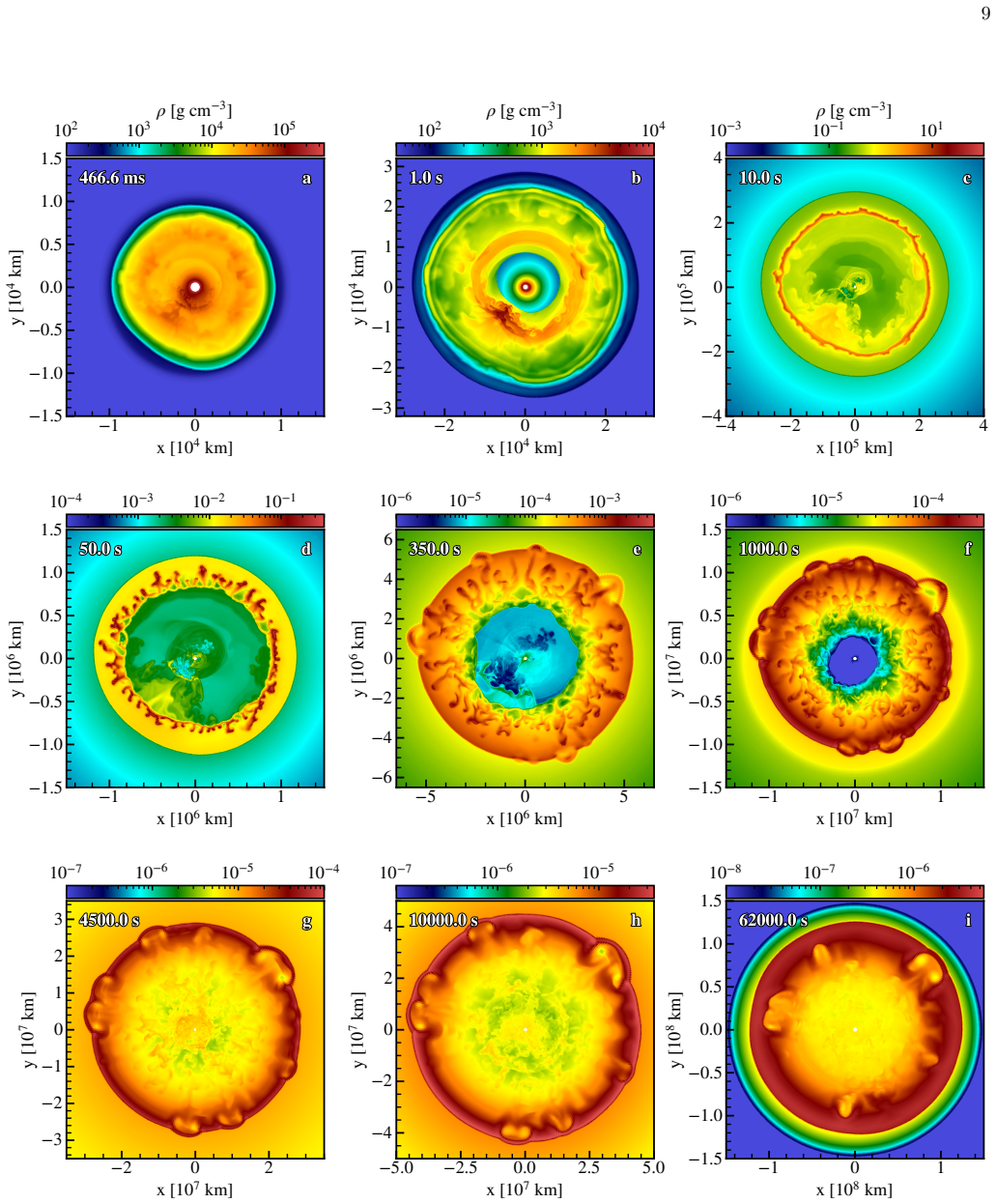
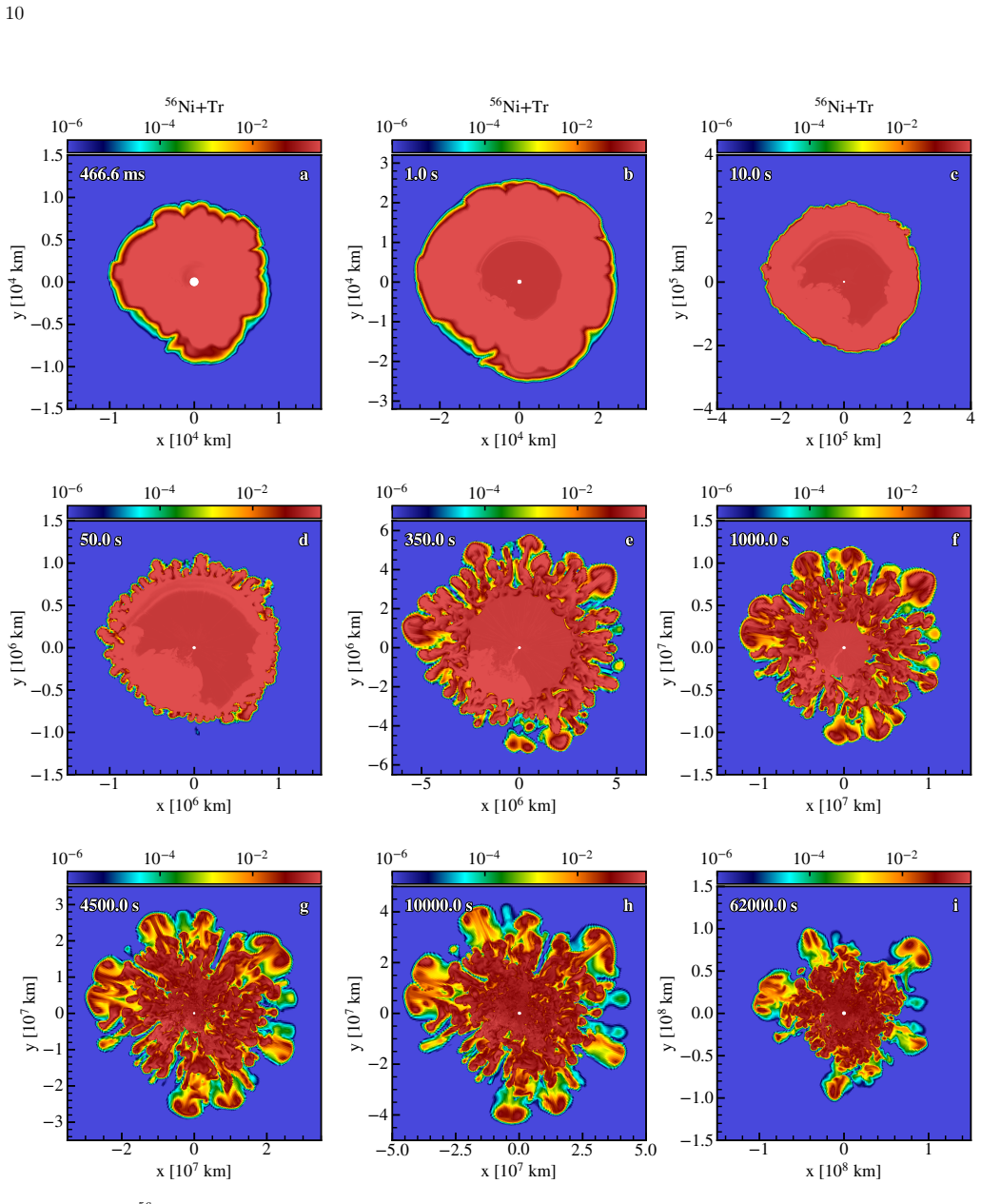
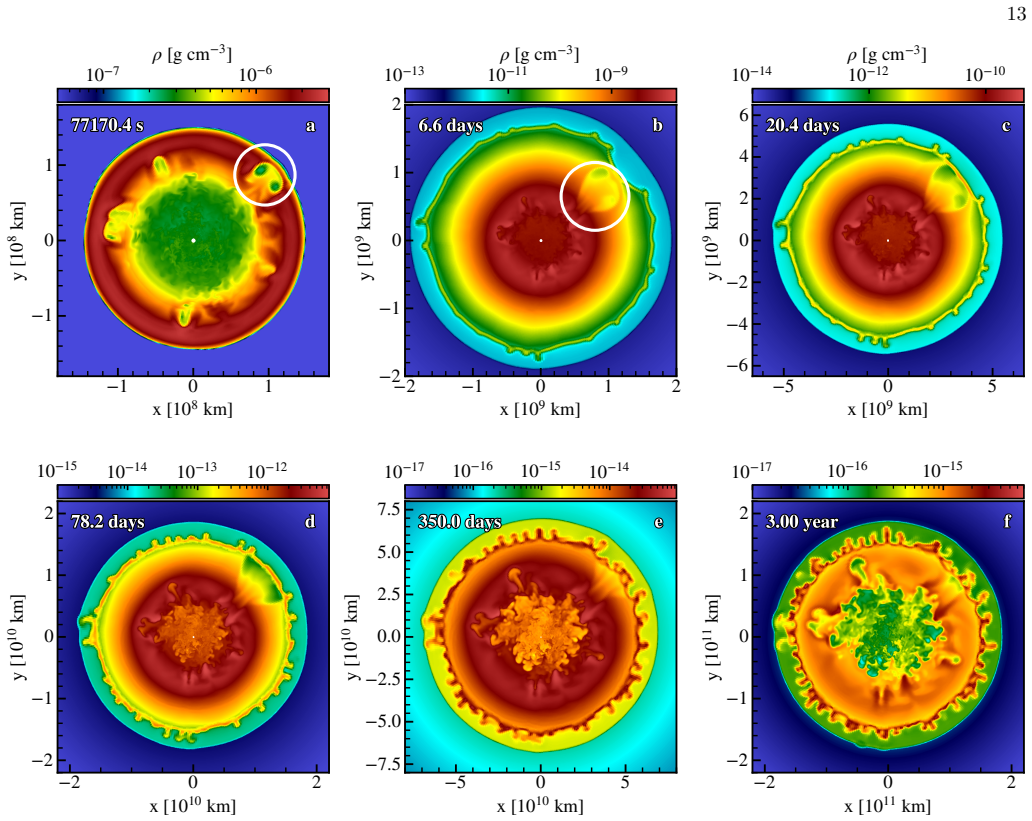
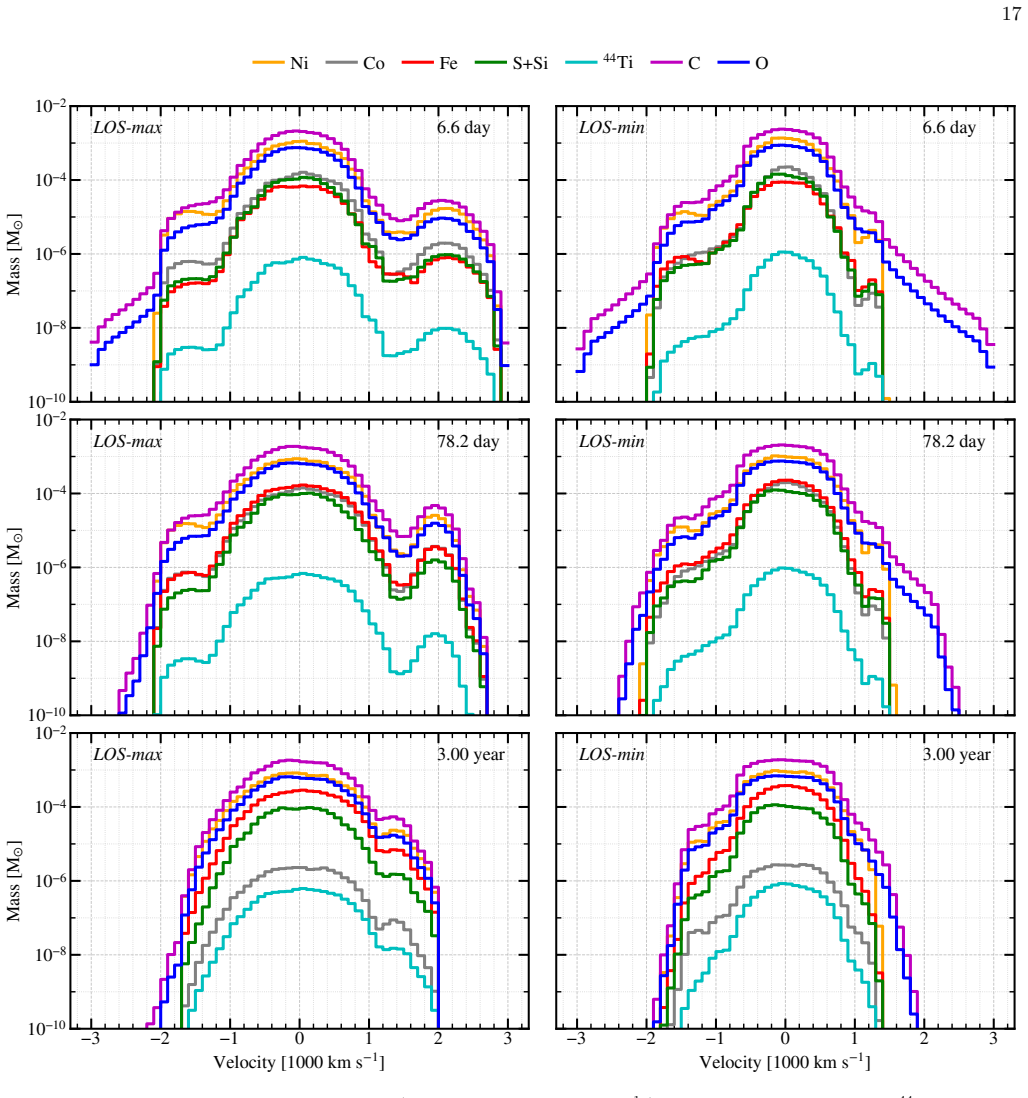
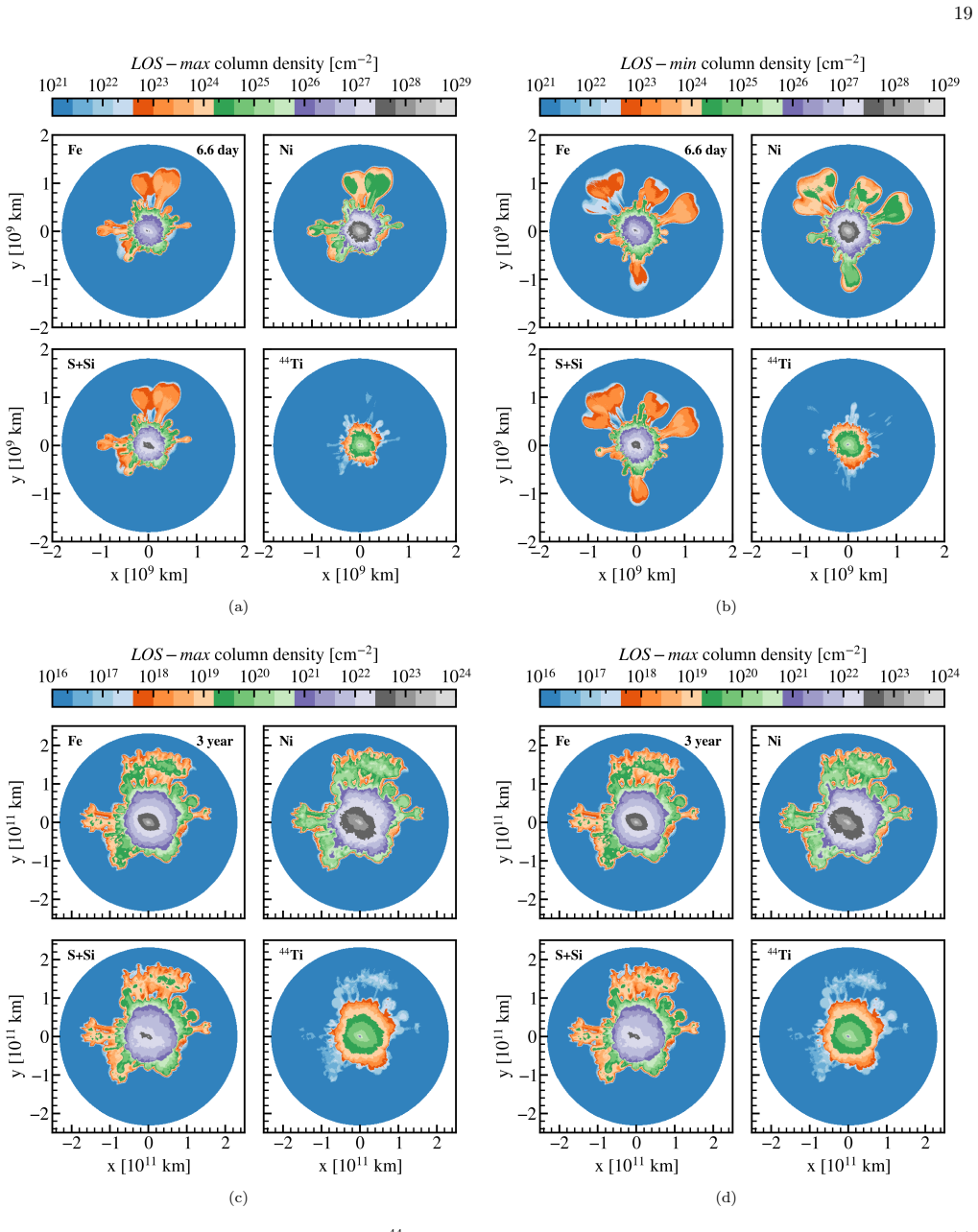
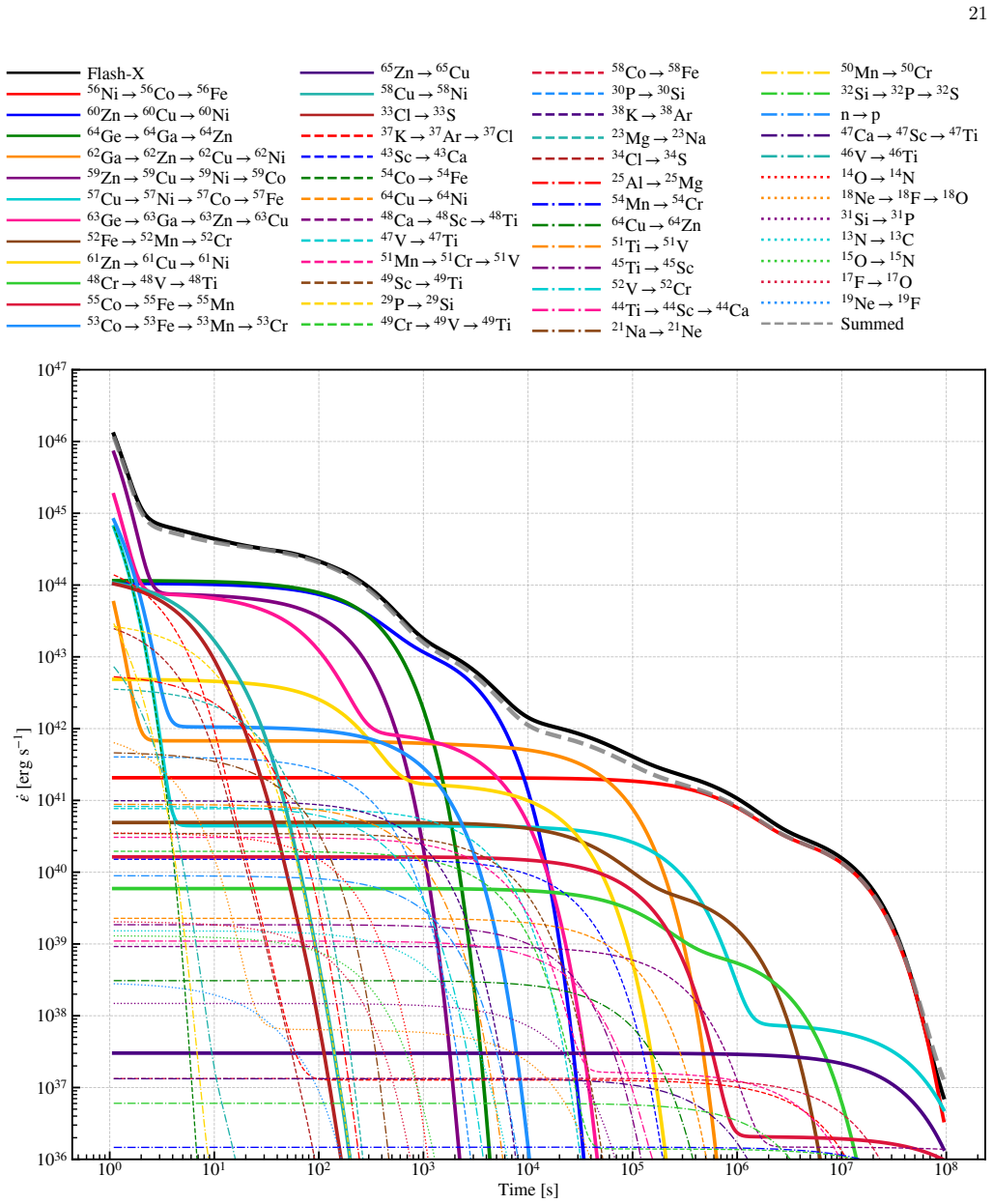
In three-dimensional calculations the neutron-star wind and radioactive decay heating reshape the plume morphology into more extended large-scale structures; these structures produce an asymmetrical shock breakout, after which the leading plumes decelerate and fragment under the reverse shock while retaining the overall asymmetry. The projected ejecta morphology and velocities depend strongly on viewing angle. The metal-rich material remains relatively uniform and does not match the strongly inhomogeneous structure seen in Cas A. The 160-isotope decay network indicates that 24.4 percent of the radioactive heating arises from chains other than the canonical nickel-56 chain. The low explosion
What carries the argument
Three-dimensional hydrodynamic evolution of metal-rich plumes under combined neutron-star wind and multi-isotope radioactive decay heating, initialized from a post-revival 9.6 solar mass progenitor snapshot.
If this is right
- The ejecta morphology and observed velocities become strongly dependent on the observer's viewing angle.
- Leading plumes decelerate and fragment after breakout while the large-scale asymmetry persists.
- A sizable fraction (24.4 percent) of the heating is supplied by decay chains other than nickel-56.
- The combination of low explosion energy, low nickel-56 mass, and nickel-to-iron ratio above unity produces signatures resembling an electron-capture supernova.
Where Pith is reading between the lines
- If the viewing-angle dependence holds, diversity among observed young remnants could arise from orientation rather than from fundamentally different explosion mechanisms.
- The contribution of non-standard decay chains may alter late-time luminosity predictions in other low-energy supernova models.
- Extending the same heating treatment to higher-mass progenitors could test whether the same plume-modification mechanism operates across the core-collapse range.
Load-bearing premise
The explosion energy, nickel yield, and post-revival density and velocity structure are taken directly from an earlier calculation rather than recomputed inside this simulation.
What would settle it
High-resolution imaging or spectroscopy of a young supernova remnant that either matches or fails to match the predicted viewing-angle dependence of ejecta velocities and the relatively uniform metal distribution.
Figures
read the original abstract
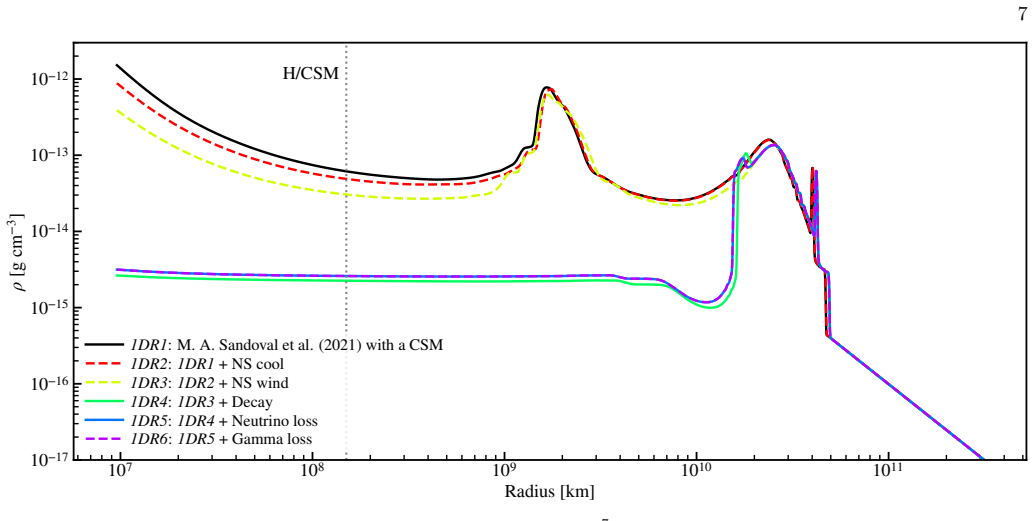
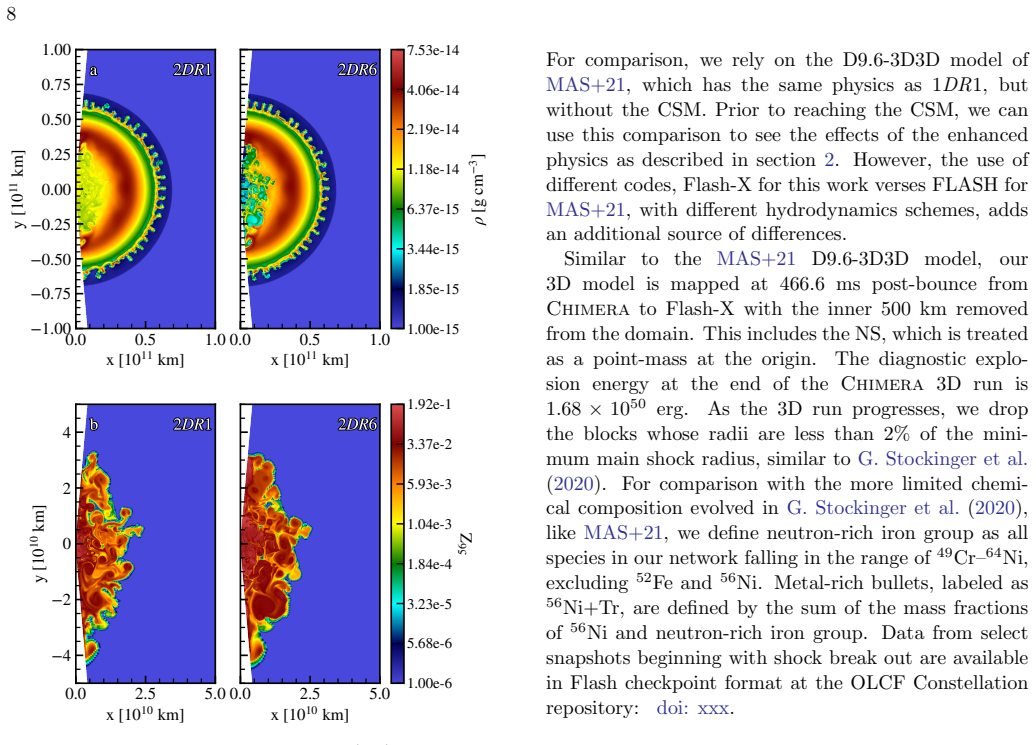
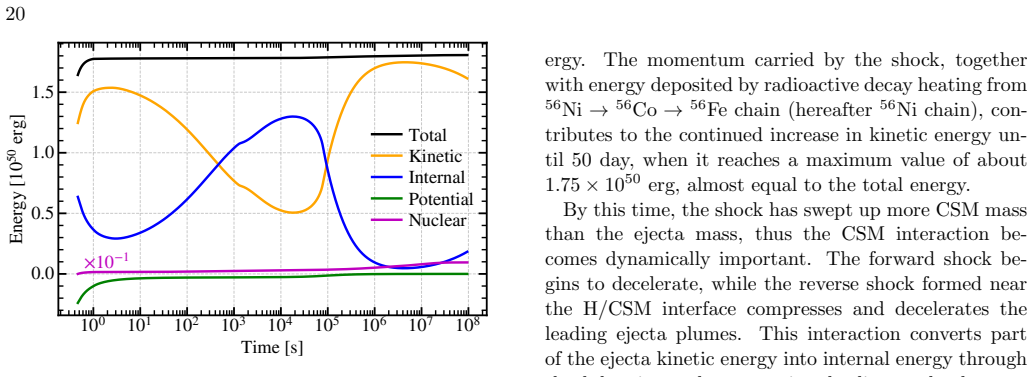
Supernova remnant observations show a high degree of asymmetry, mixing, and inhomogeneity. These asymmetries are seeded during the early seconds of the explosion and are further enhanced and modified as the shock and ejecta move through the stellar progenitor and into the circumstellar medium. We present simulations of a 9.6 solar mass zero-metallicity progenitor initialized after shock revival and evolved for several years when the ejecta is in the circumstellar medium. A suite of 1D and 2D simulations examines the effects of neutron-star wind and radioactive decay heating. In 1D, decay heating forms a low-density bubble that suppresses the reverse shock. While in 2D, the heating is localized to metal-rich pockets, inflating them and compressing the surrounding material into dense shells. In 3D the neutron-star wind and decay heating modify the plume morphology, producing more large-scale structures. The extended plume morphology leads to an asymmetrical shock breakout. After breakout, the leading plumes cannot keep up with the shock front, resulting in deceleration and fragmentation by the reverse shock while retaining the large-scale asymmetry. The projected ejecta morphology and velocities are strongly viewing angle dependent. The relatively uniform metal-rich distribution does not resemble the strongly inhomogeneous ejecta structure of Cas A. The 160-isotope decay network shows that 24.4% of the radioactive heating comes from decay chains other than the canonical Ni-56 chain. The low explosion energy, low Ni-56 yield, and Ni/Fe ratio greater than unity suggest an observational signature similar to an electron capture supernova.
Editorial analysis
A structured set of objections, weighed in public.
Referee Report
Summary. The manuscript presents 1D, 2D, and 3D hydrodynamic simulations of the post-explosion evolution of a 9.6 solar mass zero-metallicity progenitor's ejecta, initialized after shock revival and evolved for several years into the circumstellar medium. It incorporates neutron-star wind and a 160-isotope radioactive decay network to examine effects on plume morphology, asymmetric shock breakout, reverse-shock fragmentation, and viewing-angle dependence of projected ejecta, while reporting that the metal-rich distribution does not resemble Cas A and that 24.4% of heating arises from non-Ni-56 chains; the low input explosion energy, Ni-56 yield, and Ni/Fe ratio >1 are taken to suggest an electron-capture supernova signature.
Significance. If the numerical results hold, the work would advance understanding of how explosion-seeded asymmetries evolve under NS wind and decay heating into late-time remnant structures for low-mass iron-core progenitors, with the 160-isotope network result providing a concrete quantification of non-canonical heating contributions that could inform observational diagnostics.
major comments (2)
- [Abstract] Abstract and setup description: the claim that 'the low explosion energy, low Ni-56 yield, and Ni/Fe ratio greater than unity suggest an observational signature similar to an electron capture supernova' is based on fixed post-revival inputs taken from the 9.6 M⊙ model rather than quantities that emerge from the presented hydrodynamic evolution; this makes the ECSN inference conditional on an untested choice of initial state.
- [Abstract] Abstract and numerical methods: no information is supplied on grid resolution, convergence tests, code validation against known problems, or error estimates for the 1D/2D/3D runs; without these the central morphological claims (plume inflation in 2D, large-scale structures and reverse-shock fragmentation in 3D) cannot be verified and risk being dominated by numerical artifacts.
minor comments (2)
- [Title] The manuscript title contains an apparent grammatical construction ('Simulation to a Newborn...') that should be revised for standard English usage.
- Consider adding a short methods subsection or table that tabulates the adopted numerical resolutions and time-stepping criteria across dimensions to improve reproducibility.
Simulated Author's Rebuttal
We thank the referee for the constructive report. We address the two major comments point by point below and will revise the manuscript accordingly.
read point-by-point responses
-
Referee: [Abstract] Abstract and setup description: the claim that 'the low explosion energy, low Ni-56 yield, and Ni/Fe ratio greater than unity suggest an observational signature similar to an electron capture supernova' is based on fixed post-revival inputs taken from the 9.6 M⊙ model rather than quantities that emerge from the presented hydrodynamic evolution; this makes the ECSN inference conditional on an untested choice of initial state.
Authors: We agree that the quoted parameters are taken directly from the 9.6 M⊙ progenitor model used to set the post-revival initial conditions and are not recomputed by the hydrodynamic evolution itself. The simulation conserves total energy and integrated yields but does not generate new values for these quantities. We will revise the abstract to state explicitly that these characteristics are properties of the input model and that the calculations explore the subsequent evolution of an ECSN-like progenitor under NS wind and decay heating. revision: yes
-
Referee: [Abstract] Abstract and numerical methods: no information is supplied on grid resolution, convergence tests, code validation against known problems, or error estimates for the 1D/2D/3D runs; without these the central morphological claims (plume inflation in 2D, large-scale structures and reverse-shock fragmentation in 3D) cannot be verified and risk being dominated by numerical artifacts.
Authors: The referee is correct that the current manuscript lacks these numerical details. We will add a new subsection to the methods section that reports the grid resolutions used in each dimensionality, the results of resolution-doubling convergence tests, validation against standard hydrodynamic test problems, and quantitative error estimates for the reported morphological features. revision: yes
Circularity Check
No significant circularity; results follow from numerical integration of hydro equations
full rationale
The paper performs 1D/2D/3D hydrodynamic simulations initialized after shock revival with a fixed 9.6 M⊙ progenitor model, explosion energy, and Ni yield supplied as inputs. Morphology, plume evolution, asymmetric breakout, and reverse-shock fragmentation are direct outputs of the numerical solution with added source terms for NS wind and 160-isotope decay heating. The 24.4% non-Ni-56 heating fraction is likewise a simulation output. The ECSN-similarity statement is an inference drawn from the chosen input values rather than a derived prediction that reduces to those inputs by the paper's own equations. No self-definitional loops, fitted quantities renamed as predictions, or load-bearing self-citation chains appear in the provided text.
Axiom & Free-Parameter Ledger
free parameters (1)
- post-revival explosion energy and Ni-56 yield
axioms (2)
- standard math Standard Euler equations with gravity and source terms govern the ejecta evolution
- domain assumption The 160-isotope network accurately captures the dominant radioactive heating channels
Reference graph
Works this paper leans on
-
[1]
Bhalerao, J., Park, S., Schenck, A., Post, S., & Hughes, J. P. 2019, ApJ, 872, 31, doi: 10.3847/1538-4357/aafafd
-
[2]
Boggs, S. E., Harrison, F. A., Miyasaka, H., et al. 2015, Science, 348, 670, doi: 10.1126/science.aaa2259
-
[3]
Bruenn, S. W., Blondin, J. M., Hix, W. R., et al. 2020, ApJS, 248, 11, doi: 10.3847/1538-4365/ab7aff
-
[4]
Chertkow, M. A. 2012, PhD thesis, University of Tennessee, Knoxville
2012
-
[5]
A., Messer, O
Chertkow, M. A., Messer, O. E. B., Hix, W. R., et al. 2012, J. Phys.: Conf. Ser., 402, 012025
2012
-
[6]
Childs, H., Brugger, E., Whitlock, B., et al. 2012, doi: 10.1201/b12985
-
[7]
2008, http://h5py.alfven.org
Collette, A. 2008, http://h5py.alfven.org
2008
-
[8]
M., Carlson, J., Pajkos, M., et al
Couch, S. M., Carlson, J., Pajkos, M., et al. 2021, Parallel Computing, 108, 102830, doi: https://doi.org/10.1016/j.parco.2021.102830
-
[9]
Cyburt, R. H., Amthor, A. M., Ferguson, R., et al. 2010, ApJS, 189, 240, doi: 10.1088/0067-0049/189/1/240
-
[10]
Dubey, A., Antypas, K., Ganapathy, M. K., et al. 2009, Parallel Computing, 35, 512, doi: https://doi.org/10.1016/j.parco.2009.08.001
-
[11]
2022, SoftwareX, 19, 101168, doi: https://doi.org/10.1016/j.softx.2022.101168 Fern´ andez, R
Dubey, A., Weide, K., O’Neal, J., et al. 2022, SoftwareX, 19, 101168, doi: https://doi.org/10.1016/j.softx.2022.101168 Fern´ andez, R. 2012, ApJ, 749, 142, doi: 10.1088/0004-637X/749/2/142 Fern´ andez, R., Quataert, E., Kashiyama, K., & Coughlin, E. R. 2018, MNRAS, 476, 2366, doi: 10.1093/mnras/sty306
-
[12]
2000, ApJS, 131, 273–334, doi: 10.1086/317361
Fryxell, B., Olson, K., Ricker, P., et al. 2000, ApJS, 131, 273–334, doi: 10.1086/317361
-
[13]
M., Fowler, W
Fuller, G. M., Fowler, W. A., & Newman, M. J. 1985, ApJ, 293, 1
1985
-
[14]
2021, MNRAS, 502, 3264, doi: 10.1093/mnras/stab116
Gabler, M., Wongwathanarat, A., & Janka, H.-T. 2021, MNRAS, 502, 3264, doi: 10.1093/mnras/stab116
-
[15]
2025, https://arxiv.org/abs/2511.11796
Giudici, B., Gabler, M., & Janka, H.-T. 2025, https://arxiv.org/abs/2511.11796
arXiv 2025
-
[16]
Grefenstette, B. W., Harrison, F. A., Boggs, S. E., et al. 2014, Nature, 506, 339, doi: 10.1038/nature12997
-
[17]
Grefenstette, B. W., Fryer, C. L., Harrison, F. A., et al. 2017, ApJ, 834, 19, doi: 10.3847/1538-4357/834/1/19
-
[18]
1990, ApJL, 358, L57, doi: 10.1086/185779
Hachisu, I., Matsuda, T., Nomoto, K., & Shigeyama, T. 1990, ApJL, 358, L57, doi: 10.1086/185779
-
[19]
Hammer, N. J., Janka, H. T., & M¨ uller, E. 2010, ApJ, 714, 1371, doi: 10.1088/0004-637X/714/2/1371
-
[20]
Harris, C. R., Millman, K. J., van der Walt, S. J., et al. 2020, Nature, 585, 357, doi: 10.1038/s41586-020-2649-2
-
[21]
Harris, J. A., Hix, W. R., Chertkow, M. A., et al. 2017, ApJ, 843, 2, doi: 10.3847/1538-4357/aa76de
-
[22]
Heger, A., & Woosley, S. E. 2010, ApJ, 724, 341, doi: 10.1088/0004-637X/724/1/341 25
-
[23]
1992, ApJ, 387, 294, doi: 10.1086/171081
Herant, M., & Benz, W. 1992, ApJ, 387, 294, doi: 10.1086/171081
-
[24]
Hiramatsu, D., Howell, D. A., Van Dyk, S. D., et al. 2021, Nature Astronomy, 5, 903, doi: 10.1038/s41550-021-01384-2
-
[25]
Hix, W. R., & Thielemann, F.-K. 1999, ApJ, 511, 862, doi: 10.1086/306692
-
[26]
P., Rakowski, C
Hughes, J. P., Rakowski, C. E., Burrows, D. N., & Slane, P. O. 2000, ApJL, 528, L109
2000
-
[27]
Hunter, J. D. 2007, Computing in Science and Engineering, 9, 90, doi: 10.1109/MCSE.2007.55
-
[28]
2018, Transient Name Server Discovery Report, 2018-285, 1
Itagaki, K. 2018, Transient Name Server Discovery Report, 2018-285, 1
2018
-
[29]
2017, in Handbook of Supernovae, ed
Jerkstrand, A. 2017, Spectra of Supernovae in the Nebular Phase, ed. A. W. Alsabti & P. Murdin (Cham: Springer International Publishing), 795–842, doi: 10.1007/978-3-319-21846-5 29
-
[30]
Kane, J., Arnett, D., Remington, B. A., et al. 2000, ApJ, 528, 989, doi: 10.1086/308220
-
[31]
Kifonidis, K., Plewa, T., Janka, H. T., & M¨ uller, E. 2003, A&A, 408, 621, doi: 10.1051/0004-6361:20030863
-
[32]
2000, NuPhA, 673, 481
Langanke, K., & Mart´ ınez-Pinedo, G. 2000, NuPhA, 673, 481
2000
-
[33]
2026, ApJ, 1004, 3, doi: 10.3847/1538-4357/ae644d
Larsson, J., Tegkelidis, C., Fransson, C., et al. 2026, ApJ, 1004, 3, doi: 10.3847/1538-4357/ae644d
-
[34]
Lattimer, J. M., & Prakash, M. 2001, ApJ, 550, 426, doi: 10.1086/319702
-
[35]
Lattimer, J. M., & Yahil, A. 1989, ApJ, 340, 426, doi: 10.1086/167404
-
[36]
J., Hix, W
Lentz, E. J., Hix, W. R., Harris, J. A., et al. 2026, ApJ, in preparation
2026
-
[37]
2015, ApJL, 808, L42, doi: 10.1088/2041-8205/808/2/L42
Melson, T., Janka, H.-T., Bollig, R., et al. 2015, ApJL, 808, L42, doi: 10.1088/2041-8205/808/2/L42
-
[38]
2020, ApJ, 891, 27, doi: 10.3847/1538-4357/ab72a7
Melson, T., Kresse, D., & Janka, H.-T. 2020, ApJ, 891, 27, doi: 10.3847/1538-4357/ab72a7
-
[39]
1991, A&A, 251, 505 M¨ uller, B., Tauris, T
Mueller, E., Fryxell, B., & Arnett, D. 1991, A&A, 251, 505 M¨ uller, B., Tauris, T. M., Heger, A., et al. 2019, MNRAS, 484, 3307, doi: 10.1093/mnras/stz216
-
[40]
Nadyozhin, D. K. 1994, ApJS, 92, 527, doi: 10.1086/192008
-
[41]
1994, At
Oda, T., Hino, M., Muto, K., Takahara, M., & Sato, K. 1994, At. Data Nuc. Data Tab., 56, 231
1994
-
[42]
Park, S., Hughes, J. P., Slane, P. O., et al. 2007, ApJL, 670, L121, doi: 10.1086/524406
-
[43]
Sandoval, M. A., Hix, W. R., Messer, O. E. B., Lentz, E. J., & Harris, J. A. 2021, ApJ, 921, 113, doi: 10.3847/1538-4357/ac1d49
-
[44]
2019, ApJS, 241, 7, doi: 10.3847/1538-4365/ab007f
Vartanyan, D. 2019, ApJS, 241, 7, doi: 10.3847/1538-4365/ab007f
-
[45]
2020, MNRAS, 496, 2039, doi: 10.1093/mnras/staa1691
Stockinger, G., Janka, H.-T., Kresse, D., et al. 2020, MNRAS, 496, 2039, doi: 10.1093/mnras/staa1691
-
[46]
Swartz, D. A., Sutherland, P. G., & Harkness, R. P. 1995, ApJ, 446, 766, doi: 10.1086/175834
-
[47]
1999, ApJS, 124, 241, doi: 10.1086/313257
Timmes, F. 1999, ApJS, 124, 241, doi: 10.1086/313257
-
[48]
Timmes, F. X., & Swesty, F. D. 2000, ApJS, 126, 501, doi: 10.1086/313304
-
[49]
Toro, E. F. 2009, High–Order and TVD Schemes for Non–Linear Systems (Berlin, Heidelberg: Springer Berlin Heidelberg), 493–529, doi: 10.1007/b79761 14
-
[50]
1991, ARA&A, 3, 1, doi: 10.1007/BF00873456
Trimble, V. 1991, ARA&A, 3, 1, doi: 10.1007/BF00873456
-
[51]
2022, MNRAS, 518, 3475, doi: 10.1093/mnras/stac3351
Tsujimoto, T. 2022, MNRAS, 518, 3475, doi: 10.1093/mnras/stac3351
-
[52]
P., Wongwathanarat, A., Janka, H.-T., & M¨ uller, E
Utrobin, V. P., Wongwathanarat, A., Janka, H.-T., & M¨ uller, E. 2015, A&A, 581, A40, doi: 10.1051/0004-6361/201425513
-
[53]
P., Wongwathanarat, A., Janka, H.-T., & M¨ uller, E
Utrobin, V. P., Wongwathanarat, A., Janka, H.-T., & M¨ uller, E. 2017, ApJ, 846, 37, doi: 10.3847/1538-4357/aa8594
-
[54]
2025a, https://arxiv.org/abs/2509.16314
Vartanyan, D., Burrows, A., Teryoshin, L., et al. 2025a, https://arxiv.org/abs/2509.16314
-
[55]
Vartanyan, D., Tsang, B. T.-H., Kasen, D., et al. 2025b, ApJ, 982, 9, doi: 10.3847/1538-4357/adb1e4
-
[56]
Virtanen, P., Gommers, R., Oliphant, T. E., et al. 2020, Nature Methods, 17, 261, doi: 10.1038/s41592-019-0686-2
-
[57]
Weaver, T. A., Zimmerman, G. B., & Woosley, S. E. 1978, ApJ, 225, 1021, doi: 10.1086/156569
-
[58]
2013, A&A, 552, A126, doi: 10.1051/0004-6361/201220636
Wongwathanarat, A., Janka, H.-T., & M¨ uller, E. 2013, A&A, 552, A126, doi: 10.1051/0004-6361/201220636
-
[59]
2017, ApJ, 842, 13, doi: 10.3847/1538-4357/aa72de
Wongwathanarat, A., Janka, H.-T., M¨ uller, E., Pllumbi, E., & Wanajo, S. 2017, ApJ, 842, 13, doi: 10.3847/1538-4357/aa72de
-
[60]
Wongwathanarat, A., M¨ uller, E., & Janka, H. T. 2015, A&A, 577, A48, doi: 10.1051/0004-6361/201425025
discussion (0)
Sign in with ORCID, Apple, or X to comment. Anyone can read and Pith papers without signing in.