Variational Polaron Theory for Ground States of Strongly Coupled Light-Matter and Electron-Phonon Systems
Pith reviewed 2026-06-26 15:44 UTC · model grok-4.3
The pith
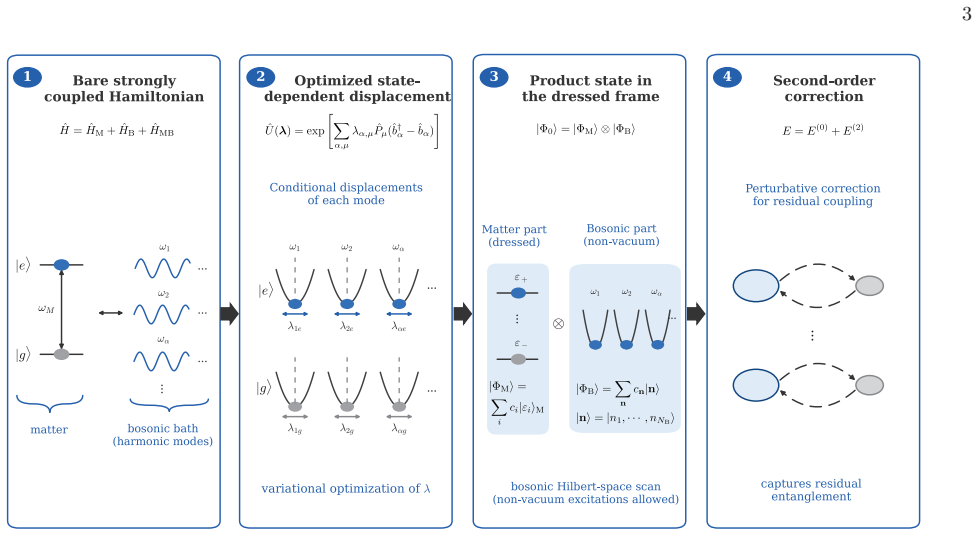
A state-dependent polaron transformation with a product ansatz produces accurate ground states for strongly coupled light-matter and electron-phonon systems in every coupling regime.
A machine-rendered reading of the paper's core claim, the machinery that carries it, and where it could break.
Core claim
The optimized transformed frame becomes asymptotically decoupled at infinite coupling, because the leading linear coupling is canceled while off-diagonal matter transitions are suppressed by displaced-oscillator overlaps. The approach is asymptotically correct in both weak- and strong-coupling limits and remains accurate in the intermediate regime, where fixed polaron transformations are least reliable.
What carries the argument
state-dependent polaron transformation: a unitary displacement of the bosonic modes whose amplitude depends on the matter state and is chosen variationally to remove the linear interaction term.
If this is right
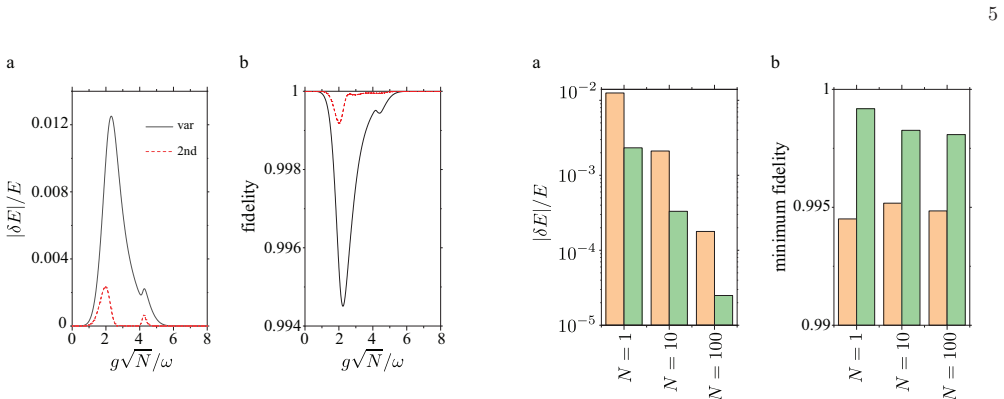
- Ground-state energies, fidelities, and the superradiant phase boundary of the Dicke model are reproduced with second-order energy errors below 0.2 percent.
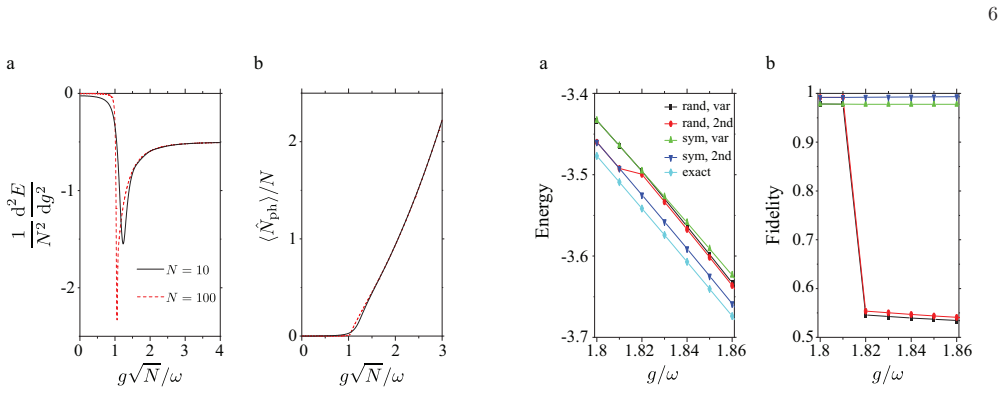
- Holstein-model energies are obtained with errors below 0.5 percent and the effect of translational symmetry on wave-function quality is clarified.
- The same dressed-basis construction supplies a nonperturbative route to ground states of any system whose Hamiltonian contains linear boson-matter coupling.
- Because the transformation is asymptotically exact at infinite coupling, the method can be used to extrapolate to the ultrastrong-coupling regime without additional approximations.
Where Pith is reading between the lines
- The same variational displacement could be applied to multimode or finite-temperature versions of the same Hamiltonians to test whether the decoupling property survives.
- The suppression of off-diagonal transitions by overlap factors suggests that the method may remain useful for real-time dynamics when the matter system evolves slowly compared with the boson frequency.
- Because the residual entanglement is treated only perturbatively, the framework naturally indicates where higher-order corrections or tensor-network methods would be needed next.
Load-bearing premise
The product-state ansatz in the transformed frame plus a second-order perturbative correction for residual entanglement captures the essential physics at all coupling strengths.
What would settle it
A direct numerical calculation of the Dicke-model ground-state energy at intermediate coupling that deviates by more than 0.5 percent from the variational result would falsify the accuracy claim.
Figures
read the original abstract
Strong light-matter and electron-phonon coupling generate ground states dressed by virtual bosonic excitations, making bare-state truncations and perturbative treatments unreliable in the ultrastrong-coupling regime. We introduce a nonperturbative variational ground-state framework based on a state-dependent polaron transformation, combined with a product-state ansatz and a second-order perturbative correction for residual matter-boson entanglement. We show that the optimized transformed frame becomes asymptotically decoupled at infinite coupling, because the leading linear coupling is canceled while off-diagonal matter transitions are suppressed by displaced-oscillator overlaps. The approach is asymptotically correct in both weak- and strong-coupling limits and remains accurate in the intermediate regime, where fixed polaron transformations are least reliable. Dicke-model benchmarks reproduce ground-state energies, fidelities, and the superradiant transition, with second-order energy errors below 0.2%. Holstein-model benchmarks yield errors below 0.5% and clarify how translational symmetry affects wave-function quality. This dressed-basis framework enables nonperturbative modeling of strongly coupled light-matter and electron-phonon systems.
Editorial analysis
A structured set of objections, weighed in public.
Referee Report
Summary. The manuscript introduces a nonperturbative variational ground-state framework for strongly coupled light-matter (Dicke) and electron-phonon (Holstein) systems. It combines a state-dependent polaron transformation, a product-state ansatz in the transformed frame, and a second-order perturbative correction for residual matter-boson entanglement. The central claims are that the optimized transformed frame becomes asymptotically decoupled at infinite coupling (leading linear coupling canceled, off-diagonal transitions suppressed by displaced-oscillator overlaps), the method is asymptotically correct in both weak- and strong-coupling limits, and remains accurate in the intermediate regime, as shown by benchmarks reproducing ground-state energies, fidelities, the superradiant transition (Dicke, second-order errors <0.2%), and energies (Holstein, errors <0.5%).
Significance. If the intermediate-regime accuracy holds, the framework would offer a useful dressed-basis tool for ultrastrong-coupling regimes where bare truncations and fixed-polaron methods fail. The asymptotic analysis and benchmarks on standard models constitute concrete strengths; the absence of an a-priori uniform error bound independent of the variational optimization is the primary limitation on the scope of the accuracy claim.
major comments (2)
- [Abstract] Abstract: the claim that the method 'remains accurate in the intermediate regime' is supported solely by post-hoc numerical benchmarks on the Dicke and Holstein models; no derivation of an a-priori error bound that holds uniformly across coupling strengths and is independent of the variational optimization is provided. This is load-bearing for the central claim about intermediate-regime performance.
- [Abstract] The product-state ansatz plus second-order perturbative correction is asserted to capture essential residual entanglement, yet the manuscript does not supply a concrete test (e.g., comparison against exact multi-mode entanglement measures or higher-order corrections) that would falsify the sufficiency of this truncation when non-perturbative channels survive the optimization.
Simulated Author's Rebuttal
We thank the referee for the thoughtful review and for highlighting both the strengths and the scope limitations of our variational framework. We address each major comment below and indicate the revisions we will make to the manuscript.
read point-by-point responses
-
Referee: [Abstract] Abstract: the claim that the method 'remains accurate in the intermediate regime' is supported solely by post-hoc numerical benchmarks on the Dicke and Holstein models; no derivation of an a-priori error bound that holds uniformly across coupling strengths and is independent of the variational optimization is provided. This is load-bearing for the central claim about intermediate-regime performance.
Authors: We agree that the manuscript provides no a-priori uniform error bound independent of the variational optimization. The intermediate-regime accuracy is established through numerical benchmarks on the Dicke and Holstein models. We will revise the abstract to replace the phrasing 'remains accurate in the intermediate regime' with 'demonstrates high accuracy in the intermediate regime, as validated by benchmarks on the Dicke and Holstein models.' We will also add a sentence in the conclusions section explicitly noting the absence of such an a-priori bound as a limitation of the present analysis. revision: yes
-
Referee: [Abstract] The product-state ansatz plus second-order perturbative correction is asserted to capture essential residual entanglement, yet the manuscript does not supply a concrete test (e.g., comparison against exact multi-mode entanglement measures or higher-order corrections) that would falsify the sufficiency of this truncation when non-perturbative channels survive the optimization.
Authors: The sufficiency of the truncation is tested indirectly through agreement with exact diagonalization for ground-state energies and fidelities across coupling regimes. We acknowledge, however, that the manuscript does not include direct comparisons to higher-order corrections or explicit multi-mode entanglement measures that could falsify the approximation when non-perturbative channels remain. We will add a short paragraph in the methods or discussion section clarifying that the second-order correction is the leading term after optimization and that the benchmarks indicate higher-order contributions are small; we will also note this as a scope limitation rather than attempting to provide new falsification tests in the revision. revision: partial
Circularity Check
Derivation self-contained from variational principles without reduction to inputs
full rationale
The paper constructs its framework from a state-dependent polaron transformation combined with a product-state ansatz and explicit second-order perturbative correction. The key claim of asymptotic decoupling at infinite coupling follows directly from cancellation of the leading linear term and suppression of off-diagonal transitions by displaced-oscillator overlaps, as stated in the abstract. Benchmarks on Dicke and Holstein models serve only as post-hoc validation of energies and fidelities, not as fitted inputs or self-defining relations. No self-citation chains, ansatzes smuggled via prior work, or renamings of known results appear as load-bearing steps in the provided derivation outline. The approach remains independent of the target observables.
Axiom & Free-Parameter Ledger
Reference graph
Works this paper leans on
-
[1]
Ebbesen, T. W. Hybrid Light–Matter States in a Molec- ular and Material Science Perspective. Acc. Chem. Res. 2016, 49, 2403–2412. 8
2016
-
[2]
F.; Mart ´ ınez-Mart ´ ınez, L
Ribeiro, R. F.; Mart ´ ınez-Mart ´ ınez, L. A.; Du, M.; Campos-Gonzalez-Angulo, J.; Yuen-Zhou, J. Polariton Chemistry: Controlling Molecular Dynamics with Opti- cal Cavities. Chem. Sci. 2018, 9, 6325–6339
2018
-
[3]
Molecular Polaritons for Con- trolling Chemistry with Quantum Optics
Herrera, F.; Owrutsky, J. Molecular Polaritons for Con- trolling Chemistry with Quantum Optics. J. Chem. Phys. 2020, 152, 100902
2020
-
[4]
J.; Ciuti, C.; Ebbesen, T
Garcia-Vidal, F. J.; Ciuti, C.; Ebbesen, T. W. Manip- ulating Matter by Strong Coupling to Vacuum Fields. Science 2021, 373, eabd0336
2021
-
[5]
T.; Ishizaki, A
Phuc, N. T.; Ishizaki, A. Precise Determination of Exci- tation Energies in Condensed-Phase Molecular Systems Based on Exciton-Polariton Measurements. Phys. Rev. Research 2019, 1, 033019
2019
-
[6]
Spano, F. C. Optical Microcavities Enhance the Exciton Coherence Length and Eliminate Vibronic Coupling in J-Aggregates. J. Chem. Phys. 2015, 142, 184707
2015
-
[7]
Herrera, F.; Spano, F. C. Cavity-Controlled Chemistry in Molecular Ensembles. Phys. Rev. Lett. 2016, 116, 238301
2016
-
[8]
Decoupling from a Thermal Bath via Molecular Polariton Formation
Takahashi, S.; Watanabe, K. Decoupling from a Thermal Bath via Molecular Polariton Formation. J. Phys. Chem. Lett. 2020, 11, 1349–1356
2020
-
[9]
Electron Transfer in Con- fined Electromagnetic Fields
Semenov, A.; Nitzan, A. Electron Transfer in Con- fined Electromagnetic Fields. J. Chem. Phys. 2019, 150, 174122
2019
-
[10]
A.; Ribeiro, R
Campos-Gonzalez-Angulo, J. A.; Ribeiro, R. F.; Yuen- Zhou, J. Resonant Catalysis of Thermally Activated Chemical Reactions with Vibrational Polaritons. Nat. Commun. 2019, 10, 4685
2019
-
[11]
T.; Trung, P
Phuc, N. T.; Trung, P. Q.; Ishizaki, A. Controlling the Nonadiabatic Electron-Transfer Reaction Rate through Molecular-Vibration Polaritons in the Ultrastrong Cou- pling Regime. Sci. Rep. 2020, 10, 7318
2020
-
[12]
D.; Huo, P
Mandal, A.; Krauss, T. D.; Huo, P. Polariton-Mediated Electron Transfer via Cavity Quantum Electrodynamics. J. Phys. Chem. B 2020, 124, 6321–6340
2020
-
[13]
N.; Zhang, P.; Beratan, D
Chowdhury, S. N.; Zhang, P.; Beratan, D. N. Interferenc e between Molecular and Photon Field-Mediated Electron Transfer Coupling Pathways in Cavities. J. Phys. Chem. Lett. 2022, 13, 9822–9828
2022
-
[14]
Cavity-Free Quantum- Electrodynamic Electron Transfer Reactions
Wei, Y.-C.; Hsu, L.-Y. Cavity-Free Quantum- Electrodynamic Electron Transfer Reactions. J. Phys. Chem. Lett. 2022, 13, 9695–9702
2022
-
[15]
Saller, M. A. C.; Lai, Y.; Geva, E. Cavity-Modified Fermi’s Golden Rule Rate Constants: Beyond the Sin- gle Mode Approximation. J. Chem. Phys. 2023, 159, 151105
2023
-
[16]
Electron Transfer in Confined Elec- tromagnetic Fields: A Unified Fermi’s Golden Rule Rate Theory and Extension to Lossy Cavities
Ying, W.; Nitzan, A. Electron Transfer in Confined Elec- tromagnetic Fields: A Unified Fermi’s Golden Rule Rate Theory and Extension to Lossy Cavities. J. Chem. Phys. 2026, 164, 024113
2026
-
[17]
Hidaka, T.; Fukushima, T.; Phuc, N. T. Molecular Elec- tron Transfer in Optical Cavities: From Excitonic to Vi- bronic Polaritons. J. Chem. Phys. 2026, ?, ?
2026
-
[18]
Phuc, N. T. Super-reaction: The Collective Enhance- ment of a Reaction Rate by Molecular Polaritons in the Presence of Energy Fluctuations. J. Chem. Phys. 2021, 155, 014308
2021
-
[19]
Phuc, N. T. Bose Enhancement of Excitation-Energy Transfer with Molecular-Exciton-Polariton Condensates. J. Chem. Phys. 2022, 156, 234301
2022
-
[20]
R.; Mandal, A.; Musser, A
Koessler, E. R.; Mandal, A.; Musser, A. J.; Krauss, T. D.; Huo, P. Polariton-Mediated Electron Transfer under the Collective Molecule–Cavity Coupling Regime. Chem. Sci. 2025, 16, 11644–11658
2025
-
[21]
Phuc, N. T. Chiral-Induced Spin Selectivity in Photon- Coupled Achiral Matters. J. Phys. Chem. Lett. 2023, 14, 1626–1632
2023
-
[22]
Phuc, N. T. Floquet-Engineered Chiral-Induced Spin Se - lectivity. J. Chem. Phys. 2023, 159, 054706
2023
-
[23]
Enhancement of Chiral- Induced Spin Selectivity via Circularly Polarized Light
Liu, W.; Chen, J.; Dou, W. Enhancement of Chiral- Induced Spin Selectivity via Circularly Polarized Light. J. Phys. Chem. C 2025, 129, 10181–10188
2025
-
[24]
T.; Ishizaki, A
Phuc, N. T.; Ishizaki, A. Control of Excitation Energy Transfer in Condensed Phase Molecular Systems by Flo- quet Engineering. J. Phys. Chem. Lett. 2018, 9, 1243– 1248
2018
-
[25]
T.; Ishizaki, A
Phuc, N. T.; Ishizaki, A. Control of Quantum Dynam- ics of Electron Transfer in Molecular Loop Structures: Spontaneous Breaking of Chiral Symmetry under Strong Decoherence. Phys. Rev. B 2019, 99, 064301
2019
-
[26]
Electron Transfer at Molecule–Metal Interfaces under Floquet Engineering: Rate Constant and Floquet Marcus Theory
Wang, Y.; Dou, W. Electron Transfer at Molecule–Metal Interfaces under Floquet Engineering: Rate Constant and Floquet Marcus Theory. ACS Phys. Chem. Au 2024, 4, 160–166
2024
-
[27]
Studies of Polaron Motion: Part I
Holstein, T. Studies of Polaron Motion: Part I. The Molecular-Crystal Model. Ann. Phys. 1959, 8, 325–342
1959
-
[28]
G.; Firsov, Yu
Lang, I. G.; Firsov, Yu. A. Kinetic Theory of Semicon- ductors with Low Mobility. Sov. Phys. JETP 1963, 16, 1301–1312
1963
-
[29]
Mahan, G. D. Many-Particle Physics ; Kluwer Aca- demic/Plenum: New York, 2000
2000
-
[30]
S.; Devreese, J
Alexandrov, A. S.; Devreese, J. T. Advances in Polaron Physics; Springer: Berlin, 2010
2010
-
[31]
F.; Miranowicz, A.; De Liberato, S.; Savasta , S.; Nori, F
Kockum, A. F.; Miranowicz, A.; De Liberato, S.; Savasta , S.; Nori, F. Ultrastrong Coupling between Light and Matter. Nat. Rev. Phys. 2019, 1, 19–40
2019
-
[32]
Ultrastrong Coupling Regimes of Light–Matter Interac- tion
Forn-D ´ ıaz, P.; Lamata, L.; Rico, E.; Kono, J.; Solano, E. Ultrastrong Coupling Regimes of Light–Matter Interac- tion. Rev. Mod. Phys. 2019, 91, 025005
2019
-
[33]
R.; Chan, G
Yang, J.; Cui, Z.-H.; Mahajan, A.; Zhai, H.; Reichman, D. R.; Chan, G. K.-L. Benchmarking the Exponential Ansatz for the Holstein Model. J. Chem. Phys. 2024, 161, 104105
2024
-
[34]
Cui, Z.-H.; Mandal, A.; Reichman, D. R. Variational Lang–Firsov Approach Plus Møller–Plesset Perturbation Theory with Applications to Ab Initio Polariton Chem- istry. J. Chem. Theory Comput. 2024, 20, 1143–1156
2024
-
[35]
First-Principles Molecular Quan- tum Electrodynamics Theory at All Coupling Strengths
Li, X.; Zhang, Y. First-Principles Molecular Quan- tum Electrodynamics Theory at All Coupling Strengths. arXiv 2023, arXiv:2310.18228
arXiv 2023
-
[36]
R.; Haugland, T
Riso, R. R.; Haugland, T. S.; Ronca, E.; Koch, H. Molec- ular Orbital Theory in Cavity QED Environments. Nat. Commun. 2022, 13, 1368
2022
-
[37]
Silbey, R.; Harris, R. A. Variational Calculation of th e Dynamics of a Two Level System Interacting with a Bath. J. Chem. Phys. 1984, 80, 2615–2617
1984
-
[38]
Light–Matter Decoupling in the Deep Strong Coupling Regime: The Breakdown of the Purcell Effect
De Liberato, S. Light–Matter Decoupling in the Deep Strong Coupling Regime: The Breakdown of the Purcell Effect. Phys. Rev. Lett. 2014, 112, 016401
2014
-
[39]
Cavity Quan- tum Electrodynamics at Arbitrary Light–Matter Cou- pling Strengths
Ashida, Y.; Imamoglu, A.; Demler, E. Cavity Quan- tum Electrodynamics at Arbitrary Light–Matter Cou- pling Strengths. Phys. Rev. Lett. 2021, 126, 153603
2021
-
[40]
Phuc, N. T. Semiclassical Truncated-Wigner- Approximation Theory of Molecular Vibration-Polariton Dynamics in Optical Cavities. J. Chem. Theory Comput. 2024, 20, 3019–3027. 9
2024
-
[41]
Phuc, N. T. Semiclassical Truncated-Wigner- Approximation Theory of Molecular Exciton-Polariton Dynamics in Optical Cavities. J. Chem. Theory Comput. 2025, 21, 1509–1520
2025
-
[42]
Dicke, R. H. Coherence in Spontaneous Radiation Pro- cesses. Phys. Rev. 1954, 93, 99–110
1954
-
[43]
Hepp, K.; Lieb, E. H. On the Superradiant Phase Tran- sition for Molecules in a Quantized Radiation Field: The Dicke Maser Model. Ann. Phys. 1973, 76, 360–404
1973
-
[44]
K.; Hioe, F
Wang, Y. K.; Hioe, F. T. Phase Transition in the Dicke Model of Superradiance. Phys. Rev. A 1973, 7, 831–836
1973
-
[45]
Phase Transitions, Two-Level Atoms, and the A2 Term
Rzazewski, K.; Wodkiewicz, K.; Zakowicz, W. Phase Transitions, Two-Level Atoms, and the A2 Term. Phys. Rev. Lett. 1975, 35, 432–434
1975
-
[46]
Gauge Ambiguities Imply Jaynes– Cummings Physics Remains Valid in Ultrastrong Cou- pling QED
Stokes, A.; Nazir, A. Gauge Ambiguities Imply Jaynes– Cummings Physics Remains Valid in Ultrastrong Cou- pling QED. Nat. Commun. 2019, 10, 499
2019
-
[47]
T.; Trung, P
Phuc, N. T.; Trung, P. Q. Direct and Ultrafast Probing of Quantum Many-Body Interactions through Coherent Two-Dimensional Spectroscopy: From Weak- to Strong- Interaction Regimes. Phys. Rev. B 2021, 104, 115105
2021
discussion (0)
Sign in with ORCID, Apple, or X to comment. Anyone can read and Pith papers without signing in.