When, Where, and How: Adaptive Binning for Tabular Self-Supervised Learning
Pith reviewed 2026-06-26 18:05 UTC · model grok-4.3
The pith
Adaptive Binning refines per-feature discretization during training to improve tabular self-supervised learning on medical data.
A machine-rendered reading of the paper's core claim, the machinery that carries it, and where it could break.
Core claim
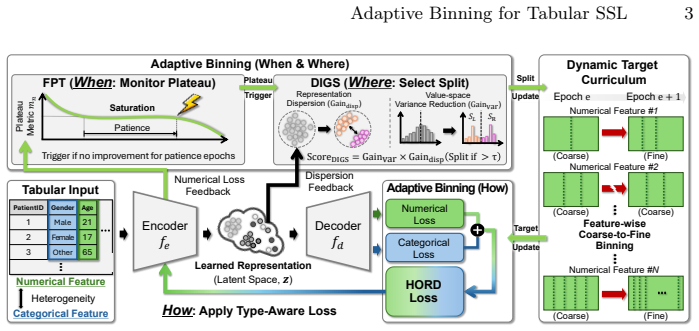
Adaptive Binning is a training-adaptive discretization pretext for tabular SSL that couples discretization to learning through a feature-wise coarse-to-fine curriculum. It progressively refines discretization per feature upon plateau detection and selects representation-aware splits to jointly improve value-space concentration and representation-space coherence. A heterogeneity-aware objective unifies categorical reconstruction with ordinal supervision for numerical features, and experiments on public medical tabular datasets under unified evaluation protocols show consistent gains for linear probing and fine-tuning without dataset-specific discretization tuning.
What carries the argument
Adaptive Binning, the training-adaptive discretization mechanism that uses plateau detection to trigger feature-wise refinement and representation-aware split selection inside a heterogeneity-aware objective.
If this is right
- Consistent gains appear in linear probing on medical tabular datasets.
- Fine-tuning also improves without any dataset-specific discretization tuning.
- A single heterogeneity-aware objective handles both categorical and numerical features.
- A standardized medical tabular SSL benchmark is provided for reproducible evaluation.
Where Pith is reading between the lines
- The same adaptive refinement logic could be tested on non-medical tabular datasets such as finance or sensor logs.
- The curriculum might reduce sensitivity to initial bin choices in other self-supervised tabular pipelines.
- The released benchmark protocols could serve as a template for evaluating new tabular pretext tasks beyond medical domains.
Load-bearing premise
The assumption that progressively refining discretization per feature upon plateau detection and selecting representation-aware splits will jointly improve value-space concentration and representation-space coherence without introducing instability or requiring dataset-specific hyperparameter search.
What would settle it
If the adaptive method produces no improvement or lower performance than fixed global quantile binning on the same public medical tabular datasets under the unified linear probing and fine-tuning protocols, the central claim would be falsified.
Figures
read the original abstract
Medical tabular data are ubiquitous in clinical research, but deep learning for tables remains underexplored because reliable labels often require costly expert adjudication, even though structured clinical variables are routinely available in tabular form. Self-supervised learning can leverage these unlabeled tables, and recent binning-based pretexts offer a promising inductive bias, but existing objectives fix a single global quantile discretization and apply feature-agnostic supervision. We propose Adaptive Binning, a training-adaptive discretization pretext for tabular SSL that couples discretization to learning through a feature-wise coarse-to-fine curriculum. Motivated by the spectral bias of neural networks and the principles of curriculum learning, our method progressively refines discretization per feature upon plateau detection and selects representation-aware splits to jointly improve value-space concentration and representation-space coherence. A heterogeneity-aware objective unifies categorical reconstruction with ordinal supervision for numerical features, and experiments on public medical tabular datasets under unified evaluation protocols show consistent gains for linear probing and fine-tuning without dataset-specific discretization tuning. We further introduce a medical tabular SSL benchmark with standardized protocols to support reproducible progress in this underexplored domain. Our code is available at https://github.com/labhai/Adaptive-Binning.
Editorial analysis
A structured set of objections, weighed in public.
Referee Report
Summary. The paper proposes Adaptive Binning, a tabular SSL pretext task that couples discretization to training via a feature-wise coarse-to-fine curriculum: per-feature refinement is triggered by plateau detection and splits are chosen in a representation-aware manner. A heterogeneity-aware objective combines categorical reconstruction with ordinal supervision. Experiments on public medical tabular datasets under unified protocols are claimed to yield consistent gains for linear probing and fine-tuning without dataset-specific discretization tuning; a new medical tabular SSL benchmark with standardized protocols is also introduced.
Significance. If the central empirical claims hold under the stated unified protocols, the work would offer a practical route to reducing manual discretization choices in tabular SSL, which is especially relevant for label-scarce medical data. The introduction of a reproducible benchmark is a clear positive contribution to an underexplored domain.
major comments (2)
- [Abstract, §3] Abstract and §3 (method): the claim that the approach works 'without dataset-specific discretization tuning' is load-bearing for the central contribution, yet the concrete thresholds for plateau detection (loss-change delta, patience) and the parameters of representation-aware split selection (number of candidate splits, embedding distance metric, clustering settings) are not shown to be globally fixed; if either component was tuned on the medical datasets or its defaults were selected after validation performance, the guarantee fails. Explicit pseudocode or fixed hyperparameter values must be provided.
- [§4] §4 (experiments): the abstract asserts 'consistent gains' and 'unified evaluation protocols' but supplies no quantitative results, baseline comparisons, statistical tests, or ablation on the curriculum components. Tables reporting linear-probing and fine-tuning accuracies, standard deviations across seeds, and direct comparison to fixed-quantile binning baselines are required to substantiate the claim.
minor comments (2)
- [§3.3] The heterogeneity-aware objective is described at a high level; the precise weighting between categorical and ordinal terms (if any) should be stated explicitly, even if it is a fixed constant.
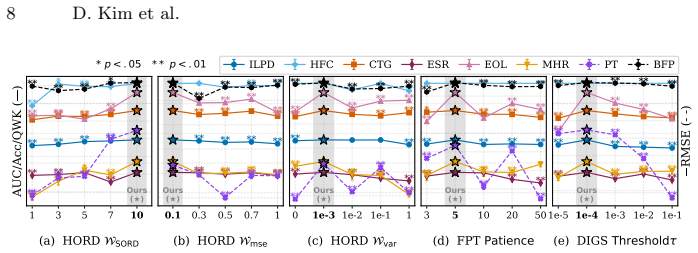
- [§4, figures] Figure captions and axis labels in the experimental section should include the exact datasets, metrics, and number of runs to allow immediate interpretation without cross-referencing the text.
Simulated Author's Rebuttal
We thank the referee for the constructive feedback on our manuscript. We address each major comment below and will make the necessary revisions to strengthen the paper.
read point-by-point responses
-
Referee: [Abstract, §3] Abstract and §3 (method): the claim that the approach works 'without dataset-specific discretization tuning' is load-bearing for the central contribution, yet the concrete thresholds for plateau detection (loss-change delta, patience) and the parameters of representation-aware split selection (number of candidate splits, embedding distance metric, clustering settings) are not shown to be globally fixed; if either component was tuned on the medical datasets or its defaults were selected after validation performance, the guarantee fails. Explicit pseudocode or fixed hyperparameter values must be provided.
Authors: We agree that explicit documentation of the fixed hyperparameters is required to support the claim. In the revised manuscript we will insert pseudocode for the full curriculum and split-selection procedure in §3 and add a dedicated table listing all fixed values (loss-change delta, patience, number of candidate splits, distance metric, clustering settings). These values were selected once on a held-out validation split from a non-medical tabular dataset and then frozen for all subsequent medical experiments; no per-dataset retuning occurred. revision: yes
-
Referee: [§4] §4 (experiments): the abstract asserts 'consistent gains' and 'unified evaluation protocols' but supplies no quantitative results, baseline comparisons, statistical tests, or ablation on the curriculum components. Tables reporting linear-probing and fine-tuning accuracies, standard deviations across seeds, and direct comparison to fixed-quantile binning baselines are required to substantiate the claim.
Authors: We acknowledge that the current manuscript version does not present the requested quantitative tables. We will expand §4 with the required tables: linear-probing and fine-tuning accuracies (mean ± std over 5 seeds), direct comparisons against fixed-quantile binning and other SSL baselines, ablations isolating the curriculum and heterogeneity-aware objective, and paired statistical tests (e.g., Wilcoxon signed-rank) under the unified protocols. revision: yes
Circularity Check
No significant circularity; method and gains presented as independent of fitted inputs.
full rationale
The paper introduces Adaptive Binning as a novel coarse-to-fine curriculum pretext motivated by spectral bias and curriculum learning, with plateau detection, representation-aware splits, and a heterogeneity-aware objective. No equations, self-citations, or derivations are shown that reduce any claimed prediction or result to quantities defined by construction from the same fitted parameters or prior self-work. The experimental claims of consistent gains without dataset-specific tuning are empirical assertions under unified protocols, not reductions of the method to its inputs. This is the common case of a self-contained new method.
Axiom & Free-Parameter Ledger
Reference graph
Works this paper leans on
-
[1]
personalized
Amin, M.B., Greene, F.L., Edge, S.B., Compton, C.C., Gershenwald, J.E., Brook- land, R.K., Meyer, L., Gress, D.M., Byrd, D.R., Winchester, D.P.: The eighth edition ajcc cancer staging manual: continuing to build a bridge from a population- based to a more “personalized” approach to cancer staging. CA: a cancer journal for clinicians67(2), 93–99 (2017)
2017
-
[2]
In: Pro- ceedings of the AAAI conference on artificial intelligence
Arik, S.Ö., Pfister, T.: Tabnet: Attentive interpretable tabular learning. In: Pro- ceedings of the AAAI conference on artificial intelligence. vol. 35, pp. 6679–6687 (2021)
2021
-
[3]
In: Pro- ceedings ofthe 26thannualinternational conference on machine learning.pp
Bengio, Y., Louradour, J., Collobert, R., Weston, J.: Curriculum learning. In: Pro- ceedings ofthe 26thannualinternational conference on machine learning.pp. 41–48 (2009)
2009
-
[4]
IEEE transactions on neural networks and learning systems35(6), 7499–7519 (2022)
Borisov, V., Leemann, T., Seßler, K., Haug, J., Pawelczyk, M., Kasneci, G.: Deep neural networks and tabular data: A survey. IEEE transactions on neural networks and learning systems35(6), 7499–7519 (2022)
2022
-
[5]
Chapman and Hall/CRC (2017)
Breiman, L., Friedman, J., Olshen, R.A., Stone, C.J.: Classification and regression trees. Chapman and Hall/CRC (2017)
2017
-
[6]
In: Proceedings of the 22nd acm sigkdd international conference on knowledge discovery and data mining
Chen, T., Guestrin, C.: Xgboost: A scalable tree boosting system. In: Proceedings of the 22nd acm sigkdd international conference on knowledge discovery and data mining. pp. 785–794 (2016)
2016
-
[7]
In: Proceedings of the IEEE/CVF conference on computer vision and pattern recognition
Diaz, R., Marathe, A.: Soft labels for ordinal regression. In: Proceedings of the IEEE/CVF conference on computer vision and pattern recognition. pp. 4738–4747 (2019)
2019
-
[8]
Nature medicine25(1), 24–29 (2019)
Esteva, A., Robicquet, A., Ramsundar, B., Kuleshov, V., DePristo, M., Chou, K., Cui, C., Corrado, G., Thrun, S., Dean, J.: A guide to deep learning in healthcare. Nature medicine25(1), 24–29 (2019)
2019
-
[9]
Advances in Neural Information Processing Systems35, 24991–25004 (2022)
Gorishniy, Y., Rubachev, I., Babenko, A.: On embeddings for numerical features in tabular deep learning. Advances in Neural Information Processing Systems35, 24991–25004 (2022)
2022
-
[10]
Advances in neural information processing systems34, 18932–18943 (2021) 10 D
Gorishniy, Y., Rubachev, I., Khrulkov, V., Babenko, A.: Revisiting deep learning models for tabular data. Advances in neural information processing systems34, 18932–18943 (2021) 10 D. Kim et al
2021
- [11]
-
[12]
JMIR Formative Research5(11), e33124 (2021)
Holub, K., Hardy, N., Kallmes, K.: Toward automated data extraction according to tabular data structure: Cross-sectional pilot survey of the comparative clinical literature. JMIR Formative Research5(11), e33124 (2021)
2021
-
[13]
In: International Conference on Machine Learning
Lee, K., Sim, Y., Cho, H.S., Eo, M., Yoon, S., Yoon, S., Lim, W.: Binning as a pre- text task: Improving self-supervised learning in tabular domains. In: International Conference on Machine Learning. PMLR (2024)
2024
-
[14]
McElfresh, D., Khandagale, S., Valverde, J., Prasad C, V., Ramakrishnan, G., Goldblum, M., White, C.: When do neural nets outperform boosted trees on tab- ular data? Advances in Neural Information Processing Systems36, 76336–76369 (2023)
2023
-
[15]
Australian & New Zealand Journal of Psychiatry 40(8), 616–622 (2006)
McGorry, P.D., Hickie, I.B., Yung, A.R., Pantelis, C., Jackson, H.J.: Clinical stag- ing of psychiatric disorders: a heuristic framework for choosing earlier, safer and more effective interventions. Australian & New Zealand Journal of Psychiatry 40(8), 616–622 (2006)
2006
-
[16]
In: Proceedings of the IEEE conference on computer vision and pattern recognition
Pan, H., Han, H., Shan, S., Chen, X.: Mean-variance loss for deep age estimation from a face. In: Proceedings of the IEEE conference on computer vision and pattern recognition. pp. 5285–5294 (2018)
2018
-
[17]
Advances in neural information pro- cessing systems31(2018)
Prokhorenkova, L., Gusev, G., Vorobev, A., Dorogush, A.V., Gulin, A.: Catboost: unbiased boosting with categorical features. Advances in neural information pro- cessing systems31(2018)
2018
-
[18]
In: International conference on machine learning
Rahaman, N., Baratin, A., Arpit, D., Draxler, F., Lin, M., Hamprecht, F., Ben- gio, Y., Courville, A.: On the spectral bias of neural networks. In: International conference on machine learning. pp. 5301–5310. PMLR (2019)
2019
-
[19]
arXiv preprint arXiv:2207.03208 (2022)
Rubachev, I., Alekberov, A., Gorishniy, Y., Babenko, A.: Revisiting pretraining objectives for tabular deep learning. arXiv preprint arXiv:2207.03208 (2022)
-
[20]
Information Sciences329, 921–936 (2016)
de Sá, C.R., Soares, C., Knobbe, A.: Entropy-based discretization methods for ranking data. Information Sciences329, 921–936 (2016)
2016
-
[21]
Information fusion81, 84–90 (2022)
Shwartz-Ziv, R., Armon, A.: Tabular data: Deep learning is not all you need. Information fusion81, 84–90 (2022)
2022
-
[22]
NPJ digital medicine5(1), 48 (2022)
Varoquaux, G., Cheplygina, V.: Machine learning for medical imaging: method- ological failures and recommendations for the future. NPJ digital medicine5(1), 48 (2022)
2022
-
[23]
In: Proceedings of the 25th interna- tional conference on Machine learning
Vincent, P., Larochelle, H., Bengio, Y., Manzagol, P.A.: Extracting and composing robust features with denoising autoencoders. In: Proceedings of the 25th interna- tional conference on Machine learning. pp. 1096–1103 (2008)
2008
-
[24]
In: Pro- ceedings of the AAAIConference on Artificial Intelligence.vol
Yan, J., Chen, J., Wu, Y., Chen, D.Z., Wu, J.: T2g-former: organizing tabular features into relation graphs promotes heterogeneous feature interaction. In: Pro- ceedings of the AAAIConference on Artificial Intelligence.vol. 37, pp. 10720–10728 (2023)
2023
-
[25]
In: Advances in Neural Information Processing Systems
Yoon, J., Zhang, Y., Jordon, J., van der Schaar, M.: VIME: Extending the success of self- and semi-supervised learning to tabular domain. In: Advances in Neural Information Processing Systems. vol. 33, pp. 11033–11043 (2020)
2020
discussion (0)
Sign in with ORCID, Apple, or X to comment. Anyone can read and Pith papers without signing in.