NNNN: Neural Networks for Newtonian Noise Mitigation at the Einstein Telescope
Pith reviewed 2026-06-26 15:52 UTC · model grok-4.3
The pith
Neural networks predict Newtonian noise from seismic arrays 15 to 80 times more accurately than Wiener filters during transient events.
A machine-rendered reading of the paper's core claim, the machinery that carries it, and where it could break.
Core claim
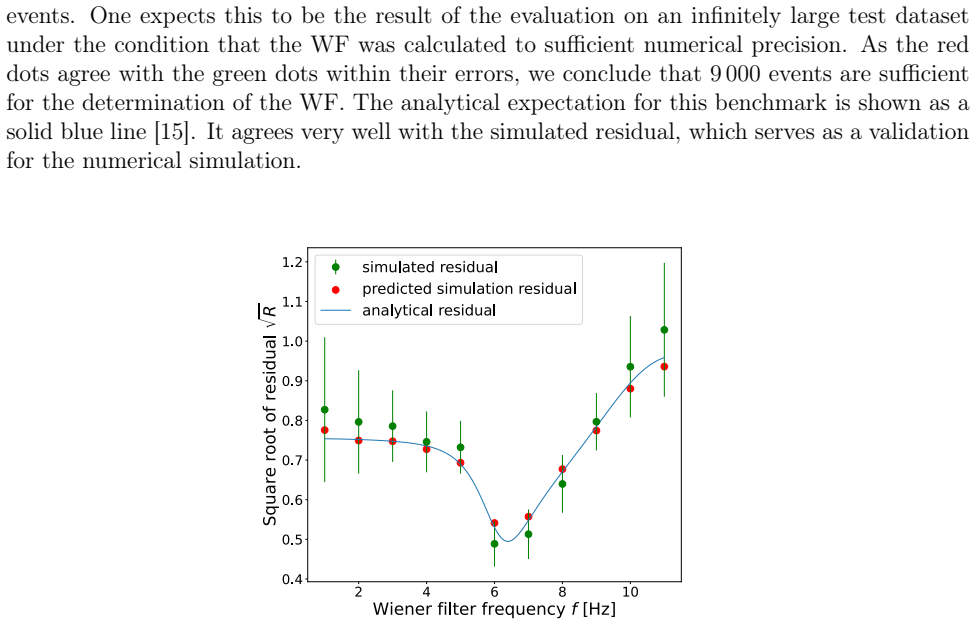
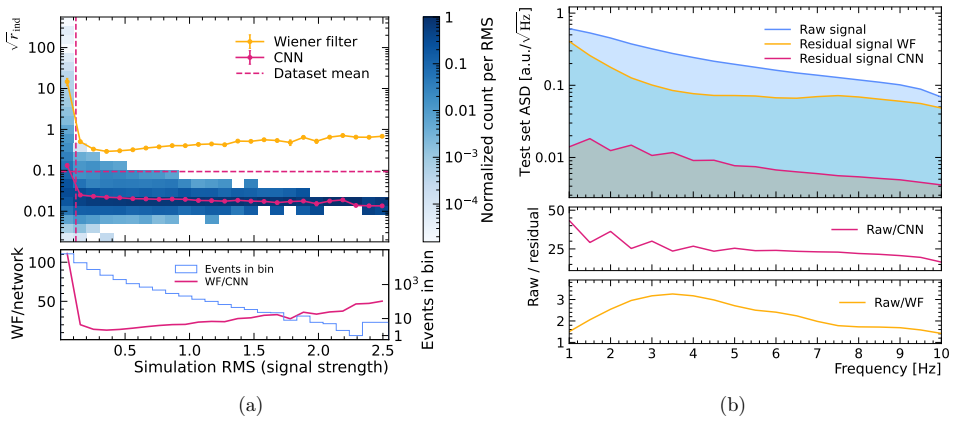
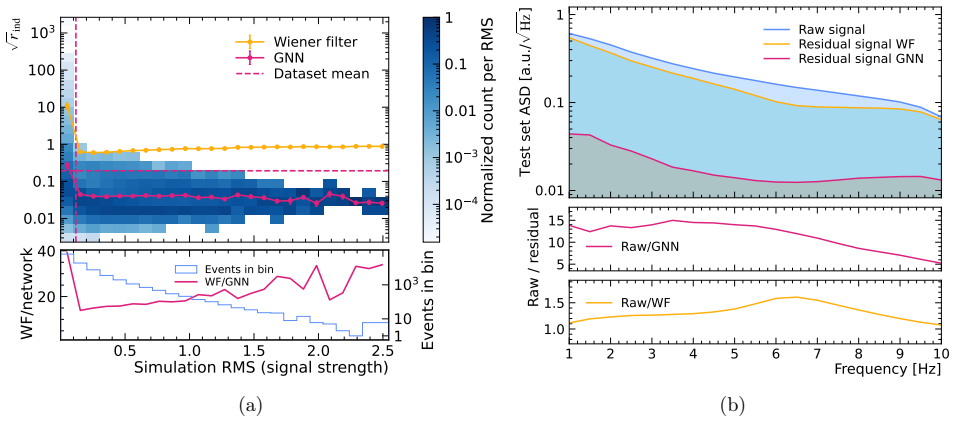
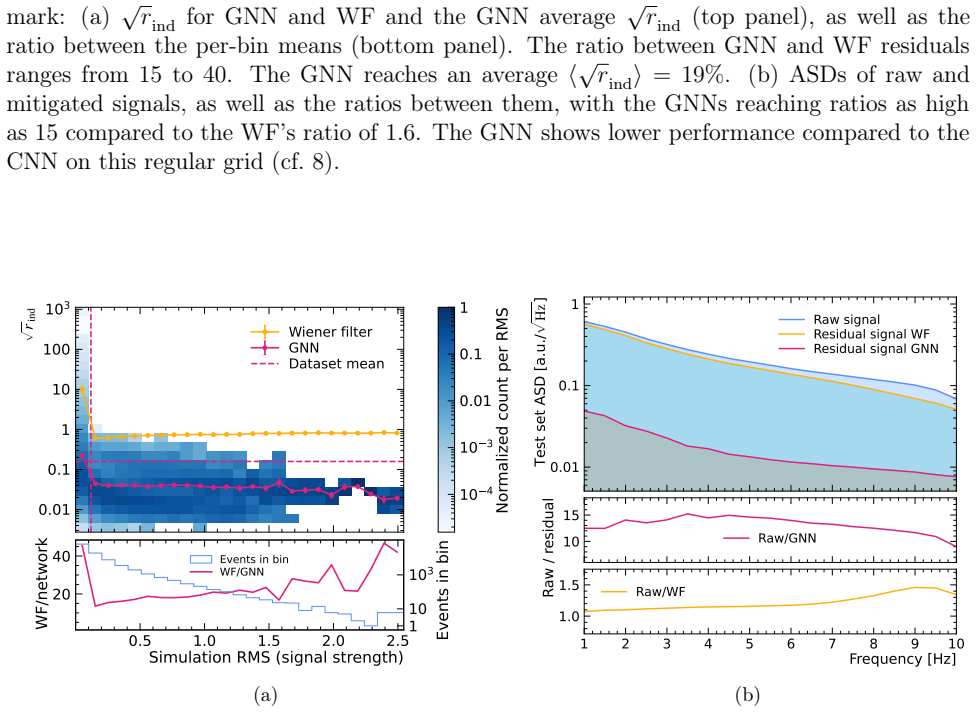
Using synthetic data generated from random plane waves and Gaussian wave packets, the authors demonstrate that convolutional neural networks and graph neural networks trained on seismometer displacement fields outperform the Wiener filter in Newtonian noise prediction, with the largest gains for non-stationary events where reduction factors reach 15-80 depending on frequency and array layout.
What carries the argument
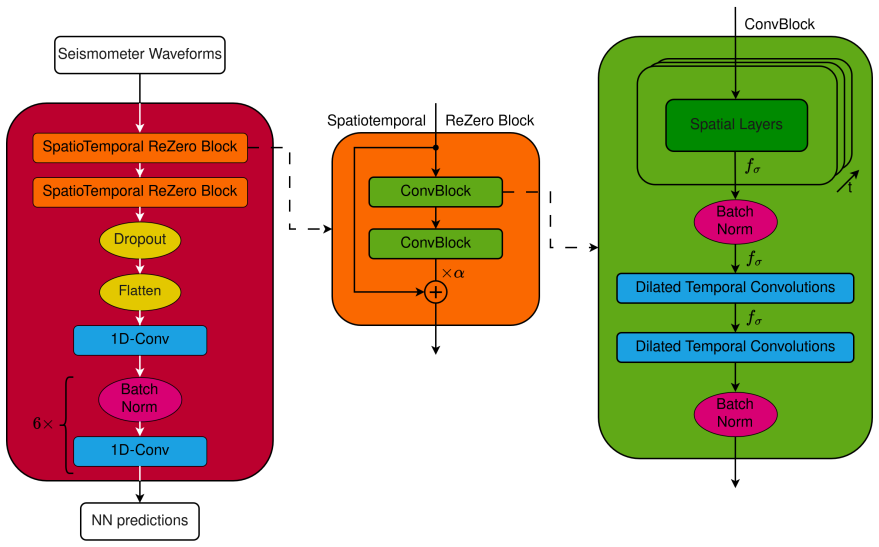
Convolutional neural networks and graph neural networks applied to simulated seismometer displacement fields to predict Newtonian noise.
Load-bearing premise
The synthetic data generated from random plane waves and Gaussian wave packets sufficiently represents the actual seismic conditions and wave-field statistics at the Einstein Telescope site.
What would settle it
Applying the trained networks and the Wiener filter to real seismic recordings from a candidate Einstein Telescope site and comparing their actual prediction errors against the simulated factors of 15-80.
Figures
read the original abstract
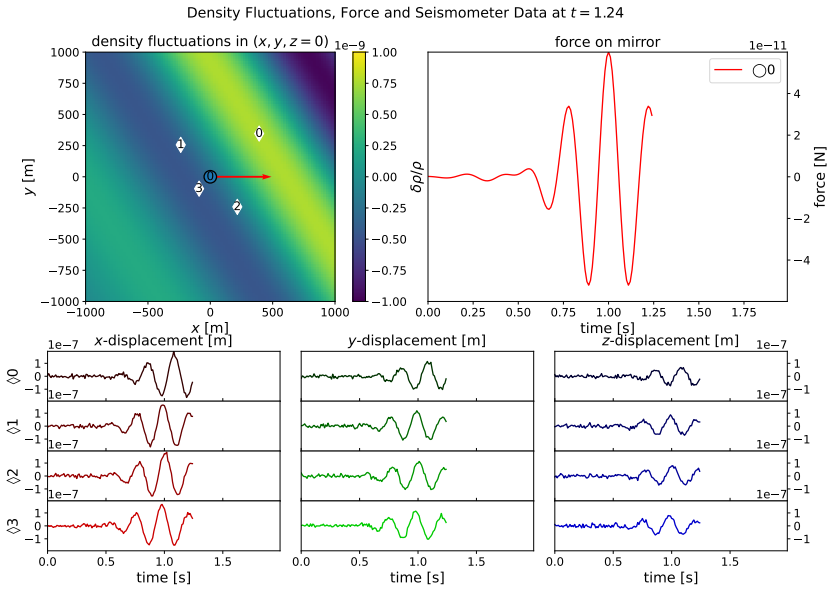
The gravitational effects of seismic waves, so-called Newtonian noise, will likely limit the low-frequency sensitivity of future ground-based gravitational wave detectors, such as the Einstein Telescope. It has been proposed to mitigate this noise source by predicting it from measurements of the surrounding seismic displacement field using an array of seismometers. In this paper, we investigate the Newtonian noise prediction abilities of neural networks based on synthetic data from such seismometer arrays and compare the results with the Wiener filter as benchmark. We developed a simulation that generates density fluctuations of random plane waves and Gaussian wave packets, and that calculates the resulting Newtonian noise and displacement field. We investigate the performance on approximately stationary wave fields and single dominating long- and short-term events. For the first case, we observe comparable performance of neural networks and the Wiener filter with the networks performing slightly better. For the second case, however, we find that convolutional neural networks and graph neural networks can outperform the Wiener filter by factors of 15-80, depending on the frequency and the array configuration, and that they can reduce the corresponding Newtonian noise amplitude spectral density by factors of 10-30.
Editorial analysis
A structured set of objections, weighed in public.
Referee Report
Summary. The paper claims that neural networks, specifically convolutional and graph neural networks, can predict Newtonian noise from synthetic seismic array data more effectively than the Wiener filter, particularly for non-stationary events generated by random plane waves and Gaussian wave packets. On stationary fields, performance is comparable with slight NN advantage, while for single events, NNs outperform by factors of 15-80 and reduce ASD by 10-30x.
Significance. If the results hold and the synthetic data is representative of ET conditions, this work could significantly advance Newtonian noise mitigation techniques for the Einstein Telescope by demonstrating the potential of machine learning methods to handle complex seismic wave fields better than traditional filters. The use of controlled synthetic data allows for clear benchmarking against the Wiener filter.
major comments (2)
- [Abstract] The abstract reports quantitative performance gains (15-80x improvement, 10-30x ASD reduction) without providing details on the neural network architectures, training procedures, data splits, error bars, or statistical tests. These are load-bearing for verifying the central performance claims.
- [Simulation and Results] The headline results are obtained exclusively on synthetic data from random plane waves and Gaussian wave packets. There is no quantitative validation that this ensemble reproduces the spatial coherence, dispersion relations, scattering, or non-stationary statistics of the seismic field at the Einstein Telescope site, which is critical for the applicability of the mitigation claims to the actual detector.
minor comments (1)
- Consider adding more details on the specific array configurations and frequency ranges tested to improve reproducibility.
Simulated Author's Rebuttal
We thank the referee for the careful review and constructive feedback. We address the major comments below and propose targeted revisions where appropriate.
read point-by-point responses
-
Referee: [Abstract] The abstract reports quantitative performance gains (15-80x improvement, 10-30x ASD reduction) without providing details on the neural network architectures, training procedures, data splits, error bars, or statistical tests. These are load-bearing for verifying the central performance claims.
Authors: The abstract is intentionally concise per journal guidelines, but we agree it can better signpost the supporting details. The architectures (CNN and GNN), training procedures, data generation/splits, and performance metrics with error bars are fully described in Sections 3 (Methods) and 4 (Results), including statistical comparisons to the Wiener filter. We will revise the abstract to briefly note the network types, the use of 80/10/10 train/validation/test splits, and that quantitative results include standard deviations across multiple realizations. revision: partial
-
Referee: [Simulation and Results] The headline results are obtained exclusively on synthetic data from random plane waves and Gaussian wave packets. There is no quantitative validation that this ensemble reproduces the spatial coherence, dispersion relations, scattering, or non-stationary statistics of the seismic field at the Einstein Telescope site, which is critical for the applicability of the mitigation claims to the actual detector.
Authors: We agree that direct quantitative validation against ET-site measurements would strengthen applicability claims; however, no such public seismic array data exists yet because ET is still in the design phase. Our synthetic ensemble is constructed from standard plane-wave and wave-packet models that reproduce the key features (non-stationarity, spatial coherence lengths, and frequency content) used in prior Newtonian-noise studies for ET. We will add an expanded discussion subsection on model assumptions, limitations, and the rationale for using controlled synthetics to benchmark against the Wiener filter under known ground truth. We do not claim site-specific fidelity beyond these established models. revision: partial
Circularity Check
No significant circularity; results are empirical on synthetic data with external benchmark
full rationale
The paper generates synthetic seismic displacement fields from random plane waves and Gaussian wave packets, computes the corresponding Newtonian noise, trains CNNs and GNNs to predict the noise from array measurements, and evaluates against the Wiener filter on held-out synthetic test cases. The reported outperformance (factors of 15-80 for events) is a direct empirical comparison on this controlled ensemble; the Wiener filter is an independent standard method applied to the same data, not a fitted parameter renamed as prediction. No self-definitional steps, no load-bearing self-citations, and no ansatz or uniqueness claims that reduce the central result to its own inputs appear in the abstract or described chain. The derivation is self-contained within the synthetic setting it explicitly studies.
Axiom & Free-Parameter Ledger
Forward citations
Cited by 1 Pith paper
-
Optimization and robustness of cost-efficient seismic arrays for Newtonian noise cancellation at the Einstein Telescope
Optimized seismic arrays with multiple sensors per borehole plus tunnel extensions achieve broadband Newtonian noise mitigation above 3-4 Hz with high robustness to position variations for the Einstein Telescope.
Reference graph
Works this paper leans on
-
[1]
B. P. Abbott et al. Observation of Gravitational Waves from a Binary Black Hole Merger. Physical Review Letters, 116:061102, 2016.doi:10 . 1103 / PhysRevLett . 116 . 061102. arXiv:1602.03837 [gr-qc]
Pith/arXiv arXiv 2016
-
[2]
J. Aasi et al. Advanced LIGO.Classical and Quantum Gravity, 32:074001, 2015.doi: 10.1088/0264-9381/32/7/074001. arXiv:1411.4547 [gr-qc]
work page internal anchor Pith review Pith/arXiv arXiv doi:10.1088/0264-9381/32/7/074001 2015
-
[3]
Advanced Virgo: a 2nd generation interferometric gravitational wave detector
F. Acernese et al. Advanced Virgo: a second-generation interferometric gravitational wave detector.Classical and Quantum Gravity, 32:024001, 2015.doi:10.1088/0264- 9381/ 32/2/024001. arXiv:1408.3978 [gr-qc]
work page internal anchor Pith review Pith/arXiv arXiv doi:10.1088/0264- 2015
-
[4]
doi:10.1088/0264-9381/29/12/124007
K.Somiya(fortheKAGRACollaboration).DetectorconfigurationofKAGRA–theJapanese cryogenic gravitational-wave detector.Classical and Quantum Gravity, 29:124007, 2012. doi:10.1088/0264-9381/29/12/124007. arXiv:1111.7185 [gr-qc]
-
[5]
Aso et al
Y. Aso et al. Interferometer design of the KAGRA gravitational wave detector.Physical Review D, 88:043007, 2013.doi:10 . 1103 / PhysRevD . 88 . 043007. arXiv:1306 . 6747 [gr-qc]
2013
-
[6]
B. P. Abbott et al. Multi-messenger Observations of a Binary Neutron Star Merger.The Astrophysical Journal Letters, 848:L12, 2017.doi:10.3847/2041-8213/aa91c9. arXiv: 1710.05833 [astro-ph.HE]
work page internal anchor Pith review Pith/arXiv arXiv doi:10.3847/2041-8213/aa91c9 2017
-
[7]
R. Abbott et al. Observation of Gravitational Waves from Two Neutron Star–Black Hole Coalescences.The Astrophysical Journal Letters, 915:L5, 2021.doi:10 . 3847 / 2041 - 8213/ac082e. arXiv:2106.15163 [astro-ph.HE]
arXiv 2021
-
[8]
Design Report Update 2020 for the Einstein Telescope, 2020.url:https://apps.et-gw.eu/tds/?r=18715
ET Steering Committee Editorial Team. Design Report Update 2020 for the Einstein Telescope, 2020.url:https://apps.et-gw.eu/tds/?r=18715
2020
-
[9]
S. Hild et al. Sensitivity studies for third-generation gravitational wave observatories. Classical and Quantum Gravity, 28:094013, 2011.doi:10 . 1088 / 0264 - 9381 / 28 / 9 / 094013. arXiv:1012.0908 [gr-qc]
Pith/arXiv arXiv 2011
-
[10]
P. R. Saulson. Terrestrial gravitational noise on a gravitational wave antenna.Physical Review D, 30:732, 1984.doi:10.1103/PhysRevD.30.732. 16
-
[11]
ET Sensitivity Curves.https : / / gitlab . et - gw . eu / pub / et - sensitivity - curves, accessed 11.04.2026
2026
-
[12]
G. Cella. Off-Line Subtraction of Seismic Newtonian Noise. In B. Casciaro, D. Fortunato, M. Francaviglia, and A. Masiello, editors,Recent Developments in General Relativity, page 495, Milan. Springer, 2000.doi:10.1007/978-88-470-2113-6_44
-
[13]
Wiener.Extrapolation, Interpolation, and Smoothing of Stationary Time Series: With Engineering Applications
N. Wiener.Extrapolation, Interpolation, and Smoothing of Stationary Time Series: With Engineering Applications. Wiley, New York, 1949
1949
-
[14]
J. Harms. Terrestrial Gravity Fluctuations.Living Reviews in Relativity, 18:3, 2015.doi: 10.1007/lrr-2015-3. arXiv:1507.05850 [gr-qc]
-
[15]
F. Badaracco and J. Harms. Optimization of seismometer arrays for the cancellation of Newtonian noise from seismic body waves.Class. Quant. Grav., 36:145006, 2019.doi: 10.1088/1361-6382/ab28c1. arXiv:1903.07936 [astro-ph.IM]
-
[16]
F. Badaracco, J. Harms, and L. Rei. Joint optimization of seismometer arrays for the cancellation of Newtonian noise from seismic body waves in the Einstein Telescope.Clas- sical and Quantum Gravity, 41:025013, 2024.doi:10.1088/1361-6382/ad1715. arXiv: 2310.05709 [astro-ph.IM]
-
[17]
P. Schillings and J. Erdmann. Fighting Newtonian noise with gradient-based optimization at the Einstein Telescope.Classical and Quantum Gravity, 42:065025, 2025.doi:10 . 1088/1361-6382/adb898. arXiv:2411.03251 [astro-ph.IM]
arXiv 2025
-
[18]
Subtraction of Newtonian Noise Using Optimized Sensor Arrays
J. Driggers, J. Harms, and R. Adhikari. Subtraction of newtonian noise using optimized sensor arrays.Physical Review D, 86, 2012.doi:10.1103/PhysRevD.86.102001. arXiv: 1207.0275 [gr-qc]
work page internal anchor Pith review Pith/arXiv arXiv doi:10.1103/physrevd.86.102001 2012
-
[19]
F. Badaracco et al. Machine learning for gravitational-wave detection: surrogate Wiener filtering for the prediction and optimized cancellation of Newtonian noise at Virgo.Clas- sical and Quantum Gravity, 37:195016, 2020.doi:10.1088/1361-6382/abab64. arXiv: 2005.09289 [astro-ph.IM]
-
[21]
S. Koley et al. Adaptive algorithms for low-latency cancellation of seismic Newtonian- noise at the Virgo gravitational-wave detector.Physical Review D, 110:022002, 2024. doi:10.1103/PhysRevD.110.022002. arXiv:2404.13170 [gr-qc]
-
[22]
P. Ophardt, F. Badaracco, and K.-S. Isleif. Silencing Newtonian noise using fusion sensor arrays, 2025. arXiv:2512.13554 [gr-qc]
arXiv 2025
-
[23]
R. Rading et al. Distributed Acoustic Sensing for Environmental Monitoring, and Newto- nian Noise Mitigation: Comparable Sensitivity to Seismometers, 2025. arXiv:2507.13523 [astro-ph.IM]
arXiv 2025
-
[24]
V. van Beveren et al. A study of deep neural networks for Newtonian noise subtraction at Terziet in Limburg—the Euregio Meuse-Rhine candidate site for Einstein Telescope. Class. Quant. Grav., 40:205008, 2023.doi:10.1088/1361-6382/acf3c8
-
[25]
F. Amann et al. Site-selection criteria for the Einstein Telescope.Review of Scientific In- struments,91:094504,2020.doi:10.1063/5.0018414.arXiv:2003.03434 [physics.ins-det]
-
[26]
T. Bachlechner et al. ReZero is All You Need: Fast Convergence at Large Depth, 2020. arXiv:2003.04887 [cs.LG]. 17
arXiv 2020
-
[27]
Y. LeCun and Y. Bengio.Convolutional networks for images, speech, and time series. In The Handbook of Brain Theory and Neural Networks. MIT Press, Cambridge, MA, USA, 1998, page 255.url:https://doi.org/10.7551/mitpress/3413.001.0001
-
[28]
P. Veličković et al. Graph Attention Networks, 2017. arXiv:1710.10903 [stat.ML]
Pith/arXiv arXiv 2017
-
[29]
J. Kennedy and R. Eberhart. Particle swarm optimization. InProceedings of ICNN’95 - International Conference on Neural Networks, volume 4, page 1942, 1995.doi:10.1109/ ICNN.1995.488968
arXiv 1942
-
[30]
S. Koley et al. Design and implementation of a seismic Newtonian noise cancellation system for the Virgo gravitational-wave detector.Eur. Phys. J. Plus, 139:48, 2024.doi: 10.1140/epjp/s13360-023-04834-0. arXiv:2310.17781 [gr-qc]. 18
discussion (0)
Sign in with ORCID, Apple, or X to comment. Anyone can read and Pith papers without signing in.