UCLCHEM 4.0: An open source gas-grain astrochemistry simulation framework
Pith reviewed 2026-06-26 16:41 UTC · model grok-4.3
The pith
UCLCHEM 4.0 supplies an open-source framework that solves time-dependent gas-grain chemical networks across interstellar scales from galaxies to disks.
A machine-rendered reading of the paper's core claim, the machinery that carries it, and where it could break.
Core claim
UCLCHEM is a comprehensive astrochemical modeling framework that can model the interstellar medium ranging from extra-galactic to protoplanetary disks scales. The framework consists of a core routine that solves chemical reaction networks as a function of time. The chemistry includes a description of gas and ice grain chemistry and the interactions between the two. The physical modeling includes parametrizations for modelling cloud collapse, protostellar cores and shocks as well as the ability to provide user defined inputs. This manuscript provides an overview of the physics and chemistry included in UCLCHEM, as well as the inner workings of the solver routine and the programming interface.
What carries the argument
The core routine that solves chemical reaction networks as a function of time, including gas and ice grain chemistry and the interactions between the two.
If this is right
- Simulations can be performed from extra-galactic scales down to protoplanetary disks using the same chemical solver.
- User-defined physical inputs allow modeling of arbitrary density, temperature, and velocity histories.
- Gas-grain interactions are treated self-consistently so ice mantles and gas-phase abundances evolve together.
- The open-source code exposes the solver routine and programming interface for community inspection and modification.
Where Pith is reading between the lines
- The framework could be coupled to hydrodynamic codes to test chemistry under more dynamic flows than the supplied parametrizations allow.
- Direct comparison of UCLCHEM output with laboratory surface-reaction rates would test whether the grain chemistry module reproduces experimental results.
- The same network could be used to generate synthetic spectra for planning observations with facilities that resolve different spatial scales.
Load-bearing premise
The parametrizations supplied for cloud collapse, protostellar cores, and shocks are assumed to be adequate representations of the physical conditions that control chemistry in real astrophysical environments.
What would settle it
A comparison of model output with measured molecular column densities in a protostellar core whose density and temperature profiles are independently constrained would falsify the claim if the abundances disagree by more than the combined uncertainties.
Figures
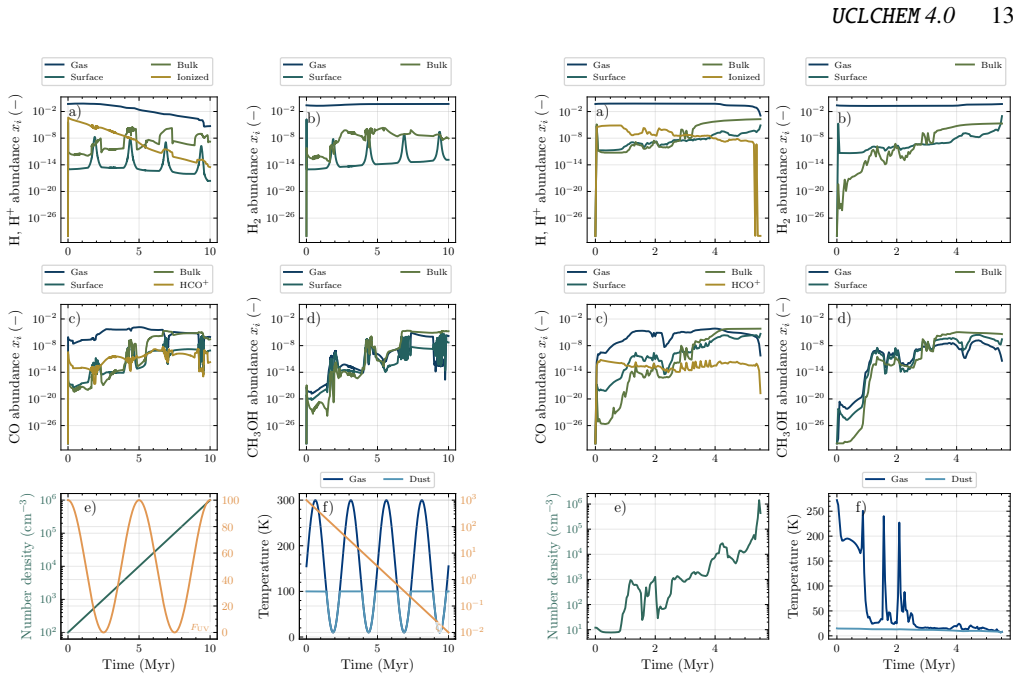
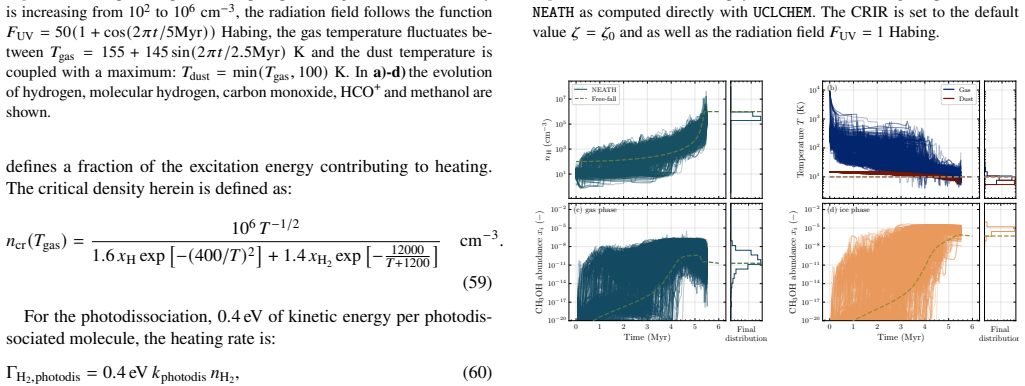
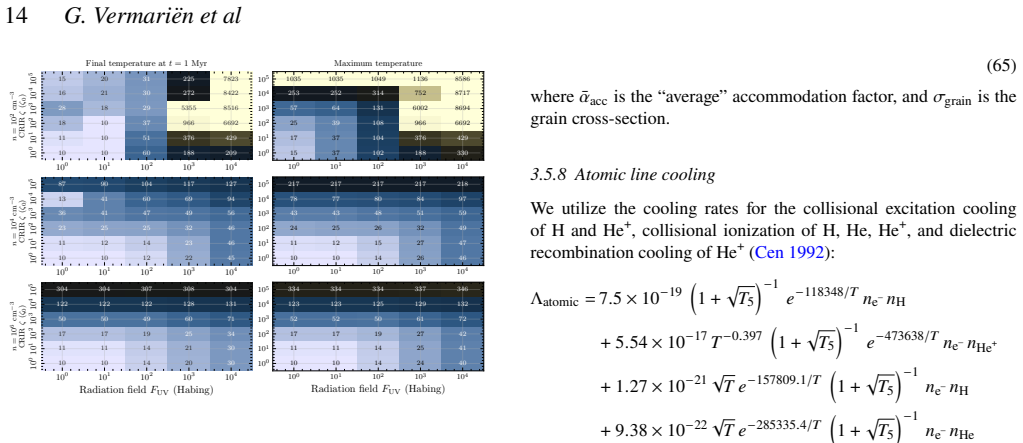
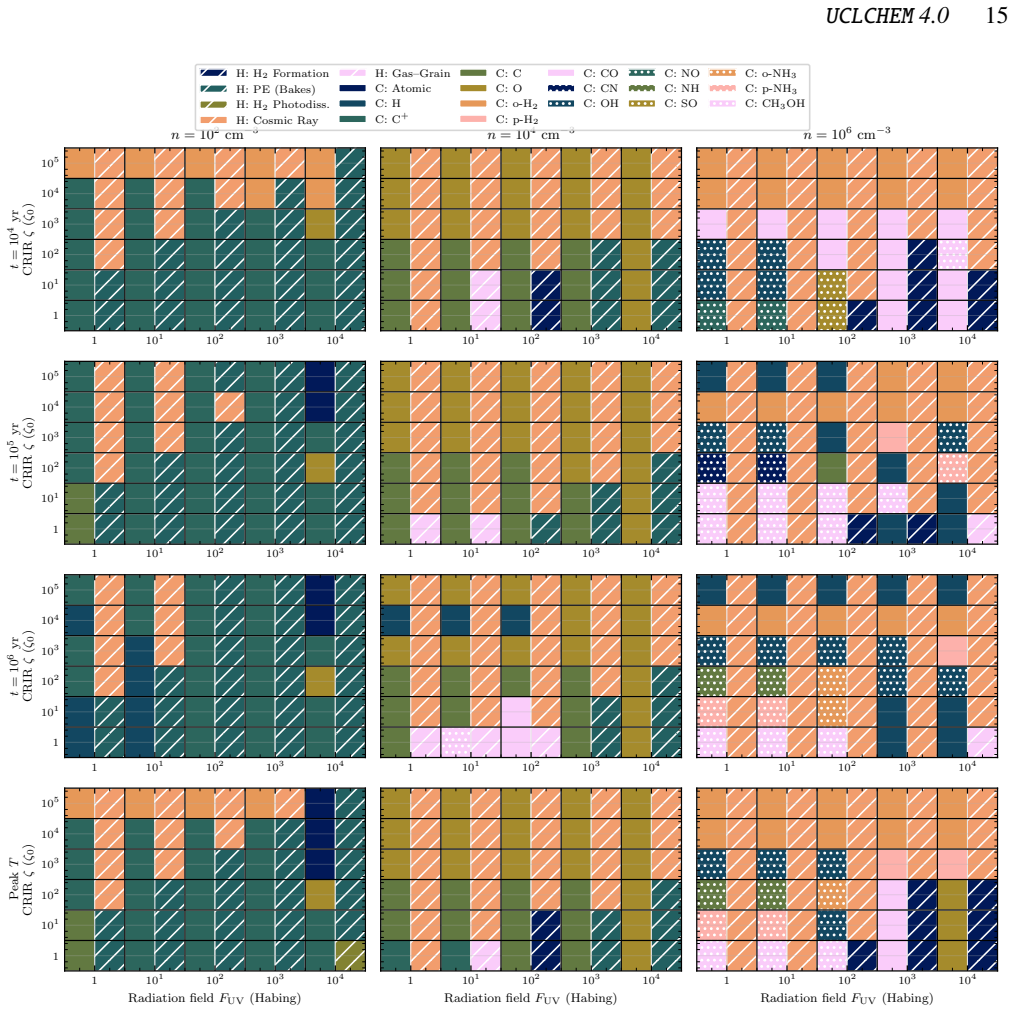
read the original abstract
Astrochemical modeling is a key tool for the understanding of the formation and destruction of molecules in the dense gas of the interstellar medium, as observed by modern day observational facilities. UCLCHEM is a comprehensive astrochemical modeling framework that can model the interstellar medium ranging from extra-galactic to protoplanetary disks scales. The framework consists of a core routine that solves chemical reaction networks as a function of time. The chemistry includes a description of gas and ice grain chemistry and the interactions between the two. The physical modeling includes parametrizations for modelling cloud collapse, protostellar cores and shocks as well as the ability to provide user defined inputs. This manuscript provides an overview of the physics and chemistry included in UCLCHEM, as well as the inner workings of the solver routine and the programming interface.
Editorial analysis
A structured set of objections, weighed in public.
Referee Report
Summary. The manuscript describes UCLCHEM 4.0, an open-source gas-grain astrochemistry simulation framework. It consists of a core routine solving time-dependent chemical reaction networks that include gas-phase and ice-grain chemistry plus their interactions; physical modules supply parametrizations for cloud collapse, protostellar cores and shocks together with user-defined inputs; the paper supplies an overview of the included physics and chemistry, solver internals, and programming interface, with the central claim that the framework can model the ISM across extragalactic to protoplanetary-disk scales.
Significance. If the implemented scope matches the description, the work supplies a publicly available, documented tool that lowers the barrier for time-dependent gas-grain modeling across widely different astrophysical regimes. The open-source release and explicit treatment of the solver and user interface constitute concrete strengths that can support reproducibility and community extensions.
major comments (1)
- [Abstract] Abstract: the assertion that UCLCHEM 'can model the interstellar medium ranging from extra-galactic to protoplanetary disks scales' is presented without any validation tests, error budgets, benchmark comparisons against observations, or cross-code verifications, so the comprehensiveness claim remains unsupported by evidence in the manuscript.
minor comments (1)
- The manuscript should include explicit repository URLs, commit hashes or version tags, and installation instructions to ensure immediate reproducibility of the described framework.
Simulated Author's Rebuttal
We thank the referee for their review and constructive comment on the manuscript. We address the point below and agree that a revision is warranted to align the abstract language with the scope of evidence presented.
read point-by-point responses
-
Referee: the assertion that UCLCHEM 'can model the interstellar medium ranging from extra-galactic to protoplanetary disks scales' is presented without any validation tests, error budgets, benchmark comparisons against observations, or cross-code verifications, so the comprehensiveness claim remains unsupported by evidence in the manuscript.
Authors: We agree that the abstract presents the modeling range as a capability without accompanying validation, benchmarks, or observational comparisons within this manuscript. This paper is a code-description article focused on the framework architecture, chemical network solver, physical modules, and user interface; it does not include new scientific validation tests. The statement derives from the parametrizations supplied for cloud collapse, protostellar cores, shocks, and user-defined inputs, which are intended to span the cited physical regimes. To address the concern, we will revise the abstract to state that UCLCHEM 'is designed to model' or 'provides the tools to model' the interstellar medium across these scales, making explicit that the range follows from the included modules rather than from demonstrations in the present work. No new validation sections will be added, as that would change the paper's purpose, but the wording will be softened for accuracy. revision: yes
Circularity Check
No significant circularity: software description paper
full rationale
The manuscript is a factual description of an open-source code framework (UCLCHEM 4.0) and its implemented modules for gas-grain chemistry, physical parametrizations, and solver routines. No derivation chain, first-principles predictions, or fitted parameters are presented that could reduce to self-definition or self-citation. The central claim is simply that the supplied code contains the listed capabilities, which is verified by inspection of the code itself rather than by any internal mathematical reduction. This matches the default expectation for non-derivational software papers.
Axiom & Free-Parameter Ledger
Reference graph
Works this paper leans on
-
[1]
Aikawa, Yuri and Herbst, Eric and Roberts, Helen and Caselli, Paola , year = 2005, month = feb, journal =. Molecular. doi:10.1086/427017 , urldate =
-
[2]
Asplund, Martin and Grevesse, Nicolas and Sauval, A. Jacques and Scott, Pat , year = 2009, month = sep, journal =. The. doi:10.1146/annurev.astro.46.060407.145222 , urldate =
-
[3]
Atkins, Peter and Paula, Julio De and Keeler, James , year = 2022, month = dec, edition =. Atkins'. doi:10.1093/hesc/9780198847816.001.0001 , urldate =
-
[4]
Awad, Zainab and Viti, Serena and Collings, Mark P. and Williams, David A. , year = 2010, month = jul, journal =. Warm Cores around Regions of Low-Mass Star Formation:. doi:10.1111/j.1365-2966.2010.17077.x , urldate =
-
[5]
Bakes, E. L. O. and Tielens, A. G. G. M. , year = 1994, month = jun, journal =. The. doi:10.1086/174188 , urldate =
-
[6]
Chemistry in Cosmic Ray Dominated Regions , author =. Monthly Notices of the Royal Astronomical Society , volume =. doi:10.1111/j.1365-2966.2011.18500.x , urldate =
-
[7]
Bayet, E. and Viti, S. and Williams, D. A. and Rawlings, J. M. C. , year = 2008, month = apr, journal =. Molecular. doi:10.1086/528678 , urldate =
-
[8]
Bayet, E. and Viti, S. and Williams, D. A. and Rawlings, J. M. C. and Bell, T. , year = 2009, month = may, journal =. Molecular. doi:10.1088/0004-637X/696/2/1466 , urldate =
-
[9]
The Chemistry of Transient Microstructure in the Diffuse Interstellar Medium , author =. Monthly Notices of the Royal Astronomical Society , volume =. doi:10.1111/j.1365-2966.2005.08693.x , urldate =
-
[10]
Bell, T. A. and Roueff, E. and Viti, S. and Williams, D. A. , year = 2006, month = oct, journal =. Molecular Line Intensities as Measures of Cloud Masses -. doi:10.1111/j.1365-2966.2006.10817.x , urldate =
-
[11]
Bisbas, T. G. and Bell, T. A. and Viti, S. and Yates, J. and Barlow, M. J. , year = 2012, month = dec, journal =. doi:10.1111/j.1365-2966.2012.22077.x , urldate =. arXiv , langid =:1209.1091 , primaryclass =
-
[12]
Black, John H. , editor =. Heating and. Interstellar. doi:10.1007/978-94-009-3861-8_27 , urldate =
-
[13]
Borshcheva, Katerina and Fedoseev, Gleb and Punanova, Anna F. and Caselli, Paola and. Formation of. The Astrophysical Journal , volume =. doi:10.3847/1538-4357/adea73 , urldate =
-
[14]
Bovino, Stenafo and Grassi, Tommaso , year = 2023, publisher =
2023
-
[15]
Bovino, Stefano and Lupi, Alessandro and Giannetti, Andrea and Sabatini, Giovanni and Schleicher, Dominik R. G. and Wyrowski, Friedrich and Menten, Karl M. , year = 2021, month = oct, journal =. Chemical Analysis of Prestellar Cores in. doi:10.1051/0004-6361/202141252 , urldate =
-
[16]
Burke, J. R. and Hollenbach, D. J. , year = 1983, month = feb, journal =. The Gas-Grain Interaction in the Interstellar Medium -. doi:10.1086/160667 , urldate =
-
[17]
Cazaux, S. and Tielens, A. G. G. M. , year = 2004, month = mar, journal =. H2. doi:10.1086/381775 , urldate =
-
[18]
Cazaux, S. and Tielens, A. G. G. M. , year = 2002, month = aug, journal =. Molecular. doi:10.1086/342607 , urldate =
-
[19]
Monthly Notices of the Royal Astronomical Society , volume =
Cosmic Ray Induced Photons in Dense Interstellar Clouds , author =. Monthly Notices of the Royal Astronomical Society , volume =. doi:10.1093/mnras/258.1.125 , urldate =
-
[20]
Cen, Renyue , year = 1992, month = feb, journal =. A. doi:10.1086/191630 , urldate =
-
[21]
Astronomy & Astrophysics , volume =
Sticking Coefficient of Hydrogen and Deuterium on Silicates under Interstellar Conditions , author =. Astronomy & Astrophysics , volume =. doi:10.1051/0004-6361/201117409 , urldate =
-
[22]
Chang, Q. and Cuppen, H. M. and Herbst, E. , year = 2007, month = jul, journal =. Gas-Grain Chemistry in Cold Interstellar Cloud Cores with a Microscopic. doi:10.1051/0004-6361:20077423 , urldate =
-
[23]
, author =
Chemical and Thermal Equilibrium in Dark Clouds. , author =. Astronomy and Astrophysics , volume =
-
[24]
Astrochemical Models of Interstellar Ices:
Cl. Astrochemical Models of Interstellar Ices:. Astronomy and Astrophysics , volume =. doi:10.1051/0004-6361/202346188 , urldate =
-
[25]
Python and
Collette, Andrew , year = 2013, publisher =. Python and
2013
-
[26]
, author =
Hydrostatic Models of Molecular Clouds. , author =. Astronomy and Astrophysics , volume =
-
[27]
Astronomy & Astrophysics , volume =
A Sensitivity Analysis of Interstellar Ice Chemistry in Astrochemical Models , author =. Astronomy & Astrophysics , volume =. doi:10.1051/0004-6361/202557925 , urldate =
-
[28]
The Astrophysical Journal , volume =
Magnetohydrodynamic Shock Waves in Molecular Clouds , author =. The Astrophysical Journal , volume =. doi:10.1086/160617 , urldate =
-
[29]
and Schlemmer, Stephan and Schilke, Peter and Stutzki, J
Endres, Christian P. and Schlemmer, Stephan and Schilke, Peter and Stutzki, J. The. Journal of Molecular Spectroscopy , series =. doi:10.1016/j.jms.2016.03.005 , urldate =
-
[30]
Atomic to Molecular Hydrogen Transition in Interstellar Clouds. , author =. The Astrophysical Journal , volume =. doi:10.1086/156753 , urldate =
-
[31]
Monthly Notices of the Royal Astronomical Society , volume =
Chemical Post-Processing of Magneto-Hydrodynamical Simulations of Star-Forming Regions: Robustness and Pitfalls , shorttitle =. Monthly Notices of the Royal Astronomical Society , volume =. doi:10.1093/mnras/stab1525 , urldate =
-
[32]
Fiedler, Robert A. and Mouschovias, Telemachos Ch. , year = 1993, month = oct, journal =. Ambipolar. doi:10.1086/173193 , urldate =
-
[33]
Flower, D. R. and Pineau Des For. The Influence of Grains on the Propagation and Structure of. Monthly Notices of the Royal Astronomical Society , volume =. doi:10.1046/j.1365-8711.2003.06716.x , urldate =
-
[34]
Flower, D. R. and Pineau Des For. Interpreting Observations of Molecular Outflow Sources: The. Astronomy & Astrophysics , volume =. doi:10.1051/0004-6361/201525740 , urldate =
-
[35]
Fredon, Adrien and Radchenko, Ash K. and Cuppen, Herma M. , year = 2021, month = feb, journal =. Quantification of the. doi:10.1021/acs.accounts.0c00636 , urldate =
-
[36]
Furuya, Kenji and Hama, Tetsuya and Oba, Yasuhiro and Kouchi, Akira and Watanabe, Naoki and Aikawa, Yuri , year = 2022, month = jun, journal =. Diffusion. doi:10.3847/2041-8213/ac78e9 , urldate =
-
[37]
Complex Chemistry in Star-Forming Regions: An Expanded Gas-Grain Warm-up Chemical Model
Garrod, Robin T. and Weaver, Susanna L. Widicus and Herbst, Eric , year = 2008, month = jul, journal =. Complex. doi:10.1086/588035 , urldate =. arXiv , langid =:0803.1214 , primaryclass =
work page internal anchor Pith review Pith/arXiv arXiv doi:10.1086/588035 2008
-
[38]
Garrod, R. T. and Pauly, T. , year = 2011, month = jul, journal =. On the. doi:10.1088/0004-637X/735/1/15 , urldate =
-
[39]
Following the Flow: Tracer Particles in Astrophysical Fluid Simulations , shorttitle =
Genel, Shy and Vogelsberger, Mark and Nelson, Dylan and Sijacki, Debora and Springel, Volker and Hernquist, Lars , year = 2013, month = oct, journal =. Following the Flow: Tracer Particles in Astrophysical Fluid Simulations , shorttitle =. doi:10.1093/mnras/stt1383 , urldate =
-
[40]
Glover, Simon C. O. and Clark, Paul C. , year = 2012, month = mar, journal =. Approximations for Modelling. doi:10.1111/j.1365-2966.2011.20260.x , urldate =
-
[41]
, year = 2001, month = aug, journal =
Goldsmith, Paul F. , year = 2001, month = aug, journal =. Molecular. doi:10.1086/322255 , urldate =
-
[42]
Gong, Munan and Ostriker, Eve C. and Wolfire, Mark G. , year = 2017, month = jul, journal =. A. doi:10.3847/1538-4357/aa7561 , urldate =
-
[43]
2012, MNRAS, 427, 1344, doi: 10.1111/j.1365-2966.2012.22008.x
Grassi, T. and Bovino, S. and Gianturco, F. A. and Baiocchi, P. and Merlin, E. , year = 2012, month = sep, journal =. Complexity Reduction of Astrochemical Networks:. doi:10.1111/j.1365-2966.2012.21537.x , urldate =
-
[44]
KROME - a package to embed chemistry in astrophysical simulations
Grassi, T. and Bovino, S. and Schleicher, D. R. G. and Prieto, J. and Seifried, D. and Simoncini, E. and Gianturco, F. A. , year = 2014, month = mar, journal =. doi:10.1093/mnras/stu114 , urldate =. arXiv , langid =:1311.1070 , primaryclass =
work page internal anchor Pith review Pith/arXiv arXiv doi:10.1093/mnras/stu114 2014
-
[45]
Guillet, V. and Pineau Des For. Shocks in Dense Clouds:. Astronomy & Astrophysics , volume =. doi:10.1051/0004-6361/201015973 , urldate =
-
[46]
Harris, Charles R. and Millman, K. Jarrod and Van Der Walt, St. Array Programming with. Nature , volume =. doi:10.1038/s41586-020-2649-2 , urldate =
-
[47]
and Herbst, Eric and Leung, Chun M
Hasegawa, Tatsuhiko I. and Herbst, Eric and Leung, Chun M. , year = 1992, month = sep, journal =. Models of. doi:10.1086/191713 , urldate =
-
[48]
Hasegawa, T. I. and Herbst, E. , year = 1993, month = aug, journal =. Three-Phase Chemical Models of Dense Interstellar Clouds: Gas, Dust Particle Mantles and Dust Particle Surfaces , shorttitle =. doi:10.1093/mnras/263.3.589 , urldate =
-
[49]
Infrared and
Herzberg, Gerhard and Herzberg, Gerhard , year = 1987, series =. Infrared and
1987
-
[50]
Faraday Discussions , volume =
A Statistical and Machine Learning Approach to the Study of Astrochemistry , author =. Faraday Discussions , volume =. doi:10.1039/D3FD00008G , urldate =
-
[51]
Astronomy and Astrophysics , volume =
A New and Simple Approach to Determine the Abundance of Hydrogen Molecules on Interstellar Ice Mantles , author =. Astronomy and Astrophysics , volume =. doi:10.1051/0004-6361/201424807 , urldate =
-
[52]
doi:10.1088/0004-637X/763/1/52 , urldate =
Hirano, Shingo and Yoshida, Naoki , year = 2013, month = jan, journal =. doi:10.1088/0004-637X/763/1/52 , urldate =
-
[53]
Hoang, Thiem , year = 2021, month = nov, journal =. Effect of. doi:10.3847/1538-4357/ac185d , urldate =
-
[54]
Hoang, Thiem and Lazarian, A. and Schlickeiser, R. , year = 2015, month = jun, journal =. On. doi:10.1088/0004-637X/806/2/255 , urldate =
-
[55]
Astronomy & Astrophysics , volume =
Parameterizing the Interstellar Dust Temperature , author =. Astronomy & Astrophysics , volume =. doi:10.1051/0004-6361/201629944 , urldate =
-
[56]
Holdship, J. and Viti, S. and Haworth, T. J. and Ilee, J. D. , year = 2021, month = sep, journal =. Chemulator:. doi:10.1051/0004-6361/202140357 , urldate =
-
[57]
Holdship, J. and Viti, S. and. The Astronomical Journal , volume =. doi:10.3847/1538-3881/aa773f , urldate =
-
[58]
Interstellar Processes , volume =
Interstellar Processes , author =. Interstellar Processes , volume =. doi:10.1007/978-94-009-3861-8 , urldate =
-
[59]
and Takahashi, Takamasa and Tielens, A
Hollenbach, David J. and Takahashi, Takamasa and Tielens, A. G. G. M. , year = 1991, month = aug, journal =. Low-. doi:10.1086/170347 , urldate =
-
[60]
Hollenbach, D. and McKee, C. F. , year = 1979, month = nov, journal =. Molecule Formation and Infrared Emission in Fast Interstellar Shocks. doi:10.1086/190631 , urldate =
-
[61]
, year = 1989, month = jul, journal =
Hollenbach, David and McKee, Christopher F. , year = 1989, month = jul, journal =. Molecule. doi:10.1086/167595 , urldate =
-
[62]
Reviews of Modern Physics , volume =
Photodissociation Regions in the Interstellar Medium of Galaxies , author =. Reviews of Modern Physics , volume =. doi:10.1103/RevModPhys.71.173 , urldate =
-
[63]
doi:10.5281/ZENODO.15852289 , urldate =
Xarray , author =. doi:10.5281/ZENODO.15852289 , urldate =
-
[64]
Hoyer, Stephan and Hamman, Joe , year = 2017, month = apr, journal =. Xarray:. doi:10.5334/jors.148 , urldate =
-
[65]
Hunter, Glen H. and Clark, Paul C. and Glover, Simon C. O. and Klessen, Ralf S. , year = 2023, month = mar, journal =. Towards the Impact of. doi:10.1093/mnras/stac3751 , urldate =
-
[66]
Ivlev, Alexei V. and Silsbee, Kedron and Sipil. Gas and. The Astrophysical Journal , volume =. doi:10.3847/1538-4357/ab4252 , urldate =
-
[67]
James, T. A. and Viti, S. and Holdship, J. and. Tracing Shock Type with Chemical Diagnostics -. Astronomy & Astrophysics , volume =. doi:10.1051/0004-6361/201936536 , urldate =
-
[68]
, year = 2009, month = aug, journal =
Jenkins, Edward B. , year = 2009, month = aug, journal =. A. doi:10.1088/0004-637X/700/2/1299 , urldate =
-
[69]
A Complete Framework for Cosmological Emulation and Inference with
Jense, H T and Harrison, I and Calabrese, E and Spurio Mancini, A and Bolliet, B and Dunkley, J and Hill, J C , year = 2025, month = jan, journal =. A Complete Framework for Cosmological Emulation and Inference with. doi:10.1093/rasti/rzaf002 , urldate =
-
[70]
Astronomy & Astrophysics , volume =
Parametrization of. Astronomy & Astrophysics , volume =. doi:10.1051/0004-6361:20078054 , urldate =
-
[71]
Johnson,. Computational. doi:10.18434/T47C7Z , urldate =
-
[72]
Kalv. Cosmic-. Open Astronomy , volume =. doi:10.1515/astro-2017-0178 , urldate =
-
[73]
Monthly Notices of the Royal Astronomical Society , volume =
The Efficiency of Photodissociation for Molecules in Interstellar Ices , author =. Monthly Notices of the Royal Astronomical Society , volume =. doi:10.1093/mnras/sty1172 , urldate =
-
[74]
Astronomy and Astrophysics , volume =
A Multi-Grain Multi-Layer Astrochemical Model with Variable Desorption Energy for Surface Species , author =. Astronomy and Astrophysics , volume =. doi:10.1051/0004-6361/202450015 , urldate =
-
[75]
and Hernquist, Lars , year = 1996, month = jul, journal =
Katz, Neal and Weinberg, David H. and Hernquist, Lars , year = 1996, month = jul, journal =. Cosmological. doi:10.1086/192305 , urldate =
-
[76]
doi:10.3847/1538-4357/ac51d0 , urldate =
Keil, Marcus and Viti, Serena and Holdship, Jonathan , year = 2022, month = mar, journal =. doi:10.3847/1538-4357/ac51d0 , urldate =
-
[77]
Astronomy & Astrophysics , volume =
Khatri, Prachi and Porciani, Cristiano and. Astronomy & Astrophysics , volume =. doi:10.1051/0004-6361/202449640 , urldate =
-
[78]
Komichi, Yuto and Aikawa, Yuri and Iwasaki, Kazunari and Furuya, Kenji , year = 2024, month = dec, journal =. Chemical Evolution during Molecular Cloud Formation Triggered by an Interstellar Shock Wave: Dependence on Shock Parameters and Comparison with Molecular Absorption Lines , shorttitle =. doi:10.1093/mnras/stae2599 , urldate =
-
[79]
Le Bourlot, J. and Le Petit, F. and Pinto, C. and Roueff, E. and Roy, F. , year = 2012, month = may, journal =. Surface Chemistry in the Interstellar Medium:. doi:10.1051/0004-6361/201118126 , urldate =
-
[80]
Ligterink, N. F. W. and Walsh, C. and Cuppen, H. M. and Drozdovskaya, M. N. and Ahmad, A. and Benoit, D. M. and Carder, J. T. and Das, A. and. Molecular Mobility of Extraterrestrial Ices: Surface Diffusion in Astrochemistry and Planetary Science , shorttitle =. Physical Chemistry Chemical Physics (Incorporating Faraday Transactions) , volume =. doi:10.103...
discussion (0)
Sign in with ORCID, Apple, or X to comment. Anyone can read and Pith papers without signing in.