Constitutive birefringence and critical curves in the rotating Garc\'ia--D\'iaz black hole
Pith reviewed 2026-06-26 16:31 UTC · model grok-4.3
The pith
Nonlinear electrodynamics splits the critical light contours around a rotating black hole into two polarization-dependent curves.
A machine-rendered reading of the paper's core claim, the machinery that carries it, and where it could break.
Core claim
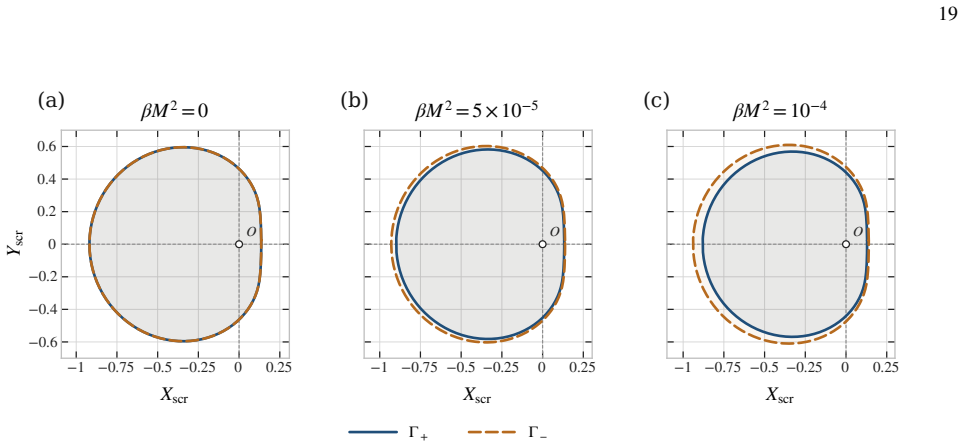
At the perturbative order considered here, the Fresnel quartic factorizes into two quadratic branches, each defining an effective optical metric. Both optical metrics admit Carter-type separation of the Hamilton-Jacobi equation and possess their own radial and angular potentials, critical constants and unstable critical families. By projecting these families onto the celestial sphere of a finite-distance observer, two critical contours Γ+ and Γ- are obtained that coincide in the Maxwell limit and split when the nonlinear constitutive response is active; the splitting is generated by the constitutive response, redistributed by rotation and stable under local projection changes within the pert
What carries the argument
The constitutive response matrix reconstructed from the aligned scalars E, B, D and H via the map (D, B) to (E, H), which is inserted into the Fresnel equation to produce the factorized optical metrics.
If this is right
- Each effective optical metric carries independent radial and angular potentials together with its own critical constants and unstable photon families.
- Projection of the two families onto the celestial sphere yields distinct contours whose maximum angular separation, relative diameter shift and normalized width are set by the nonlinear coupling.
- Numerical evaluation over coupling strength, spin and observer inclination shows the splitting is produced by the constitutive response and redistributed by rotation.
- The separation remains unchanged under local projection adjustments inside the perturbative regime.
Where Pith is reading between the lines
- The mechanism supplies a polarization-dependent signature that could appear in high-resolution images of black hole shadows if the nonlinear coupling reaches detectable values.
- The same factorization route may be applied to other nonlinear electrodynamics Lagrangians to predict analogous birefringent splittings.
- Viewing-angle dependence of the split implies that the observed width of any birefringent feature would vary with the inclination of the observer relative to the black hole spin axis.
Load-bearing premise
At the perturbative order considered the Fresnel quartic factorizes into two quadratic branches each defining an effective optical metric.
What would settle it
A calculation at the same perturbative order that produces identical critical contours Γ+ and Γ- for any nonzero value of the nonlinear coupling parameter would falsify the claimed splitting.
Figures
read the original abstract
We study high-frequency electromagnetic propagation in the rotating Garc\'ia--D\'iaz solution of Einstein gravity coupled to NLED. In this system, light is not governed only by the null cone of the spacetime metric, because the NLED field also behaves as an optical medium whose constitutive response determines the physical optical cones. Starting from the mixed electromagnetic potentials, we project the field $F$ and the excitation $P$ on a principal tetrad and obtain the aligned scalars $E$, $B$, $D$ and $H$. These scalars allow us to reconstruct the regular local constitutive branch connected with Maxwell theory through the map $(D,B)\mapsto(E,H)$. We then insert the resulting response matrix into the Fresnel characteristic problem. At the perturbative order considered here, the Fresnel quartic factorizes into two quadratic branches, each defining an effective optical metric. Both optical metrics admit Carter-type separation of the Hamilton--Jacobi equation and possess their own radial and angular potentials, critical constants and unstable critical families. By projecting these families onto the celestial sphere of a finite-distance observer, we obtain two critical contours, $\Gamma_+$ and $\Gamma_-$, which coincide in the Maxwell limit and split when the nonlinear constitutive response is active. We quantify this birefringent splitting through the maximum angular separation, the relative diameter shift and the normalized birefringent width. Numerical scans over the nonlinear coupling, spin and observer inclination show that the splitting is generated by the constitutive response, redistributed by rotation and stable under local projection changes within the perturbative domain. This provides a direct geometrical link between the local NLED response and a polarization-dependent critical structure on the observer screen.
Editorial analysis
A structured set of objections, weighed in public.
Referee Report
Summary. The manuscript examines high-frequency electromagnetic propagation in the rotating García-Díaz black hole coupled to nonlinear electrodynamics (NLED). It projects the field strength F and excitation P onto a principal tetrad to obtain aligned scalars E, B, D, H, reconstructs the local constitutive map (D,B)↦(E,H), and inserts the resulting response matrix into the Fresnel characteristic equation. At the stated perturbative order in the nonlinear coupling, the quartic factorizes into two quadratic branches, each defining an effective optical metric that admits Carter-type separation of the Hamilton-Jacobi equation. This produces independent radial and angular potentials, critical constants, and unstable photon families whose projections onto a finite-distance observer’s celestial sphere yield two distinct critical contours Γ+ and Γ−. These contours coincide in the Maxwell limit and split when the NLED response is active; the splitting is quantified by maximum angular separation, relative diameter shift, and normalized birefringent width. Numerical scans over coupling strength, spin, and inclination indicate that the splitting originates from the constitutive response, is redistributed by rotation, and remains stable under local projection changes within the perturbative regime.
Significance. If the factorization and separability hold, the work supplies a direct geometric bridge between the local NLED constitutive tensor and polarization-dependent critical curves on the observer screen. The construction of two independent, separable effective metrics and the explicit quantification of birefringent measures (angular separation, diameter shift, normalized width) constitute a concrete, falsifiable extension of standard null-geodesic shadow calculations to nonlinear media. The reported stability under projection changes and the redistribution by rotation are additional strengths that could be tested numerically or observationally.
major comments (1)
- [Abstract] Abstract (paragraph beginning 'At the perturbative order considered here'): The central claim that the Fresnel quartic factorizes exactly into two quadratic branches, each yielding an effective optical metric whose Hamilton–Jacobi equation separates in Carter form, is load-bearing for the independent construction of Γ+ and Γ−. The manuscript asserts this factorization occurs at the working perturbative order, yet the explicit expansion that demonstrates the vanishing of all cross terms (and the retention of separability) is not shown; without that verification the reported birefringent splitting measures lack a geometric foundation.
minor comments (2)
- The abstract refers to 'numerical scans over the nonlinear coupling, spin and observer inclination' but does not state the sampled ranges, step sizes, or convergence criteria used for the reported splitting quantities.
- Notation for the two effective optical metrics (e.g., g+μν and g−μν) is introduced only implicitly; an explicit definition in the section deriving the Fresnel factorization would improve readability.
Simulated Author's Rebuttal
We thank the referee for the careful reading, positive assessment of the work's significance, and the constructive major comment. We address the point below.
read point-by-point responses
-
Referee: [Abstract] Abstract (paragraph beginning 'At the perturbative order considered here'): The central claim that the Fresnel quartic factorizes exactly into two quadratic branches, each yielding an effective optical metric whose Hamilton–Jacobi equation separates in Carter form, is load-bearing for the independent construction of Γ+ and Γ−. The manuscript asserts this factorization occurs at the working perturbative order, yet the explicit expansion that demonstrates the vanishing of all cross terms (and the retention of separability) is not shown; without that verification the reported birefringent splitting measures lack a geometric foundation.
Authors: We agree that the explicit perturbative expansion verifying the factorization of the Fresnel quartic, the vanishing of cross terms, and the retention of Carter separability for each optical metric is essential to support the construction of the independent critical contours Γ+ and Γ−. The current manuscript states the result at the working order but does not display the intermediate algebra. In the revised version we will insert the required calculation (either in the main text after the constitutive map or as a short appendix) to demonstrate explicitly how the quartic reduces to two quadratic branches at the stated perturbative order in the nonlinear coupling. This addition will directly address the concern and provide the missing geometric foundation. revision: yes
Circularity Check
No significant circularity; derivation applies standard methods to NLED model
full rationale
The paper starts from the García-Díaz metric and a given NLED Lagrangian, projects fields onto the principal tetrad to obtain the constitutive map (D,B)→(E,H), inserts the response matrix into the Fresnel equation, and reports that the resulting quartic factorizes at the working perturbative order. This factorization and subsequent Carter separability are presented as computed properties of the expanded equations rather than definitions or fitted inputs. The birefringent contours Γ+ and Γ− and their splitting measures are then obtained by standard projection of the critical photon families. No load-bearing step reduces to a self-citation chain, a renamed empirical pattern, or a parameter fitted to the target observable and then called a prediction. The central claim therefore retains independent mathematical content.
Axiom & Free-Parameter Ledger
free parameters (1)
- nonlinear coupling strength
axioms (2)
- domain assumption High-frequency electromagnetic propagation is governed by the Fresnel characteristic equation derived from the constitutive matrix.
- domain assumption The NLED model possesses a regular local constitutive branch connected to Maxwell theory via the map (D,B)→(E,H).
Reference graph
Works this paper leans on
-
[1]
This is the tetrad mani- festation of the birefringent splitting of the propagation cones
= 0 +O(β 2).(189) The difference between ν+ and ν− is therefore translated into two distinct local dispersion relations. This is the tetrad mani- festation of the birefringent splitting of the propagation cones. 13 For each optical representative to preserve Lorentzian signa- ture in the domain of interest, we require Υ±(r, θ)>0,Φ ±(r, θ)>0.(190) These in...
-
[2]
(225) Although Υ± and Φ± separately contain mixed dependences, their conformal ratio preserves a radial–angular separable struc- ture at first order
+O(β 2).(222) With (216) and (218), Υ± Φ± = 1 +βα ±Σ +O(β 2).(223) Finally, since Σ =r 2 +a 2 cos2 θ,(224) the ratio admits the perturbative factorization 1 +βα ±Σ = 1 +βα ±r2 1 +βα ±a2 cos2 θ +O(β 2). (225) Although Υ± and Φ± separately contain mixed dependences, their conformal ratio preserves a radial–angular separable struc- ture at first order. C. Ca...
-
[3]
This scan isolates the role of the constitutive response
Constitutive opening The first scan varies the nonlinear coupling while keeping a/M= 0.93 and θo = 85◦ fixed. This scan isolates the role of the constitutive response. In the Maxwell limit the two branches collapse into a single contour, whereas for β̸= 0 a geometrical separation between Γ+ and Γ− appears. Table I shows this behavior directly: all birefri...
-
[4]
This scan does not measure the generation of birefringence, which is already present for β̸= 0 , but rather how rotation redistributes the signal on the local screen
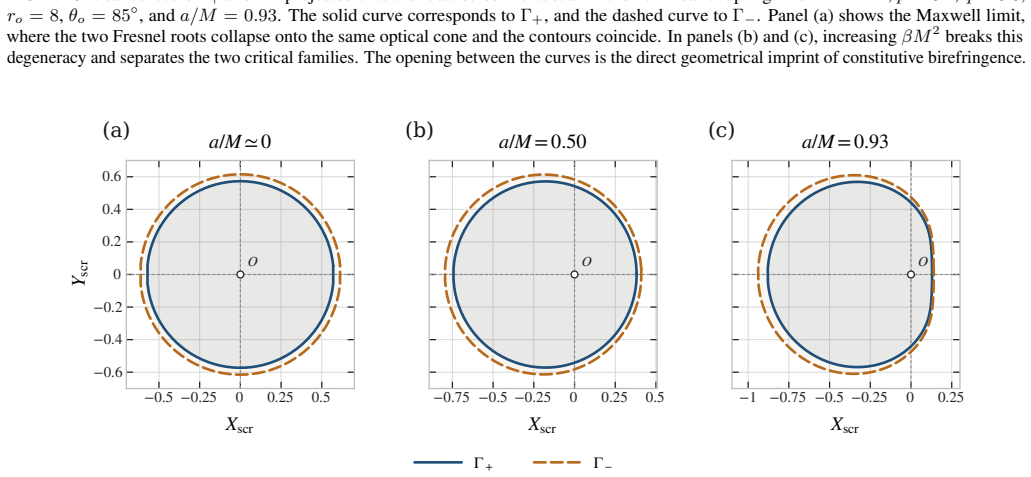
Rotational redistribution The second scan varies a/M while keeping βM 2 = 10−4 and θo = 85◦ fixed. This scan does not measure the generation of birefringence, which is already present for β̸= 0 , but rather how rotation redistributes the signal on the local screen. As shown in Table II, the constitutive response already separates the branches in the nonro...
-
[5]
The background geom- etry and the two effective optical metrics are unchanged; only the way in which the observer cuts and projects the critical families changes
Observer-projection dependence The third scan varies the observer inclination while keeping a/M= 0.93 and βM 2 = 10−4 fixed. The background geom- etry and the two effective optical metrics are unchanged; only the way in which the observer cuts and projects the critical families changes. Table III shows that the splitting is not tied to a special observer ...
-
[6]
J. L. Synge,Relativity: The General Theory, North-Holland Series in Physics (North-Holland Publishing Company, Ams- terdam, 1960) p. 505
1960
-
[7]
R. M. Wald,General Relativity(University of Chicago Press, Chicago, 1984) p. 506
1984
-
[8]
Born and L
M. Born and L. Infeld, Foundations of the New Field Theory, Proceedings of the Royal Society of London. Series A144, 425 (1934)
1934
-
[9]
Heisenberg and H
W. Heisenberg and H. Euler, Folgerungen aus der Diracschen Theorie des Positrons, Zeitschrift für Physik98, 714 (1936)
1936
-
[10]
Bialynicka-Birula and I
Z. Bialynicka-Birula and I. Bialynicki-Birula, Nonlinear Ef- fects in Quantum Electrodynamics. Photon Propagation and Photon Splitting in an External Field, Physical Review D2, 2341 (1970)
1970
-
[11]
S. L. Adler, Photon Splitting and Photon Dispersion in a Strong Magnetic Field, Annals of Physics67, 599 (1971)
1971
-
[12]
Dittrich and H
W. Dittrich and H. Gies,Probing the Quantum V acuum: Pertur- bative Effective Action Approach in Quantum Electrodynamics and its Application(Springer, Berlin, 2000)
2000
-
[13]
G. V . Dunne, Heisenberg–Euler Effective Lagrangians: Ba- sics and Extensions, arXiv e-prints , hep (2004), arXiv:hep- th/0406216 [hep-th]
arXiv 2004
-
[14]
G. M. Shore, Quantum Gravitational Optics, Contemporary Physics44, 503 (2003), arXiv:gr-qc/0304059 [gr-qc]
Pith/arXiv arXiv 2003
-
[15]
J. Pleba ´nski,Lectures on Non-linear Electrodynamics: An Extended V ersion of Lectures Given at the Niels Bohr Institute and NORDITA, Copenhagen, in October 1968(NORDITA, Copenhagen, 1970) p. 147
1968
-
[16]
Salazar I., A
H. Salazar I., A. García D., and J. Pleba´nski, Duality Rotations and Type D Solutions to Einstein Equations with Nonlinear Electromagnetic Sources, Journal of Mathematical Physics28, 2171 (1987)
1987
-
[17]
Salazar Ibarguen, A
H. Salazar Ibarguen, A. García, and J. Plebanski, Signals in Nonlinear Electrodynamics Invariant under Duality Rotations, Journal of Mathematical Physics30, 2689 (1989)
1989
-
[18]
Boillat, Nonlinear Electrodynamics: Lagrangians and Equa- tions of Motion, Journal of Mathematical Physics11, 941 (1970)
G. Boillat, Nonlinear Electrodynamics: Lagrangians and Equa- tions of Motion, Journal of Mathematical Physics11, 941 (1970)
1970
-
[19]
M. Novello, V . A. De Lorenci, J. M. Salim, and R. Klippert, Geometrical Aspects of Light Propagation in Nonlinear Elec- trodynamics, Physical Review D61, 045001 (2000), arXiv:gr- qc/9911085 [gr-qc]
arXiv 2000
-
[20]
Y . N. Obukhov and G. F. Rubilar, Fresnel Analysis of Wave Propagation in Nonlinear Electrodynamics, Physical Review D 66, 024042 (2002), arXiv:gr-qc/0204028 [gr-qc]
Pith/arXiv arXiv 2002
-
[21]
F. W. Hehl and Y . N. Obukhov,F oundations of Classical Elec- trodynamics: Charge, Flux, and Metric(Birkhäuser, Boston, 2003)
2003
-
[22]
G. F. Rubilar,Linear Pre-Metric Electrodynamics and Deduc- tion of the Light Cone, Ph.D. thesis, Universität zu Köln (2002)
2002
-
[23]
Ayón-Beato and A
E. Ayón-Beato and A. García, Regular Black Hole in General Relativity Coupled to Nonlinear Electrodynamics, Physical Review Letters80, 5056 (1998)
1998
-
[24]
E. Ayón-Beato and A. García, New Regular Black Hole Solu- tion from Nonlinear Electrodynamics, Physics Letters B464, 25 (1999), arXiv:hep-th/9911174 [hep-th]
Pith/arXiv arXiv 1999
-
[25]
E. Ayón-Beato and A. García, The Bardeen Model as a Non- linear Magnetic Monopole, Physics Letters B493, 149 (2000), arXiv:gr-qc/0009077 [gr-qc]
Pith/arXiv arXiv 2000
-
[26]
K. A. Bronnikov, Regular Magnetic Black Holes and Monopoles from Nonlinear Electrodynamics, Physical Review D63, 044005 (2001), arXiv:gr-qc/0006014 [gr-qc]
Pith/arXiv arXiv 2001
-
[27]
Dymnikova, Vacuum Nonsingular Black Hole, General Rela- tivity and Gravitation24, 235 (1992)
I. Dymnikova, Vacuum Nonsingular Black Hole, General Rela- tivity and Gravitation24, 235 (1992)
1992
-
[28]
L. Balart and E. C. Vagenas, Regular Black Holes with a Non- linear Electrodynamics Source, Physical Review D90, 124045 (2014), arXiv:1408.0306 [gr-qc]
Pith/arXiv arXiv 2014
-
[29]
Z.-Y . Fan and X. Wang, Construction of Regular Black Holes in General Relativity, Physical Review D94, 124027 (2016), arXiv:1610.02636 [gr-qc]
Pith/arXiv arXiv 2016
-
[30]
K. A. Bronnikov, Regular Black Holes Sourced by Nonlinear Electrodynamics, Universe8, 565 (2022), arXiv:2211.00743 [gr-qc]
arXiv 2022
-
[31]
M. A. A. de Paula, H. C. D. Lima, P. V . P. Cunha, and L. C. B. Crispino, Electrically Charged Regular Black Holes in Non- linear Electrodynamics: Light Rings, Shadows, and Grav- itational Lensing, Physical Review D108, 084029 (2023), arXiv:2305.04776 [gr-qc]
arXiv 2023
-
[32]
R. K. Walia, Exploring Nonlinear Electrodynamics Theo- ries: Shadows of Regular Black Holes and Horizonless Ultra- Compact Objects, Physical Review D110, 064058 (2024), arXiv:2409.13290 [gr-qc]
arXiv 2024
- [33]
-
[34]
Z. Tang, Y . Wang, and S. A. Klioner, Effect of Nonlinear Elec- trodynamics on Shadows of Slowly Rotating Black Holes with a Cosmological Constant, Physical Review D108, 104010 (2023), arXiv:2309.09038 [gr-qc]
arXiv 2023
-
[35]
M. A. A. de Paula, H. C. D. Lima, P. V . P. Cunha, C. A. R. Herdeiro, and L. C. B. Crispino, The Two Shad- ows of a Single Black Hole: Vacuum Birefringence Phe- nomena within Einstein–Nonlinear-Electrodynamics (2026), arXiv:2603.17007 [gr-qc]
arXiv 2026
- [36]
-
[37]
J. M. Bardeen, Timelike and Null Geodesics in the Kerr Metric, inBlack Holes (Les Astres Occlus), edited by C. DeWitt and B. S. DeWitt (Gordon and Breach, New York, 1973) pp. 215– 239
1973
-
[38]
Luminet, Image of a Spherical Black Hole with Thin Accretion Disk, Astronomy and Astrophysics75, 228 (1979)
J.-P. Luminet, Image of a Spherical Black Hole with Thin Accretion Disk, Astronomy and Astrophysics75, 228 (1979)
1979
-
[39]
H. Falcke, F. Melia, and E. Agol, Viewing the Shadow of the Black Hole at the Galactic Center, Astrophysical Journal Letters528, L13 (2000), arXiv:astro-ph/9912263 [astro-ph]
Pith/arXiv arXiv 2000
-
[40]
R. Takahashi, Shapes and Positions of Black Hole Shadows in Accretion Disks and Spin Parameters of Black Holes, As- trophysical Journal611, 996 (2004), arXiv:astro-ph/0405099 [astro-ph]
Pith/arXiv arXiv 2004
-
[41]
K. Hioki and K.-i. Maeda, Measurement of the Kerr Spin Pa- rameter by Observation of a Compact Object’s Shadow, Phys- ical Review D80, 024042 (2009), arXiv:0904.3575 [astro- ph.HE]
Pith/arXiv arXiv 2009
-
[42]
T. Johannsen and D. Psaltis, Testing the No-Hair Theo- rem with Observations in the Electromagnetic Spectrum. II. Black Hole Images, Astrophysical Journal718, 446 (2010), arXiv:1005.1931 [astro-ph.HE]
Pith/arXiv arXiv 2010
-
[43]
A. Abdujabbarov, F. Atamurotov, Y . Kucukakca, B. Ahmedov, and U. Camci, Shadow of Kerr–Taub–NUT Black Hole, Astro- physics and Space Science344, 429 (2013), arXiv:1212.4949 25 [physics.gen-ph]
Pith/arXiv arXiv 2013
-
[44]
A. Grenzebach, V . Perlick, and C. Lämmerzahl, Photon Re- gions and Shadows of Kerr–Newman–NUT Black Holes with a Cosmological Constant, Physical Review D89, 124004 (2014), arXiv:1403.5234 [gr-qc]
Pith/arXiv arXiv 2014
-
[45]
N. Tsukamoto, Z. Li, and C. Bambi, Constraining the Spin and the Deformation Parameters from the Black Hole Shadow, Journal of Cosmology and Astroparticle Physics2014(06), 043, arXiv:1403.0371 [gr-qc]
-
[46]
Z. Younsi, A. Zhidenko, L. Rezzolla, R. Konoplya, and Y . Mizuno, A New Method for Shadow Calculations: Appli- cation to Parametrized Axisymmetric Black Holes, Physical Review D94, 084025 (2016), arXiv:1607.05767 [gr-qc]
Pith/arXiv arXiv 2016
-
[47]
P. V . P. Cunha, C. A. R. Herdeiro, and E. Radu, Fundamental Photon Orbits: Black Hole Shadows and Spacetime Instabili- ties, Physical Review D96, 024039 (2017), arXiv:1705.05461 [gr-qc]
Pith/arXiv arXiv 2017
-
[48]
P. V . P. Cunha and C. A. R. Herdeiro, Shadows and Strong Gravitational Lensing: A Brief Review, General Relativity and Gravitation50, 42 (2018), arXiv:1801.00860 [gr-qc]
Pith/arXiv arXiv 2018
-
[49]
S. Vagnozzi and L. Visinelli, Hunting for Extra Dimensions in the Shadow of M87*, Physical Review D100, 024020 (2019), arXiv:1905.12421 [gr-qc]
arXiv 2019
-
[50]
S. E. Gralla, D. E. Holz, and R. M. Wald, Black Hole Shadows, Photon Rings, and Lensing Rings, Physical Review D100, 024018 (2019), arXiv:1906.00873 [astro-ph.HE]
Pith/arXiv arXiv 2019
-
[51]
V . Perlick and O. Y . Tsupko, Calculating Black Hole Shadows: Review of Analytical Studies, Physics Reports947, 1 (2022), arXiv:2105.07101 [gr-qc]
arXiv 2022
-
[52]
Akiyama,et al., First M87 Event Horizon Telescope Results
Event Horizon Telescope Collaboration, K. Akiyama,et al., First M87 Event Horizon Telescope Results. I. The Shadow of the Supermassive Black Hole, The Astrophysical Journal Letters875, L1 (2019), arXiv:1906.11238 [astro-ph.GA]
Pith/arXiv arXiv 2019
-
[53]
Akiyama,et al., First M87 Event Horizon Telescope Results
Event Horizon Telescope Collaboration, K. Akiyama,et al., First M87 Event Horizon Telescope Results. II. Array and Instrumentation, Astrophysical Journal Letters875, L2 (2019)
2019
-
[54]
Akiyama,et al., First M87 Event Horizon Telescope Results
Event Horizon Telescope Collaboration, K. Akiyama,et al., First M87 Event Horizon Telescope Results. III. Data Process- ing and Calibration, Astrophysical Journal Letters875, L3 (2019)
2019
-
[55]
Akiyama,et al., First M87 Event Horizon Telescope Results
Event Horizon Telescope Collaboration, K. Akiyama,et al., First M87 Event Horizon Telescope Results. IV . Imaging the Central Supermassive Black Hole, Astrophysical Journal Let- ters875, L4 (2019)
2019
-
[56]
Akiyama,et al., First M87 Event Horizon Telescope Results
Event Horizon Telescope Collaboration, K. Akiyama,et al., First M87 Event Horizon Telescope Results. V . Physical Origin of the Asymmetric Ring, The Astrophysical Journal Letters 875, L5 (2019), arXiv:1906.11242 [astro-ph.GA]
Pith/arXiv arXiv 2019
-
[57]
Akiyama,et al., First M87 Event Horizon Telescope Results
Event Horizon Telescope Collaboration, K. Akiyama,et al., First M87 Event Horizon Telescope Results. VI. The Shadow and Mass of the Central Black Hole, The Astrophysical Journal Letters875, L6 (2019), arXiv:1906.11243 [astro-ph.GA]
Pith/arXiv arXiv 2019
-
[58]
Akiyama,et al., First M87 Event Horizon Telescope Results
Event Horizon Telescope Collaboration, K. Akiyama,et al., First M87 Event Horizon Telescope Results. VII. Polarization of the Ring, The Astrophysical Journal Letters910, L12 (2021), arXiv:2105.01169 [astro-ph.HE]
arXiv 2021
-
[59]
Akiyama,et al., First Sagittarius A* Event Horizon Telescope Results
Event Horizon Telescope Collaboration, K. Akiyama,et al., First Sagittarius A* Event Horizon Telescope Results. I. The Shadow of the Supermassive Black Hole in the Center of the Milky Way, The Astrophysical Journal Letters930, L12 (2022), arXiv:2311.08680 [astro-ph.HE]
Pith/arXiv arXiv 2022
-
[60]
Akiyama,et al., First Sagittarius A* Event Horizon Telescope Results
Event Horizon Telescope Collaboration, K. Akiyama,et al., First Sagittarius A* Event Horizon Telescope Results. II. EHT and Multiwavelength Observations, Data Processing, and Cali- bration, Astrophysical Journal Letters930, L13 (2022)
2022
-
[61]
Akiyama,et al., First Sagittarius A* Event Horizon Telescope Results
Event Horizon Telescope Collaboration, K. Akiyama,et al., First Sagittarius A* Event Horizon Telescope Results. III. Imag- ing of the Galactic Center Supermassive Black Hole, Astro- physical Journal Letters930, L14 (2022)
2022
-
[62]
Akiyama,et al., First Sagittarius A* Event Horizon Telescope Results
Event Horizon Telescope Collaboration, K. Akiyama,et al., First Sagittarius A* Event Horizon Telescope Results. IV . Vari- ability, Morphology, and Black Hole Mass, The Astrophysi- cal Journal Letters930, L15 (2022), arXiv:2311.08697 [astro- ph.HE]
arXiv 2022
-
[63]
Akiyama,et al., First Sagittarius A* Event Horizon Telescope Results
Event Horizon Telescope Collaboration, K. Akiyama,et al., First Sagittarius A* Event Horizon Telescope Results. V . Test- ing Astrophysical Models of the Galactic Center Black Hole, Astrophysical Journal Letters930, L16 (2022)
2022
-
[64]
Akiyama,et al., First Sagittarius A* Event Horizon Telescope Results
Event Horizon Telescope Collaboration, K. Akiyama,et al., First Sagittarius A* Event Horizon Telescope Results. VI. Test- ing the Black Hole Metric, Astrophysical Journal Letters930, L17 (2022)
2022
-
[65]
M. D. Johnson, A. Lupsasca, A. Strominger, G. N. Wong, S. Hadar, D. Kapec, R. Narayan, A. Chael, C. F. Gammie, P. Galison, D. C. M. Palumbo, S. S. Doeleman, L. Black- burn, M. Wielgus, D. W. Pesce, J. R. Farah, and J. M. Moran, Universal Interferometric Signatures of a Black Hole’s Photon Ring, Science Advances6, eaaz1310 (2020), arXiv:1907.04329 [astro-ph.IM]
arXiv 2020
-
[66]
S. E. Gralla, A. Lupsasca, and D. P. Marrone, The Shape of the Black Hole Photon Ring: A Precise Test of Strong-Field General Relativity, Physical Review D102, 124004 (2020), arXiv:2008.03879 [gr-qc]
arXiv 2020
-
[67]
E. Himwich, M. D. Johnson, A. Lupsasca, and A. Stro- minger, Universal Polarimetric Signatures of the Black Hole Photon Ring, Physical Review D101, 084020 (2020), arXiv:2001.08750 [gr-qc]
arXiv 2020
-
[68]
M. Wielgus, J. Horak, F. Vincent, and M. Abramowicz, Re- flection Asymmetric Wormholes and Their Double Shadows, Physical Review D102, 084044 (2020), arXiv:2008.10130 [gr-qc]
arXiv 2020
-
[69]
W. Lockhart and S. E. Gralla, How Wide Is the Black Hole Photon Ring?, Monthly Notices of the Royal Astronomical Society509, 3643 (2022), arXiv:2107.06948 [astro-ph.HE]
arXiv 2022
-
[70]
H. Paugnat, A. Lupsasca, F. H. Vincent, and M. Wielgus, Photon Ring Test of the Kerr Hypothesis: Variation in the Ring Shape, Astronomy & Astrophysics668, A11 (2022), arXiv:2206.02781 [astro-ph.HE]
arXiv 2022
-
[71]
P. Kocherlakota, L. Rezzolla, R. Roy, and M. Wielgus, Hotspots and Photon Rings in Spherically Symmetric Space-Times, Monthly Notices of the Royal Astronomical Society531, 3606 (2024), arXiv:2403.08862 [astro-ph.HE]
arXiv 2024
-
[72]
A. Lupsasca, A. Cárdenas-Avendaño, D. C. M. Palumbo, M. D. Johnson, S. E. Gralla, D. P. Marrone, P. Galison, P. Tiede, and L. Keeble, The Black Hole Explorer: Photon Ring Science, Detection and Shape Measurement, inSpace Telescopes and Instrumentation 2024: Optical, Infrared, and Millimeter Wave, Proceedings of SPIE, V ol. 13092 (SPIE, 2024) p. 130926Q, a...
arXiv 2024
-
[73]
Carter, Hamilton–Jacobi and Schrödinger Separable Solu- tions of Einstein’s Equations, Communications in Mathemati- cal Physics10, 280 (1968)
B. Carter, Hamilton–Jacobi and Schrödinger Separable Solu- tions of Einstein’s Equations, Communications in Mathemati- cal Physics10, 280 (1968)
1968
-
[74]
Carter, Global Structure of the Kerr Family of Gravitational Fields, Physical Review174, 1559 (1968)
B. Carter, Global Structure of the Kerr Family of Gravitational Fields, Physical Review174, 1559 (1968)
1968
-
[75]
Chandrasekhar,The Mathematical Theory of Black Holes, International Series of Monographs on Physics, V ol
S. Chandrasekhar,The Mathematical Theory of Black Holes, International Series of Monographs on Physics, V ol. 69 (Claren- don Press, Oxford, 1983)
1983
-
[76]
Walker and R
M. Walker and R. Penrose, On Quadratic First Integrals of the 26 Geodesic Equations for Type 22 Spacetimes, Communications in Mathematical Physics18, 265 (1970)
1970
-
[77]
Kinnersley, Type D Vacuum Metrics, Journal of Mathemati- cal Physics10, 1195 (1969)
W. Kinnersley, Type D Vacuum Metrics, Journal of Mathemati- cal Physics10, 1195 (1969)
1969
-
[78]
Benenti and M
S. Benenti and M. Francaviglia, Remarks on Certain Separa- bility Structures and Their Applications to General Relativity, General Relativity and Gravitation10, 79 (1979)
1979
-
[79]
Floyd, The Dynamics of Kerr Fields, PhD thesis, London University (1973)
R. Floyd, The Dynamics of Kerr Fields, PhD thesis, London University (1973)
1973
-
[80]
V . P. Frolov, P. Krtouš, and D. Kubizˇnák, Black Holes, Hidden Symmetries, and Complete Integrability, Living Reviews in Relativity20, 6 (2017), arXiv:1705.05482 [gr-qc]
Pith/arXiv arXiv 2017
discussion (0)
Sign in with ORCID, Apple, or X to comment. Anyone can read and Pith papers without signing in.