Multi-particle gates on driven one-dimensional paths: probing deep traps
Pith reviewed 2026-06-26 15:18 UTC · model grok-4.3
The pith
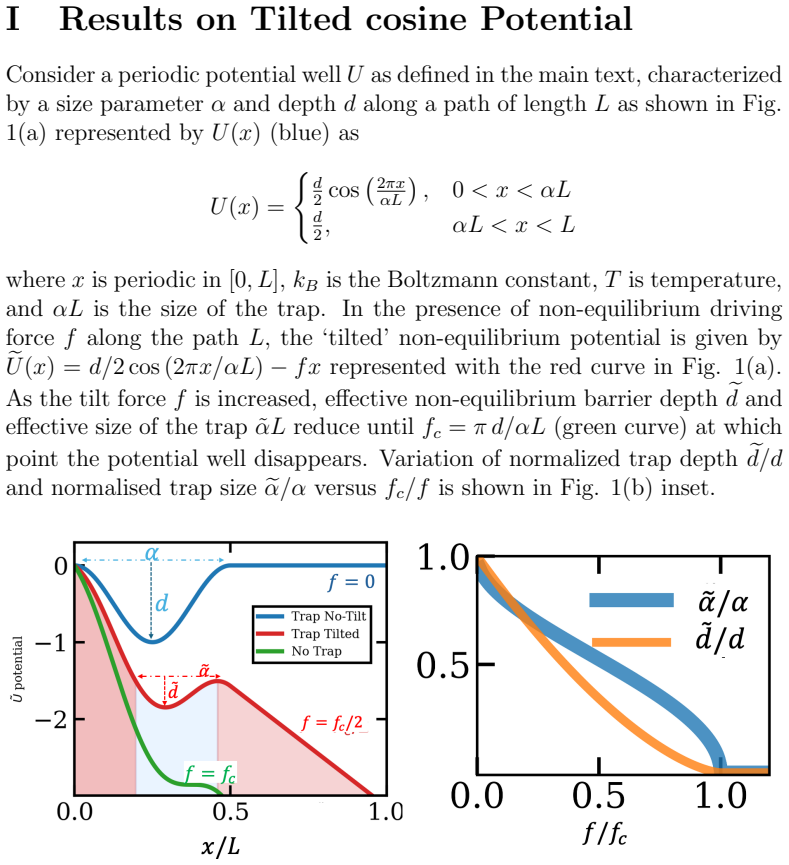
Driven colloidal particles on a periodic path show zero current until their number exceeds a critical threshold n_c, after which n_c particles cluster behind each trap and extras circulate.
A machine-rendered reading of the paper's core claim, the machinery that carries it, and where it could break.
Core claim
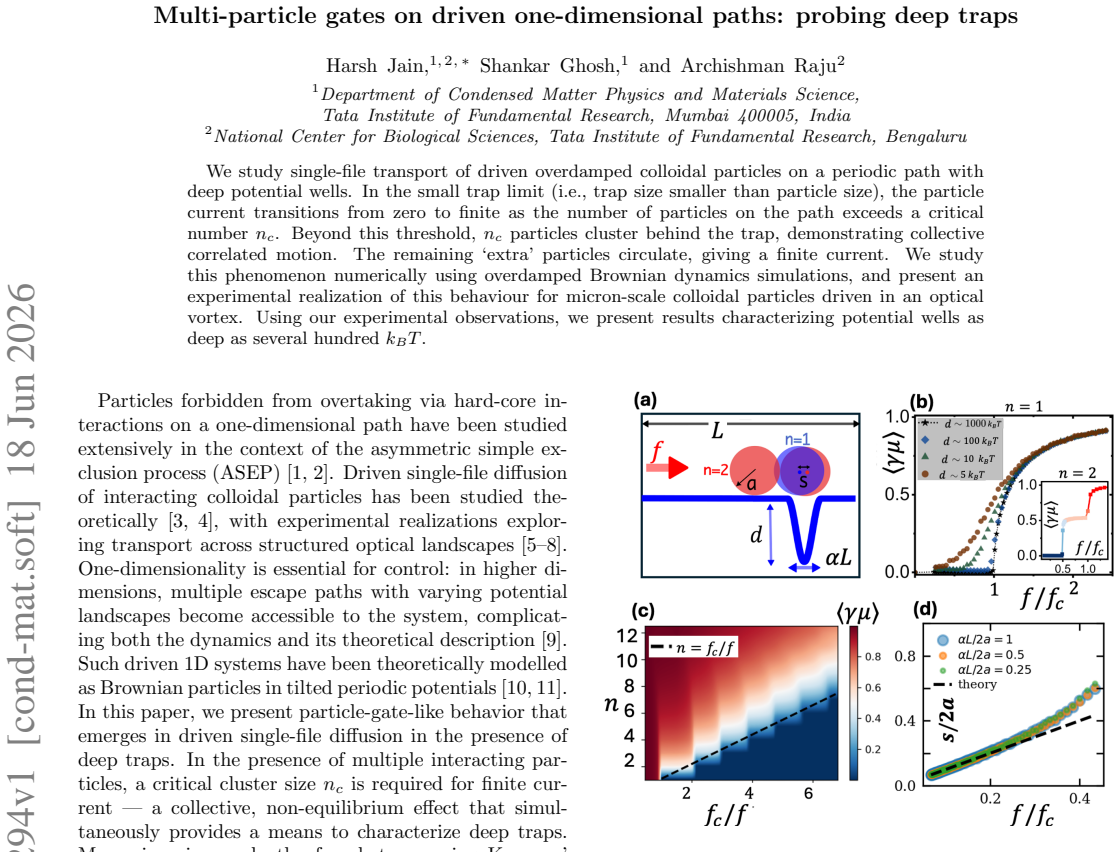
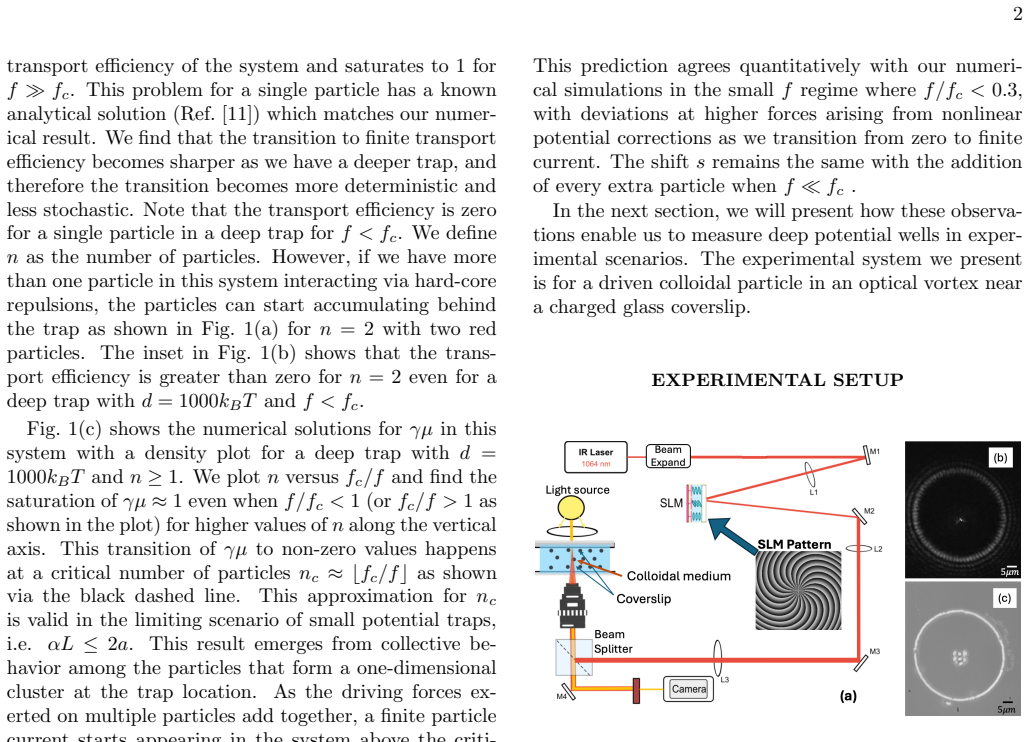
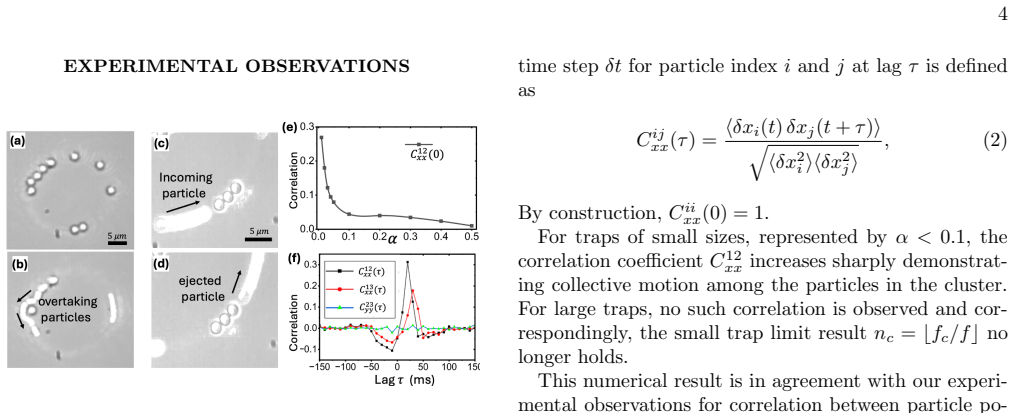
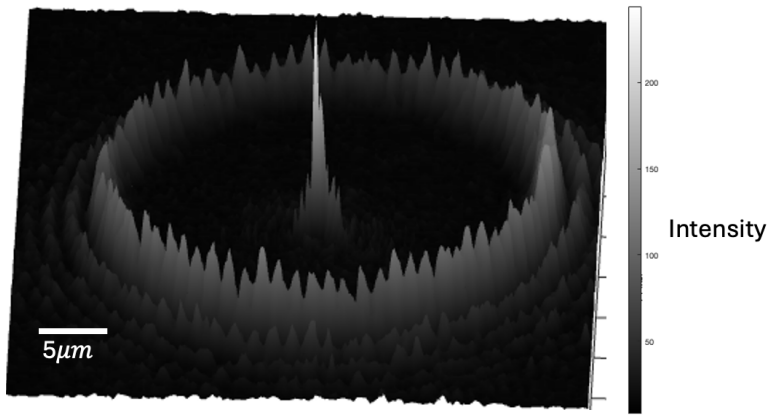
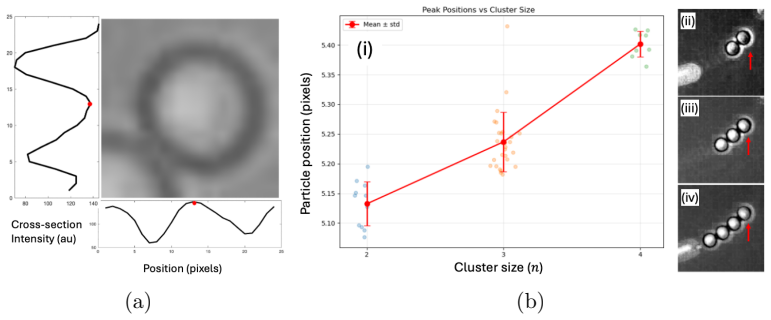
In the small trap limit the particle current transitions from zero to finite as the number of particles on the path exceeds a critical number n_c. Beyond this threshold, n_c particles cluster behind the trap, demonstrating collective correlated motion. The remaining extra particles circulate, giving a finite current. The behavior is confirmed numerically with overdamped Brownian dynamics simulations and realized experimentally for colloidal particles driven in an optical vortex, which also permits characterization of deep potential wells.
What carries the argument
The multi-particle gate formed when n_c particles cluster behind a deep trap whose size is smaller than the particle diameter.
If this is right
- Overdamped Brownian dynamics simulations reproduce the zero-to-finite current transition at n_c.
- Experiments using optical vortices on micron-scale colloids observe both the clustering and the resulting finite current.
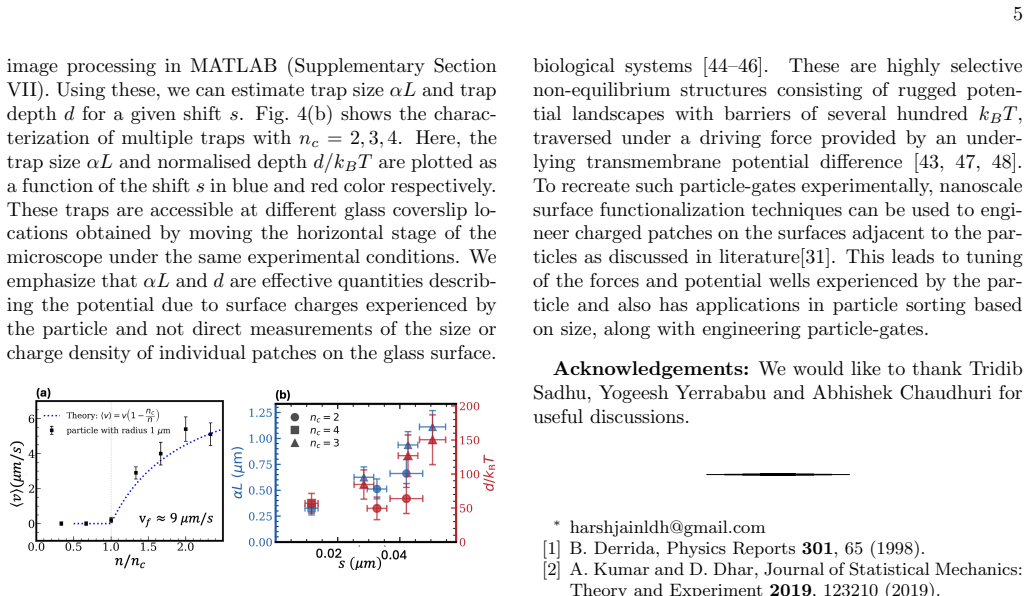
- Potential wells as deep as several hundred k_BT can be characterized from the observed particle behavior.
- The clustering of n_c particles demonstrates collective correlated motion in the driven single-file system.
Where Pith is reading between the lines
- The same accumulation threshold might appear in other single-file driven systems such as ions through narrow channels.
- Systematically varying trap depth while counting n_c would reveal how the critical number depends on well strength.
- The sharp switch from blocked to flowing transport could be exploited to accumulate or release particles at chosen densities.
Load-bearing premise
The transition to finite current and the clustering occur specifically when trap size is smaller than particle size.
What would settle it
Measuring current versus total particle number and finding either no sharp onset at any n_c when traps are small, or an onset even when trap size equals or exceeds particle size, would falsify the claim.
Figures
read the original abstract
We study single-file transport of driven overdamped colloidal particles on a periodic path with deep potential wells. In the small trap limit (i.e., trap size smaller than particle size), the particle current transitions from zero to finite as the number of particles on the path exceeds a critical number $n_c$. Beyond this threshold, $n_c$ particles cluster behind the trap, demonstrating collective correlated motion. The remaining `extra' particles circulate, giving a finite current. We study this phenomenon numerically using overdamped Brownian dynamics simulations, and present an experimental realization of this behaviour for micron-scale colloidal particles driven in an optical vortex. Using our experimental observations, we present results characterizing potential wells as deep as several hundred $k_BT$.
Editorial analysis
A structured set of objections, weighed in public.
Referee Report
Summary. The paper studies single-file transport of driven overdamped colloidal particles on a periodic path containing deep potential wells. It claims that, specifically in the small-trap limit (trap size smaller than particle size), the steady-state particle current undergoes a transition from zero to finite once the number of particles exceeds a critical value n_c; beyond this threshold, n_c particles form a cluster behind the trap while excess particles circulate freely. The claim is supported by overdamped Brownian-dynamics simulations and by an optical-vortex experiment on micron-scale colloids, with the experiment also used to characterize wells as deep as several hundred k_B T.
Significance. If the transition and its restriction to the small-trap regime are quantitatively validated, the work would provide a clear example of collective, correlated motion arising from geometric confinement and deep traps in one-dimensional driven transport. The combination of simulation and experiment, together with the ability to access very deep wells, would be a useful addition to the literature on single-file diffusion and colloidal ratchets.
major comments (1)
- [Abstract] Abstract (and the simulation/experiment sections that implement the claim): the headline transition and clustering are asserted only for the small-trap limit, yet the manuscript supplies neither a quantitative criterion confirming that the simulated and experimental trap widths satisfy trap size < particle diameter nor a control run (simulation or experiment) with trap size comparable to or larger than particle diameter that shows the current remains zero for all n. This is load-bearing for the central claim that the phenomenon is specific to the small-trap regime.
Simulated Author's Rebuttal
We thank the referee for their constructive report and for highlighting the importance of rigorously establishing the small-trap regime. We address the single major comment below and will revise the manuscript accordingly.
read point-by-point responses
-
Referee: [Abstract] Abstract (and the simulation/experiment sections that implement the claim): the headline transition and clustering are asserted only for the small-trap limit, yet the manuscript supplies neither a quantitative criterion confirming that the simulated and experimental trap widths satisfy trap size < particle diameter nor a control run (simulation or experiment) with trap size comparable to or larger than particle diameter that shows the current remains zero for all n. This is load-bearing for the central claim that the phenomenon is specific to the small-trap regime.
Authors: We agree that explicit confirmation of the small-trap condition and a control comparison are required to substantiate the regime-specific claim. In the revised manuscript we will (i) report the precise trap widths and particle diameters employed in both the Brownian-dynamics simulations and the optical-vortex experiments, together with the resulting ratio confirming trap size < particle diameter; (ii) add a control simulation in which the trap width is set comparable to or larger than the particle diameter, demonstrating that the steady-state current remains zero for all particle numbers n; and (iii) update the abstract and relevant sections to reference these quantitative checks. These additions will make the restriction to the small-trap limit fully explicit and verifiable. revision: yes
Circularity Check
No circularity: claims rest on direct simulation and experiment without self-referential derivation
full rationale
The manuscript presents its central observation—the current transition at n_c in the small-trap limit—as an outcome of overdamped Brownian dynamics simulations and optical-vortex experiments. No equations, fitted parameters, or ansatzes are introduced whose outputs are then relabeled as predictions. No self-citations appear in the provided text, and the small-trap restriction is stated as a modeling regime rather than derived from prior author work. The derivation chain therefore contains no load-bearing step that reduces to its own inputs by construction.
Axiom & Free-Parameter Ledger
axioms (1)
- domain assumption overdamped Brownian dynamics governs the particle motion
Reference graph
Works this paper leans on
-
[1]
Physical review letters , volume=
Structure of optical vortices , author=. Physical review letters , volume=. 2003 , publisher=
2003
-
[2]
Wiley Interdisciplinary Reviews: Computational Molecular Science , volume=
Umbrella sampling , author=. Wiley Interdisciplinary Reviews: Computational Molecular Science , volume=. 2011 , publisher=
2011
-
[3]
Nature methods , volume=
Rapid, accurate particle tracking by calculation of radial symmetry centers , author=. Nature methods , volume=. 2012 , publisher=
2012
-
[4]
Proceedings of the National Academy of Sciences , volume=
Broad distributions of transition-path times are fingerprints of multidimensionality of the underlying free energy landscapes , author=. Proceedings of the National Academy of Sciences , volume=. 2020 , publisher=
2020
-
[5]
Physical Review E , volume=
Pumping single-file colloids: Absence of current reversal , author=. Physical Review E , volume=. 2015 , publisher=
2015
-
[6]
Physical Review E , volume=
Colloidal particles driven across periodic optical-potential-energy landscapes , author=. Physical Review E , volume=. 2016 , publisher=
2016
-
[7]
Physical Review E , volume=
Characterizing potentials by a generalized Boltzmann factor , author=. Physical Review E , volume=. 2007 , publisher=
2007
-
[8]
Physical Review E , volume=
Transition of a particle between adjacent optical traps: A study using catastrophe theory , author=. Physical Review E , volume=. 2013 , publisher=
2013
-
[9]
Instantaneous ion configurations in the K ^
Kratochvil, Huong T and Carr, Joshua K and Matulef, Kimberly and Annen, Alvin W and Li, Hui and Maj, Micha. Instantaneous ion configurations in the K ^. Science , volume=. 2016 , publisher=
2016
-
[10]
Ion permeation in K ^
K. Ion permeation in K ^. Science , volume=. 2014 , publisher=
2014
-
[11]
Optics letters , volume=
Dynamics of microparticles trapped in a perfect vortex beam , author=. Optics letters , volume=. 2013 , publisher=
2013
-
[12]
PLoS ONE , volume=
Energetics of Transport through the Nuclear Pore Complex , author=. PLoS ONE , volume=. 2016 , publisher=
2016
-
[13]
Nucleus , volume=
The selective permeability barrier in the nuclear pore complex , author=. Nucleus , volume=. 2016 , publisher=
2016
-
[14]
Nature Communications , volume=
A single NaK channel conformation is not enough for non-selective ion conduction , author=. Nature Communications , volume=. 2018 , publisher=
2018
-
[15]
Conductance selectivity of Na ^
Mita, Kenichiro and Sumikama, Takashi and Iwamoto, Masayuki and Matsuki, Yuka and Shigemi, Kenji and Oiki, Shigetoshi , journal=. Conductance selectivity of Na ^. 2021 , publisher=
2021
-
[16]
Nature Communications , volume=
Cryo-EM structures of prokaryotic ligand-gated ion channel GLIC provide insights into gating in a lipid environment , author=. Nature Communications , volume=. 2024 , publisher=
2024
-
[17]
Nature Communications , volume=
Lipid-protein interactions modulate the conformational equilibrium of a potassium channel , author=. Nature Communications , volume=. 2020 , publisher=
2020
-
[18]
Physical Review Letters , volume=
Driving particle current through narrow channels using a classical pump , author=. Physical Review Letters , volume=. 2007 , publisher=
2007
-
[19]
2019 , howpublished =
Jain, Harsh , title =. 2019 , howpublished =
2019
-
[20]
2025 , howpublished =
Jain, Harsh , title =. 2025 , howpublished =
2025
-
[21]
Stratonovich, R. L. , title =
-
[22]
2011 , publisher=
Intermolecular and Surface Forces , author=. 2011 , publisher=
2011
-
[23]
The European Physical Journal Plus , volume=
Optical tweezers: theory and practice , author=. The European Physical Journal Plus , volume=. 2020 , publisher=
2020
-
[24]
2005 , publisher=
Introduction to Fourier optics , author=. 2005 , publisher=
2005
-
[25]
The Journal of Chemical Physics , volume=
The charge of glass and silica surfaces , author=. The Journal of Chemical Physics , volume=. 2001 , publisher=
2001
-
[26]
Soft Matter , year=
Line optical tweezers as controllable micromachines: techniques and emerging trends , author=. Soft Matter , year=
-
[27]
Proceedings of the National Academy of Sciences , volume=
Enhanced stochastic fluctuations to measure steep adhesive energy landscapes , author=. Proceedings of the National Academy of Sciences , volume=. 2016 , publisher=
2016
-
[28]
1989 , edition=
Chapter 11, The Fokker-Planck Equation: Methods of Solution and Applications , author=. 1989 , edition=
1989
-
[29]
2015 , publisher=
Optical Tweezers: Principles and Applications , author=. 2015 , publisher=
2015
-
[30]
1965 , publisher=
Low Reynolds Number Hydrodynamics: with Special Applications to Particulate Media , author=. 1965 , publisher=
1965
-
[31]
P. Coullet and L. Gil and F. Rocca , abstract =. Optical vortices , journal =. 1989 , issn =. doi:https://doi.org/10.1016/0030-4018(89)90180-6 , url =
-
[32]
N. R. Heckenberg and R. McDuff and C. P. Smith and A. G. White , journal =. Generation of optical phase singularities by computer-generated holograms , volume =. 1992 , url =. doi:10.1364/OL.17.000221 , abstract =
-
[33]
Orbital angular momentum of light and the transformation of Laguerre-Gaussian laser modes , author =. Phys. Rev. A , volume =. 1992 , month =. doi:10.1103/PhysRevA.45.8185 , url =
-
[34]
and Santore, M
Kozlova, N. and Santore, M. M. , title =. Langmuir , volume =. 2007 , doi =
2007
-
[35]
, title =
Sonnefeld, J. , title =. Colloid Polym. Sci. , volume =. 1995 , doi =
1995
-
[36]
and Ebeling, D
Siretanu, I. and Ebeling, D. and Andersson, M. P. and Stipp, S. L. S. and Philipse, A. and Stuart, M. C. and van den Ende, D. and Mugele, F. , title =. Sci. Rep. , volume =. 2014 , doi =
2014
-
[37]
Journal of colloid and interface science , volume=
The impact of nanoscale chemical features on micron-scale adhesion: Crossover from heterogeneity-dominated to mean-field behavior , author=. Journal of colloid and interface science , volume=. 2009 , publisher=
2009
-
[38]
and Allen, Les , title =
Padgett, Miles J. and Allen, Les , title =. Optics Communications , volume =. 1995 , doi =
1995
-
[39]
and Saunter, Christopher and Love, Gordon D
Leach, Jonathan and Keen, Stephen and Padgett, Miles J. and Saunter, Christopher and Love, Gordon D. , title =. Optics Express , volume =. 2006 , doi =
2006
-
[40]
and Huffman, Donald R
Bohren, Craig F. and Huffman, Donald R. , title =. 1983 , isbn =
1983
-
[41]
Prieve, D. C. , title =. Advances in Colloid and Interface Science , volume =. 1999 , doi =
1999
-
[42]
Bevan, M. A. and Prieve, D. C. , title =. Journal of Chemical Physics , volume =. 2000 , doi =
2000
-
[43]
and Asakura, T
Harada, Y. and Asakura, T. , title =. Optics Communications , volume =. 1996 , doi =
1996
-
[44]
and Santore, M
Kalasin, S. and Santore, M. M. , title =. ACS Nano , volume =. 2015 , doi =
2015
-
[45]
Walz, J. Y. , title =. Advances in Colloid and Interface Science , volume =. 1998 , doi =
1998
-
[46]
and Prieve, D
Ruckenstein, E. and Prieve, D. C. , title =. AIChE Journal , volume =. 1976 , doi =
1976
-
[47]
and Davis, J
Bendersky, M. and Davis, J. M. , title =. Journal of Colloid and Interface Science , volume =. 2011 , doi =
2011
-
[48]
and Elimelech, M
Bhattacharjee, S. and Elimelech, M. , title =. Journal of Colloid and Interface Science , volume =. 1997 , doi =
1997
-
[49]
and Gregory, J
Elimelech, M. and Gregory, J. and Jia, X. and Williams, R. A. , title =
-
[50]
Goldman, A. J. and Cox, R. G. and Brenner, H. , title =. Chemical Engineering Science , volume =. 1967 , doi =
1967
-
[51]
Annalen der Physik , volume =
Mie, Gustav , title =. Annalen der Physik , volume =. 1908 , doi =
1908
-
[52]
Wiscombe, W. J. , title =. Applied Optics , volume =. 1980 , doi =
1980
-
[53]
and Beijersbergen, M
Allen, L. and Beijersbergen, M. W. and Spreeuw, R. J. C. and Woerdman, J. P. , title =. Physical Review A , volume =. 1992 , doi =
1992
-
[54]
, title =
Padgett, Miles J. , title =. Optics Express , volume =. 2017 , doi =
2017
-
[55]
and Kasarova, S
Sultanova, N. and Kasarova, S. and Nikolov, I. , title =. Acta Physica Polonica A , volume =. 2009 , doi =
2009
-
[56]
and Tildesley, Dominic J
Allen, Michael P. and Tildesley, Dominic J. , title =. 1987 , address =
1987
-
[57]
, title =
Derrida, B. , title =. Physics Reports , volume =
-
[58]
Kramers, H. A. , title =. Physica , volume =. 1940 , doi =
1940
-
[59]
Science , volume =
Poon, Wilson , title =. Science , volume =
-
[60]
and Kollmann, M
Lutz, C. and Kollmann, M. and Bechinger, C. , title =. Physical Review Letters , volume =
-
[61]
Journal of Statistical Mechanics: Theory and Experiment , volume =
Sadhu, Tridib and Derrida, Bernard , title =. Journal of Statistical Mechanics: Theory and Experiment , volume =
-
[62]
Journal of Statistical Mechanics: Theory and Experiment , volume =
Kumar, Aanjaneya and Dhar, Deepak , title =. Journal of Statistical Mechanics: Theory and Experiment , volume =. 2019 , doi =
2019
-
[63]
2023 , type =
Harsh Jain , title =. 2023 , type =
2023
discussion (0)
Sign in with ORCID, Apple, or X to comment. Anyone can read and Pith papers without signing in.