REVIEW 1 major objections 51 references
VeriBound derives PAC-Bayesian bounds showing that formal-verification labels on symbolic tasks control expected error on unseen reasoning tasks.
Reviewed by Pith at T0; open to challenge. T0 means a machine referee read the full paper against a public rubric. the ladder, T0–T4 →
T0 review · grok-4.3
2026-06-26 20:45 UTC pith:VECC3CTY
load-bearing objection VeriBound applies standard PAC-Bayes to PRMs trained on formal-verification labels, but the bounds require knowing verifier accuracy and task divergence that are not obviously measurable. the 1 major comments →
VeriBound: PAC-Bayesian Generalization Bounds for Process Reward Models Trained with Formal Verification Tools
The pith
A machine-rendered reading of the paper's core claim, the machinery that carries it, and where it could break.
Core claim
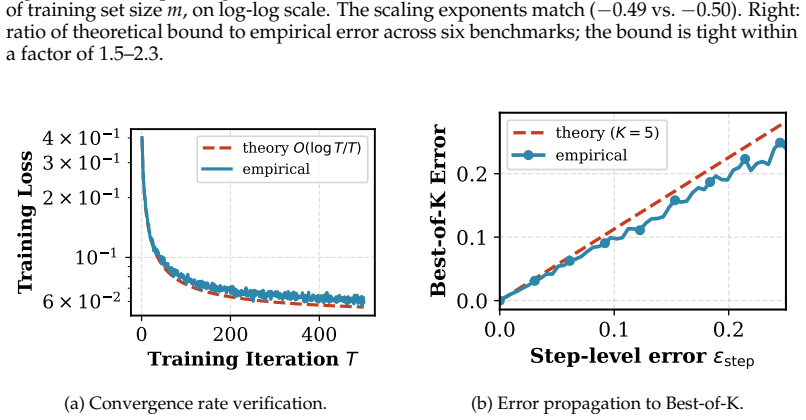
VeriBound supplies four results for process reward models trained on formal-verification labels: a PAC-Bayesian generalization bound relating empirical verification error to expected error on new tasks (depending on verifier accuracy and distribution divergence); a sample-complexity bound of O(d log(d/δ)/ε²) examples for error ε with probability 1-δ; linear convergence of training under L-smoothness and bounded variance; and an error-propagation inequality from step-level verification error to Best-of-K performance degradation.
What carries the argument
The VeriBound PAC-Bayesian generalization bound, which converts empirical verification error on formal-verification-annotated data into a high-probability guarantee on expected error for unseen tasks while incorporating verifier accuracy and task-distribution divergence.
Load-bearing premise
Formal verification tools must supply labels whose accuracy is known or bounded, and the divergence between the distribution of symbolic training tasks and the distribution of target reasoning tasks must be quantifiable or bounded.
What would settle it
Collect a held-out set of reasoning tasks whose distribution divergence from the symbolic training distribution has been measured; train a PRM on formal-verification labels and check whether the observed test error lies above the VeriBound PAC-Bayesian upper bound for the measured verifier accuracy and divergence.
If this is right
- O(d log(d/δ)/ε²) formal-verification-annotated examples suffice to guarantee generalization error ε with probability 1-δ.
- Under L-smoothness and bounded variance, PRM training on these labels converges at a linear rate.
- Step-level verification error translates into a quantifiable degradation of Best-of-K performance via the derived propagation bound.
- Tighter formal-verification accuracy directly improves the numerical value of the generalization bound.
Where Pith is reading between the lines
- The same bounding technique could be applied to other automatic label sources whose error rate can be measured, such as cheaper symbolic checkers or hybrid human-verifier pipelines.
- If the distribution-divergence term can be estimated from task embeddings, practitioners could decide in advance how many symbolic tasks are needed before switching to a new reasoning domain.
- The linear convergence result suggests that early stopping or learning-rate schedules derived from the smoothness constant may be optimal for this training regime.
- Extending the framework to multi-step verification chains would allow bounds on full proof or solution traces rather than single steps.
Editorial analysis
A structured set of objections, weighed in public.
Referee Report
Summary. The manuscript proposes VeriBound, a PAC-Bayesian framework for generalization bounds on Process Reward Models (PRMs) trained with step-level labels from formal verification tools (Z3, Isabelle). It claims four results: (i) a PAC-Bayesian bound relating empirical verification error on formal-annotated data to expected error on unseen tasks, depending on verification accuracy and train-test divergence; (ii) sample complexity O(d log(d/δ)/ε²); (iii) linear convergence under L-smoothness and bounded variance; (iv) error propagation from step-level verification to Best-of-K degradation.
Significance. If the derivations hold and the key quantities can be bounded in practice, the work would supply the first theoretical account of cross-task generalization from symbolic tasks to reasoning benchmarks for verification-trained PRMs, extending empirical observations such as FOVER. The sample-complexity and convergence claims would be particularly useful for guiding data-efficient training.
major comments (1)
- [Abstract] Abstract (paragraph on the four results): Result (i) and all downstream claims (ii)–(iv) are stated to depend on the formal verification accuracy being known or bounded and on a quantifiable divergence between symbolic training tasks and target reasoning tasks. No explicit procedure, estimator, or bound is supplied for obtaining either quantity from the cited tools or distributions, rendering the PAC-Bayesian bound and its corollaries non-instantiable on the cross-task setting described.
Simulated Author's Rebuttal
We thank the referee for their constructive feedback. We address the major comment regarding the abstract and the instantiability of the bounds in the response below. We will revise the manuscript to improve clarity on this aspect.
read point-by-point responses
-
Referee: [Abstract] Abstract (paragraph on the four results): Result (i) and all downstream claims (ii)–(iv) are stated to depend on the formal verification accuracy being known or bounded and on a quantifiable divergence between symbolic training tasks and target reasoning tasks. No explicit procedure, estimator, or bound is supplied for obtaining either quantity from the cited tools or distributions, rendering the PAC-Bayesian bound and its corollaries non-instantiable on the cross-task setting described.
Authors: We appreciate the referee pointing out this limitation in the presentation of our results. The PAC-Bayesian bound is formulated to explicitly depend on the verification accuracy and the train-test divergence, as these are fundamental to the cross-task generalization setting. The manuscript derives the bound under the assumption that these quantities are available or can be separately bounded, which is standard in PAC-Bayesian analyses where such terms appear. However, we acknowledge that no explicit estimation procedure is provided in the current version. In the revised manuscript, we will include an additional paragraph in the discussion section outlining practical approaches: for verification accuracy, leveraging the soundness guarantees of tools like Z3 and Isabelle on their decidable domains; for divergence, using empirical estimates based on feature distributions or proxy tasks. This will not change the theoretical results but will make the framework more actionable. revision: yes
Circularity Check
No circularity: standard PAC-Bayes application with explicit external dependencies
full rationale
The claimed results apply known PAC-Bayesian theorems, sample-complexity bounds, smoothness-based convergence rates, and error-propagation inequalities to the PRM setting. The four results are stated to depend explicitly on two external quantities (formal verification accuracy and train-test divergence), which are listed as assumptions rather than derived or fitted inside the paper. No equations reduce a claimed prediction to a fitted parameter by construction, no self-citation chain is invoked as a uniqueness theorem, and no ansatz is smuggled via prior work. The derivation chain therefore remains self-contained against external benchmarks once the two stated quantities are supplied from outside the model.
Axiom & Free-Parameter Ledger
axioms (2)
- standard math Loss function is bounded in [0,1]
- domain assumption Formal verification accuracy is known or bounded independently of the PRM parameters
read the original abstract
Process Reward Models (PRMs) provide step-level verification for Large Language Model (LLM) reasoning, yet their training data acquisition remains a bottleneck: human annotation is costly and Monte Carlo roll-out estimates are noisy. A recent approach, FOVER, trains PRMs on step-level error labels automatically annotated by formal verification tools such as Z3 and Isabelle, and empirically observes cross-task generalization from symbolic tasks to diverse reasoning benchmarks. However, this generalization phenomenon lacks any theoretical explanation, and no formal bounds exist on the generalization error, sample complexity, convergence rate, or downstream Best-of-K performance of such PRMs. We propose VeriBound, a theoretical framework that provides PAC-Bayesian generalization bounds for PRMs trained with formal verification tools. We establish four main results: (i) a PAC-Bayesian generalization bound that relates the empirical verification error on formal-verification-annotated training data to the expected error on unseen reasoning tasks, with the bound depending on the formal verification accuracy and the divergence between training and test task distributions; (ii) a sample complexity result showing that $O(d \log(d/\delta) / \epsilon^2)$ formal-verification-annotated examples suffice to achieve generalization error $\epsilon$ with probability $1-\delta$, where $d$ is the complexity of the PRM hypothesis class; (iii) a convergence analysis proving that PRM training with formal verification labels converges at a linear rate under $L$-smoothness and bounded variance conditions; and (iv) an error propagation bound that relates step-level verification error to Best-of-K performance degradation.
Figures



Reference graph
Works this paper leans on
-
[1]
Efficient PRM Training Data Synthesis via Formal Verification
Ryo Kamoi and Yusen Zhang and Nan Zhang and Sarkar Snigdha Sarathi Das and Rui Zhang , title =. CoRR , volume =. 2025 , url =. doi:10.48550/ARXIV.2505.15960 , eprinttype =. 2505.15960 , timestamp =
work page internal anchor Pith review Pith/arXiv arXiv doi:10.48550/arxiv.2505.15960 2025
-
[2]
2026 , eprint =
VeriGate: Verifier-Gated Step-Level Supervision for GRPO , author =. 2026 , eprint =
2026
-
[3]
2026 , eprint =
Beyond Outcome Verification: Verifiable Process Reward Models for Structured Reasoning , author =. 2026 , eprint =
2026
-
[4]
2024 , eprint =
Evaluating LLM-driven User-Intent Formalization for Verification-Aware Languages , author =. 2024 , eprint =
2024
-
[5]
2025 , eprint =
Hard2Verify: A Step-Level Verification Benchmark for Open-Ended Frontier Math , author =. 2025 , eprint =
2025
-
[6]
2026 , eprint =
ConfSpec: Efficient Step-Level Speculative Reasoning via Confidence-Gated Verification , author =. 2026 , eprint =
2026
-
[7]
2025 , eprint =
Linking Process to Outcome: Conditional Reward Modeling for LLM Reasoning , author =. 2025 , eprint =
2025
-
[8]
2025 , eprint =
R-PRM: Reasoning-Driven Process Reward Modeling , author =. 2025 , eprint =
2025
-
[9]
2026 , eprint =
The Hidden Signal of Verifier Strictness: Controlling and Improving Step-Wise Verification via Selective Latent Steering , author =. 2026 , eprint =
2026
-
[10]
2025 , eprint =
Neural Theorem Proving: Generating and Structuring Proofs for Formal Verification , author =. 2025 , eprint =
2025
-
[11]
2025 , eprint =
ReasonFlux-PRM: Trajectory-Aware PRMs for Long Chain-of-Thought Reasoning in LLMs , author =. 2025 , eprint =
2025
-
[12]
2025 , eprint =
Fin-PRM: A Domain-Specialized Process Reward Model for Financial Reasoning in Large Language Models , author =. 2025 , eprint =
2025
-
[13]
2025 , eprint =
GM-PRM: A Generative Multimodal Process Reward Model for Multimodal Mathematical Reasoning , author =. 2025 , eprint =
2025
-
[14]
2025 , eprint =
Formal Verification of a Token Sale Launchpad: A Compositional Approach in Dafny , author =. 2025 , eprint =
2025
-
[15]
2025 , eprint =
PRM-BAS: Enhancing Multimodal Reasoning through PRM-guided Beam Annealing Search , author =. 2025 , eprint =
2025
-
[16]
2025 , eprint =
Safe: Enhancing Mathematical Reasoning in Large Language Models via Retrospective Step-aware Formal Verification , author =. 2025 , eprint =
2025
-
[17]
2026 , eprint =
Reliable Self-Improvement Training by Verifying Reasoning, Not Just Answers , author =. 2026 , eprint =
2026
-
[18]
2026 , eprint =
Towards Formal Verification of Hybrid Synchronous Programs with Refinement Types , author =. 2026 , eprint =
2026
-
[19]
2013 , eprint =
A Framework for the Verification of Certifying Computations , author =. 2013 , eprint =
2013
-
[20]
2025 , eprint =
DreamPRM-Code: Function-as-Step Process Reward Model with Label Correction for LLM Coding , author =. 2025 , eprint =
2025
-
[21]
2025 , eprint =
TIM-PRM: Verifying multimodal reasoning with Tool-Integrated PRM , author =. 2025 , eprint =
2025
-
[22]
2025 , eprint =
Monitor-Generate-Verify (MGV): Formalising Metacognitive Theory for Language Model Reasoning , author =. 2025 , eprint =
2025
-
[23]
2025 , eprint =
Limits of PRM-Guided Tree Search for Mathematical Reasoning with LLMs , author =. 2025 , eprint =
2025
-
[24]
2018 , eprint =
Formal Verification of Platoon Control Strategies , author =. 2018 , eprint =
2018
-
[25]
2025 , eprint =
Is PRM Necessary? Problem-Solving RL Implicitly Induces PRM Capability in LLMs , author =. 2025 , eprint =
2025
-
[26]
2025 , eprint =
Uncertainty-Aware Step-wise Verification with Generative Reward Models , author =. 2025 , eprint =
2025
-
[27]
2025 , eprint =
I-RAVEN-X: Benchmarking Generalization and Robustness of Analogical and Mathematical Reasoning in Large Language and Reasoning Models , author =. 2025 , eprint =
2025
-
[28]
2025 , eprint =
Bayesian Epistemology with Weighted Authority: A Formal Architecture for Truth-Promoting Autonomous Scientific Reasoning , author =. 2025 , eprint =
2025
-
[29]
2025 , eprint =
Adaptive Coopetition: Leveraging Coarse Verifier Signals for Resilient Multi-Agent LLM Reasoning , author =. 2025 , eprint =
2025
-
[30]
2025 , eprint =
MedRule-KG: A Knowledge-Graph--Steered Scaffold for Mathematical Reasoning with a Lightweight Verifier , author =. 2025 , eprint =
2025
-
[31]
2025 , eprint =
Accurate and Diverse LLM Mathematical Reasoning via Automated PRM-Guided GFlowNets , author =. 2025 , eprint =
2025
-
[32]
2020 , eprint =
SoK: Attacks on Industrial Control Logic and Formal Verification-Based Defenses , author =. 2020 , eprint =
2020
-
[33]
2025 , eprint =
DeepSeekMath-V2: Towards Self-Verifiable Mathematical Reasoning , author =. 2025 , eprint =
2025
-
[34]
2025 , eprint =
ARS: Adaptive Reasoning Suppression for Efficient Large Reasoning Language Models , author =. 2025 , eprint =
2025
-
[35]
2025 , eprint =
MM-PRM: Enhancing Multimodal Mathematical Reasoning with Scalable Step-Level Supervision , author =. 2025 , eprint =
2025
-
[36]
2025 , eprint =
When Reasoning Beats Scale: A 1.5B Reasoning Model Outranks 13B LLMs as Discriminator , author =. 2025 , eprint =
2025
-
[37]
2025 , eprint =
From <Answer> to <Think>: Multidimensional Supervision of Reasoning Process for LLM Optimization , author =. 2025 , eprint =
2025
-
[38]
2025 , eprint =
REASONING GYM: Reasoning Environments for Reinforcement Learning with Verifiable Rewards , author =. 2025 , eprint =
2025
-
[39]
2025 , eprint =
Navigating the State of Cognitive Flow: Context-Aware AI Interventions for Effective Reasoning Support , author =. 2025 , eprint =
2025
-
[40]
2017 , eprint =
From Propositional Logic to Plausible Reasoning: A Uniqueness Theorem , author =. 2017 , eprint =
2017
-
[41]
2025 , eprint =
Dynamic Scaling of Unit Tests for Code Reward Modeling , author =. 2025 , eprint =
2025
-
[42]
Proceedings of the 2025 Conference on Empirical Methods in Natural Language Processing , pages=
GATEAU: Selecting Influential Samples for Long Context Alignment , author=. Proceedings of the 2025 Conference on Empirical Methods in Natural Language Processing , pages=
2025
-
[43]
Advances in Neural Information Processing Systems , volume=
Spokenwoz: A large-scale speech-text benchmark for spoken task-oriented dialogue agents , author=. Advances in Neural Information Processing Systems , volume=
-
[44]
Proceedings of the 63rd Annual Meeting of the Association for Computational Linguistics (Volume 1: Long Papers) , pages=
Aligning Large Language Models to Follow Instructions and Hallucinate Less via Effective Data Filtering , author=. Proceedings of the 63rd Annual Meeting of the Association for Computational Linguistics (Volume 1: Long Papers) , pages=
-
[45]
International Conference on Neural Information Processing , pages=
Detect an Object At Once Without Fine-Tuning , author=. International Conference on Neural Information Processing , pages=. 2024 , organization=
2024
-
[46]
European Conference on Computer Vision , pages=
DrivingDiffusion: layout-guided multi-view driving scenarios video generation with latent diffusion model , author=. European Conference on Computer Vision , pages=. 2024 , organization=
2024
-
[47]
Proceedings of the 33rd ACM International Conference on Multimedia , pages=
DriVerse: Navigation world model for driving simulation via multimodal trajectory prompting and motion alignment , author=. Proceedings of the 33rd ACM International Conference on Multimedia , pages=
-
[48]
Proceedings of the IEEE/CVF International Conference on Computer Vision , pages=
U-ViLAR: Uncertainty-Aware Visual Localization for Autonomous Driving via Differentiable Association and Registration , author=. Proceedings of the IEEE/CVF International Conference on Computer Vision , pages=
-
[49]
Findings of the Association for Computational Linguistics,
Visual In-Context Learning for Large Vision-Language Models , author=. Findings of the Association for Computational Linguistics,. 2024 , publisher=
2024
-
[50]
OpenReview , year=
From Medical LLMs to Versatile Medical Agents: A Comprehensive Survey , author=. OpenReview , year=
-
[51]
Proceedings of the 63rd Annual Meeting of the Association for Computational Linguistics (Volume 1: Long Papers) , pages=
Improving medical large vision-language models with abnormal-aware feedback , author=. Proceedings of the 63rd Annual Meeting of the Association for Computational Linguistics (Volume 1: Long Papers) , pages=
discussion (0)
Sign in with ORCID, Apple, or X to comment. Anyone can read and Pith papers without signing in.