Ab Initio Nuclear Theory for Heavy Nuclei and Its Application to Dark Matter-Nucleus Scattering
Pith reviewed 2026-06-26 13:09 UTC · model grok-4.3
The pith
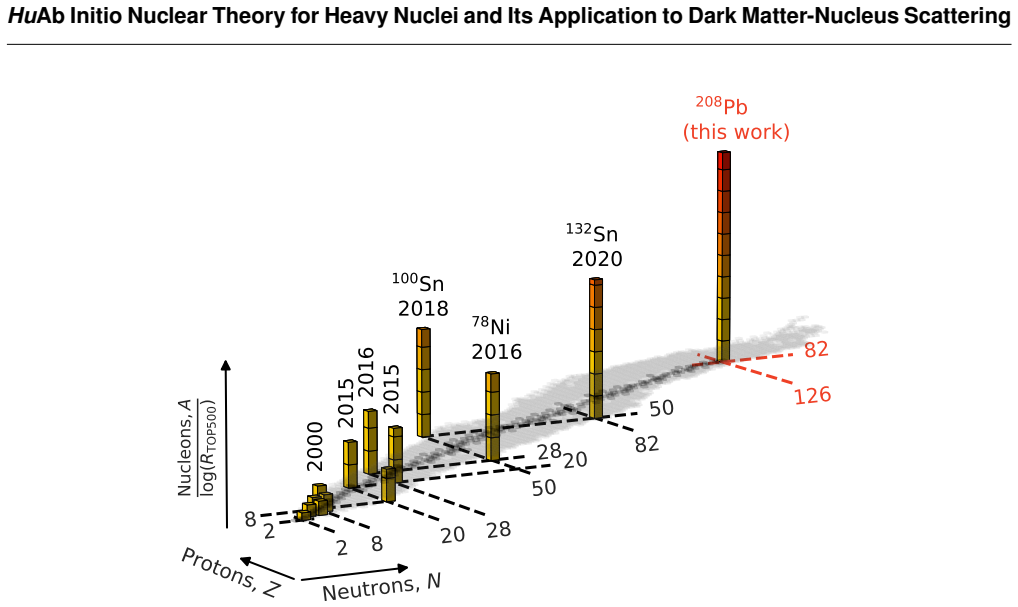
Ab initio nuclear theory now delivers uncertainty-quantified predictions for heavy nuclei like 208Pb and their responses to dark matter particles.
A machine-rendered reading of the paper's core claim, the machinery that carries it, and where it could break.
Core claim
Ab initio methods have reached the point where they furnish uncertainty-quantified predictions for the structure of 208Pb and other heavy systems, as well as for the nuclear responses that govern dark matter scattering, all derived from the underlying nuclear force and electroweak currents.
What carries the argument
Ab initio calculations of nuclear structure and response functions derived directly from nuclear forces and electroweak currents, with quantified uncertainties.
If this is right
- Nuclear-physics uncertainties in dark matter direct detection are substantially reduced.
- Interpretation of current and future precision experiments searching for physics beyond the Standard Model becomes more robust.
- Predictions for nuclear responses become available for heavy, deformed, and dripline nuclei.
- Uncertainty-quantified results are obtained for both nuclear structure observables and scattering cross sections.
Where Pith is reading between the lines
- The same framework could be applied to other nuclei used in rare-event searches, such as xenon or germanium targets.
- If the uncertainty reduction holds, it would allow tighter constraints on dark matter particle properties from existing experimental limits.
- New measurements of nuclear radii or electromagnetic responses in 208Pb could serve as direct tests of the predictions.
- The methods might be extended to calculate responses for other beyond-Standard-Model probes, such as neutrino-nucleus scattering.
Load-bearing premise
The ab initio calculations for 208Pb and the other nuclei discussed yield reliable uncertainty-quantified predictions that can be directly applied to dark matter scattering.
What would settle it
A large mismatch between the predicted nuclear response functions for 208Pb and the values extracted from dark matter direct detection data or from independent nuclear experiments on the same nucleus would falsify the central claim.
Figures
read the original abstract
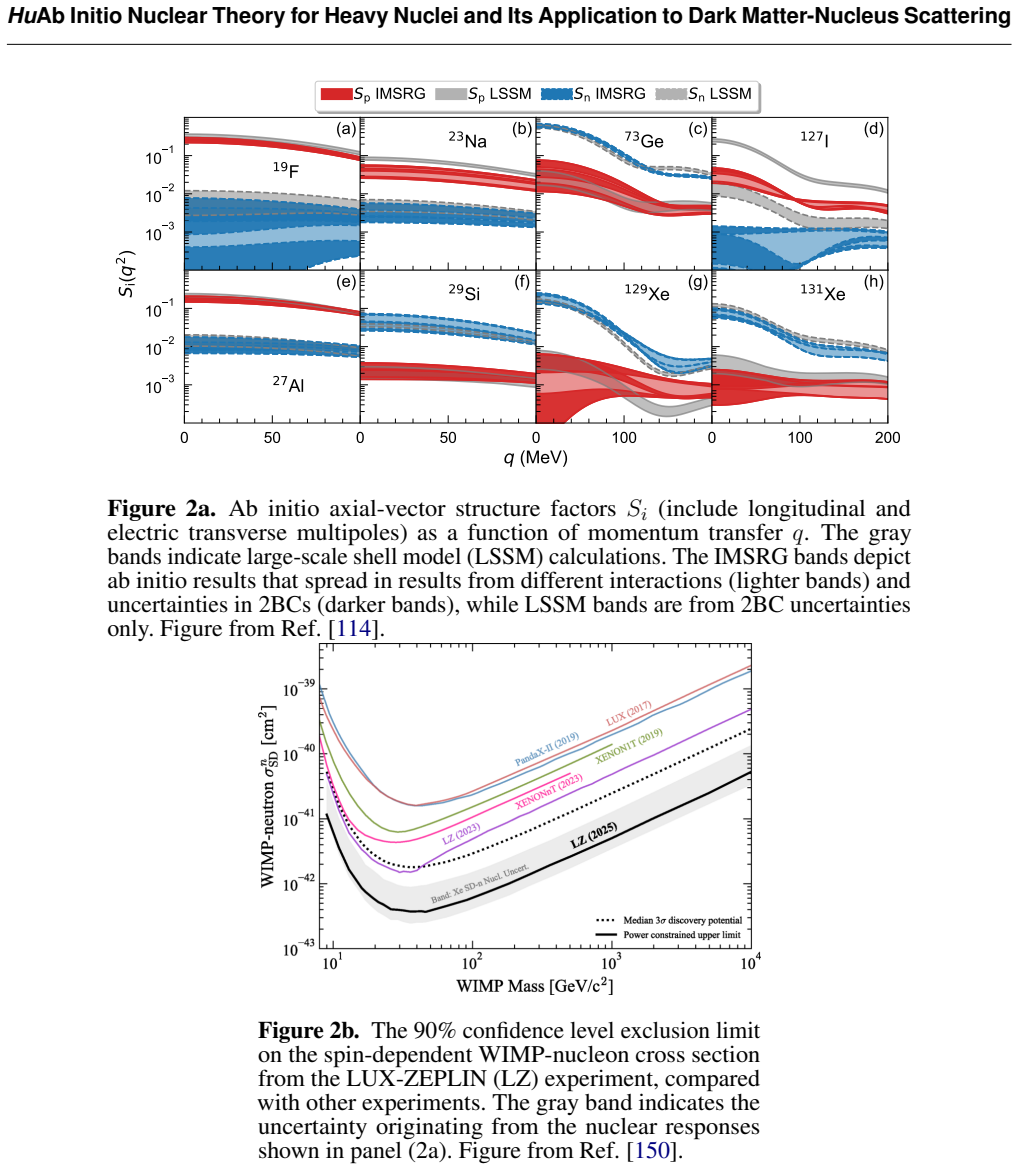
The era of precision ab initio nuclear theory has arrived, enabling uncertainty-quantified predictions for nuclear structure and for interactions with external probes directly from the underlying nuclear force and electroweak currents. This review highlights recent breakthroughs that extend ab initio calculations to the heavy nucleus $^{208}$Pb, to medium-mass systems with complex deformation, and to weakly-bound nuclei near the driplines. We also summarize ab initio calculations of nuclear responses for dark matter direct detection. Together, these advances demonstrate how ab initio methods can substantially reduce nuclear-physics uncertainties in searches for physics beyond the Standard Model, providing a more robust interpretation of current and forthcoming precision experiments.
Editorial analysis
A structured set of objections, weighed in public.
Referee Report
Summary. The manuscript is a review summarizing recent breakthroughs in ab initio nuclear theory, including extensions of calculations to the heavy nucleus 208Pb, to medium-mass systems with complex deformation, and to weakly-bound nuclei near the driplines. It also summarizes ab initio calculations of nuclear responses for dark matter direct detection. The central claim is that these advances enable uncertainty-quantified predictions directly from nuclear forces and currents, substantially reducing nuclear-physics uncertainties in beyond-Standard-Model searches and supporting more robust interpretation of precision experiments.
Significance. If the cited advances hold, the review is significant for synthesizing progress on previously intractable systems (heavy nuclei and deformed cases) and for explicitly linking these to DM response calculations. It gives credit to the underlying methodological breakthroughs that enable uncertainty quantification, which is a key strength for applications in BSM physics.
minor comments (1)
- [Abstract] Abstract: the phrasing 'the era of precision ab initio nuclear theory has arrived' is a strong claim; a short quantitative example of achieved precision or uncertainty reduction (drawn from the cited works) would strengthen the opening paragraph.
Simulated Author's Rebuttal
We thank the referee for their positive summary of the manuscript, recognition of its significance in synthesizing recent ab initio advances for heavy and deformed nuclei as well as dark matter responses, and recommendation to accept. No major comments were raised.
Circularity Check
Review of external ab initio results; no internal derivation chain
full rationale
This is a review paper that summarizes cited breakthroughs in ab initio calculations for 208Pb, deformed nuclei, dripline systems, and DM responses. No new equations, predictions, or derivations are presented whose validity depends on internal steps. All load-bearing claims rest on external prior works, which are independent of this manuscript. No self-definitional, fitted-input, or self-citation-load-bearing patterns exist within the text.
Axiom & Free-Parameter Ledger
Reference graph
Works this paper leans on
-
[2]
Ekström A, Forssén C, Hagen G, Jansen GR, Jiang W, Papenbrock T. What is ab initio in nuclear theory? Front. Phys.\/ 11 (2023) 1129094. doi:10.3389/fphy.2023.1129094
-
[7]
The particle physics experiments database [webpage can be accessed at the link: https://athompson-git.github.io/experiments.html] (2025)
[Dataset] Thompson A. The particle physics experiments database [webpage can be accessed at the link: https://athompson-git.github.io/experiments.html] (2025)
2025
-
[10]
Modern theory of nuclear forces
Epelbaum E, Hammer HW, Mei ner UG. Modern theory of nuclear forces. Rev. Mod. Phys.\/ 81 (2009) 1773--1825. doi:10.1103/RevModPhys.81.1773
-
[11]
Chiral effective field theory and nuclear forces
Machleidt R, Entem DR. Chiral effective field theory and nuclear forces. Phys. Rep.\/ 503 (2011) 1. doi:http://dx.doi.org/10.1016/j.physrep.2011.02.001
-
[12]
Nuclear effective field theory: Status and perspectives
Hammer HW, K\"onig S, van Kolck U. Nuclear effective field theory: Status and perspectives. Rev. Mod. Phys.\/ 92 (2020) 025004. doi:10.1103/RevModPhys.92.025004
-
[13]
Nuclear forces for precision nuclear physics: A collection of perspectives
Tews I, Davoudi Z, Ekstr \"o m A, Holt JD, Becker K, Brice \ n o R, et al. Nuclear forces for precision nuclear physics: A collection of perspectives. Few-Body Syst.\/ 63 (2022) 67. doi:10.1007/s00601-022-01749-x
-
[17]
The neutron dripline in calcium isotopes from a chiral interaction
Hu BS, Ekström A, Forssén C, Hagen G, Jiang WG, Miyagi T, et al. The neutron dripline in calcium isotopes from a chiral interaction. arXiv:2512.11723 [nucl-th]\/ (2025 a ). doi:10.48550/arXiv.2512.11723
-
[18]
An Advanced Course in Computational Nuclear Physics\/ (Cham: Springer) (2017)
Hjorth-Jensen M, Lombardo MP, van Kolck U. An Advanced Course in Computational Nuclear Physics\/ (Cham: Springer) (2017)
2017
-
[22]
Quantum monte carlo methods for nuclear physics
Carlson J, Gandolfi S, Pederiva F, Pieper SC, Schiavilla R, Schmidt KE, et al. Quantum monte carlo methods for nuclear physics. Rev. Mod. Phys.\/ 87 (2015) 1067--1118. doi:10.1103/RevModPhys.87.1067
-
[27]
Ab initio no-core full configuration calculations of light nuclei
Maris P, Vary JP, Shirokov AM. Ab initio no-core full configuration calculations of light nuclei. Phys. Rev. C\/ 79 (2009) 014308. doi:10.1103/PhysRevC.79.014308
-
[28]
Origin of the anomalous long lifetime of ^ 14 C
Maris P, Vary JP, Navr\'atil P, Ormand WE, Nam H, Dean DJ. Origin of the anomalous long lifetime of ^ 14 C . Phys. Rev. Lett.\/ 106 (2011) 202502. doi:10.1103/PhysRevLett.106.202502
-
[32]
Ab initio calculation of the Hoyle state
Epelbaum E, Krebs H, Lee D, Mei ner UG. Ab initio calculation of the Hoyle state. Phys. Rev. Lett.\/ 106 (2011) 192501. doi:10.1103/PhysRevLett.106.192501
-
[36]
Many-body Methods in Chemistry and Physics\/ (Cambridge UK: Cambridge University Press) (2009)
Shavitt I, Bartlett RJ. Many-body Methods in Chemistry and Physics\/ (Cambridge UK: Cambridge University Press) (2009)
2009
-
[37]
Coupled-cluster computations of atomic nuclei
Hagen G, Papenbrock T, Hjorth-Jensen M, Dean DJ. Coupled-cluster computations of atomic nuclei. Rep. Prog. Phys.\/ 77 (2014) 096302. doi:10.1088/0034-4885/77/9/096302
-
[39]
Jansen GR, Engel J, Hagen G, Navratil P, Signoracci A. Ab initio coupled-cluster effective interactions for the shell model: Application to neutron-rich oxygen and carbon isotopes. Phys. Rev. Lett.\/ 113 (2014) 142502. doi:10.1103/PhysRevLett.113.142502
-
[50]
Ab initio Gamow in-medium similarity renormalization group with resonance and continuum
Hu BS, Wu Q, Sun ZH, Xu FR. Ab initio Gamow in-medium similarity renormalization group with resonance and continuum. Phys. Rev. C\/ 99 (2019) 061302. doi:10.1103/PhysRevC.99.061302
-
[52]
Deformed in-medium similarity renormalization group
Yuan Q, Fan SQ, Hu BS, Li JG, Zhang S, Wang SM, et al. Deformed in-medium similarity renormalization group. Phys. Rev. C\/ 105 (2022) L061303. doi:10.1103/PhysRevC.105.L061303
-
[55]
Ab initio nuclear many-body perturbation calculations in the hartree-fock basis
Hu BS, Xu FR, Sun ZH, Vary JP, Li T. Ab initio nuclear many-body perturbation calculations in the hartree-fock basis. Phys. Rev. C\/ 94 (2016) 014303. doi:10.1103/PhysRevC.94.014303
-
[56]
Chiral interactions up to next-to-next-to-next-to-leading order and nuclear saturation
Drischler C, Hebeler K, Schwenk A. Chiral interactions up to next-to-next-to-next-to-leading order and nuclear saturation. Phys. Rev. Lett.\/ 122 (2019) 042501. doi:10.1103/PhysRevLett.122.042501
-
[63]
Ab initio mapping of the boundary of the n=20 island of inversion (2026)
[Dataset] Zhou EF, Ding CR, Luo QY, Yao JM, Hergert H. Ab initio mapping of the boundary of the n=20 island of inversion (2026). doi:10.48550/arXiv.2603.07363
-
[64]
Angular-momentum projection in coupled-cluster theory: Structure of ^ 34 Mg
Hagen G, Novario SJ, Sun ZH, Papenbrock T, Jansen GR, Lietz JG, et al. Angular-momentum projection in coupled-cluster theory: Structure of ^ 34 Mg . Phys. Rev. C\/ 105 (2022) 064311. doi:10.1103/PhysRevC.105.064311
-
[70]
Dynamics of quantum systems embedded in a continuum
Okołowicz J, Płoszajczak M, Rotter I. Dynamics of quantum systems embedded in a continuum. Phys. Rep.\/ 374 (2003) 271--383. doi:https://doi.org/10.1016/S0370-1573(02)00366-6
-
[71]
Shell model in the complex energy plane
Michel N, Nazarewicz W, Płoszajczak M, Vertse T. Shell model in the complex energy plane. J. Phys. G: Nucl. Part. Phys.\/ 36 (2009) 013101. doi:10.1088/0954-3899/36/1/013101
-
[72]
Two-particle resonant states in a many-body mean field
Id Betan R, Liotta RJ, Sandulescu N, Vertse T. Two-particle resonant states in a many-body mean field. Phys. Rev. Lett.\/ 89 (2002) 042501. doi:10.1103/PhysRevLett.89.042501
-
[73]
Gamow shell model description of neutron-rich nuclei
Michel N, Nazarewicz W, P oszajczak M, Bennaceur K. Gamow shell model description of neutron-rich nuclei. Phys. Rev. Lett.\/ 89 (2002) 042502. doi:10.1103/PhysRevLett.89.042502
-
[75]
White paper: from bound states to the continuum
Johnson CW, Launey KD, Auerbach N, Bacca S, Barrett BR, Brune C, et al. White paper: from bound states to the continuum. J. Phys. G: Nucl. Part. Phys.\/ 47 (2020) 123001. doi:10.1088/1361-6471/abb129
-
[79]
Ab initio no-core Gamow shell model calculations with realistic interactions
Papadimitriou G, Rotureau J, Michel N, P oszajczak M, Barrett BR. Ab initio no-core Gamow shell model calculations with realistic interactions. Phys. Rev. C\/ 88 (2013) 044318. doi:10.1103/PhysRevC.88.044318
-
[80]
Ab initio no-core Gamow shell-model calculations of multineutron systems
Li JG, Michel N, Hu BS, Zuo W, Xu FR. Ab initio no-core Gamow shell-model calculations of multineutron systems. Phys. Rev. C\/ 100 (2019) 054313. doi:10.1103/PhysRevC.100.054313
-
[81]
Ab initio computation of the ^ 17 F proton halo state and resonances in A=17 nuclei
Hagen G, Papenbrock T, Hjorth-Jensen M. Ab initio computation of the ^ 17 F proton halo state and resonances in A=17 nuclei. Phys. Rev. Lett.\/ 104 (2010) 182501. doi:10.1103/PhysRevLett.104.182501
-
[82]
Continuum effects and three-nucleon forces in neutron-rich oxygen isotopes
Hagen G, Hjorth-Jensen M, Jansen GR, Machleidt R, Papenbrock T. Continuum effects and three-nucleon forces in neutron-rich oxygen isotopes. Phys. Rev. Lett.\/ 108 (2012 a ) 242501. doi:10.1103/PhysRevLett.108.242501
-
[83]
Evolution of shell structure in neutron-rich calcium isotopes
Hagen G, Hjorth-Jensen M, Jansen GR, Machleidt R, Papenbrock T. Evolution of shell structure in neutron-rich calcium isotopes. Phys. Rev. Lett.\/ 109 (2012 b ) 032502. doi:10.1103/PhysRevLett.109.032502
-
[84]
An ab-initio Gamow shell model approach with a core
Hu BS, Wu Q, Li JG, Ma YZ, Sun ZH, Michel N, et al. An ab-initio Gamow shell model approach with a core. Phys. Lett. B\/ 802 (2020) 135206. doi:https://doi.org/10.1016/j.physletb.2020.135206
-
[85]
Zhang S, Ma YZ, Li JG, Hu BS, Yuan Q, Cheng ZH, et al. The roles of three-nucleon force and continuum coupling in mirror symmetry breaking of oxygen mass region. Phys. Lett. B\/ 827 (2022) 136958. doi:https://doi.org/10.1016/j.physletb.2022.136958. ArXiv: https://doi.org/10.48550/arXiv.2112.02844
-
[86]
Ab initio descriptions of A =16 mirror nuclei with resonance and continuum coupling
Zhang S, Xu FR, Li JG, Hu BS, Cheng ZH, Michel N, et al. Ab initio descriptions of A =16 mirror nuclei with resonance and continuum coupling. Phys. Rev. C\/ 108 (2023) 064316. doi:10.1103/PhysRevC.108.064316
-
[89]
Ab initio calculations of neutrinoless decay refine neutrino mass limits (2023)
Belley A, Miyagi T, Stroberg SR, Holt JD. Ab initio calculations of neutrinoless decay refine neutrino mass limits (2023)
2023
-
[91]
Ab initio correlations between neutrinoless and two-neutrino double-beta decays in $^{48}$Ca
Lian X, Ding CR, Bai CL, Yao JM. Ab initio correlations between neutrinoless and two-neutrino double-beta decays in ^ 48 Ca . arXiv:2605.19479 [nucl-th]\/ (2026). doi:10.48550/arXiv.2605.19479
work page internal anchor Pith review Pith/arXiv arXiv doi:10.48550/arxiv.2605.19479 2026
-
[99]
2018, RvMP, 90, 045002, doi: 10.1103/RevModPhys.90.045002
Bertone G, Hooper D. History of dark matter. Rev. Mod. Phys.\/ 90 (2018) 045002. doi:10.1103/RevModPhys.90.045002
-
[100]
Dark matter candidates from particle physics and methods of detection
Feng JL. Dark matter candidates from particle physics and methods of detection. Annu. Rev. Astron. Astrophys.\/ 48 (2010) 495--545. doi:10.1146/annurev-astro-082708-101659
-
[101]
Dark matter direct-detection experiments
Undagoitia TM, Rauch L. Dark matter direct-detection experiments. J. Phys. G: Nucl. Part. Phys.\/ 43 (2015) 013001. doi:10.1088/0954-3899/43/1/013001
-
[103]
Current status of direct dark matter detection experiments
Liu JL, Chen X, Ji XD. Current status of direct dark matter detection experiments. Nat. Phys.\/ 13 (2017) 212--216
2017
-
[104]
Del Nobile E. The Theory of Direct Dark Matter Detection: A Guide to Computations\/ (Gewerbestrasse 11, 6330 Cham, Switzerland: Springer Cham) (2022). doi:https://doi.org/10.1007/978-3-030-95228-0
-
[105]
Nuclear physics of dark matter detection
Engel J, Pittel S, Vogel P. Nuclear physics of dark matter detection. Int. J. Mod. Phys. E\/ 01 (1992) 1--37. doi:10.1142/S0218301392000023
-
[106]
Jungman G, Kamionkowski M, Griest K. Supersymmetric dark matter. Phys. Rep.\/ 267 (1996) 195--373. doi:https://doi.org/10.1016/0370-1573(95)00058-5
-
[107]
WIMP dark matter candidates and searches current status and future prospects
Roszkowski L, Sessolo EM, Trojanowski S. WIMP dark matter candidates and searches current status and future prospects. Rep. Prog. Phys.\/ 81 (2018) 066201. doi:10.1088/1361-6633/aab913
-
[108]
Direct detection of WIMP dark matter: concepts and status
Schumann M. Direct detection of WIMP dark matter: concepts and status. J. Phys. G: Nucl. Part. Phys.\/ 46 (2019) 103003. doi:10.1088/1361-6471/ab2ea5
-
[120]
Chiral power counting of one- and two-body currents in direct detection of dark matter
Hoferichter M, Klos P, Schwenk A. Chiral power counting of one- and two-body currents in direct detection of dark matter. Phys. Lett. B\/ 746 (2015) 410--416. doi:https://doi.org/10.1016/j.physletb.2015.05.041
-
[121]
Nuclear currents in chiral effective field theory
Krebs H. Nuclear currents in chiral effective field theory. Eur. Phys. J. A\/ 56 (2020) 234. doi:10.1140/epja/s10050-020-00230-9
-
[124]
Analysis strategies for general spin-independent WIMP-nucleus scattering
Hoferichter M, Klos P, Men\'endez J, Schwenk A. Analysis strategies for general spin-independent WIMP-nucleus scattering . Phys. Rev. D\/ 94 (2016) 063505. doi:10.1103/PhysRevD.94.063505
-
[125]
Coherent elastic neutrino-nucleus scattering: EFT analysis and nuclear responses
Hoferichter M, Men\'endez J, Schwenk A. Coherent elastic neutrino-nucleus scattering: EFT analysis and nuclear responses. Phys. Rev. D\/ 102 (2020) 074018. doi:10.1103/PhysRevD.102.074018
-
[132]
Gazit D, Quaglioni S, Navr\'atil P. Three-nucleon low-energy constants from the consistency of interactions and currents in chiral effective field theory. Phys. Rev. Lett.\/ 103 (2009) 102502. doi:10.1103/PhysRevLett.103.102502
-
[133]
Gazit D, Quaglioni S, Navr\'atil P. Erratum: Three-nucleon low-energy constants from the consistency of interactions and currents in chiral effective field theory [ Phys. Rev. Lett. 103, 102502 (2009) ]. Phys. Rev. Lett.\/ 122 (2019) 029901. doi:10.1103/PhysRevLett.122.029901
-
[134]
Chiral two-body currents in nuclei: Gamow-teller transitions and neutrinoless double-beta decay
Men\'endez J, Gazit D, Schwenk A. Chiral two-body currents in nuclei: Gamow-teller transitions and neutrinoless double-beta decay. Phys. Rev. Lett.\/ 107 (2011) 062501. doi:10.1103/PhysRevLett.107.062501
-
[135]
Pastore S, Pieper SC, Schiavilla R, Wiringa RB. Quantum M onte C arlo calculations of electromagnetic moments and transitions in A 9 nuclei with meson-exchange currents derived from chiral effective field theory. Phys. Rev. C\/ 87 (2013) 035503. doi:10.1103/PhysRevC.87.035503
-
[136]
Electromagnetic reactions on light nuclei
Bacca S, Pastore S. Electromagnetic reactions on light nuclei. J. Phys. G: Nucl. Part. Phys.\/ 41 (2014) 123002. doi:10.1088/0954-3899/41/12/123002
-
[137]
Effects of three-nucleon forces and two-body currents on gamow-teller strengths
Ekstr\"om A, Jansen GR, Wendt KA, Hagen G, Papenbrock T, Bacca S, et al. Effects of three-nucleon forces and two-body currents on gamow-teller strengths. Phys. Rev. Lett.\/ 113 (2014) 262504. doi:10.1103/PhysRevLett.113.262504
-
[138]
Electromagnetic response of ^ 12 C : A first-principles calculation
Lovato A, Gandolfi S, Carlson J, Pieper SC, Schiavilla R. Electromagnetic response of ^ 12 C : A first-principles calculation. Phys. Rev. Lett.\/ 117 (2016) 082501. doi:10.1103/PhysRevLett.117.082501
-
[139]
Discrepancy between experimental and theoretical -decay rates resolved from first principles
Gysbers P, Hagen G, Holt JD, Jansen GR, Morris TD, Navr \'a til P, et al. Discrepancy between experimental and theoretical -decay rates resolved from first principles. Nat. Phys.\/ 15 (2019) 428--431. doi:10.1038/s41567-019-0450-7
-
[140]
Spin-dependent WIMP scattering off nuclei
Men\'endez J, Gazit D, Schwenk A. Spin-dependent WIMP scattering off nuclei. Phys. Rev. D\/ 86 (2012) 103511. doi:10.1103/PhysRevD.86.103511
-
[141]
Klos P, Men\'endez J, Gazit D, Schwenk A. Large-scale nuclear structure calculations for spin-dependent WIMP scattering with chiral effective field theory currents. Phys. Rev. D\/ 88 (2013) 083516. doi:10.1103/PhysRevD.88.083516
-
[142]
Klos P, Men\'endez J, Gazit D, Schwenk A. Erratum: Large-scale nuclear structure calculations for spin-dependent WIMP scattering with chiral effective field theory currents [ P hys. R ev. D 88, 083516 (2013)]. Phys. Rev. D\/ 89 (2014) 029901. doi:10.1103/PhysRevD.89.029901
-
[143]
Nuclear structure factors for general spin-independent WIMP -nucleus scattering
Hoferichter M, Klos P, Men\'endez J, Schwenk A. Nuclear structure factors for general spin-independent WIMP -nucleus scattering. Phys. Rev. D\/ 99 (2019) 055031. doi:10.1103/PhysRevD.99.055031
-
[144]
Quantum monte carlo calculations of dark matter scattering off light nuclei
Andreoli L, Cirigliano V, Gandolfi S, Pederiva F. Quantum monte carlo calculations of dark matter scattering off light nuclei. Phys. Rev. C\/ 99 (2019) 025501. doi:10.1103/PhysRevC.99.025501
-
[145]
First results on the scalar WIMP -pion coupling, using the XENON1T experiment
Aprile E, et al. First results on the scalar WIMP -pion coupling, using the XENON1T experiment. Phys. Rev. Lett.\/ 122 (2019) 071301. doi:10.1103/PhysRevLett.122.071301
-
[147]
Theoretical tools for neutrino scattering: interplay between lattice qcd, efts, nuclear physics, phenomenology, and neutrino event generators
Alvarez Ruso L, et al. Theoretical tools for neutrino scattering: interplay between lattice qcd, efts, nuclear physics, phenomenology, and neutrino event generators. J. Phys. G: Nucl. Part. Phys.\/ (2025)
2025
-
[149]
Trends of neutron skins and radii of mirror nuclei from first principles
Novario SJ, Lonardoni D, Gandolfi S, Hagen G. Trends of neutron skins and radii of mirror nuclei from first principles. Phys. Rev. Lett.\/ 130 (2023) 032501. doi:10.1103/PhysRevLett.130.032501
-
[157]
Dark matter-induced nuclear de-excitation at SBND with ab initio nuclear theory
Dutta B, Goswami D, Hu BS, Huang WC, Pandey V. Dark matter-induced nuclear de-excitation at SBND with ab initio nuclear theory. arXiv:2602.02817 [nucl-th]\/ (2026). doi:10.48550/arXiv.2602.02817
-
[158]
Ab initio mapping of the boundary of the N=20 island of inversion , author=. 2026 , journal=. 2603.07363 , archivePrefix=
arXiv 2026
-
[159]
Nuclear Lattice Effective Field Theory : An introduction
L. Nuclear Lattice Effective Field Theory : An introduction. 2019. doi:10.1007/978-3-030-14189-9
-
[160]
Perturbative Quantum Monte Carlo Method for Nuclear Physics , author =. Phys. Rev. Lett. , volume =. 2022 , month =. doi:10.1103/PhysRevLett.128.242501 , url =
-
[161]
Structure Factors for Hot Neutron Matter from Ab Initio Lattice Simulations with High-Fidelity Chiral Interactions , author =. Phys. Rev. Lett. , volume =. 2024 , month =. doi:10.1103/PhysRevLett.132.232502 , url =
-
[162]
Auxiliary field diffusion Monte Carlo calculations of light and medium-mass nuclei with local chiral interactions , author =. Phys. Rev. C , volume =. 2018 , month =. doi:10.1103/PhysRevC.97.044318 , url =
-
[163]
Spencer, James S. and Blunt, Nick S. and Choi, Seonghoon and Etrych, Ji. The HANDE-QMC Project: Open-Source Stochastic Quantum Chemistry from the Ground State Up , volume =. J. Chem. Theory Comput. , publisher =. 2019 , month =. doi:10.1021/acs.jctc.8b01217 , number =
-
[164]
Configuration-interaction Monte Carlo method and its application to the trapped unitary Fermi gas , author =. Phys. Rev. A , volume =. 2013 , month =. doi:10.1103/PhysRevA.88.053622 , url =
-
[165]
Quantum Monte Carlo Calculations of Neutron Matter with Nonlocal Chiral Interactions , author =. Phys. Rev. Lett. , volume =. 2014 , month =. doi:10.1103/PhysRevLett.112.221103 , url =
-
[166]
Quantum Monte Carlo calculations in configuration space with three-nucleon forces , author =. Phys. Rev. C , volume =. 2023 , month =. doi:10.1103/PhysRevC.107.044303 , url =
-
[167]
and Navr\'atil, Petr and Vary, James P
Barrett, Bruce R. and Navr\'atil, Petr and Vary, James P. , year =. doi:10.1016/j.ppnp.2012.10.003 , journal =
-
[168]
Liebig, S. and Mei. Jacobi no-core shell model for p -shell nuclei , volume =. Eur. Phys. J. A , publisher =. 2016 , month =. doi:10.1140/epja/i2016-16103-5 , number =
-
[169]
Coupled-cluster theory in quantum chemistry , author =. Rev. Mod. Phys. , volume =. 2007 , month =. doi:10.1103/RevModPhys.79.291 , url =
-
[170]
Hu, B. S. and Sun, Z. H. and Hagen, G. and Papenbrock, T. , journal =. Ab initio computations of strongly deformed nuclei near ^. 2024 , month =. doi:10.1103/PhysRevC.110.L011302 , url =
-
[171]
Multiscale Physics of Atomic Nuclei from First Principles , author =. Phys. Rev. X , volume =. 2025 , month =. doi:10.1103/PhysRevX.15.011028 , url =
discussion (0)
Sign in with ORCID, Apple, or X to comment. Anyone can read and Pith papers without signing in.