ACE-GS: Acing the Trade-off with Accurate, Compact and Efficient 3D Gaussian Splatting
Pith reviewed 2026-06-26 14:14 UTC · model grok-4.3
The pith
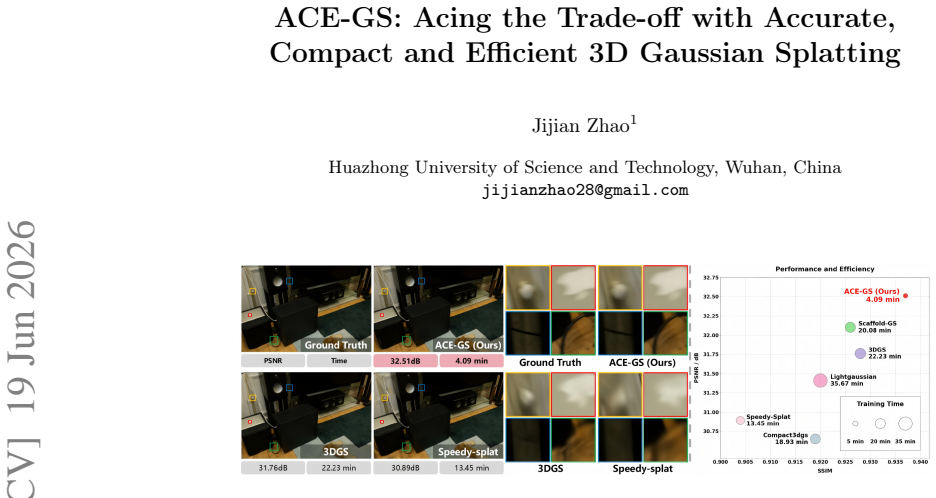
ACE-GS achieves 3.7 times faster training and up to 0.89 dB higher PSNR than standard 3D Gaussian Splatting while keeping a compact scene representation.
A machine-rendered reading of the paper's core claim, the machinery that carries it, and where it could break.
Core claim
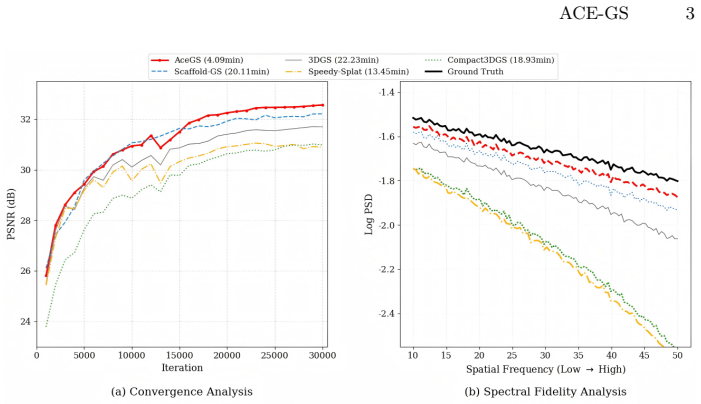
ACE-GS shows that momentum consistency-guided densification strictly constrains primitive growth onto authentic geometric manifolds to accelerate convergence without waste, statistical sensitivity-driven sparsification precisely prunes redundant primitives for a smaller footprint, and cross-dimensional residual frequency compensation back-injects high-frequency error energy into primitive attributes to restore sharp details, together delivering a compact representation that trains up to 3.7 times faster than Speedy-Splat, converges in 3 to 5 minutes, and reaches peak PSNR gains of 0.89 dB over original 3DGS with the highest structural similarity.
What carries the argument
The three coordinated strategies of momentum consistency-guided densification, statistical sensitivity-driven sparsification, and cross-dimensional residual frequency compensation that together control primitive growth, pruning, and detail restoration.
If this is right
- Training completes in 3 to 5 minutes while maintaining higher structural similarity than prior methods.
- Scene storage stays compact after sparsification yet quality exceeds the original 3DGS baseline.
- Peak PSNR improves by as much as 0.89 dB relative to the original 3D Gaussian Splatting formulation.
- Training speed reaches up to 3.7 times that of the Speedy-Splat acceleration baseline.
- The combined strategies produce the highest structural similarity scores among compared approaches.
Where Pith is reading between the lines
- The residual frequency compensation step could transfer to other pruning-heavy acceleration techniques that risk detail loss.
- Shorter training cycles may enable repeated on-device reconstruction of scenes when hardware resources are limited.
- The momentum consistency constraint might be adapted to enforce temporal coherence in dynamic or time-varying scenes.
- Lower overall compute could reduce the energy cost of generating high-quality novel view synthesis models at scale.
Load-bearing premise
The assumption that momentum consistency and statistical sensitivity pruning remove only redundant primitives without irreversible loss of high-frequency geometric structure that the compensation step can always restore.
What would settle it
Rendered images from the full ACE-GS pipeline compared against the same pipeline with the frequency compensation step disabled, measured by drop in SSIM or visible loss of sharp edges and textures on standard benchmark scenes.
Figures




read the original abstract
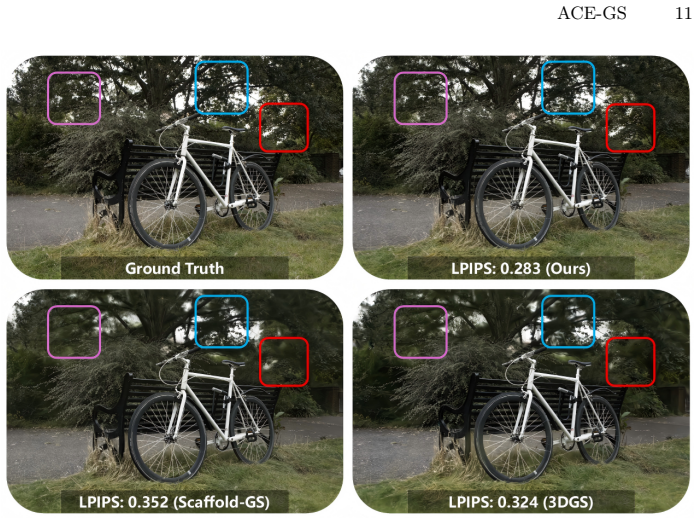
3D Gaussian Splatting achieves exceptional real-time rendering, but its substantial computational and storage demands hinder widespread deployment. Existing accelerated paradigms often aggressively prune primitives for rapid convergence, causing severe loss of high-frequency details. To address this, we tackle the fundamental problem of achieving both exceptional rendering quality and ultra-fast reconstruction speed. In this paper, we propose ACE-GS, a progressive optimization framework tailored for accurate, compressed, and efficient scene representation. We realize that precise primitive management is the key to breaking this trade-off. Therefore, we first design a momentum consistency-guided densification strategy, strictly constraining primitive growth onto authentic geometric manifolds to avoid computational waste while significantly accelerating convergence. Building upon this efficient initialization, we deploy a statistical sensitivity-driven sparsification mechanism to precisely prune redundant primitives, yielding a further compressed footprint. Finally, to thoroughly compensate for the risk of micro-structure loss caused by the aforementioned strict primitive control, we introduce a cross-dimensional residual frequency compensation scheme that explicitly back-injects high-frequency error energy into primitive attributes, perfectly restoring sharp geometric details. Extensive experiments validate our superiority. While maintaining a highly compact scene representation, our system achieves up to 3.7 times training acceleration against the rapid framework Speedy-Splat. Requiring only 3 to 5 minutes to converge, ACE-GS secures the highest structural similarity and achieves a peak PSNR improvement of up to 0.89 dB over the original 3DGS, establishing a new benchmark for ultra-fast and high-fidelity novel view synthesis.
Editorial analysis
A structured set of objections, weighed in public.
Referee Report
Summary. The paper proposes ACE-GS, a progressive optimization framework for 3D Gaussian Splatting. It introduces three strategies—momentum consistency-guided densification to constrain primitive growth to geometric manifolds, statistical sensitivity-driven sparsification to prune redundancies, and cross-dimensional residual frequency compensation to restore high-frequency details—claiming these break the quality-speed-compactness trade-off. Reported results include up to 3.7× training acceleration versus Speedy-Splat, convergence in 3–5 minutes, highest SSIM, and up to 0.89 dB PSNR gain over original 3DGS while keeping a compact representation.
Significance. If the mechanisms are shown to work as described, the result would be significant for real-time novel-view synthesis, as it targets a practically important operating point (minutes-scale training with competitive or superior fidelity and reduced storage) that existing accelerated 3DGS variants have not simultaneously achieved.
major comments (2)
- [Abstract] Abstract (paragraph describing the three strategies): the central claim that momentum consistency 'strictly constraining primitive growth onto authentic geometric manifolds' yields both acceleration and no irreversible high-frequency loss is load-bearing for the reported 3.7× speedup and 0.89 dB PSNR gain, yet the abstract supplies neither the momentum update rule nor a definition of the manifold constraint. Without these, it is impossible to verify that densification avoids extraneous primitives or that residual compensation can reliably restore structure.
- [Abstract] Abstract (paragraph describing the three strategies): the statistical sensitivity-driven sparsification is asserted to 'precisely prune redundant primitives' without irreversible loss, which underpins the compactness claim. No sensitivity metric, threshold derivation, or ablation isolating its effect on high-frequency content is referenced, leaving the assumption that only redundant primitives are removed untestable and directly relevant to whether the quality numbers can be attributed to the method rather than to the compensation stage alone.
Simulated Author's Rebuttal
We thank the referee for the constructive comments regarding the abstract. The points raised correctly identify that the abstract presents high-level descriptions of the proposed strategies without the underlying technical details. We address each comment below and will revise the abstract to improve precision while preserving conciseness.
read point-by-point responses
-
Referee: [Abstract] Abstract (paragraph describing the three strategies): the central claim that momentum consistency 'strictly constraining primitive growth onto authentic geometric manifolds' yields both acceleration and no irreversible high-frequency loss is load-bearing for the reported 3.7× speedup and 0.89 dB PSNR gain, yet the abstract supplies neither the momentum update rule nor a definition of the manifold constraint. Without these, it is impossible to verify that densification avoids extraneous primitives or that residual compensation can reliably restore structure.
Authors: We agree that the abstract does not include the momentum update rule or a definition of the manifold constraint. These elements are formally specified in Section 3.1 of the manuscript, including the momentum consistency equations and the geometric manifold constraint derived from multi-iteration consistency checks. To address the concern, we will revise the abstract to briefly reference the momentum update mechanism and direct readers to the methods section for the manifold definition. This change will be incorporated in the revised manuscript. revision: yes
-
Referee: [Abstract] Abstract (paragraph describing the three strategies): the statistical sensitivity-driven sparsification is asserted to 'precisely prune redundant primitives' without irreversible loss, which underpins the compactness claim. No sensitivity metric, threshold derivation, or ablation isolating its effect on high-frequency content is referenced, leaving the assumption that only redundant primitives are removed untestable and directly relevant to whether the quality numbers can be attributed to the method rather than to the compensation stage alone.
Authors: The observation is accurate: the abstract does not specify the sensitivity metric, threshold derivation, or reference the relevant ablation. These are detailed in Section 3.2 (sensitivity metric based on statistical gradient analysis and threshold selection) and Section 4.3 (ablations isolating high-frequency effects). We will revise the abstract to include a concise description of the sensitivity-driven pruning and note the supporting ablations, enabling clearer attribution of results to the full pipeline. revision: yes
Circularity Check
No circularity; empirical claims rest on proposed algorithms without reduction to inputs
full rationale
The paper introduces three new strategies (momentum consistency-guided densification, statistical sensitivity-driven sparsification, cross-dimensional residual frequency compensation) and reports empirical gains (3.7× speedup, 0.89 dB PSNR) from experiments. No equations, fitted parameters renamed as predictions, or self-citation chains appear in the abstract or described claims. Performance numbers are presented as measured outcomes of the algorithmic steps rather than quantities forced by construction from the inputs. The derivation chain is self-contained against external benchmarks.
Axiom & Free-Parameter Ledger
axioms (1)
- domain assumption Gaussian primitives can be added and removed while preserving geometric fidelity when guided by momentum and sensitivity statistics.
Reference graph
Works this paper leans on
-
[1]
IEEE Transactions on Circuits and Systems for Video Technology35(7), 6832–6852 (2025)
Bao, Y., Ding, T., Huo, J., Liu, Y., Li, Y., Li, W., Gao, Y., Luo, J.: 3d gaussian splatting: Survey, technologies, challenges, and opportunities. IEEE Transactions on Circuits and Systems for Video Technology35(7), 6832–6852 (2025)
2025
-
[2]
In: Proceedings of the IEEE/CVF conference on computer vision and pattern recognition
Barron, J.T., Mildenhall, B., Verbin, D., Srinivasan, P.P., Hedman, P.: Mip- nerf 360: Unbounded anti-aliased neural radiance fields. In: Proceedings of the IEEE/CVF conference on computer vision and pattern recognition. pp. 5470–5479 (2022)
2022
-
[3]
In: Proceedings of the IEEE/CVF conference on computer vision and pattern recognition
Charatan,D.,Li,S.L.,Tagliasacchi,A.,Sitzmann,V.:pixelsplat:3dgaussiansplats from image pairs for scalable generalizable 3d reconstruction. In: Proceedings of the IEEE/CVF conference on computer vision and pattern recognition. pp. 19457– 19467 (2024) ACE-GS 15
2024
-
[4]
A Survey on 3D Gaussian Splatting
Chen, G., Wang, W.: A survey on 3d gaussian splatting. arXiv preprint arXiv:2401.03890 (2024)
work page internal anchor Pith review Pith/arXiv arXiv 2024
-
[5]
In: European Conference on Computer Vision
Chen,Y.,Wu,Q.,Lin,W.,Harandi,M.,Cai,J.:Hac:Hash-gridassistedcontextfor 3d gaussian splatting compression. In: European Conference on Computer Vision. pp. 422–438. Springer (2024)
2024
-
[6]
In: Proceedings of the IEEE/CVF conference on computer vision and pattern recognition
Chen, Y., Chen, Z., Zhang, C., Wang, F., Yang, X., Wang, Y., Cai, Z., Yang, L., Liu, H., Lin, G.: Gaussianeditor: Swift and controllable 3d editing with gaussian splatting. In: Proceedings of the IEEE/CVF conference on computer vision and pattern recognition. pp. 21476–21485 (2024)
2024
-
[7]
Advances in Neural Information Pro- cessing Systems37, 34487–34512 (2024)
Chen, Y., Lee, G.H.: Dogs: Distributed-oriented gaussian splatting for large-scale 3d reconstruction via gaussian consensus. Advances in Neural Information Pro- cessing Systems37, 34487–34512 (2024)
2024
-
[8]
In: European conference on computer vision
Chen, Y., Xu, H., Zheng, C., Zhuang, B., Pollefeys, M., Geiger, A., Cham, T.J., Cai, J.: Mvsplat: Efficient 3d gaussian splatting from sparse multi-view images. In: European conference on computer vision. pp. 370–386. Springer (2024)
2024
-
[9]
In: Forty-first International Conference on Machine Learning (2024)
Cheng, K., Long, X., Yang, K., Yao, Y., Yin, W., Ma, Y., Wang, W., Chen, X.: Gaussianpro: 3d gaussian splatting with progressive propagation. In: Forty-first International Conference on Machine Learning (2024)
2024
-
[10]
Advances in neural information processing systems37, 140138–140158 (2024)
Fan, Z., Wang, K., Wen, K., Zhu, Z., Xu, D., Wang, Z.: Lightgaussian: Unbounded 3d gaussian compression with 15x reduction and 200+ fps. Advances in neural information processing systems37, 140138–140158 (2024)
2024
-
[11]
In: European conference on computer vision
Fang,G.,Wang,B.:Mini-splatting:Representingsceneswithaconstrainednumber of gaussians. In: European conference on computer vision. pp. 165–181. Springer (2024)
2024
-
[12]
IEEE Transactions on Visualization and Computer Graphics (2024)
Fei, B., Xu, J., Zhang, R., Zhou, Q., Yang, W., He, Y.: 3d gaussian splatting as new era: A survey. IEEE Transactions on Visualization and Computer Graphics (2024)
2024
-
[13]
In: European Conference on Computer Vision
Girish, S., Gupta, K., Shrivastava, A.: Eagles: Efficient accelerated 3d gaussians with lightweight encodings. In: European Conference on Computer Vision. pp. 54–71. Springer (2024)
2024
-
[14]
In: Proceedings of the IEEE/CVF conference on computer vision and pattern recognition
Guédon, A., Lepetit, V.: Sugar: Surface-aligned gaussian splatting for efficient 3d mesh reconstruction and high-quality mesh rendering. In: Proceedings of the IEEE/CVF conference on computer vision and pattern recognition. pp. 5354–5363 (2024)
2024
-
[15]
In: Proceedings of the IEEE/CVF Conference on Computer Vision and Pattern Recognition
Hamdi, A., Melas-Kyriazi, L., Mai, J., Qian, G., Liu, R., Vondrick, C., Ghanem, B., Vedaldi, A.: Ges: Generalized exponential splatting for efficient radiance field rendering. In: Proceedings of the IEEE/CVF Conference on Computer Vision and Pattern Recognition. pp. 19812–19822 (2024)
2024
-
[16]
In: Proceedings of the Computer Vision and Pattern Recognition Conference
Hanson, A., Tu, A., Lin, G., Singla, V., Zwicker, M., Goldstein, T.: Speedy-splat: Fast 3d gaussian splatting with sparse pixels and sparse primitives. In: Proceedings of the Computer Vision and Pattern Recognition Conference. pp. 21537–21546 (2025)
2025
-
[17]
In: Proceedings of the Computer Vision and Pattern Recognition Conference
Hanson, A., Tu, A., Singla, V., Jayawardhana, M., Zwicker, M., Goldstein, T.: Pup 3d-gs: Principled uncertainty pruning for 3d gaussian splatting. In: Proceedings of the Computer Vision and Pattern Recognition Conference. pp. 5949–5958 (2025)
2025
-
[18]
ACM Transactions on Graphics (ToG)37(6), 1–15 (2018)
Hedman, P., Philip, J., Price, T., Frahm, J.M., Drettakis, G., Brostow, G.: Deep blending for free-viewpoint image-based rendering. ACM Transactions on Graphics (ToG)37(6), 1–15 (2018)
2018
-
[19]
In: ACM SIGGRAPH 2024 conference papers
Huang, B., Yu, Z., Chen, A., Geiger, A., Gao, S.: 2d gaussian splatting for geo- metrically accurate radiance fields. In: ACM SIGGRAPH 2024 conference papers. pp. 1–11 (2024) 16 J. Zhao
2024
-
[20]
In: Proceedings of the IEEE/CVF conference on computer vision and pattern recognition
Jiang, Y., Tu, J.,Liu,Y., Gao, X., Long, X., Wang, W., Ma, Y.: Gaussianshader: 3d gaussian splatting with shading functions for reflective surfaces. In: Proceedings of the IEEE/CVF conference on computer vision and pattern recognition. pp. 5322– 5332 (2024)
2024
-
[21]
ACM Trans
Kerbl, B., Kopanas, G., Leimkühler, T., Drettakis, G., et al.: 3d gaussian splatting for real-time radiance field rendering. ACM Trans. Graph.42(4), 139–1 (2023)
2023
-
[22]
ACM Transactions on Graphics (ToG)36(4), 1–13 (2017)
Knapitsch, A., Park, J., Zhou, Q.Y., Koltun, V.: Tanks and temples: Benchmarking large-scale scene reconstruction. ACM Transactions on Graphics (ToG)36(4), 1–13 (2017)
2017
-
[23]
In: Proceedings of the IEEE/CVF Conference on Computer Vision and Pattern Recognition
Lee, J.C., Rho, D., Sun, X., Ko, J.H., Park, E.: Compact 3d gaussian representation for radiance field. In: Proceedings of the IEEE/CVF Conference on Computer Vision and Pattern Recognition. pp. 21719–21728 (2024)
2024
-
[24]
In: European conference on computer vision
Liang, Z., Zhang, Q., Hu, W., Zhu, L., Feng, Y., Jia, K.: Analytic-splatting: Anti- aliased 3d gaussian splatting via analytic integration. In: European conference on computer vision. pp. 281–297. Springer (2024)
2024
-
[25]
In: Proceed- ings of the IEEE/CVF Conference on Computer Vision and Pattern Recognition
Lin, J., Li, Z., Tang, X., Liu, J., Liu, S., Liu, J., Lu, Y., Wu, X., Xu, S., Yan, Y., et al.: Vastgaussian: Vast 3d gaussians for large scene reconstruction. In: Proceed- ings of the IEEE/CVF Conference on Computer Vision and Pattern Recognition. pp. 5166–5175 (2024)
2024
-
[26]
In: European Conference on Computer Vision
Liu, Y., Luo, C., Fan, L., Wang, N., Peng, J., Zhang, Z.: Citygaussian: Real-time high-quality large-scale scene rendering with gaussians. In: European Conference on Computer Vision. pp. 265–282. Springer (2024)
2024
-
[27]
In: Proceedings of the IEEE/CVF conference on computer vision and pattern recognition
Lu, T., Yu, M., Xu, L., Xiangli, Y., Wang, L., Lin, D., Dai, B.: Scaffold-gs: Struc- tured 3d gaussians for view-adaptive rendering. In: Proceedings of the IEEE/CVF conference on computer vision and pattern recognition. pp. 20654–20664 (2024)
2024
-
[28]
In: 2024 International Conference on 3D Vision (3DV)
Luiten, J., Kopanas, G., Leibe, B., Ramanan, D.: Dynamic 3d gaussians: Tracking by persistent dynamic view synthesis. In: 2024 International Conference on 3D Vision (3DV). pp. 800–809. IEEE (2024)
2024
-
[29]
Commu- nications of the ACM65(1), 99–106 (2021)
Mildenhall, B., Srinivasan, P.P., Tancik, M., Barron, J.T., Ramamoorthi, R., Ng, R.: Nerf: Representing scenes as neural radiance fields for view synthesis. Commu- nications of the ACM65(1), 99–106 (2021)
2021
-
[30]
In: Proceedings of the IEEE/CVF Con- ference on Computer Vision and Pattern Recognition
Niedermayr, S., Stumpfegger, J., Westermann, R.: Compressed 3d gaussian splat- ting for accelerated novel view synthesis. In: Proceedings of the IEEE/CVF Con- ference on Computer Vision and Pattern Recognition. pp. 10349–10358 (2024)
2024
-
[31]
Proceedings of the ACM on Computer Graphics and Interactive Techniques7(1), 1–17 (2024)
Papantonakis, P., Kopanas, G., Kerbl, B., Lanvin, A., Drettakis, G.: Reducing the memory footprint of 3d gaussian splatting. Proceedings of the ACM on Computer Graphics and Interactive Techniques7(1), 1–17 (2024)
2024
-
[32]
ACM Transactions on Graphics (TOG)43(4), 1–17 (2024)
Radl, L., Steiner, M., Parger, M., Weinrauch, A., Kerbl, B., Steinberger, M.: Stopthepop: Sorted gaussian splatting for view-consistent real-time rendering. ACM Transactions on Graphics (TOG)43(4), 1–17 (2024)
2024
-
[33]
arXiv preprint arXiv:2403.17898 (2024)
Ren, K., Jiang, L., Lu, T., Yu, M., Xu, L., Ni, Z., Dai, B.: Octree-gs: Towards consistent real-time rendering with lod-structured 3d gaussians. arXiv preprint arXiv:2403.17898 (2024)
-
[34]
In: Proceedings of the IEEE/CVF conference on computer vision and pattern recognition
Szymanowicz, S., Rupprecht, C., Vedaldi, A.: Splatter image: Ultra-fast single- view 3d reconstruction. In: Proceedings of the IEEE/CVF conference on computer vision and pattern recognition. pp. 10208–10217 (2024)
2024
-
[35]
In: European Conference on Computer Vision
Wang, H., Zhu, H., He, T., Feng, R., Deng, J., Bian, J., Chen, Z.: End-to-end rate-distortion optimized 3d gaussian representation. In: European Conference on Computer Vision. pp. 76–92. Springer (2024) ACE-GS 17
2024
-
[36]
In: Proceedings of the IEEE/CVF conference on computer vision and pattern recognition
Wu, G., Yi, T., Fang, J., Xie, L., Zhang, X., Wei, W., Liu, W., Tian, Q., Wang, X.: 4d gaussian splatting for real-time dynamic scene rendering. In: Proceedings of the IEEE/CVF conference on computer vision and pattern recognition. pp. 20310– 20320 (2024)
2024
-
[37]
In: Eu- ropean conference on computer vision
Xie, S., Zhang, W., Tang, C., Bai, Y., Lu, R., Ge, S., Wang, Z.: Mesongs: Post- training compression of 3d gaussians via efficient attribute transformation. In: Eu- ropean conference on computer vision. pp. 434–452. Springer (2024)
2024
-
[38]
In: Proceedings of the IEEE/CVF Conference on Computer Vision and Pattern Recognition
Xie, T., Zong, Z., Qiu, Y., Li, X., Feng, Y., Yang, Y., Jiang, C.: Physgaussian: Physics-integrated 3d gaussians for generative dynamics. In: Proceedings of the IEEE/CVF Conference on Computer Vision and Pattern Recognition. pp. 4389– 4398 (2024)
2024
-
[39]
In: Proceedings of the IEEE/CVF conference on computer vi- sion and pattern recognition
Yu, Z., Chen, A., Huang, B., Sattler, T., Geiger, A.: Mip-splatting: Alias-free 3d gaussian splatting. In: Proceedings of the IEEE/CVF conference on computer vi- sion and pattern recognition. pp. 19447–19456 (2024)
2024
-
[40]
ACM Transactions on Graphics (ToG)43(6), 1–13 (2024)
Yu, Z., Sattler, T., Geiger, A.: Gaussian opacity fields: Efficient adaptive surface reconstruction in unbounded scenes. ACM Transactions on Graphics (ToG)43(6), 1–13 (2024)
2024
-
[41]
In: Proceedings of the IEEE/CVF Conference on Computer Vision and Pattern Recognition
Zhang, J., Zhan, F., Xu, M., Lu, S., Xing, E.: Fregs: 3d gaussian splatting with progressive frequency regularization. In: Proceedings of the IEEE/CVF Conference on Computer Vision and Pattern Recognition. pp. 21424–21433 (2024)
2024
-
[42]
In: NeurIPS (2024)
Zhu, Z., Fan, Z., Jiang, Y., Wang, H., Zhang, X., Wang, Z., et al.: Spec-gaussian: Anisotropic view-dependent appearance for 3d gaussian splatting. In: NeurIPS (2024)
2024
discussion (0)
Sign in with ORCID, Apple, or X to comment. Anyone can read and Pith papers without signing in.