The Fundamental Planes of Black Hole Activity for High-Synchrotron-Peaked BL Lacertae Objects
Pith reviewed 2026-06-26 13:40 UTC · model grok-4.3
The pith
Synchrotron cooling of jet electrons produces the shallow radio-X-ray correlation and fundamental plane in high-synchrotron-peaked BL Lacs.
A machine-rendered reading of the paper's core claim, the machinery that carries it, and where it could break.
Core claim
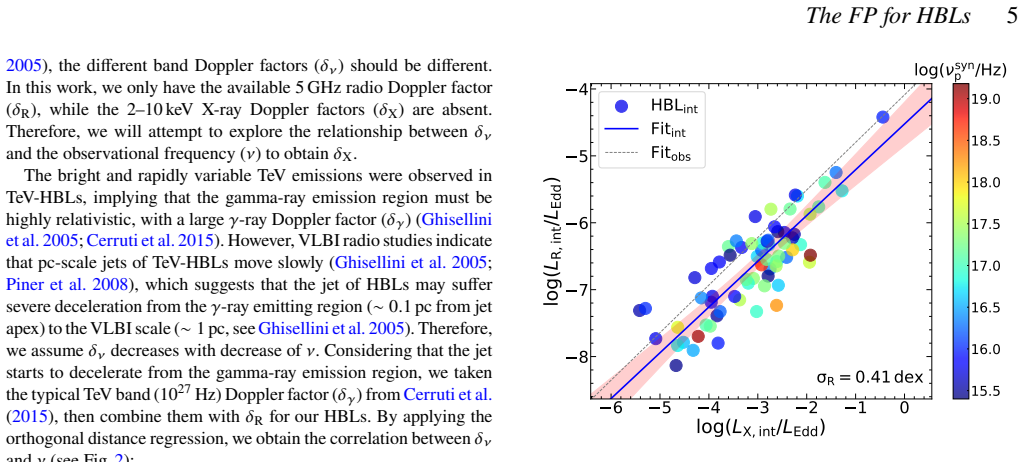
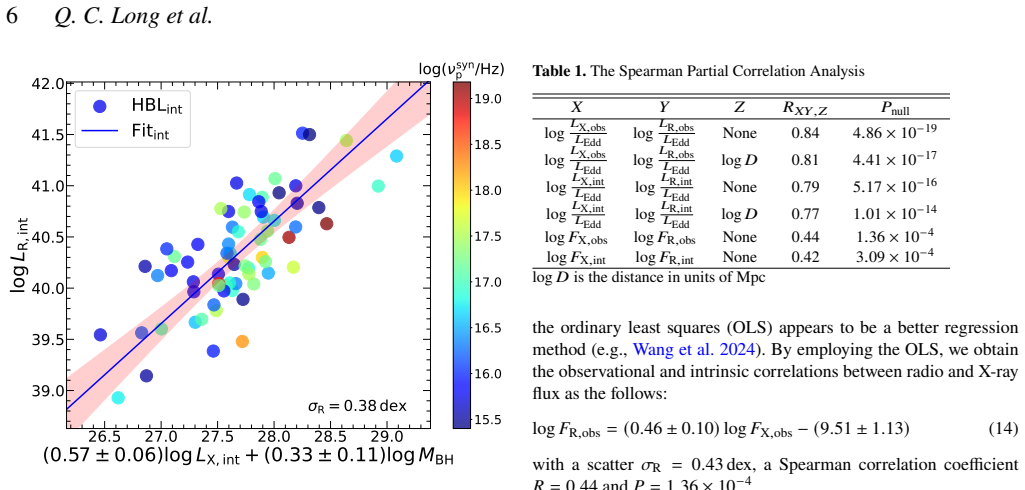
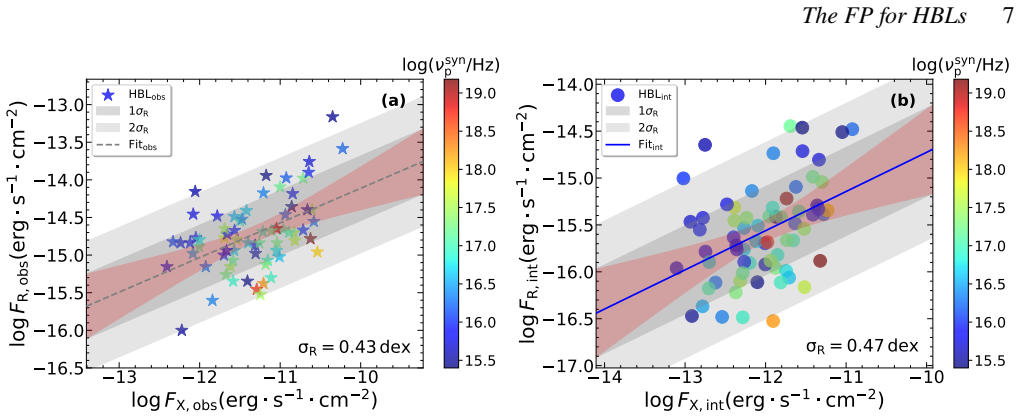
After correcting for Doppler beaming effects, the intrinsic radio-X-ray correlation for HBLs is L_R,int proportional to L_X,int to the power 0.68 and the fundamental plane is log L_R,int equals (0.57 plus or minus 0.06) log L_X,int plus (0.33 plus or minus 0.11) log M_BH plus (12.65 plus or minus 2.00). These relations are explained by the synchrotron cooling model, indicating that the X-ray emissions of HBLs are produced by rapidly cooling, high-energy electrons accelerated at a shock in the jet.
What carries the argument
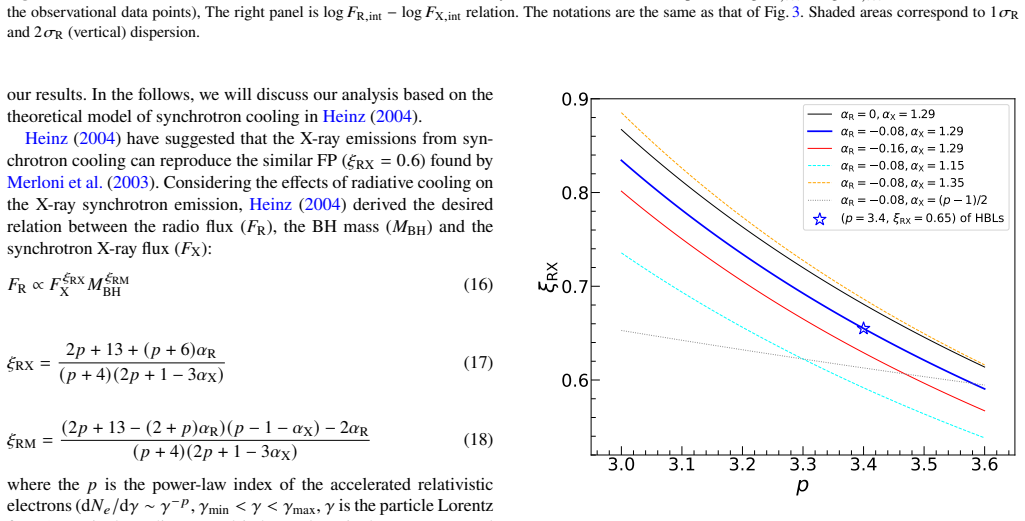
The synchrotron cooling (Syn-c) model for high-energy electrons in jets, which produces the observed shallow radio-X-ray scaling when cooling occurs rapidly after shock acceleration.
If this is right
- X-ray emission in these HBLs originates from the synchrotron process of rapidly cooling high-energy electrons at shocks.
- The shallow radio-X-ray correlations and fundamental plane are intrinsic properties of the sources.
- The results are consistent with recent X-ray polarization observations that support a synchrotron origin for the X-rays.
- The scaling L_R proportional to L_X_Syn-c to the power 0.6-0.7 holds as an observational signature of this emission mechanism.
Where Pith is reading between the lines
- If the Syn-c picture is correct, similar shallow correlations could appear in other jet-dominated sources where synchrotron cooling sets the X-ray output.
- Long-term multi-wavelength variability campaigns could check whether flux changes follow the timing expected for shock-accelerated cooling electrons.
- Improved jet orientation indicators might allow tighter tests of whether the recovered slope remains stable near 0.68.
Load-bearing premise
Doppler beaming corrections recover true intrinsic luminosities without leftover orientation biases, and synchrotron cooling dominates X-ray production with negligible contribution from other channels.
What would settle it
A measured intrinsic radio-X-ray slope after refined beaming estimates that lies well outside the 0.6-0.7 range, or X-ray polarization fractions and angles that contradict expectations for synchrotron emission from cooling shock-accelerated electrons.
Figures
read the original abstract
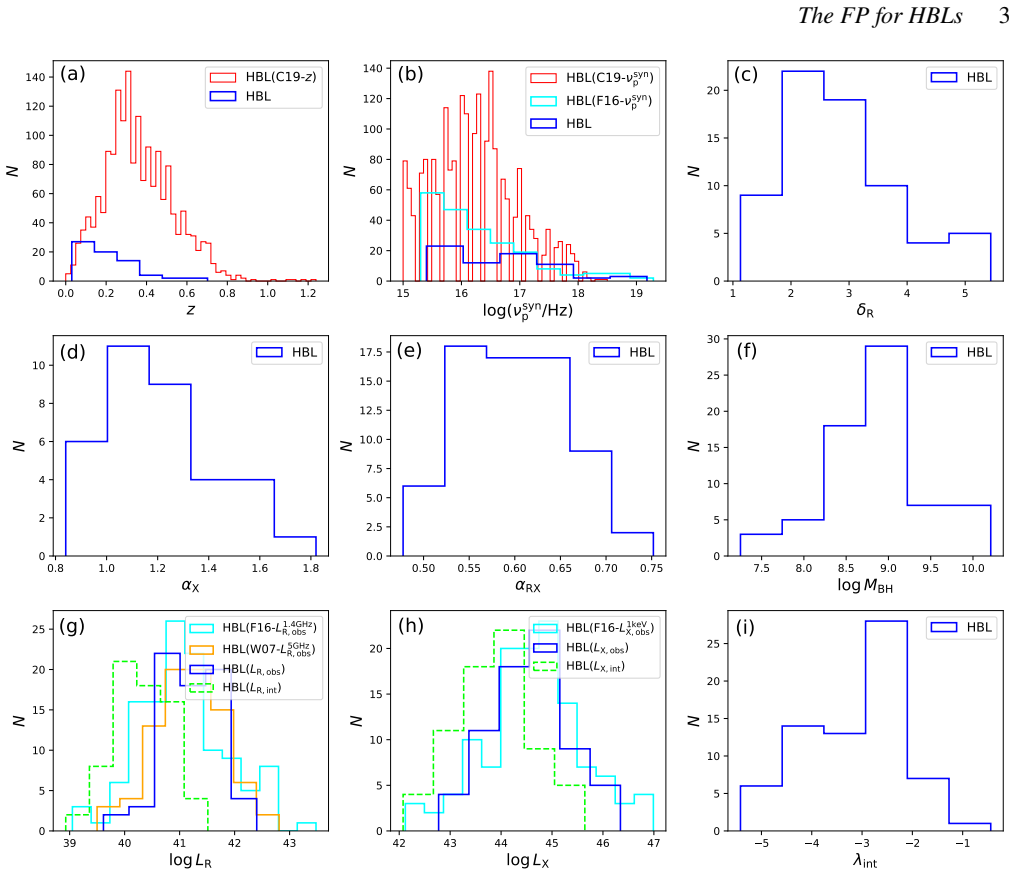
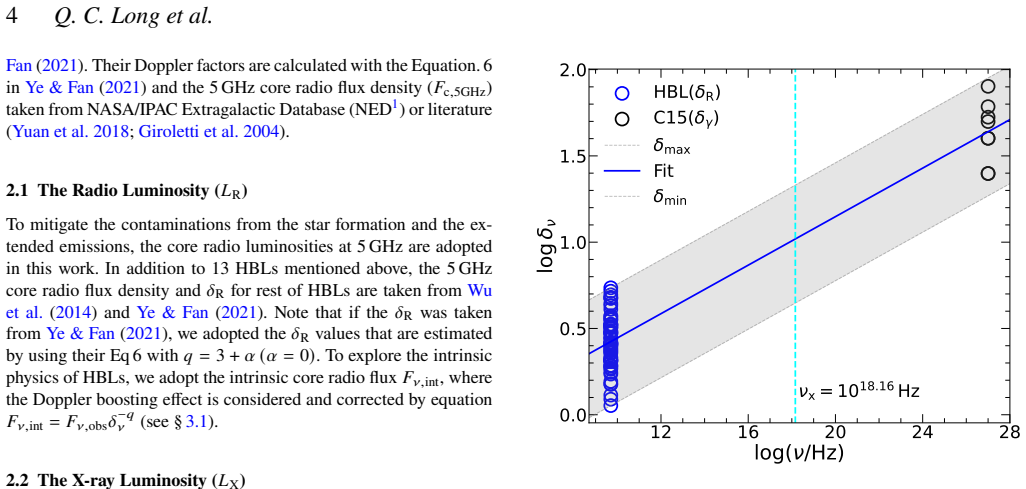
The radio--X-ray correlation and Fundamental Plane (FP) of black hole activity can serve as a diagnostic tool for the origin of X-ray emissions. There was a scaling relation between radio and X-ray emissions for High-synchrotron-peaked BL Lacertae objects (HBLs), i.e., $L_{\rm{R}}\propto L_{\rm{X}}^{0.64}$, which can be explained by ADAF-dominated mode or synchrotron cooling (Syn-c). However, many results of studying blazar physics show that the X-ray emissions of HBLs are mainly produced by the synchrotron process of jets. Therefore, Syn-c appears to provide a plausible explanation for this relation. To further clarify the origin of X-ray emissions of HBLs, we constructed a sample containing 69 HBLs in this paper to re-investigate their radio--X-ray correlation and FP. Considering the Doppler beaming effect, we find that the intrinsic radio--X-ray correlation and FP of HBLs are $L_{\rm R,int}\propto L_{\rm X,int}^{0.68}$ and $\log L_{\rm R,int}=(0.57\pm0.06)\log L_{\rm X,int}+(0.33\pm0.11)\log M_{\rm BH}+(12.65\pm2.00)$, respectively. Our results agree with the scaling relation mention above, which suggests these scaling relations are not artificial. By employing the theoretical model of Syn-c, we find that these shallow radio--X-ray correlations and FP are caused by Syn-c, which implies that the X-ray emissions of HBLs may be produced by rapidly cooling, high-energy electrons accelerated at a shock. This is consistent with results of the recent X-ray polarization observations of HBLs. Our results provide the observational evidence of $L_{\rm R}\propto L_{\rm X_{\text{Syn-c}}}^{0.6\sim0.7}$.
Editorial analysis
A structured set of objections, weighed in public.
Referee Report
Summary. The manuscript analyzes a sample of 69 high-synchrotron-peaked BL Lacertae objects (HBLs) to re-examine their radio-X-ray correlation and fundamental plane (FP) of black hole activity. After applying Doppler beaming corrections, it reports intrinsic relations L_{R,int} ∝ L_{X,int}^{0.68} and log L_{R,int} = (0.57±0.06) log L_{X,int} + (0.33±0.11) log M_{BH} + (12.65±2.00), attributes the shallow slope to the synchrotron cooling (Syn-c) model, and concludes that X-ray emission originates from rapidly cooling high-energy electrons accelerated at shocks, providing observational evidence for L_R ∝ L_{X_Syn-c}^{0.6~0.7}.
Significance. If the Doppler corrections are shown to be free of residual biases and the Syn-c model comparison is performed with an independent derivation of the exponent plus quantitative metrics, the result would supply direct observational support for jet-based synchrotron origins of X-rays in HBLs and for the Syn-c mechanism explaining shallow correlations, consistent with recent X-ray polarization data.
major comments (3)
- [Abstract] Abstract: the central claim that the observed intrinsic slope of 0.68 matches the Syn-c expectation of 0.6-0.7 and is caused by Syn-c requires an independent derivation of the model exponent and a quantitative test (e.g., predicted vs. observed slope with uncertainties); none is supplied, creating a circularity risk for the attribution of X-ray origin.
- [Abstract] Abstract: the Doppler beaming correction is load-bearing for recovering unbiased intrinsic luminosities and the reported slope of 0.68, yet no details are given on how Doppler factors were estimated for the 69 HBLs, what assumptions were used, or any validation against orientation-dependent or luminosity-correlated residuals.
- [Abstract] Abstract: sample selection criteria, completeness, error propagation on the fitted exponents and FP coefficients, and any statistical comparison (e.g., χ² or posterior odds) to the Syn-c model predictions are absent, preventing assessment of whether the relations are robust or driven by selection effects.
minor comments (1)
- [Abstract] The final sentence uses the non-standard subscript notation L_{X_Syn-c}; a brief definition or reference to the Syn-c luminosity definition would improve clarity.
Simulated Author's Rebuttal
We thank the referee for the constructive comments, which highlight areas where the manuscript can be strengthened. We agree that additional details on the Syn-c derivation, Doppler methodology, and sample statistics will improve clarity and robustness. We address each major comment below and will incorporate the suggested revisions.
read point-by-point responses
-
Referee: [Abstract] Abstract: the central claim that the observed intrinsic slope of 0.68 matches the Syn-c expectation of 0.6-0.7 and is caused by Syn-c requires an independent derivation of the model exponent and a quantitative test (e.g., predicted vs. observed slope with uncertainties); none is supplied, creating a circularity risk for the attribution of X-ray origin.
Authors: We acknowledge the risk of circularity if the Syn-c attribution rests solely on matching the observed slope without explicit derivation. In the revised manuscript we will add a dedicated subsection that independently derives the expected exponent (0.6-0.7) from the synchrotron cooling framework, starting from the electron energy distribution and cooling timescale. We will also include a quantitative comparison (chi-squared statistic and uncertainty overlap) between the fitted slope (0.68 ± 0.06) and the model prediction. revision: yes
-
Referee: [Abstract] Abstract: the Doppler beaming correction is load-bearing for recovering unbiased intrinsic luminosities and the reported slope of 0.68, yet no details are given on how Doppler factors were estimated for the 69 HBLs, what assumptions were used, or any validation against orientation-dependent or luminosity-correlated residuals.
Authors: The Doppler factors were obtained from the standard variability-based method combined with apparent jet speeds where available. To address the concern, the revised version will expand the methods section with the explicit formulas, the adopted bulk Lorentz factor and viewing-angle distributions, and any checks performed for residual correlations with luminosity or orientation. If additional validation tests are needed, we will add them. revision: yes
-
Referee: [Abstract] Abstract: sample selection criteria, completeness, error propagation on the fitted exponents and FP coefficients, and any statistical comparison (e.g., χ² or posterior odds) to the Syn-c model predictions are absent, preventing assessment of whether the relations are robust or driven by selection effects.
Authors: We agree these elements are necessary for assessing robustness. The revised manuscript will include an explicit description of the selection criteria (synchrotron peak frequency threshold and multi-wavelength data availability), a discussion of sample completeness relative to existing HBL catalogs, the error-propagation procedure used for the regression coefficients (Monte Carlo resampling), and a statistical comparison (chi-squared and posterior odds) of the observed relations against the Syn-c predictions. revision: yes
Circularity Check
No circularity: observed slope measured independently and compared to external theoretical model
full rationale
The paper measures intrinsic luminosities for 69 HBLs after applying Doppler beaming corrections, then fits the radio-X-ray correlation to obtain L_R,int ∝ L_X,int^0.68 and the FP relation. This observed slope is noted to agree with a prior scaling relation (0.64) and to lie within the Syn-c model's stated range (0.6-0.7). The text presents the Syn-c model as a theoretical explanation for the shallow slope without any indication that the model's exponent was derived from, fitted to, or defined using the current sample's data. No equations reduce the claimed result to its inputs by construction, no self-citations are shown as load-bearing for the exponent, and the central measurement step remains independent of the model attribution.
Axiom & Free-Parameter Ledger
free parameters (2)
- radio-X-ray exponent =
0.68
- FP coefficients =
0.57, 0.33, 12.65
axioms (1)
- domain assumption Doppler beaming correction yields unbiased intrinsic luminosities
Reference graph
Works this paper leans on
-
[1]
Active Galactic Nuclei: what's in a name?
Active galactic nuclei: what's in a name?. , keywords =. doi:10.1007/s00159-017-0102-9 , archivePrefix =. 1707.07134 , primaryClass =
work page internal anchor Pith review Pith/arXiv arXiv doi:10.1007/s00159-017-0102-9
-
[2]
Optical and Radio Properties of Extragalactic Sources Observed by the FIRST and SDSS Surveys
Optical and Radio Properties of Extragalactic Sources Observed by the FIRST Survey and the Sloan Digital Sky Survey. , keywords =. doi:10.1086/344069 , archivePrefix =. astro-ph/0202408 , primaryClass =
work page internal anchor Pith review Pith/arXiv arXiv doi:10.1086/344069
-
[3]
Radio Loud and Radio Quiet Quasars
Radio-loud and Radio-quiet QSOs. , keywords =. doi:10.3847/0004-637X/831/2/168 , archivePrefix =. 1608.04586 , primaryClass =
work page internal anchor Pith review Pith/arXiv arXiv doi:10.3847/0004-637x/831/2/168
-
[4]
Electromagnetic extraction of energy from Kerr black holes. , keywords =. 1977. doi:10.1093/mnras/179.3.433 , adsurl =
-
[5]
Hydromagnetic flows from accretion disks and the production of radio jets. , keywords =. 1982. doi:10.1093/mnras/199.4.883 , adsurl =
-
[6]
Relativistic Jets from Active Galactic Nuclei. , keywords =. 2019. doi:10.1146/annurev-astro-081817-051948 , archivePrefix =. 1812.06025 , primaryClass =
-
[7]
Exploring X-ray and radio emission of type 1 AGN up to z ~ 2.3
Exploring X-ray and radio emission of type 1 AGN up to z -0.5ex 2.3. , keywords =. doi:10.1051/0004-6361/201117464 , archivePrefix =. 1208.1716 , primaryClass =
work page internal anchor Pith review Pith/arXiv arXiv doi:10.1051/0004-6361/201117464
-
[8]
, keywords =
Radio and X-ray bright AGN: the ROSAT - FIRST correlation. , keywords =
-
[9]
The FIRST Bright Quasar Survey. II. 60 Nights and 1200 Spectra Later. , keywords =. doi:10.1086/313300 , archivePrefix =. astro-ph/9912215 , primaryClass =
work page internal anchor Pith review Pith/arXiv arXiv doi:10.1086/313300
-
[10]
Tools for Computing the AGN Feedback: Radio-loudness Distribution and the Kinetic Luminosity Function. , keywords =. doi:10.1088/0004-637X/718/1/368 , archivePrefix =. 1006.1247 , primaryClass =
work page internal anchor Pith review Pith/arXiv arXiv doi:10.1088/0004-637x/718/1/368
-
[11]
On the AGN radio luminosity distribution and the black hole fundamental plane
On the radio luminosity distribution of active galactic nuclei and the black hole fundamental plane. , keywords =. doi:10.1093/mnras/sts456 , archivePrefix =. 1211.2688 , primaryClass =
work page internal anchor Pith review Pith/arXiv arXiv doi:10.1093/mnras/sts456
-
[12]
Exploring the radio loudness of SDSS quasars with spectral stacking. , keywords =. doi:10.1093/mnras/stae233 , archivePrefix =. 2401.08774 , primaryClass =
-
[13]
Observational appearance
Black holes in binary systems. Observational appearance. , year = 1973, month = jan, volume =
1973
-
[14]
From the Blazar Sequence to the Blazar Envelope: Revisiting the Relativistic Jet Dichotomy in Radio-loud Active Galactic Nuclei. , keywords =. doi:10.1088/0004-637X/740/2/98 , archivePrefix =. 1107.5105 , primaryClass =
work page internal anchor Pith review Pith/arXiv arXiv doi:10.1088/0004-637x/740/2/98
-
[15]
The relativistic jet dichotomy and the end of the blazar sequence. , keywords =. doi:10.1093/mnras/stab1182 , archivePrefix =. 2007.12661 , primaryClass =
-
[16]
On the origin of X-ray emission in some FR Is: ADAF or jet?
On the Origin of X-Ray Emission in Some FR I Galaxies: ADAF or Jet?. , keywords =. doi:10.1086/521212 , archivePrefix =. 0706.4124 , primaryClass =
work page internal anchor Pith review Pith/arXiv arXiv doi:10.1086/521212
-
[17]
The origin of X-ray emission in 3CRR sources: Hints from mid-infrared Spitzer observations. , keywords =. doi:10.1051/0004-6361/202141301 , archivePrefix =. 2107.13142 , primaryClass =
-
[18]
The X-ray to optical-UV luminosity ratio of X-ray selected Type 1 AGN in XMM-COSMOS
The X-ray to optical-UV luminosity ratio of X-ray selected type 1 AGN in XMM-COSMOS. , keywords =. doi:10.1051/0004-6361/200913298 , archivePrefix =. 0912.4166 , primaryClass =
work page internal anchor Pith review Pith/arXiv arXiv doi:10.1051/0004-6361/200913298
-
[19]
The L _ X -L _ uv -L _ radio relation and corona-disc-jet connection in optically selected radio-loud quasars. , keywords =. doi:10.1093/mnras/staa1411 , archivePrefix =. 2006.13226 , primaryClass =
-
[20]
A Fundamental Plane of black hole activity. , keywords =. doi:10.1046/j.1365-2966.2003.07017.x , archivePrefix =. astro-ph/0305261 , primaryClass =
-
[21]
A scheme to unify low-power accreting black holes. Jet-dominated accretion flows and the radio/X-ray correlation. , keywords =. doi:10.1051/0004-6361:20031683 , archivePrefix =. astro-ph/0305335 , primaryClass =
work page internal anchor Pith review Pith/arXiv arXiv doi:10.1051/0004-6361:20031683
-
[22]
Refining the fundamental plane of accreting black holes
Refining the fundamental plane of accreting black holes. , keywords =. doi:10.1051/0004-6361:20054144 , archivePrefix =. astro-ph/0603117 , primaryClass =
work page internal anchor Pith review Pith/arXiv arXiv doi:10.1051/0004-6361:20054144
-
[23]
Radio--X-ray Correlation and the "Quiescent State" of Black Hole Sources
Radio-X-Ray Correlation and the ``Quiescent State'' of Black Hole Sources. , keywords =. doi:10.1086/431453 , archivePrefix =. astro-ph/0411770 , primaryClass =
work page internal anchor Pith review Pith/arXiv arXiv doi:10.1086/431453
-
[24]
Revisiting the "Fundamental Plane" of Black Hole Activity at Extremely Low Luminosities
Revisiting the ``Fundamental Plane'' of Black Hole Activity at Extremely Low Luminosities. , keywords =. doi:10.1088/0004-637X/703/1/1034 , archivePrefix =. 0902.3704 , primaryClass =
work page internal anchor Pith review Pith/arXiv arXiv doi:10.1088/0004-637x/703/1/1034
-
[25]
The black hole fundamental plane from a uniform sample of radio and X-ray emitting broad line AGNs
The Black Hole Fundamental Plane from a Uniform Sample of Radio and X-Ray-emitting Broad-Line AGNs. , keywords =. doi:10.1086/504401 , archivePrefix =. astro-ph/0603514 , primaryClass =
work page internal anchor Pith review Pith/arXiv arXiv doi:10.1086/504401
-
[26]
The Black Hole Fundamental Plane: Revisited with a Larger Sample of Radio and X-Ray-Emitting Broad-Line AGNs. , keywords =. doi:10.1086/592314 , archivePrefix =. 0808.0541 , primaryClass =
work page internal anchor Pith review Pith/arXiv arXiv doi:10.1086/592314
-
[27]
The Fundamental Plane of Accretion Onto Black Holes with Dynamical Masses
The Fundamental Plane of Accretion onto Black Holes with Dynamical Masses. , keywords =. doi:10.1088/0004-637X/706/1/404 , archivePrefix =. 0906.3285 , primaryClass =
work page internal anchor Pith review Pith/arXiv arXiv doi:10.1088/0004-637x/706/1/404
-
[28]
The active nuclei of z < 1.0 3CRR radio sources. , keywords =. doi:10.1111/j.1365-2966.2009.14887.x , archivePrefix =. 0904.1323 , primaryClass =
-
[29]
Using the Fundamental Plane of black hole activity to distinguish X-ray processes from weakly accreting black holes. MNRAS , keywords =. doi:10.1111/j.1365-2966.2011.19689.x , archivePrefix =. 1105.3211 , primaryClass =
-
[30]
The Radio/X-Ray Correlation and Black Hole Fundamental Plane for Young Radio Sources: Implications for X-Ray Origin and Accretion Mode. , keywords =. doi:10.3847/0004-637X/818/2/185 , adsurl =
-
[31]
A new fundamental plane for radiatively efficient black-hole sources
A New Fundamental Plane for Radiatively Efficient Black-hole Sources. , keywords =. doi:10.1088/2041-8205/787/2/L20 , archivePrefix =. 1404.5317 , primaryClass =
work page internal anchor Pith review Pith/arXiv arXiv doi:10.1088/2041-8205/787/2/l20 2041
-
[32]
Revisit the fundamental plane of black-hole activity from sub-Eddington to quiescent state
Revisit the Fundamental Plane of black hole activity from sub-Eddington to quiescent state. , keywords =. doi:10.1093/mnras/stv1801 , archivePrefix =. 1509.05088 , primaryClass =
work page internal anchor Pith review Pith/arXiv arXiv doi:10.1093/mnras/stv1801
-
[33]
Fundamental Plane of Black Hole Activity in Quiescent Regime
Fundamental Plane of Black Hole Activity in the Quiescent Regime. , keywords =. doi:10.3847/1538-4357/aa5b90 , archivePrefix =. 1701.06143 , primaryClass =
work page internal anchor Pith review Pith/arXiv arXiv doi:10.3847/1538-4357/aa5b90
-
[34]
Black Hole Fundamental Plane in Low-Excitation Radio Galaxies
The black hole fundamental plane in low-excitation radio galaxies. , keywords =. doi:10.1093/mnrasl/sly154 , archivePrefix =. 1808.07188 , primaryClass =
work page internal anchor Pith review Pith/arXiv arXiv doi:10.1093/mnrasl/sly154
-
[35]
The X-ray emission in young radio active galactic nuclei. , keywords =. doi:10.1093/mnras/staa1559 , archivePrefix =. 2006.01079 , primaryClass =
-
[36]
The Fundamental Planes of black hole activity for radio-loud and radio-quiet quasars. , keywords =. doi:10.1093/mnras/stac1153 , archivePrefix =. 2201.04666 , primaryClass =
-
[37]
The fundamental plane of blazars based on the black hole spin-mass energy. , keywords =. doi:10.1093/mnras/stae765 , archivePrefix =. 2403.09088 , primaryClass =
-
[38]
The fundamental plane of black hole activity for low-luminosity radio active galactic nuclei across 0 < z < 4. , keywords =. doi:10.1051/0004-6361/202449732 , archivePrefix =. 2402.17991 , primaryClass =
-
[39]
Revisiting the Fundamental Planes of Black Hole Activity for Strong Jet Sources. , keywords =. doi:10.3847/1538-4357/adaaee , archivePrefix =. 2501.11381 , primaryClass =
-
[40]
The Accretion Rates and Spectral Energy Distributions of BL Lacertae Objects
The Accretion Rates and Spectral Energy Distributions of BL Lacertae Objects. , keywords =. doi:10.1086/342875 , archivePrefix =. astro-ph/0207305 , primaryClass =
work page internal anchor Pith review Pith/arXiv arXiv doi:10.1086/342875
-
[41]
K. I. Kellermann and R. Sramek and M. Schmidt and D. B. Shaffer and R. Green , title = ". , keywords =. doi:10.1086/115207 , adsurl =
-
[42]
Is there really a dichotomy in active galactic nucleus jet power?. , keywords =. doi:10.1111/j.1365-2966.2011.19060.x , archivePrefix =. 1105.3769 , primaryClass =
-
[43]
A Sample of Low-Redshift BL Lacertae Objects. II. EVN and MERLIN Data and Multiwavelength Analysis. , keywords =. doi:10.1086/504971 , archivePrefix =. astro-ph/0604224 , primaryClass =
work page internal anchor Pith review Pith/arXiv arXiv doi:10.1086/504971
-
[44]
Unified Schemes for Radio-Loud Active Galactic Nuclei
Unified Schemes for Radio-Loud Active Galactic Nuclei. , keywords =. doi:10.1086/133630 , archivePrefix =. astro-ph/9506063 , primaryClass =
work page internal anchor Pith review Pith/arXiv arXiv doi:10.1086/133630
-
[45]
, keywords =
Are high polarization quasars and BL Lacertae objects really different? A study of the optical spectral properties. , keywords =
-
[46]
The Spectral Energy Distributions of Fermi Blazars
The Spectral Energy Distributions of Fermi Blazars. , keywords =. doi:10.3847/0067-0049/226/2/20 , archivePrefix =. 1608.03958 , primaryClass =
work page internal anchor Pith review Pith/arXiv arXiv doi:10.3847/0067-0049/226/2/20
-
[47]
The Spectral Energy Distributions for 4FGL Blazars. , keywords =. doi:10.3847/1538-4365/ac7deb , adsurl =
-
[48]
The Fourth Catalog of Active Galactic Nuclei Detected by the Fermi Large Area Telescope: Data Release 3. , keywords =. doi:10.3847/1538-4365/ac9523 , archivePrefix =. 2209.12070 , primaryClass =
-
[49]
Basic properties of Fermi blazars and the "blazar sequence"
Basic properties of Fermi blazars and the `blazar sequence'. , keywords =. doi:10.1093/mnras/stv812 , archivePrefix =. 1504.02706 , primaryClass =
work page internal anchor Pith review Pith/arXiv arXiv doi:10.1093/mnras/stv812
-
[50]
Why are some BL Lacs detected by \fermi, but others not ?
Why are some BL Lacertaes detected by Fermi, but others not?. , keywords =. doi:10.1051/0004-6361/201220851 , archivePrefix =. 1401.0652 , primaryClass =
work page internal anchor Pith review Pith/arXiv arXiv doi:10.1051/0004-6361/201220851
-
[51]
VLBI observations of seven BL Lac objects from RGB sample
VLBI observations of seven BL Lacertae objects from RGB sample. , keywords =. doi:10.1051/0004-6361:20066754 , archivePrefix =. 0706.0191 , primaryClass =
work page internal anchor Pith review Pith/arXiv arXiv doi:10.1051/0004-6361:20066754
-
[52]
Unification of BL Lac objects and FR I and FR II(G) radio galaxies, and Doppler factor estimation for BL Lac objects. , keywords =. doi:10.1093/pasj/psab039 , archivePrefix =. 2111.09023 , primaryClass =
-
[53]
A Sample of Low-Redshift BL Lacertae Objects. I. The Radio Data. , keywords =. doi:10.1086/423231 , archivePrefix =. astro-ph/0406255 , primaryClass =
work page internal anchor Pith review Pith/arXiv arXiv doi:10.1086/423231
-
[54]
Hard X-ray properties of blazars
Hard X-ray properties of blazars. , keywords =. doi:10.1051/0004-6361:20010675 , archivePrefix =. astro-ph/0105203 , primaryClass =
work page internal anchor Pith review Pith/arXiv arXiv doi:10.1051/0004-6361:20010675
-
[55]
BL Lac Objects and Acceleration Model. , keywords =. doi:10.1007/BF00658217 , adsurl =
-
[56]
A Survey for High Optical Polarization in Quasars with Core-dominant Radio Structure: Is There a Beamed Optical Continuum?. , keywords =. doi:10.1086/171869 , adsurl =
-
[57]
INTEGRAL observations of the blazar Mrk 421 in outburst (Results of a multi-wavelength campaign)
INTEGRAL observations of the blazar Mrk 421 in outburst. Results of a multi-wavelength campaign. , keywords =. doi:10.1051/0004-6361:20079199 , archivePrefix =. 0805.2577 , primaryClass =
work page internal anchor Pith review Pith/arXiv arXiv doi:10.1051/0004-6361:20079199
-
[58]
Blazar spectral variability as explained by a twisted inhomogeneous jet. , keywords =. doi:10.1038/nature24623 , archivePrefix =. 1712.02098 , primaryClass =
-
[59]
Jet power extracted from ADAFs and the application to Fermi BL Lacertae objects. , keywords =. doi:10.1093/mnras/stad2623 , archivePrefix =. 2308.15707 , primaryClass =
-
[60]
The Energy Budget in the Jet of High-frequency Peaked BL Lacertae Objects. , keywords =. doi:10.3847/1538-4357/ad3ba9 , archivePrefix =. 2406.01046 , primaryClass =
-
[61]
The transition between BL Lac objects and flat spectrum radio quasars. , keywords =. doi:10.1111/j.1365-2966.2011.18578.x , archivePrefix =. 1012.0308 , primaryClass =
-
[62]
The jet-disc connection in AGN
The jet-disc connection in AGN. , keywords =. doi:10.1093/mnras/stu1759 , archivePrefix =. 1405.4865 , primaryClass =
work page internal anchor Pith review Pith/arXiv arXiv doi:10.1093/mnras/stu1759
-
[63]
A unifying view of the spectral energy distributions of blazars. , keywords =. doi:10.1046/j.1365-8711.1998.01828.x , archivePrefix =. astro-ph/9804103 , primaryClass =
-
[64]
The Central Engines of Fermi Blazars. , keywords =. doi:10.3847/1538-4365/abe135 , archivePrefix =. 2101.10849 , primaryClass =
-
[65]
L., Nichol, R., Bamford, S., et al
An X-ray view of the INTEGRAL/IBIS blazars. , keywords =. doi:10.1111/j.1365-2966.2010.17725.x , archivePrefix =. 1010.5713 , primaryClass =
-
[66]
BAT AGN Spectroscopic Survey. V. X-Ray Properties of the Swift/BAT 70-month AGN Catalog. , keywords =. doi:10.3847/1538-4365/aa96ad , archivePrefix =. 1709.03989 , primaryClass =
work page internal anchor Pith review Pith/arXiv arXiv doi:10.3847/1538-4365/aa96ad
-
[67]
Discovery of VHE gamma-rays from the high-frequency-peaked BL Lac object RGB J0152+017
Discovery of VHE -rays from the high-frequency-peaked BL Lacertae object RGB J0152+017. , keywords =. doi:10.1051/0004-6361:200809603 , archivePrefix =. 0802.4021 , primaryClass =
work page internal anchor Pith review Pith/arXiv arXiv doi:10.1051/0004-6361:200809603
-
[68]
Six years of BeppoSAX observations of blazars: a spectral catalog
Six years of BeppoSAX observations of blazars: A spectral catalog. , keywords =. doi:10.1051/0004-6361:20034555 , archivePrefix =. physics/0412114 , primaryClass =
work page internal anchor Pith review Pith/arXiv arXiv doi:10.1051/0004-6361:20034555
-
[69]
1ES 0229+200: An extreme blazar with a very high minimum Lorentz factor
1ES 0229+200: an extreme blazar with a very high minimum Lorentz factor. , keywords =. doi:10.1051/0004-6361/201117215 , archivePrefix =. 1109.3628 , primaryClass =
work page internal anchor Pith review Pith/arXiv arXiv doi:10.1051/0004-6361/201117215
-
[70]
High-Resolution Spectroscopy of X-Ray Quasars: Searching for the X-Ray Absorption from the Warm-Hot Intergalactic Medium. , keywords =. doi:10.1086/431749 , archivePrefix =. astro-ph/0506127 , primaryClass =
work page internal anchor Pith review Pith/arXiv arXiv doi:10.1086/431749
-
[71]
TeV BL Lac objects at the dawn of the Fermi era. , keywords =. doi:10.1111/j.1365-2966.2009.15784.x , archivePrefix =. 0909.0651 , primaryClass =
-
[72]
Discovery of VHE gamma-rays from the BL Lac object PKS 0548-322
Discovery of VHE -rays from the BL Lacertae object PKS 0548-322. , keywords =. doi:10.1051/0004-6361/200912363 , archivePrefix =. 1006.5289 , primaryClass =
work page internal anchor Pith review Pith/arXiv arXiv doi:10.1051/0004-6361/200912363
-
[73]
Multiwavelength Observations of the Previously Unidentified Blazar RX J0648.7+1516
Multiwavelength Observations of the Previously Unidentified Blazar RX J0648.7+1516. , keywords =. doi:10.1088/0004-637X/742/2/127 , archivePrefix =. 1110.5949 , primaryClass =
work page internal anchor Pith review Pith/arXiv arXiv doi:10.1088/0004-637x/742/2/127
-
[74]
Long-term multi-wavelength study of 1ES 0647+250. , keywords =. doi:10.1051/0004-6361/202244477 , archivePrefix =. 2211.13268 , primaryClass =
-
[75]
Exploring the spectral properties of faint hard X-ray sources with XMM-Newton
Exploring the spectral properties of faint hard X-ray sources with XMM-Newton. , keywords =. doi:10.1051/0004-6361:20021235 , archivePrefix =. astro-ph/0208183 , primaryClass =
work page internal anchor Pith review Pith/arXiv arXiv doi:10.1051/0004-6361:20021235
-
[76]
General physical properties of bright Fermi blazars. , keywords =. doi:10.1111/j.1365-2966.2009.15898.x , archivePrefix =. 0909.0932 , primaryClass =
-
[77]
X-ray spectra, light curves and SEDs of blazars frequently observed by Swift. , keywords =. doi:10.1093/mnras/stab2425 , archivePrefix =. 2108.07255 , primaryClass =
-
[78]
Spectral Survey of X-Ray Bright Active Galactic Nuclei from the Rossi X-ray Timing Explorer
Spectral Survey of X-ray Bright Active Galactic Nuclei from the Rossi X-ray Timing Explorer. , keywords =. doi:10.1088/0067-0049/193/1/3 , archivePrefix =. 1101.1545 , primaryClass =
work page internal anchor Pith review Pith/arXiv arXiv doi:10.1088/0067-0049/193/1/3
-
[79]
The relation between broad lines and -ray luminosities in Fermi blazars. , keywords =. doi:10.1111/j.1365-2966.2012.20442.x , archivePrefix =. 1108.0927 , primaryClass =
-
[80]
General Physical Properties of CGRaBS Blazars
General Physical Properties of CGRaBS Blazars. , keywords =. doi:10.3847/1538-4357/aa98e1 , archivePrefix =. 1711.01292 , primaryClass =
work page internal anchor Pith review Pith/arXiv arXiv doi:10.3847/1538-4357/aa98e1
discussion (0)
Sign in with ORCID, Apple, or X to comment. Anyone can read and Pith papers without signing in.