Heavy-quark pair-production in DIS at NLO QCD matched to a parton shower
Pith reviewed 2026-06-26 13:46 UTC · model grok-4.3
The pith
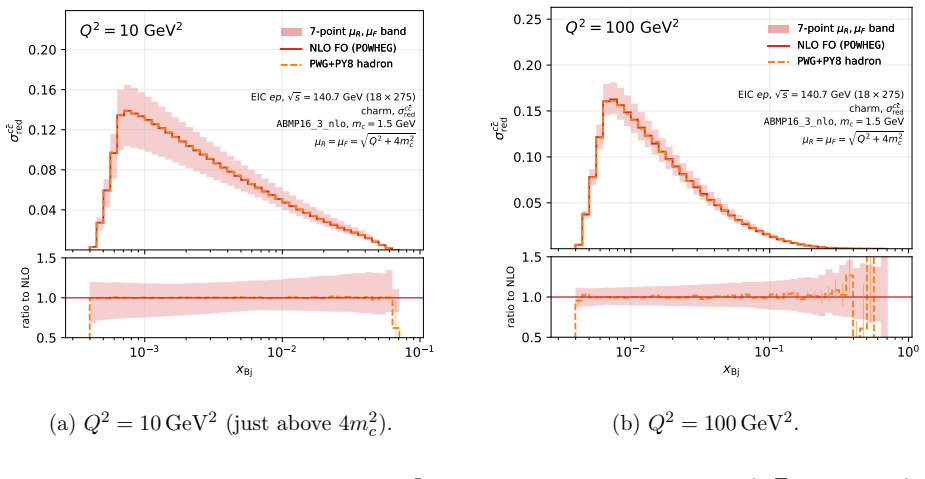
Heavy-quark pair production in deep-inelastic scattering is computed at NLO QCD and matched to a parton shower via POWHEG.
A machine-rendered reading of the paper's core claim, the machinery that carries it, and where it could break.
Core claim
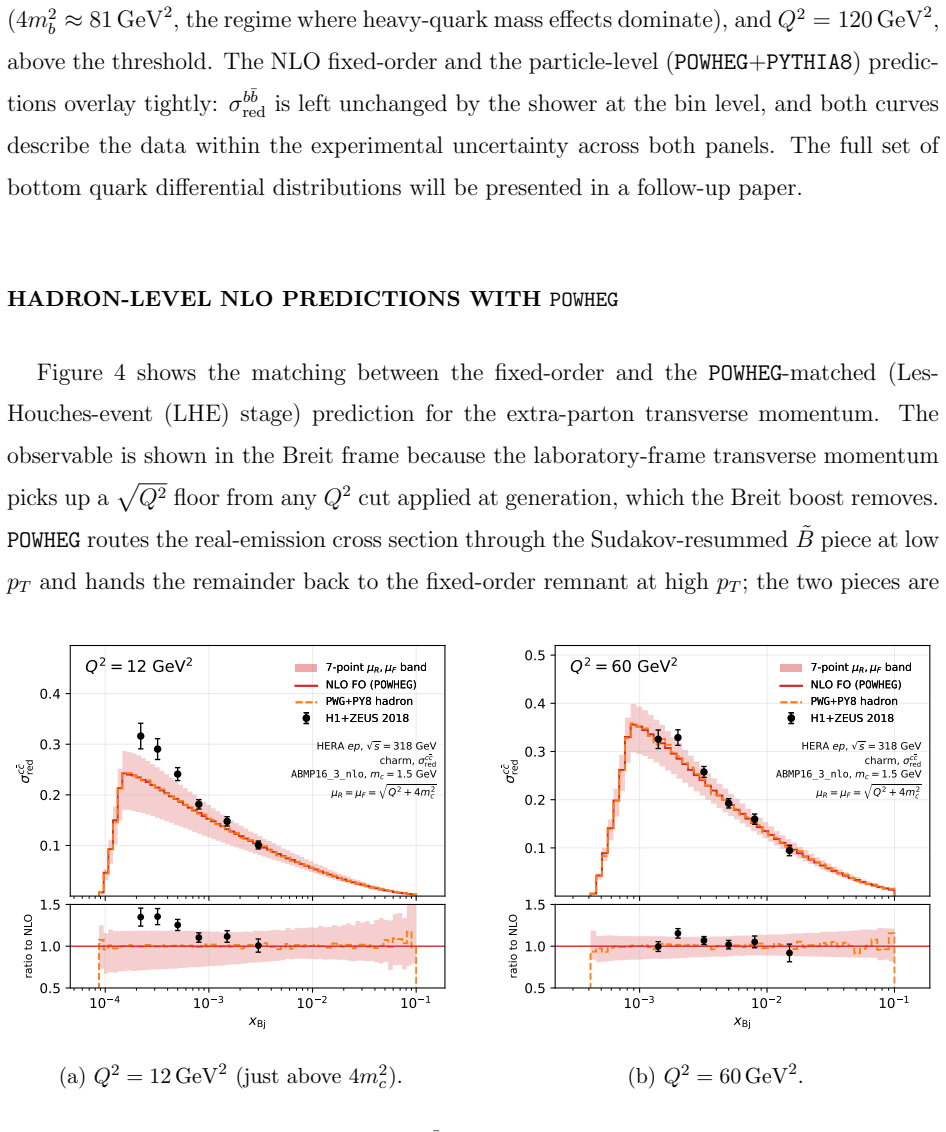
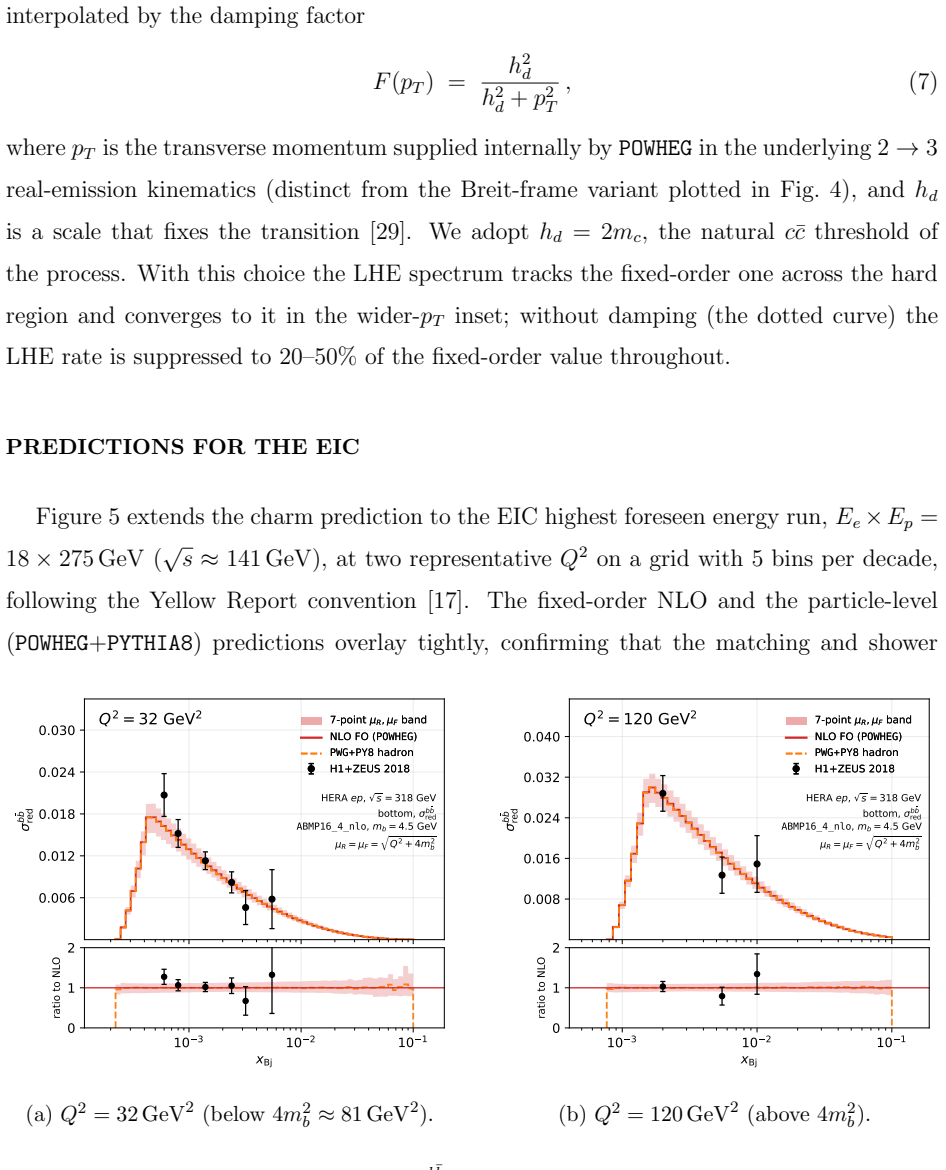
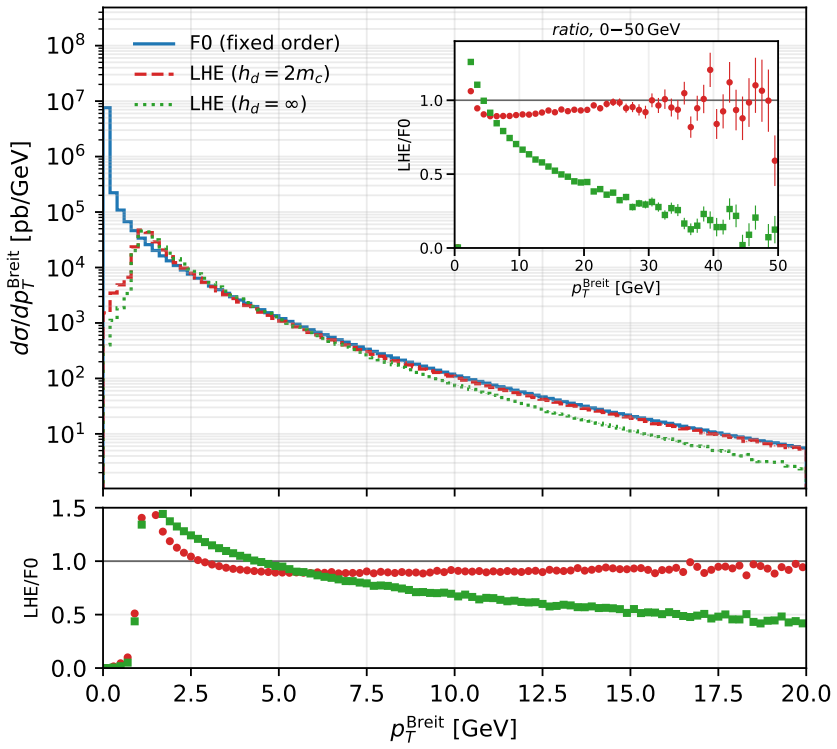
We present theoretical predictions for heavy-quark pair-production in deep-inelastic scattering at NLO in QCD matched to a parton shower in the POWHEG framework, with consistent treatment of heavy-quark mass effects and avoidance of double counting between fixed-order and shower radiation; the gluon-initiated channel is treated and virtual corrections are validated through massification.
What carries the argument
POWHEG matching procedure that combines NLO fixed-order matrix elements with parton-shower evolution while preserving heavy-quark mass dependence and subtracting overlapping soft and collinear contributions.
If this is right
- The matched calculation supplies differential distributions that include both NLO accuracy and resummed logarithmic effects from the shower.
- Predictions become available for observables sensitive to the gluon density at moderate to low x at HERA and the EIC.
- The gluon-initiated channel can be used as a benchmark for extending the framework to quark-initiated contributions.
Where Pith is reading between the lines
- The same matching setup could be applied to other heavy-quark processes once the remaining channels are added.
- Numerical results from this implementation would allow direct tests of how mass effects propagate into shower-generated jets.
Load-bearing premise
The matching procedure is implemented without residual overlaps or missing terms between the NLO calculation and the parton shower.
What would settle it
Direct comparison of the matched predictions with existing HERA measurements of heavy-flavor production in DIS, or with future Electron-Ion Collider data in the same kinematic region.
Figures
read the original abstract
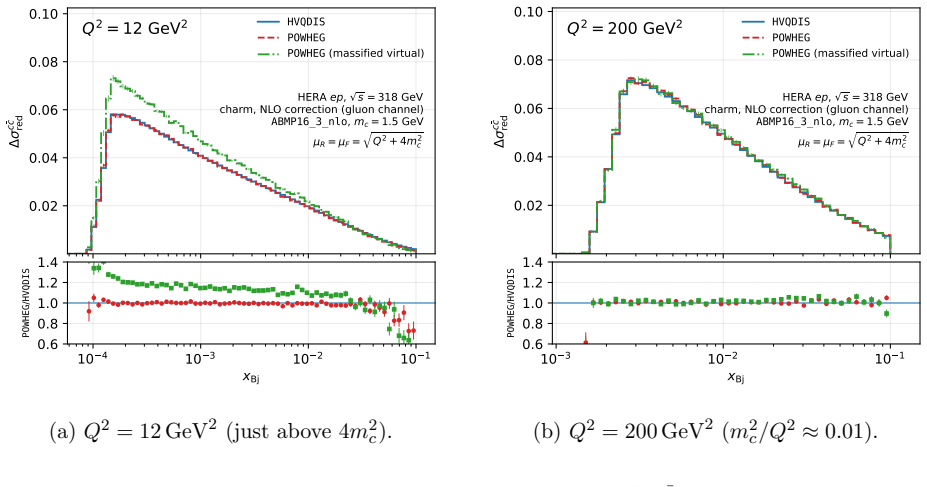
We present theoretical predictions for heavy-quark pair-production in deep-inelastic scattering (DIS) at next-to-leading order (NLO) in quantum chromodynamics (QCD), matched to a parton shower in the POWHEG framework. We revisit the NLO heavy-quark pair-production cross section and implement a consistent matching to parton-shower evolution, with careful treatment of heavy-quark mass effects and the avoidance of double counting between fixed-order and parton-shower radiation. In addition, we compare the virtual NLO corrections available in the literature to one-loop amplitudes obtained through massification in the small-mass limit. This provides an independent validation of the virtual contributions. The study is presently restricted to the gluon-initiated channel, which dominates the kinematic region of interest at the HERA collider and remains important for the future Electron-Ion Collider.
Editorial analysis
A structured set of objections, weighed in public.
Referee Report
Summary. The manuscript presents an implementation of NLO QCD corrections for heavy-quark pair production in deep-inelastic scattering, matched to a parton shower within the POWHEG framework. It focuses on the gluon-initiated channel, incorporates careful treatment of heavy-quark mass effects to avoid double counting between fixed-order and shower contributions, and validates the virtual NLO corrections by comparing literature results to one-loop amplitudes obtained via massification in the small-mass limit.
Significance. If the matching procedure is implemented without residual overlaps or missing terms, the work supplies a practical framework for generating realistic predictions that incorporate both NLO accuracy and parton-shower resummation. This is relevant for existing HERA data and forthcoming Electron-Ion Collider measurements, where heavy-quark production is an important probe. The independent massification check of the virtual pieces is a concrete strength that increases in the fixed-order component.
minor comments (2)
- The abstract states that the study is restricted to the gluon channel; a brief statement in the introduction or conclusions on the expected size of quark-initiated contributions in the HERA and EIC kinematics would help readers assess the scope of the current results.
- Notation for the heavy-quark mass and the factorization/renormalization scales should be defined explicitly at first use to avoid ambiguity when the mass effects are discussed.
Simulated Author's Rebuttal
We thank the referee for their positive assessment of the manuscript and the recommendation for minor revision. The referee summary accurately reflects the scope of our work, including the restriction to the gluon-initiated channel and the independent validation of virtual corrections via massification. We appreciate the noted relevance to HERA data and future EIC measurements.
Circularity Check
No significant circularity in derivation chain
full rationale
The paper describes a standard NLO QCD calculation for heavy-quark pair production in DIS, matched to parton showers via POWHEG, with explicit mass-effect handling and double-counting avoidance. It revisits the known NLO cross section and performs an independent validation of virtual corrections by comparing literature results to massification amplitudes in the gluon channel. No load-bearing step reduces by construction to a fitted parameter, self-definition, or self-citation chain; the central result is a computational implementation whose outputs are not equivalent to its inputs by definition. The derivation remains self-contained against external benchmarks.
Axiom & Free-Parameter Ledger
Reference graph
Works this paper leans on
-
[1]
H1 and ZEUS Collaborations, H. Abramowicz,et al., Eur. Phys. J. C73, 2311 (2013), arXiv:1211.1182 [hep-ex]
Pith/arXiv arXiv 2013
-
[2]
H1 and ZEUS Collaborations, H. Abramowicz,et al., Eur. Phys. J. C78, 473 (2018), arXiv:1804.01019 [hep-ex]
Pith/arXiv arXiv 2018
-
[3]
H. Kawamura, N. A. Lo Presti, S. Moch, and A. Vogt, Nucl. Phys. B864, 399 (2012), arXiv:1205.5727 [hep-ph]
Pith/arXiv arXiv 2012
-
[4]
J. Ablinger, A. Behring, J. Bl¨ umlein, A. De Freitas, A. von Manteuffel, C. Schneider, and K. Sch¨ onwald, (2025), arXiv:2509.16124 [hep-ph]
arXiv 2025
-
[5]
S. Riemersma, J. Smith, and W. L. van Neerven, Phys. Lett. B347, 143 (1995), arXiv:hep- ph/9411431. 12
arXiv 1995
-
[6]
B. W. Harris and J. Smith, Nucl. Phys. B452, 109 (1995), arXiv:hep-ph/9503484
Pith/arXiv arXiv 1995
-
[7]
B. W. Harris and J. Smith, Phys. Rev. D57, 2806 (1998), arXiv:hep-ph/9706334 [hep-ph]
Pith/arXiv arXiv 1998
-
[8]
Nason, JHEP11, 040 (2004), arXiv:hep-ph/0409146 [hep-ph]
P. Nason, JHEP11, 040 (2004), arXiv:hep-ph/0409146 [hep-ph]
Pith/arXiv arXiv 2004
-
[9]
S. Frixione, P. Nason, and C. Oleari, JHEP11, 070 (2007), arXiv:0709.2092 [hep-ph]
Pith/arXiv arXiv 2007
-
[10]
P. Nason and B. Webber, Ann. Rev. Nucl. Part. Sci.62, 187 (2012), arXiv:1202.1251 [hep-ph]
Pith/arXiv arXiv 2012
-
[11]
S. Alioli, P. Nason, C. Oleari, and E. Re, JHEP06, 043 (2010), arXiv:1002.2581 [hep-ph]
Pith/arXiv arXiv 2010
-
[12]
L. Buonocore, G. Limatola, P. Nason, and F. Tramontano, JHEP08, 083 (2024), arXiv:2406.05115 [hep-ph]
arXiv 2024
- [13]
-
[14]
A. Mitov and S. Moch, JHEP05, 001 (2007), arXiv:hep-ph/0612149 [hep-ph]
Pith/arXiv arXiv 2007
-
[15]
M. Czakon, A. Mitov, and S. Moch, Phys. Lett. B651, 147 (2007), arXiv:0705.1975 [hep-ph]
Pith/arXiv arXiv 2007
-
[16]
M. Czakon, A. Mitov, and S. Moch, Nucl. Phys. B798, 210 (2008), arXiv:0707.4139 [hep-ph]
Pith/arXiv arXiv 2008
-
[17]
R. Abdul Khaleket al., Nucl. Phys. A1026, 122447 (2022), arXiv:2103.05419 [physics.ins-det]
Pith/arXiv arXiv 2022
-
[18]
Laenen, S
E. Laenen, S. Riemersma, J. Smith, and W. L. van Neerven, Nucl. Phys. B392, 162 (1993)
1993
-
[19]
Laenen, S
E. Laenen, S. Riemersma, J. Smith, and W. L. van Neerven, Nucl. Phys. B392, 229 (1993)
1993
-
[20]
J. M. Campbell and R. K. Ellis, JHEP10, 125 (2023), arXiv:2309.03323 [hep-ph]
arXiv 2023
-
[21]
G. Cullenet al.(GoSam), Eur. Phys. J. C74, 3001 (2014), arXiv:1404.7096 [hep-ph]
Pith/arXiv arXiv 2014
-
[22]
The Singular Behaviour of QCD Amplitudes at Two-loop Order
S. Catani, (1998), 10.1016/S0370-2693(98)00332-3, arXiv:hep-ph/9802439 [hep-ph]
work page internal anchor Pith review Pith/arXiv arXiv doi:10.1016/s0370-2693(98)00332-3 1998
-
[23]
One-loop Singular Behaviour of QCD and SUSY QCD Amplitudes with Massive Partons
S. Catani, S. Dittmaier, and Z. Tr´ ocs´ anyi, (2001), 10.1016/S0370-2693(01)00065-X, arXiv:hep-ph/0011222 [hep-ph]
work page internal anchor Pith review Pith/arXiv arXiv doi:10.1016/s0370-2693(01)00065-x 2001
-
[24]
S. Frixione, Z. Kunszt, and A. Signer, Nucl. Phys. B467, 399 (1996), arXiv:hep-ph/9512328
Pith/arXiv arXiv 1996
-
[25]
S. Catani and M. H. Seymour, Nucl. Phys. B485, 291 (1997), [Erratum: Nucl.Phys.B 510, 503–504 (1998)], arXiv:hep-ph/9605323
Pith/arXiv arXiv 1997
-
[26]
S. Alekhin, J. Bl¨ umlein, S. Moch, and R. Plaˇ cakyt˙ e, Phys. Rev. D96, 014011 (2017), arXiv:1701.05838 [hep-ph]
Pith/arXiv arXiv 2017
-
[27]
A. Buckley, J. Ferrando, S. Lloyd, K. Nordstr¨ om, B. Page, M. R¨ ufenacht, M. Sch¨ onherr, and G. Watt, Eur. Phys. J. C75, 132 (2015), arXiv:1412.7420 [hep-ph]
Pith/arXiv arXiv 2015
-
[28]
C. Bierlichet al., SciPost Phys. Codeb.2022, 8 (2022), arXiv:2203.11601 [hep-ph]
Pith/arXiv arXiv 2022
-
[29]
S. Alioli, P. Nason, C. Oleari, and E. Re, JHEP04, 002 (2009), arXiv:0812.0578 [hep-ph]
Pith/arXiv arXiv 2009
-
[30]
G. Bewicket al., Eur. Phys. J. C84, 1053 (2024), arXiv:2312.05175 [hep-ph]. 13
arXiv 2024
-
[31]
S. Alekhin and S. Moch, Phys. Lett. B699, 345 (2011), arXiv:1011.5790 [hep-ph]
Pith/arXiv arXiv 2011
-
[32]
F. Hekhorn and M. Stratmann, Phys. Rev. D98, 014018 (2018), arXiv:1805.09026 [hep-ph]. 14
arXiv 2018
discussion (0)
Sign in with ORCID, Apple, or X to comment. Anyone can read and Pith papers without signing in.