Backpropagating Through Simulation: Analytic Policy Gradients for Sample and Learning Efficient Differentiable Continuous Control
Pith reviewed 2026-06-26 14:18 UTC · model grok-4.3
The pith
When environment dynamics are differentiable, the return is an end-to-end differentiable function of the policy parameters, enabling exact gradient computation via backpropagation through simulation.
A machine-rendered reading of the paper's core claim, the machinery that carries it, and where it could break.
Core claim
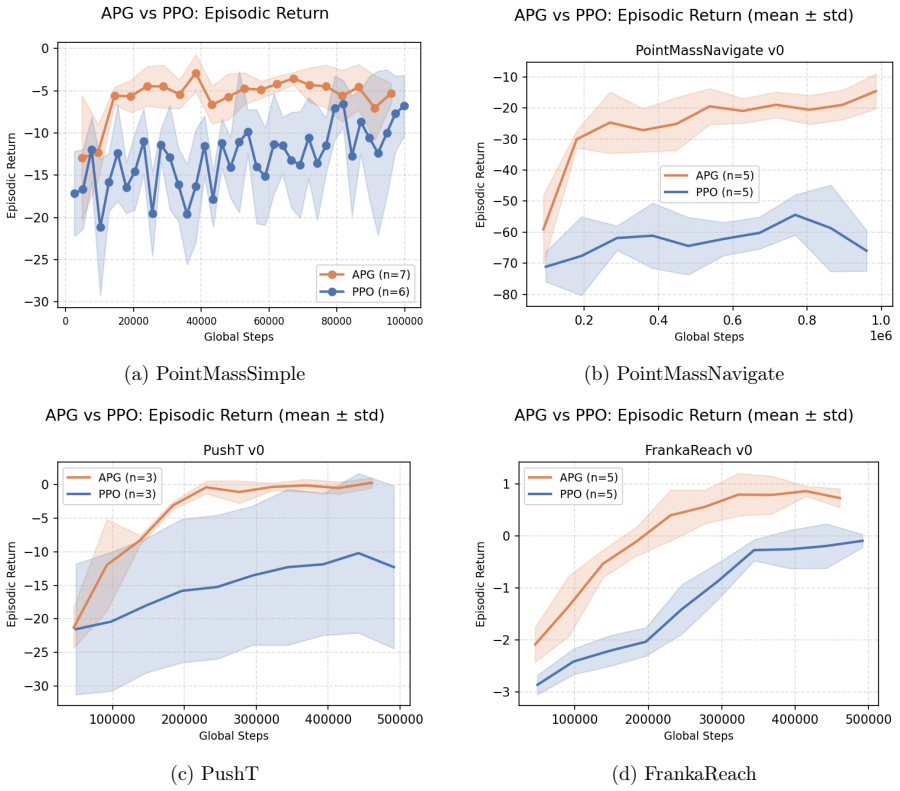
When environment dynamics are differentiable, the return is an end-to-end differentiable function of the policy parameters, enabling exact gradient computation via backpropagation through simulation. The authors term this Analytic Policy Gradients (APG) and evaluate it against PPO on four tasks: 1D point-mass, 2D navigation with obstacles, 2D T-block pushing, and 7-DOF Franka reaching. Both methods use the same model architectures and settings, with a multi-axis protocol tracking performance against environment steps and gradient steps. A segmented backpropagation scheme with Monte Carlo and critic-based bootstrap modes is used to mitigate gradient degradation on long-horizon tasks.
What carries the argument
Analytic Policy Gradients (APG) computed by backpropagating through the differentiable environment simulation.
If this is right
- Exact gradients eliminate the high variance of advantage estimates in PPO.
- Learning requires far fewer environment interactions.
- Performance can be compared separately on sample count and gradient computation steps.
- Segmented backpropagation enables application to longer task horizons.
Where Pith is reading between the lines
- If simulators become more accurate and differentiable, this could shift RL from sample-heavy to gradient-heavy optimization.
- The method assumes perfect simulator fidelity, which may limit transfer to real robots.
- It could be combined with model-based methods that learn the dynamics differentiably.
Load-bearing premise
The environment dynamics must be differentiable and accurately modeled in simulation for the tasks.
What would settle it
If APG requires more environment steps than PPO to reach the same performance on any of the four tasks under identical conditions, the claim of improved sample efficiency would be disproven.
Figures


read the original abstract
Model-free reinforcement learning algorithms such as Proximal Policy Optimization (PPO) treat the environment as a black box, estimating policy gradients from sampled rewards; this process demands millions of interactions and relies on high-variance advantage estimates. When environment dynamics are differentiable, the return is an end-to-end differentiable function of the policy parameters, enabling exact gradient computation via backpropagation through simulation. We term this approach Analytic Policy Gradients (APG) and evaluate it against PPO on four continuous control tasks of increasing dynamical complexity: a one-dimensional point-mass target-reaching task, a 2D point-mass navigation task with obstacle avoidance, a 2D rigid-body T-block pushing task, and a 7-DOF Franka FR3 end-effector reaching task. Both algorithms share identical model architectures, observation normalization, and optimizer settings. To decouple sample efficiency from compute efficiency, we design a multi-axis evaluation protocol that records performance against environment steps and gradient steps. We report a segmented backpropagation scheme with MC and critic-based bootstrap modes that mitigates gradient degradation on long-horizon tasks, and present ablations over segment length and bootstrap strategy.
Editorial analysis
A structured set of objections, weighed in public.
Referee Report
Summary. The paper proposes Analytic Policy Gradients (APG), which computes exact policy gradients by backpropagating through differentiable environment dynamics rather than estimating them from sampled rewards as in model-free methods like PPO. It evaluates APG against PPO on four continuous control tasks of increasing complexity (1D point-mass reaching, 2D point-mass navigation with obstacles, 2D rigid-body T-block pushing, and 7-DOF Franka reaching), using identical model architectures and a multi-axis protocol that tracks performance versus both environment steps and gradient steps. The work introduces a segmented backpropagation scheme with Monte Carlo and critic-based bootstrap modes to mitigate gradient degradation on long horizons.
Significance. If the reported efficiency gains hold under the multi-axis evaluation, the method would provide a practical way to obtain low-variance, exact gradients in differentiable simulators, potentially reducing the millions of interactions typically required by PPO while maintaining comparable final performance.
minor comments (2)
- [Abstract] Abstract: the description of the segmented backpropagation scheme would benefit from a brief statement of how the bootstrap modes preserve the exactness of the gradient with respect to the computed (segmented) objective.
- The multi-axis evaluation protocol is a strength; ensure that the results section explicitly separates the two axes in all reported figures and tables so readers can directly compare sample versus compute efficiency.
Simulated Author's Rebuttal
We thank the referee for the positive assessment of our manuscript and the recommendation for minor revision. The provided summary accurately captures the core contributions of Analytic Policy Gradients (APG), the multi-axis evaluation protocol, and the segmented backpropagation approach.
Circularity Check
No significant circularity detected
full rationale
The paper's core claim—that differentiable environment dynamics make the return an end-to-end differentiable function of policy parameters, allowing exact gradients via backpropagation—follows directly from the chain rule applied to the finite unrolled trajectory of dynamics, policy, and reward. This is a standard mathematical fact independent of the paper and does not reduce to any self-definition, fitted input renamed as prediction, or self-citation chain. The segmented backpropagation with MC/critic bootstrap is presented as a numerical implementation detail for long horizons, not as a load-bearing derivation step. No equations or premises in the provided text exhibit the enumerated circularity patterns, and the method is self-contained against external benchmarks of differentiability.
Axiom & Free-Parameter Ledger
axioms (1)
- domain assumption Environment dynamics are differentiable
Reference graph
Works this paper leans on
-
[1]
Schulman, J., Wolski, F., Dhariwal, P., Radford, A., & Klimov, O. (2017). Proximal Policy Optimization Algorithms.arXiv preprint arXiv:1707.06347
work page internal anchor Pith review Pith/arXiv arXiv 2017
-
[2]
Schulman, J., Moritz, P., Levine, S., Abbeel, P., & Jordan, M. (2016). High-Dimensional Continuous Control Using Generalized Advantage Estimation.ICLR 2016
2016
-
[3]
Werbos, P. J. (1990). Backpropagation Through Time: What It Does and How to Do It. Proceedings of the IEEE, 78(10), 1550–1560
1990
- [4]
-
[5]
Xu, Z., Guo, X., Liu, C., & Wen, Y. (2022). Accelerated Policy Learning with Parallel Differentiable Simulation.ICLR 2023
2022
-
[6]
Hafner, D., Lillicrap, T., Norouzi, M., & Ba, J. (2023). Mastering Diverse Domains through World Models.arXiv preprint arXiv:2301.04104
work page internal anchor Pith review Pith/arXiv arXiv 2023
-
[7]
Hansen, N., Su, H., & Wang, X. (2024). TD-MPC2: Scalable, Robust World Models for Continuous Control.ICLR 2024. 19
2024
-
[8]
Pascanu, R., Mikolov, T., & Bengio, Y. (2013). On the Difficulty of Training Recurrent Neural Networks.ICML 2013, 1310–1318
2013
-
[9]
Degrave, J., Hermans, M., Dambre, J., & Wyffels, F. (2019). A Differentiable Physics Engine for Deep Learning in Robotics.Frontiers in Neurorobotics, 13, 6
2019
-
[10]
Zhong, Y., Han, J., & Berseth, G. (2022). Differentiable Simulation for Physical System Identification.IEEE Robotics and Automation Letters, 7(1), 153–160
2022
-
[11]
J., Simchowitz, M., Zhang, K., & Tedrake, R
Suh, H. J., Simchowitz, M., Zhang, K., & Tedrake, R. (2022). Do Differentiable Simulators Give Better Policy Gradients?ICML 2022
2022
-
[12]
Haarnoja, T., Zhou, A., Abbeel, P., & Levine, S. (2018). Soft Actor-Critic: Off-Policy Maximum Entropy Deep Reinforcement Learning with a Stochastic Actor.ICML 2018
2018
-
[13]
Amari, S. (1998). Natural Gradient Works Efficiently in Learning.Neural Computation, 10(2), 251–276
1998
-
[14]
Martens, J., & Grosse, R. (2015). Optimizing Neural Networks with Kronecker-Factored Approximate Curvature.ICML 2015
2015
-
[15]
Williams, R. J. (1992). Simple Statistical Gradient-Following Algorithms for Connectionist Reinforcement Learning.Machine Learning, 8(3–4), 229–256
1992
-
[16]
Schulman, J., Levine, S., Abbeel, P., Jordan, M., & Moritz, P. (2015). Trust Region Policy Optimization.ICML 2015, 1889–1897
2015
-
[17]
Brax–a differentiable physics engine for large scale rigid body simulation,
Freeman, C. D., Frey, E., Raichuk, A., Girgin, S., Mordatch, I., & Bachem, O. (2021). Brax – Differentiable Physics for Large Scale Rigid Body Simulation.arXiv preprint arXiv:2106.13281
-
[18]
Todorov, E., Erez, T., & Tassa, Y. (2012). MuJoCo: A Physics Engine for Model-Based Control.IROS 2012, 5026–5033
2012
-
[19]
Hu, Y., Li, T.-M., Anderson, L., Ragan-Kelley, J., & Durand, F. (2020). DiffTaichi: Differ- entiable Programming for Physical Simulation.ICLR 2020
2020
-
[20]
NVIDIA. (2024). Warp: A Python Framework for High-Performance GPU Simulation and Graphics.https://github.com/NVIDIA/warp. A Environment Visualizations Rendered frames and GIFs for the custom differentiable environments are produced by the environment-specific renderers during evaluation. PointMassSimple renders the one-dimensional track, target marker, su...
2024
discussion (0)
Sign in with ORCID, Apple, or X to comment. Anyone can read and Pith papers without signing in.