Assessing Majorana states and qubits through quantum capacitance
Pith reviewed 2026-06-26 13:10 UTC · model grok-4.3
The pith
An auxiliary quantum dot sensor allows quantum capacitance measurements to determine both the ground-state energy splitting and the overlap between Majorana bound states.
A machine-rendered reading of the paper's core claim, the machinery that carries it, and where it could break.
Core claim
By employing an auxiliary quantum dot (QD) as a sensor, we demonstrate that QC measurements simultaneously resolve two fundamental figures of merit of the device, the ground-state energy splitting and the MBS overlap, thus providing direct access to the underlying internal degrees of freedom. Using a low-energy effective model, we provide analytic expressions for these two figures of merit that can be determined from the relative position and magnitude of the QC maxima in the even and odd parity sectors as functions of the auxiliary-QD energy. We further validate these results with a microscopic model of QD-based Kitaev chains and qubits, demonstrating their applicability in a wide range of
What carries the argument
Auxiliary quantum dot used as a sensor whose energy is swept while recording quantum capacitance maxima in even and odd parity sectors, with the positions and relative magnitudes of those maxima mapped by analytic expressions to ground-state splitting and MBS overlap.
If this is right
- QC measurements with the auxiliary dot simultaneously resolve ground-state energy splitting and MBS overlap.
- The extracted values supply direct access to the internal degrees of freedom of the Majorana device.
- The same QC data continue to serve as a parity readout.
- The method applies across a wide range of MBS-based devices including QD-based Kitaev chains and qubits.
- QC thereby functions as both a quality probe for MBSs and an optimization tool that preserves fermion parity.
Where Pith is reading between the lines
- The mapping could be used to adjust device parameters in real time until the extracted overlap reaches a target minimum.
- The sensor technique may be combined with existing parity-readout hardware without requiring separate measurement channels.
- Validation in microscopic models suggests the method remains useful even when the low-energy approximation is only moderately accurate.
Load-bearing premise
The low-energy effective model supplies analytic expressions in which the relative position and magnitude of the QC maxima in even and odd parity sectors map directly onto the ground-state energy splitting and MBS overlap as functions of auxiliary-QD energy, and that this mapping remains valid in the microscopic QD-based Kitaev models without additional interfering effects.
What would settle it
In a controlled experiment on a QD-based Kitaev chain, if the measured locations and height ratios of the even- and odd-parity QC peaks fail to yield the independently measured ground-state splitting and MBS overlap when plugged into the analytic expressions, the claimed direct mapping is falsified.
Figures
read the original abstract
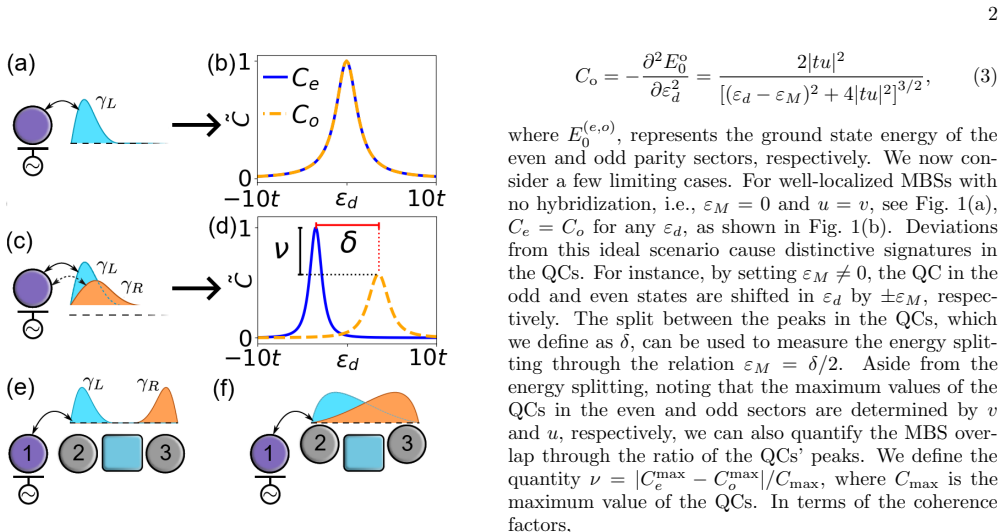
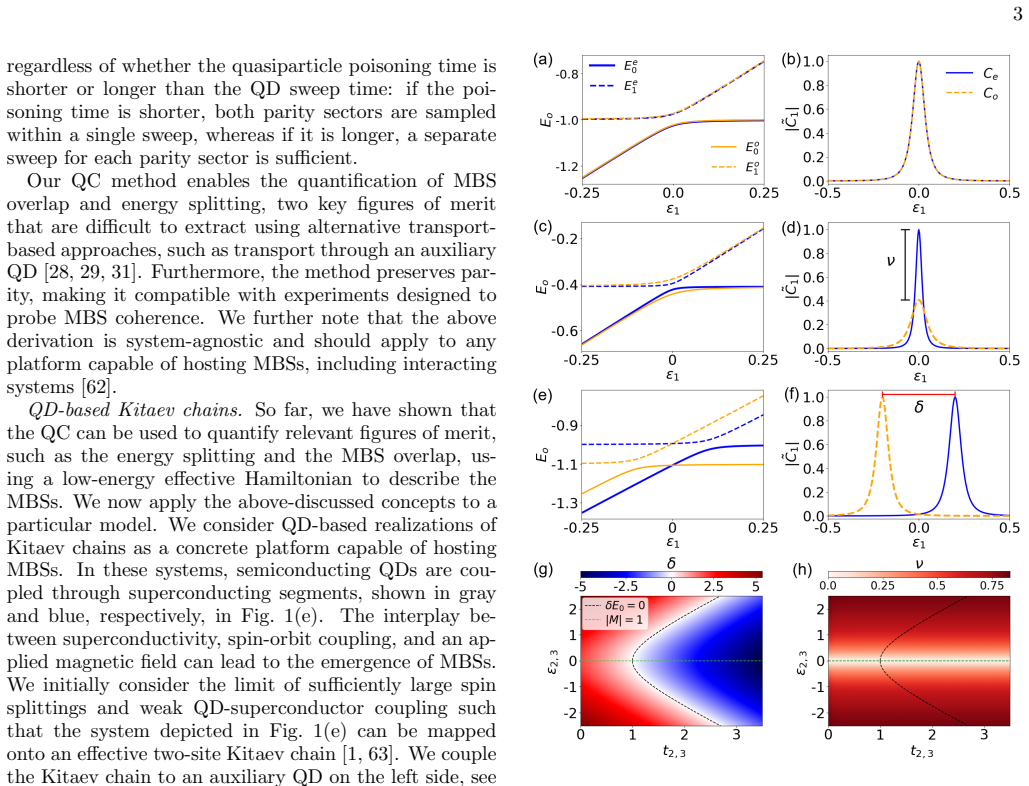
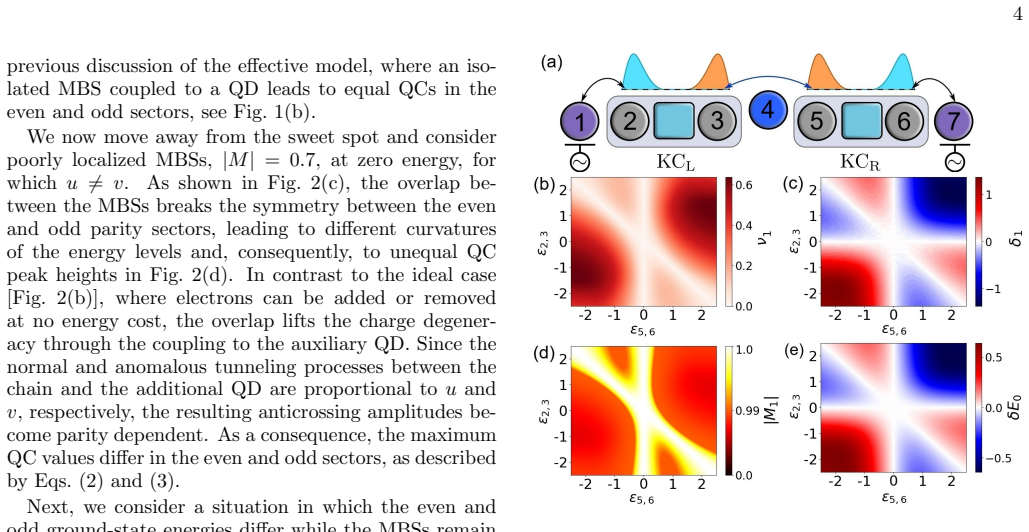
Quantum capacitance (QC) has recently emerged as a promising tool for parity readout in topological qubits based on Majorana bound states (MBSs). Here, we show that this capability can be extended further: by employing an auxiliary quantum dot (QD) as a sensor, we demonstrate that QC measurements simultaneously resolve two fundamental figures of merit of the device, the ground-state energy splitting and the MBS overlap, thus providing direct access to the underlying internal degrees of freedom. Using a low-energy effective model, we provide analytic expressions for these two figures of merit that can be determined from the relative position and magnitude of the QC maxima in the even and odd parity sectors as functions of the auxiliary-QD energy. We further validate these results with a microscopic model of QD-based Kitaev chains and qubits, demonstrating their applicability in a wide range of MBS-based devices. Our results establish QC as a probe of MBS quality and a tool for topological-device optimization that preserves fermion parity.
Editorial analysis
A structured set of objections, weighed in public.
Referee Report
Summary. The paper claims that quantum capacitance (QC) measurements, using an auxiliary quantum dot (QD) as a sensor, can simultaneously extract the ground-state energy splitting and Majorana bound state (MBS) overlap in MBS-based devices. Analytic expressions from a low-energy effective model map the relative positions and magnitudes of QC maxima in even/odd parity sectors to these quantities as functions of auxiliary-QD energy; these are validated against microscopic QD-based Kitaev chain models across a range of devices, establishing QC as a probe of MBS quality that preserves fermion parity.
Significance. If the analytic mapping holds without interfering effects, the approach extends QC from parity readout to a direct, non-destructive characterization tool for two key internal figures of merit, aiding optimization of topological qubits. The explicit validation against microscopic models and provision of closed-form expressions are strengths that support broad applicability.
major comments (2)
- [§3, Eq. (8)] §3, Eq. (8): the derivation of the QC maxima positions assumes the auxiliary QD couples only to one MBS end; it is unclear whether the mapping to energy splitting remains exact when the microscopic model includes finite overlap with the second MBS, as shown in the Kitaev-chain numerics of Fig. 4.
- [§4.2, Fig. 5] §4.2, Fig. 5: the reported agreement between effective-model predictions and microscopic simulations for MBS overlap holds only for t/Δ > 2; below this the QC peak magnitude deviates by >15%, which may limit the claimed wide-range applicability.
minor comments (2)
- [§2] The notation for even/odd parity sectors is introduced in §2 but used inconsistently in §3.1; define P_e/P_o once and reuse.
- [Fig. 3] Fig. 3 caption should explicitly state the parameter values used for the effective-model curves to allow direct reproduction.
Simulated Author's Rebuttal
We thank the referee for the constructive comments and positive recommendation. We address each major comment below and will incorporate clarifications where appropriate.
read point-by-point responses
-
Referee: [§3, Eq. (8)] the derivation of the QC maxima positions assumes the auxiliary QD couples only to one MBS end; it is unclear whether the mapping to energy splitting remains exact when the microscopic model includes finite overlap with the second MBS, as shown in the Kitaev-chain numerics of Fig. 4.
Authors: The low-energy effective model leading to Eq. (8) is derived under the standard approximation of dominant coupling to one MBS end, which holds when MBSs are well separated. The microscopic Kitaev-chain simulations in Fig. 4 do include finite overlap with the second MBS, yet the analytic mapping for the energy splitting continues to match the numerics closely. This indicates the approximation remains quantitatively useful even with moderate overlap. We will add a clarifying sentence in §3 noting the regime of validity of the single-MBS coupling assumption. revision: partial
-
Referee: [§4.2, Fig. 5] the reported agreement between effective-model predictions and microscopic simulations for MBS overlap holds only for t/Δ > 2; below this the QC peak magnitude deviates by >15%, which may limit the claimed wide-range applicability.
Authors: The referee correctly identifies that deviations exceed 15% for t/Δ < 2. The low-energy effective model is expected to be most accurate in the regime t/Δ > 2, where the topological gap is well developed. We will revise the discussion in §4.2 and the abstract to explicitly state the range of validity (t/Δ > 2) while retaining the claim of applicability across a wide range of experimentally relevant devices within that regime. revision: yes
Circularity Check
No significant circularity; derivation self-contained
full rationale
The paper derives analytic expressions for QC maxima mapping to ground-state splitting and MBS overlap within a low-energy effective model, then independently validates the mapping against a separate microscopic QD-based Kitaev chain model across parameter regimes. No equations reduce predictions to fitted inputs by construction, no self-definitional loops, and no load-bearing self-citations or uniqueness theorems imported from prior author work. The central claim rests on explicit cross-validation between models, making the derivation self-contained against external benchmarks.
Axiom & Free-Parameter Ledger
axioms (2)
- domain assumption Low-energy effective model for MBSs accurately captures QC response
- domain assumption QC peak positions and magnitudes map one-to-one onto energy splitting and MBS overlap
Reference graph
Works this paper leans on
-
[1]
A. Y. Kitaev, Unpaired Majorana fermions in quantum wires, Physics-Uspekhi44, 131 (2001)
2001
-
[2]
A. Y. Kitaev, Fault-tolerant quantum computation by anyons, Annals of physics303, 2 (2003)
2003
-
[3]
Nayak, S
C. Nayak, S. H. Simon, A. Stern, M. Freedman, and S. Das Sarma, Non-Abelian anyons and topological quan- tum computation, Rev. Mod. Phys.80, 1083 (2008)
2008
-
[4]
R. M. Lutchyn, J. D. Sau, and S. Das Sarma, Ma- jorana fermions and a topological phase transition in semiconductor-superconductor heterostructures, Phys. Rev. Lett.105, 077001 (2010)
2010
-
[5]
Y. Oreg, G. Refael, and F. Von Oppen, Helical liquids and Majorana bound states in quantum wires, Physical review letters105, 177002 (2010)
2010
-
[6]
Mourik, K
V. Mourik, K. Zuo, S. M. Frolov, S. Plissard, E. P. Bakkers, and L. P. Kouwenhoven, Signatures of majo- rana fermions in hybrid superconductor-semiconductor nanowire devices, Science336, 1003 (2012)
2012
-
[7]
C. W. J. Beenakker, Search for non-Abelian Majorana braiding statistics in superconductors, SciPost Phys. Lect. Notes , 15 (2020)
2020
-
[8]
Flensberg, F
K. Flensberg, F. von Oppen, and A. Stern, Engineered platforms for topological superconductivity and Ma- jorana zero modes, Nature Reviews Materials6, 944 (2021)
2021
-
[9]
Aguado, Majorana quasiparticles in condensed mat- ter, La Rivista del Nuovo Cimento40, 523 (2017)
R. Aguado, Majorana quasiparticles in condensed mat- ter, La Rivista del Nuovo Cimento40, 523 (2017)
2017
-
[10]
Alicea, New directions in the pursuit of Majorana fermions in solid state systems, Reports on progress in physics75, 076501 (2012)
J. Alicea, New directions in the pursuit of Majorana fermions in solid state systems, Reports on progress in physics75, 076501 (2012)
2012
-
[11]
Prada, P
E. Prada, P. San-Jose, M. W. de Moor, A. Geresdi, E. J. Lee, J. Klinovaja, D. Loss, J. Nyg˚ ard, R. Aguado, and L. P. Kouwenhoven, From Andreev to Majorana bound states in hybrid superconductor–semiconductor nanowires, Nature Reviews Physics2, 575 (2020)
2020
-
[12]
M. Pita-Vidal, R. S. Souto, S. Goswami, C. K. Andersen, G. Katsaros, J. Shabani, and R. Aguado, Novel qubits in hybrid semiconductor-superconductor nanostructures (2025), arXiv:2512.23336 [cond-mat.mes-hall]
arXiv 2025
-
[13]
T. Dvir, G. Wang, N. van Loo, C.-X. Liu, G. P. Mazur, A. Bordin, S. L. Ten Haaf, J.-Y. Wang, D. van Driel, F. Zatelli,et al., Realization of a minimal kitaev chain in 6 coupled quantum dots, Nature614, 445 (2023)
2023
-
[14]
Bordin, G
A. Bordin, G. Wang, C.-X. Liu, S. L. Ten Haaf, N. Van Loo, G. P. Mazur, D. Xu, D. Van Driel, F. Zatelli, S. Gazibegovic,et al., Tunable crossed andreev reflection and elastic cotunneling in hybrid nanowires, Physical Re- view X13, 031031 (2023)
2023
-
[15]
Bordin, C.-X
A. Bordin, C.-X. Liu, T. Dvir, F. Zatelli, S. L. Ten Haaf, D. van Driel, G. Wang, N. Van Loo, Y. Zhang, J. C. Wolff,et al., Enhanced majorana stability in a three-site kitaev chain, Nature Nanotechnology , 1 (2025)
2025
-
[16]
Bordin, F
A. Bordin, F. J. Bennebroek Evertsz’, B. Roovers, J. D. Torres Luna, W. D. Huisman, F. Zatelli, G. P. Mazur, S. L. Ten Haaf, G. Badawy, E. P. Bakkers,et al., Prob- ing Majorana localization of a phase-controlled three-site Kitaev chain with an additional quantum dot, Nature Communications (2026)
2026
-
[17]
S. L. Ten Haaf, Y. Zhang, Q. Wang, A. Bordin, C.-X. Liu, I. Kulesh, V. P. Sietses, C. G. Prosko, D. Xiao, C. Thomas,et al., Observation of edge and bulk states in a three-site Kitaev chain, Nature641, 890–895 (2025)
2025
-
[18]
D. van Driel, R. Koch, V. P. Sietses, S. L. ten Haaf, C.- X. Liu, F. Zatelli, B. Roovers, A. Bordin, N. van Loo, G. Wang,et al., Cross-platform autonomous control of minimal kitaev chains, arXiv preprint arXiv:2405.04596 (2024)
Pith/arXiv arXiv 2024
- [19]
-
[20]
Q. Wang, S. L. Ten Haaf, I. Kulesh, D. Xiao, C. Thomas, M. J. Manfra, and S. Goswami, Triplet correlations in Cooper pair splitters realized in a two-dimensional elec- tron gas, Nature Communications14, 4876 (2023)
2023
-
[21]
S. L. Ten Haaf, Q. Wang, A. M. Bozkurt, C.-X. Liu, I. Kulesh, P. Kim, D. Xiao, C. Thomas, M. J. Man- fra, T. Dvir,et al., A two-site Kitaev chain in a two- dimensional electron gas, Nature630, 329 (2024)
2024
-
[22]
Seoane Souto and R
R. Seoane Souto and R. Aguado, Subgap states in semiconductor-superconductor devices for quantum tech- nologies: Andreev qubits and minimal Majorana chains, inNew Trends and Platforms for Quantum Technolo- gies, edited by R. Aguado, R. Citro, M. Lewenstein, and M. Stern (Springer Nature Switzerland, Cham, 2024) pp. 133–223
2024
-
[23]
G¨ ul, H
¨O. G¨ ul, H. Zhang, J. D. Bommer, M. W. de Moor, D. Car, S. R. Plissard, E. P. Bakkers, A. Geresdi, K. Watanabe, T. Taniguchi,et al., Ballistic Majorana nanowire devices, Nature nanotechnology13, 192 (2018)
2018
-
[24]
Pan, C.-X
H. Pan, C.-X. Liu, M. Wimmer, and S. Das Sarma, Quan- tized and unquantized zero-bias tunneling conductance peaks in Majorana nanowires: Conductance below and above 2 e 2/h, Physical Review B103, 214502 (2021)
2021
-
[25]
D. I. Pikulin, B. van Heck, T. Karzig, E. A. Martinez, B. Nijholt, T. Laeven, G. W. Winkler, J. D. Watson, S. Heedt, M. Temurhan, V. Svidenko, R. M. Lutchyn, M. Thomas, G. de Lange, L. Casparis, and C. Nayak, Protocol to identify a topological superconducting phase in a three-terminal device, arXiv:2103.12217 (2021)
arXiv 2021
-
[26]
Aghaee, A
M. Aghaee, A. Akkala, Z. Alam, R. Ali, A. Al- caraz Ramirez, M. Andrzejczuk, A. E. Antipov, P. Aseev, M. Astafev, B. Bauer, J. Becker, S. Boddapati, F. Boekhout, J. Bommer, T. Bosma, L. Bourdet, S. Boutin, P. Caroff, L. Casparis, M. Cassidy, S. Cha- toor, A. W. Christensen, N. Clay, W. S. Cole, F. Corsetti, A. Cui, P. Dalampiras, A. Dokania, G. de Lange, ...
2023
-
[27]
M. Deng, S. Vaitiek˙ enas, E. B. Hansen, J. Danon, M. Lei- jnse, K. Flensberg, J. Nyg˚ ard, P. Krogstrup, and C. M. Marcus, Majorana bound state in a coupled quantum-dot hybrid-nanowire system, Science354, 1557 (2016)
2016
-
[28]
Prada, R
E. Prada, R. Aguado, and P. San-Jose, Measuring majo- rana nonlocality and spin structure with a quantum dot, Phys. Rev. B96, 085418 (2017)
2017
-
[29]
D. J. Clarke, Experimentally accessible topological qual- ity factor for wires with zero energy modes, Phys. Rev. B96, 201109 (2017)
2017
-
[30]
M.-T. Deng, S. Vaitiek˙ enas, E. Prada, P. San-Jose, J. Nyg˚ ard, P. Krogstrup, R. Aguado, and C. M. Mar- cus, Nonlocality of majorana modes in hybrid nanowires, Phys. Rev. B98, 085125 (2018)
2018
-
[31]
R. S. Souto, A. Tsintzis, M. Leijnse, and J. Danon, Probing Majorana localization in minimal Kitaev chains through a quantum dot, Phys. Rev. Res.5, 043182 (2023)
2023
-
[32]
E. J. H. Lee, X. Jiang, M. Houzet, R. Aguado, C. M. Lieber, and S. De Franceschi, Spin-resolved andreev levels and parity crossings in hybrid superconductor– semiconductor nanostructures, Nature Nanotechnology 9, 79 (2014)
2014
-
[33]
Pe˜ naranda, R
F. Pe˜ naranda, R. Aguado, P. San-Jose, and E. Prada, Quantifying wave-function overlaps in inhomogeneous majorana nanowires, Phys. Rev. B98, 235406 (2018)
2018
-
[34]
A. Vuik, B. Nijholt, A. R. Akhmerov, and M. Wimmer, Reproducing topological properties with quasi-Majorana states, SciPost Phys.7, 61 (2019)
2019
-
[35]
Avila, F
J. Avila, F. Pe˜ naranda, E. Prada, P. San-Jose, and R. Aguado, Non-hermitian topology as a unifying frame- work for the andreev versus majorana states controversy, Communications Physics2, 133 (2019)
2019
-
[36]
Gharavi, D
K. Gharavi, D. Hoving, and J. Baugh, Readout of ma- jorana parity states using a quantum dot, Phys. Rev. B 94, 155417 (2016)
2016
-
[37]
Sz´ echenyi and A
G. Sz´ echenyi and A. P´ alyi, Parity-to-charge conversion 7 for readout of topological majorana qubits, Phys. Rev. B 101, 235441 (2020)
2020
-
[38]
M. I. K. Munk, J. Schulenborg, R. Egger, and K. Flens- berg, Parity-to-charge conversion in majorana qubit readout, Phys. Rev. Res.2, 033254 (2020)
2020
-
[39]
J. F. Steiner and F. von Oppen, Readout of majorana qubits, Phys. Rev. Res.2, 033255 (2020)
2020
-
[40]
Schulenborg, M
J. Schulenborg, M. Burrello, M. Leijnse, and K. Flens- berg, Multilevel effects in quantum dot based parity-to- charge conversion of majorana box qubits, Phys. Rev. B 103, 245407 (2021)
2021
-
[41]
T. B. Smith, M. C. Cassidy, D. J. Reilly, S. D. Bartlett, and A. L. Grimsmo, Dispersive readout of majorana qubits, PRX Quantum1, 020313 (2020)
2020
-
[42]
L. Peri, M. Benito, C. J. Ford, and M. F. Gonzalez-Zalba, Unified linear response theory of quantum electronic cir- cuits, npj Quantum Information10, 114 (2024)
2024
-
[43]
C.-X. Liu, Quantum capacitance and parity switch- ing of a quantum-dot-based kitaev chain (2026), arXiv:2601.20252 [cond-mat.mes-hall]
Pith/arXiv arXiv 2026
-
[44]
M. A. Quantum, M. Aghaee, A. Alcaraz Ramirez, Z. Alam, R. Ali, M. Andrzejczuk, A. Antipov, M. Astafev, A. Barzegar, B. Bauer,et al., Interferomet- ric single-shot parity measurement in InAs–Al hybrid de- vices, Nature638, 651 (2025)
2025
-
[45]
N. van Loo, F. Zatelli, G. O. Steffensen, B. Roovers, G. Wang, T. V. Caekenberghe, A. Bordin, D. van Driel, Y. Zhang, W. D. Huisman, G. Badawy, E. P. A. M. Bakkers, G. P. Mazur, R. Aguado, and L. P. Kouwen- hoven, Single-shot parity readout of a minimal Kitaev chain (2025), arXiv:2507.01606 [cond-mat.mes-hall]
arXiv 2025
-
[46]
J. D. Sau and S. D. Sarma, Realizing a robust practical majorana chain in a quantum-dot-superconductor linear array, Nature communications3, 964 (2012)
2012
-
[47]
I. C. Fulga, A. Haim, A. R. Akhmerov, and Y. Oreg, Adaptive tuning of Majorana fermions in a quantum dot chain, New journal of physics15, 045020 (2013)
2013
-
[48]
Tsintzis, R
A. Tsintzis, R. S. Souto, and M. Leijnse, Creating and de- tecting poor man’s Majorana bound states in interacting quantum dots, Physical Review B106, L201404 (2022)
2022
-
[49]
Tsintzis, R
A. Tsintzis, R. S. Souto, K. Flensberg, J. Danon, and M. Leijnse, Majorana qubits and non-abelian physics in quantum dot–based minimal Kitaev chains, PRX Quan- tum5, 010323 (2024)
2024
-
[50]
R. A. Dourado, J. C. Egues, and P. H. Penteado, Two- site Kitaev sweet spots evolving into topological islands, Phys. Rev. B113, 035432 (2026)
2026
-
[51]
R. A. Dourado, M. Leijnse, and R. S. Souto, Majorana sweet spots in three-site Kitaev chains, Phys. Rev. B111, 235409 (2025)
2025
-
[52]
Alvarado, A
M. Alvarado, A. L. Yeyati, R. Aguado, and R. S. Souto, Interplay between majorana and shiba states in a mini- mal kitaev chain coupled to a superconductor, Phys. Rev. B110, 245144 (2024)
2024
-
[53]
M. Alvarado, R. S. Souto, M. J. Calder´ on, and R. Aguado, Optimal majoranas in mesoscopic kitaev chains (2026), arXiv:2604.13945 [cond-mat.mes-hall]
Pith/arXiv arXiv 2026
-
[54]
S. L. D. ten Haaf, Q. Wang, A. M. Bozkurt, C.-X. Liu, I. Kulesh, P. Kim, D. Xiao, C. Thomas, M. J. Manfra, T. Dvir, M. Wimmer, and S. Goswami, Engineering ma- jorana bound states in coupled quantum dots in a two- dimensional electron gas (2023), arXiv:2311.03208
arXiv 2023
-
[55]
A. Bordin, C.-X. Liu, T. Dvir, F. Zatelli, S. L. ten Haaf, D. van Driel, G. Wang, N. van Loo, T. van Caekenberghe, J. C. Wolff,et al., Signatures of majorana protection in a three-site kitaev chain, arXiv preprint arXiv:2402.19382 (2024)
arXiv 2024
-
[56]
D. M. Pino, R. S. Souto, and R. Aguado, Minimal kitaev- transmon qubit based on double quantum dots, Phys. Rev. B109, 075101 (2024)
2024
-
[57]
H. Pan, S. Das Sarma, and C.-X. Liu, Rabi and Ram- sey oscillations of a Majorana qubit in a quantum dot- superconductor array, Phys. Rev. B111, 075416 (2025)
2025
-
[58]
Sticlet, C
D. Sticlet, C. Bena, and P. Simon, Spin and Majorana polarization in topological superconducting wires, Phys- ical Review Letters108, 096802 (2012)
2012
-
[59]
Sedlmayr and C
N. Sedlmayr and C. Bena, Visualizing Majorana bound states in one and two dimensions using the generalized Majorana polarization, Physical Review B92, 115115 (2015)
2015
-
[60]
Sedlmayr, J
N. Sedlmayr, J. Aguiar-Hualde, and C. Bena, Majorana bound states in open quasi-one-dimensional and two- dimensional systems with transverse Rashba coupling, Physical Review B93, 155425 (2016)
2016
-
[61]
R. A. Dourado, N. Mart´ ınez-Valero, J. Benestad, M. Lei- jnse, J. Danon, and R. S. Souto, Machine-learned tuning to protected states by probing noise resilience, Phys. Rev. Lett. (2026)
2026
-
[62]
Samuelson, J
W. Samuelson, J. D. Torres Luna, S. Miles, A. M. Bozkurt, M. Leijnse, M. Wimmer, and V. Svensson, Quantifying robustness and locality of Majorana bound states in interacting systems, PRX Quantum7, 020341 (2026)
2026
-
[63]
C.-X. Liu, G. Wang, T. Dvir, and M. Wimmer, Tun- able superconducting coupling of quantum dots via Andreev bound states in semiconductor-superconductor nanowires, Phys. Rev. Lett.129, 267701 (2022)
2022
-
[64]
Leijnse and K
M. Leijnse and K. Flensberg, Parity qubits and poor man’s Majorana bound states in double quantum dots, Phys. Rev. B86, 134528 (2012)
2012
-
[65]
Besides, we consider interacting arrays of QDs at finite Zeeman fields, asymmetric Kitaev chains, and different parameter regimes for the qubit setup
See the Supplemental Material, where we provide quanti- tative comparisons between the MP measured from QC and calculated from the definition and also betweenδ andδE 0. Besides, we consider interacting arrays of QDs at finite Zeeman fields, asymmetric Kitaev chains, and different parameter regimes for the qubit setup
-
[66]
H. Pan, S. Das Sarma, and C.-X. Liu, Rabi and ram- sey oscillations of a majorana qubit in a quantum dot- superconductor array, Phys. Rev. B111, 075416 (2025)
2025
-
[67]
Assessing Majorana states and qubits through quantum capacitance
M. Aghaee, Z. Alam, M. Andrzejczuk, A. Antipov, T. Asimakidis, M. Astafev, L. Avilovas, A. Azizimanesh, A. Barzegar, B. Bauer, J. Becker, U. K. Bhaskar, A. G. Boa, S. Boddapati, N. Bohac, J. Bommer, J. Borovsky, L. Bourdet, S. Boutin, S. Chakravarthi, B. J. Chapman, N. Chatzaras, T.-C. Chien, J. Cho, P. T. Codd, W. Cole, P. W. Cooper, F. Corsetti, A. Cui,...
Pith/arXiv arXiv 2026
-
[68]
Tsintzis, R
A. Tsintzis, R. S. Souto, and M. Leijnse, Physical Review B106, L201404 (2022)
2022
-
[69]
Tsintzis, R
A. Tsintzis, R. S. Souto, K. Flensberg, J. Danon, and M. Leijnse, PRX Quantum5, 010323 (2024)
2024
-
[70]
R. A. Dourado, M. Leijnse, and R. S. Souto, Phys. Rev. B111, 235409 (2025)
2025
-
[71]
R. S. Souto, A. Tsintzis, M. Leijnse, and J. Danon, Phys. Rev. Res.5, 043182 (2023)
2023
-
[72]
Bordin, F
A. Bordin, F. J. Bennebroek Evertsz’, B. Roovers, J. D. Torres Luna, W. D. Huisman, F. Zatelli, G. P. Mazur, S. L. Ten Haaf, G. Badawy, E. P. Bakkers,et al., Nature Communications (2026)
2026
discussion (0)
Sign in with ORCID, Apple, or X to comment. Anyone can read and Pith papers without signing in.