20 Second Parity Lifetime in an InAs--Pb Tetron Device
Pith reviewed 2026-06-28 08:31 UTC · model grok-4.3
The pith
An InAs-Pb tetron achieves a 20-second parity lifetime by using a higher-gap superconductor.
A machine-rendered reading of the paper's core claim, the machinery that carries it, and where it could break.
Core claim
Replacing aluminum with lead in InAs superconductor-semiconductor hybrids yields a characteristic parity switching time of approximately 20 seconds in a tetron device, with some instances reaching minute scale, as measured by h/2e-periodic bimodal shifts in the quantum capacitance of a coupled quantum dot.
What carries the argument
The InAs-Pb hybrid nanowire tetron combined with rf quantum capacitance readout in an interference loop, which tracks controllable parity changes of the topological phase.
If this is right
- Pauli measurements in topological qubits can reach higher fidelity because parity information persists far longer than gate times.
- Device bring-up at scale becomes practical with the rf technique that resolves wire-end state splittings to micro-eV precision.
- Larger-gap superconductors can be systematically tested as a route to more robust topological phases.
- Multi-tetron arrays become feasible once individual wires show minute-scale parity stability.
Where Pith is reading between the lines
- The same gap-engineering approach may apply to other hybrid platforms where parity poisoning currently limits coherence.
- Direct comparison of parity lifetimes across multiple superconductors in identical geometries would isolate the gap-size effect.
- Integration with fast qubit control hardware could test whether the 20-second window enables error-corrected logical operations.
Load-bearing premise
The observed h/2e-periodic bimodal shifts arise from controllable parity changes in the topological phase of the hybrid nanowire rather than from unrelated low-energy states or measurement artifacts.
What would settle it
A device using aluminum instead of lead that exhibits comparable 20-second parity lifetimes under the same measurement conditions would falsify the link between the larger gap and the extended lifetime.
Figures
read the original abstract
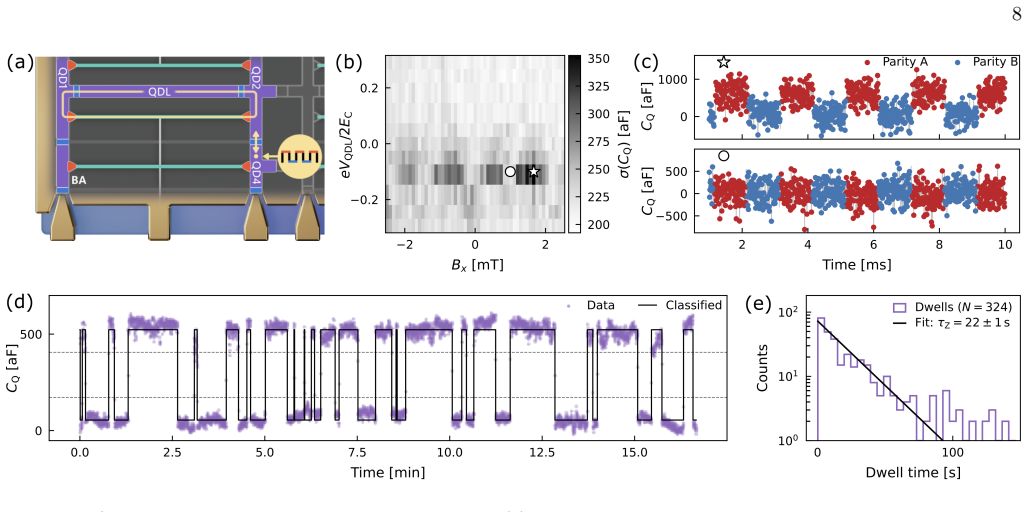
A central promise of topological quantum computing is that increasing the excitation gap improves device performance significantly. Here, we experimentally validate this principle in an InAs--Pb tetron device via interferometric single-shot parity measurements. By replacing aluminum with the higher-gap superconductor lead in our superconductor-semiconductor hybrid devices, we have improved the robustness of our topological phase. In addition, to enable fast and precise bring-up at scale, we have developed an rf measurement technique that resolves low-energy wire-end states and directly measures their energy splitting with $\mu\text{eV}$ precision. We employ this technique to bring up a device in a multi-tetron array and perform parity measurements of one of the tetron's hybrid nanowires (NWs). By controllably switching the wire parity, we observe $h/2e$-periodic bimodal shifts in the quantum capacitance of a quantum dot coupled to the hybrid nanowire in an interference loop. Further time-resolved measurements reveal a characteristic parity switching time of $\sim 20$ s with some instances reaching minute-scale. Such extremely long parity lifetimes are orders of magnitude longer than typical qubit operation times, which are on the order of $\mu\text{s}$. Finally, we discuss potential implications for the fidelity of Pauli measurements.
Editorial analysis
A structured set of objections, weighed in public.
Referee Report
Summary. The manuscript reports experimental results from an InAs-Pb tetron device in which replacement of aluminum by the higher-gap superconductor lead is claimed to yield a robust topological phase. Using a developed rf interferometric technique, the authors perform single-shot parity measurements on a hybrid nanowire and observe h/2e-periodic bimodal shifts in the quantum capacitance of a coupled quantum dot. Time-resolved measurements are stated to reveal a characteristic parity switching time of ~20 s (with some instances reaching minute scale), far exceeding typical qubit operation times of order μs. Implications for Pauli measurement fidelity are discussed.
Significance. If the observed capacitance shifts are correctly assigned to controllable topological parity, the result would provide direct experimental support for the principle that increasing the superconducting gap improves parity lifetime by orders of magnitude. This would constitute a notable advance for hybrid-nanowire topological qubits. The rf technique for resolving low-energy wire-end states with μeV precision is a clear methodological contribution that could aid scalable device bring-up.
major comments (1)
- [Abstract] Abstract (paragraph on parity measurements): The central lifetime claim rests on interpreting the h/2e-periodic bimodal capacitance shifts as controllable even/odd occupation of topological zero modes. No magnetic-field or gate-voltage dependence is cited that places the device inside versus outside the topological regime, nor are controls reported that would exclude even-odd effects from trivial proximitized states, quasiparticle traps, or rf back-action. This assignment is load-bearing and requires quantitative validation.
Simulated Author's Rebuttal
We thank the referee for their careful reading and for identifying the need to strengthen the topological assignment in the abstract. We address the comment below.
read point-by-point responses
-
Referee: [Abstract] Abstract (paragraph on parity measurements): The central lifetime claim rests on interpreting the h/2e-periodic bimodal capacitance shifts as controllable even/odd occupation of topological zero modes. No magnetic-field or gate-voltage dependence is cited that places the device inside versus outside the topological regime, nor are controls reported that would exclude even-odd effects from trivial proximitized states, quasiparticle traps, or rf back-action. This assignment is load-bearing and requires quantitative validation.
Authors: The abstract summarizes the key result but does not detail the supporting data. The full manuscript shows gate-voltage tuning that brings the InAs-Pb nanowire into the regime where h/2e-periodic bimodal capacitance shifts appear; this periodicity is a direct signature of even-odd parity occupation and is not expected for trivial Andreev states, which typically lack this flux periodicity. The larger Pb gap is shown to suppress quasiparticle density relative to prior Al devices, directly supporting the observed ~20 s lifetime. Rf back-action is quantified in the methods and supplementary sections and shown to be negligible on the measured timescales. We will revise the abstract to reference the gate-tuning data and the h/2e signature as evidence against trivial interpretations. revision: yes
Circularity Check
No circularity: purely experimental result with no derivation chain or fitted predictions
full rationale
The paper reports an experimental measurement of parity switching times in an InAs-Pb hybrid nanowire device using rf quantum capacitance readout. No equations, parameter fits, or self-citations are invoked to derive the ~20 s lifetime; the reported value is obtained directly from time-resolved observations of bimodal shifts. The central claim rests on empirical data rather than any reduction of a prediction to its own inputs by construction, satisfying the criteria for a self-contained experimental result.
Axiom & Free-Parameter Ledger
axioms (1)
- domain assumption The hybrid nanowire operates in the topological superconducting phase when the observed h/2e periodicity appears.
Forward citations
Cited by 3 Pith papers
-
Assessing Majorana states and qubits through quantum capacitance
Quantum capacitance with an auxiliary quantum dot measures ground-state energy splitting and Majorana overlap in topological qubits via peak positions and magnitudes in even and odd parity sectors.
-
Rotating Zeeman field as a tool for Majorana zero mode detection in topological superconducting wire
Rotating the Zeeman field in the wire attached to a quantum dot reveals Majorana zero modes through significant changes in dot spin polarization and identifies the topological transition via non-linear field dependence.
-
Majorana bound states in a hybrid Kitaev ladder with long-range pairing
Varying the long-range pairing exponent in a hybrid Kitaev ladder shifts topological phase boundaries and induces a transition from two to four Majorana zero modes with a crossover regime containing massive Dirac modes.
Reference graph
Works this paper leans on
-
[1]
Our roadmap draws on concepts explored in Refs
INTRODUCTION Recently, we presented a roadmap [1] to fault-tolerant quantum computation using topological qubits [ 2–4] built around Majorana zero modes (MZMs) in superconductor- semiconductor hybrid devices [ 5–9]. Our roadmap draws on concepts explored in Refs. 10–39. It entails building successively larger arrays of qubits which are progres- sively dee...
Pith/arXiv arXiv 2026
-
[2]
1 is a prototype unit cell for multi-tetron devices
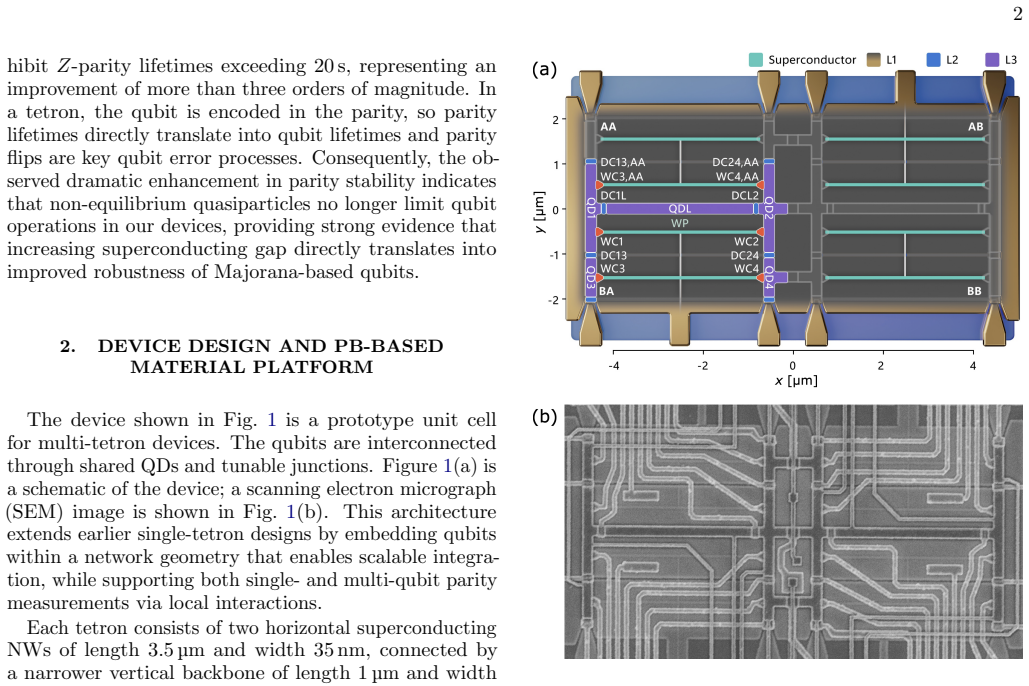
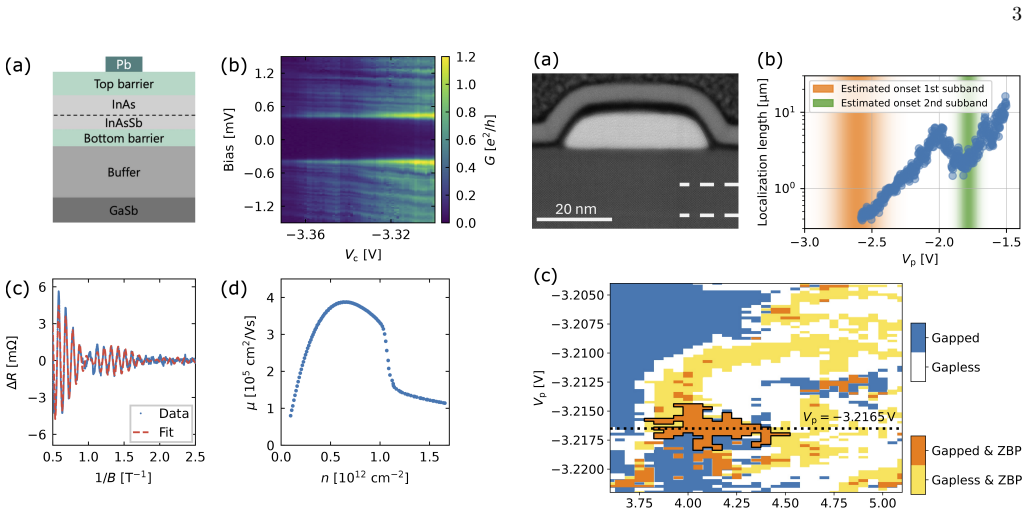
DEVICE DESIGN AND PB-BASED MA TERIAL PLA TFORM The device shown in Fig. 1 is a prototype unit cell for multi-tetron devices. The qubits are interconnected through shared QDs and tunable junctions. Figure 1(a) is a schematic of the device; a scanning electron micrograph (SEM) image is shown in Fig. 1(b). This architecture extends earlier single-tetron desi...
-
[3]
More broadly, transport- based protocols are not naturally matched to scalable architectures based on floating hybrid superconductor- semiconductor islands
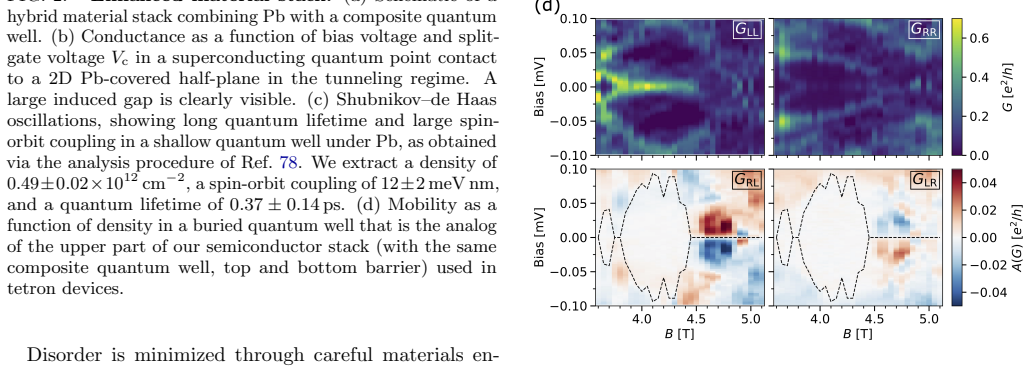
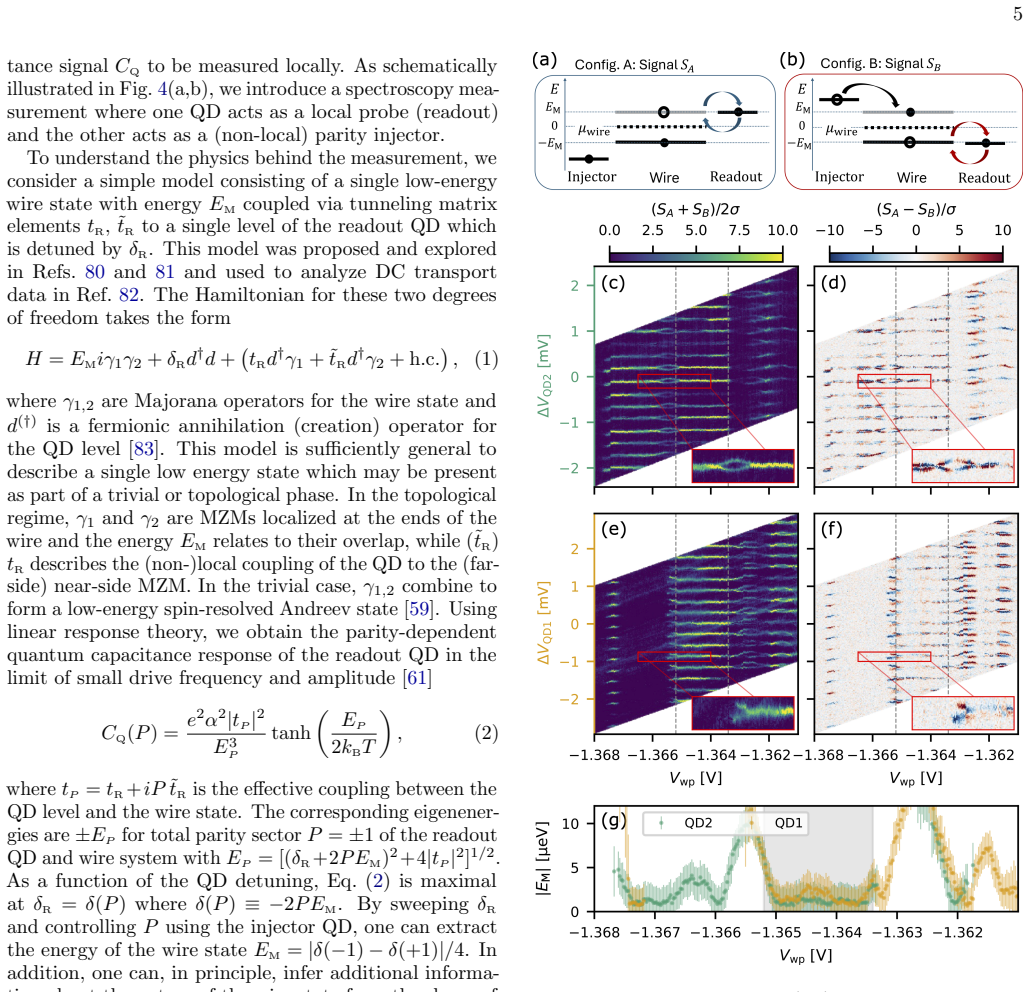
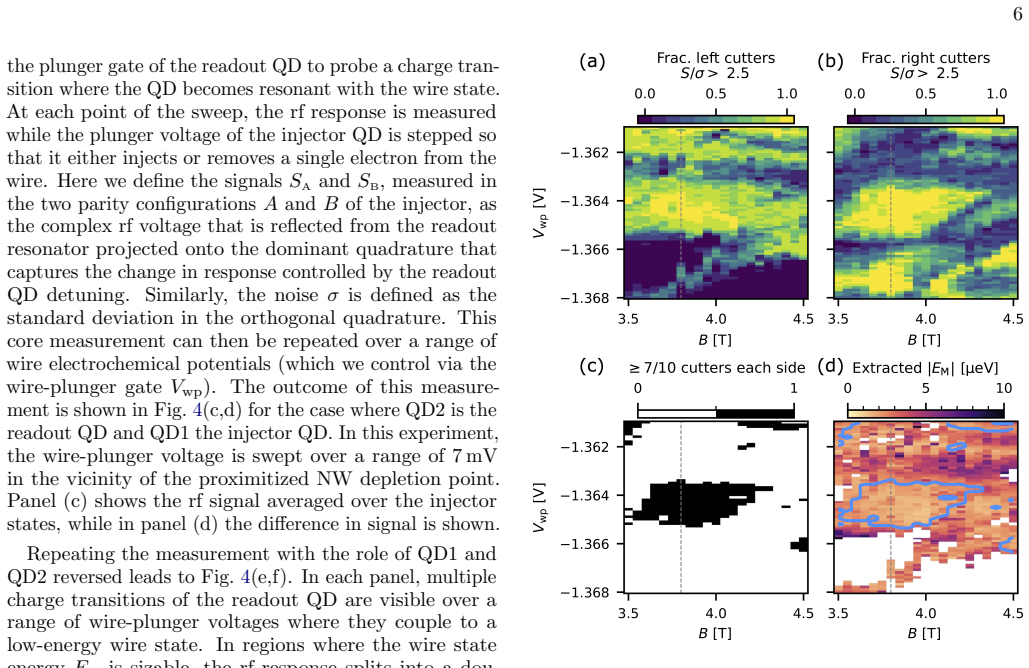
RF-BASED WIRE SPECTROSCOPY AND TUNING While local and non-local DC transport measurements have underpinned the tuning of topological NWs in our earlier work [ 59–61], they do not offer a scalable char- acterization strategy for large Majorana-based qubit ar- rays because they require end-to-end transport paths and a grounded third terminal, thereby limiti...
-
[4]
It can be implemented by probing the parity of the NW via an interference loop formed between the NW and a long QD
INTERFEROMETRIC P ARITY READOUT The Pauli-Zmeasurement is a fundamental operation of a tetron. It can be implemented by probing the parity of the NW via an interference loop formed between the NW and a long QD. This QD is coupled to the ends of the NWs through smaller intermediary QDs. As demon- strated in previous works [ 59, 61], the signature of this m...
-
[5]
unit cell
DISCUSSION AND OUTLOOK Our results confirm a central premise of topological quantum computing: increasing the excitation gap dra- matically reduces error mechanisms and improves qubit performance. By incorporating a higher- TC superconduc- tor (Pb) and an optimized semiconductor heterostructure into a multi-tetron array, we achieve a robust topological ph...
-
[6]
Aasenet al.(Microsoft Quantum), Blueprint for fault- tolerant quantum computation with topological qubit arrays, Phys
D. Aasenet al.(Microsoft Quantum), Blueprint for fault- tolerant quantum computation with topological qubit arrays, Phys. Rev. Res.7, 041002 (2025)
2025
-
[7]
A. Y. Kitaev, Fault-tolerant quantum computation by anyons, Ann. Phys.303, 2 (2003), arXiv:quant- ph/9707021
arXiv 2003
-
[8]
M. H. Freedman, P /N P, and the quantum field computer, Proc. Natl. Acad. Sci. USA95, 98 (1998)
1998
-
[9]
C. Nayak, S. H. Simon, A. Stern, M. Freedman, and S. Das Sarma, Non-Abelian anyons and topological quan- tum computation, Rev. Mod. Phys.80, 1083 (2008), arXiv:0707.1889
Pith/arXiv arXiv 2008
-
[10]
A. Y. Kitaev, Unpaired Majorana fermions in quan- tum wires, Phys.-Usp.44, 131 (2001), arXiv:cond- mat/0010440
arXiv 2001
-
[11]
L. Fu and C. L. Kane, Superconducting proximity ef- fect and Majorana fermions at the surface of a topo- logical insulator, Phys. Rev. Lett.100, 096407 (2008), arXiv:0707.1692
Pith/arXiv arXiv 2008
-
[12]
J. D. Sau, R. M. Lutchyn, S. Tewari, and S. Das Sarma, Generic new platform for topological quantum compu- tation using semiconductor heterostructures, Phys. Rev. Lett.104, 040502 (2010), arXiv:0907.2239
Pith/arXiv arXiv 2010
-
[13]
R. M. Lutchyn, J. D. Sau, and S. Das Sarma, Ma- jorana fermions and a topological phase transition in semiconductor-superconductor heterostructures, Phys. Rev. Lett.105, 077001 (2010), arXiv:1002.4033
Pith/arXiv arXiv 2010
-
[14]
Y. Oreg, G. Refael, and F. von Oppen, Helical liquids and Majorana bound states in quantum wires, Phys. Rev. Lett.105, 177002 (2010), arXiv:1003.1145
Pith/arXiv arXiv 2010
-
[15]
Fu and C
L. Fu and C. L. Kane, Josephson current and noise at a superconductor/quantum-spin-Hall- insulator/superconductor junction, Phys. Rev. B 79, 161408(R) (2009)
2009
-
[16]
A. R. Akhmerov, J. Nilsson, and C. W. J. Beenakker, Electrically detected interferometry of Majorana fermions in a topological insulator, Phys. Rev. Lett.102, 216404 (2009), arXiv:0903.2196
Pith/arXiv arXiv 2009
-
[17]
Fu and C
L. Fu and C. L. Kane, Probing neutral Majorana fermion edge modes with charge transport, Phys. Rev. Lett.102, 216403 (2009)
2009
-
[18]
Fu, Electron teleportation via Majorana bound states in a mesoscopic superconductor, Phys
L. Fu, Electron teleportation via Majorana bound states in a mesoscopic superconductor, Phys. Rev. Lett.104, 056402 (2010), arXiv:0909.5172
Pith/arXiv arXiv 2010
-
[19]
F. Hassler, A. R. Akhmerov, C.-Y. Hou, and C. W. J. Beenakker, Anyonic interferometry without anyons: how a flux qubit can read out a topological qubit, New J. Phys. 12, 125002 (2010), arXiv:1005.3423
Pith/arXiv arXiv 2010
-
[20]
J. D. Sau, D. J. Clarke, and S. Tewari, Controlling non-Abelian statistics of Majorana fermions in semi- conductor nanowires, Phys. Rev. B84, 094505 (2011), arXiv:1012.0561
Pith/arXiv arXiv 2011
-
[21]
L. Fidkowski, R. M. Lutchyn, C. Nayak, and M. P. A. Fisher, Majorana zero modes in one-dimensional quantum wires without long-ranged superconducting order, Phys. Rev. B84, 195436 (2011), arXiv:1106.2598
Pith/arXiv arXiv 2011
-
[22]
Alicea, New directions in the pursuit of Majorana fermions in solid state systems, Rep
J. Alicea, New directions in the pursuit of Majorana fermions in solid state systems, Rep. Prog. Phys.75, 076501 (2012), arXiv:1202.1293
Pith/arXiv arXiv 2012
-
[23]
Das Sarma, M
S. Das Sarma, M. Freedman, and C. Nayak, Majorana zero modes and topological quantum computation, npj Quantum Inf.1, 15001 (2015)
2015
-
[24]
van Heck, F
B. van Heck, F. Hassler, A. R. Akhmerov, and C. W. J. Beenakker, Coulomb stability of the 4 π-periodic Joseph- son effect of Majorana fermions, Phys. Rev. B84, 180502 (2011)
2011
-
[25]
B. van Heck, A. R. Akhmerov, F. Hassler, M. Burrello, and C. W. J. Beenakker, Coulomb-assisted braiding of Majorana fermions in a Josephson junction array, New J. Phys.14, 035019 (2012), arXiv:1111.6001
Pith/arXiv arXiv 2012
-
[26]
T. Hyart, B. van Heck, I. C. Fulga, M. Burrello, A. R. Akhmerov, and C. W. J. Beenakker, Flux-controlled quan- tum computation with Majorana fermions, Phys. Rev. B 88, 035121 (2013), arXiv:1303.4379
Pith/arXiv arXiv 2013
-
[27]
Houzet, J
M. Houzet, J. S. Meyer, D. M. Badiane, and L. I. Glazman, Dynamics of Majorana states in a topological Josephson junction, Phys. Rev. Lett.111, 046401 (2013)
2013
-
[28]
Pientka, A
F. Pientka, A. Romito, M. Duckheim, Y. Oreg, and F. von Oppen, Signatures of topological phase transi- tions in mesoscopic superconducting rings, New J. Phys. 15, 025001 (2013)
2013
-
[29]
Cheng and R
M. Cheng and R. Lutchyn, Fractional Josephson effect in number-conserving systems, Phys. Rev. B92, 134516 (2015)
2015
-
[30]
J. D. Sau, B. Swingle, and S. Tewari, Proposal to probe quantum nonlocality of Majorana fermions in tunneling experiments, Phys. Rev. B92, 020511 (2015)
2015
-
[31]
Yavilberg, E
K. Yavilberg, E. Ginossar, and E. Grosfeld, Fermion parity measurement and control in Majorana circuit quantum electrodynamics, Phys. Rev. B92, 075143 (2015)
2015
-
[32]
D. Aasen, M. Hell, R. V. Mishmash, A. Higginbotham, J. Danon, M. Leijnse, T. S. Jespersen, J. A. Folk, C. M. Marcus, K. Flensberg, and J. Alicea, Milestones toward Majorana-based quantum computing, Phys. Rev. X6, 031016 (2016), arXiv:1511.05153
Pith/arXiv arXiv 2016
-
[33]
M. Hell, K. Flensberg, and M. Leijnse, Distinguishing Majorana bound states from localized Andreev bound states by interferometry, Phys. Rev. B97, 161401 (2018)
2018
-
[34]
C.-K. Chiu, J. D. Sau, and S. Das Sarma, Conductance interference in a superconducting Coulomb blockaded Majorana ring, Phys. Rev. B97, 035310 (2018)
2018
-
[35]
Drukier, H.-G
C. Drukier, H.-G. Zirnstein, B. Rosenow, A. Stern, and Y. Oreg, Evolution of the transmission phase through a Coulomb-blockaded Majorana wire, Phys. Rev. B98, 161401 (2018)
2018
-
[36]
S. Vijay, T. H. Hsieh, and L. Fu, Majorana fermion surface code for universal quantum computation, Phys. Rev. X 5, 041038 (2015), arXiv:1504.01724
Pith/arXiv arXiv 2015
-
[37]
S. Vijay and L. Fu, Physical implementation of a Majorana fermion surface code for fault-tolerant quantum computa- tion, Phys. Scr.T168, 014002 (2016), arXiv:1509.08134
Pith/arXiv arXiv 2016
-
[38]
S. Vijay and L. Fu, Teleportation-based quantum infor- 11 mation processing with Majorana zero modes, Phys. Rev. B94, 235446 (2016), arXiv:1609.00950
Pith/arXiv arXiv 2016
-
[39]
Knapp, T
C. Knapp, T. Karzig, R. M. Lutchyn, and C. Nayak, Dephasing of Majorana-based qubits, Phys. Rev. B97, 125404 (2018)
2018
-
[40]
Knapp, M
C. Knapp, M. Beverland, D. I. Pikulin, and T. Karzig, Modeling noise and error correction for Majorana-based quantum computing, Quantum2, 88 (2018)
2018
-
[41]
C.-X. Liu, W. S. Cole, and J. D. Sau, Proposal for mea- suring the parity anomaly in a topological superconductor ring, Phys. Rev. Lett.122, 117001 (2019)
2019
-
[42]
M. I. K. Munk, J. Schulenborg, R. Egger, and K. Flens- berg, Parity-to-charge conversion in Majorana qubit read- out, Phys. Rev. Res.2, 033254 (2020), arXiv:2004.02123
arXiv 2020
-
[43]
J. F. Steiner and F. von Oppen, Readout of Ma- jorana qubits, Phys. Rev. Res.2, 033255 (2020), arXiv:2004.02124
arXiv 2020
-
[44]
A. Khindanov, D. Pikulin, and T. Karzig, Visibility of noisy quantum dot-based measurements of Majorana qubits, SciPost Phys.10, 127 (2021), arXiv:2007.11024
arXiv 2021
-
[45]
Motrunich, K
O. Motrunich, K. Damle, and D. A. Huse, Griffiths effects and quantum critical points in dirty superconductors with- out spin-rotation invariance: One-dimensional examples, Phys. Rev. B63, 224204 (2001)
2001
-
[46]
I. A. Gruzberg, N. Read, and S. Vishveshwara, Local- ization in disordered superconducting wires with broken spin-rotation symmetry, Phys. Rev. B71, 245124 (2005)
2005
-
[47]
P. W. Brouwer, M. Duckheim, A. Romito, and F. von Oppen, Topological superconducting phases in disordered quantum wires with strong spin-orbit coupling, Phys. Rev. B84, 144526 (2011)
2011
-
[48]
P. W. Brouwer, M. Duckheim, A. Romito, and F. von Oppen, Probability distribution of Majorana end-state energies in disordered wires, Phys. Rev. Lett.107, 196804 (2011)
2011
-
[49]
T. D. Stanescu, R. M. Lutchyn, and S. Das Sarma, Majo- rana fermions in semiconductor nanowires, Phys. Rev. B 84, 144522 (2011), arXiv:1106.3078
Pith/arXiv arXiv 2011
-
[50]
A. M. Lobos, R. M. Lutchyn, and S. Das Sarma, Interplay of disorder and interaction in Majorana quantum wires, Phys. Rev. Lett.109, 146403 (2012)
2012
-
[51]
J. D. Sau, S. Tewari, and S. Das Sarma, Experimental and materials considerations for the topological super- conducting state in electron- and hole-doped semicon- ductors: Searching for non-Abelian Majorana modes in 1D nanowires and 2D heterostructures, Phys. Rev. B85, 064512 (2012)
2012
-
[52]
De Gottardi,Strong correlations and topological order in one-dimensional systems, Ph.D
W. De Gottardi,Strong correlations and topological order in one-dimensional systems, Ph.D. thesis, University of Illinois at Urbana-Champaign (2012)
2012
-
[53]
DeGottardi, D
W. DeGottardi, D. Sen, and S. Vishveshwara, Majorana fermions in superconducting 1D systems having periodic, quasiperiodic, and disordered potentials, Phys. Rev. Lett. 110, 146404 (2013)
2013
-
[54]
Pekerten, A
B. Pekerten, A. Teker, O. Bozat, M. Wimmer, and I. Adagideli, Disorder-induced topological transitions in multichannel Majorana wires, Phys. Rev. B95, 064507 (2017)
2017
-
[55]
Das Sarma and H
S. Das Sarma and H. Pan, Disorder-induced zero-bias peaks in Majorana nanowires, Phys. Rev. B103, 195158 (2021)
2021
-
[56]
S. Ahn, H. Pan, B. Woods, T. D. Stanescu, and S. Das Sarma, Estimating disorder and its adverse ef- fects in semiconductor Majorana nanowires, Phys. Rev. Mater.5, 124602 (2021)
2021
-
[57]
Das Sarma, J
S. Das Sarma, J. D. Sau, and T. D. Stanescu, Spectral properties, topological patches, and effective phase dia- grams of finite disordered Majorana nanowires, Phys. Rev. B108, 085416 (2023)
2023
-
[58]
Kanne, M
T. Kanne, M. Marnauza, D. Olsteins, D. J. Carrad, J. E. Sestoft, J. de Bruijckere, L. Zeng, E. Johnson, E. Olsson, K. Grove-Rasmussen, and J. Nyg˚ ard, Epitaxial Pb on InAs nanowires for quantum devices, Nat. Nanotechnol. 16, 776 (2021)
2021
-
[59]
M. Pendharkar, B. Zhang, H. Wu, A. Zarassi, P. Zhang, C. P. Dempsey, J. S. Lee, S. D. Harrington, G. Badawy, S. Gazibegovic, J. Jung, A. H. Chen, M. A. Verheijen, M. Hocevar, E. P. A. M. Bakkers, C. J. Palmstrøm, and S. M. Frolov, Parity-preserving and magnetic field resilient superconductivity in indium antimonide nanowires with tin shells (2019), arXiv:...
arXiv 2019
-
[60]
W. Song, Z. Yu, Y. Wang, Y. Gao, Z. Li, S. Yang, S. Zhang, Z. Geng, R. Li, Z. Wang, F. Chen, L. Yang, W. Miao, J. Xu, X. Feng, T. Wang, Y. Zang, L. Li, R. Shang, Q. Xue, K. He, and H. Zhang, Reducing disor- der in PbTe nanowires for Majorana research, Nano Lett. 25, 2350 (2025)
2025
-
[61]
Zhang, W
S. Zhang, W. Song, Z. Li, Z. Yu, R. Li, Y. Wang, Z. Yan, J. Xu, Z. Wang, Y. Gao, S. Yang, L. Yang, X. Feng, T. Wang, Y. Zang, L. Li, R. Shang, Q.-K. Xue, K. He, and H. Zhang, Strong enhancement of g-factor in PbTe– Pb hybrid nanowires, Nano Lett.26, 4739 (2026)
2026
-
[62]
Plugge, A
S. Plugge, A. Rasmussen, R. Egger, and K. Flensberg, Majorana box qubits, New J. Phys.19, 012001 (2017)
2017
-
[63]
Karzig, C
T. Karzig, C. Knapp, R. M. Lutchyn, P. Bonderson, M. B. Hastings, C. Nayak, J. Alicea, K. Flensberg, S. Plugge, Y. Oreg, C. M. Marcus, and M. H. Freedman, Scalable designs for quasiparticle-poisoning-protected topological quantum computation with Majorana zero modes, Phys. Rev. B95, 235305 (2017)
2017
-
[64]
M. Aghaeeet al.(Microsoft Quantum), Distinct lifetimes for X and Z loop measurements in a Majorana tetron device (2025), arXiv:2507.08795
arXiv 2025
-
[65]
Aghaeeet al.(Microsoft Quantum), InAs-Al hybrid devices passing the topological gap protocol, Phys
M. Aghaeeet al.(Microsoft Quantum), InAs-Al hybrid devices passing the topological gap protocol, Phys. Rev. B107, 245423 (2023), arXiv:2207.02472
arXiv 2023
-
[66]
M. Aghaeeet al.(Microsoft Quantum), Interferometric single-shot parity measurement in InAs-Al hybrid devices, Nature638, 651 (2025), arXiv:2401.09549
arXiv 2025
-
[67]
Aumentado, M
J. Aumentado, M. W. Keller, J. M. Martinis, and M. H. Devoret, Nonequilibrium quasiparticles and 2e periodicity in single-Cooper-pair transistors, Phys. Rev. Lett.92, 066802 (2004)
2004
-
[68]
Naaman and J
O. Naaman and J. Aumentado, Time-domain measure- ments of quasiparticle tunneling rates in a single-Cooper- pair transistor, Phys. Rev. B73, 172504 (2006)
2006
-
[69]
R. M. Lutchyn, L. I. Glazman, and A. I. Larkin, Kinetics of the superconducting charge qubit in the presence of a quasiparticle, Phys. Rev. B74, 064515 (2006)
2006
-
[70]
A. J. Ferguson, N. A. Court, F. E. Hudson, and R. G. Clark, Microsecond resolution of quasiparticle tunneling in the single-Cooper-pair transistor, Phys. Rev. Lett.97, 106603 (2006)
2006
-
[71]
M. D. Shaw, R. M. Lutchyn, P. Delsing, and P. M. Echter- nach, Kinetics of nonequilibrium quasiparticle tunneling in superconducting charge qubits, Phys. Rev. B78, 024503 (2008)
2008
-
[72]
Persson, C
F. Persson, C. M. Wilson, M. Sandberg, and P. Delsing, 12 Fast readout of a single Cooper-pair box using its quantum capacitance, Phys. Rev. B82, 134533 (2010)
2010
-
[73]
Barends, J
R. Barends, J. Wenner, M. Lenander, Y. Chen, R. C. Bialczak, J. Kelly, E. Lucero, P. O’Malley, M. Mariantoni, D. Sank, H. Wang, T. C. White, Y. Yin, J. Zhao, A. N. Cleland, J. M. Martinis, and J. J. A. Baselmans, Mini- mizing quasiparticle generation from stray infrared light in superconducting quantum circuits, Appl. Phys. Lett. 99, 113507 (2011)
2011
-
[74]
Rist` e, C
D. Rist` e, C. Bultink, M. J. Tiggelman, R. N. Schouten, K. W. Lehnert, and L. DiCarlo, Millisecond charge-parity fluctuations and induced decoherence in a superconduct- ing transmon qubit, Nat. Commun.4, 1913 (2013)
1913
-
[75]
Janvier, L
C. Janvier, L. Tosi, L. Bretheau, C ¸. ¨O. Girit, M. Stern, P. Bertet, P. Joyez, D. Vion, D. Esteve, M. F. Goffman, H. Pothier, and C. Urbina, Coherent manipulation of An- dreev states in superconducting atomic contacts, Science 349, 1199 (2015)
2015
-
[76]
M. Hays, G. de Lange, K. Serniak, D. J. van Wo- erkom, D. Bouman, P. Krogstrup, J. Nygˆ ard, A. Geresdi, and M. H. Devoret, Direct microwave measurement of Andreev-bound-state dynamics in a semiconductor- nanowire Josephson junction, Phys. Rev. Lett.121, 047001 (2018)
2018
-
[77]
K. Serniak, S. Diamond, M. Hays, V. Fatemi, S. Shankar, L. Frunzio, R. J. Schoelkopf, and M. H. Devoret, Direct dispersive monitoring of charge parity in offset-charge- sensitive transmons, Phys. Rev. Appl.12, 014052 (2019), arXiv:1903.00113
arXiv 2019
-
[78]
W. Uilhoorn, J. G. Kroll, A. Bargerbos, S. D. Nabi, C.-K. Yang, P. Krogstrup, L. P. Kouwenhoven, A. Kou, and G. de Lange, Quasiparticle trapping by orbital effect in a hybrid superconducting-semiconducting circuit (2021), arXiv:2105.11038
arXiv 2021
-
[79]
E. T. Mannila, P. Samuelsson, S. Simbierowicz, J. T. Pel- tonen, V. Vesterinen, L. Gr¨ onberg, J. Hassel, V. F. Maisi, and J. P. Pekola, A superconductor free of quasiparticles for seconds, Nat. Phys.18, 145 (2022), arXiv:2102.00484
arXiv 2022
-
[80]
O. Erlandsson, D. Sabonis, A. Kringhøj, T. W. Larsen, P. Krogstrup, K. D. Petersson, and C. M. Marcus, Parity switching in a full-shell superconductor-semiconductor nanowire qubit, Phys. Rev. B108, L121406 (2023), arXiv:2202.05974
arXiv 2023
discussion (0)
Sign in with ORCID, Apple, or X to comment. Anyone can read and Pith papers without signing in.