Rotating Zeeman field as a tool for Majorana zero mode detection in topological superconducting wire
Pith reviewed 2026-06-26 07:10 UTC · model grok-4.3
The pith
Rotating the Zeeman field in a superconducting wire changes the attached quantum dot's Fermi-level spin polarization only when Majorana zero modes are present.
A machine-rendered reading of the paper's core claim, the machinery that carries it, and where it could break.
Core claim
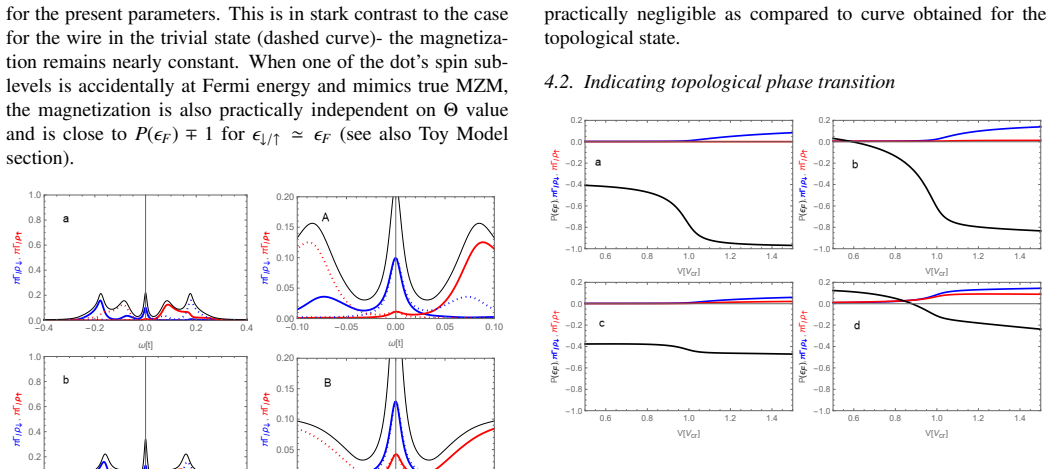
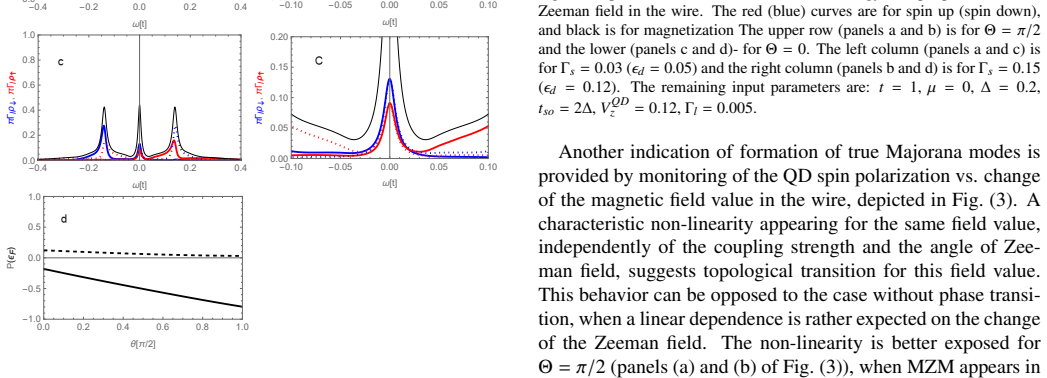
The paper establishes that when a Majorana zero mode exists in the wire the effective spin polarization of the attached quantum dot at the Fermi energy varies markedly upon rotating the Zeeman field from parallel to perpendicular orientation, whereas in the trivial phase this polarization remains essentially unchanged. A nonlinear dependence of the polarization on the magnitude of the magnetic field at its critical value further marks the topological phase transition, and this behavior holds irrespective of the wire-dot coupling strength or the angle of the Zeeman field.
What carries the argument
The differential response of the quantum dot spin polarization at the Fermi energy to the orientation of the Zeeman field in the wire, which is sensitive to the presence of a Majorana zero mode.
Load-bearing premise
The quantum dot spin polarization at the Fermi energy can be isolated from effects of disorder, finite temperature, or additional sub-gap states that might produce similar responses.
What would settle it
Measuring no significant change in quantum dot spin polarization upon rotating the Zeeman field in a wire confirmed to host Majorana zero modes would falsify the detection scheme.
Figures
read the original abstract
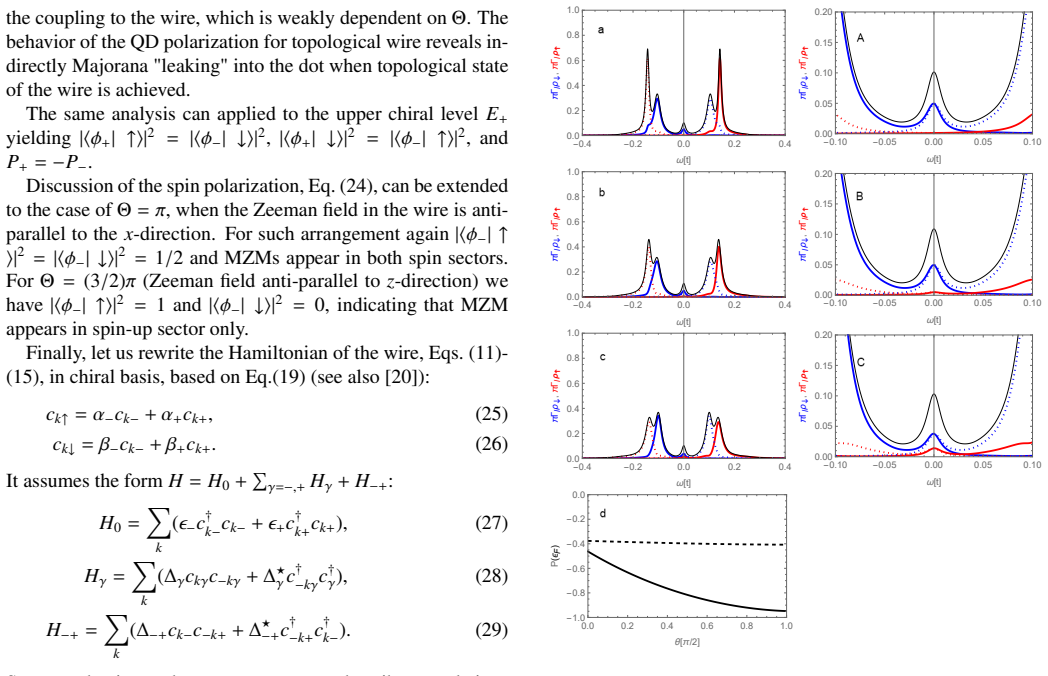
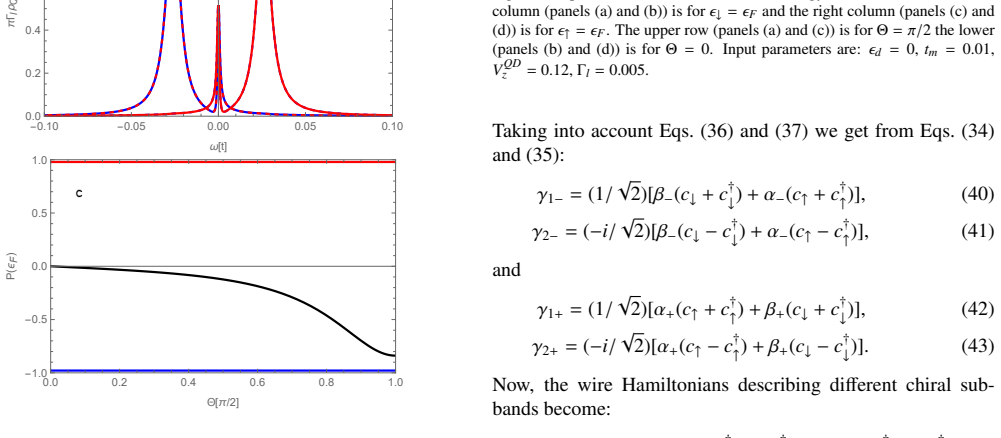
We demonstrate that analysis of the spin polarization of a quantum dot (QD) attached to the topological wire can provide valuable insights into Majorana zero mode (MZM) formation and topological phase transition. Detection is realized by rotation of the Zeeman field in the wire, while retaining the Zeeman field direction in the dot intact. In the presence of Majorana mode, the effective QD spin polarization at Fermi energy changes significantly when the direction of the Zeeman field in the wire changes from parallel to perpendicular to the wire axis. It can be opposed to the wire in its trivial state, when spin polarization remains practically constant while the magnetic field is rotated. Similar unaltered spin polarization is observed when QD spin sub-level at Fermi energy mimics MZM. Moreover, the characteristic non-linear dependence of the spin polarization on the magnetic field magnitude at its critical value identifies a topological phase transition in the wire. This feature is observed independently on the coupling strength of the wire to the dot and the angle of the Zeeman field.
Editorial analysis
A structured set of objections, weighed in public.
Referee Report
Summary. The manuscript proposes using rotation of the Zeeman field direction in a topological superconducting wire (while keeping the QD Zeeman field fixed) to detect Majorana zero modes via changes in the attached quantum dot's spin polarization at the Fermi energy. It claims that the presence of an MZM produces a significant change in QD polarization when the wire field rotates from parallel to perpendicular to the wire axis, in contrast to the trivial regime (and to cases where a QD sub-level mimics an MZM) where polarization remains essentially constant. A non-linear dependence of polarization on field magnitude at the critical value is also reported to identify the topological phase transition, independent of wire-dot coupling strength and field angle.
Significance. If the central claims hold under realistic conditions, the method would supply a distinct experimental signature for MZM presence and topological phase transitions that complements conductance-based probes and is insensitive to coupling strength. The contrast between topological and trivial regimes under field rotation is a potentially falsifiable prediction. However, the idealized clean-model setting limits immediate experimental impact.
major comments (2)
- [Abstract and numerical results] The central claim (Abstract) requires that the angular dependence of QD spin polarization at E_F is markedly different in the topological versus trivial regimes. The analysis is performed in an idealized Kitaev-like wire + QD Hamiltonian at zero temperature with no disorder; the manuscript does not quantify how the reported contrast survives when disorder, finite-temperature broadening, or additional Andreev states are included, any of which can hybridize the zero-energy feature and flatten or induce spurious angular variation.
- [Abstract] The claim that the non-linear dependence on magnetic-field magnitude at the critical value 'identifies a topological phase transition' independently of coupling strength and angle (Abstract) is load-bearing for the detection proposal. Without explicit checks against disorder or sub-gap states that could shift or broaden the critical point, it is unclear whether this feature remains a reliable indicator.
minor comments (1)
- [Abstract] The abstract states expected signatures but supplies no model Hamiltonian, equations, or figure references; the full manuscript should include these in the main text or supplementary material for reproducibility.
Simulated Author's Rebuttal
We thank the referee for the careful reading and constructive comments. We address each major comment below.
read point-by-point responses
-
Referee: [Abstract and numerical results] The central claim (Abstract) requires that the angular dependence of QD spin polarization at E_F is markedly different in the topological versus trivial regimes. The analysis is performed in an idealized Kitaev-like wire + QD Hamiltonian at zero temperature with no disorder; the manuscript does not quantify how the reported contrast survives when disorder, finite-temperature broadening, or additional Andreev states are included, any of which can hybridize the zero-energy feature and flatten or induce spurious angular variation.
Authors: We agree that the calculations are performed in an idealized clean model at zero temperature. This establishes the proposed signature under controlled conditions, which is the standard starting point for such theoretical proposals. We will revise the abstract and add a dedicated paragraph in the discussion to explicitly state the idealized nature of the model and to note that quantitative assessment of robustness to disorder, finite temperature, and additional Andreev states lies beyond the present scope. revision: partial
-
Referee: [Abstract] The claim that the non-linear dependence on magnetic-field magnitude at the critical value 'identifies a topological phase transition' independently of coupling strength and angle (Abstract) is load-bearing for the detection proposal. Without explicit checks against disorder or sub-gap states that could shift or broaden the critical point, it is unclear whether this feature remains a reliable indicator.
Authors: Within the clean model the non-linear dependence on field magnitude at the critical point is observed and is independent of coupling strength and angle. We concur that its reliability as an indicator has not been tested against disorder or sub-gap states. We will revise the abstract to qualify the claim as applying to the idealized model and will add a corresponding statement in the conclusions. revision: yes
- Quantitative checks of the angular contrast and non-linear field dependence under disorder, finite temperature, or additional Andreev states.
Circularity Check
No circularity; model-based distinction is independent of inputs
full rationale
The paper computes QD spin polarization at E_F from an explicit Kitaev-like wire + QD Hamiltonian under rotating Zeeman field. The reported contrast (large angular variation only in topological regime) follows directly from the model's zero-energy mode structure and is not obtained by fitting parameters to the target observable, redefining inputs, or invoking self-citations. No load-bearing step reduces to its own output by construction. The derivation remains self-contained against the stated model assumptions.
Axiom & Free-Parameter Ledger
Reference graph
Works this paper leans on
-
[1]
Majorana, A symmetric theory of electrons and positrons, Nouvo Cim
E. Majorana, A symmetric theory of electrons and positrons, Nouvo Cim. 14 (3) (1937) 171–184.doi: 10.1007/978-3-540-48095-2_10
-
[2]
R. M. Lutchyn, E. P. Bakkers, L. P. Kouwenhoven, P. Krogstrup, C. M. Marcus, Y . Oreg, Majorana zero modes in superconductor-semiconductor heterostructures, Nat. Rev. Mater. 3 (5) (2018) 52.arXiv:1707.04899, doi:10.1038/s41578-018-0003-1
work page internal anchor Pith review Pith/arXiv arXiv doi:10.1038/s41578-018-0003-1 2018
-
[3]
R. M. Lutchyn, J. D. Sau, S. Das Sarma, Ma- jorana fermions and a topological phase transition in semiconductor-superconductor heterostructures, Phys. Rev. Lett. 105 (7) (2010) 077001.arXiv:1002.4033, doi:10.1103/PhysRevLett.105.077001. 7
work page internal anchor Pith review Pith/arXiv arXiv doi:10.1103/physrevlett.105.077001 2010
-
[4]
Y . Oreg, G. Refael, F. von Oppen, Helical liquids and Ma- jorana bound states in quantum wires, Phys. Rev. Lett. 105 (17) (2010) 177002.arXiv:1003.1145,doi:10. 1103/PhysRevLett.105.177002
Pith/arXiv arXiv 2010
-
[5]
S. D. Sarma, M. Freedman, C. Nayak, Majorana zero modes and topological quantum computation, npj Quan- tum Inf. 1 (1) (2015) 15001.doi:10.1038/npjqi. 2015.1
-
[6]
Marra, Majorana nanowires for topological quantum computation, J
P. Marra, Majorana nanowires for topological quantum computation, J. Appl. Phys. 132 (2022) 231101.arXiv: 2206.14828,doi:10.1063/5.0102999
-
[7]
Microsoft Azure Quantum, M. Aghaee, A. Al- caraz Ramirez, Z. Alam, R. Ali, M. Andrzejczuk, A. Antipov, M. Astafev, A. Barzegar, B. Bauer, et al., Interferometric single-shot parity measurement in InAs– Al hybrid devices, Nature 638 (8051) (2025) 651–655. doi:10.1038/s41586-024-08445-2
-
[9]
Aghaee, et al., InAs-Al Hybrid Devices Passing the Topological Gap Protocol (2022).arXiv:2103.12217
M. Aghaee, et al., InAs-Al Hybrid Devices Passing the Topological Gap Protocol (2022).arXiv:2103.12217
arXiv 2022
-
[10]
20 Second Parity Lifetime in an InAs--Pb Tetron Device
M. Aghaee, Z. Alam, M. Andrzejczuk, A. Antipov, et al., 20 Second Parity Lifetime in an InAs–Pb Tetron Device, submitted 2 June 2026; revised 3 June 2026 (2026).arXiv:2606.03884,doi:10.48550/arXiv. 2606.03884
work page internal anchor Pith review Pith/arXiv arXiv doi:10.48550/arxiv 2026
-
[11]
J. Chen, B. D. Woods, P. Yu, M. Hocevar, D. Car, S. R. Plissard, E. P. A. M. Bakkers, T. D. Stanescu, S. M. Frolov, Ubiquitous non-majorana zero-bias conductance peaks in nanowire devices, Phys. Rev. Lett. 123 (2019) 107703.doi:10.1103/PhysRevLett.123.107703
-
[12]
M. Valentini, F. Peñaranda, A. Hofmann, M. Brauns, R. Hauschild, P. Krogstrup, P. San-Jose, E. Prada, R. Aguado, G. Katsaros, Non-topological zero bias peaks in full-shell nanowires induced by flux tunable Andreev states, Science 373 (2021) 82.arXiv:2008.02348,doi: 10.1126/science.abf1513
-
[13]
S. Das Sarma, H. Pan, Disorder-induced zero-bias peaks in majorana nanowires, Phys. Rev. B 103 (2021) 195158. doi:10.1103/PhysRevB.103.195158
-
[14]
P. Yu, J. Chen, M. Gomanko, G. Badawy, E. P. A. M. Bakkers, K. Zuo, V . Mourik, S. M. Frolov, Non-Majorana states yield nearly quantized conduc- tance in proximatized nanowires, Nature Physics 17 (4) (2021) 482–488.arXiv:2004.08583,doi:10.1038/ s41567-020-01107-w
arXiv 2021
-
[15]
R. Hess, H. F. Legg, D. Loss, J. Klinovaja, Trivial Andreev band mimicking topological bulk gap reopening in the non-local conductance of long Rashba nanowires, Phys. Rev. Lett. 130 (2023) 207001.arXiv:2210.03507,doi: 10.1103/PhysRevLett.130.207001
-
[16]
interferometric single-shot par- ity measurement in inas-al hybrid devices
H. F. Legg, Comment on “interferometric single-shot par- ity measurement in inas-al hybrid devices”, microsoft quantum, nature 638, 651–655 (2025) (2025).arXiv: 2503.08944,doi:10.48550/arXiv.2503.08944
-
[17]
inas-al hybrid devices passing the topological gap protocol
H. F. Legg, Comment on "inas-al hybrid devices passing the topological gap protocol", microsoft quantum, phys. rev. b 107, 245423 (2023) (2025).arXiv:2502.19560, doi:10.48550/arXiv.2502.19560
-
[18]
D. Castelvecchi, Microsoft upgrades controver- sial quantum chip – researchers are still scep- tical, NatureNature News (Jun. 2026).doi: 10.1038/d41586-026-01788-y
-
[19]
F. Zhang, C. L. Kane, E. J. Mele, Time-reversal-invariant topological superconductivity and Majorana Kramers pairs, Phys. Rev. Lett. 111 (2013) 056402.arXiv:1212. 4232,doi:10.1103/PhysRevLett.111.056402
-
[20]
Alicea, Majorana fermions in a tunable semiconductor device, Physical Review B 81 (2010) 125318.doi:10
J. Alicea, Majorana fermions in a tunable semiconductor device, Physical Review B 81 (2010) 125318.doi:10. 1103/PhysRevB.81.125318
2010
-
[21]
P. Stefa ´nski, Quantum dot detects Majorana modes of both chiralities, Journal of Magnetism and Magnetic Ma- terials 584 (2023) 171067.arXiv:2307.13366,doi: 10.1016/j.jmmm.2023.171067
-
[22]
J. Yoneda, T. Otsuka, T. Takakura, M. Pioro-Ladrière, R. Brunner, H. Lu, T. Nakajima, T. Obata, A. Noiri, C. J. Palmstrøm, A. C. Gossard, S. Tarucha, Robust micro- magnet design for fast electrical manipulations of single spins in quantum dots, Applied Physics Express 8 (2015) 084401.doi:10.7567/APEX.8.084401
-
[23]
N. I. D. Stuyck, F. A. Mohiyaddin, R. Li, M. Heyns, B. Govoreanu, I. P. Radu, Low dephasing and robust mi- cromagnet designs for silicon spin qubits, Applied Physics Letters 119 (2021) 094001.doi:10.1063/5.0059939
-
[24]
S. G. Philips, M. T. M˛ adzik, S. V . Amitonov, S. L. de Snoo, M. Russ, N. Kalhor, C. V olk, W. I. Lawrie, D. Brousse, L. Tryputen, B. P. Wuetz, A. Sammak, M. Veldhorst, G. Scappucci, L. M. Vandersypen, Uni- versal control of a six-qubit quantum processor in sil- icon, Nature 609 (2022) 919–924.doi:10.1038/ s41586-022-05117-x
2022
-
[25]
Jiang, M
Y . Jiang, M. Gupta, C. Riggert, M. Pendharkar, C. Dempsey, J. S. Lee, S. D. Harrington, C. J. Palm- strøm, V . S. Pribiag, S. M. Frolov, Zero-bias conductance peaks at zero applied magnetic field due to stray fields 8 from integrated micromagnets in hybrid nanowire quan- tum dots, SciPost Phys. 19 (2025) 030.doi:10.21468/ SciPostPhys.19.2.030
2025
-
[26]
Interacting Dark Energy after DESI Baryon Acoustic Oscillation Measure- ments
M. Bagchi, T. Y . Tounsi, A. Safeer, C. V . Efferen, A. Rosch, T. Michely, W. Jolie, T. A. Costi, J. Fischer, Spin-polarized scanning tunneling microscopy measure- ments of an anderson impurity, Physical Review Letters 133 (2024) 246701.doi:10.1103/PhysRevLett.133. 246701
-
[27]
H. A. Nilsson, P. Caroff, C. Thelander, M. Larsson, J. B. Wagner, L.-E. Wernersson, L. Samuelson, H. Q. Xu, Gi- ant, level-dependentgfactors in InAs nanowire quan- tum dots, Nano Letters 9 (9) (2009) 3151–3156.doi: 10.1021/nl901234w
-
[28]
J. Shen, S. Heedt, F. Borsoi, B. van Heck, S. Gaz- ibegovic, R. L. M. Op het Veld, D. Car, J. A. Logan, M. Pendharkar, S. J. J. Ramakers, G. Wang, D. Xu, D. Bouman, B. Shojaei, D. E. Lee, L. P. Kouwenhoven, E. P. A. M. Bakkers, Parity transitions in the supercon- ducting ground state of hybrid InSb–Al Coulomb islands, Nature Communications 9 (2018) 4801.d...
2018
-
[29]
S. Heedt, M. Quintero-Pérez, F. Borsoi, A. Fursina, N. van Loo, G. P. Mazur, M. P. Nowak, M. Ammerlaan, K. Li, S. Korneychuk, J. Shen, M. A. Y . van de Poll, G. Badawy, S. Gazibegovic, N. de Jong, P. Aseev, K. van Hoogdalem, E. P. A. M. Bakkers, L. P. Kouwenhoven, Shadow-wall lithography of ballistic superconductor– semiconductor quantum devices, Nature C...
arXiv 2021
-
[30]
T. Dvir, G. Wang, N. van Loo, C.-X. Liu, G. P. Mazur, A. Bordin, S. L. D. ten Haaf, D. van Driel, F. Zatelli, X. Li, F. K. Malinowski, S. Gazibegovic, G. Badawy, E. P. A. M. Bakkers, M. Wimmer, L. P. Kouwenhoven, Realization of a minimal Kitaev chain in coupled quantum dots, Nature 614 (7948) (2023) 445–450.arXiv:2206.08045,doi: 10.1038/s41586-022-05585-1
-
[31]
de Sousa, S
R. de Sousa, S. Das Sarma, Gate control of spin dynam- ics in III-V semiconductor quantum dots, Phys. Rev. B 68 (2003) 1553301.arXiv:0306417,doi:10.1103/ PhysRevB.68.155330
2003
-
[32]
E. M. Stoudenmire, J. Alicea, O. A. Starykh, M. P. Fisher, Interaction effects in topological superconducting wires supporting Majorana fermions, Phys. Rev. B 84 (1) (2011) 014503.arXiv:1104.5493,doi:10.1103/PhysRevB. 84.014503
work page internal anchor Pith review Pith/arXiv arXiv doi:10.1103/physrevb 2011
-
[33]
G. Y . Huang, M. Leijnse, K. Flensberg, H. Q. Xu, Tunnel spectroscopy of Majorana bound states in topo- logical superconductor/quantum dot Josephson junctions, Phys. Rev. B 90 (21) (2014) 214507.doi:10.1103/ PhysRevB.90.214507
2014
-
[34]
D. Rainis, L. Trifunovic, J. Klinovaja, D. Loss, To- wards a realistic transport modeling in a superconduct- ing nanowire with Majorana fermions, Phys. Rev. B 87 (2) (2013) 024515.arXiv:1207.5907,doi:10. 1103/PhysRevB.87.024515
Pith/arXiv arXiv 2013
-
[35]
Stefa ´nski, Sub-gap Fano resonances in a topological su- perconducting wire with on-site Coulomb interactions, J
P. Stefa ´nski, Sub-gap Fano resonances in a topological su- perconducting wire with on-site Coulomb interactions, J. Phys. Condens. Matter 33 (2021) 465602.doi:10.1088/ 1361-648x/ac1d6d
2021
-
[36]
D. E. Liu, H. U. Baranger, Detecting a Majorana-fermion zero mode using a quantum dot, Physical Review B 84 (2011) 201308.arXiv:1107.4338,doi:10.1103/ PhysRevB.84.201308. 9
Pith/arXiv arXiv 2011
discussion (0)
Sign in with ORCID, Apple, or X to comment. Anyone can read and Pith papers without signing in.