Observational Constraints on f(Q,T) Gravity in the Presence of DBI-Essence Scalar Field
Pith reviewed 2026-06-26 11:58 UTC · model grok-4.3
The pith
The linear f(Q,T) model with DBI scalar field yields background solutions consistent with Hubble, BAO and supernova data as a viable alternative to ΛCDM.
A machine-rendered reading of the paper's core claim, the machinery that carries it, and where it could break.
Core claim
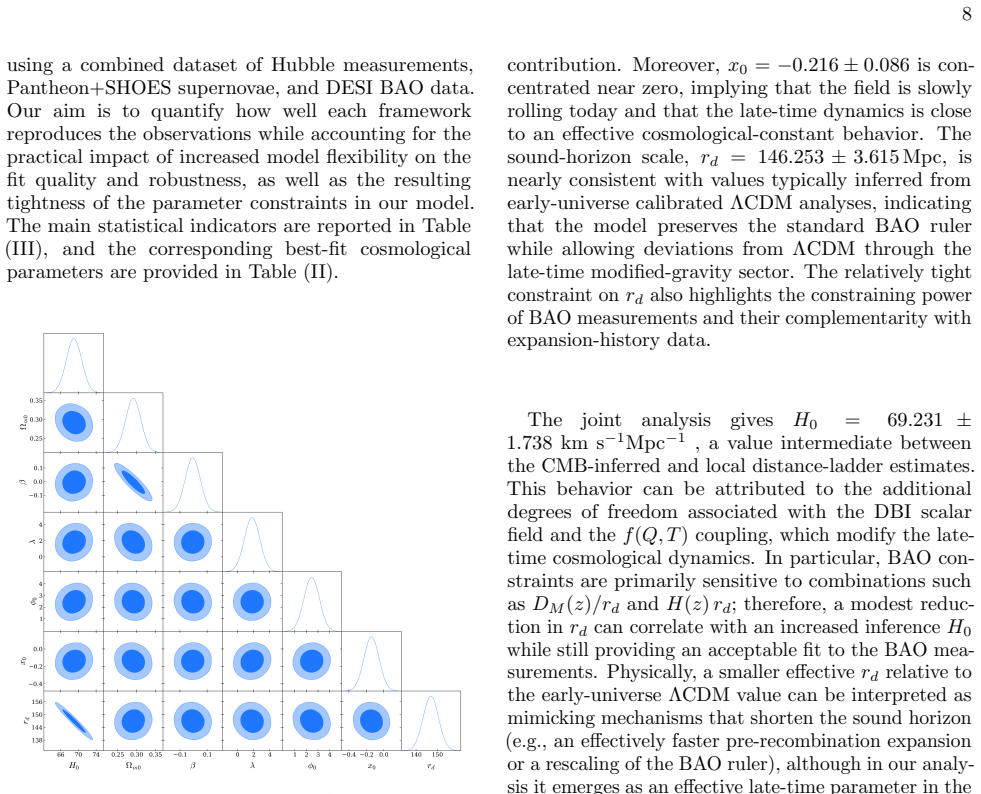
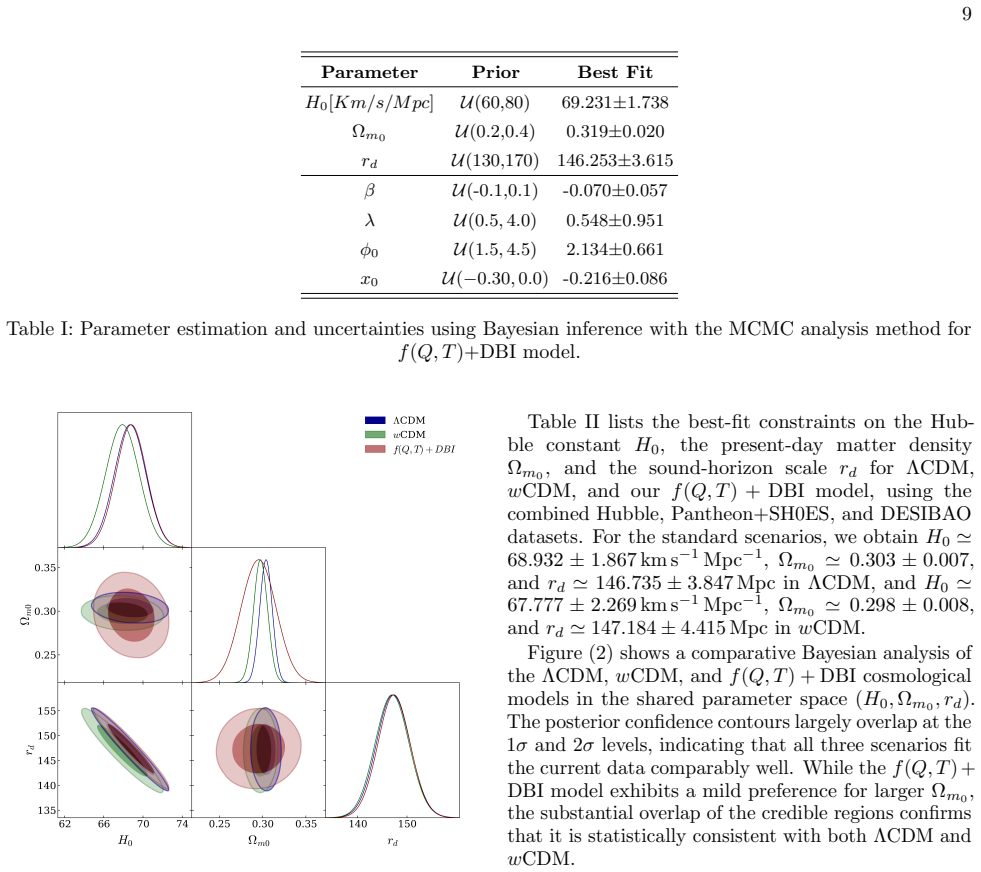
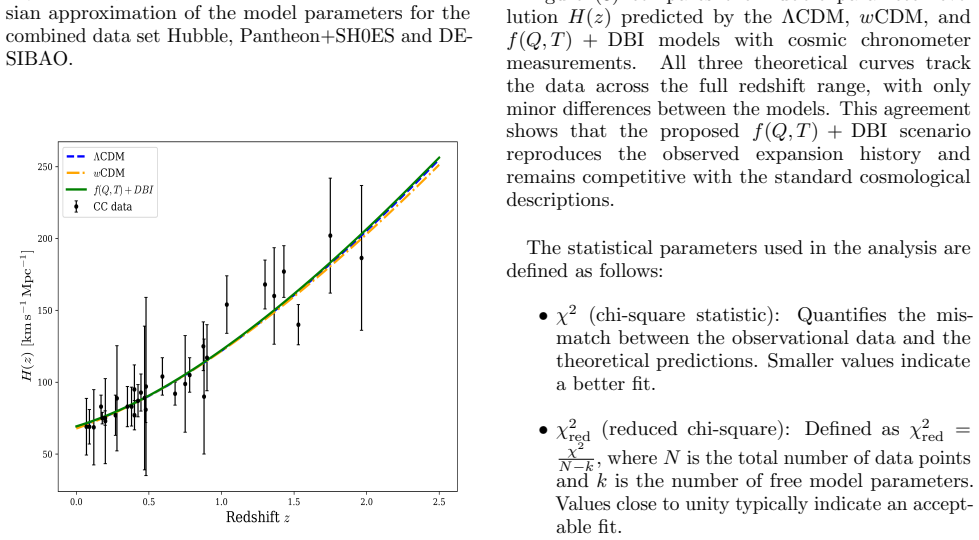
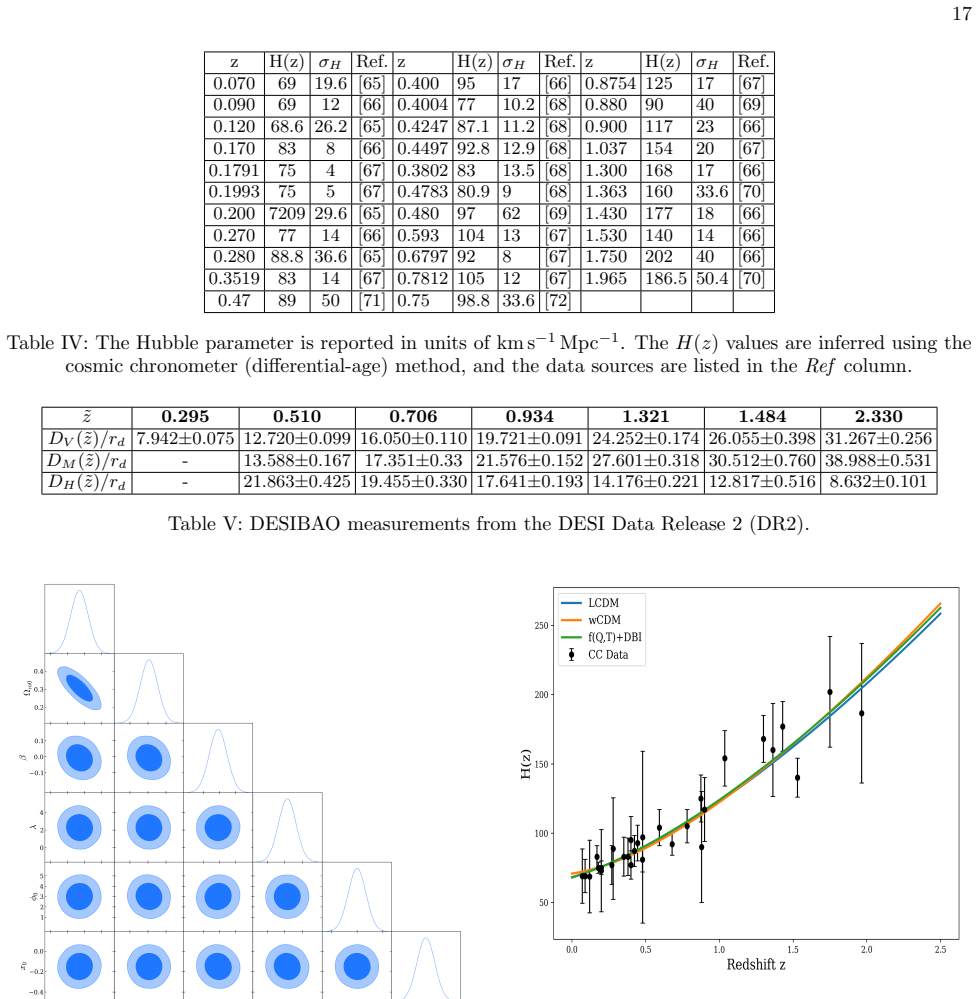
For the linear choice f(Q,T)=αQ+βT coupled to a DBI scalar field, the background equations on flat FLRW admit analytic solutions that, when fitted to Hubble, DESI BAO DR2, and Pantheon+SHOES data via MCMC, produce joint posteriors consistent with late-time constraints and allow direct comparison to ΛCDM, establishing the model as a statistically viable alternative.
What carries the argument
The linear function f(Q,T)=αQ+βT coupled to the DBI-essence scalar field, which alters the Friedmann equations through non-metricity and trace-of-stress-energy contributions.
If this is right
- The model admits direct statistical comparison with ΛCDM on identical datasets.
- The βT coupling and DBI sector produce measurable departures from standard expansion history.
- The framework supplies a concrete setting in which to explore possible remedies for the H0 discrepancy.
- Posterior constraints remain broadly consistent with current late-time observations.
Where Pith is reading between the lines
- Higher-redshift BAO or supernova samples could tighten bounds on the β parameter and reveal whether the DBI sector is required.
- The same linear f(Q,T) ansatz could be tested against growth-rate or weak-lensing data to check consistency beyond background expansion.
- Analytic solutions derived here may serve as a template for studying other scalar-field couplings in symmetric teleparallel gravity.
Load-bearing premise
The linear choice f(Q,T)=αQ+βT together with the effective perfect-fluid treatment on flat FLRW is sufficient to capture the relevant late-time dynamics.
What would settle it
A new high-precision Hubble or BAO measurement at moderate redshift lying systematically outside the 2σ range of the MCMC posterior predictions for the best-fit α, β and DBI parameters would falsify the viability statement.
Figures
read the original abstract
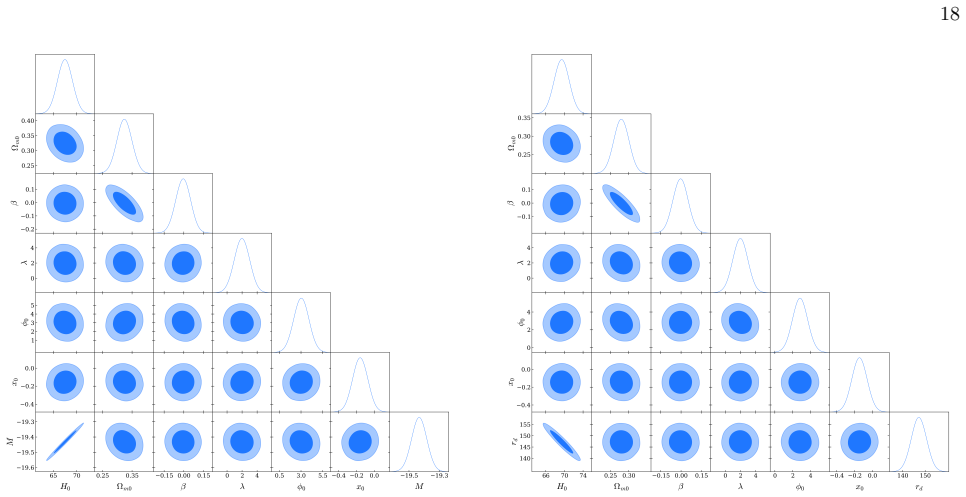
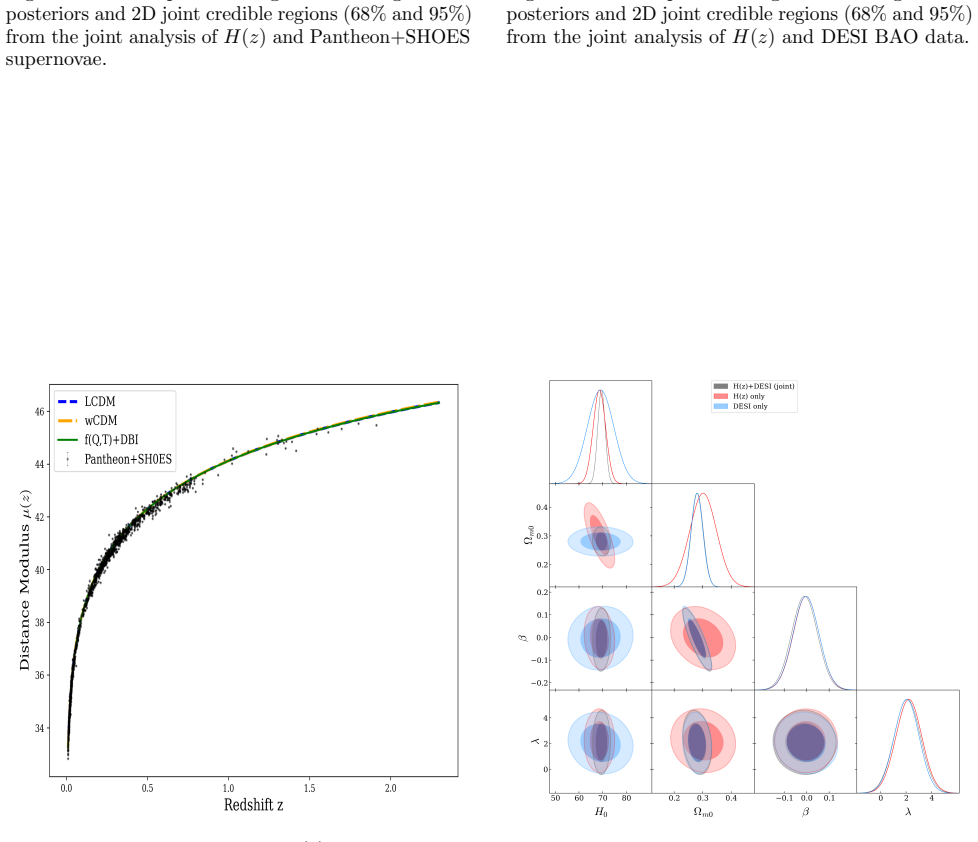
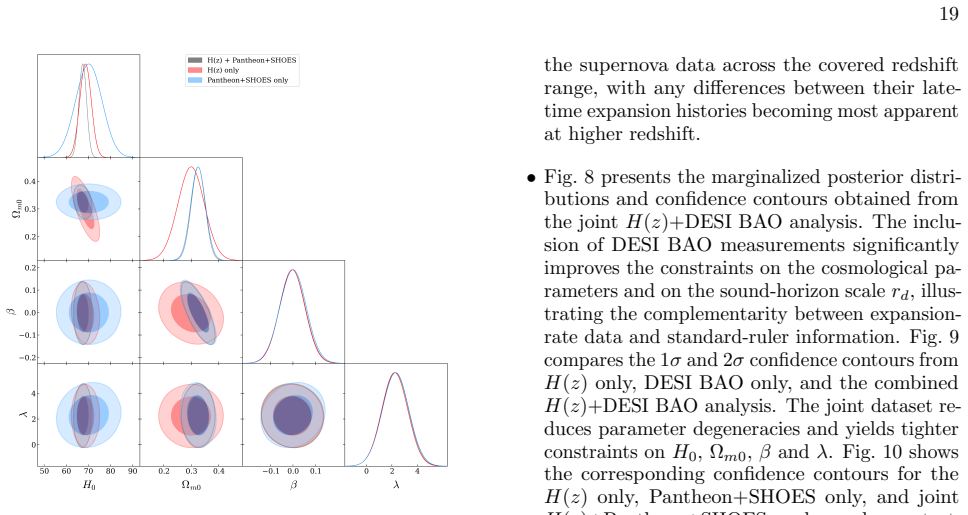
We investigate late-time cosmology in extended symmetric teleparallel gravity coupled to a Dirac-Born-Infeld (DBI) scalar field within $f(Q,T)$ gravity, where $Q$ is the non-metricity scalar and $T$ is the trace of the matter energy-momentum tensor. Working on a spatially flat Friedmann-Lema\^itre-Robertson-Walker background and treating the cosmic medium as an effective perfect fluid, we derive the background field equations for $f(Q,T)+\mathrm{DBI}$ gravity and obtain analytic solutions for the linear choice $f(Q,T)=\alpha Q+\beta T$. We then constrain the model parameters with a Markov Chain Monte Carlo analysis using Hubble-rate data, DESI BAO (DR2) measurements, and the Pantheon+SHOES Type~Ia supernova sample. The joint posteriors (Tables II and III) are broadly consistent with current late-time constraints and allow a direct comparison with $\Lambda$CDM, quantifying the departures driven by the $\beta T$ coupling and the DBI sector. Although the model does not reproduce every observational feature exactly, it provides a statistically viable alternative avenue to the standard paradigm and a useful framework for exploring potential remedies to existing tensions, including the $H_0$ discrepancy, without claiming a definitive resolution.
Editorial analysis
A structured set of objections, weighed in public.
Referee Report
Summary. The paper derives background field equations for f(Q,T) gravity coupled to a DBI scalar field on flat FLRW, treating the medium as an effective perfect fluid. For the linear choice f(Q,T)=αQ+βT it obtains analytic solutions and performs MCMC constraints using Hubble-rate, DESI BAO (DR2), and Pantheon+SHOES data. The resulting joint posteriors (Tables II and III) are reported to be consistent with late-time observations and to position the model as a statistically viable alternative to ΛCDM, with quantified departures from the βT coupling and DBI sector.
Significance. If the background equations and perfect-fluid treatment are valid, the work supplies concrete observational bounds on α and β, enables direct comparison with ΛCDM, and offers a framework for exploring remedies to the H0 tension. The inclusion of recent DESI BAO data and the analytic solutions for the linear model are positive features that facilitate reproducibility of the fits.
major comments (2)
- [background field equations section] Background field equations section: the derivation adopts the effective perfect-fluid ansatz for the cosmic medium without demonstrating that the non-canonical DBI kinetic term remains compatible with this form once coupled to the βT piece of f(Q,T). If anisotropic stress or modified continuity equations arise, the Friedmann equations underlying the MCMC analysis would be incomplete, directly affecting the reliability of the posteriors in Tables II and III and the viability claim.
- [analytic solutions] Analytic solutions for linear f(Q,T)=αQ+βT: it is not shown whether these closed-form expressions satisfy the full set of modified continuity and acceleration equations that include the DBI contributions; an explicit substitution back into the field equations (or a numerical cross-check) is required to confirm internal consistency before the solutions can be used for parameter fitting.
minor comments (2)
- [Tables II and III] Tables II and III: reporting only marginalised posteriors without the corresponding minimum χ² values or Δχ² relative to ΛCDM makes it difficult to judge the absolute goodness-of-fit and the statistical weight of the claimed viability.
- Notation: the effective equation-of-state parameter for the combined f(Q,T)+DBI system is introduced without an explicit definition in terms of the DBI Lagrangian and the βT coupling; a short clarifying equation would improve readability.
Simulated Author's Rebuttal
We thank the referee for the careful reading and constructive comments, which help improve the clarity of the manuscript. We address each major comment point by point below.
read point-by-point responses
-
Referee: [background field equations section] Background field equations section: the derivation adopts the effective perfect-fluid ansatz for the cosmic medium without demonstrating that the non-canonical DBI kinetic term remains compatible with this form once coupled to the βT piece of f(Q,T). If anisotropic stress or modified continuity equations arise, the Friedmann equations underlying the MCMC analysis would be incomplete, directly affecting the reliability of the posteriors in Tables II and III and the viability claim.
Authors: The effective perfect-fluid ansatz is preserved because the flat FLRW symmetries force the DBI stress-energy tensor to remain diagonal and isotropic, with no anisotropic stress generated by the non-canonical kinetic term. The βT coupling enters only through the trace T, which is a scalar, and is absorbed into the definitions of the effective energy density and pressure that appear in the modified Friedmann equations. The continuity equation is accordingly modified and is already incorporated when deriving the background equations used for the MCMC fits. We will add a short clarifying paragraph in the background-equations section to make this compatibility explicit. revision: yes
-
Referee: [analytic solutions] Analytic solutions for linear f(Q,T)=αQ+βT: it is not shown whether these closed-form expressions satisfy the full set of modified continuity and acceleration equations that include the DBI contributions; an explicit substitution back into the field equations (or a numerical cross-check) is required to confirm internal consistency before the solutions can be used for parameter fitting.
Authors: The closed-form solutions are obtained by direct integration of the complete set of background equations that already contain the DBI contributions to ρ and p. They therefore satisfy the full system by construction. To address the request for explicit verification, we will insert a brief appendix that substitutes the analytic expressions back into the modified continuity and acceleration equations and confirms that they hold identically; a short numerical consistency check for sample parameter values will also be included. revision: yes
Circularity Check
No significant circularity; derivation and fitting are independent steps
full rationale
The paper first derives the background field equations from the f(Q,T)+DBI action on flat FLRW under the effective perfect-fluid assumption, obtains analytic solutions for the linear ansatz f(Q,T)=αQ+βT, and only then performs MCMC parameter estimation on Hubble+BAO+SNIa data. The consistency statement and quantified departures are outputs of that standard fit rather than a claimed first-principles prediction that reduces to the fitted inputs by construction. No self-definitional equations, load-bearing self-citations, or uniqueness theorems imported from the authors' prior work appear in the derivation chain. The central claim therefore remains self-contained against external data.
Axiom & Free-Parameter Ledger
free parameters (2)
- α
- β
axioms (2)
- domain assumption Spatially flat FLRW metric
- domain assumption Cosmic medium treated as effective perfect fluid
Reference graph
Works this paper leans on
-
[1]
D. J. Eisenstein. et al. (2025). “Detection of the baryon acoustic peak in the large-scale correlation function of SDSS luminous red galaxies.”The Astro- physical Journal, 633(2), 560. https://doi.org/10.1086/466512
-
[3]
R. R. Caldwell, & M. Doran. (2004). “Cosmic mi- crowave background and supernova constraints on quintessence: concordance regions and target mod- els.”Physical Review D,69(10), 103517. https://doi.org/10.1103/PhysRevD.69.103517
-
[4]
Z. Y. Huang. et al. (2026). “Holographic explanation of wide-angle power correlation suppression in the cosmicmicrowave background radiation.”Journal of Cosmology and Astroparticle Physics,2006(05), 013. https://doi.org/10.1088/1475-7516/2006/05/ 013
-
[5]
Dark energy anisotropic stress and large scale structure formation
T. Koivisto, & D. F. Mota. (2006). “Dark energy anisotropic stress and large scale structure formation.” Physical Review D—Particles, Fields, Gravitation, and Cosmology,73(8), 083502. https://doi.org/10.1103/PhysRevD.73.083502
-
[6]
Large scale structure as a probe of gravitational slip
S. F. Daniel. et al. (2008). “Large scale structure as a probe of gravitational slip.”Physical Review D—Particles, Fields, Gravitation, and Cosmology, 77(10), 103513. https://doi.org/10.1103/PhysRevD.77.103513
-
[7]
Observational Evidence from Supernovae for an Accelerating Universe and a Cosmological Constant
A. G. Riess. et al. (1998). “Observational evidence from supernovae for an accelerating universe and a cosmological constant.”The astronomical journal, 116(3), 1009. https://doi.org/10.1086/300499
work page internal anchor Pith review doi:10.1086/300499 1998
-
[8]
Measur- ing cosmology with supernovae. In Supernovae and Gamma-Ray Bursters (pp. 195-217)
S. Perlmutter, & B. P. Schmidt. (2003). “Measur- ing cosmology with supernovae. In Supernovae and Gamma-Ray Bursters (pp. 195-217).”Berlin, Heidel- berg: Springer Berlin Heidelberg. https://doi.org/10.1007/3-540-45863-8_11
-
[9]
Astronomy and Astrophysics , author =
P. Collaboration. et al. (2015). “Planck 2015 results. XIII. Cosmological parameters.” https://doi.org/10.1051/0004-6361/201525830
-
[11]
S. M. Carroll. (2001). “The cosmological constant.” Living reviews in relativity, 4(1), 1-56. DOI:https://doi.org/10.1103/RevModPhys.61.1
-
[12]
Quintessence and the Rest of the World
S. M. Carroll. (1998). “Quintessence and the rest of the world.”arXiv preprint astro-ph/9806099. https://doi.org/10.1103/PhysRevLett.81.3067
work page internal anchor Pith review Pith/arXiv arXiv doi:10.1103/physrevlett.81.3067 1998
-
[13]
Y. Fujii. (1982). Origin of the gravitational constant and particle masses in a scale-invariant scalar-tensor theory.Physical Review D,26(10), 2580. https://doi.org/10.1103/PhysRevD.26.2580 13
-
[14]
A. Khosroshahi. et al. (2015). “International consen- sus guidance statement on the management and treat- ment of IgG4-related disease.” Arthritis & rheuma- tology, 67(7), 1688-1699. https://doi.org/10.1002/art.39132
-
[17]
M. C. Bento, O. Bertolami, & A. A. Sen. (2002). Generalized Chaplygin gas, accelerated expansion, and dark-energy-matter unification.Physical Review D, 66(4), 043507. https://doi.org/10.1103/PhysRevD.66.043507
-
[18]
B. Thakran. et al. (2025). “Cosmological constraints on interacting holographic dark energy and extended Chaplygin gas in using MCMC analysis.”Inter- national Journal of Geometric Methods in Modern Physics. https://doi.org/10.1142/S0219887825502548
-
[19]
Praveen Kumar Dhankar. et al. (2025) “Observa- tional analysis of bulk viscous modified Chaplygin gas in (2+1)-dimensional universe using MCMC,” arXiv:2504.18612 [gr-qc] https://doi.org/10.48550/arXiv.2504.18612
-
[20]
An alternative to quintessence
A. Kamenshchik, U. Moschella, & V. Pasquier. (2001). “An alternative to quintessence.” Physics Letters B,511(2-4), 265-268
2001
-
[21]
Dark energy properties in DBI theory
C. Ahn, C. Kim, & E. V. Linder. (2009). “Dark energy properties in DBI theory.”Physical Review D—Particles, Fields, Gravitation, and Cosmology, 80(12), 123016. https://doi.org/10.1016/S0370-2693(01) 00571-8
-
[22]
Cosmo- logical constant behavior in DBI theory
C. Ahn, C. Kim, & E. V. Linder. (2010). “Cosmo- logical constant behavior in DBI theory.”Physics Letters B, 684(4-5), 181-184. https://doi.org/10.1016/j.physletb.2009.12. 069
-
[23]
Bayesian Analysis of Viscous FRW Cosmology with Inhomogeneous Equation of State
R. Patel. et al. (2026). “Bayesian Analysis of Viscous FRW Cosmology with Inhomogeneous Equation of State.”Mathematics, 14(11), 1888. https://doi.org/10.3390/math14111888
-
[24]
Testing logarithmic f(G) model with observational data sets
M. Thakre. et al. (2026). “Testing logarithmic f(G) model with observational data sets”.Journal of Holog- raphy Applications in Physics. https://doi.org/10.22128/jhap.2026.3248.1191
-
[25]
Large-scale struc- ture and matter power spectrum in f(T ) gravity
P. Kumar Dhankar. et al. (2026). “Large-scale struc- ture and matter power spectrum in f(T ) gravity.” Modern Physics Letters A,2650117. https://doi.org/10.1142/S0217732326501178
-
[27]
Cosmic Hysteresis in Reconstructed f(T ) Bounce Models A Torsion- Based Thermodynamic Perspective
A. Sanyal. et al. (2026). “Cosmic Hysteresis in Reconstructed f(T ) Bounce Models A Torsion- Based Thermodynamic Perspective.”arXiv preprint arXiv:2602.15924. https://doi.org/10.48550/arXiv.2602.15924
-
[28]
Constraining f(G) gravity models using MCMC method
A. Munyeshyaka. et al. (2026). “Constraining f(G) gravity models using MCMC method.”Physics of the Dark Universe, 102246. https://doi.org/10.1016/j.dark.2026.102246
-
[29]
Studying Bianchi Type-I Uni- verses in the Modified f(R)-Gravity Scenario Using MCMC Approach
S. Joshi. et al. (2026). “Studying Bianchi Type-I Uni- verses in the Modified f(R)-Gravity Scenario Using MCMC Approach”.Iranian Journal of Science, 1-14. https://doi.org/10.1007/s40995-026-01962-x
-
[30]
Symmetric teleparallel general relativity
J. M. Nester, & H. J. Yo. (1998). “Symmetric teleparallel general relativity.”arXiv preprint gr- qc/9809049. https://doi.org/10.48550/arXiv.gr-qc/9809049
work page internal anchor Pith review doi:10.48550/arxiv.gr-qc/9809049 1998
-
[31]
J. B. Jim´ enez, L. Heisenberg, & T. Koivisto. (2018). “Coincident general relativity.”Physical Review D, 98(4), 044048. DOI:https://doi.org/10.1103/PhysRevD.98. 044048
-
[32]
J. B. Jim´ enez. et al. (2020). “Cosmology in f(Q) geometry.”Physical Review D, 101(10), 103507. https://doi.org/10.1103/PhysRevD.101.103507
-
[33]
Observational constraints of f(Q) gravity
R. Lazkoz. et al. (2019). “Observational constraints of f(Q) gravity.”Physical Review D, 100(10), 104027. https://doi.org/10.1103/PhysRevD.100.104027
-
[35]
General- ized curvature-matter couplings in modified gravity,
T. Harko and F. S. N. Lobo, (2014) “General- ized curvature-matter couplings in modified gravity,” Galaxies 2, 3, 410-465 https://doi.org/10.3390/ galaxies2030410
2014
-
[36]
T. Harko, et al. (2011). “ f(R, T) gravity.”Physical Review D—Particles, Fields, Gravitation, and Cosmology,84(2), 024020. DOI:https://doi.org/10.1103/PhysRevD.84. 024020
-
[37]
Thermodynamics and cosmol- ogy
I. Prigogine, (1989). “Thermodynamics and cosmol- ogy.”International journal of theoretical physics, 28(9), 927-933. https://doi.org/10.1007/BF00670337
-
[38]
Physical Review D , year = 1981, month = jan, volume =
A. H. Guth, (1981). “Inflationary universe: A pos- sible solution to the horizon and flatness problems.” Physical Review D, 23(2), 347. https://doi.org/10.1103/PhysRevD.23.347
-
[39]
Physics Letters B , year = 1982, month = feb, volume = 108, pages =
A. D. Linde, (1982). “A new inflationary universe scenario: a possible solution of the horizon, flatness, homogeneity, isotropy and primordial monopole prob- lems.”Physics Letters B, 108(6), 389-393. https://doi.org/10.1016/0370-2693(82)91219-9
-
[40]
Cosmology for grand unified theories with radiatively induced symmetry breaking
A. Albrecht, & P. J. Steinhardt, (1982). “Cosmology for grand unified theories with radiatively induced symmetry breaking.”Physical Review Letters,48(17), 1220. https://doi.org/10.1103/PhysRevLett.48.1220
-
[41]
E. J. Copeland, M. Sami, & S. Tsujikawa, (2006). “Dynamics of dark energy.”International Journal of Modern Physics D,15(11), 1753-1935. https://doi.org/10.1142/S021827180600942X
-
[42]
Cosmological Consequences of a Rolling Homogeneous Scalar Field
B. Ratra, & P. J. Peebles, (1988). “Cosmological consequences of a rolling homogeneous scalar field.” Physical Review D, 37(12), 3406. https://doi.org/10.1103/PhysRevD.37.3406
-
[43]
Cosmological imprint of an energy component with general equation of state
R. R. Caldwell, R. Dave, & P. J. Steinhardt, (1998). “Cosmological imprint of an energy component with general equation of state.”Physical Review Letters, 80(8), 1582. https://doi.org/10.1103/PhysRevLett.80.1582
-
[44]
Purely kinetic k essence as unified dark matter
R. J. Scherrer, (2004). “Purely kinetic k essence as unified dark matter.”Physical review letters,93(1), 14 011301. https://doi.org/10.1103/PhysRevLett.93. 011301
-
[45]
Dynamical solution to the problem of a small cosmological constant and late-time cosmic acceleration
C. Armendariz-Picon, V. Mukhanov, & P. J. Stein- hardt, (2000). “Dynamical solution to the problem of a small cosmological constant and late-time cosmic acceleration.”Physical Review Letters, 85(21), 4438. https://doi.org/10.1103/PhysRevLett.85.4438
-
[46]
Non-Gaussian features of primordial fluctuations in single field inflationary models
J. Maldacena, (2003). “Non-Gaussian features of primordial fluctuations in single field inflationary models.”Journal of High Energy Physics, 2003(05), 013-013. https://doi.org/10.1088/1126-6708/2003/05/ 013
-
[47]
Running non-Gaussianities in Dirac-Born-Infeld inflation
C. Xingang, (2005). “Running non-Gaussianities in Dirac-Born-Infeld inflation.”Physical Review. D, Par- ticles Fields, 72(12). https://doi.org/10.1103/PhysRevD.72.123518
-
[48]
Perturba- tions in k-inflation
J. Garriga, & V. F. Mukhanov, (1999). “Perturba- tions in k-inflation.”Physics Letters B,458(2-3), 219-225. https://doi.org/10.1016/S0370-2693(99) 00602-4
-
[51]
Ki- netically driven quintessence
T. Chiba, T. Okabe, & M. Yamaguchi, (2000). “Ki- netically driven quintessence.”Physical Review D, 62(2), 023511. https://doi.org/10.1103/PhysRevD.62.023511
-
[52]
C. Armendariz-Picon, V. Mukhanov, & P. J. Stein- hardt, (2001). “Essentials of k-essence.”Physical Re- view D, 63(10), 103510. https://doi.org/10.1103/PhysRevD.63.103510
-
[53]
Second-order scalar-tensor field equations in a four-dimensional space
G. W. Horndeski, “Second-order scalar-tensor field equations in a four-dimensional space”, Int. J. Theor. Phys.10, 363–384, (1974), https://doi.org/10. 1007/BF01807638
1974
-
[54]
Fromk-essence to generalized Galileons
C. Deffayet, X. Gao, D. A. Steer, and G. Zahariade, “Fromk-essence to generalized Galileons”, Phys. Rev. D84, 064039, (2011), https://doi.org/10.1103/ PhysRevD.84.064039
2011
-
[55]
Gen- eralized G-inflation: Inflation with the most general second-order field equations
T. Kobayashi, M. Yamaguchi and J. Yokoyama, “Gen- eralized G-inflation: Inflation with the most general second-order field equations”, Prog. Theor. Phys. 126, 511-529, (2011), https://doi.org/10.1143/ PTP.126.511
2011
-
[56]
L. Heisenberg, (2024). “Review on f(Q) gravity.” Physics Reports, 1066, 1-78. https://doi.org/10.1016/j.physrep.2024.02. 001
-
[57]
K-essence: cosmology, causal- ity and emergent geometry
A. Vikman, (2007). “K-essence: cosmology, causal- ity and emergent geometry” (Doctoral dissertation, M¨ unchen, Univ., Diss., 2007)
2007
-
[58]
J. Martin, & M. Yamaguchi, (2008). “DBI-essence.” Physical Review D—Particles, Fields, Gravitation, and Cosmology,77(12), 123508. https://doi.org/10.1103/PhysRevD.77.123508
-
[59]
G. Manna, (2020). “Gravitational collapse for the K-essence emergent Vaidya spacetime.”The European Physical Journal C, 80(9), 1-9. https://doi.org/10.1140/epjc/ s10052-020-8383-y
-
[60]
k-essence emergent spacetime as a generalized Vaidya geometry
G. Manna, P. Majumdar, & B. Majumder, (2020). “k-essence emergent spacetime as a generalized Vaidya geometry.”Physical Review D, 101(12), 124034.(2020). https://doi.org/10.1103/PhysRevD.101.124034
-
[61]
Observational Insights on DBI K-Essence Models Using Machine Learning and Bayesian Analysis
S. Ganguly, et al. (2026). “Observational Insights on DBI K-Essence Models Using Machine Learning and Bayesian Analysis.”Fortschritte der Physik,74(5), e70117. https://doi.org/10.1002/prop.70117
-
[62]
Gravitational Wave Propagation in K-essence Cosmology: Theory and Observational Constraints
S. Bhunia et al., (2026), “Gravitational Wave Prop- agation in K-essence Cosmology: Theory and Ob- servational Constraints,” arXiv: 2605.25466, https: //doi.org/10.48550/arXiv.2605.25466
work page internal anchor Pith review Pith/arXiv arXiv doi:10.48550/arxiv.2605.25466 2026
-
[63]
Dynamical system analysis of a Dirac-Born-Infeld model: a center mani- fold perspective
S. Pal, & S. Chakraborty, (2019). “Dynamical system analysis of a Dirac-Born-Infeld model: a center mani- fold perspective.”General Relativity and Gravitation, 51(9), 124. https://doi.org/10.1007/s10714-019-2608-0
-
[64]
Ex- ploring the dynamics of coincident f (Q) gravity in the presence of DBI-essence scalar field
R. Mandal, U. Debnath& A. Pradhan, (2025). “Ex- ploring the dynamics of coincident f (Q) gravity in the presence of DBI-essence scalar field.”Annals of Physics,170245. https://doi.org/10.1016/j.aop.2025.170245
-
[65]
Research in Astronomy and Astrophysics , abstract =
C. Zhang, et al. (2014). “Four new observational H (z) data from luminous red galaxies in the Sloan Digital Sky Survey data release seven.”Research in Astronomy and Astrophysics, 14(10), 1221-1233. https://doi.org/10.1088/1674-4527/14/10/002
work page internal anchor Pith review doi:10.1088/1674-4527/14/10/002 2014
-
[66]
J. Simon, L. Verde & R. Jimenez, (2005). “Con- straints on the redshift dependence of the dark en- ergy potential.”Physical Review D—Particles, Fields, Gravitation, and Cosmology, 71(12), 123001. https://doi.org/10.1103/PhysRevD.71.123001
work page internal anchor Pith review doi:10.1103/physrevd.71.123001 2005
-
[67]
M. Moresco, et al. (2012). “Improved constraints on the expansion rate of the Universe up to z ∼ 1.1 from the spectroscopic evolution of cosmic chronometers.” Journal of Cosmology and Astroparticle Physics, 2012(08), 006. https://doi.org/10.1088/1475-7516/2012/08/ 006
-
[68]
M. Moresco, et al. (2016). “A 6 % measurement of the Hubble parameter at z ∼ 0.45: direct evidence of the epoch of cosmic re-acceleration.”Journal of Cosmology and Astroparticle Physics, 2016(05), 014. https://doi.org/10.1088/1475-7516/2016/05/ 014
-
[69]
Cosmic chronometers: constraining the equation of state of dark energy. I: H (z) measurements
D. Stern, et al. (2010). “Cosmic chronometers: constraining the equation of state of dark energy. I: H (z) measurements.”Journal of Cosmology and Astroparticle Physics, 2010(02), 008. https://doi.org/10.1088/1475-7516/2010/02/ 008
-
[70]
Monthly Notices of the Royal Astronomical Society: Letters , volume =
M. Moresco, (2015). “Raising the bar: new con- straints on the Hubble parameter with cosmic chronometers at z∼ 2.”Monthly Notices of the Royal Astronomical Society: Letters, 450(1), L16-L20. https://doi.org/10.1093/mnrasl/slv037
work page internal anchor Pith review doi:10.1093/mnrasl/slv037 2015
-
[71]
Age-dating lumi- nous red galaxies observed with the Southern African Large Telescope
A. L. Ratsimbazafy, et al. (2017). “Age-dating lumi- nous red galaxies observed with the Southern African Large Telescope.”Monthly Notices of the Royal As- tronomical Society,467(3), 3239-3254
2017
-
[72]
To- ward a better understanding of cosmic chronometers: a new measurement of H (z) at z ∼ 0.7
N. Borghi, M. Moresco, & A. Cimatti, (2022). “To- ward a better understanding of cosmic chronometers: a new measurement of H (z) at z ∼ 0.7. ”The Astro- physical Journal Letters,928(1), L4. 15
2022
-
[73]
Constraints on DBI dark energy with chameleon mechanism
B. Gumjudpai, N. Roy, & J. Ward, (2025). “Con- straints on DBI dark energy with chameleon mecha- nism.”arXiv preprint arXiv:2508.05436. https://doi.org/10.48550/arXiv.2508.05436
work page internal anchor Pith review Pith/arXiv arXiv doi:10.48550/arxiv.2508.05436 2025
-
[74]
Scalar speed limits and cosmology: Acceleration from D-cceleration
E. Silverstein, & D. Tong, (2004). “Scalar speed limits and cosmology: Acceleration from D-cceleration.” Physical Review D—Particles, Fields, Gravitation, and Cosmology, 70(10), 103505. https://doi.org/10.1103/PhysRevD.70.103505
-
[75]
DBI in the sky: non-Gaussianity from inflation with a speed limit
M. Alishahiha, E. Silverstein, & D. Tong, (2004). “DBI in the sky: non-Gaussianity from inflation with a speed limit.”Physical Review D—Particles, Fields, Gravitation, and Cosmology, 70(12), 123505. https://doi.org/10.1103/PhysRevD.70.123505
-
[76]
S. Hussain, et al. (2026). “Probing the dynamics of Gaussian dark energy equation of state using DESI BAO.”Monthly Notices of the Royal Astronomical Society,545(2), staf1924. https://doi.org/10.1093/mnras/staf1924
-
[77]
Akaike, A new look at the statistical model identification
H. Akaike, (1974). “A new look at the statistical model identification.”IEEE transactions on auto- matic control, 19(6), 716-723. https://doi.org/10.1109/TAC.1974.1100705
-
[78]
Estimating the dimension of a model
G. Schwarz, (1978). “Estimating the dimension of a model.”The annals of statistics, 461-464. https://www.jstor.org/stable/2958889
arXiv 1978
-
[79]
The role of machine learning in the next decade of cosmology
M. Ntampaka, et al. (2019). “The role of machine learning in the next decade of cosmology.”arXiv preprint arXiv:1902.10159. https://doi.org/10.48550/arXiv.1902.10159
-
[80]
W. J. Percival, et al. (2010). “Baryon acoustic oscillations in the Sloan Digital Sky Survey data release 7 galaxy sample.”Monthly Notices of the Royal Astronomical Society,401(4), 2148-2168. https://doi.org/10.1111/j.1365-2966.2009. 15812.x
-
[81]
Probing dark energy using baryonic oscillations in the galaxy power spectrum as a cosmological ruler
C. Blake, & K. Glazebrook, (2003). “Probing dark energy using baryonic oscillations in the galaxy power spectrum as a cosmological ruler.”The Astrophysical Journal,594(2), 665-673. https://doi.org/10.1086/376983
-
[82]
Small-scale cosmo- logical perturbations: an analytic approach
W. Hu, & N. Sugiyama, (1996). “Small-scale cosmo- logical perturbations: an analytic approach.”The Astrophysical Journal,471(2), 542-570. https://doi.org/10.1086/177989
-
[83]
and Hu, Wayne , year = 1998, month = mar, journal =
D. J. Eisenstein, & W. Hu, (1998). “Baryonic features in the matter transfer function.”The Astrophysical Journal,496(2), 605-614. https://doi.org/10.1086/305424
-
[84]
M. Abdul Karim, et al. (2025). “DESI DR2 results. II. Measurements of baryon acoustic oscillations and cosmological constraints.”Physical Review D,112(8), 083515. https://doi.org/10.1103/tr6y-kpc6
-
[85]
Data analysis recipes: Fitting a model to data
D. W. Hogg, J. Bovy, & D. Lang, (2010). “Data analysis recipes: Fitting a model to data.”arXiv preprint arXiv:1008.4686. https://doi.org/10.48550/arXiv.1008.4686
work page internal anchor Pith review Pith/arXiv arXiv doi:10.48550/arxiv.1008.4686 2010
-
[86]
D. W. Hogg, & D. Foreman-Mackey, (2018). “Data analysis recipes: Using markov chain monte carlo.” The Astrophysical Journal Supplement Series,236(1), 11. https://doi.org/10.3847/1538-4365/aab76e
-
[87]
2022, The Astrophysical Journal, 938, 110, doi: 10.3847/1538-4357/ac8e04
D. Brout, et al. (2022). “The Pantheon+ analysis: cosmological constraints.”The Astrophysical Journal, 938(2), 110. https://doi.org/10.3847/1538-4357/ac8e04
-
[88]
D. Scolnic, et al. (2022). “The Pantheon+ analysis: the full data set and light-curve release.”The Astro- physical Journal,938(2), 113. https://doi.org/10.3847/1538-4357/ac8b7a
discussion (0)
Sign in with ORCID, Apple, or X to comment. Anyone can read and Pith papers without signing in.