REVIEW 2 major objections 1 minor 48 references
A receptor-glomerular bottleneck inspired by olfaction improves low-resource NER F1 scores by regularization.
Reviewed by Pith at T0; open to challenge. T0 means a machine referee read the full paper against a public rubric. the ladder, T0–T4 →
T0 review · grok-4.3
2026-06-26 12:24 UTC pith:PA5Y3YUB
load-bearing objection The paper adds an olfactory-inspired bottleneck to low-resource NER and reports gains mainly in Bangla and Telugu, but the edge over generic bottlenecks looks narrow and needs matched controls to confirm. the 2 major comments →
Olfactory-Inspired Sparse Combinatorial Coding for Low-Resource Named Entity Recognition
The pith
A machine-rendered reading of the paper's core claim, the machinery that carries it, and where it could break.
Core claim
Introducing a receptor-glomerular bottleneck between token embeddings and a BiLSTM-CRF sequence model yields F1 score improvements under severe data scarcity, primarily by acting as a powerful regularizer. Under the 1k capped training condition, at least one olfactory-inspired configuration achieves the highest mean F1 score across all six datasets. The architecture provides a significant advantage in languages like Bangla where generic bottlenecks degrade performance, and sparse specialization emerges within the receptor layer.
What carries the argument
receptor-glomerular bottleneck: a biologically-inspired layer enforcing sparse combinatorial coding between token embeddings and the sequence labeler
Load-bearing premise
That the performance edge in Bangla and Telugu arises specifically from the olfactory receptor-glomerular structure rather than from any generic bottleneck or regularization effect.
What would settle it
If a generic non-olfactory bottleneck achieves equal or higher F1 scores than the olfactory version on the Bangla and Telugu datasets under identical 1k training conditions, the claim that the specific biological structure is responsible would be falsified.
If this is right
- Under 1k-sentence training, at least one olfactory configuration achieves the highest mean F1 across all six datasets.
- The architecture delivers notable F1 gains in Bangla (+6.23% over baseline) and in ultra-low-resource Telugu.
- Sparse specialization emerges naturally within the receptor layer.
- The gains occur primarily through the regularization effect of the structured bottleneck.
Where Pith is reading between the lines
- The approach could extend to other sequence labeling tasks such as part-of-speech tagging under similar data limits.
- The advantage over generic bottlenecks may be tied to specific language families or writing systems rather than a universal property.
- Such bottlenecks might enable effective NER in settings where even generic regularization layers fail.
- Optimal receptor and glomerular dimensions could be derived from dataset statistics without manual tuning.
Editorial analysis
A structured set of objections, weighed in public.
Referee Report
Summary. The paper introduces a receptor-glomerular bottleneck inspired by biological olfaction, placed between token embeddings and a BiLSTM-CRF for named entity recognition. It evaluates the architecture on six multilingual datasets trained from scratch under varying data scales, including a strict 1k-sentence low-resource setting, claiming that the bottleneck acts as a regularizer yielding F1 improvements under scarcity, with at least one olfactory configuration achieving the highest mean F1 across datasets and specific gains in Bangla (+8.47% over best control) and Telugu.
Significance. If the receptor-glomerular structure supplies an inductive bias beyond generic sparsity or dimensionality reduction, the approach could provide a new regularization strategy for low-resource sequence labeling. The multi-dataset evaluation under a 1k cap and observation of emergent sparse specialization are positive aspects of the experimental design.
major comments (2)
- [Results / Experimental Setup] Results section (and associated experimental setup): the generic bottleneck controls must be shown to be capacity-matched to the olfactory receptor layer in hidden dimension, sparsity fraction, and initialization. The abstract reports near-ties on most languages and isolates gains to Bangla and Telugu; without explicit matching details, the advantage cannot be attributed to the combinatorial coding motif rather than an incidental difference in regularization strength.
- [Results] Evaluation protocol: no variance estimates, standard deviations across runs, or statistical significance tests are referenced for the reported F1 differences (e.g., +8.47% in Bangla). This is required to establish that the isolated gains are reliable rather than within-run noise.
minor comments (1)
- [Abstract] The abstract states improvements under the 1k condition but does not specify the exact number of runs or random seeds used for the mean F1 scores.
Simulated Author's Rebuttal
Thank you for the constructive feedback on our manuscript. We address each major comment below and commit to revisions that strengthen the experimental rigor without altering the core claims.
read point-by-point responses
-
Referee: [Results / Experimental Setup] Results section (and associated experimental setup): the generic bottleneck controls must be shown to be capacity-matched to the olfactory receptor layer in hidden dimension, sparsity fraction, and initialization. The abstract reports near-ties on most languages and isolates gains to Bangla and Telugu; without explicit matching details, the advantage cannot be attributed to the combinatorial coding motif rather than an incidental difference in regularization strength.
Authors: We agree that capacity matching is required to attribute gains specifically to the combinatorial coding motif. The generic bottleneck controls were configured with identical hidden dimensions, sparsity fractions, and initialization distributions as the olfactory receptor layers; however, these matching details were not explicitly tabulated or described in the experimental setup. We will revise the manuscript to include a dedicated subsection and table confirming the matched parameters for each control configuration across all datasets. revision: yes
-
Referee: [Results] Evaluation protocol: no variance estimates, standard deviations across runs, or statistical significance tests are referenced for the reported F1 differences (e.g., +8.47% in Bangla). This is required to establish that the isolated gains are reliable rather than within-run noise.
Authors: We acknowledge that the absence of variance estimates and significance testing weakens the reliability of the reported differences. The current results reflect single-run evaluations. We will rerun all experiments with at least five random seeds, report mean F1 scores with standard deviations, and include statistical tests (e.g., paired t-tests) for the Bangla and Telugu gains in the revised results section and tables. revision: yes
Circularity Check
No circularity: purely empirical architecture comparison with no derivations or fitted predictions
full rationale
The paper introduces a receptor-glomerular bottleneck architecture for NER and reports empirical F1 results across datasets under low-resource conditions. No equations, parameter-fitting steps, or first-principles derivations are described that could reduce to inputs by construction. All claims rest on experimental comparisons to baselines and controls rather than self-referential definitions or self-citation chains. The central result (performance under 1k training) is an observed outcome, not a prediction forced by the model definition itself.
Axiom & Free-Parameter Ledger
axioms (1)
- domain assumption Biological olfaction relies on sparse combinatorial coding through receptor and glomerular organization and this organization offers a compelling paradigm for learning robust representations under uncertainty.
invented entities (1)
-
receptor-glomerular bottleneck
no independent evidence
read the original abstract
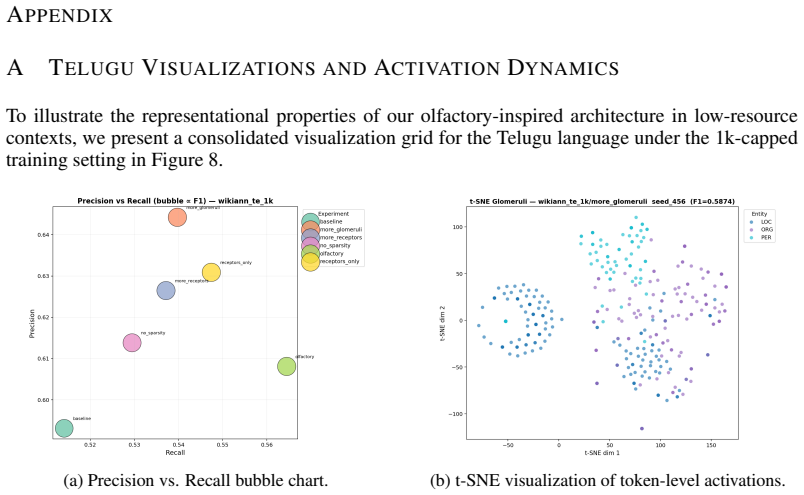
Named Entity Recognition (NER) in low-resource languages suffers from limited supervision and a lack of high-quality pretrained embeddings. Biological olfaction, which relies on sparse combinatorial coding through receptor and glomerular organization, offers a compelling paradigm for learning robust representations under uncertainty. In this paper, we introduce a receptor-glomerular bottleneck - a novel, biologically-inspired olfactory architecture - between standard token embeddings and a BiLSTM-CRF sequence model. We evaluate our architecture across six multilingual datasets trained entirely from scratch (without pre-trained embeddings) under varied data-scale conditions, including a strict 1k-sentence low-resource control. Our results demonstrate that introducing a representation bottleneck yields F1 score improvements under severe data scarcity, primarily by acting as a powerful regularizer. Under the 1k capped training condition, at least one olfactory-inspired configuration achieves the highest mean F1 score across all six datasets. While these improvements represent near-ties with generic bottleneck controls for most languages, the olfactory architecture provides a significant advantage in languages like Bangla (+6.23% F1 over standard baseline and +8.47% F1 over the best control baseline) where generic bottlenecks degrade performance. We also observe improvements in the ultra-low-resource Telugu setting (+4.43% F1) at full-scale, and find that sparse specialization naturally emerges within the receptor layer. Our findings suggest that structured sparse coding inspired by olfactory networks serves as an effective inductive bias and regularizer when representations must be learned from limited or noisy supervision.
Figures




Reference graph
Works this paper leans on
-
[1]
Proceedings of NAACL , year=
Neural Architectures for Named Entity Recognition , author=. Proceedings of NAACL , year=
-
[2]
Bidirectional LSTM-CRF Models for Sequence Tagging
Bidirectional LSTM-CRF Models for Sequence Tagging , author=. arXiv preprint arXiv:1508.01991 , year=
work page internal anchor Pith review Pith/arXiv arXiv
-
[3]
Proceedings of NAACL , year=
BERT: Pre-training of Deep Bidirectional Transformers for Language Understanding , author=. Proceedings of NAACL , year=
-
[4]
Nature , volume=
Emergence of Simple-Cell Receptive Field Properties by Learning a Sparse Code for Natural Images , author=. Nature , volume=
-
[5]
International Conference on Learning Representations , year=
Outrageously Large Neural Networks: The Sparsely-Gated Mixture-of-Experts Layer , author=. International Conference on Learning Representations , year=
-
[6]
Cell , volume=
A Novel Multigene Family May Encode Odorant Receptors: A Molecular Basis for Odor Recognition , author=. Cell , volume=
-
[7]
The information bottleneck method
The Information Bottleneck Method , author=. arXiv preprint physics/0004057 , year=
work page internal anchor Pith review Pith/arXiv arXiv
-
[8]
Neuron , volume=
Evolving the Olfactory System with Machine Learning , author=. Neuron , volume=
-
[9]
Proceedings of MetaNLP , year=
Meta-Learning for Few-Shot Named Entity Recognition , author=. Proceedings of MetaNLP , year=
-
[10]
Proceedings of EMNLP , pages=
GloVe: Global Vectors for Word Representation , author=. Proceedings of EMNLP , pages=
-
[11]
Proceedings of BSNLP , year=
Named Entity Recognition for Low-Resource Languages - Profiting from Language Families , author=. Proceedings of BSNLP , year=
-
[12]
Proceedings of CoNLL , pages=
Introduction to the CoNLL-2003 Shared Task: Language-Independent Named Entity Recognition , author=. Proceedings of CoNLL , pages=
2003
-
[13]
Proceedings of AAAI , year=
Structured IB: Improving Information Bottleneck with Structured Feature Learning , author=. Proceedings of AAAI , year=
-
[14]
Proceedings of the International Conference on Learning Representations (ICLR) , year=
Deep Variational Information Bottleneck , author=. Proceedings of the International Conference on Learning Representations (ICLR) , year=
-
[15]
2016 , publisher=
Deep Learning , author=. 2016 , publisher=
2016
-
[16]
Journal of Machine Learning Research , volume=
Switch Transformers: Scaling to Trillion Parameter Models with Simple and Efficient Sparsity , author=. Journal of Machine Learning Research , volume=
-
[17]
Proceedings of the International Conference on Learning Representations (ICLR) Workshop , year=
Recent Advances in Named Entity Recognition: A Comprehensive Survey and Comparative Study , author=. Proceedings of the International Conference on Learning Representations (ICLR) Workshop , year=
-
[18]
Nature Neuroscience , volume=
Sparse, decorrelated odor coding in the mushroom body enhances learned odor discrimination , author=. Nature Neuroscience , volume=
-
[19]
NeurIPS , year=
Attention Is All You Need , author=. NeurIPS , year=
-
[20]
Nature Neuroscience , volume=
Predictive Coding in the Visual Cortex: A Functional Interpretation of Some Extra-Classical Receptive-Field Effects , author=. Nature Neuroscience , volume=
-
[21]
Nature , volume=
Hybrid Computing Using a Neural Network with Dynamic External Memory , author=. Nature , volume=
-
[22]
A spatial map of olfactory receptor expression in the
Vosshall, Leslie B and Amrein, Hubert and Morozov, Pavel S and Rzhetsky, Andrey and Axel, Richard , journal=. A spatial map of olfactory receptor expression in the. 1999 , publisher=
1999
-
[23]
Cell , volume=
An olfactory sensory map in the fly brain , author=. Cell , volume=. 2000 , publisher=
2000
-
[24]
Cell , volume=
A novel multigene family may encode odorant receptors: a molecular basis for odor recognition , author=. Cell , volume=. 1991 , publisher=
1991
-
[25]
Proceedings of the National Academy of Sciences , volume=
The mouse olfactory receptor gene family , author=. Proceedings of the National Academy of Sciences , volume=. 2004 , publisher=
2004
-
[26]
Nature neuroscience , volume=
The olfactory receptor gene superfamily of the mouse , author=. Nature neuroscience , volume=. 2002 , publisher=
2002
-
[27]
Cell , volume=
Visualizing an olfactory sensory map , author=. Cell , volume=. 1996 , publisher=
1996
-
[28]
Cell , volume=
A zonal organization of odorant receptor gene expression in the olfactory epithelium , author=. Cell , volume=. 1993 , publisher=
1993
-
[29]
Cell , volume=
Information coding in the olfactory system: evidence for a stereotyped and highly organized epitope map in the olfactory bulb , author=. Cell , volume=. 1994 , publisher=
1994
-
[30]
Cell , volume=
Topographic organization of sensory projections to the olfactory bulb , author=. Cell , volume=. 1994 , publisher=
1994
-
[31]
Comprehensive maps of
Jefferis, Gregory SXE and Potter, Christopher J and Chan, Alexander M and Marin, Elizabeth C and Rohlfing, Torsten and Maurer Jr, Calvin R and Luo, Liqun , journal=. Comprehensive maps of. 2007 , publisher=
2007
-
[32]
Representation of the glomerular olfactory map in the
Marin, Elizabeth C and Jefferis, Gregory SXE and Komiyama, Takaki and Zhu, Haining and Luo, Liqun , journal=. Representation of the glomerular olfactory map in the. 2002 , publisher=
2002
-
[33]
Spatial representation of the glomerular map in the
Wong, Allan M and Wang, Jing W and Axel, Richard , journal=. Spatial representation of the glomerular map in the. 2002 , publisher=
2002
-
[34]
Journal of cell science , volume=
The mitral and short axon cells of the olfactory bulb , author=. Journal of cell science , volume=. 1970 , publisher=
1970
-
[35]
Associative odor learning in
de Belle, J Steven and Heisenberg, Martin , journal=. Associative odor learning in. 1994 , publisher=
1994
-
[36]
Disruption of neurotransmission in
Dubnau, Josh and Grady, Leo and Kitamoto, Toshihiro and Tully, Tim , journal=. Disruption of neurotransmission in. 2001 , publisher=
2001
-
[37]
1985 , publisher=
Heisenberg, Martin and Borst, Alexander and Wagner, Sibylle and Byers, David , journal=. 1985 , publisher=
1985
-
[38]
The role of
McGuire, Sean E and Le, Phi T and Davis, Ronald L , journal=. The role of. 2001 , publisher=
2001
-
[39]
Neuron , volume=
Neural circuit mechanisms for pattern detection and feature combination in olfactory cortex , author=. Neuron , volume=. 2011 , publisher=
2011
-
[40]
Nature , volume=
Cortical representations of olfactory input by trans-synaptic tracing , author=. Nature , volume=. 2011 , publisher=
2011
-
[41]
Random convergence of olfactory inputs in the
Caron, Sophie JC and Ruta, Vanessa and Abbott, LF and Axel, Richard , journal=. Random convergence of olfactory inputs in the. 2013 , publisher=
2013
-
[42]
The connectome of the adult
Li, Feng and Lindsey, Jack W and Marin, Elizabeth C and Otto, Nils and Dreher, Marisa and Dempsey, Georgia and Stark, Iaroslav and Bates, Alexander Shakeel and Pleijzier, Markus William and Schlegel, Philipp and others , journal=. The connectome of the adult. 2020 , publisher=
2020
-
[43]
A complete electron microscopy volume of the brain of adult
Zheng, Zhihao and Lauritzen, J Scott and Perlman, Eric and Robinson, Camillia G and Nichols, Matthew and Milkie, Daniel and Torrens, Omar and Price, John and Fisher, Corey B and Sharifi, Nadiya and others , journal=. A complete electron microscopy volume of the brain of adult. 2018 , publisher=
2018
-
[44]
Neuron , volume=
Evolving the olfactory system with machine learning , author=. Neuron , volume=. 2021 , publisher=
2021
-
[45]
Neuron , volume=
Sparseness and expansion in sensory representations , author=. Neuron , volume=. 2014 , publisher=
2014
-
[46]
and Johnston, R
Aso, Yoshinori and Hattori, Daisuke and Yu, Y. and Johnston, R. M. and Iyer, N. A. and Ngo, T. T. B. and Dionne, H. and Abbott, L. F. and Axel, R. and Tanimoto, H. and Rubin, G. M. , title =. eLife , volume =
-
[47]
International Conference on Machine Learning (ICML) , pages=
Rectified Linear Units Improve Restricted Boltzmann Machines , author=. International Conference on Machine Learning (ICML) , pages=
-
[48]
International Conference on Learning Representations (ICLR) , year=
Adam: A Method for Stochastic Optimization , author=. International Conference on Learning Representations (ICLR) , year=
discussion (0)
Sign in with ORCID, Apple, or X to comment. Anyone can read and Pith papers without signing in.