REVIEW 2 major objections 1 minor 68 references
MindTailor creates personalized emotional support by formulating cases from seekers' post histories and refining them collaboratively with counselor agents.
Reviewed by Pith at T0; open to challenge. T0 means a machine referee read the full paper against a public rubric. the ladder, T0–T4 →
T0 review · grok-4.3
2026-06-26 12:13 UTC pith:EBI6L2QI
load-bearing objection MindTailor adds a new Reddit dataset and history-based case formulation to emotional support work, but the evaluation claims rest on unverified subjective judgments without controls. the 2 major comments →
MindTailor: Personalized Emotional Support via Post History-Grounded Case Formulation and Collaborative Refinement
The pith
A machine-rendered reading of the paper's core claim, the machinery that carries it, and where it could break.
Core claim
MindTailor generates personalized emotional support responses by constructing a case formulation from the seeker's post history and iteratively refining responses through collaborative critique among counselor agents grounded in distinct counseling strategies. This approach, evaluated on the ReddiSupp dataset, outperforms baselines in LLM-as-a-Judge, expert human, and user studies for empathy, personalization, understanding, and overall preference.
What carries the argument
The case formulation from post history combined with collaborative refinement by multiple counselor agents using distinct strategies.
Load-bearing premise
The three evaluation methods—LLM-as-a-judge, expert human raters, and seeker user studies—provide unbiased and valid measures of emotional support quality.
What would settle it
A follow-up experiment where real seekers receive ongoing support from MindTailor versus baselines and show no measurable difference in reported emotional improvement or satisfaction.
If this is right
- Responses show improved empathy, personalization, and understanding.
- The method achieves the highest overall preference in user studies with seekers.
- It outperforms baselines across LLM judge, expert, and human evaluations.
- The ReddiSupp dataset of 798 Reddit posts with prior histories enables further history-aware support research.
Where Pith is reading between the lines
- If past posts prove central to quality, support systems may need to retain and process longer user timelines by default.
- The collaborative refinement step could transfer to other dialogue tasks that benefit from multiple strategy perspectives, such as education or advice bots.
- Real deployment would require testing whether the gains hold when seekers know responses come from an AI system rather than in blinded studies.
Editorial analysis
A structured set of objections, weighed in public.
Referee Report
Summary. The paper proposes MindTailor, a framework for generating personalized emotional support responses on social media by constructing case formulations from seekers' post histories and iteratively refining outputs via collaborative critique among counselor agents using distinct strategies. It introduces the ReddiSupp dataset (798 Reddit posts with prior histories) and claims that MindTailor outperforms baselines in empathy, personalization, understanding, and overall preference, as shown by LLM-as-Judge evaluation, expert human evaluation, and a seeker user study.
Significance. If the central performance claims hold under rigorous validation, the work would advance history-grounded personalization in emotional support systems, addressing a gap beyond current-state features like emotional state or persona. The ReddiSupp dataset construction is a clear strength that enables future research on this task. However, the significance is tempered by the reliance on subjective evaluations whose validity is not yet demonstrated.
major comments (2)
- [Abstract] Abstract: The central claim of outperformance across empathy, personalization, understanding, and preference rests on three subjective evaluations but provides no information on statistical tests, baseline implementation details, inter-rater agreement, effect sizes, blinding procedures, or prompt templates. This is load-bearing because LLM-as-Judge and human ratings in subjective domains are known to be sensitive to prompt phrasing and demand characteristics; without these controls the reported gains cannot be distinguished from evaluation artifacts.
- [Evaluation Methodology] Evaluation sections (implied by abstract description of LLM-as-Judge, expert, and user study): No evidence is presented that the history component causally drives gains (e.g., via ablation removing history grounding) or that raters were blinded to system identity, making it impossible to rule out that preferences reflect stylistic cues rather than support quality.
minor comments (1)
- [Introduction] The abstract and introduction would benefit from explicit comparison to prior work on history-aware personalization to clarify the precise novelty of the case-formulation step.
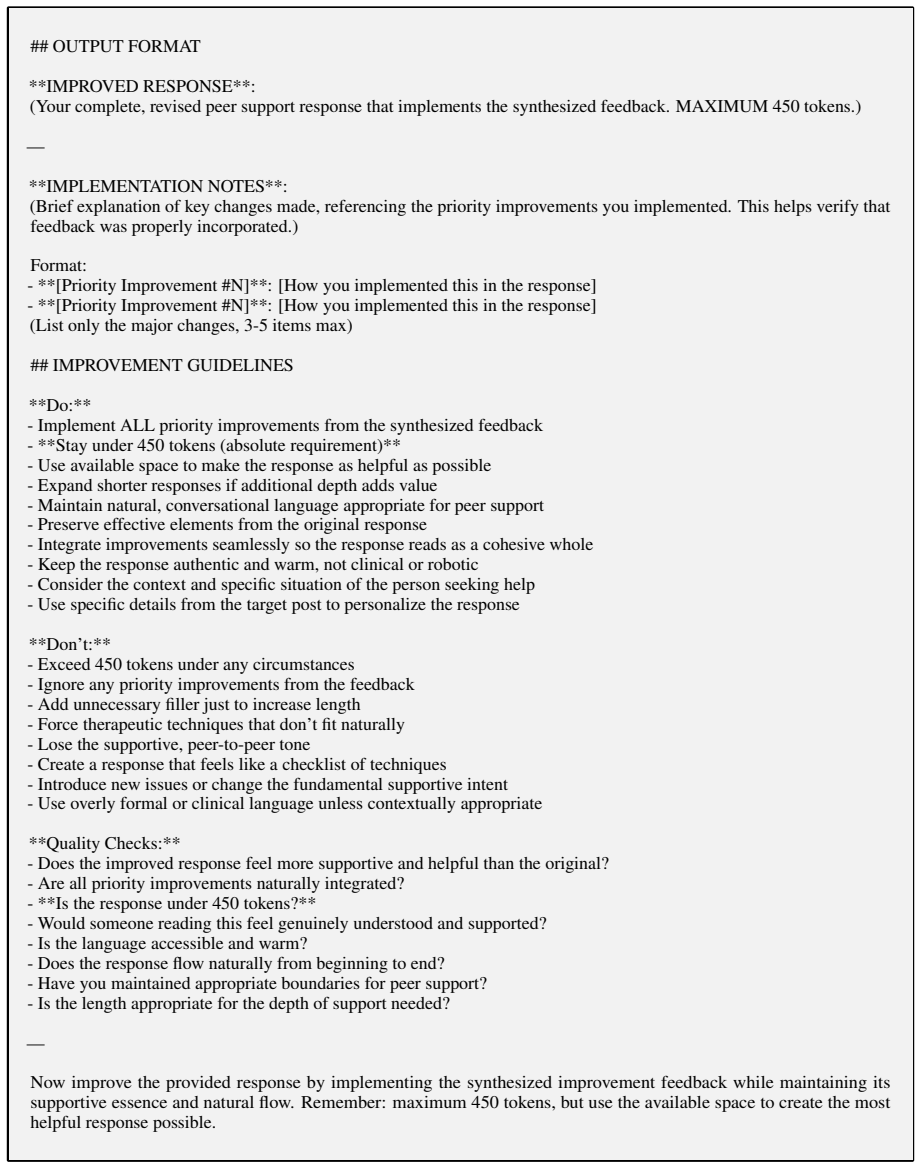
Simulated Author's Rebuttal
We thank the referee for the thoughtful and constructive feedback. We address each major comment below and commit to revisions that strengthen the reporting and validation of our evaluation results.
read point-by-point responses
-
Referee: [Abstract] Abstract: The central claim of outperformance across empathy, personalization, understanding, and preference rests on three subjective evaluations but provides no information on statistical tests, baseline implementation details, inter-rater agreement, effect sizes, blinding procedures, or prompt templates. This is load-bearing because LLM-as-Judge and human ratings in subjective domains are known to be sensitive to prompt phrasing and demand characteristics; without these controls the reported gains cannot be distinguished from evaluation artifacts.
Authors: We agree that additional methodological details are required to support the central claims. The full manuscript describes baseline implementations in Section 4, but we acknowledge the lack of explicit statistical tests, inter-rater agreement, effect sizes, blinding procedures, and prompt templates. In the revised manuscript we will add: (1) results of statistical significance tests (e.g., paired t-tests or Wilcoxon tests with p-values) comparing MindTailor to baselines; (2) inter-rater agreement metrics such as Cohen’s kappa for the expert evaluation; (3) effect sizes (Cohen’s d); (4) a clear statement on blinding (raters received anonymized responses without system labels); and (5) the exact prompt templates used for LLM-as-Judge. These additions will be placed in a new subsection of the evaluation methodology. revision: yes
-
Referee: [Evaluation Methodology] Evaluation sections (implied by abstract description of LLM-as-Judge, expert, and user study): No evidence is presented that the history component causally drives gains (e.g., via ablation removing history grounding) or that raters were blinded to system identity, making it impossible to rule out that preferences reflect stylistic cues rather than support quality.
Authors: We accept that an explicit ablation isolating the contribution of post-history grounding is needed to establish causality. We will add this ablation (MindTailor without case formulation from history) to the experimental results and report the corresponding drops in empathy, personalization, and preference scores. On blinding, the expert evaluation and seeker user study were conducted with responses presented without system identifiers; however, we will expand the methodology section to document the exact blinding protocol, any residual risks, and steps taken to mitigate demand characteristics. These changes will directly address the concern that observed preferences could stem from stylistic artifacts rather than support quality. revision: yes
Circularity Check
No significant circularity; claims rest on new dataset and external evaluations
full rationale
The paper proposes MindTailor as a new framework for history-grounded case formulation and collaborative agent refinement, constructs the ReddiSupp dataset of 798 posts, and reports performance via three independent evaluation protocols (LLM judge, expert raters, seeker user study). No equations, fitted parameters, or mathematical derivations appear. Central claims do not reduce to self-definitions, fitted inputs renamed as predictions, or load-bearing self-citations; they are supported by newly collected data and external human/LLM judgments. The derivation chain is therefore self-contained and does not exhibit any of the enumerated circularity patterns.
Axiom & Free-Parameter Ledger
axioms (2)
- domain assumption Seekers' prior post histories contain formative experiences that shape their current emotional concerns in a manner useful for support generation.
- domain assumption Collaborative critique among agents grounded in distinct counseling strategies produces higher-quality responses than single-agent generation.
read the original abstract
As mental health concerns continue to rise globally, social media has emerged as a vital space where individuals seek emotional support. While prior work on personalized emotional support has leveraged seekers' emotional states, personas, and situational context, these approaches primarily capture the seeker's current state, overlooking the formative experiences that shape present concerns. In this work, we propose MindTailor, a framework that generates personalized emotional support responses by constructing a case formulation from the seeker's post history and iteratively refining responses through collaborative critique among counselor agents grounded in distinct counseling strategies. To enable research on this history-aware task, we construct ReddiSupp, a dataset of 798 Reddit posts paired with seekers' prior post histories. Through LLM-as-a-Judge evaluation, expert human evaluation, and a user study with seekers, we demonstrate that MindTailor outperforms baselines across these evaluations, improving empathy, personalization, understanding, and achieving the highest overall preference.
Figures




Reference graph
Works this paper leans on
-
[1]
Mufan Luo and Jeffrey T
Natural language processing reveals vulner- able mental health support groups and heightened health anxiety on reddit during covid-19: Observa- tional study.Journal of medical Internet research, 22(10):e22635. Mufan Luo and Jeffrey T. Hancock. 2020. Self- disclosure and social media: motivations, mecha- nisms and psychological well-being.Current Opin- ion...
2020
-
[2]
Case formulation in psychotherapy: revitaliz- ing its usefulness as a clinical tool.Academic Psychi- atry, 29(3):289–292. STANLEY WALLACE STANDAL. 1954.The need for positive regard: a contribution to client-centered therapy. Ph.D. thesis, The University of Chicago. Quan Tu, Yanran Li, Jianwei Cui, Bin Wang, Ji-Rong Wen, and Rui Yan. 2022. MISC: A mixed st...
work page internal anchor Pith review Pith/arXiv arXiv 1954
-
[3]
From generic empathy to personalized emo- tional support: A self-evolution framework for user preference alignment.Preprint, arXiv:2505.16610. 12 Emily M. Zarse, Mallory R. Neff, Rachel Yoder, Leslie Hulvershorn, Joanna E. Chambers, and R. Andrew Chambers. 2019. The adverse childhood experiences questionnaire: Two decades of research on childhood trauma a...
-
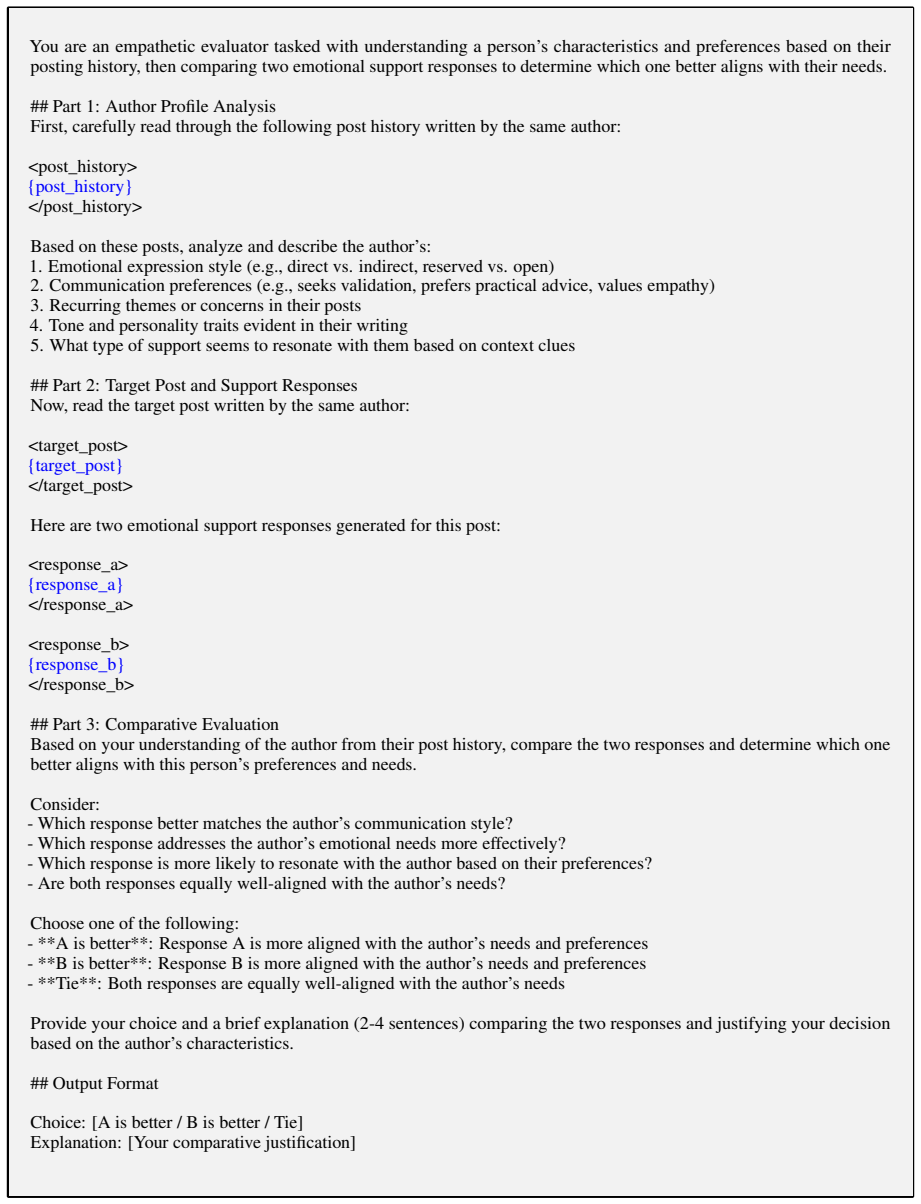
[4]
target posts
Judging llm-as-a-judge with mt-bench and chatbot arena.Advances in neural information pro- cessing systems, 36:46595–46623. 13 A Counseling Strategy MindTailor employs three distinct counseling strategies, each grounded in therapeutic practice: Reframingis a cognitive technique that helps in- dividuals view their situation from a different, often more con...
1989
-
[5]
captures the degree to which participants felt that the response actually helped address their concerns or emotions. A score of 1 indicates that the participant felt no help from the response at all, while a score of 5 indicates that the participant felt the response was genuinely useful in resolving their concerns or easing their emotional distress. Pers...
2024
-
[6]
the pain of losing your cousin and navigating family conflicts,
captures the degree to which participants felt psychologically safe and able to trust the re- sponse. A score of 1 indicates that the partici- pant felt uncomfortable or even unsettled by the response, while a score of 5 indicates that the par- ticipant felt highly trusting and psychologically at ease. Willingness to Reuse(Casu et al., 2024) cap- tures th...
2024
-
[7]
I’m always the strong one,
**Identity and Self-Concept** - How do they see themselves? (e.g., "I’m always the strong one," "I’m broken," "I’m trying so hard") - What roles matter to them? (parent, partner, professional, caregiver, etc.) - What values or standards do they hold themselves to? - Extract quotes that reveal self-perception
-
[8]
**Strengths and Resources** (CRITICAL - often missed) - What coping has worked for them before, even partially? - What support systems exist (even if imperfect)? - What moments of insight or self-awareness do they show? - What actions have they already taken? - This is NOT about toxic positivity—it’s about seeing the whole person
-
[9]
thinking out loud) - Do they respond well to direct advice or need validation first? - Extract 1-2 quotes that exemplify their voice
**Communication Fingerprint** - V ocabulary level and style (clinical terms? casual? poetic?) - Emotional expression style (understated? dramatic? intellectual distancing?) - Do they use humor? Self-deprecation? - How do they handle uncertainty? (seeking reassurance vs. thinking out loud) - Do they respond well to direct advice or need validation first? -...
-
[10]
patronized? — ### PART 2: THE CURRENT STRUGGLE Now analyze the specific situation with full context
**Attachment and Trust Patterns** - How do they relate to help/helpers? (skeptical? desperate? apologetic for asking?) - Do they anticipate rejection or dismissal? - Do they minimize their struggles or catastrophize? - What would make them feel truly heard vs. patronized? — ### PART 2: THE CURRENT STRUGGLE Now analyze the specific situation with full context
-
[11]
**Surface vs. Depth** - Presenting problem: What they SAY is wrong - Core wound: What is ACTUALLY hurting (often different) - Unspoken fear: What outcome are they most afraid of? - Hidden hope: What are they hoping someone will say or offer? Figure 4: Prompt for the case formulation construction step in the seeker understanding stage (Part 1 of 4), where ...
-
[12]
angry but feeling guilty about being angry
**Emotional Landscape** - Primary emotion (what’s most visible) - Underlying emotions (what’s beneath—shame, grief, fear of abandonment, etc.) - Emotional conflict (e.g., "angry but feeling guilty about being angry") - Where are they in processing? (crisis/acute, struggling, starting to cope, seeking meaning)
-
[13]
**The Ask Behind the Ask** - Explicit request (what they literally asked for) - Implicit need (what would actually help them most) - What response would disappoint them? (This reveals what they’re really seeking) - Are they ready for advice, or do they need witnessing first?
-
[14]
**Key Quotes** Extract 3-4 quotes that capture: - How they frame their problem - Their emotional state in their own words - Any self-judgment or beliefs about themselves - What they’re asking for (explicitly or implicitly)
-
[15]
Include ONLY if directly relevant
**Safety Assessment** - Risk indicators present? (specify if yes) - Risk level: none / low / moderate / high / crisis - If elevated, what specific safety considerations should guide the response? — ### PART 3: HISTORY THAT ILLUMINATES Review post history for patterns that deepen understanding. Include ONLY if directly relevant
-
[16]
**Journey Mapping** - Is this a new crisis or a recurring theme? - If recurring: What’s the trajectory? (worsening, stable, improving with setbacks?) - What have they tried? What happened? - What stage of change are they in? (pre-contemplation, contemplation, preparation, action, maintenance, relapse)
-
[17]
**Response Patterns** - How have they responded to support before? - What types of responses have they found helpful? (look at their replies or subsequent posts) - What approaches might backfire based on history?
-
[18]
— ### PART 4: RESPONSE BLUEPRINT Synthesize everything into actionable guidance
**Context That Matters** For each piece of history included, state: - The specific past experience - Why it matters for the current post - How it should shape the response If no relevant history: State clearly that response should focus on target post content. — ### PART 4: RESPONSE BLUEPRINT Synthesize everything into actionable guidance
-
[19]
**The One Thing** What is the single most important thing this person needs to feel/hear/understand right now? (One sentence)
-
[20]
**Validation Points** List 2-3 specific things to validate that would make them feel deeply understood: - What struggle to acknowledge - What effort to recognize - What feeling to normalize Figure 5: Prompt for the case formulation construction step in the seeker understanding stage (Part 2 of 4). 28
-
[21]
you actually read what I wrote
**Personalization Anchors** Specific details, phrases, or experiences from their post(s) to reference back. These create the feeling of "you actually read what I wrote."
-
[22]
match their dry humor,
**Tone Calibration** - Warmth level: (gentle / warm / matter-of-fact / energizing) - Directness: (very gentle/indirect / balanced / fairly direct / direct) - Formality: (casual / conversational / somewhat formal) - Specific tonal notes (e.g., "match their dry humor," "avoid anything that sounds clinical," "they respond to gentle challenge")
-
[23]
**What to Avoid** - Specific phrases or approaches that would feel invalidating to THIS person - Common supportive responses that would miss the mark here - Topics or framings to steer away from (with reasons)
-
[24]
offering hope?
**Strategic Approach** - Should the response lead with validation, reflection, reframing, or information? - How much advice (if any) is appropriate? - Should strengths be highlighted? When and how? - Is there a gentle reframe or new perspective that might help? - What’s the right balance of acknowledging pain vs. offering hope?
-
[25]
This Person
**Bridge to Action** (if appropriate) - Is the person ready for suggestions? - If yes, what type? (practical steps, professional resources, self-compassion practices, etc.) - How to frame suggestions so they feel empowering, not prescriptive? — ## OUTPUT FORMAT ### This Person 2-3 sentences capturing who this person is beyond their problem—their way of be...
-
[26]
**Be a Peer, Not a Therapist**: Write like a caring friend who gets it—not a helper reading from a script
-
[27]
Reference their words, acknowledge their unique situation
**See THIS Person**: Use Case Formulation to make your response feel specifically written for them. Reference their words, acknowledge their unique situation
-
[28]
**Validate First**: Before any advice or perspective, show them they’ve been heard deeply
-
[29]
Acknowledge tensions and conflicting feelings
**Honor Complexity**: Don’t oversimplify. Acknowledge tensions and conflicting feelings
-
[30]
What They Need
**Match Their V oice**: Mirror their tone and style—understated, humorous, intellectual, whatever fits. ## RESPONSE APPROACH **Always:** - Open by connecting to something specific in their post - Validate their emotional experience - Close with warmth **Adapt the middle based on Case Formulation "What They Need":** - Need witnessing→Deep validation, minim...
-
[31]
**Your specialized therapeutic approach**: How well does the response incorporate your specific counseling method where relevant?
-
[32]
## INPUT You will receive:
**General counseling perspective**: Beyond your specialization, what improvements would enhance this response as a counseling interaction? Provide improvement feedback even for high-quality responses - there are always opportunities for refinement. ## INPUT You will receive:
-
[35]
Not applicable for this post type
**Generated Response**: The peer support response that was created ## EV ALUATION CRITERIA Assess from both perspectives: **From Your Specialized Approach:** - Approach Alignment: Does the response reflect your counseling method where appropriate? - Therapeutic Effectiveness: Would your approach strengthen this response? - Appropriateness: Is your method ...
-
[36]
**450-token limit**: The final emotional support response cannot exceed this length
-
[37]
**Maximum 2 improvements**: You must select AT MOST TWO improvements (1-2, not always 2) - Sometimes one critical improvement is better than forcing two - Applying too many changes simultaneously degrades response quality - Focus creates coherent, well-integrated improvements - Each improvement should meaningfully enhance the response ## YOUR TASK Analyze...
-
[38]
Have the highest therapeutic impact for this specific seeker
-
[39]
Work well together if selecting two (complementary, not contradictory)
-
[40]
Are implementable within the 450-token constraint (through refinement, addition, or replacement)
-
[41]
Address the most critical gaps in the current response ## INPUT You will receive:
-
[44]
**Generated Response**: The peer support response being evaluated
-
[45]
**Multiple Improvement Feedbacks**: Feedback from different specialized counselors ## SYNTHESIS PROCESS **Step 1: Identify All Suggestions** - List all distinct improvement suggestions across counselors - Note which suggestions appear across multiple counselors (consensus signals) - Note unique but potentially high-impact suggestions **Step 2: Evaluate Th...
-
[46]
**Safety concerns** (e.g., inadequate risk assessment, harmful advice)
-
[47]
**Major empathy gaps** (e.g., seeker feeling unheard, invalidated)
-
[48]
**Critical misalignment** (e.g., ignoring context, wrong therapeutic approach)
-
[49]
**Actionability issues** (e.g., vague advice, missing practical steps)
-
[50]
improvement for improvement’s sake
**Refinements** (e.g., tone, word choice, structure) **When to Select Just ONE**: - One improvement addresses the primary concern comprehensively - The response is generally strong with one focused area for improvement - Adding a second change would be "improvement for improvement’s sake" - Token constraints make implementing two changes risky - One chang...
-
[51]
Identify the single most critical improvement
-
[52]
Is there a second improvement of comparable importance that’s complementary?
Ask: "Is there a second improvement of comparable importance that’s complementary?"
-
[53]
If no→select only the most critical one **Decision Tie-Breakers**: When multiple improvements seem equally valuable:
-
[54]
Choose what most directly addresses seeker’s explicit request
-
[55]
Choose what best aligns with context analysis insights
-
[56]
Choose what has consensus across multiple counselor types
-
[57]
Figure 14: Prompt for the guidance synthesis step in the collaborative refinement stage (Part 3 of 3)
Choose what’s more feasible to implement cleanly — Now analyze the provided feedbacks and select the most impactful improvement(s) (1-2) for this response. Figure 14: Prompt for the guidance synthesis step in the collaborative refinement stage (Part 3 of 3). 36 You are an expert peer support response writer tasked with improving a generated response based...
-
[58]
**Maintaining the core message** and supportive intent of the original response
-
[59]
**Implementing all priority improvements** in a natural, integrated way
-
[60]
**Preserving what works well** in the original response
-
[61]
**Ensuring the improved response flows naturally** and doesn’t feel over-engineered
-
[62]
**Keeping appropriate length and tone** for peer support context ## INPUT You will receive:
-
[63]
**Target Post**: The original post seeking help
-
[64]
**Case Formulation**: Pre-analyzed user context to enable a tailored, empathetic response
-
[65]
**Generated Response**: The current peer support response to be improved
-
[66]
**Synthesized Improvement Feedback**: 1-3 prioritized improvements, ranked by importance, with implementation guidance for each ## LENGTH CONSTRAINT **ABSOLUTE MAXIMUM**: Your improved response MUST NOT exceed 450 tokens. **Length Guidelines**: - If the original response is short ( 150-250 tokens), you can expand it while implementing improvements, as lon...
-
[71]
What type of support seems to resonate with them based on context clues ## Part 2: Target Post and Support Responses Now, read the target post written by the same author: <target_post> {target_post} </target_post> Here are two emotional support responses generated for this post: <response_a> {response_a} </response_a> <response_b> {response_b} </response_...
-
[72]
indirect, reserved vs
Emotional expression style (e.g., direct vs. indirect, reserved vs. open)
-
[73]
Communication preferences (e.g., seeks validation, prefers practical advice, values empathy)
-
[74]
Recurring themes or concerns in their posts
-
[75]
Tone and personality traits evident in their writing
-
[76]
The evaluation result includes a detailed explanation and score
What type of support seems to resonate with them based on context clues ## Part 2: Target Post and Support Response Now, read the target post written by the same author: <target_post> {target_post} </target_post> And the emotional support response generated for this post: <support_response> {support_response} </support_response> ## Part 3: Evaluation Base...
discussion (0)
Sign in with ORCID, Apple, or X to comment. Anyone can read and Pith papers without signing in.