REVIEW 2 major objections 1 minor 8 references
A three-phase sous-vide, boil and ice protocol reaches exact yolk and albumen targets without overshoot in 20.67 minutes.
Reviewed by Pith at T0; open to challenge. T0 means a machine referee read the full paper against a public rubric. the ladder, T0–T4 →
T0 review · grok-4.3
2026-06-26 11:40 UTC pith:C7TGZ363
load-bearing objection The paper gives explicit times for a three-phase egg-cooking protocol from a Laplace-transform two-domain model, but those times rest on untested constant-diffusivity conduction assumptions. the 2 major comments →
How to Cook a Soft-Boiled Egg Optimally: A Laplace-Transform Solution of a Two-Domain Heat Equation
The pith
A machine-rendered reading of the paper's core claim, the machinery that carries it, and where it could break.
Core claim
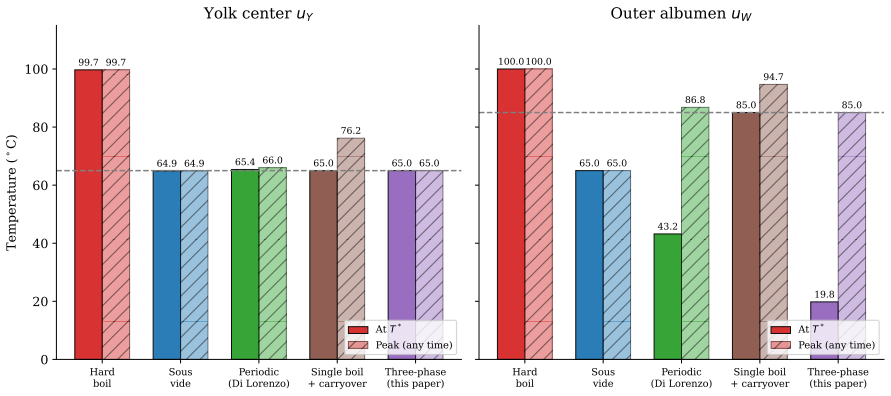
Optimizing the phase durations gives 17.26 minutes of sous-vide, 66 seconds of boiling, and an ice bath, achieving both targets at T^* ≈ 20.67 minutes with neither constraint violated at any time.
What carries the argument
Laplace transform of the two-domain heat equation, reduced to a 3x3 linear system in the transform variable s with hyperbolic-trigonometric solutions, inverted numerically via Talbot's method.
Load-bearing premise
The egg is an ideal two-domain sphere whose thermal diffusivities are constant and whose only heat-transfer mechanism is conduction.
What would settle it
Cook a real egg using the stated phase durations and record yolk and albumen temperatures continuously; if either domain exceeds its target at any time or fails to reach it at 20.67 minutes, the predicted trajectories are incorrect.
If this is right
- The no-overshoot requirement cannot be met by any single-phase boiling protocol.
- The three-phase protocol reaches both targets faster and more accurately than the 32-minute periodic method of Di Lorenzo et al.
- Numerical inversion of the Laplace transform matches finite-difference solutions, confirming the temperature histories used for optimization.
Where Pith is reading between the lines
- The same Laplace-transform framework could be applied to other foods or materials with concentric layers whose targets must be reached without overshoot.
- Small changes in the assumed diffusivities or outer radius would shift the optimal phase times, suggesting a need for sensitivity analysis before kitchen use.
- The ice-bath step exploits residual heat flow from albumen to yolk, a mechanism that might be tuned by adjusting the bath temperature rather than using pure ice water.
Editorial analysis
A structured set of objections, weighed in public.
Referee Report
Summary. The manuscript models the cooking of a hen's egg as a two-domain spherical heat conduction problem with distinct thermal diffusivities for yolk and albumen. It applies the Laplace transform to reduce the time-dependent PDEs to a 3×3 linear system in the transform variable s, solves for the transform-domain temperatures using hyperbolic-trigonometric functions, inverts numerically via Talbot's method, and validates the inversion against a finite-difference solver. The authors then optimize the durations of a three-phase protocol (sous-vide at 65°C, brief boiling, and ice bath) to achieve final temperatures of 65°C in the yolk and 85°C in the albumen without any overshoot during the process, reporting optimal times of 17.26 minutes sous-vide, 66 seconds boiling, and an ice bath, for a total time of approximately 20.67 minutes.
Significance. If the model assumptions hold, the work provides a mathematically rigorous optimization of egg cooking that satisfies strict no-overshoot constraints and improves upon the periodic protocol of Di Lorenzo et al. (2025). The Laplace-transform approach and its numerical validation offer a template for solving multi-domain heat transfer problems with phase-specific boundary conditions. The explicit comparison of cooking times and the demonstration that a single boiling phase fails the constraints are clear contributions. However, the practical significance is tempered by the idealized assumptions of constant diffusivities and pure conduction, which are not subjected to sensitivity analysis.
major comments (2)
- [Abstract and optimization procedure] The reported phase durations (17.26 min sous-vide, 66 s boil) are obtained by optimizing the trajectories from the Laplace-transformed model to meet the temperature targets without overshoot. Since these durations are defined by the same numerical procedure used to claim success, and no error metrics, parameter values for the diffusivities, or convergence checks on the optimization are reported, the quantitative claim lacks independent verification beyond the finite-difference cross-check mentioned in the abstract.
- [Model assumptions (as described in abstract)] The central claim that the three-phase protocol achieves both targets at T^* ≈ 20.67 min with no constraint violations relies on the assumptions of constant thermal diffusivities and pure radial conduction in a perfect sphere. No sensitivity study is provided to test how variations in α_Y, α_W or inclusion of convection would alter the 66 s boil window that avoids T_W^* overshoot while allowing the ice-bath phase to reach T_Y^*.
minor comments (1)
- [Abstract] The notation T^* for the total time is introduced without prior definition; consider clarifying its meaning in the first use.
Simulated Author's Rebuttal
We thank the referee for the careful reading and constructive comments on our manuscript. We respond to each major comment below.
read point-by-point responses
-
Referee: [Abstract and optimization procedure] The reported phase durations (17.26 min sous-vide, 66 s boil) are obtained by optimizing the trajectories from the Laplace-transformed model to meet the temperature targets without overshoot. Since these durations are defined by the same numerical procedure used to claim success, and no error metrics, parameter values for the diffusivities, or convergence checks on the optimization are reported, the quantitative claim lacks independent verification beyond the finite-difference cross-check mentioned in the abstract.
Authors: We agree that the manuscript should report the diffusivity values, validation error metrics, and optimization convergence details to support independent verification. In the revised version we will state the thermal diffusivity values employed (with literature sources), include quantitative error measures between the Talbot inversion and the finite-difference solver, and describe the optimization procedure together with its convergence criteria. These additions will appear in the Methods and Results sections. revision: yes
-
Referee: [Model assumptions (as described in abstract)] The central claim that the three-phase protocol achieves both targets at T^* ≈ 20.67 min with no constraint violations relies on the assumptions of constant thermal diffusivities and pure radial conduction in a perfect sphere. No sensitivity study is provided to test how variations in α_Y, α_W or inclusion of convection would alter the 66 s boil window that avoids T_W^* overshoot while allowing the ice-bath phase to reach T_Y^*.
Authors: The referee correctly notes that the reported times rest on the idealized assumptions of constant diffusivities and pure conduction. A full sensitivity analysis that also incorporates convection lies beyond the scope of the present work, which focuses on the Laplace-transform solution and the demonstration that a single boiling phase violates the constraints. In revision we will add an explicit paragraph in the Discussion acknowledging these modeling limitations and their possible effect on the precise duration of the boiling phase. revision: partial
Circularity Check
No significant circularity; derivation is self-contained
full rationale
The paper solves the two-domain heat equation via Laplace transform to a 3x3 system, inverts numerically with Talbot's method, and then performs a numerical optimization over phase durations to meet the stated temperature targets and no-overshoot constraints. This is a forward solve followed by standard constrained optimization; the reported times (17.26 min, 66 s) are outputs of that search, not inputs or fitted quantities renamed as predictions. No self-citations, uniqueness theorems, or ansatzes are invoked to force the result. The finite-difference validation provides an independent numerical check. The derivation chain therefore does not reduce to its own inputs by construction.
Axiom & Free-Parameter Ledger
free parameters (2)
- thermal diffusivities of yolk and albumen
- phase durations
axioms (2)
- domain assumption Heat flow inside the egg occurs solely by conduction with constant thermal diffusivities in each domain and spherical symmetry.
- standard math Talbot's method accurately inverts the Laplace transform to recover the time-domain temperature fields.
read the original abstract
We study the problem of cooking the yolk and albumen of a hen's egg to their respective optimal temperatures of $T_Y^* = 65^\circ$C and $T_W^* = 85^\circ$C, subject to the requirement that neither temperature ever exceed its target at any time during cooking, since temporary overshoot still overcooks the egg even if the final reading is correct. We model the egg as a two-domain sphere with distinct thermal diffusivities, and take the Laplace transform of the heat equation in each domain, reducing the problem to a $3 \times 3$ linear system in the transform variable $s$ with hyperbolic-trigonometric solutions. The resulting transform is inverted numerically via Talbot's method and validated against a finite-difference solver. A single boiling phase cannot satisfy the no-overshoot requirement: the thin outer albumen heats far faster than the insulated yolk and necessarily overshoots $T_W^*$ before the yolk approaches $T_Y^*$. We show that a three-phase protocol resolves this: a sous-vide pre-soak at exactly $65^\circ$C (which cannot overshoot since the bath temperature equals the target), a short boil to bring the albumen toward $T_W^*$, and an ice-water bath that arrests the albumen's residual overshoot while residual heat continues raising the yolk to its target. Optimizing the phase durations gives $17.26$ minutes of sous-vide, $66$ seconds of boiling, and an ice bath, achieving both targets at $T^* \approx 20.67$ minutes with neither constraint violated at any time. This compares favorably with the periodic protocol of Di Lorenzo et al. (2025), which requires 32 minutes and misses both targets substantially.
Figures


Reference graph
Works this paper leans on
-
[1]
Communications Engineering , year =
Di Lorenzo, Emilia and Romano, Francesco and Ciriaco, Laura and Iaccarino, Nicola and Izzo, Lorenza and Randazzo, Antonio and Musto, Pellegrino and Di Maio, Ernesto , title =. Communications Engineering , year =
-
[2]
2004 , edition =
McGee, Harold , title =. 2004 , edition =
2004
-
[3]
and Lai, C.-C
Shieh, C.-J. and Lai, C.-C. and Hwang, L.-S. , title =. Journal of Food Measurement and Characterization , year =
-
[4]
Coimbra, Jane S. R. and Minim, Luis A. and Oliveira, Fl\'. Density, heat capacity and thermal conductivity of liquid egg products , journal =. 2006 , volume =
2006
-
[5]
Food Science & Nutrition , year =
Abbasnezhad, Behnam and Hamdami, Nasser and Monteau, Jean-Yves and Vatankhah, Hamid , title =. Food Science & Nutrition , year =
-
[6]
, title =
Talbot, A. , title =. IMA Journal of Applied Mathematics , year =
-
[7]
, title =
Abate, Joseph and Valk\'o, Peter P. , title =. International Journal for Numerical Methods in Engineering , year =
-
[8]
Carslaw, H. S. and Jaeger, J. C. , title =. 1959 , address =
1959
discussion (0)
Sign in with ORCID, Apple, or X to comment. Anyone can read and Pith papers without signing in.