REVIEW 1 major objections 2 minor 47 references
Age and gender information in children's speech is encoded unevenly across layers of self-supervised models, strongest in early to mid layers.
Reviewed by Pith at T0; open to challenge. T0 means a machine referee read the full paper against a public rubric. the ladder, T0–T4 →
T0 review · grok-4.3
2026-06-26 11:12 UTC pith:LWFCMCJZ
load-bearing objection This extends layer-wise SSL probing to age and gender in children's speech with robustness checks across models and datasets, but the fixed CNN probe is the weakest link in the layer and model comparisons. the 1 major comments →
How Well Do Self-Supervised Speech Models Encode Age and Gender in Children's Speech? A Layer-Wise Analysis Across Multiple Architectures
The pith
A machine-rendered reading of the paper's core claim, the machinery that carries it, and where it could break.
Core claim
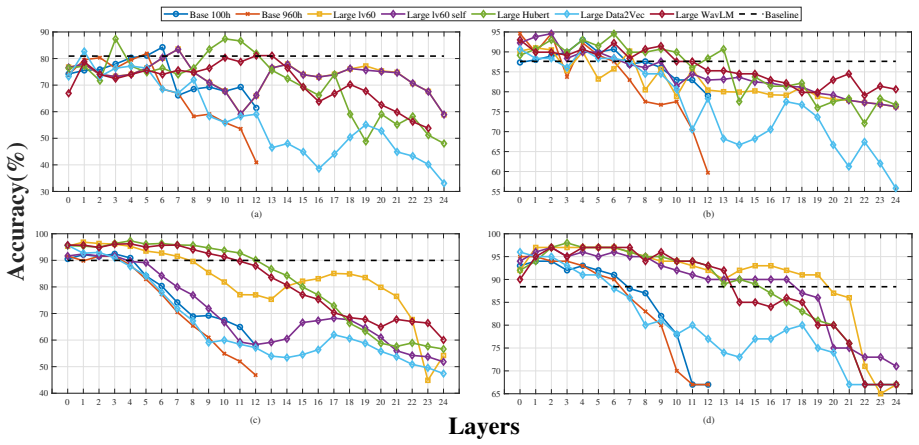
The central discovery is that age- and gender-related information is unevenly distributed across the layers of SSL models, with early to mid-level layers encoding the strongest paralinguistic cues for children's speech. HuBERT performs best overall for age classification, while Wav2Vec2 and HuBERT lead in gender classification depending on the dataset. These findings are robust to speaker-wise cross-validation, layer aggregation, and cross-database evaluation.
What carries the argument
Layer-wise probing of SSL model features using a lightweight CNN classifier on PFSTAR and CMU Kids corpora, combined with PCA for feature analysis.
Load-bearing premise
The lightweight CNN classifier accurately measures the information present in the SSL layer features without its own design substantially affecting the layer comparisons.
What would settle it
Observing that a different probing classifier architecture reverses the layer performance rankings or eliminates the uneven distribution pattern would challenge the claim.
If this is right
- Early to mid layers can be used preferentially for paralinguistic tasks in children's speech.
- HuBERT is the strongest model for age classification across the tested setups.
- Classification remains reliable even with speech segments as short as 1-3 seconds.
- Results are stable under speaker-independent evaluation and cross-corpus testing.
Where Pith is reading between the lines
- Designers of speech systems for children may benefit from extracting features from specific layers rather than the final output.
- The findings could inform selection of pre-trained models for other speaker attributes in developing speech.
- Further work might test whether fine-tuning only certain layers improves performance on age and gender tasks.
Editorial analysis
A structured set of objections, weighed in public.
Referee Report
Summary. The paper analyzes how age and gender information is encoded across layers of four SSL models (Wav2Vec2, HuBERT, Data2Vec, WavLM) on children's speech from PFSTAR and CMU Kids corpora. Layer features are extracted and classified using a lightweight CNN probe, with PCA applied to assess redundancy; results indicate uneven distribution with strongest cues in early-to-mid layers, HuBERT leading on age classification, and Wav2Vec2/HuBERT leading on gender depending on the dataset. Claims include robustness under speaker-wise cross-validation, layer aggregation, cross-database evaluation, and viability on 1-3s segments.
Significance. If the probing results hold without methodological bias, the work offers useful empirical guidance on layer selection and model choice for paralinguistic tasks in children's speech, a domain with distinct acoustic challenges. The reported robustness checks and short-segment findings add practical relevance for downstream applications.
major comments (1)
- [Experimental setup and probing classifier description] The central claims on layer-wise distribution of age/gender information and model rankings rest on the assumption that the fixed lightweight CNN probe extracts information content comparably across layers without its own architecture introducing confounding biases (e.g., sensitivity to feature dimensionality or temporal structure that may differ by layer). The manuscript applies the same probe to all layers/models but provides no ablations on probe variants (linear classifier, deeper CNN, etc.) to test this; this is the least secure link for the reported patterns.
minor comments (2)
- [Abstract and Results] Abstract and results lack error bars, exact data splits, or full hyperparameter details for the CNN, limiting verifiability of performance differences.
- [Feature analysis section] PCA analysis for feature compactness is mentioned but its quantitative impact on the classification results is not clearly tied back to the layer-wise claims.
Simulated Author's Rebuttal
We thank the referee for their insightful comments on our manuscript. We provide a point-by-point response to the major comment below and outline the revisions we plan to make.
read point-by-point responses
-
Referee: The central claims on layer-wise distribution of age/gender information and model rankings rest on the assumption that the fixed lightweight CNN probe extracts information content comparably across layers without its own architecture introducing confounding biases (e.g., sensitivity to feature dimensionality or temporal structure that may differ by layer). The manuscript applies the same probe to all layers/models but provides no ablations on probe variants (linear classifier, deeper CNN, etc.) to test this; this is the least secure link for the reported patterns.
Authors: We agree that ablations on the probe architecture would strengthen the robustness of our findings. The lightweight CNN was selected to provide a consistent, non-trivial probe that can capture temporal dependencies in the features while remaining computationally efficient. To address this concern, we will add experiments in the revised version using (1) a simple linear classifier and (2) a deeper CNN probe. We will report whether the layer-wise trends and model comparisons remain consistent across these variants. This will help confirm that the observed patterns reflect the SSL representations rather than probe-specific effects. We believe this addition will directly mitigate the identified methodological concern. revision: yes
Circularity Check
No circularity: empirical evaluation on external benchmarks
full rationale
The paper reports layer-wise probing of SSL features (Wav2Vec2, HuBERT, Data2Vec, WavLM) via a fixed CNN classifier on independent children's speech corpora (PFSTAR, CMU Kids). No equations, derivations, fitted parameters renamed as predictions, or self-citation chains are present. All reported findings (layer distributions, model rankings, robustness under cross-validation) are direct experimental outcomes against external data, satisfying the self-contained benchmark criterion.
Axiom & Free-Parameter Ledger
axioms (1)
- domain assumption Pre-trained SSL models on adult speech can be directly probed for paralinguistic attributes in children's speech using a downstream CNN
read the original abstract
Self-supervised learning (SSL) models have become a central component of modern speech processing systems, as they enable the learning of rich acoustic representations without reliance on labeled data. Despite their success on adult speech, it remains unclear how effectively these models capture speaker-related attributes such as age and gender in children's speech, which differs substantially from adult speech due to ongoing physiological and cognitive development. Higher pitch, increased articulatory variability, and age-dependent acoustic changes make children's speech a particularly challenging domain. In this work, we present a comprehensive analysis of how age and gender information is encoded across layers of four widely used SSL models: Wav2Vec2, HuBERT, Data2Vec, and WavLM. Layer-wise features are extracted and evaluated using a lightweight CNN on two benchmark children's speech corpora, PFSTAR and CMU Kids. To analyze feature compactness and redundancy, PCA is applied to identify redundancy and highlight the dimensions that contribute most to classification performance. Experimental results show that age- and gender-related information is unevenly distributed across SSL layers, with early to mid-level layers encoding the strongest paralinguistic cues. HuBERT achieves the best overall performance for age classification, while Wav2Vec2 and HuBERT lead gender classification on PFSTAR and CMU Kids, respectively. Beyond single-split evaluation, we further demonstrate that these findings remain stable under speaker-wise cross-validation, layer aggregation, and cross-database evaluation, indicating robustness to data imbalance and domain mismatch. Finally, we show that reliable age and gender classification is achievable even from short speech segments of 1--3 seconds.
Figures




Reference graph
Works this paper leans on
-
[1]
Automatic speaker, age-group and gender identifi- cation from children’s speech,
Saeid Safavi, Martin Russell, and Peter Jančovič, “Automatic speaker, age-group and gender identifi- cation from children’s speech,”Computer Speech & Language, vol. 50, pp. 141–156, 2018
2018
-
[2]
Automated prediction of children’s age from voice acoustics,
Michal Novotny, Roman Cmejla, and Tereza Tykalova, “Automated prediction of children’s age from voice acoustics,”Biomedical Signal Processing and Control, vol. 81, pp. 104490, 2023
2023
-
[3]
Children’s age and gender recognition from raw speech waveform using dnn,
Mousmita Sarma, Kandarpa Kumar Sarma, and Nagendra Kumar Goel, “Children’s age and gender recognition from raw speech waveform using dnn,” inAdvances in Intelligent Computing and Commu- nication: Proceedings of ICAC 2019. Springer, 2020, pp. 1–9
2019
-
[4]
Automated speech analysis tools for children’s speech production: A systematic literature review,
Jacqui McKechnie, Beena Ahmed, Ricardo Gutierrez-Osuna, Penelope Monroe, Patricia McCabe, and Kirrie J Ballard, “Automated speech analysis tools for children’s speech production: A systematic literature review,”International journal of speech-language pathology, vol. 20, no. 6, pp. 583–598, 2018
2018
-
[5]
Modeling the perception of children’s age from speech acoustics,
Santiago Barreda and Peter F. Assmann, “Modeling the perception of children’s age from speech acoustics,”The Journal of the Acoustical Society of America, vol. 143, no. 5, pp. EL361–EL366, 2018
2018
-
[6]
Speech production variability in fricatives of children and adults: Results of functional data analysis,
Laura L Koenig, Jorge C Lucero, and Elizabeth Perlman, “Speech production variability in fricatives of children and adults: Results of functional data analysis,”The Journal of the Acoustical Society of America, vol. 124, no. 5, pp. 3158–3170, 2008
2008
-
[7]
Analysis of disfluency in children’s speech,
T. Tran, M. Tinkler, G. Yeung, A. Alwan, and M. Ostendorf, “Analysis of disfluency in children’s speech,”Interspeech, 2020
2020
-
[8]
Vowel acoustic space development in children: a synthesis of acoustic and anatomic data.,
Houri K. Vorperian and Raymond D. Kent, “Vowel acoustic space development in children: a synthesis of acoustic and anatomic data.,”Journal of speech, language, and hearing research : JSLHR, vol. 50 6, pp. 1510–45, 2007
2007
-
[9]
Acoustics of children’s speech: Developmental changes of temporal and spectral parameters,
Sungbok Lee, Alexandros Potamianos, and Shrikanth Narayanan, “Acoustics of children’s speech: Developmental changes of temporal and spectral parameters,”The Journal of the Acoustical Society of America, vol. 105, no. 3, pp. 1455–1468, 1999
1999
-
[10]
On the difficulties of automatic speech recognition for kindergarten- aged children,
Gary Yeung and Abeer Alwan, “On the difficulties of automatic speech recognition for kindergarten- aged children,”Interspeech, 2018
2018
-
[11]
A survey about databases of children’s speech.,
Felix Claus, Hamurabi Gamboa Rosales, Rico Petrick, Horst-Udo Hain, and Rüdiger Hoffmann, “A survey about databases of children’s speech.,” inInterspeech, 2013, pp. 2410–2414
2013
-
[12]
Automatic speaker age and gender recognition using acoustic and prosodic level information fusion,
Ming Li, Kyu J Han, and Shrikanth Narayanan, “Automatic speaker age and gender recognition using acoustic and prosodic level information fusion,”Computer Speech & Language, vol. 27, no. 1, pp. 151–167, 2013. 24
2013
-
[13]
Roleofacousticsandprosodicfeatures for children’s age classification,
VishakhaKumari, AbhijitSinha, andHemantKumarKathania, “Roleofacousticsandprosodicfeatures for children’s age classification,” inInternational Conference on Signal Processing and Communications (SPCOM). IEEE, 2024, pp. 1–5
2024
-
[14]
Age and gender recognition based on multiple systems-early vs. late fusion.,
Tobias Bocklet, Georg Stemmer, Viktor Zeissler, and Elmar Nöth, “Age and gender recognition based on multiple systems-early vs. late fusion.,” inINTERSPEECH, 2010, pp. 2830–2833
2010
-
[15]
Combining short-term cepstral and long-term pitch features for automatic recognition of speaker age.,
Christian A Müller and Felix Burkhardt, “Combining short-term cepstral and long-term pitch features for automatic recognition of speaker age.,” inInterspeech, 2007, pp. 2277–2280
2007
-
[16]
Age and gender detection in the i-dash project,
Hugo Meinedo and Isabel Trancoso, “Age and gender detection in the i-dash project,”ACM Transac- tions on Speech and Language Processing (TSLP), vol. 7, no. 4, pp. 1–16, 2011
2011
-
[17]
Identification of age-group from children’s speech by computers and humans.,
Saeid Safavi, Martin J Russell, and Peter Jancovic, “Identification of age-group from children’s speech by computers and humans.,” inInterspeech, 2014, pp. 243–247
2014
-
[18]
Emotion, age, and gender classification in children’s speech by humans and machines,
Heysem Kaya, Albert Ali Salah, Alexey Karpov, Olga Frolova, Aleksey Grigorev, and Elena Lyakso, “Emotion, age, and gender classification in children’s speech by humans and machines,”Computer Speech & Language, vol. 46, pp. 268–283, 2017
2017
-
[19]
Children age and gender classification based on speech using convnets,
Humberto Pérez-Espinosa, Himer Avila-George, Juan Martınez-Miranda, Ismael Espinosa-Curiel, Jose- fina Rodriguez-Jacobo, and Hector A Cruz-Mendoza, “Children age and gender classification based on speech using convnets,”Res. Comput. Sci., vol. 147, no. 4, pp. 23–35, 2018
2018
-
[20]
Analyzing features for automatic age estimation on cross-sectional data.,
Werner Spiegl, Georg Stemmer, Eva Lasarcyk, Varada Kolhatkar, Andrew Cassidy, Blaise Potard, Stephen Shum, Young Chol Song, Puyang Xu, Peter Beyerlein, et al., “Analyzing features for automatic age estimation on cross-sectional data.,” inInterspeech, 2009, vol. 2009, p. 2923
2009
-
[21]
Calibration of probabilistic age recognition,
David Van Leeuwen and Mohamad Hasan Bahari, “Calibration of probabilistic age recognition,”Pro- ceedings Interspeech 2012, pp. 502–505, 2012
2012
-
[22]
Speaker age estimation using age-dependent insensitive loss,
Yuki Kitagishi, Hosana Kamiyama, Atsushi Ando, Naohiro Tawara, Takeshi Mori, and Satoshi Kobashikawa, “Speaker age estimation using age-dependent insensitive loss,” inAsia-Pacific Signal and Information Processing Association Annual Summit and Conference (APSIPA ASC). IEEE, 2020, pp. 319–324
2020
-
[23]
Speaker recognition for children’s speech,
Saeid Safavi, Maryam Najafian, Abualsoud Hanani, Martin Russell, Peter Jančovič, and Michael Carey, “Speaker recognition for children’s speech,” inInterspeech, 2012, pp. 1836–1839
2012
-
[24]
Gender and age estimation methods based on speech using deep neural networks,
Damian Kwasny and Daria Hemmerling, “Gender and age estimation methods based on speech using deep neural networks,”Sensors, vol. 21, no. 14, pp. 4785, 2021
2021
-
[25]
Age group classification and gender recognition from speech with temporal convolutional neural networks,
Héctor A Sánchez-Hevia, Roberto Gil-Pita, Manuel Utrilla-Manso, and Manuel Rosa-Zurera, “Age group classification and gender recognition from speech with temporal convolutional neural networks,” Multimedia Tools and Applications, vol. 81, no. 3, pp. 3535–3552, 2022
2022
-
[26]
Automatic speaker and age identification of children from raw speech using sincnet over erb scale,
Kodali Radha, Mohan Bansal, and Ram Bilas Pachori, “Automatic speaker and age identification of children from raw speech using sincnet over erb scale,”Speech Communication, vol. 159, pp. 103069, 2024
2024
-
[27]
wav2vec2.0: Aframeworkfor self-supervised learning of speech representations,
AlexeiBaevski, YuhaoZhou, AbdelrahmanMohamed, andMichaelAuli, “wav2vec2.0: Aframeworkfor self-supervised learning of speech representations,”Advances in neural information processing systems, vol. 33, pp. 12449–12460, 2020
2020
-
[28]
Hubert: Self-supervised speech representation learning by masked prediction of hidden units,
Wei-Ning Hsu, Benjamin Bolte, Yao-Hung Hubert Tsai, Kushal Lakhotia, Ruslan Salakhutdinov, and Abdelrahman Mohamed, “Hubert: Self-supervised speech representation learning by masked prediction of hidden units,”IEEE/ACM transactions on audio, speech, and language processing, vol. 29, pp. 3451– 3460, 2021
2021
-
[29]
Data2vec: A general framework for self-supervised learning in speech, vision and language,
Alexei Baevski, Wei-Ning Hsu, Qiantong Xu, Arun Babu, Jiatao Gu, and Michael Auli, “Data2vec: A general framework for self-supervised learning in speech, vision and language,” inInternational Conference on Machine Learning. PMLR, 2022, pp. 1298–1312
2022
-
[30]
Wavlm: Large-scale self-supervised pre-training for full stack speech processing,
Sanyuan Chen, Chengyi Wang, Zhengyang Chen, Yu Wu, Shujie Liu, Zhuo Chen, Jinyu Li, Naoyuki Kanda, Takuya Yoshioka, Xiong Xiao, et al., “Wavlm: Large-scale self-supervised pre-training for full stack speech processing,”IEEE Journal of Selected Topics in Signal Processing, vol. 16, no. 6, pp. 1505–1518, 2022
2022
-
[31]
Emotion Recognition from Speech Using Wav2vec 2.0 Embeddings
Leonardo Pepino, Pablo Ernesto Riera, and Luciana Ferrer, “Emotion recognition from speech using 25 wav2vec 2.0 embeddings,”Interspeech, vol. abs/2104.03502, 2021
work page Pith review arXiv 2021
-
[32]
Effect of speech modification on wav2vec2 models for children speech recognition,
Abhijit Sinha, Mittul Singh, Sudarsana Reddy Kadiri, Mikko Kurimo, and Hemant Kumar Kathania, “Effect of speech modification on wav2vec2 models for children speech recognition,” inInternational Conference on Signal Processing and Communications (SPCOM). IEEE, 2024, pp. 1–5
2024
-
[33]
Wav2vec2- based paralinguistic systems to recognise vocalised emotions and stuttering,
Tamás Grósz, Dejan Porjazovski, Yaroslav Getman, Sudarsana Kadiri, and Mikko Kurimo, “Wav2vec2- based paralinguistic systems to recognise vocalised emotions and stuttering,” inProceedings of the 30th ACM International Conference on Multimedia, 2022, pp. 7026–7029
2022
-
[34]
Two-stage finetuning of wav2vec 2.0 for speech emotion recognition with asr and gender pretraining,
Yuan Gao, Chenhui Chu, and Tatsuya Kawahara, “Two-stage finetuning of wav2vec 2.0 for speech emotion recognition with asr and gender pretraining,” inInterspeech, 2023
2023
-
[35]
A noise-robust self-supervised pre-training model based speech representation learning for automatic speech recogni- tion,
Qiu-Shi Zhu, Jie Zhang, Zi-Qiang Zhang, Ming-Hui Wu, Xin Fang, and Li-Rong Dai, “A noise-robust self-supervised pre-training model based speech representation learning for automatic speech recogni- tion,” inIEEE International Conference on Acoustics, Speech and Signal Processing (ICASSP), 2022, pp. 3174–3178
2022
-
[36]
Exploring wav2vec 2.0 on speaker verification and language identification,
Zhiyun Fan, Meng Li, Shiyu Zhou, and Bo Xu, “Exploring wav2vec 2.0 on speaker verification and language identification,” 08 2021, pp. 1509–1513
2021
-
[37]
Speech emotion recognition using self-supervised features,
Edmilson Morais, Ron Hoory, Weizhong Zhu, Itai Gat, Matheus Damasceno, and Hagai Aronowitz, “Speech emotion recognition using self-supervised features,” 05 2022, pp. 6922–6926
2022
-
[38]
Harnessing the power of wav2vec2 and cnns for robust speaker identification on the voxceleb and librispeech datasets,
Or Haim Anidjar, Revital Marbel, and Roi Yozevitch, “Harnessing the power of wav2vec2 and cnns for robust speaker identification on the voxceleb and librispeech datasets,”Expert Systems with Applica- tions, vol. 255, pp. 124671, 2024
2024
-
[39]
On the robustness of wav2vec 2.0 based speaker recognition systems,
Sergey Novoselov, Galina Lavrentyeva, Anastasia Avdeeva, Vladimir Volokhov, Nikita Khmelev, Artem Akulov, and Polina Leonteva, “On the robustness of wav2vec 2.0 based speaker recognition systems,” inInterspeech, 2023, pp. 3177–3181
2023
-
[40]
Uti- lizing wav2vec in database-independent voice disorder detection,
Saska Tirronen, Farhad Javanmardi, Manila Kodali, Sudarsana Reddy Kadiri, and Paavo Alku, “Uti- lizing wav2vec in database-independent voice disorder detection,” inIEEE International Conference on Acoustics, Speech and Signal Processing (ICASSP), 2023, pp. 1–5
2023
-
[41]
Pre-trained models for detection and severity level classification of dysarthria from speech,
Farhad Javanmardi, Sudarsana Reddy Kadiri, and Paavo Alku, “Pre-trained models for detection and severity level classification of dysarthria from speech,”Speech Communication, vol. 158, pp. 103047, 2024
2024
-
[42]
Exploring the impact of fine-tuning the wav2vec2 model in database-independent detection of dysarthric speech,
Farhad Javanmardi, Sudarsana Reddy Kadiri, and Paavo Alku, “Exploring the impact of fine-tuning the wav2vec2 model in database-independent detection of dysarthric speech,”IEEE journal of biomedical and health informatics, vol. 28, no. 8, pp. 4951–4962, 2024
2024
-
[43]
Svldl: Improved speaker age estimation using selective variance label distribution learning,
Zuheng Kang, Jianzong Wang, Junqing Peng, and Jing Xiao, “Svldl: Improved speaker age estimation using selective variance label distribution learning,” inIEEE Spoken Language Technology Workshop (SLT), 2022, pp. 1037–1044
2022
-
[44]
What are differ- ences? comparing dnn and human by their performance and characteristics in speaker age estimation,
Yuki Kitagishi, Naohiro Tawara, Atsunori Ogawa, Ryo Masumura, and Taichi Asami, “What are differ- ences? comparing dnn and human by their performance and characteristics in speaker age estimation,” inInterspeech, 2023, pp. 1873–1877
2023
-
[45]
Layer-wise analysis of self-supervised representations for age and gender clas- sification in children’s speech,
Abhijit Sinha, Harishankar Kumar, Mohit Joshi, Hemant Kumar Kathania, Shrikanth Narayanan, and Sudarsana Reddy Kadiri, “Layer-wise analysis of self-supervised representations for age and gender clas- sification in children’s speech,” in7th Workshop on Child Computer Interaction (WOCCI), Interspeech, 2025
2025
-
[46]
The pf-star british english childrens speech corpus,
Martin Russell, “The pf-star british english childrens speech corpus,”The Speech Ark Limited, 2006
2006
-
[47]
The cmu kids corpus,
Maxine Eskenazi, Jack Mostow, and David Graff, “The cmu kids corpus,”Linguistic Data Consortium, vol. 11, 1997. 26
1997
discussion (0)
Sign in with ORCID, Apple, or X to comment. Anyone can read and Pith papers without signing in.