Probing the Weak-Driving Quantum Speed Limit via Drift-Aware Shooting Methods
Pith reviewed 2026-06-26 11:35 UTC · model grok-4.3
The pith
A critical gate time exists below which low-energy pulses for the two-qubit quantum Fourier transform on exchange-coupled spins cease to exist.
A machine-rendered reading of the paper's core claim, the machinery that carries it, and where it could break.
Core claim
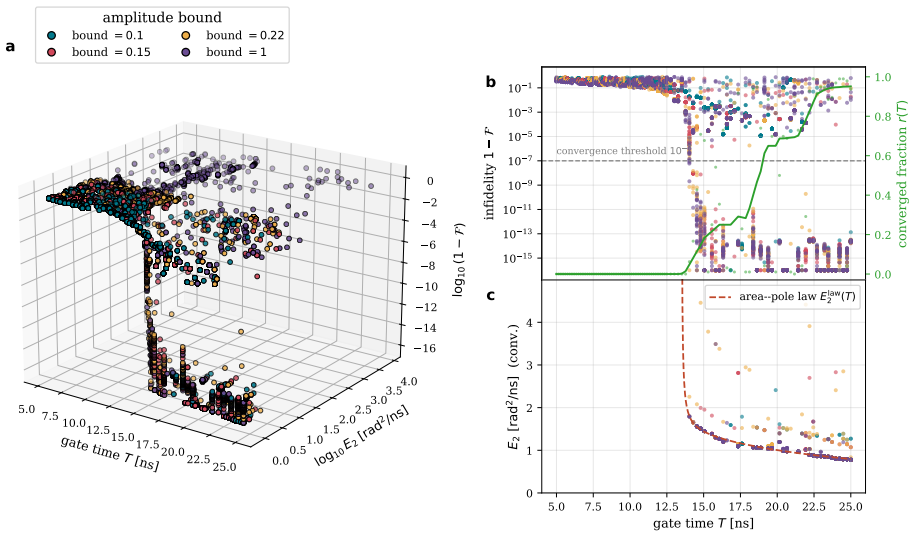
A large statistical survey of unselected optimization runs resolves a weak-driving quantum speed limit for two exchange-coupled electron spins: low-amplitude realizations of the two-qubit quantum Fourier transform cease to exist below a critical gate time T* set by the drift's interaction rate, and the minimum control energy diverges on approach to this limit. The divergence obeys a simple two-parameter area-pole law, E₂ˡᵃʷ(T)=A/T+B/(T−T*), whose first term is the time-optimal area cost and whose second term is a pole at the speed limit.
What carries the argument
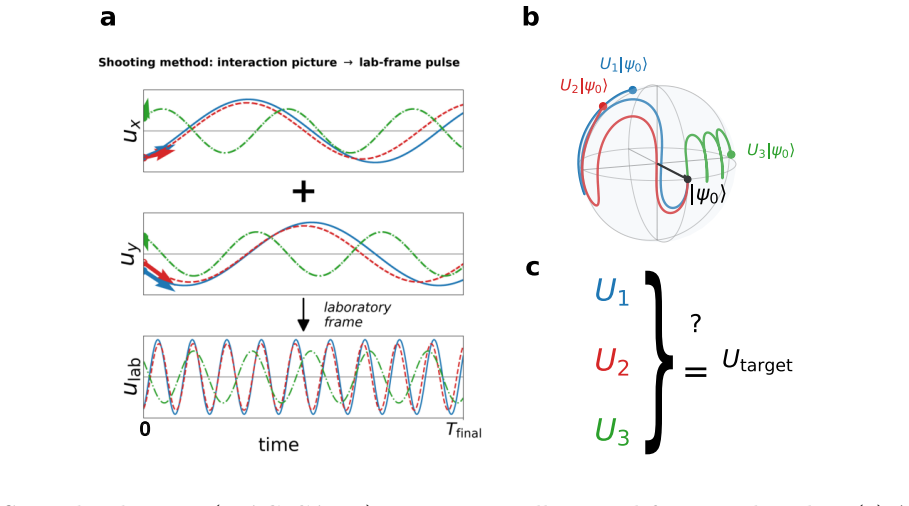
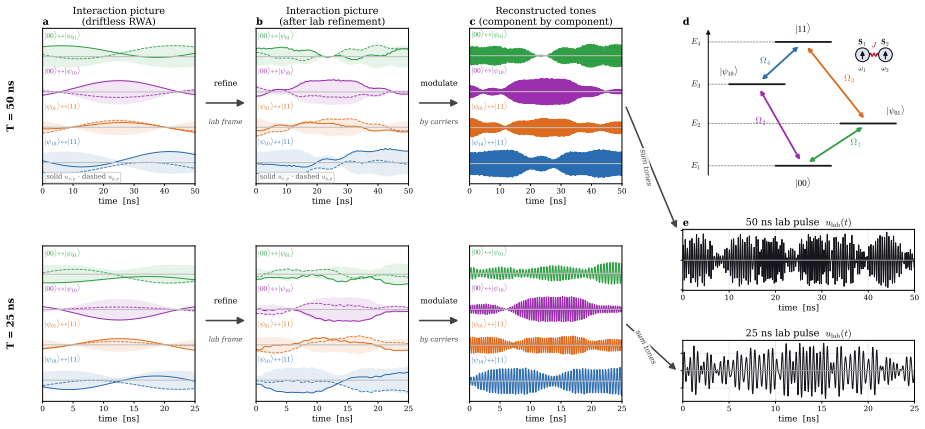
The MAGICARP shooting method extended to systems with constant drift, which generates an entire smooth pulse from a small set of parameters and is applied in staged rotating-wave then laboratory-frame optimization.
If this is right
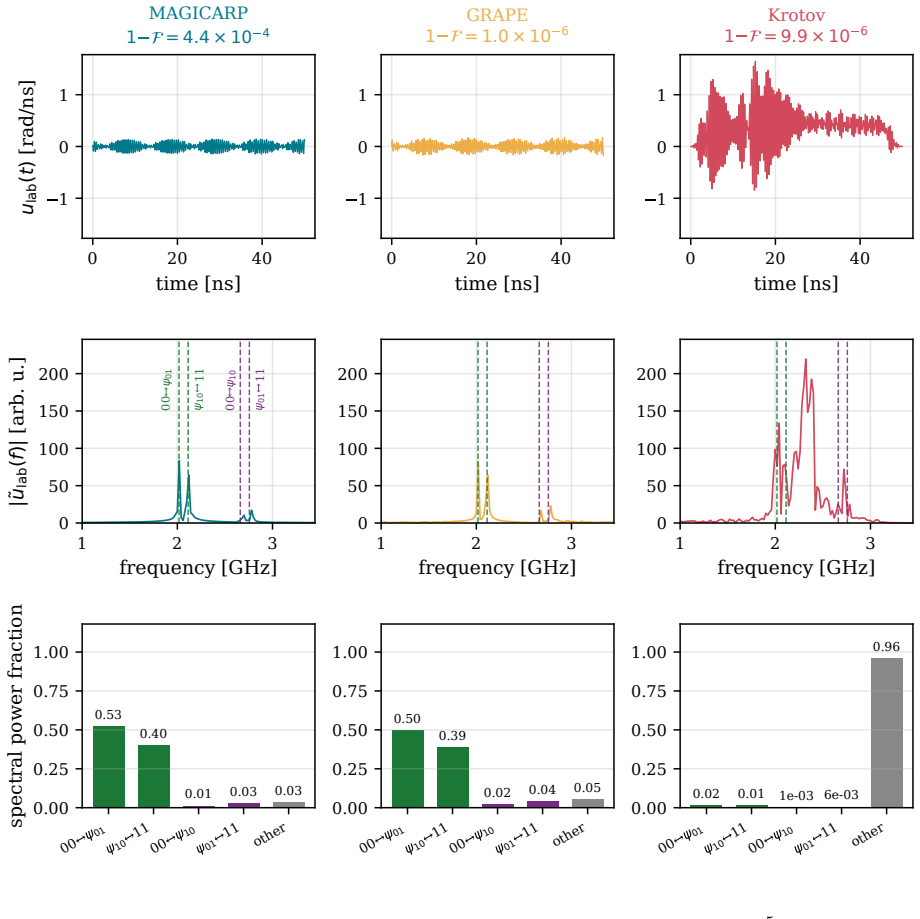
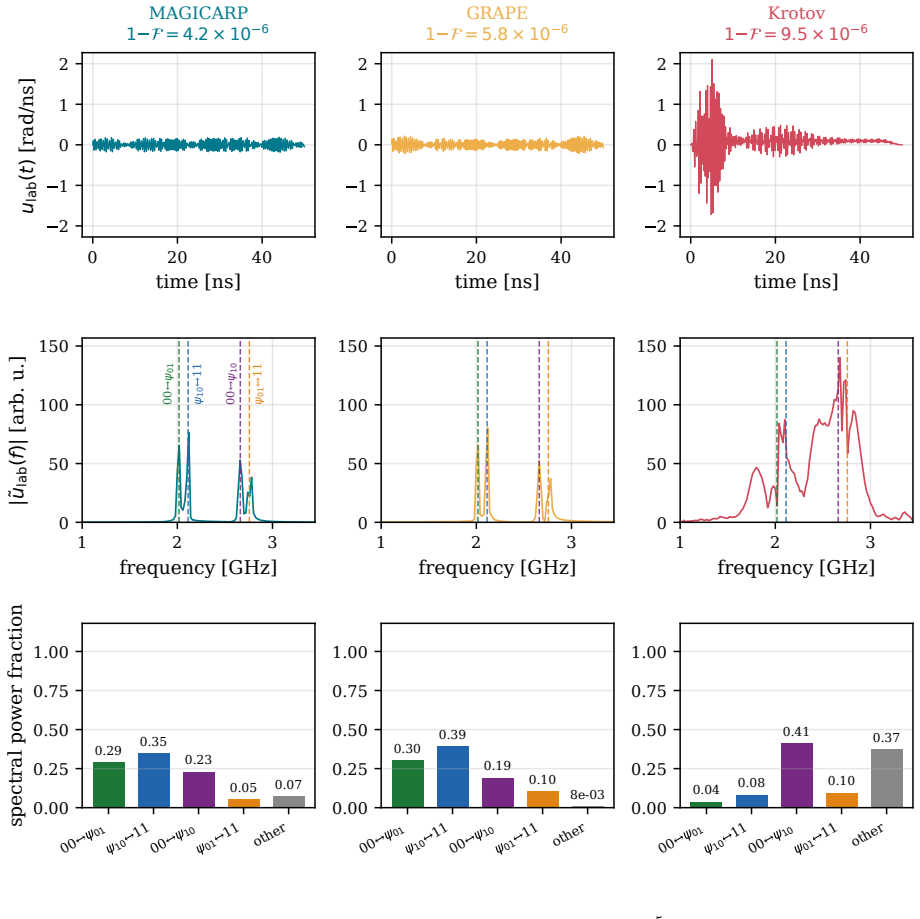
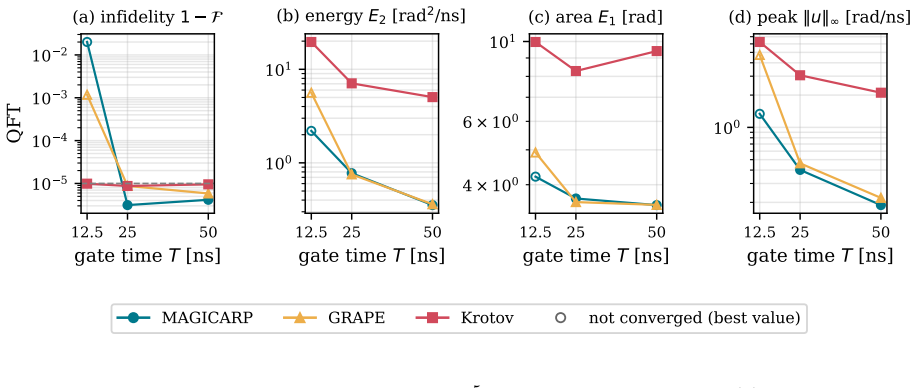
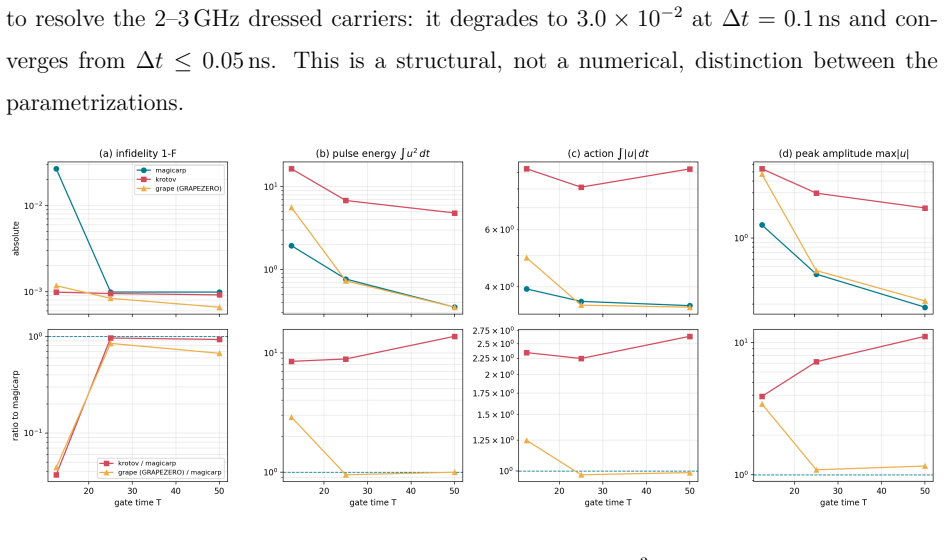
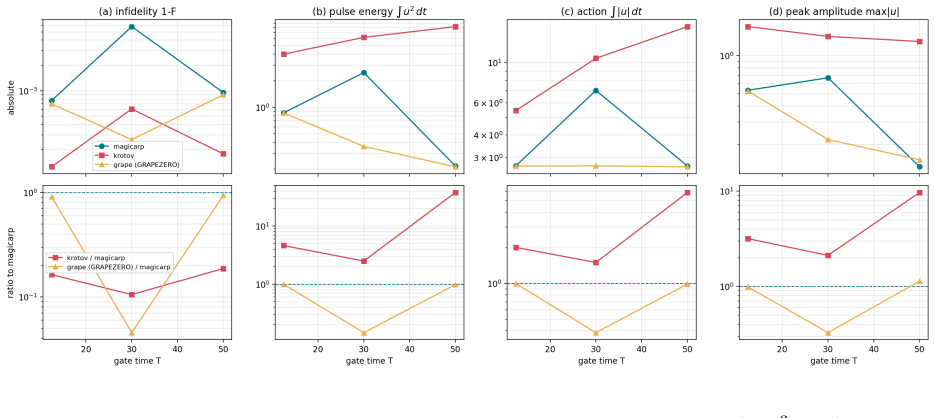
- MAGICARP achieves lower energy than Krotov or GRAPE at matched gate infidelity while conserving pulse area.
- The minimum control energy obeys the two-parameter area-pole law across a range of gate times.
- The critical time T* is determined by the drift interaction rate and marks the boundary below which low-amplitude realizations cease to exist.
- GRAPE converges to essentially the same pulses as MAGICARP, while Krotov incurs an order-of-magnitude energy premium.
Where Pith is reading between the lines
- The area-pole form may serve as a diagnostic for speed limits in other drifted two-qubit systems or gates.
- An experimental test could track measured minimal pulse energies versus gate time to check for the predicted divergence.
- The staged optimization workflow could be reused to locate similar weak-driving limits without exhaustive search in larger spin networks.
Load-bearing premise
The large statistical survey of unselected optimization runs reliably locates the true global minimum control energy for each gate time without systematic bias from the shooting method, initial guesses, or the staged procedure.
What would settle it
A direct calculation or measurement showing that the minimal control energy remains finite for gate times below the reported T* or fails to follow the 1/(T-T*) pole divergence would falsify the claimed speed limit.
Figures
read the original abstract
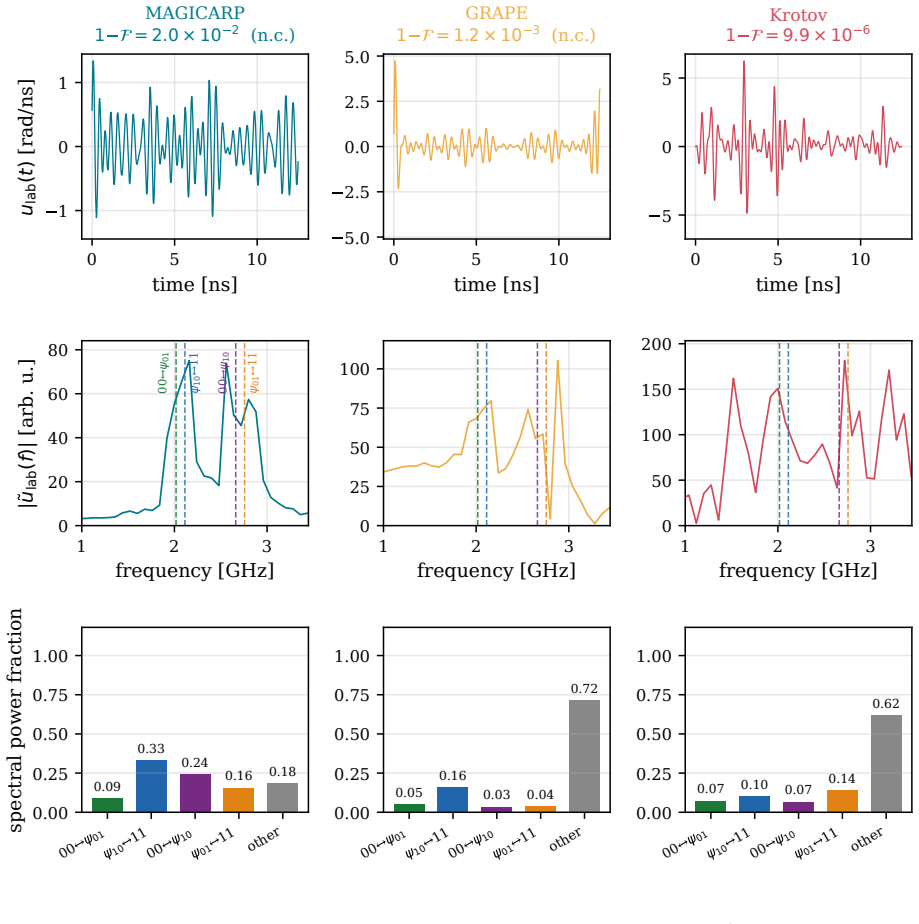
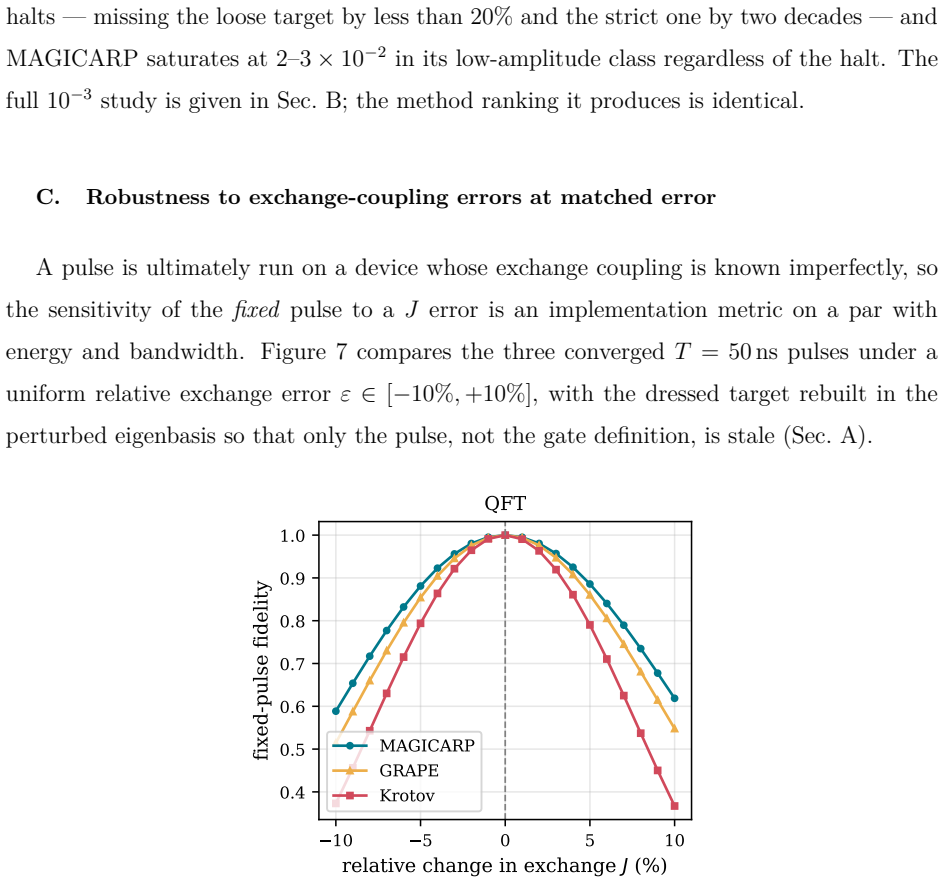
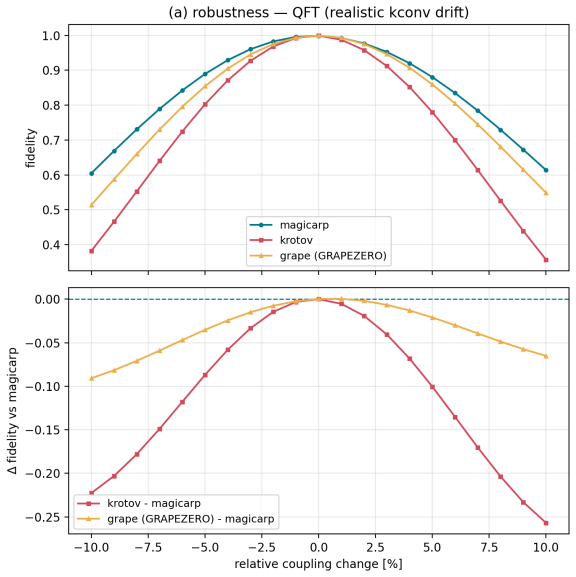
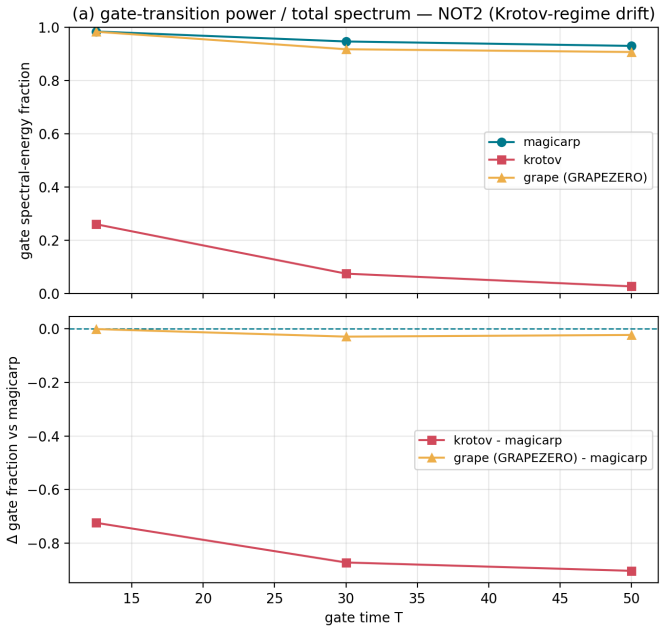
A central goal of quantum optimal control is to achieve high-fidelity and low-energy control pulses. When quantum optimal control methods optimize every point of a pulse discretized over small time steps independently this can yield high fidelity control but also results in broadband and energy-hungry waveforms. We extend MAGICARP -- a shooting method inspired by Pontryagin's maximum principle on energy that generates an entire pulse from a small set of parameters, making it smooth and energy-efficient by construction -- from driftless systems to closed systems with the constant drift Hamiltonian of two exchange-coupled spins in an external magnetic field. The optimization proceeds in stages: the dressed states of the drift Hamiltonian structure the target, an initial shooting optimization is performed in the rotating-wave frame, and an exact laboratory-frame refinement follows. Benchmarked against Krotov and GRAPE at matched gate infidelity, MAGICARP consistently achieves the lowest energy and a conserved pulse area, concentrates its spectral weight on the gate-relevant transitions, and is the most robust to fluctuations in the exchange coupling; GRAPE independently converges to essentially the same pulse, while Krotov's method pays an order-of-magnitude energy premium. Moreover, a large statistical survey of unselected optimization runs resolves a weak-driving quantum speed limit for two exchange-coupled electron spins: low-amplitude realizations of the two-qubit quantum Fourier transform cease to exist below a critical gate time $T^*$ set by the drift's interaction rate, and the minimum control energy diverges on approach to this limit. The divergence obeys a simple two-parameter area-pole law, $E_2^{\mathrm{law}}(T)=A/T+B/(T-T^*)$, whose first term is the time-optimal area cost and whose second term is a pole at the speed limit.
Editorial analysis
A structured set of objections, weighed in public.
Referee Report
Summary. The paper extends the MAGICARP shooting method (inspired by Pontryagin's maximum principle) from driftless to drifted two-qubit systems with constant exchange coupling and magnetic field. It introduces a staged optimization (dressed-state targeting, rotating-wave shooting, then lab-frame refinement) and benchmarks it on the two-qubit QFT against Krotov and GRAPE at matched infidelity. The central claim is that a large statistical survey of unselected MAGICARP runs reveals a weak-driving quantum speed limit T* set by the drift interaction rate, below which low-amplitude controls cease to exist, with the minimal control energy diverging according to the empirical two-parameter form E₂ˡᵃʷ(T) = A/T + B/(T − T*).
Significance. If the reported global minima are reliable, the work supplies concrete numerical evidence for a weak-driving quantum speed limit in an experimentally relevant spin system together with a simple area-pole functional form for the energy cost. The staged drift-aware shooting procedure and the observation that GRAPE converges to essentially the same low-energy pulses are positive contributions to the quantum optimal control literature.
major comments (2)
- [Abstract / statistical survey results] Abstract and the section describing the statistical survey: the headline divergence law E₂ˡᵃʷ(T)=A/T+B/(T−T*) is obtained by a two-parameter fit (A, B, T*) directly to the energies collected from the same unselected MAGICARP runs; this renders the functional form descriptive of the observed data rather than an independent prediction, and no cross-validation, held-out T values, or application to a second gate is reported to test robustness.
- [Abstract / optimization procedure] Abstract and methods on the optimization procedure: the claim that the survey resolves the true infimum energy for each T (and therefore that the pole at T* is physical) rests on the unverified assumption that unselected shooting runs with the staged rotating-wave plus lab-frame procedure locate the global minimum without systematic bias; the paper notes that GRAPE reaches similar pulses but provides no convergence diagnostics, multiple-random-seed statistics, or comparison against theoretical lower bounds near T*.
minor comments (1)
- [Abstract] Notation: the subscript “2” in E₂ˡᵃʷ and the superscript “law” are introduced without explicit definition in the abstract; a short clarifying sentence would help.
Simulated Author's Rebuttal
We thank the referee for the constructive feedback. We address each major comment below, indicating where revisions will be made to improve clarity and robustness while noting limitations that cannot be fully resolved with the current methodology.
read point-by-point responses
-
Referee: [Abstract / statistical survey results] Abstract and the section describing the statistical survey: the headline divergence law E₂ˡᵃʷ(T)=A/T+B/(T−T*) is obtained by a two-parameter fit (A, B, T*) directly to the energies collected from the same unselected MAGICARP runs; this renders the functional form descriptive of the observed data rather than an independent prediction, and no cross-validation, held-out T values, or application to a second gate is reported to test robustness.
Authors: The functional form is physically motivated rather than purely empirical: the A/T term follows directly from the minimal pulse-area cost required to implement the gate (consistent with the time-optimal area theorem for unitary control), while the pole term encodes the divergence expected when the gate time approaches the drift-limited speed limit T*. We agree, however, that the fit is performed on the full dataset and that additional validation would strengthen the result. In the revised manuscript we will add a cross-validation study (partitioning T values into training and held-out sets) and repeat the full survey-plus-fit procedure for the CNOT gate to test generality. revision: yes
-
Referee: [Abstract / optimization procedure] Abstract and methods on the optimization procedure: the claim that the survey resolves the true infimum energy for each T (and therefore that the pole at T* is physical) rests on the unverified assumption that unselected shooting runs with the staged rotating-wave plus lab-frame procedure locate the global minimum without systematic bias; the paper notes that GRAPE reaches similar pulses but provides no convergence diagnostics, multiple-random-seed statistics, or comparison against theoretical lower bounds near T*.
Authors: We acknowledge that a finite number of unselected shooting runs cannot rigorously certify global optimality, and that the absence of theoretical lower bounds prevents a definitive proof that the observed energies are the absolute infima. The large sample size (1000 runs per T) together with the independent convergence of GRAPE to comparable low-energy pulses supplies supporting evidence, but we agree that further diagnostics are required. In revision we will report energy histograms and convergence statistics from multiple random seeds for both MAGICARP and GRAPE, and we will explicitly note the lack of known theoretical bounds as a limitation. We maintain that the consistent divergence across methods still constitutes robust numerical evidence for the existence of T*. revision: partial
- We do not possess theoretical lower bounds on the minimal control energy near T* for the drifted two-qubit system and therefore cannot provide the requested comparison.
Circularity Check
Area-pole law is a two-parameter fit to energies from the same optimization survey
specific steps
-
fitted input called prediction
[Abstract]
"a large statistical survey of unselected optimization runs resolves a weak-driving quantum speed limit ... The divergence obeys a simple two-parameter area-pole law, E₂ˡᵃʷ(T)=A/T+B/(T−T*), whose first term is the time-optimal area cost and whose second term is a pole at the speed limit."
The functional form and its two free parameters (A, B) are determined by fitting the observed minimum energies E(T) obtained from the identical set of MAGICARP runs that are used to claim the existence of the divergence and T*. The 'law' is therefore a descriptive fit to the target data rather than an independent prediction or first-principles derivation.
full rationale
The paper's headline result is the existence of T* and the divergence of min energy E(T) as T approaches T*, with the functional form presented as an observed 'law'. This form is obtained by fitting A and B directly to the E(T) values produced by the MAGICARP survey on the same two-qubit QFT instances. No independent derivation or external benchmark establishes the pole form; the claim therefore reduces to a post-hoc parametrization of the simulation outputs. The global-minimum assumption is noted as a separate reliability issue but does not itself create definitional circularity in the reported law.
Axiom & Free-Parameter Ledger
free parameters (2)
- A and B in area-pole law =
fitted to simulation data
- T* =
determined from statistical survey
axioms (2)
- domain assumption Pontryagin's maximum principle can be applied to generate energy-optimal pulses via shooting
- domain assumption Rotating-wave approximation is sufficiently accurate for the initial optimization stage before lab-frame refinement
Reference graph
Works this paper leans on
-
[1]
spectral content (Sec. IIIA),
-
[2]
IIIB), and
energy, area, and peak-amplitude cost (Sec. IIIB), and
-
[3]
useful set
robustness to parameter error (Sec. IIIC) These axes separate the optimization methods sharply where fidelity alone does not, and they set up the speed-limit analysis of Sec. IV. Throughoutthissectionweworkatthemoderate-exchangeoperatingpointofSec.IID,ω 1 = 17 GHz,ω2 = 13 GHzwiththeNOT 2 anddressed-QFTtargets, gatetimesT∈{50,25,12.5}ns, and∆t= 0.02 ns. Th...
2021
-
[4]
We acknowledge fruitful discussions with Killian Lutz and Rémi Pasquier
and EUR QMAT (QMAT ANR-17-EURE-0024) under the framework of the French 33 Investments for the Future Program. We acknowledge fruitful discussions with Killian Lutz and Rémi Pasquier. 34
-
[5]
S. J. Glaser et al. Training Schrödinger’s cat: quantum optimal control.Eur. Phys. J. D, 69:279, 2015
2015
-
[6]
C. P. Koch et al. Quantum optimal control in quantum technologies. Strategic report on current status, visions and goals for research in Europe.EPJ Quantum Technol., 9:19, 2022
2022
-
[7]
C. Brif, R. Chakrabarti, and H. Rabitz. Control of quantum phenomena: past, present and future.New J. Phys., 12:075008, 2010
2010
-
[8]
Krantz, M
P. Krantz, M. Kjaergaard, F. Yan, T. P. Orlando, S. Gustavsson, and W. D. Oliver. A quantum engineer’s guide to superconducting qubits.Applied Physics Reviews, 6(2):021318, 2019
2019
-
[9]
Bruzewicz, John Chiaverini, Robert McConnell, and Jeremy M
Colin D. Bruzewicz, John Chiaverini, Robert McConnell, and Jeremy M. Sage. Trapped-ion quantum computing: Progress and challenges.Applied Physics Reviews, 6(2):021314, 2019
2019
-
[10]
Burkard, T
G. Burkard, T. D. Ladd, A. Pan, J. M. Nichol, and J. R. Petta. Semiconductor spin qubits. Rev. Mod. Phys., 95:025003, 2023
2023
-
[11]
Barry, Jennifer M
John F. Barry, Jennifer M. Schloss, Erik Bauch, Matthew J. Turner, Connor A. Hart, Linh M. Pham, and Ronald L. Walsworth. Sensitivity optimization for NV-diamond magnetometry. Reviews of Modern Physics, 92(1):015004, 2020
2020
-
[12]
Control of an NV center as a two-qubit system
David Tinoco, Charles Babin, Ivan Beschastnyi, Jean-Baptiste Caillau, and Dominique Sugny. Control of an NV center as a two-qubit system. working paper or preprint, December 2025
2025
-
[13]
Khaneja, T
N. Khaneja, T. Reiss, C. Kehlet, T. Schulte-Herbrüggen, and S. J. Glaser. Optimal control of coupled spin dynamics: design of NMR pulse sequences by gradient ascent algorithms.J. Magn. Reson., 172:296, 2005
2005
-
[14]
de Fouquières, S
P. de Fouquières, S. G. Schirmer, S. J. Glaser, and I. Kuprov. Second order gradient ascent pulse engineering.J. Magn. Reson., 212:412, 2011
2011
-
[15]
V. F. Krotov.Global Methods in Optimal Control Theory. Marcel Dekker, New York, 1996
1996
-
[16]
D. M. Reich, M. Ndong, and C. P. Koch. Monotonically convergent optimization in quantum control using Krotov’s method.J. Chem. Phys., 136:104103, 2012
2012
-
[17]
M. H. Goerz et al. Krotov: A Python implementation of Krotov’s method for quantum optimal control.SciPost Phys., 7:080, 2019. 35
2019
-
[18]
Auffèves
A. Auffèves. Quantum technologies need a quantum energy initiative.PRX Quantum, 3:020101, 2022
2022
-
[19]
Abdelhafez, B
M. Abdelhafez, B. Baker, A. Gyenis, P. Mundada, A. A. Houck, D. Schuster, and J. Koch. Universal gates for protected superconducting qubits using optimal control.Phys. Rev. A, 101:022321, 2020
2020
-
[20]
Janković, J.-G
D. Janković, J.-G. Hartmann, M. Ruben, and P.-A. Hervieux. Noisy qudit vs multiple qubits: conditions on gate efficiency for enhancing fidelity.npj Quantum Inf., 10:59, 2024
2024
-
[21]
Landauer
R. Landauer. Irreversibility and heat generation in the computing process.IBM Journal of Research and Development, 5(3):183–191, 1961
1961
-
[22]
From quantum speed limits to energy-efficient quantum gates.New Journal of Physics, 24(5):055002, 2022
Maxwell Aifer and Sebastian Deffner. From quantum speed limits to energy-efficient quantum gates.New Journal of Physics, 24(5):055002, 2022
2022
-
[23]
Caneva, T
T. Caneva, T. Calarco, and S. Montangero. Chopped random-basis quantum optimization. Phys. Rev. A, 84:022326, 2011
2011
-
[24]
N. Rach, M. M. Müller, T. Calarco, and S. Montangero. Dressing the chopped-random-basis optimization: a bandwidth-limited access to the trap-free landscape.Phys. Rev. A, 92:062343, 2015
2015
-
[25]
Machnes, E
S. Machnes, E. Assémat, D. Tannor, and F. K. Wilhelm. Tunable, flexible, and efficient optimization of control pulses for practical qubits.Phys. Rev. Lett., 120:150401, 2018
2018
-
[26]
L. S. Pontryagin, V. G. Boltyanskii, R. V. Gamkrelidze, and E. F. Mishchenko.The Mathe- matical Theory of Optimal Processes. Interscience, New York, 1962
1962
-
[27]
Boscain, M
U. Boscain, M. Sigalotti, and D. Sugny. Introduction to the Pontryagin maximum principle for quantum optimal control.PRX Quantum, 2:030203, 2021
2021
-
[28]
D. Janković, J.-G. Hartmann, P.-L. Etienney, K. Lutz, Y. Privat, and P.-A. Hervieux. Quan- tum optimal control using MAGICARP: combining Pontryagin’s maximum principle and gra- dient ascent. arXiv:2505.21203, 2025
Pith/arXiv arXiv 2025
-
[29]
P.-L. Etienney, P.-A. Hervieux, D. Janković, K. Lutz, E. Franck, and J.-G. Hartmann. Implementation of a shooting technique for quantum optimal control on spin qudits. arXiv:2603.21689, 2026
Pith/arXiv arXiv 2026
-
[30]
Loss and D
D. Loss and D. P. DiVincenzo. Quantum computation with quantum dots.Phys. Rev. A, 57:120, 1998. 36
1998
-
[31]
J. R. Petta et al. Coherent manipulation of coupled electron spins in semiconductor quantum dots.Science, 309:2180, 2005
2005
-
[32]
Bui, Christoph Wolf, Masahiro Haze, Cristina Mier, Jinkyung Kim, Deung-Jang Choi, Christopher P
Yu Wang, Yi Chen, Hong T. Bui, Christoph Wolf, Masahiro Haze, Cristina Mier, Jinkyung Kim, Deung-Jang Choi, Christopher P. Lutz, Yujeong Bae, Soo hyon Phark, and Andreas J. Heinrich. An atomic-scale multi-qubit platform.Science, 382(6666):87–92, 2023
2023
-
[33]
H.-A. Le, S. Taherpour, D. Janković, et al. Overcoming limitations on gate fidelity in noisy static exchange-coupled surface qubits.npj Quantum Inf., 12:69, 2026
2026
-
[34]
Grimsmo, S
Alexandre Blais, Arne L. Grimsmo, S. M. Girvin, and Andreas Wallraff. Circuit quantum electrodynamics.Reviews of Modern Physics, 93(2):025005, 2021
2021
-
[35]
M. V. Gurudev Dutt, L. Childress, L. Jiang, E. Togan, J. Maze, F. Jelezko, A. S. Zibrov, P. R. Hemmer, and M. D. Lukin. Quantum register based on individual electronic and nuclear spin qubits in diamond.Science, 316(5829):1312–1316, 2007
2007
-
[36]
Molecular spins for quantum computation.Nature Chemistry, 11(4):301–309, 2019
Alejandro Gaita-Ariño, Fernando Luis, Stephen Hill, and Eugenio Coronado. Molecular spins for quantum computation.Nature Chemistry, 11(4):301–309, 2019
2019
-
[37]
Increasing the hilbert space dimension using a single coupled molecular spin.Nature Communications, 12(1), 2021
Hugo Biard, Eufemio Moreno-Pineda, Mario Ruben, Edgar Bonet, Wolfgang Wernsdorfer, and Franck Balestro. Increasing the hilbert space dimension using a single coupled molecular spin.Nature Communications, 12(1), 2021
2021
-
[38]
J. H. Shirley. Solution of the Schrödinger equation with a Hamiltonian periodic in time.Phys. Rev., 138:B979, 1965
1965
-
[39]
Bloch and A
F. Bloch and A. Siegert. Magnetic resonance for nonrotating fields.Phys. Rev., 57:522, 1940
1940
-
[40]
Caneva, M
T. Caneva, M. Murphy, T. Calarco, R. Fazio, S. Montangero, V. Giovannetti, and G. E. Santoro. Optimal control at the quantum speed limit.Phys. Rev. Lett., 103:240501, 2009
2009
-
[41]
Deffner and S
S. Deffner and S. Campbell. Quantum speed limits: from Heisenberg’s uncertainty principle to optimal quantum control.J. Phys. A: Math. Theor., 50:453001, 2017
2017
-
[42]
Vidal, K
G. Vidal, K. Hammerer, and J. I. Cirac. Interaction cost of nonlocal gates.Phys. Rev. Lett., 88:237902, 2002
2002
-
[43]
Khaneja, R
N. Khaneja, R. Brockett, and S. J. Glaser. Time optimal control in spin systems.Phys. Rev. A, 63:032308, 2001
2001
-
[44]
Horodecki, P
M. Horodecki, P. Horodecki, and R. Horodecki. General teleportation channel, singlet fraction, and quasidistillation.Phys. Rev. A, 60:1888, 1999. 37
1999
-
[45]
M. A. Nielsen. A simple formula for the average gate fidelity of a quantum dynamical opera- tion.Phys. Lett. A, 303:249, 2002
2002
-
[46]
R. H. Byrd, P. Lu, J. Nocedal, and C. Zhu. A limited memory algorithm for bound constrained optimization.SIAM J. Sci. Comput., 16:1190, 1995
1995
-
[47]
M. A. Nielsen and I. L. Chuang.Quantum Computation and Quantum Information. Cam- bridge University Press, Cambridge, 2010
2010
-
[48]
Virtanen et al
P. Virtanen et al. SciPy 1.0: fundamental algorithms for scientific computing in Python.Nat. Methods, 17:261, 2020
2020
-
[49]
Quantumoptimallycontrolled transition landscapes.Science, 303(5666):1998–2001, 2004
HerschelA.Rabitz, MichaelM.Hsieh, andCareyM.Rosenthal. Quantumoptimallycontrolled transition landscapes.Science, 303(5666):1998–2001, 2004
1998
-
[50]
Quantum control landscapes are almost always trap free: a geometric assessment.Journal of Physics A: Mathematical and Theoretical, 50(20):205302, 2017
Benjamin Russell, Herschel Rabitz, and Re-Bing Wu. Quantum control landscapes are almost always trap free: a geometric assessment.Journal of Physics A: Mathematical and Theoretical, 50(20):205302, 2017
2017
-
[51]
Pechen and David J
Alexander N. Pechen and David J. Tannor. Are there traps in quantum control landscapes? Physical Review Letters, 106(12):120402, 2011
2011
-
[52]
Carlini, A
A. Carlini, A. Hosoya, T. Koike, and Y. Okudaira. Time-optimal quantum evolution.Phys. Rev. Lett., 96:060503, 2006
2006
-
[53]
H. Akaike. A new look at the statistical model identification.IEEE Trans. Autom. Control, 19:716, 1974
1974
-
[54]
Mandelstam and I
L. Mandelstam and I. Tamm. The uncertainty relation between energy and time in non- relativistic quantum mechanics.Journal of Physics (USSR), 9:249–254, 1945
1945
-
[55]
Norman Margolus and Lev B. Levitin. The maximum speed of dynamical evolution.Physica D: Nonlinear Phenomena, 120(1–2):188–195, 1998
1998
-
[56]
Tinoco, C
D. Tinoco, C. Babin, I. Beschastnyi, J.-B. Caillau, and D. Sugny. Control of an NV center as a two-qubit system. HAL preprint hal-05404999, 2025
2025
-
[57]
Kraus and J
B. Kraus and J. I. Cirac. Optimal creation of entanglement using a two-qubit gate.Phys. Rev. A, 63:062309, 2001
2001
-
[58]
Zhang, J
J. Zhang, J. Vala, S. Sastry, and K. B. Whaley. Geometric theory of nonlocal two-qubit operations.Phys. Rev. A, 67:042313, 2003
2003
-
[59]
Navin Khaneja and Steffen J. Glaser. Cartan decomposition of SU(2n) and control of spin systems.Chemical Physics, 267(1–2):11–23, 2001. 38
2001
-
[60]
Control of inhomogeneous quantum ensembles.Physical Review A, 73(3):030302, 2006
Jr-Shin Li and Navin Khaneja. Control of inhomogeneous quantum ensembles.Physical Review A, 73(3):030302, 2006
2006
-
[61]
Goerz, Eli J
Michael H. Goerz, Eli J. Halperin, Jon M. Aytac, Christiane P. Koch, and K. Birgitta Whaley. Robustness of high-fidelity rydberg gates with single-site addressability.Physical Review A, 90(3):032329, 2014
2014
-
[62]
Bradbury et al
J. Bradbury et al. JAX: composable transformations of Python+NumPy programs. github.com/google/jax, 2018
2018
-
[63]
verified
J. R. Johansson, P. D. Nation, and F. Nori. QuTiP 2: A Python framework for the dynamics of open quantum systems.Comput. Phys. Commun., 184:1234, 2013. 39 Appendix A: Fair-Halting Benchmark Protocol Optimal-control methods are commonly compared on the fidelity they reach under het- erogeneous stopping criteria (internal cost thresholds, fixed iteration co...
2013
-
[64]
QFT: comparison with Krotov and GRAPE at matched verified error Underthefair-haltingprotocolofSec.Awiththehaltloosenedto10 −3—identicalmodel, grid, target, and verified metric; every optimizer stopped at verified1−F≤10−3; lowest- energy converged restart kept — the dressed QFT separates the three methods bycontrol cost, not by capability (Tab. VII). The s...
-
[65]
[29], at the surface-qubit operating point of Sec
Benchmark against Krotov:NOT 2 on an exchange-coupled surface qubit To place the drift-aware MAGICARP construction on the same footing as a state-of- the-art gradient method, we reproduce the closed-systemNOT2 benchmark of the static exchange-coupled surface-qubit platform of Ref. [29], at the surface-qubit operating point of Sec. IID. Time evolution is c...
-
[66]
useful set
Dressed QFT at moderate exchange We finally apply the identical drift-aware MAGICARP workflow, with the same drift and scalar control, to the dressed two-qubit QFT of Sec. IID. In contrast toNOT2, which only flips two dressed transitions, the QFT is a fully entangling gate that connects all four levels. TABLE X. Drift-aware MAGICARP dressed QFT at the mod...
discussion (0)
Sign in with ORCID, Apple, or X to comment. Anyone can read and Pith papers without signing in.