REVIEW 2 major objections 1 minor 54 references
Reviewed by Pith at T0; open to challenge.
T0 means a machine referee read the full paper against a public rubric. The mark states how deep the mechanical check went, never who wrote it. the ladder, T0–T4 →
T0 review · grok-4.3
WebCQ uses deep multi-agent RL with feature-based action vectors to explore more states and actions in large web GUIs than tabular methods.
2026-06-26 09:52 UTC pith:54AGMKBR
load-bearing objection WebCQ adds QTRAN coordination and feature-concatenated DQN to MARL web testing and reports clear gains over MARG on real sites, but the dynamic action space mechanism is not shown in enough detail to explain the results. the 2 major comments →
WebCQ: Cooperative Multi-Agent Deep Reinforcement Learning for Scalable Web GUI Testing
The pith
A machine-rendered reading of the paper's core claim, the machinery that carries it, and where it could break.
Core claim
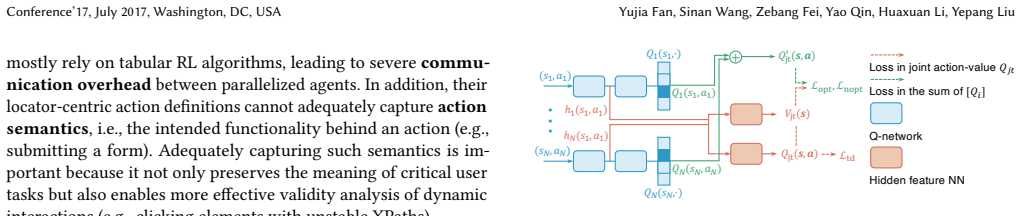
WebCQ incorporates QTRAN for multi-agent coordination and a lightweight synchronization mechanism allowing it to work under asynchronous web testing scenarios. It extracts semantic and exploration features for each UI event to form an action vector. This vector is concatenated with the current state vector and fed into the policy network, enabling DQN-based decision making within a dynamic action space. On eight large-scale commercial websites, under the same time budget and agent count, WebCQ explored 33.3 percent more states and executed 42.2 percent more unique actions than MARG while triggering more failures on six of the eight sites. It maintained higher action throughput during twenty-
What carries the argument
The action vector formed by concatenating semantic and exploration features of each UI event, concatenated with the state vector and passed to a DQN policy network under QTRAN coordination.
Load-bearing premise
The assumption that concatenating semantic and exploration features into an action vector and feeding it to a DQN policy network will produce effective decisions in the dynamic action spaces of real web applications.
What would settle it
A controlled comparison on one of the eight websites or a similar large site in which WebCQ under the same time budget and agent count explores fewer states or executes fewer unique actions than MARG.
Editorial analysis
A structured set of objections, weighed in public.
Referee Report
Summary. The paper proposes WebCQ, a MARL approach for web GUI testing that combines QTRAN for multi-agent coordination with a DQN policy network. Semantic and exploration features are extracted per UI event to form action vectors, which are concatenated with the state vector and passed to the DQN for decisions in dynamic action spaces. On eight commercial websites, under fixed time budgets and agent counts, it reports exploring 33.3% more states and executing 42.2% more unique actions than MARG, triggering more failures on six sites, and showing improved throughput and scaling with more agents in 20-hour runs.
Significance. If the empirical gains and architectural choices hold under rigorous controls, WebCQ would address a practical scalability gap in MARL-based GUI testing by moving beyond tabular methods, offering a concrete path to higher coverage on large web applications.
major comments (2)
- [Abstract / policy network description] The description of the policy network (abstract and method) states that per-event feature vectors are concatenated with the state and fed to DQN for dynamic action spaces, yet provides no equation, pseudocode, or ablation addressing how variable-length action sets are managed (e.g., action masking, per-action heads, or invalid-action filtering). Standard DQN assumes a fixed discrete output dimension; without this mechanism the reported 33.3% state and 42.2% action gains cannot be attributed to the coordination or feature design rather than baseline or environment artifacts.
- [Evaluation] The evaluation section reports quantitative improvements but supplies no information on experimental controls, statistical significance tests, how failures were defined and counted, or whether the eight websites and 20-hour scalability runs used identical configurations across methods. These omissions make the central performance claims unverifiable from the given text.
minor comments (1)
- [Abstract] The abstract contains a typographical error: 'WebCQovercomes' should be 'WebCQ overcomes'.
Simulated Author's Rebuttal
We thank the referee for the constructive comments, which highlight important areas for improving the clarity and rigor of our manuscript. We address each major comment below and will revise the paper accordingly.
read point-by-point responses
-
Referee: [Abstract / policy network description] The description of the policy network (abstract and method) states that per-event feature vectors are concatenated with the state and fed to DQN for dynamic action spaces, yet provides no equation, pseudocode, or ablation addressing how variable-length action sets are managed (e.g., action masking, per-action heads, or invalid-action filtering). Standard DQN assumes a fixed discrete output dimension; without this mechanism the reported 33.3% state and 42.2% action gains cannot be attributed to the coordination or feature design rather than baseline or environment artifacts.
Authors: We agree that the manuscript's description of the policy network is insufficiently detailed regarding the handling of dynamic action spaces. The text states that action vectors are concatenated with the state vector and fed to DQN, but provides no equation, pseudocode, or explicit mechanism (such as masking) for variable-length sets. This omission prevents clear attribution of the reported gains. We will revise the method section to include a formal description of the input construction, the action selection process, and how invalid actions are filtered, along with any relevant implementation details from our experiments. revision: yes
-
Referee: [Evaluation] The evaluation section reports quantitative improvements but supplies no information on experimental controls, statistical significance tests, how failures were defined and counted, or whether the eight websites and 20-hour scalability runs used identical configurations across methods. These omissions make the central performance claims unverifiable from the given text.
Authors: We acknowledge that the evaluation section lacks necessary details on experimental controls, statistical significance, failure definitions, and confirmation of identical configurations across methods and runs. While the manuscript indicates that comparisons used the same time budget and agent count on eight commercial sites with 20-hour scalability experiments, these specifics are not elaborated. We will expand the evaluation section to document the experimental setup, failure criteria (e.g., how crashes or errors were identified), any statistical tests applied, and explicit statements confirming consistent configurations, thereby making the performance claims verifiable. revision: yes
Circularity Check
No circularity: empirical comparisons rest on external benchmarks
full rationale
The paper's derivation chain consists of a proposed MARL architecture (QTRAN coordination plus DQN on concatenated semantic/exploration features) followed by direct experimental evaluation on eight commercial websites. Reported gains (33.3% more states, 42.2% more actions than MARG) are measured outcomes under fixed time/agent budgets, not predictions or quantities derived from fitted parameters. No equations, uniqueness theorems, or self-citations are invoked to force the central results; the evaluation is externally falsifiable against the websites and baseline. This satisfies the self-contained criterion with no load-bearing reductions to inputs.
Axiom & Free-Parameter Ledger
read the original abstract
Multi-agent reinforcement learning (MARL)-based techniques have shown promise for GUI testing. However, as the complexity of modern GUI software increases, existing MARL-based approaches (e.g., MARG and Fastbot) struggle to scale due to the inherent limitations of their underlying tabular reinforcement learning algorithms. This limits their applicability to large-scale commercial GUI software, especially web applications with vast state spaces and many interactive elements. To fill this gap, we propose WebCQ, a novel MARL-based approach for scalable web GUI testing. WebCQ incorporates QTRAN for multi-agent coordination and a lightweight synchronization mechanism, allowing it to work under asynchronous web testing scenarios. It extracts semantic and exploration features for each UI event to form an action vector. This vector is concatenated with the current state vector and fed into the policy network, enabling DQN-based decision making within a dynamic action space. We evaluated WebCQ on eight large-scale commercial websites. Under the same time budget and agent count, WebCQ explored 33.3% more states and executed 42.2% more unique actions than MARG, while triggering more failures on six of the eight websites under test. It also demonstrated strong scalability, maintaining higher action throughput during 20-hour experiments, and achieving greater performance improvements as the number of agents increased. These results show that WebCQovercomes key limitations of existing MARL-based approaches, providing a scalable and effective solution for enhancing modern web GUI testing.
Figures


Reference graph
Works this paper leans on
-
[1]
Release glove-wiki-gigaword-300·piskvorky/gensim-data
2017. Release glove-wiki-gigaword-300·piskvorky/gensim-data. https://github. com/piskvorky/gensim-data/releases/tag/glove-wiki-gigaword-300. [Accessed 11-04-2025]
2017
-
[2]
Top Websites in the World - Most Visited & Popular Rankings - Semrush — semrush.com
2025. Top Websites in the World - Most Visited & Popular Rankings - Semrush — semrush.com. https://semrush.com/website/top/. [Accessed 01-04-2025]
2025
-
[3]
W3Schools.com — w3schools.com
2025. W3Schools.com — w3schools.com. https://www.w3schools.com/js/js_ htmldom.asp. [Accessed 19-05-2025]
2025
-
[4]
Andrea Arcuri and Lionel Briand. 2014. A hitchhiker’s guide to statistical tests for assessing randomized algorithms in software engineering.Software Testing, Verification and Reliability24, 3 (2014), 219–250
2014
-
[5]
Ishan Banerjee, Bao Nguyen, Vahid Garousi, and Atif Memon. 2013. Graphical user interface (GUI) testing: Systematic mapping and repository.Information and Software Technology55, 10 (2013), 1679–1694
2013
-
[6]
Sebastian Bauersfeld and Tanja Vos. 2012. A reinforcement learning approach to automated gui robustness testing. InFast abstracts of the 4th symposium on search-based software engineering (SSBSE 2012). 7–12
2012
-
[7]
Sebastian Bauersfeld and Tanja EJ Vos. 2014. User interface level testing with TESTAR; what about more sophisticated action specification and selection?. In SATToSE. 60–78
2014
-
[8]
Matteo Biagiola, Filippo Ricca, and Paolo Tonella. 2017. Search based path and input data generation for web application testing. InSearch Based Software Engi- neering: 9th International Symposium, SSBSE 2017, Paderborn, Germany, September 9-11, 2017, Proceedings 9. Springer, 18–32
2017
-
[9]
Matteo Biagiola, Andrea Stocco, Filippo Ricca, and Paolo Tonella. 2019. Diversity- based web test generation. InProceedings of the 2019 27th ACM Joint Meeting on European Software Engineering Conference and Symposium on the Foundations of Software Engineering. 142–153
2019
-
[10]
Tianqin Cai, Zhao Zhang, and Ping Yang. 2020. Fastbot: A Multi-Agent Model- Based Test Generation System Beijing Bytedance Network Technology Co., Ltd.. InProceedings of the IEEE/ACM 1st International Conference on Automation of Software Test. 93–96
2020
-
[11]
Yuanchao Chen, Yuliang Lu, Zulie Pan, Juxing Chen, Fan Shi, Yang Li, and Yonghui Jiang. 2024. APIMiner: Identifying Web Application APIs Based on Web Page States Similarity Analysis.Electronics13, 6 (2024), 1112
2024
-
[12]
Eliane Collins, Arilo Neto, Auri Vincenzi, and José Maldonado. 2021. Deep reinforcement learning based android application gui testing. InProceedings of the XXXV Brazilian Symposium on Software Engineering. 186–194
2021
- [13]
-
[14]
Chris Dann, Yishay Mansour, Mehryar Mohri, Ayush Sekhari, and Karthik Srid- haran. 2022. Guarantees for epsilon-greedy reinforcement learning with function approximation. InInternational conference on machine learning. PMLR, 4666– 4689
2022
-
[15]
Yujia Fan, Sinan Wang, Zebang Fei, Yao Qin, Huaxuan Li, and Yepang Liu. 2024. Can Cooperative Multi-Agent Reinforcement Learning Boost Automatic Web Testing? An Exploratory Study. InProceedings of the 39th IEEE/ACM International Conference on Automated Software Engineering. 14–26
2024
-
[16]
Yujia Fan, Siyi Wang, Sinan Wang, Yepang Liu, Guoyao Wen, and Qi Rong. 2023. A Comprehensive Evaluation of Q-Learning Based Automatic Web GUI Testing. In 2023 10th International Conference on Dependable Systems and Their Applications (DSA). IEEE, 12–23
2023
-
[17]
Jakob Foerster, Nantas Nardelli, Gregory Farquhar, Triantafyllos Afouras, Philip HS Torr, Pushmeet Kohli, and Shimon Whiteson. 2017. Stabilising ex- perience replay for deep multi-agent reinforcement learning. InInternational conference on machine learning. PMLR, 1146–1155
2017
-
[18]
Hui Guo, Ting Su, Xiaoqiang Liu, Siyi Gu, and Jingling Sun. 2023. Effectively Finding ICC-related Bugs in Android Apps via Reinforcement Learning. In2023 IEEE 34th International Symposium on Software Reliability Engineering (ISSRE). IEEE, 403–414
2023
-
[19]
Jayesh K Gupta, Maxim Egorov, and Mykel Kochenderfer. 2017. Cooperative multi-agent control using deep reinforcement learning. InAutonomous Agents and Multiagent Systems: AAMAS 2017 Workshops, Best Papers, São Paulo, Brazil, May 8-12, 2017, Revised Selected Papers 16. Springer, 66–83
2017
-
[20]
Kenish Rajesh Halani, Rahul Saxena, et al . 2021. Critical analysis of manual versus automation testing. In2021 International Conference on Computational Performance Evaluation (ComPE). IEEE, 132–135
2021
-
[21]
Eric A Hansen, Daniel S Bernstein, and Shlomo Zilberstein. 2004. Dynamic programming for partially observable stochastic games. InAAAI, Vol. 4. 709– 715
2004
-
[22]
Weinberger
Gao Huang, Zhuang Liu, Laurens van der Maaten, and Kilian Q. Weinberger
-
[23]
Densely Connected Convolutional Networks
Densely Connected Convolutional Networks. arXiv:1608.06993 [cs.CV] https://arxiv.org/abs/1608.06993
work page internal anchor Pith review Pith/arXiv arXiv
-
[24]
Yavuz Koroglu, Alper Sen, Ozlem Muslu, Yunus Mete, Ceyda Ulker, Tolga Tan- riverdi, and Yunus Donmez. 2018. QBE: QLearning-based exploration of android applications. In2018 IEEE 11th International Conference on Software Testing, Veri- fication and Validation (ICST). IEEE, 105–115
2018
-
[25]
Yuanhong Lan, Yifei Lu, Zhong Li, Minxue Pan, Wenhua Yang, Tian Zhang, and Xuandong Li. 2024. Deeply Reinforcing Android GUI Testing with Deep Rein- forcement Learning. InProceedings of the 46th IEEE/ACM International Conference on Software Engineering. 1–13
2024
-
[26]
Tao Li, Chenhui Cui, Rubing Huang, Dave Towey, and Lei Ma. [n. d.]. Large Language Models for Automated Web-Form-Test Generation: An Empirical Study. ACM Transactions on Software Engineering and Methodology([n. d.])
-
[27]
Chenxu Liu, Junheng Wang, Wei Yang, Ying Zhang, and Tao Xie. [n. d.]. Judge: Effective State Abstraction for Guiding Automated Web GUI Testing.ACM Transactions on Software Engineering and Methodology([n. d.])
-
[28]
Leonardo Mariani, Mauro Pezzè, Oliviero Riganelli, and Mauro Santoro. 2011. AutoBlackTest: a tool for automatic black-box testing. InProceedings of the 33rd international conference on software engineering. 1013–1015
2011
-
[29]
Leonardo Mariani, Mauro Pezzè, Oliviero Riganelli, and Mauro Santoro. 2014. Automatic testing of GUI-based applications.Software Testing, Verification and Reliability24, 5 (2014), 341–366
2014
-
[30]
Ali Mesbah, Engin Bozdag, and Arie Van Deursen. 2008. Crawling Ajax by inferring user interface state changes. In2008 eighth international conference on web engineering. IEEE, 122–134
2008
-
[31]
Volodymyr Mnih, Koray Kavukcuoglu, David Silver, Andrei A Rusu, Joel Veness, Marc G Bellemare, Alex Graves, Martin Riedmiller, Andreas K Fidjeland, Georg Ostrovski, et al. 2015. Human-level control through deep reinforcement learning. nature518, 7540 (2015), 529–533
2015
-
[32]
Marco Mobilio, Diego Clerissi, Giovanni Denaro, and Leonardo Mariani. 2023. GUI Testing to the Power of Parallel Q-Learning. In2023 IEEE/ACM 45th International Conference on Software Engineering: Companion Proceedings (ICSE-Companion). IEEE, 55–59
2023
-
[33]
2020.Grokking deep reinforcement learning
Miguel Morales. 2020.Grokking deep reinforcement learning. Manning Publica- tions
2020
-
[34]
2016.A concise introduction to decentralized POMDPs
Frans A Oliehoek, Christopher Amato, et al . 2016.A concise introduction to decentralized POMDPs. Vol. 1. Springer
2016
-
[35]
Minxue Pan, An Huang, Guoxin Wang, Tian Zhang, and Xuandong Li. 2020. Reinforcement learning based curiosity-driven testing of Android applications. InProceedings of the 29th ACM SIGSOFT International Symposium on Software Testing and Analysis. 153–164
2020
-
[36]
Jeffrey Pennington, Richard Socher, and Christopher D Manning. 2014. Glove: Global vectors for word representation. InProceedings of the 2014 conference on empirical methods in natural language processing (EMNLP). 1532–1543. Conference’17, July 2017, Washington, DC, USA Yujia Fan, Sinan Wang, Zebang Fei, Yao Qin, Huaxuan Li, Yepang Liu
2014
-
[37]
Simon Poulding and John A Clark. 2010. Efficient software verification: Statistical testing using automated search.IEEE Transactions on Software Engineering36, 6 (2010), 763–777
2010
-
[38]
Andrea Romdhana, Alessio Merlo, Mariano Ceccato, and Paolo Tonella. 2022. Deep reinforcement learning for black-box testing of android apps.ACM Trans- actions on Software Engineering and Methodology (TOSEM)31, 4 (2022), 1–29
2022
-
[39]
Tom Schaul, John Quan, Ioannis Antonoglou, and David Silver. 2015. Prioritized experience replay.arXiv preprint arXiv:1511.05952(2015)
work page internal anchor Pith review Pith/arXiv arXiv 2015
-
[40]
Salman Sherin, Asmar Muqeet, Muhammad Uzair Khan, and Muhammad Zohaib Iqbal. 2023. QExplore: An exploration strategy for dynamic web applications using guided search.Journal of Systems and Software195 (2023), 111512
2023
-
[41]
Kyunghwan Son, Daewoo Kim, Wan Ju Kang, David Earl Hostallero, and Yung Yi. 2019. Qtran: Learning to factorize with transformation for cooperative multi- agent reinforcement learning. InInternational conference on machine learning. PMLR, 5887–5896
2019
-
[42]
András Vargha and Harold D Delaney. 2000. A critique and improvement of the CL common language effect size statistics of McGraw and Wong.Journal of Educational and Behavioral Statistics25, 2 (2000), 101–132
2000
-
[43]
Oriol Vinyals, Timo Ewalds, Sergey Bartunov, Petko Georgiev, Alexander Sasha Vezhnevets, Michelle Yeo, Alireza Makhzani, Heinrich Küttler, John Agapiou, Julian Schrittwieser, John Quan, Stephen Gaffney, Stig Petersen, Karen Simonyan, Tom Schaul, Hado van Hasselt, David Silver, Timothy Lillicrap, Kevin Calderone, Paul Keet, Anthony Brunasso, David Lawrence...
work page internal anchor Pith review Pith/arXiv arXiv 2017
-
[44]
Siyi Wang, Sinan Wang, Yujia Fan, Xiaolei Li, and Yepang Liu. 2024. Leveraging Large Vision-Language Model for Better Automatic Web GUI Testing. In2024 IEEE International Conference on Software Maintenance and Evolution (ICSME). IEEE, 125–137
2024
-
[45]
Christopher JCH Watkins and Peter Dayan. 1992. Q-learning.Machine learning 8 (1992), 279–292
1992
- [46]
-
[47]
Shengcheng Yu, Chunrong Fang, Xin Li, Yuchen Ling, Zhenyu Chen, and Zhen- dong Su. 2024. Effective, Platform-Independent GUI Testing via Image Embedding and Reinforcement Learning.ACM Transactions on Software Engineering and Methodology33, 7 (2024), 1–27
2024
-
[48]
Kaiqing Zhang, Zhuoran Yang, and Tamer Başar. 2021. Multi-agent reinforce- ment learning: A selective overview of theories and algorithms.Handbook of reinforcement learning and control(2021), 321–384
2021
-
[49]
Shuai Zhang, Hongkang Li, Meng Wang, Miao Liu, Pin-Yu Chen, Songtao Lu, Sijia Liu, Keerthiram Murugesan, and Subhajit Chaudhury. 2023. On the convergence and sample complexity analysis of deep q-networks with 𝜀-greedy exploration. Advances in Neural Information Processing Systems36 (2023), 13064–13102
2023
-
[50]
Zhaoxu Zhang, Robert Winn, Yu Zhao, Tingting Yu, and William GJ Halfond
-
[51]
InProceedings of the 32nd ACM SIGSOFT International Symposium on Software Testing and Analysis
Automatically reproducing android bug reports using natural language processing and reinforcement learning. InProceedings of the 32nd ACM SIGSOFT International Symposium on Software Testing and Analysis. 411–422
-
[52]
Yu Zhao, Brent Harrison, and Tingting Yu. 2024. Dinodroid: Testing android apps using deep q-networks.ACM Transactions on Software Engineering and Methodology33, 5 (2024), 1–24
2024
-
[53]
Yan Zheng, Yi Liu, Xiaofei Xie, Yepang Liu, Lei Ma, Jianye Hao, and Yang Liu
-
[54]
In 2021 IEEE/ACM 43rd International Conference on Software Engineering (ICSE)
Automatic web testing using curiosity-driven reinforcement learning. In 2021 IEEE/ACM 43rd International Conference on Software Engineering (ICSE). IEEE, 423–435
2021
discussion (0)
Sign in with ORCID, Apple, or X to comment. Anyone can read and Pith papers without signing in.