Orientation matters: Consequences for gravitational-wave background detectability
Pith reviewed 2026-06-26 08:09 UTC · model grok-4.3
The pith
The relative orientation of Earth-based L-shaped interferometers can drastically impact the detectability of gravitational-wave backgrounds.
A machine-rendered reading of the paper's core claim, the machinery that carries it, and where it could break.
Core claim
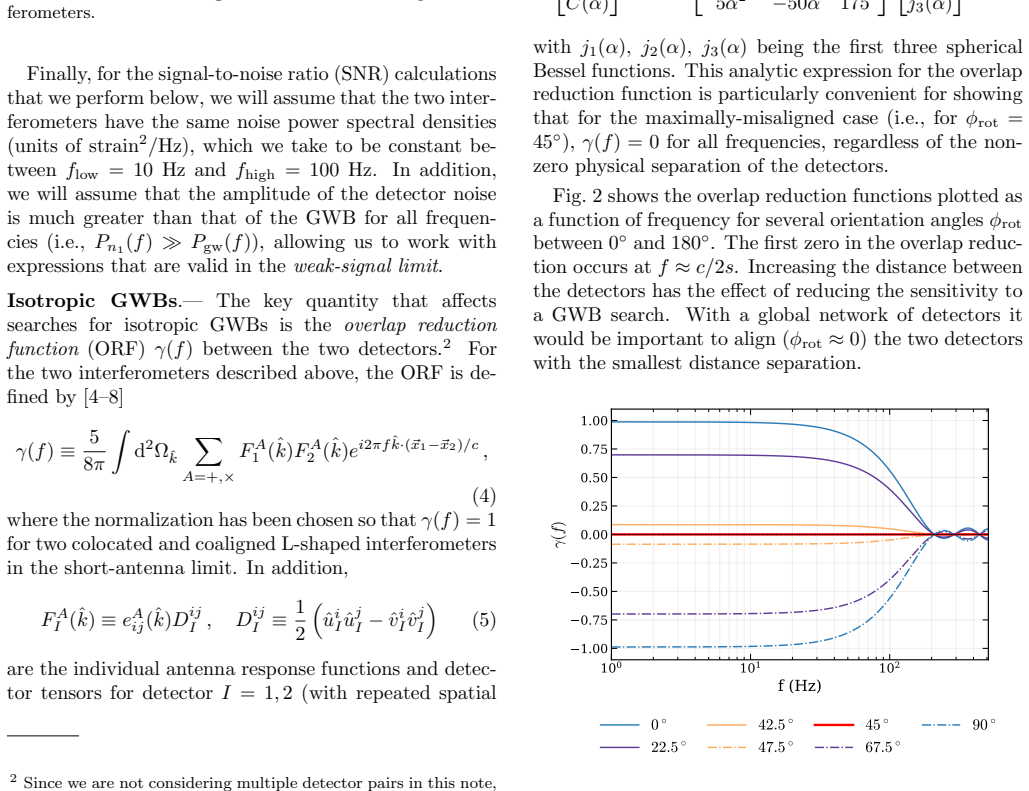
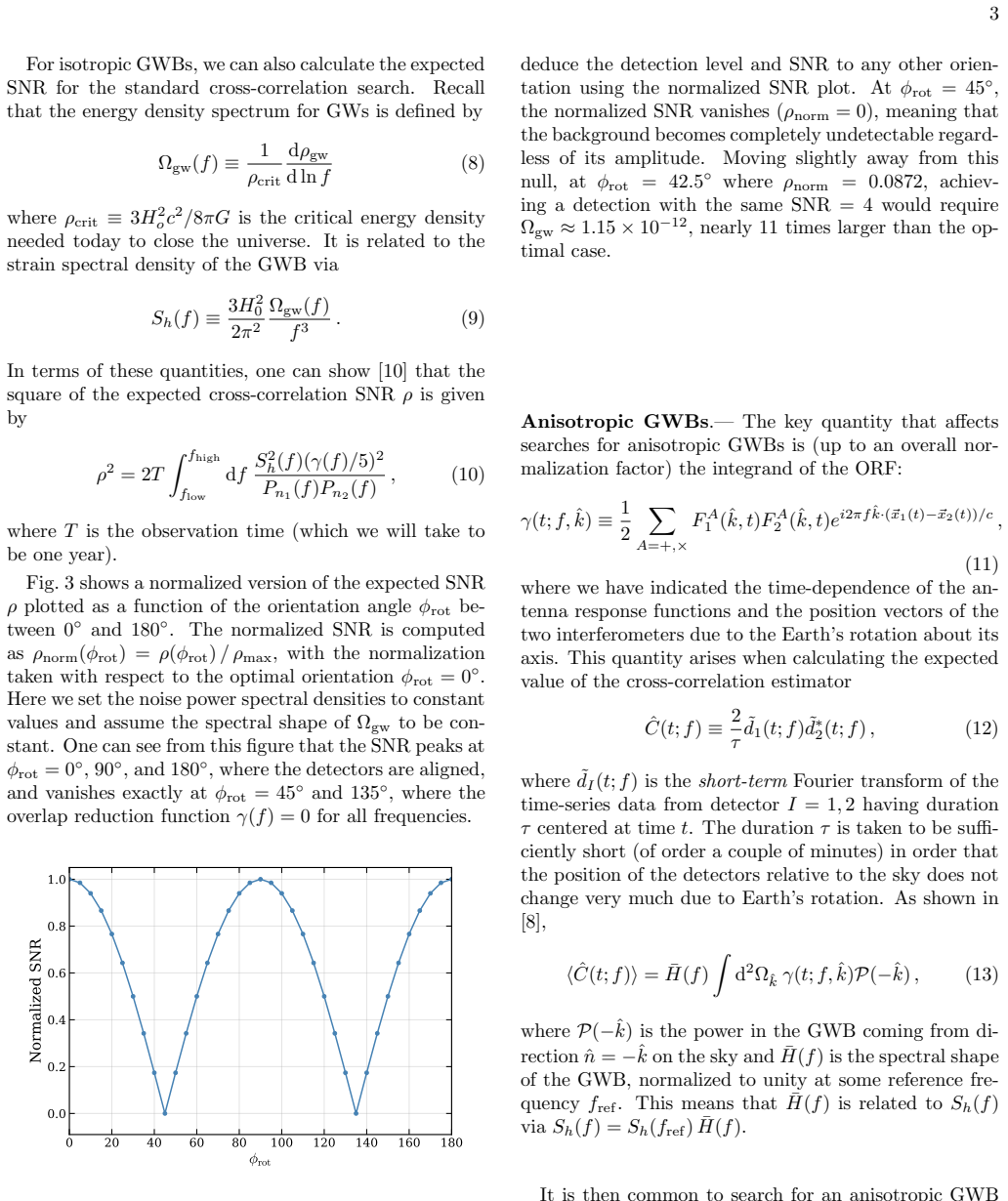
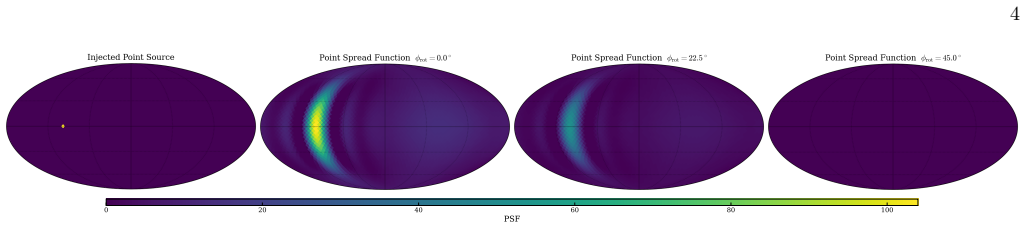
Applying standard cross-correlation techniques to a few simple examples, the relative orientation of a pair of Earth-based L-shaped laser interferometers can drastically impact the detectability of both isotropic and anisotropic gravitational-wave backgrounds, as the geometrical configuration controls the overlap reduction function in the searches.
What carries the argument
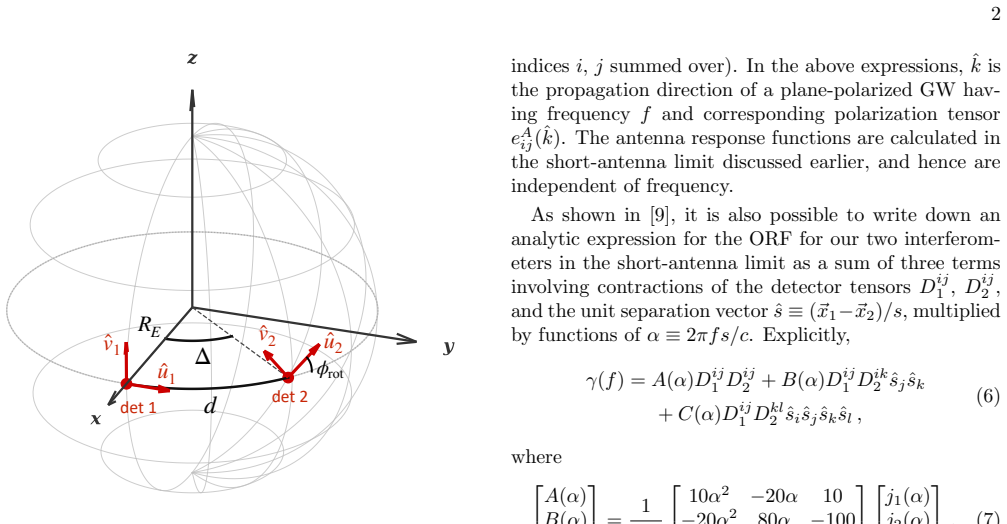
The geometrical configuration of detector pairs, specifically physical separation and relative orientation, which determines the overlap reduction function for cross-correlation statistics.
If this is right
- Detector networks must account for orientation when planning placements to maximize sensitivity to gravitational-wave backgrounds.
- Existing pairs of detectors may have orientations that limit or enhance detection prospects depending on their alignment.
- Both isotropic and anisotropic backgrounds are affected, requiring orientation-specific analysis strategies.
- Simple examples show drastic impacts, suggesting orientation effects are not negligible in practice.
Where Pith is reading between the lines
- Future detector siting decisions could prioritize optimal relative orientations to improve background searches.
- Reanalyzing past data with orientation-corrected filters might reveal previously missed signals.
- Extending this to more complex networks or space-based detectors could show similar orientation sensitivities.
- Connecting to other stochastic signals like pulsar timing arrays might benefit from similar geometric considerations.
Load-bearing premise
The geometrical configuration is the dominant factor controlling detectability, and standard cross-correlation techniques on simple examples capture the full practical impact without additional unmodeled effects.
What would settle it
A direct comparison of cross-correlation sensitivity for two detector pairs with identical separation but different relative orientations in simulated or real data, checking if the detection threshold changes as predicted.
Figures
read the original abstract
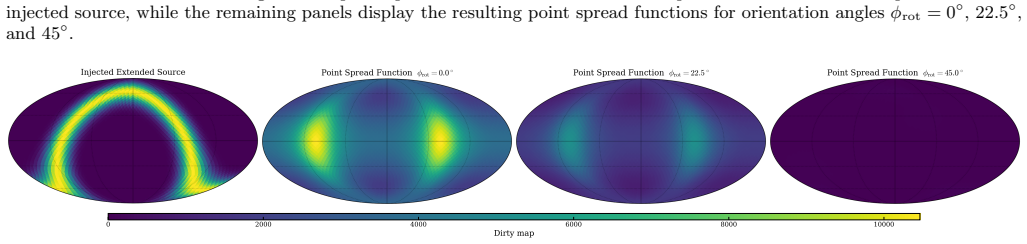
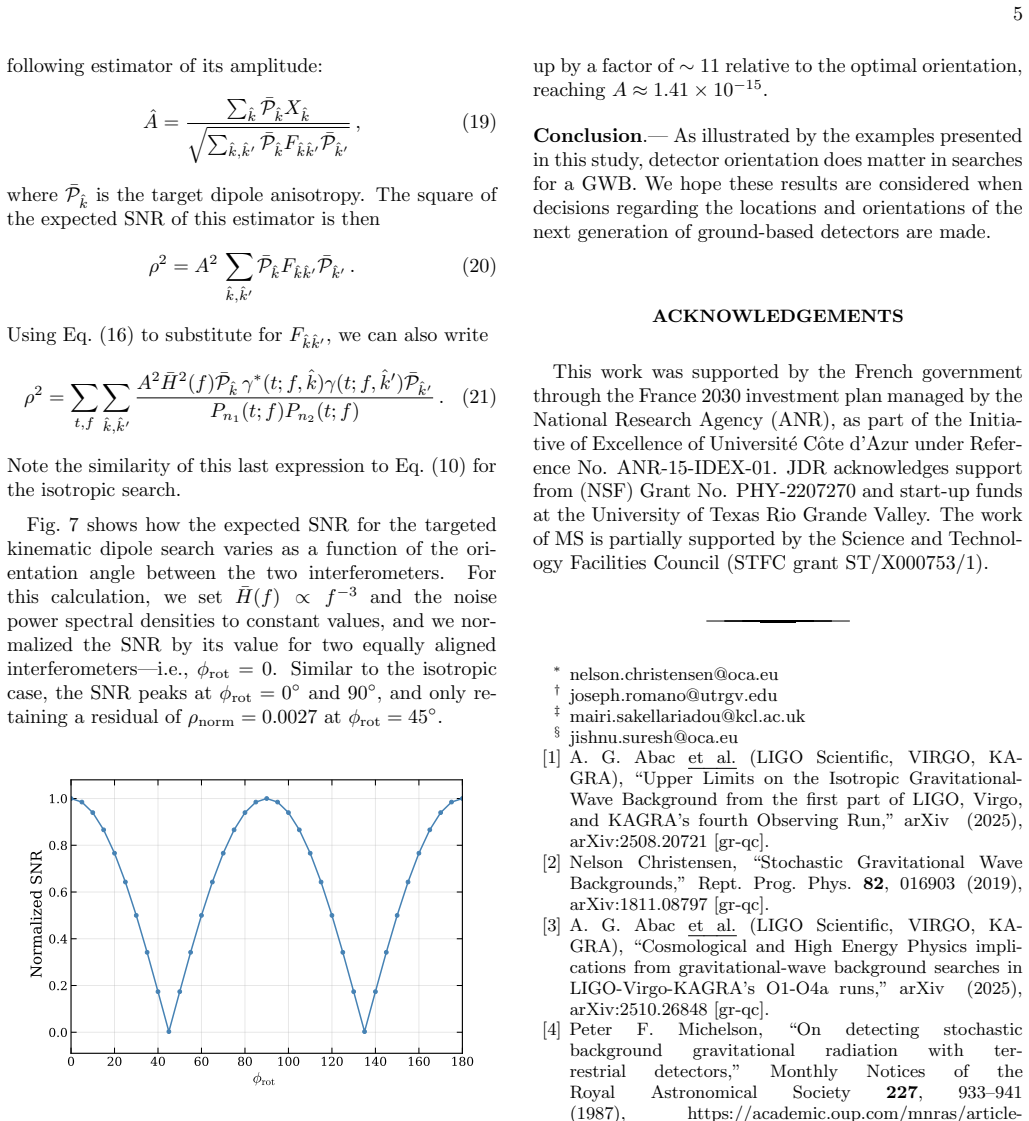
Cross-correlation searches for gravitational-wave backgrounds depend on the geometrical configuration (physical separation and relative orientation) of the detectors comprising the network. Applying standard techniques to a few simple examples, we illustrate how the relative orientation of a pair of Earth-based L-shaped laser interferometers can drastically impact the detectability of both isotropic and anisotropic gravitational-wave backgrounds.
Editorial analysis
A structured set of objections, weighed in public.
Referee Report
Summary. The manuscript applies standard cross-correlation techniques for gravitational-wave background searches to a few simple configurations of Earth-based L-shaped interferometers. It illustrates that the relative orientation (in addition to separation) of detector pairs can strongly affect the overlap reduction function and resulting signal-to-noise ratio for both isotropic (direction-averaged) and anisotropic (direction-dependent) backgrounds.
Significance. The central illustration follows directly from the known angular dependence of the overlap reduction function γ(f) and provides concrete, parameter-free examples of how orientation modulates detectability. This is useful for network planning even if geometry is not claimed to be the sole factor; the absence of new free parameters or invented entities strengthens the pedagogical value.
minor comments (2)
- The abstract states that 'standard techniques are applied to simple examples,' but the manuscript would benefit from an explicit enumeration of the chosen configurations (e.g., co-aligned vs. orthogonal arms, specific baseline vectors) already in §2 or the introduction to allow immediate reproducibility.
- Figure captions or the results section should state the frequency band and assumed power-law index for the anisotropic case so that the 'drastic impact' claim can be directly compared to existing literature on γ(f) for LIGO-Virgo pairs.
Simulated Author's Rebuttal
We thank the referee for their positive summary, significance assessment, and recommendation of minor revision. No specific major comments were raised in the report.
Circularity Check
No significant circularity; derivation applies standard formalism to explicit examples
full rationale
The paper states it applies standard cross-correlation techniques and the established overlap reduction function to a few simple detector configurations to illustrate orientation effects on detectability. No equations or claims reduce by construction to fitted inputs, self-definitions, or self-citation chains; the geometry-to-SNR mapping follows from pre-existing independent formalism without renaming known results or smuggling ansatzes. The central claim remains independent of the paper's own inputs.
Axiom & Free-Parameter Ledger
Reference graph
Works this paper leans on
-
[1]
A. G. Abac et al. (LIGO Scientific, VIRGO, KA- GRA), “Upper Limits on the Isotropic Gravitational- Wave Background from the first part of LIGO, Virgo, and KAGRA’s fourth Observing Run,” arXiv (2025), arXiv:2508.20721 [gr-qc]
arXiv 2025
-
[2]
Stochastic Gravitational Wave Backgrounds,
Nelson Christensen, “Stochastic Gravitational Wave Backgrounds,” Rept. Prog. Phys.82, 016903 (2019), arXiv:1811.08797 [gr-qc]
Pith/arXiv arXiv 2019
-
[3]
A. G. Abac et al. (LIGO Scientific, VIRGO, KA- GRA), “Cosmological and High Energy Physics impli- cations from gravitational-wave background searches in LIGO-Virgo-KAGRA’s O1-O4a runs,” arXiv (2025), arXiv:2510.26848 [gr-qc]
arXiv 2025
-
[4]
On detecting stochastic background gravitational radiation with ter- restrial detectors,
Peter F. Michelson, “On detecting stochastic background gravitational radiation with ter- restrial detectors,” Monthly Notices of the Royal Astronomical Society227, 933–941 (1987), https://academic.oup.com/mnras/article- pdf/227/4/933/3926536/mnras227-0933.pdf
1987
-
[5]
Measuring the stochastic gravitational-radiation background with laser- interferometric antennas,
Nelson Christensen, “Measuring the stochastic gravitational-radiation background with laser- interferometric antennas,” Phys. Rev. D46, 5250–5266 (1992)
1992
-
[6]
Sensitivity of the laser interferom- eter gravitational wave observatory to a stochastic back- ground, and its dependence on the detector orientations,
Eanna E. Flanagan, “Sensitivity of the laser interferom- eter gravitational wave observatory to a stochastic back- ground, and its dependence on the detector orientations,” Phys. Rev. D48, 2389–2407 (1993)
1993
-
[7]
Optimal detection strategies for measuring the stochastic gravitational radiation back- ground with laser interferometric antennas,
Nelson Christensen, “Optimal detection strategies for measuring the stochastic gravitational radiation back- ground with laser interferometric antennas,” Phys. Rev. D55, 448–454 (1997). 6
1997
-
[8]
Detection methods for stochastic gravitational-wave backgrounds: a unified treatment,
Joseph D. Romano and Neil J. Cornish, “Detection methods for stochastic gravitational-wave backgrounds: a unified treatment,” Living Rev. Rel.20, 2 (2017), arXiv:1608.06889 [gr-qc]
Pith/arXiv arXiv 2017
-
[9]
Bruce Allen and Joseph D. Romano, “Detecting a stochastic background of gravitational radiation: Signal processing strategies and sensitivities,” Phys. Rev. D59, 102001 (1999), arXiv:gr-qc/9710117
Pith/arXiv arXiv 1999
-
[10]
Sensitivity curves for searches for gravitational-wave backgrounds,
Eric Thrane and Joseph D. Romano, “Sensitivity curves for searches for gravitational-wave backgrounds,” Phys. Rev. D88, 124032 (2013), arXiv:1310.5300 [astro-ph.IM]
Pith/arXiv arXiv 2013
-
[11]
Probing the anisotropies of a stochas- tic gravitational-wave background using a network of ground-based laser interferometers,
Eric Thrane, Stefan Ballmer, Joseph D. Romano, San- jit Mitra, Dipongkar Talukder, Sukanta Bose, and Vuk Mandic, “Probing the anisotropies of a stochas- tic gravitational-wave background using a network of ground-based laser interferometers,” Phys. Rev. D80, 122002 (2009)
2009
-
[12]
Multi-baseline gravitational wave radiometry,
Dipongkar Talukder, Sanjit Mitra, and Sukanta Bose, “Multi-baseline gravitational wave radiometry,” Phys. Rev. D83, 063002 (2011), arXiv:1012.4530 [gr-qc]
Pith/arXiv arXiv 2011
-
[13]
Deepali Agarwal, Jishnu Suresh, Vuk Mandic, Andrew Matas, and Tania Regimbau, “Targeted search for the stochastic gravitational-wave background from the galac- tic millisecond pulsar population,” Phys. Rev. D106, 043019 (2022), arXiv:2204.08378 [gr-qc]
arXiv 2022
-
[14]
Planck 2018 results. I. Overview and the cosmological legacy of Planck,
N. Aghanim et al. (Planck), “Planck 2018 results. I. Overview and the cosmological legacy of Planck,” Astron. Astrophys.641, A1 (2020), arXiv:1807.06205 [astro- ph.CO]. Appendix A: Proof thatγ(f) = 0forϕ rot = 45◦ To prove thatγ(f) is identically zero forϕ rot = 45 ◦, we show that the three geometrical factors that appear in Eq. (6): Dij 1 Dij 2 , D ij 1 ...
Pith/arXiv arXiv 2018
discussion (0)
Sign in with ORCID, Apple, or X to comment. Anyone can read and Pith papers without signing in.