REVIEW 3 minor 20 references
The quadratic spinor Lagrangian yields no propagating spin-3/2 field on any background, leaving only its composite spin-1/2 Dirac fermion as a dark-matter candidate.
Reviewed by Pith at T0; open to challenge. T0 means a machine referee read the full paper against a public rubric. the ladder, T0–T4 →
T0 review · grok-4.3
2026-06-30 10:31 UTC pith:N5MOVBDL
load-bearing objection The paper gives a no-go for spin-3/2 modes in the QSL by showing the second-order term vanishes identically and dynamics reduce to massless graviton plus scalar composites.
Dark matter from the quadratic spinor Lagrangian II: A spin-3/2 no-go and the uniqueness of the spin-1/2 candidate
The pith
A machine-rendered reading of the paper's core claim, the machinery that carries it, and where it could break.
Core claim
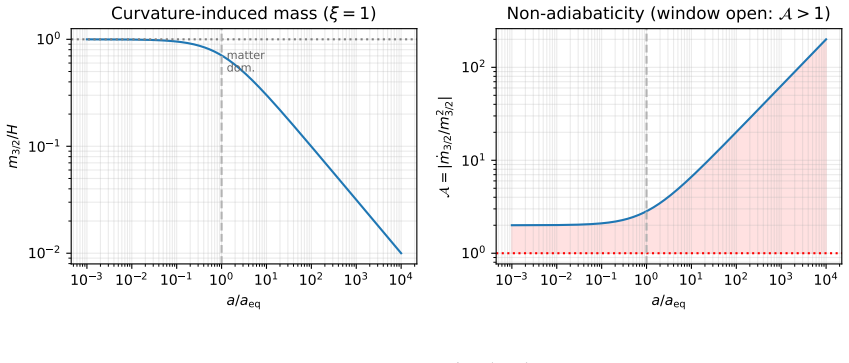
The composite Quadratic Spinor Lagrangian propagates a spin-1/2 Dirac fermion whose mass is generated geometrically by cosmological trace torsion. Promoting the spinor 1-form to an independent Dirac-vector field does not produce a massive spin-3/2 mode. The torsional term is frame-aligned and confined to the time-component sector. The second-order form 2 DΨ γ5 DΨ is the boundary part of the spinor-curvature identity and carries no bulk dynamics. Genuine dynamics therefore reside in the curvature side S = −∫ ψ̄ψ R √−g, where both the metric and the scalar are composites of Ψ; the second variation consequently factors through the linearized metric and a scalar, both massless. Every propagating
What carries the argument
The spinor-curvature identity, whose boundary term supplies no bulk dynamics and forces all propagation into the curvature side that factors through metric and scalar composites of the spinor.
Load-bearing premise
The second-order form for the independent spinor field is identically a boundary term carrying no bulk kinetic energy.
What would settle it
Observation of a massive spin-3/2 propagating mode whose dispersion and couplings arise from an independent spinor 1-form in the quadratic spinor Lagrangian on a curved background.
If this is right
- The composite spin-1/2 Dirac fermion is the unique propagating matter excitation of the quadratic spinor Lagrangian.
- No massive spin-3/2 mode exists on any background.
- The unique dark-matter candidate is the geometrically massive spin-1/2 fermion.
- The surviving mode can be read as the Goldstino of local supersymmetry broken by the metric condensate.
Where Pith is reading between the lines
- The result tightens the link between geometric mass generation and the absence of higher-spin modes in composite spinor theories.
- It suggests that any extension attempting to restore a spin-3/2 candidate would need to alter the boundary character of the second-order term or the composite nature of the metric.
Editorial analysis
A structured set of objections, weighed in public.
Referee Report
Summary. The manuscript claims a no-go theorem for spin-3/2 dark matter in the quadratic spinor Lagrangian (QSL): treating the composite spinor 1-form Ψ_μ as an independent Dirac-vector field yields no propagating massive spin-3/2 mode on any background. Three exact results are combined: (i) the torsional term reduces via Clifford algebra to a frame-aligned mass confined to the time-component sector; (ii) the second-order term 2 DΨ γ5 DΨ is identically the boundary piece of the spinor-curvature identity and therefore supplies zero bulk kinetic or cross terms; (iii) the genuine dynamics reside in the curvature side S = −∫ ψ̄ψ R √−g whose second variation factors through the linearized metric h_μν[δΨ] and scalar δΦ[δΨ], both massless, so that every pole lies on the light cone k²=0. This establishes the composite spin-1/2 Dirac fermion as the unique propagating matter excitation and dark-matter candidate, interpretable as the Goldstino of broken local supersymmetry.
Significance. If the derivations hold, the result is significant because it supplies a dynamical completion to the kinematic absence of spin-3/2 in the composite and rules out spin-3/2 as a dark-matter candidate within the QSL framework on arbitrary backgrounds. Credit is due for the parameter-free, identity-based approach (exact Clifford reduction and boundary-term identification) that yields a falsifiable prediction of only massless metric and scalar poles; the super-SL(2,C) Goldstino reading also connects the construction to earlier gravitino-dark-matter literature.
minor comments (3)
- The three central results are stated clearly in the abstract but would benefit from explicit equation numbers and section references in the main text so that each identity (Clifford reduction, boundary term, second-variation factoring) can be located immediately.
- Notation for the independent vector-spinor (Ψ_μ versus the composite) and for the metric condensate g = Ψ ⊗_S Ψ should be introduced once with a short table or glossary to avoid ambiguity when the same symbols appear in both composite and independent contexts.
- A brief remark on the relation of this no-go to the results of Paper I would help readers who have not followed the series.
Simulated Author's Rebuttal
We thank the referee for the careful reading of the manuscript and for the positive assessment. The provided summary accurately reflects the content and conclusions of the paper.
Circularity Check
No significant circularity
full rationale
The derivation relies on explicit Clifford reductions of the torsional term and the identification of 2 DΨ γ5 DΨ as the boundary term of the spinor-curvature identity, both presented as direct algebraic consequences with no bulk dynamics for the independent field. The second variation is then shown to factor through the composites g=Ψ⊗_S Ψ and the scalar, yielding only massless poles on k²=0. These steps are self-contained mathematical identities and exact computations performed in the present work; the kinematic fact referenced from prior work is not load-bearing for the dynamical no-go, and no fitted parameters, self-definitions, or unverified self-citation chains appear in the central argument.
Axiom & Free-Parameter Ledger
axioms (2)
- standard math Clifford reduction computes the torsional term exactly as a frame-aligned mass
- standard math The spinor-curvature identity makes the second-order form a boundary term
invented entities (2)
-
Quadratic Spinor Lagrangian
no independent evidence
-
composite spinor 1-form Ψ_μ
no independent evidence
read the original abstract
The composite Quadratic Spinor Lagrangian (QSL) propagates a spin-1/2 Dirac fermion whose mass is generated geometrically by cosmological trace torsion. It is natural to ask whether promoting the spinor 1-form $\Psi_\mu$ to an independent Dirac-vector field yields a genuine spin-3/2 dark-matter candidate. We prove that it does not. Three results combine into a no-go theorem. First, the torsional term, computed exactly by Clifford reduction, is a frame-aligned mass confined to the time-component sector -- not a uniform spin-3/2 mass. Second, the second-order form $2 D\Psi \gamma_5 D\Psi$ has identically vanishing kinetic and cross terms for the independent field: as a component expression it is the boundary part of the spinor-curvature identity and carries no bulk dynamics. Third, the genuine dynamics therefore reside in the curvature side of that identity, $S=-\int\bar\psi\psi R\sqrt{-g}$, in which the metric $g=\Psi\otimes_S\Psi$ and the scalar $\bar\psi\psi$ are both composites of $\Psi$; the second variation consequently factors, $\delta^2S=\mathcal Q(h_{\mu\nu}[\delta\Psi],\delta\Phi[\delta\Psi])$, through the linearized metric and a scalar, both massless. Every propagating pole therefore lies on the metric light cone $k^2=0$ -- the graviton and a scalar -- and no massive spin-3/2 mode exists, on any background. This is the dynamical completion of the kinematic fact that the composite spinor 1-form has no spin-3/2 part, and it establishes the composite spin-1/2 Dirac fermion as the unique propagating matter excitation, and the unique dark-matter candidate, of the QSL. Through the super-SL(2,C) structure this surviving mode is naturally read as the Goldstino of the local supersymmetry broken by the metric condensate -- a composite, gravitational descendant of the light-gravitino dark matter of Fayet and of Pagels and Primack.
Figures
Reference graph
Works this paper leans on
-
[1]
Nester J M and Tung R-S 1995Gen. Relativ. Gravit.27115
- [2]
- [3]
-
[4]
Blagojevi´ c M and Nikoli´ c I A 1983Phys. Rev. D282455
-
[5]
Yo H-J and Nester J M 1999Int. J. Mod. Phys. D8459
-
[6]
Shaposhnikov M, Shkerin A, Timiryasov I and Zell S 2021Phys. Rev. Lett.126161301; 127169901(E)
-
[7]
Maleknejad A and Kopp J 2026Phys. Rev. Lett.136131501
- [8]
- [9]
-
[10]
Fayet P 1977Phys. Lett. B70461
-
[11]
Fayet P 1979Phys. Lett. B84421
-
[12]
Fayet P 1979Phys. Lett. B86272
-
[13]
Experimental consequences of supersymmetry
Fayet P 1981, “Experimental consequences of supersymmetry”, inProc. 16th Rencontre de Moriond, ed. J Tran Thanh Van (Editions Fronti` eres) Vol. 1, p. 347
work page 1981
-
[14]
Pagels H and Primack J R 1982Phys. Rev. Lett.48223
-
[15]
Deser S and Zumino B 1976Phys. Lett. B62335
- [16]
-
[17]
Kallosh R, Kofman L, Linde A D and Van Proeyen A 2000Phys. Rev. D61103503 (hep-th/9907124) 15
work page internal anchor Pith review Pith/arXiv arXiv
- [18]
-
[19]
Tung R-S 2026 Spacetime torsion fixes the mass and spin of gravitationally produced dark matter,arXiv:2606.23418
work page internal anchor Pith review Pith/arXiv arXiv 2026
-
[20]
Tung R-S 2026 Dark matter from the quadratic spinor Lagrangian I: Geometric mass for a gravitationally produced spin-1/2 fermion,arXiv:2606.23447. 16
work page internal anchor Pith review Pith/arXiv arXiv 2026
discussion (0)
Sign in with ORCID, Apple, or X to comment. Anyone can read and Pith papers without signing in.