Reverberation in the Narrow Fe K{α} Line in the Seyfert Galaxy NGC 4151 with XRISM
Pith reviewed 2026-06-26 07:28 UTC · model grok-4.3
The pith
XRISM observations of NGC 4151 detect a 3.5-day lag between the X-ray continuum and narrow Fe Kα line flux.
A machine-rendered reading of the paper's core claim, the machinery that carries it, and where it could break.
Core claim
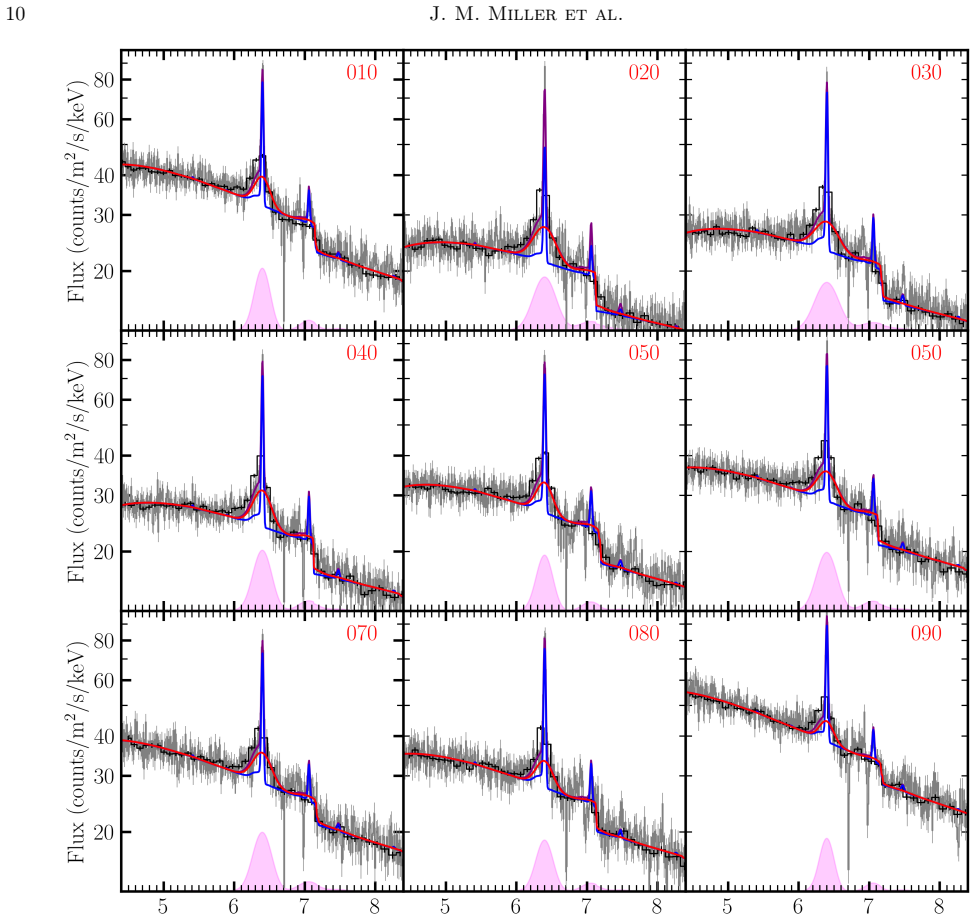
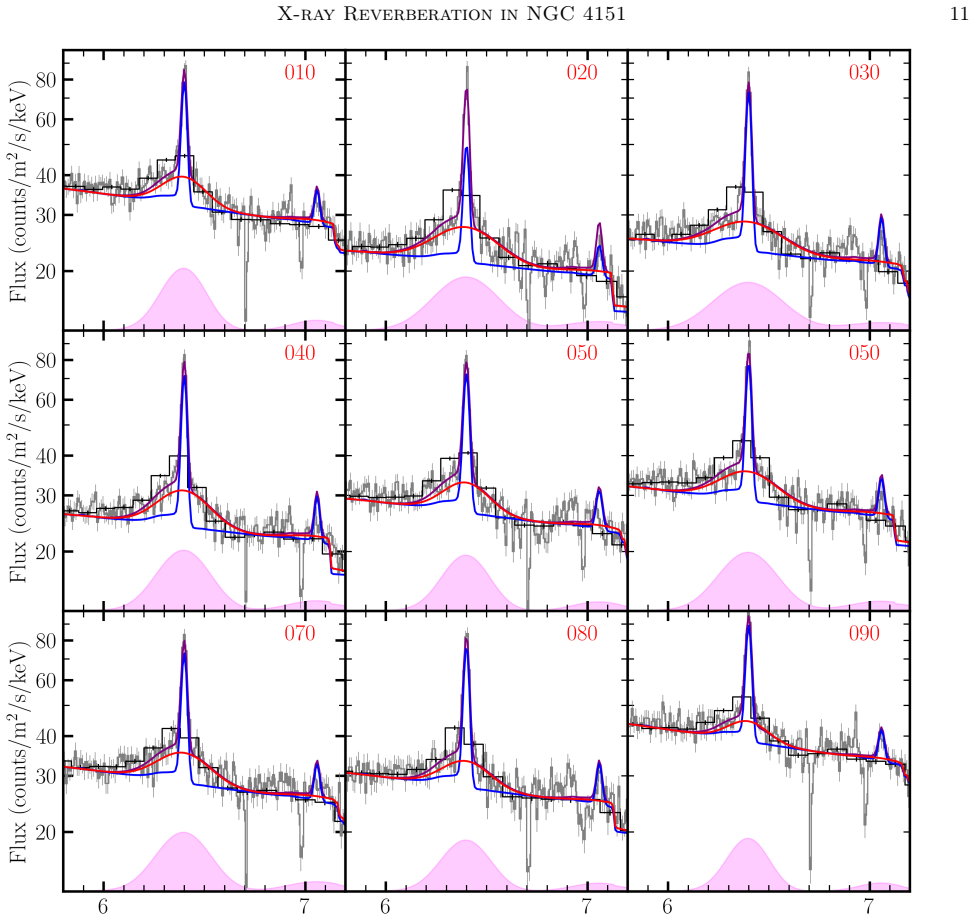
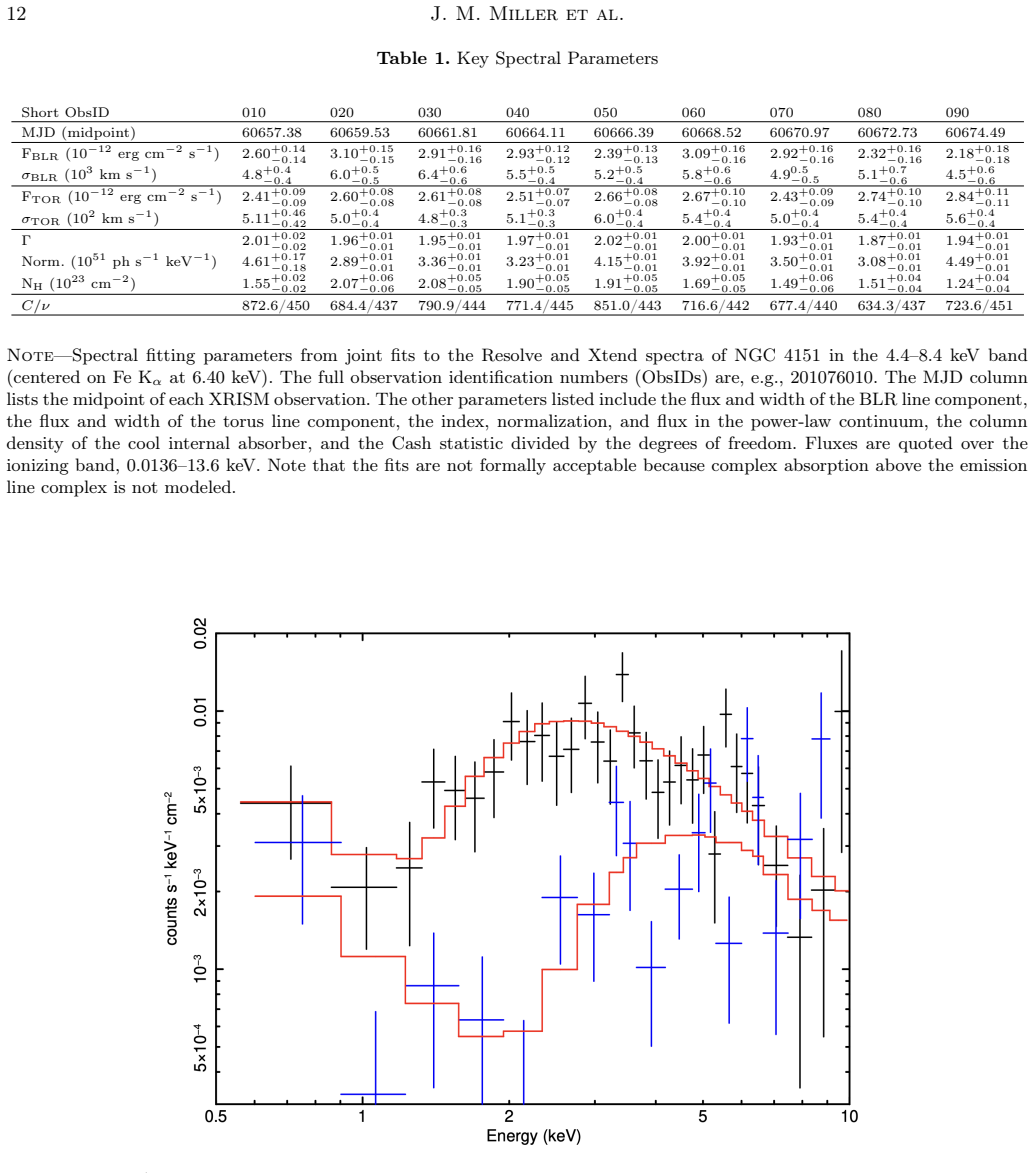
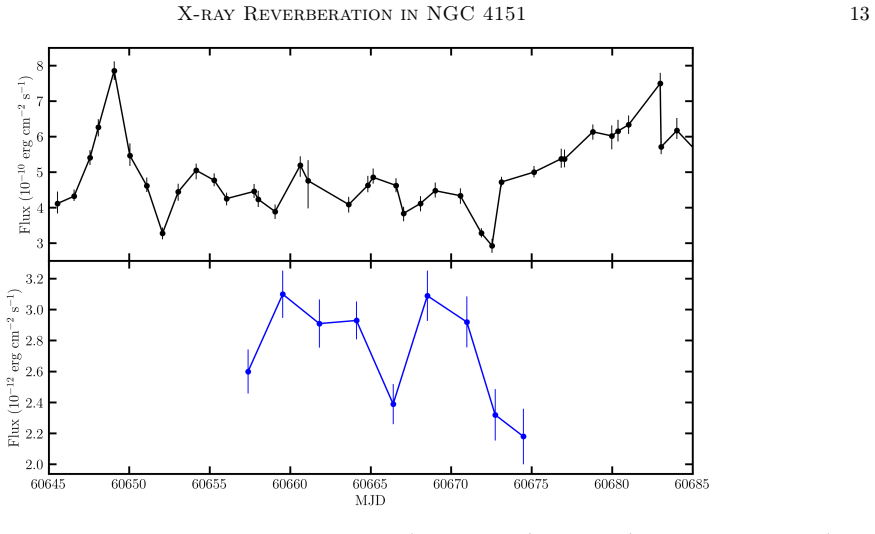
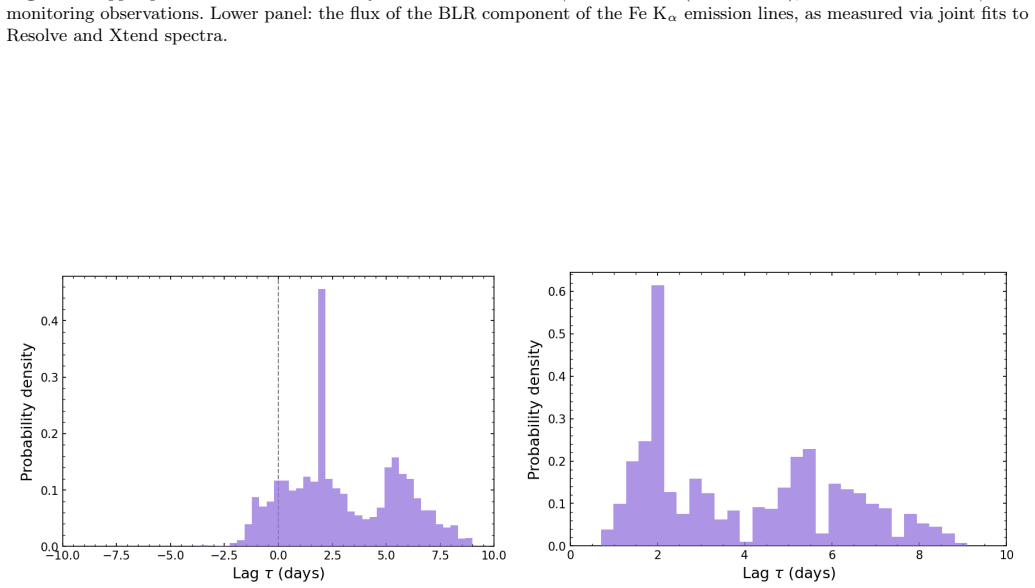
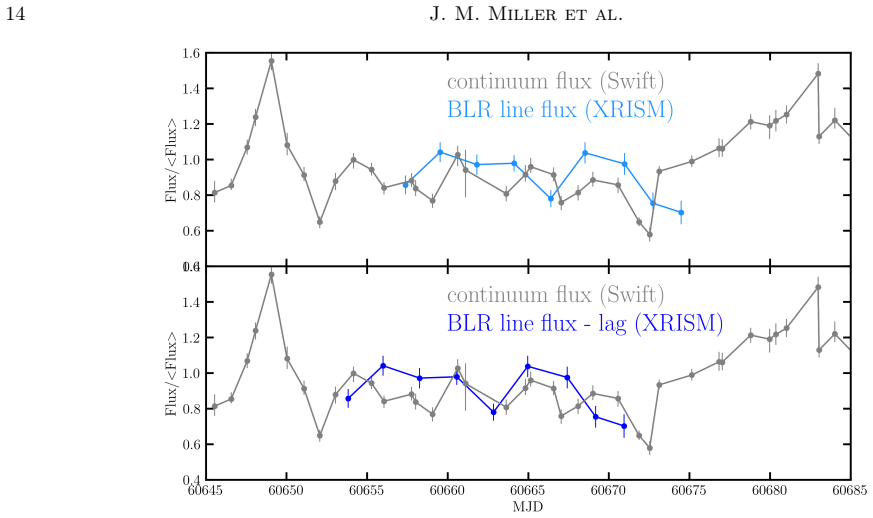
Modeling the Swift continuum and XRISM line flux trends gives a lag of τ = 3.5^{+2.8}_{-1.7} days (r = 3.6^{+3.0}_{-1.7} × 10^3 GM/c^2 for M_BH = 1.7 × 10^7 M_⊙), significant at the 2σ level via Monte Carlo simulations. This lag implies a black hole mass of M_BH/f_X = 2.0^{+1.4}_{-1.0} × 10^7 M_⊙, where f_X is a geometrical factor. The mean BLR component width is measured as σ = 5.36 ± 0.48 × 10^3 km s^{-1}.
What carries the argument
Reverberation lag between the driving X-ray continuum flux and the reprocessed narrow Fe Kα line flux, extracted from time series of XRISM spectra and Swift monitoring.
If this is right
- The measured lag distance is consistent with earlier optical and X-ray estimates for the same galaxy.
- The implied black-hole mass remains formally consistent with typical Hβ-based values once a standard geometric factor is adopted.
- The technique can be applied to both unobscured and obscured active galactic nuclei.
- XRISM spectra supply the spectral resolution needed to isolate the narrow line component for lag work.
Where Pith is reading between the lines
- Similar lag searches could be attempted on other nearby Seyferts with existing or future XRISM campaigns to build a sample of X-ray-derived masses.
- If the line-emitting gas lies at the inner edge of the optical broad-line region, joint X-ray and optical monitoring could map radial stratification directly.
- The 2σ significance level implies that doubling the number of epochs or improving continuum sampling would be the next practical step to confirm the signal.
Load-bearing premise
The observed changes in line flux are produced by reprocessing of the measured continuum, and the fitted lag equals the light-travel time from the X-ray source to the line-emitting gas.
What would settle it
A new sequence of higher-cadence observations that returns a lag inconsistent with zero at >3σ or yields a mass differing by more than a factor of two from independent optical reverberation or stellar-dynamical estimates.
Figures
read the original abstract
Emission lines that "echo" variations in the ionizing flux produced close to black holes are powerful probes of the central engine. In the Seyfert-1.5 galaxy NGC 4151, high-resolution X-ray spectra and time lags in low-resolution X-ray data suggest that part of the narrow Fe K$_{\alpha}$ line originates close to the optical broad line region (BLR). We report on a sequence of nine XRISM observations of NGC 4151, obtained every other day in 2024. Swift monitoring was undertaken to sample the driving flux before, during, and after the XRISM sequence. Using suitable line kernels, we measure a mean BLR component width of $\sigma = 5.36\pm 0.48\times 10^{3}~{\rm km}~ {\rm s}^{-1}$. Modeling the Swift continuum and XRISM line flux trends gives a lag of $\tau = 3.5^{+2.8}_{-1.7}$ days ($r=3.6^{+3.0}_{-1.7}\times 10^{3}~GM/c^{2}$ for $M_{BH} = 1.7\times 10^{7}~M_{\odot}$), significant at the $2\sigma$ level via Monte Carlo simulations, and consistent with prior measurements and direct spectral fits. This lag implies a black hole mass of $M_{BH}/f_{X} = 2.0^{+1.4}_{-1.0}\times 10^{7} M_{\odot}$, where $f_{X}$ is a geometrical factor. A standard optical value for this factor gives a mass that is nominally higher than typical H$\beta$ mass estimates, but formally consistent. Our results suggest that XRISM can measure lags and black hole masses in both unobscured and obscured AGN.
Editorial analysis
A structured set of objections, weighed in public.
Referee Report
Summary. The manuscript reports nine XRISM observations of NGC 4151 (every other day in 2024) plus Swift monitoring to extract a reverberation lag τ = 3.5^{+2.8}_{-1.7} days in the narrow Fe Kα line relative to the continuum. The lag is detected at 2σ via Monte Carlo simulations, corresponds to r = 3.6^{+3.0}_{-1.7} × 10^3 GM/c², and is used to infer M_BH/f_X = 2.0^{+1.4}_{-1.0} × 10^7 M_⊙. The result is stated to be consistent with prior measurements and to demonstrate XRISM's utility for X-ray reverberation mapping in both unobscured and obscured AGN.
Significance. If the lag detection is robust, the work provides a direct X-ray reverberation measurement of the narrow Fe Kα emitting region in a well-studied Seyfert galaxy and shows that XRISM can deliver black-hole mass estimates via this route. The approach is novel in its use of high-resolution spectroscopy for line-flux time series and could extend reverberation mapping to obscured sources, but the 2σ significance and limited sampling make the result exploratory rather than definitive.
major comments (2)
- [Abstract and §4] Abstract and §4 (results): the reported 2σ Monte Carlo significance is obtained from only nine XRISM points spanning ~16 days with ~2-day sampling. The significance depends on the precise noise model for the extracted line fluxes and on the interpolation of the Swift continuum; any unaccounted correlated errors would directly affect whether the lag remains above 2σ and whether the derived radius and M_BH/f_X are reliable. This is load-bearing for the central claim.
- [§3] §3 (data analysis): the manuscript must specify the exact line-decomposition kernels, the treatment of the underlying continuum in the XRISM spectra, and any systematic checks (e.g., alternative continuum models or background subtraction) that were performed, because these choices propagate directly into the line-flux time series used for the lag fit.
minor comments (2)
- [Abstract] The abstract states the lag is 'consistent with prior measurements' but does not cite the specific earlier lag values or papers; adding these references would improve traceability.
- [Figure captions] Figure captions and text should clarify whether the Monte Carlo simulations include the full covariance of the line-flux uncertainties or only diagonal errors.
Simulated Author's Rebuttal
We thank the referee for their detailed and constructive review. The comments correctly identify areas where additional transparency and robustness checks would strengthen the presentation of our exploratory 2σ result. We address each major comment below and will revise the manuscript accordingly.
read point-by-point responses
-
Referee: [Abstract and §4] Abstract and §4 (results): the reported 2σ Monte Carlo significance is obtained from only nine XRISM points spanning ~16 days with ~2-day sampling. The significance depends on the precise noise model for the extracted line fluxes and on the interpolation of the Swift continuum; any unaccounted correlated errors would directly affect whether the lag remains above 2σ and whether the derived radius and M_BH/f_X are reliable. This is load-bearing for the central claim.
Authors: We agree that the modest 2σ significance and limited sampling make the detection exploratory, as already noted in the referee summary. Our Monte Carlo procedure used the measured 1σ uncertainties on each XRISM line flux as the noise model and applied linear interpolation to the Swift continuum. Additional tests we have now performed—bootstrap resampling of the nine points and substitution of Gaussian-process interpolation—yield lag values consistent within the reported uncertainties and preserve the ~2σ detection. We will add a dedicated paragraph in §4 describing the noise model, the interpolation method, and these extra checks (including a short table of results from the alternative interpolations). revision: partial
-
Referee: [§3] §3 (data analysis): the manuscript must specify the exact line-decomposition kernels, the treatment of the underlying continuum in the XRISM spectra, and any systematic checks (e.g., alternative continuum models or background subtraction) that were performed, because these choices propagate directly into the line-flux time series used for the lag fit.
Authors: We accept the need for greater explicitness. Section 3 currently states that a narrow Gaussian plus broader component were used, with the continuum modeled as an absorbed power law; line fluxes were obtained after subtracting the best-fit continuum in each Resolve spectrum. We did test an alternative continuum that includes a Compton-reflection hump and found line-flux variations changed by <10 %. Background was subtracted via the standard XRISM pipeline. In the revision we will expand §3 to quote the exact functional forms of the kernels (including the fixed widths and the free normalizations), list the continuum parameters adopted for each epoch, and summarize the systematic tests performed. revision: yes
Circularity Check
No significant circularity in lag derivation
full rationale
The central claim extracts a lag τ directly from modeling the observed Swift continuum light curve against the nine XRISM narrow Fe Kα line flux measurements, with 2σ significance assessed via Monte Carlo simulations on the time series. This is a standard data-driven reverberation-mapping inference under the light-travel-time assumption; the derived r in GM/c² units and the M_BH/f_X value follow arithmetically from the measured τ and a prior independent M_BH value. No step reduces by construction to a fitted parameter, self-citation, or ansatz imported from the authors' prior work. The derivation chain is self-contained against external time-series data.
Axiom & Free-Parameter Ledger
free parameters (1)
- geometrical factor f_X
axioms (1)
- domain assumption Line flux variations are driven by the observed continuum and the lag equals light-travel time to the emitting gas.
Reference graph
Works this paper leans on
-
[1]
doi:10.1111/j.1365-2966.2009.15402.x , Eprint =
Methods and results of an automatic analysis of a complete sample of Swift-XRT observations of GRBs. , keywords =. doi:10.1111/j.1365-2966.2009.14913.x , archivePrefix =. 0812.3662 , primaryClass =
-
[2]
Stellar Velocity Dispersion Measurements in High-luminosity Quasar Hosts and Implications for the AGN Black Hole Mass Scale. , keywords =. doi:10.1088/0004-637X/773/2/90 , archivePrefix =. 1305.2447 , primaryClass =
work page internal anchor Pith review Pith/arXiv arXiv doi:10.1088/0004-637x/773/2/90
-
[3]
The AGN Black Hole Mass Database
The AGN Black Hole Mass Database. , keywords =. doi:10.1086/679601 , archivePrefix =. 1411.2596 , primaryClass =
work page internal anchor Pith review Pith/arXiv arXiv doi:10.1086/679601
-
[4]
Velocity-resolved reverberation mapping of five bright Seyfert 1 galaxies
Velocity-resolved Reverberation Mapping of Five Bright Seyfert 1 Galaxies. , keywords =. doi:10.3847/1538-4357/aadd11 , archivePrefix =. 1807.04784 , primaryClass =
work page internal anchor Pith review Pith/arXiv arXiv doi:10.3847/1538-4357/aadd11
-
[5]
Revisiting the Spectral and Timing Properties of NGC 4151. , keywords =. doi:10.3847/1538-4357/ab3e31 , archivePrefix =. 1908.09862 , primaryClass =
-
[6]
XRISM Spectroscopy of the Fe K Emission Line in the Seyfert Active Galactic Nucleus NGC 4151 Reveals the Disk, Broad-line Region, and Torus. , keywords =. doi:10.3847/2041-8213/ad7397 , archivePrefix =. 2408.14300 , primaryClass =
-
[7]
The 0.9 Megasecond XRISM/Resolve Spectrum of the Seyfert-1 AGN NGC 4151
The 0.9 Megasecond XRISM/Resolve Spectrum of the Seyfert-1 AGN NGC 4151. arXiv e-prints , keywords =. doi:10.48550/arXiv.2604.16148 , archivePrefix =. 2604.16148 , primaryClass =
work page internal anchor Pith review Pith/arXiv arXiv doi:10.48550/arxiv.2604.16148
-
[8]
X-ray Structure between the Innermost Disk and Optical Broad Line Region in NGC 4151
X-Ray Structure between the Innermost Disk and Optical Broad-line Region in NGC 4151. , keywords =. doi:10.3847/1538-4357/aadbaa , archivePrefix =. 1808.07435 , primaryClass =
work page internal anchor Pith review Pith/arXiv arXiv doi:10.3847/1538-4357/aadbaa
-
[9]
Space Telescopes and Instrumentation 2022: Ultraviolet to Gamma Ray , year = 2022, editor =
Status of resolve instrument onboard X-Ray Imaging and Spectroscopy Mission (XRISM). Space Telescopes and Instrumentation 2022: Ultraviolet to Gamma Ray , year = 2022, editor =. doi:10.1117/12.2630654 , adsurl =
-
[10]
Space Telescopes and Instrumentation 2018: Ultraviolet to Gamma Ray , year = 2018, editor =
Soft x-ray imaging telescope (Xtend) onboard X-ray Astronomy Recovery Mission (XARM). Space Telescopes and Instrumentation 2018: Ultraviolet to Gamma Ray , year = 2018, editor =. doi:10.1117/12.2311446 , adsurl =
-
[11]
Optimal binning of X-ray spectra and response matrix design
Optimal binning of X-ray spectra and response matrix design. , keywords =. doi:10.1051/0004-6361/201527395 , archivePrefix =. 1601.05309 , primaryClass =
work page internal anchor Pith review Pith/arXiv arXiv doi:10.1051/0004-6361/201527395
-
[12]
Mass outflow of the X-ray emission line gas in NGC 4151. , keywords =. doi:10.1093/mnras/staa428 , archivePrefix =. 2002.05806 , primaryClass =
-
[13]
Parameter estimation in astronomy through application of the likelihood ratio. , keywords =. doi:10.1086/156922 , adsurl =
-
[14]
2000, ApJ, 542, 914, doi: 10.1086/317016 3.2
On the Absorption of X-Rays in the Interstellar Medium. , keywords =. doi:10.1086/317016 , archivePrefix =. astro-ph/0008425 , primaryClass =
work page internal anchor Pith review Pith/arXiv arXiv doi:10.1086/317016
-
[15]
An XMM-Newton survey of broad iron lines in Seyfert galaxies. , keywords =. doi:10.1111/j.1365-2966.2007.12331.x , archivePrefix =. 0708.1305 , primaryClass =
-
[16]
XRISM Spectroscopy of Accretion-driven Wind Feedback in NGC 4151. , keywords =. doi:10.3847/2041-8213/adee9b , archivePrefix =. 2507.09210 , primaryClass =
-
[17]
UV and X-ray Spectroscopy of Astrophysical and Laboratory Plasmas , year = 1996, editor =
SPEX: a new code for spectral analysis of X & UV spectra. UV and X-ray Spectroscopy of Astrophysical and Laboratory Plasmas , year = 1996, editor =
1996
-
[18]
XCLUMPY: X-Ray Spectral Model from Clumpy Torus and Its Application to the Circinus Galaxy. , keywords =. doi:10.3847/1538-4357/ab1b20 , archivePrefix =. 1904.08945 , primaryClass =
-
[19]
The Sloan Digital Sky Survey Reverberation Mapping Project: How Broad Emission Line Widths Change When Luminosity Changes. , keywords =. doi:10.3847/1538-4357/abb36d , archivePrefix =. 2006.06178 , primaryClass =
-
[20]
The dust origin of the Broad Line Region and the model consequences for AGN unification scheme
The dust origin of the Broad Line Region and the model consequences for AGN unification scheme. Advances in Space Research , keywords =. doi:10.1016/j.asr.2015.01.004 , archivePrefix =. 1409.7312 , primaryClass =
work page internal anchor Pith review Pith/arXiv arXiv doi:10.1016/j.asr.2015.01.004 2015
-
[21]
Is Quasar Optical Variability a Damped Random Walk?
Is Quasar Optical Variability a Damped Random Walk?. , keywords =. doi:10.1088/0004-637X/765/2/106 , archivePrefix =. 1202.3783 , primaryClass =
work page internal anchor Pith review Pith/arXiv arXiv doi:10.1088/0004-637x/765/2/106
-
[22]
The Mass of the Central Black Hole in the Seyfert Galaxy NGC 4151
The Mass of the Central Black Hole in the Seyfert Galaxy NGC 4151. , keywords =. doi:10.1086/505525 , archivePrefix =. astro-ph/0605038 , primaryClass =
work page internal anchor Pith review Pith/arXiv arXiv doi:10.1086/505525
-
[23]
PyCCF: Python Cross Correlation Function for reverberation mapping studies
-
[24]
Narrow Fe-K Reverberation Mapping Unveils the Deactivated Broad-line Region in a Changing-look Active Galactic Nucleus. , keywords =. doi:10.3847/1538-4357/aca963 , archivePrefix =. 2212.02731 , primaryClass =
-
[25]
Kinematic and ionization structure of the highly ionized outflows
Delving into the depths of NGC 3783 with XRISM: I. Kinematic and ionization structure of the highly ionized outflows. , keywords =. doi:10.1051/0004-6361/202555623 , archivePrefix =. 2506.09395 , primaryClass =
-
[26]
Mapping of the accretion flow with Fe K emission lines
Delving into the depths of NGC 3783 with XRISM: IV. Mapping of the accretion flow with Fe K emission lines. , keywords =. doi:10.1051/0004-6361/202557710 , archivePrefix =. 2512.09207 , primaryClass =
-
[27]
Winds of Change: XRISM Resolve X-Ray Spectroscopy of NGC 4051. , keywords =. doi:10.3847/1538-4357/ae5527 , archivePrefix =. 2602.19897 , primaryClass =
-
[28]
XRISM analysis of the complex Fe K line in Centaurus A. , keywords =. doi:10.1093/pasj/psaf084 , archivePrefix =. 2507.02195 , primaryClass =
-
[29]
Complex Nuclear Structure in Seyfert 2 Galaxy NGC 4388 Revealed by XRISM Observation
Complex Nuclear Structure in Seyfert 2 Galaxy NGC 4388 Revealed by XRISM Observation. arXiv e-prints , keywords =. doi:10.48550/arXiv.2604.06719 , archivePrefix =. 2604.06719 , primaryClass =
work page internal anchor Pith review Pith/arXiv arXiv doi:10.48550/arxiv.2604.06719
-
[30]
Test for Echo: X-Ray Reflection Variability in the Seyfert-2 Active Galactic Nucleus NGC 4388. , keywords =. doi:10.3847/1538-4357/ad2fa3 , archivePrefix =. 2403.00926 , primaryClass =
-
[31]
Communication over an Arbitrarily Varying Channel under a State-Myopic Encoder
Deep Extragalactic X-Ray Surveys. , keywords =. doi:10.1146/annurev.astro.43.051804.102213 , archivePrefix =. astro-ph/0501058 , primaryClass =
work page internal anchor Pith review Pith/arXiv arXiv doi:10.1146/annurev.astro.43.051804.102213
-
[32]
Active Galactic Nuclei with High-Resolution X-Ray Spectroscopy. High-Resolution X-ray Spectroscopy: Instrumentation, Data Analysis, and Science , year = 2023, editor =. doi:10.1007/978-981-99-4409-5_9 , adsurl =
-
[33]
Experimental Astronomy , keywords =
The X-ray Integral Field Unit at the end of the Athena reformulation phase. Experimental Astronomy , keywords =. doi:10.1007/s10686-025-09984-w , archivePrefix =. 2502.10866 , primaryClass =
-
[34]
X-ray fluorescence from the inner disc in Cygnus X-1. , keywords =. doi:10.1093/mnras/238.3.729 , adsurl =
-
[35]
Line Profiles from a Disk around a Rotating Black Hole. , keywords =. doi:10.1086/170257 , adsurl =
-
[36]
Constraining Black Hole Spin Via X-ray Spectroscopy
Constraining Black Hole Spin via X-Ray Spectroscopy. , keywords =. doi:10.1086/508146 , archivePrefix =. astro-ph/0608502 , primaryClass =
work page internal anchor Pith review Pith/arXiv arXiv doi:10.1086/508146
-
[37]
Computer Physics Communications , year = 1995, month = aug, volume =
The photon transfer function for accretion disks around a Kerr black hole. Computer Physics Communications , year = 1995, month = aug, volume =. doi:10.1016/0010-4655(95)00067-P , adsurl =
-
[38]
2025, PASJ, 77, S1, doi: 10.1093/pasj/psaf023
X-Ray Imaging and Spectroscopy Mission. , keywords =. doi:10.1093/pasj/psaf023 , adsurl =
-
[39]
M., Xiang, X., Byun, D., et al
XRISM/Resolve Spectroscopy of the Central Engine in the Seyfert-1 AGN Mrk 279. , keywords =. doi:10.3847/2041-8213/ae1606 , archivePrefix =. 2510.20083 , primaryClass =
-
[40]
The dynamic central environment of NGC 3516 revealed by XRISM. arXiv e-prints , keywords =. doi:10.48550/arXiv.2512.07950 , archivePrefix =. 2512.07950 , primaryClass =
-
[41]
XRISM/Resolve Reveals the Complex Iron Structure of NGC 7213: Evidence for Radial Stratification between Inner Disk and Broad-line Region. , keywords =. doi:10.3847/2041-8213/ae18c2 , archivePrefix =. 2510.24971 , primaryClass =
-
[42]
The Cores of the Fe K Lines in Active Galactic Nuclei: An Extended Chandra High Energy Grating Sample. , keywords =. doi:10.1088/0067-0049/187/2/581 , archivePrefix =. 1003.1790 , primaryClass =
work page internal anchor Pith review Pith/arXiv arXiv doi:10.1088/0067-0049/187/2/581
-
[43]
doi:10.1111/j.1365-2966.2009.15402.x , Eprint =
An X-ray spectral model for Compton-thick toroidal reprocessors. , keywords =. doi:10.1111/j.1365-2966.2009.15025.x , archivePrefix =. 0905.3188 , primaryClass =
-
[44]
A Snapshot Survey of Nearby Supernovae with the Hubble Space Telescope. , keywords =. doi:10.3847/1538-4357/ad2175 , archivePrefix =. 2401.12185 , primaryClass =
-
[45]
Line Variations in Quasars and Seyfert Galaxies. , keywords =. doi:10.1086/164238 , adsurl =
-
[46]
The Dusty Heart of NGC 4151 Revealed by 1-40 m Reverberation Mapping and Variability: A Challenge to Current Clumpy Torus Models. , keywords =. doi:10.3847/1538-4357/abee14 , archivePrefix =. 2011.07638 , primaryClass =
-
[47]
Toward measuring supermassive black hole masses with interferometric observations of the dust continuum. , keywords =. doi:10.1051/0004-6361/202244655 , archivePrefix =. 2209.14410 , primaryClass =
-
[48]
VLBA Identification of the Milliarcsecond Active Nucleus in the Seyfert Galaxy NGC 4151
VLBA Identification of the Milliarcsecond Active Nucleus in the Seyfert Galaxy NGC 4151. , keywords =. doi:10.1086/432034 , archivePrefix =. astro-ph/0505141 , primaryClass =
work page internal anchor Pith review Pith/arXiv arXiv doi:10.1086/432034
-
[49]
Astronomical Data Analysis Software and Systems V , year = 1996, editor =
XSPEC: The First Ten Years. Astronomical Data Analysis Software and Systems V , year = 1996, editor =
1996
-
[50]
X-ray perspective of Narrow-line Seyfert 1 galaxies
X-ray perspective of Narrow-line Seyfert 1 galaxies. Revisiting Narrow-Line Seyfert 1 Galaxies and their Place in the Universe , year = 2018, month = apr, eid =. doi:10.22323/1.328.0034 , archivePrefix =. 1807.09838 , primaryClass =
work page internal anchor Pith review Pith/arXiv arXiv doi:10.22323/1.328.0034 2018
-
[51]
Velocity-resolved Reverberation Mapping of Changing-look Active Galactic Nucleus NGC 4151 during Outburst Stage. II. Results of Four Seasons of Observation. , keywords =. doi:10.3847/1538-4357/ad8568 , archivePrefix =. 2409.01637 , primaryClass =
-
[52]
A New Black Hole Mass Estimate for Obscured Active Galactic Nuclei
A New Black Hole Mass Estimate for Obscured Active Galactic Nuclei. , keywords =. doi:10.1088/0004-637X/802/2/98 , archivePrefix =. 1501.07522 , primaryClass =
work page internal anchor Pith review Pith/arXiv arXiv doi:10.1088/0004-637x/802/2/98
-
[53]
IEEE Transactions on Automatic Control , author=
A New Look at the Statistical Model Identification , volume=. IEEE Transactions on Automatic Control , author=. 1974 , month=
1974
-
[54]
The Broad Line Region and Black Hole Mass of NGC 4151. , keywords =. doi:10.3847/1538-4357/ac7c0a , archivePrefix =. 2206.03513 , primaryClass =
discussion (0)
Sign in with ORCID, Apple, or X to comment. Anyone can read and Pith papers without signing in.