Revisiting the 'Lensing is Low' Problem with UNIONS
Pith reviewed 2026-06-26 07:16 UTC · model grok-4.3
The pith
New UNIONS measurements find no significant lensing is low effect for BOSS CMASS galaxies.
A machine-rendered reading of the paper's core claim, the machinery that carries it, and where it could break.
Core claim
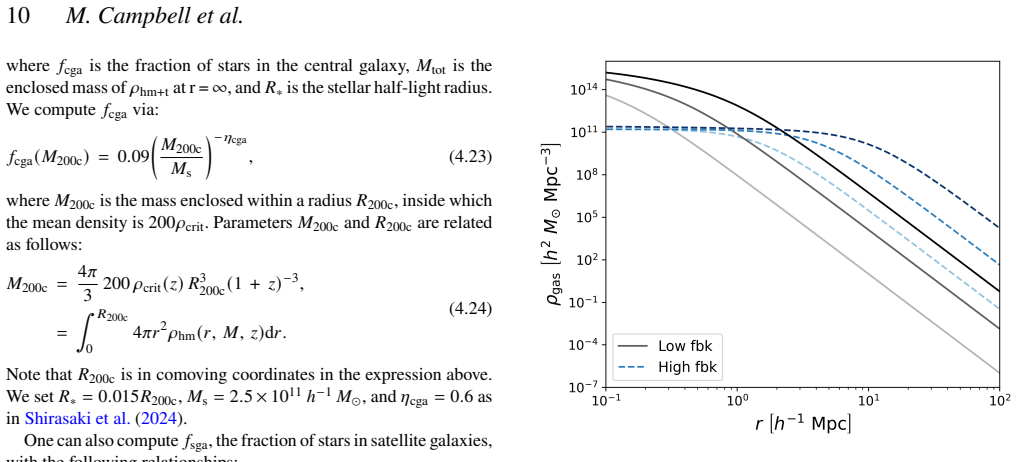
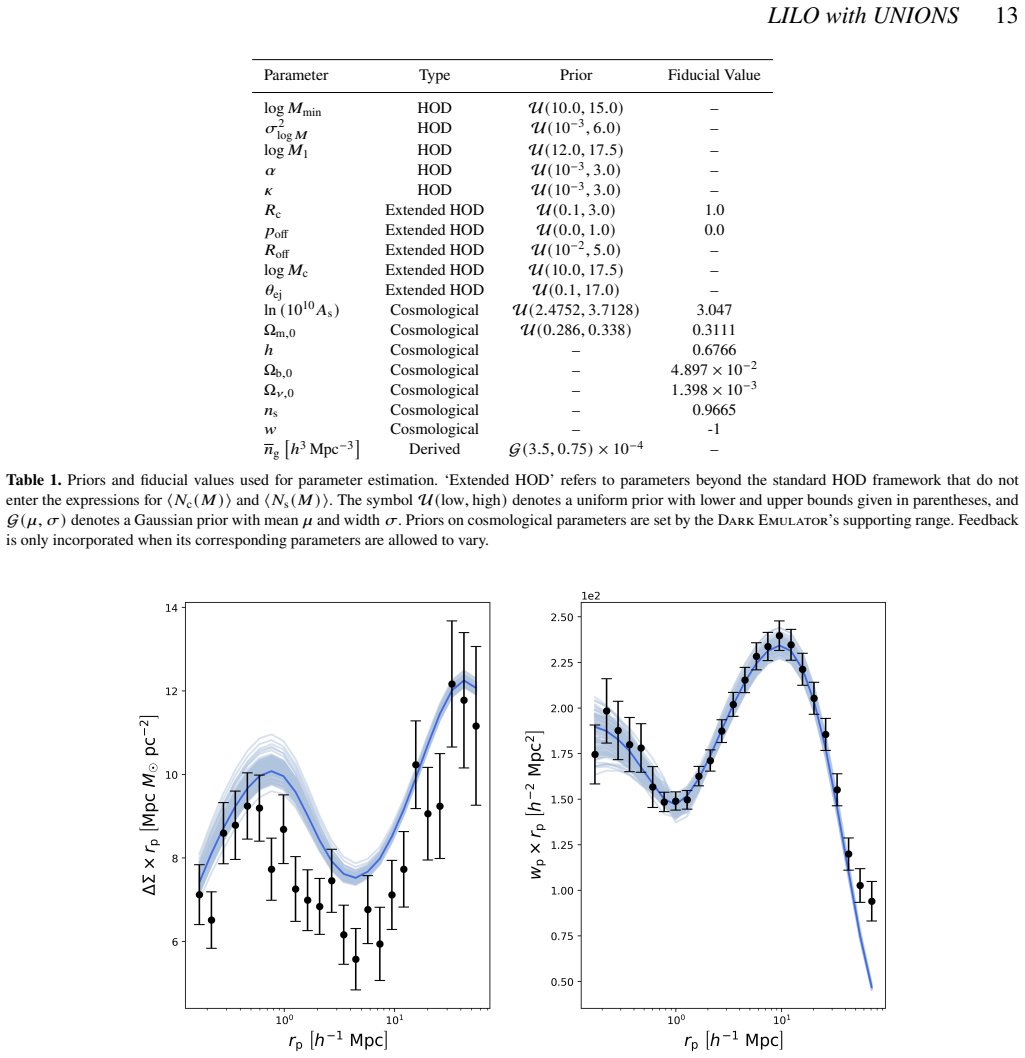
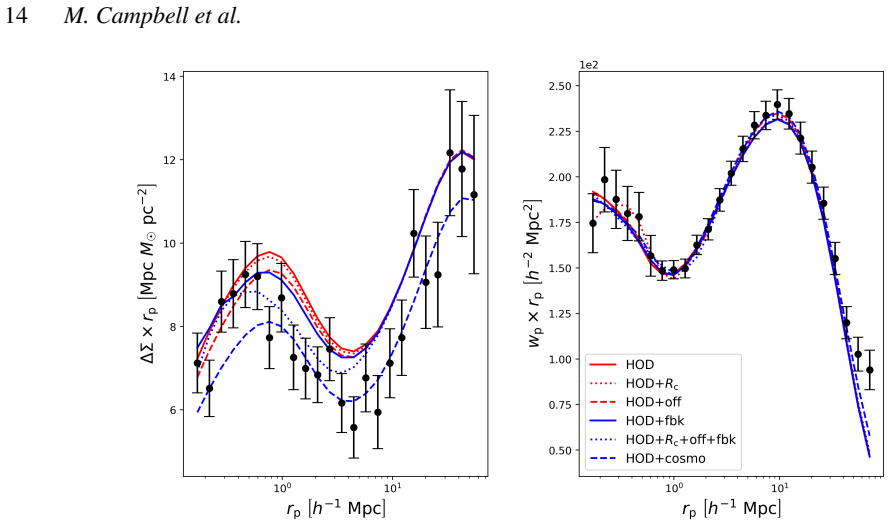
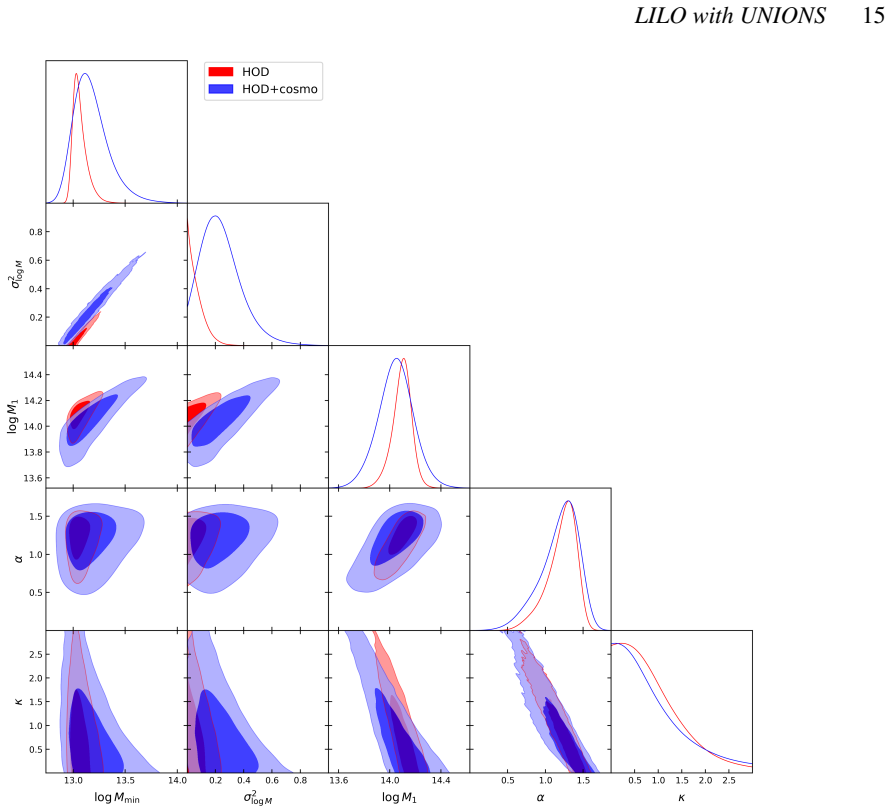
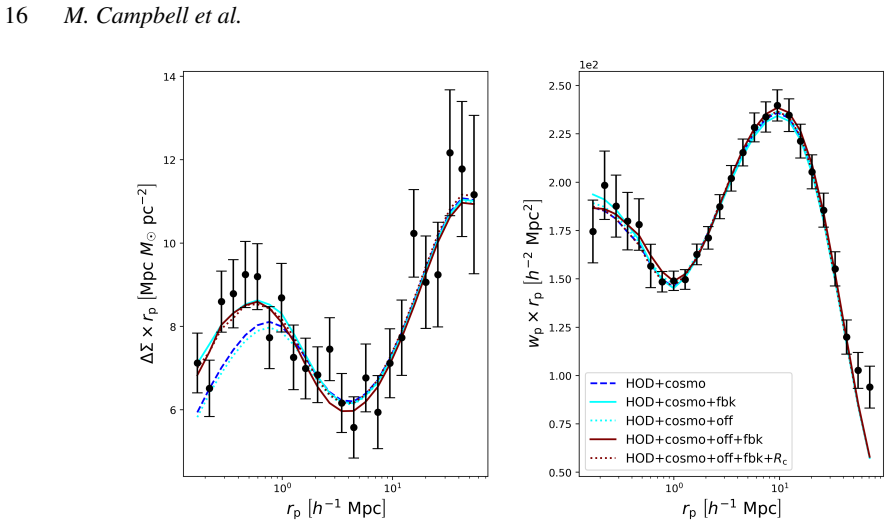
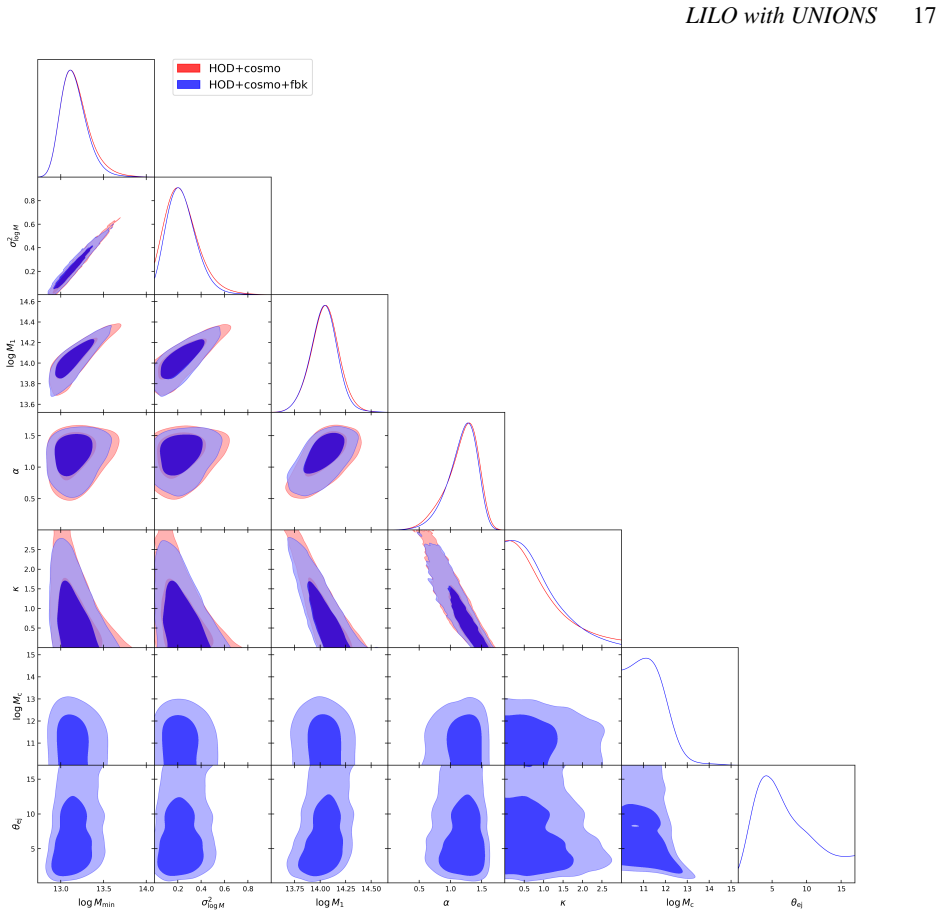
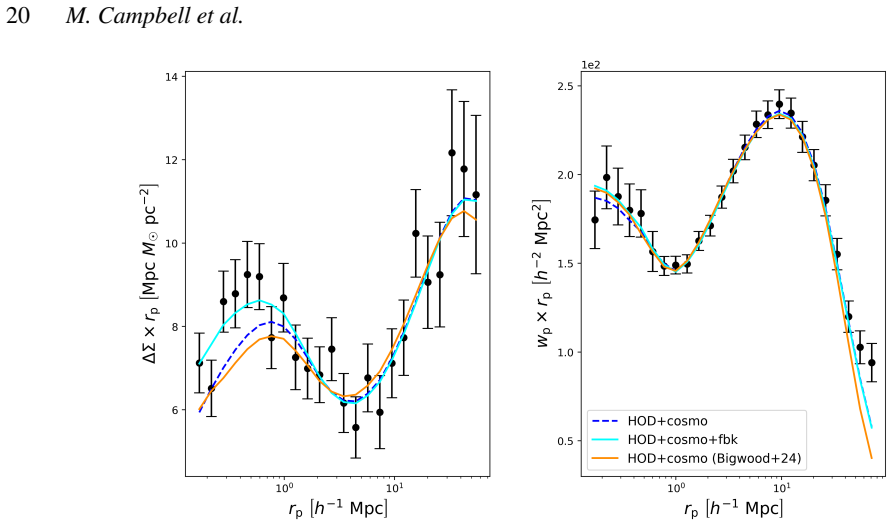
Using high-quality imaging from the UNIONS survey, we obtain precise galaxy-galaxy lensing measurements around BOSS CMASS galaxies. When a halo occupation distribution model is fitted jointly to both the lensing and clustering signals, the data show no significant lensing is low effect, in contrast to previous work. The best joint fits are achieved by decreasing the amplitude of the matter power spectrum slightly relative to Planck cosmological parameters. Two models describe the observables similarly well: one with free HOD and cosmological parameters, and one that also frees feedback parameters. Large scales play an important role in constraining the effect.
What carries the argument
Halo occupation distribution (HOD) model that parametrizes how galaxies occupy dark matter halos and is fitted jointly to galaxy-galaxy lensing and galaxy clustering signals.
If this is right
- Joint HOD fits to lensing and clustering can be performed without a large residual mismatch in the CMASS sample.
- A modest decrease in the amplitude of the matter power spectrum relative to Planck values improves the joint fit.
- Both an HOD-plus-cosmology model and an HOD-plus-cosmology-plus-feedback model describe the data comparably well.
- Including large-scale measurements is necessary to properly constrain any lensing is low discrepancy.
Where Pith is reading between the lines
- Similar wide-area lensing data on other spectroscopic samples could test whether the absence of a strong discrepancy is specific to CMASS or more general.
- The emphasis on large scales suggests that future analyses of galaxy-galaxy lensing should ensure sufficient survey overlap at those scales rather than focusing only on small-scale modeling.
- A slight downward shift in the matter power spectrum amplitude to match the data could be checked against independent probes such as the full CMB power spectrum or weak lensing surveys.
Load-bearing premise
The halo occupation distribution model is sufficient to describe both the galaxy clustering and galaxy-galaxy lensing signals across a wide range of scales.
What would settle it
If the measured galaxy-galaxy lensing amplitude around CMASS galaxies is 20-40 percent lower than the prediction from a clustering-only HOD fit that assumes Planck cosmology, the claim of no significant lensing is low effect would be falsified.
Figures
read the original abstract
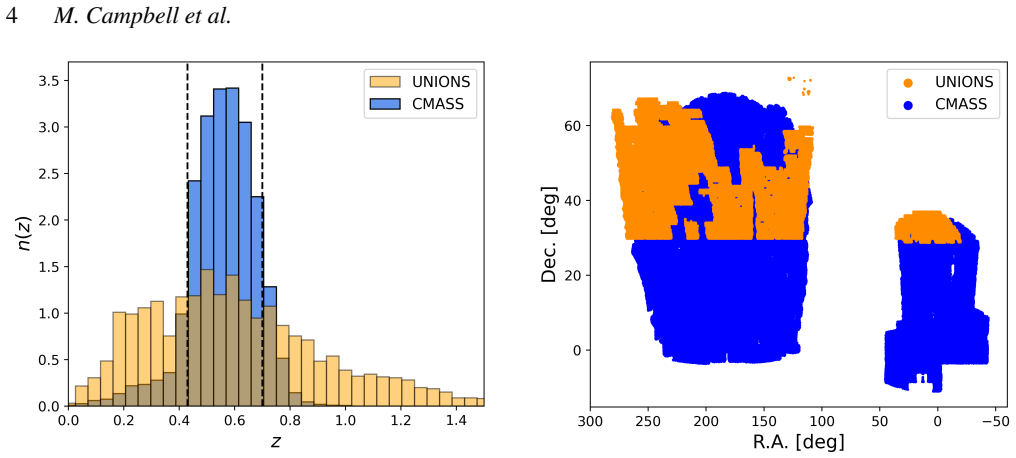
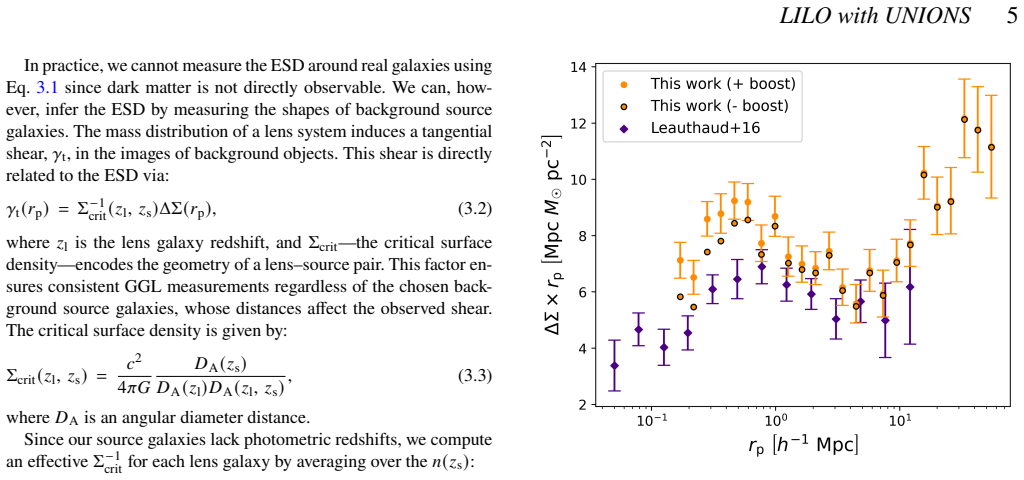
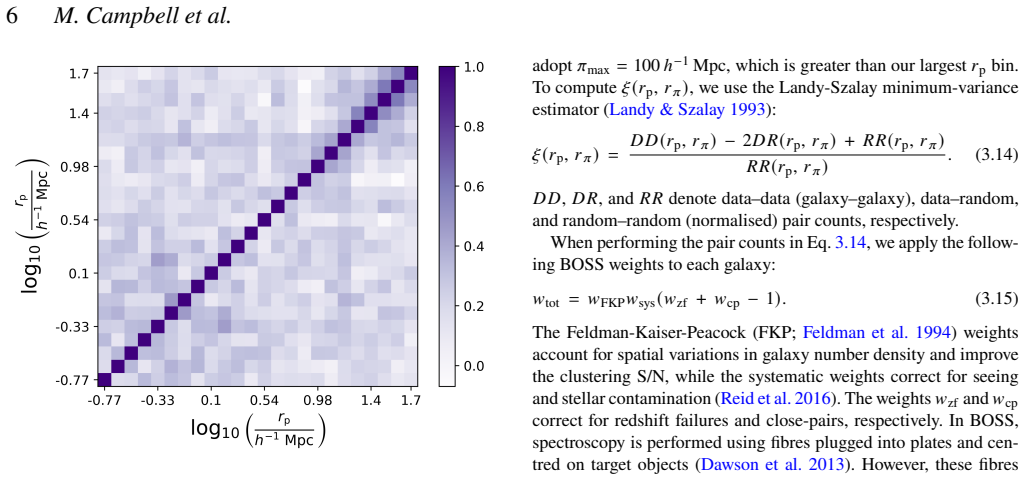
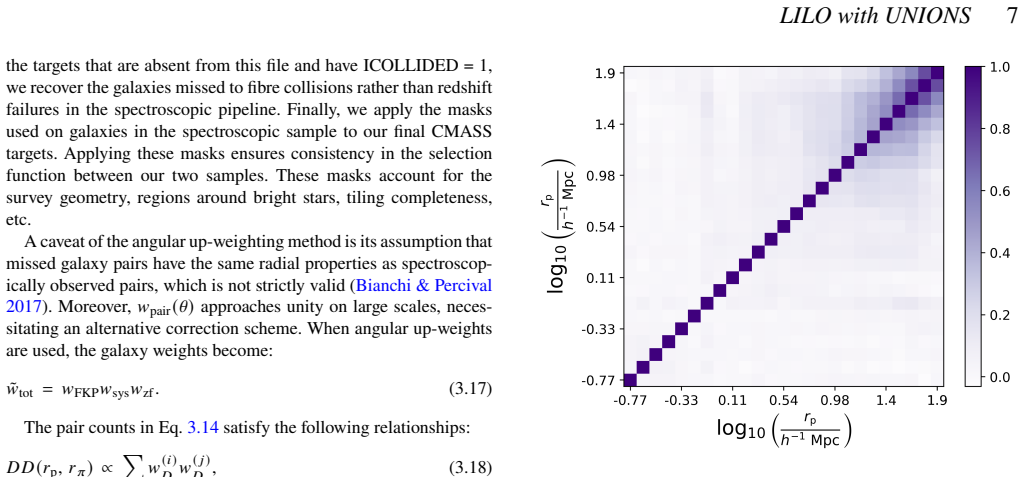
We present new measurements of the galaxy-galaxy lensing (GGL) signal around Baryon Oscillation Spectroscopic Survey (BOSS) CMASS galaxies using background sources from the Ultraviolet Near-Infrared Optical Northern Survey (UNIONS). With high-quality imaging of background sources and a survey overlap of approximately 2650 square degrees, we obtain precise large-scale GGL measurements. Building on these new measurements, we revisit the so-called 'lensing is low' problem, wherein galaxy-halo connection models calibrated on galaxy clustering (GC) data over-predict the GGL signal by 20-40% assuming CMB-based cosmological parameters. We model the galaxy-halo connection using a halo occupation distribution (HOD), and perform joint fits to both GGL and GC signals across a wide range of scales, as well as a GC-only fit. In contrast to previous work, we do not find a significant 'lensing is low' effect in the CMASS sample, although the best joint fits are achieved by decreasing the amplitude of the matter power spectrum slightly relative to the Planck cosmological parameters. Overall, we find that two models describe our observables similarly well: one where HOD and cosmological parameters are free, and one where HOD, cosmological, and feedback parameters are free. Importantly, we emphasise the role of large scales in constraining the lensing is low effect, shifting the narrative away from an exclusively small-scale issue.
Editorial analysis
A structured set of objections, weighed in public.
Referee Report
Summary. The paper reports new galaxy-galaxy lensing measurements around BOSS CMASS galaxies using UNIONS background sources over ~2650 deg². The authors model the galaxy-halo connection with an HOD, perform joint fits to GGL and GC signals (as well as GC-only fits), and conclude there is no significant 'lensing is low' effect in this sample—unlike prior work—although the best joint fits prefer a slightly lower matter power spectrum amplitude than Planck parameters. Models with free HOD+cosmology parameters and those also freeing feedback parameters fit the data similarly well. The analysis stresses the constraining power of large scales.
Significance. If the central result holds, the work would indicate that the 'lensing is low' tension is absent or substantially reduced for the CMASS sample when using the new UNIONS data, thereby easing apparent inconsistencies with CMB cosmology. The emphasis on large-scale GGL constraints and the explicit comparison of HOD+cosmology versus HOD+cosmology+feedback models are useful contributions. The new precise measurements themselves constitute a clear data product for the field.
major comments (3)
- [§4.2] §4.2 (HOD modeling section): The central claim that the joint fits show no significant lensing-is-low discrepancy rests on the assumption that the chosen HOD parametrization fully captures the galaxy-halo connection on all scales. The manuscript provides no explicit tests (e.g., for assembly bias, velocity bias, or scale-dependent incompleteness) that would demonstrate this sufficiency; without them the apparent consistency could arise from HOD flexibility absorbing mismatches rather than from agreement with Planck cosmology.
- [§5.1] §5.1 and Table 3 (joint-fit results): The statement of 'no significant lensing is low effect' is not accompanied by a quantitative metric such as the best-fit GGL amplitude ratio relative to the GC-only prediction, the tension significance in sigma, or the change in chi-squared when cosmology is fixed to Planck values. This omission prevents direct verification that the new UNIONS data have resolved the 20-40% discrepancy reported in the literature.
- [§5.3] §5.3 (cosmological parameter constraints): The best joint fits are said to prefer a slightly lower matter power spectrum amplitude, yet the text does not report the posterior mean, uncertainty, or the statistical significance of the shift relative to Planck. Because this shift is presented as the mechanism that achieves the best fit, the lack of these numbers is load-bearing for assessing whether the result is merely a mild preference or a meaningful adjustment.
minor comments (2)
- [Abstract] Abstract: The claim of 'precise large-scale GGL measurements' would be strengthened by quoting the achieved fractional uncertainty or S/N on the largest-scale bins.
- [Figure 4] Figure 4: The scale cuts applied to the joint fit are not labeled on the plotted data points, making it difficult to see which scales drive the cosmological constraints.
Simulated Author's Rebuttal
We thank the referee for their careful reading and constructive comments, which help clarify the presentation of our results. We address each major comment below and will revise the manuscript accordingly where the points identify gaps in quantification or discussion.
read point-by-point responses
-
Referee: [§4.2] The central claim that the joint fits show no significant lensing-is-low discrepancy rests on the assumption that the chosen HOD parametrization fully captures the galaxy-halo connection on all scales. The manuscript provides no explicit tests (e.g., for assembly bias, velocity bias, or scale-dependent incompleteness) that would demonstrate this sufficiency.
Authors: We acknowledge that the standard HOD does not include assembly bias, velocity bias, or scale-dependent incompleteness, and the manuscript contains no dedicated tests of these extensions. Our defense rests on the emphasis on large scales (r > few Mpc/h), where the two-halo term dominates and the signal is primarily sensitive to the linear bias and cosmology rather than small-scale HOD details. The joint GGL+GC fits remain consistent on these scales without requiring unphysical HOD parameters. We will add an explicit limitations paragraph in §4.2 noting the absence of these tests and that more flexible models could be explored in future work. revision: partial
-
Referee: [§5.1] The statement of 'no significant lensing is low effect' is not accompanied by a quantitative metric such as the best-fit GGL amplitude ratio relative to the GC-only prediction, the tension significance in sigma, or the change in chi-squared when cosmology is fixed to Planck values.
Authors: The referee is correct that no such quantitative metric is reported. We will add to §5.1 and Table 3 the ratio of the best-fit GGL amplitude (from joint fit) to the GC-only prediction, the associated tension in sigma, and Δχ² when cosmology is fixed to Planck. These numbers confirm the lack of significant discrepancy (ratio consistent with 1 within ~1σ) while still showing the mild preference for lower amplitude. revision: yes
-
Referee: [§5.3] The best joint fits are said to prefer a slightly lower matter power spectrum amplitude, yet the text does not report the posterior mean, uncertainty, or the statistical significance of the shift relative to Planck.
Authors: We agree that the posterior mean, uncertainty, and significance of the shift (e.g., in S₈) are not stated. We will report these values from the joint posterior in §5.3, showing a mild ~1.5σ preference for lower amplitude relative to Planck while remaining statistically consistent. This will be added to the text and, if space allows, to a revised Table 3. revision: yes
Circularity Check
No significant circularity; result follows from new UNIONS GGL data and joint HOD+cosmology fits
full rationale
The paper reports new galaxy-galaxy lensing measurements from UNIONS overlapping BOSS CMASS, then performs joint HOD+cosmology fits to GC and GGL signals. The central claim (no significant lensing-is-low discrepancy, with best fits preferring slightly lower matter power spectrum amplitude) is obtained by comparing the joint-fit posterior to Planck parameters and to prior literature results. No equation or procedure reduces a claimed prediction to a fitted input by construction, nor does any load-bearing step rely on a self-citation chain whose content is unverified. The HOD parametrization is an explicit modeling choice whose sufficiency is an assumption, not a definitional identity. The analysis is therefore self-contained against external benchmarks (new imaging data, standard HOD framework) and receives score 0.
Axiom & Free-Parameter Ledger
free parameters (2)
- HOD parameters
- matter power spectrum amplitude
axioms (2)
- domain assumption CMB-based cosmological parameters provide the baseline for expected GGL signal
- domain assumption HOD model is adequate for describing galaxy-halo connection on the scales used
Reference graph
Works this paper leans on
-
[1]
Galaxy Formation and Evolution , publisher=
Mo, Houjun and van den Bosch, Frank and White, Simon , year=. Galaxy Formation and Evolution , publisher=
-
[2]
Gravitational Lensing , publisher=
Dodelson, Scott , year=. Gravitational Lensing , publisher=
-
[3]
Metacalibration: Direct Self-Calibration of Biases in Shear Measurement
Metacalibration: Direct Self-Calibration of Biases in Shear Measurement. arXiv e-prints , keywords =. doi:10.48550/arXiv.1702.02600 , archivePrefix =. 1702.02600 , primaryClass =
work page internal anchor Pith review Pith/arXiv arXiv doi:10.48550/arxiv.1702.02600
-
[4]
Lensing is Low: Cosmology, Galaxy Formation, or New Physics?
Lensing is low: cosmology, galaxy formation or new physics?. , keywords =. doi:10.1093/mnras/stx258 , archivePrefix =. 1611.08606 , primaryClass =
work page internal anchor Pith review Pith/arXiv arXiv doi:10.1093/mnras/stx258
-
[5]
The galaxy formation origin of the lensing is low problem. , keywords =. doi:10.1093/mnras/stad243 , archivePrefix =. 2211.01744 , primaryClass =
-
[6]
Consistent lensing and clustering in a low-S _ 8 Universe with BOSS, DES Year 3, HSC Year 1, and KiDS-1000. , keywords =. doi:10.1093/mnras/stac2938 , archivePrefix =. 2202.07440 , primaryClass =
-
[7]
UNIONS: The Ultraviolet Near-Infrared Optical Northern Survey. arXiv e-prints , keywords =. doi:10.48550/arXiv.2503.13783 , archivePrefix =. 2503.13783 , primaryClass =
-
[8]
ShapePipe: A new shape measurement pipeline and weak-lensing application to UNIONS/CFIS data. , keywords =. doi:10.1051/0004-6361/202141847 , archivePrefix =. 2204.04798 , primaryClass =
-
[9]
dsigma: Galaxy-galaxy lensing Python package
-
[10]
Why your model parameter confidences might be too optimistic. Unbiased estimation of the inverse covariance matrix. , keywords =. doi:10.1051/0004-6361:20066170 , archivePrefix =. astro-ph/0608064 , primaryClass =
work page internal anchor Pith review Pith/arXiv arXiv doi:10.1051/0004-6361:20066170
-
[11]
Theoretical Models of the Halo Occupation Distribution: Separating Central and Satellite Galaxies
Theoretical Models of the Halo Occupation Distribution: Separating Central and Satellite Galaxies. , keywords =. doi:10.1086/466510 , archivePrefix =. astro-ph/0408564 , primaryClass =
work page internal anchor Pith review Pith/arXiv arXiv doi:10.1086/466510
-
[12]
emcee: The MCMC Hammer. , keywords =. doi:10.1086/670067 , archivePrefix =. 1202.3665 , primaryClass =
work page internal anchor Pith review Pith/arXiv arXiv doi:10.1086/670067
-
[13]
Planck 2018 results. VI. Cosmological parameters. , keywords =. doi:10.1051/0004-6361/201833910 , archivePrefix =. 1807.06209 , primaryClass =
work page internal anchor Pith review Pith/arXiv arXiv doi:10.1051/0004-6361/201833910 2018
-
[14]
Masses of Sunyaev-Zel'dovich galaxy clusters detected by the Atacama Cosmology Telescope: Stacked lensing measurements with Subaru HSC year 3 data. , keywords =. doi:10.1103/PhysRevD.110.103006 , archivePrefix =. 2407.08201 , primaryClass =
-
[15]
Dark Quest. I. Fast and Accurate Emulation of Halo Clustering Statistics and Its Application to Galaxy Clustering. , keywords =. doi:10.3847/1538-4357/ab3719 , archivePrefix =. 1811.09504 , primaryClass =
-
[16]
Cosmological inference from an emulator based halo model. I. Validation tests with HSC and SDSS mock catalogs. , keywords =. doi:10.1103/PhysRevD.106.083519 , archivePrefix =. 2101.00113 , primaryClass =
-
[17]
Quantifying baryon effects on the matter power spectrum and the weak lensing shear correlation
Quantifying baryon effects on the matter power spectrum and the weak lensing shear correlation. , keywords =. doi:10.1088/1475-7516/2019/03/020 , archivePrefix =. 1810.08629 , primaryClass =
work page internal anchor Pith review Pith/arXiv arXiv doi:10.1088/1475-7516/2019/03/020 2019
-
[18]
Black Hole Halo Mass Relation from UNIONS Weak Lensing. , keywords =. doi:10.3847/2041-8213/ad58b0 , archivePrefix =. 2402.10740 , primaryClass =
-
[19]
The Weak Lensing Signal and the Clustering of BOSS Galaxies. II. Astrophysical and Cosmological Constraints. , keywords =. doi:10.1088/0004-637X/806/1/2 , archivePrefix =. 1407.1856 , primaryClass =
work page internal anchor Pith review Pith/arXiv arXiv doi:10.1088/0004-637x/806/1/2
-
[20]
CORRFUNC - a suite of blazing fast correlation functions on the CPU. , keywords =. 2020. doi:10.1093/mnras/stz3157 , adsurl =
-
[21]
Software Challenges to Exascale Computing
Corrfunc: Blazing fast correlation functions with AVX512F SIMD Intrinsics. Software Challenges to Exascale Computing. Second Workshop , year = 2019, month = jan, pages =. doi:10.1007/978-981-13-7729-7_1 , archivePrefix =. 1911.08275 , primaryClass =
-
[22]
Hyper Suprime-Cam view of the CMASS galaxy sample. Halo mass as a function of stellar mass, size, and S \'e rsic index. , keywords =. doi:10.1051/0004-6361/201834260 , archivePrefix =. 1811.04934 , primaryClass =
work page internal anchor Pith review Pith/arXiv arXiv doi:10.1051/0004-6361/201834260
-
[23]
A 2.5 per cent measurement of the growth rate from small-scale redshift space clustering of SDSS-III CMASS galaxies. , keywords =. doi:10.1093/mnras/stu1391 , archivePrefix =. 1404.3742 , primaryClass =
work page internal anchor Pith review Pith/arXiv arXiv doi:10.1093/mnras/stu1391
-
[24]
Contraction of Dark Matter Galactic Halos Due to Baryonic Infall. , keywords =. doi:10.1086/163867 , adsurl =
-
[25]
Bias and Variance of Angular Correlation Functions. , keywords =. doi:10.1086/172900 , adsurl =
-
[26]
SHAPEPIPE: A modular weak-lensing processing and analysis pipeline. , keywords =. doi:10.1051/0004-6361/202243970 , archivePrefix =. 2206.14689 , primaryClass =
-
[27]
The Structure of Cold Dark Matter Halos
The Structure of Cold Dark Matter Halos. , keywords =. doi:10.1086/177173 , archivePrefix =. astro-ph/9508025 , primaryClass =
work page internal anchor Pith review Pith/arXiv arXiv doi:10.1086/177173
-
[28]
Halo Models of Large Scale Structure
Halo models of large scale structure. , keywords =. doi:10.1016/S0370-1573(02)00276-4 , archivePrefix =. astro-ph/0206508 , primaryClass =
work page internal anchor Pith review Pith/arXiv arXiv doi:10.1016/s0370-1573(02)00276-4
-
[29]
Analytic model for galaxy and dark matter clustering. , keywords =. doi:10.1046/j.1365-8711.2000.03715.x , archivePrefix =. astro-ph/0001493 , primaryClass =
-
[30]
On Departures From a Power Law in the Galaxy Correlation Function
On Departures from a Power Law in the Galaxy Correlation Function. , keywords =. doi:10.1086/386535 , archivePrefix =. astro-ph/0301280 , primaryClass =
work page internal anchor Pith review Pith/arXiv arXiv doi:10.1086/386535
-
[31]
Galaxy clustering and galaxy-galaxy lensing: a promising union to constrain cosmological parameters. , keywords =. doi:10.1111/j.1365-2966.2008.14362.x , archivePrefix =. 0807.4932 , primaryClass =
-
[32]
Hyper Suprime-Cam Year 3 results: Cosmology from galaxy clustering and weak lensing with HSC and SDSS using the minimal bias model. , keywords =. doi:10.1103/PhysRevD.108.123521 , archivePrefix =. 2304.00705 , primaryClass =
-
[33]
New perspectives on the BOSS small-scale lensing discrepancy for the Planck CDM cosmology. , keywords =. doi:10.1093/mnras/stz2124 , archivePrefix =. 1906.08680 , primaryClass =
-
[34]
Galaxy Evolution from Halo Occupation Distribution Modeling of DEEP2 and SDSS Galaxy Clustering
Galaxy Evolution from Halo Occupation Distribution Modeling of DEEP2 and SDSS Galaxy Clustering. , keywords =. doi:10.1086/521074 , archivePrefix =. astro-ph/0703457 , primaryClass =
work page internal anchor Pith review Pith/arXiv arXiv doi:10.1086/521074
-
[35]
Dark Energy Survey Year 3 results: Cosmological constraints from galaxy clustering and galaxy-galaxy lensing using the MAGLIM lens sample. , keywords =. doi:10.1103/PhysRevD.106.103530 , archivePrefix =. 2105.13546 , primaryClass =
-
[36]
Dark Energy Survey year 3 results: Constraints on cosmological parameters and galaxy-bias models from galaxy clustering and galaxy-galaxy lensing using the redMaGiC sample. , keywords =. doi:10.1103/PhysRevD.106.043520 , archivePrefix =. 2105.13545 , primaryClass =
-
[37]
KiDS-1000 Cosmology: Multi-probe weak gravitational lensing and spectroscopic galaxy clustering constraints. , keywords =. doi:10.1051/0004-6361/202039063 , archivePrefix =. 2007.15632 , primaryClass =
-
[38]
Dark energy survey year 3 results: High-precision measurement and modeling of galaxy-galaxy lensing. , keywords =. doi:10.1103/PhysRevD.105.083528 , archivePrefix =. 2105.13541 , primaryClass =
-
[39]
On the halo-mass and radial scale dependence of the lensing is low effect. , keywords =. doi:10.1093/mnras/stab189 , archivePrefix =. 2011.02377 , primaryClass =
-
[40]
On the ``Lensing is Low'' of BOSS Galaxies. arXiv e-prints , keywords =. doi:10.48550/arXiv.2010.01143 , archivePrefix =. 2010.01143 , primaryClass =
-
[41]
Velocity Bias from the Small Scale Clustering of SDSS-III BOSS Galaxies
Velocity bias from the small-scale clustering of SDSS-III BOSS galaxies. , keywords =. doi:10.1093/mnras/stu2120 , archivePrefix =. 1407.4811 , primaryClass =
work page internal anchor Pith review Pith/arXiv arXiv doi:10.1093/mnras/stu2120
-
[42]
Connecting massive galaxies to dark matter haloes in BOSS - I. Is galaxy colour a stochastic process in high-mass haloes?. , keywords =. doi:10.1093/mnras/stw1080 , archivePrefix =. 1509.00482 , primaryClass =
work page internal anchor Pith review Pith/arXiv arXiv doi:10.1093/mnras/stw1080
-
[43]
DESI DR2 results. II. Measurements of baryon acoustic oscillations and cosmological constraints. , keywords =. doi:10.1103/tr6y-kpc6 , archivePrefix =. 2503.14738 , primaryClass =
work page internal anchor Pith review Pith/arXiv arXiv doi:10.1103/tr6y-kpc6
-
[44]
Modelling Galaxy Clustering and Tomographic Galaxy-Galaxy Lensing with HSC Y3 and SDSS using the Point-Mass Correction Model and Redshift Self-Calibration. arXiv e-prints , keywords =. doi:10.48550/arXiv.2507.01377 , archivePrefix =. 2507.01377 , primaryClass =
-
[45]
KiDS-Legacy: Cosmological constraints from cosmic shear with the complete Kilo-Degree Survey
KiDS-Legacy: Cosmological constraints from cosmic shear with the complete Kilo-Degree Survey. arXiv e-prints , keywords =. doi:10.48550/arXiv.2503.19441 , archivePrefix =. 2503.19441 , primaryClass =
work page internal anchor Pith review Pith/arXiv arXiv doi:10.48550/arxiv.2503.19441
-
[46]
Cosmological inference from an emulator based halo model. II. Joint analysis of galaxy-galaxy weak lensing and galaxy clustering from HSC-Y1 and SDSS. , keywords =. doi:10.1103/PhysRevD.106.083520 , archivePrefix =. 2111.02419 , primaryClass =
-
[47]
The importance of magnification effects in galaxy-galaxy lensing. , keywords =. doi:10.1051/0004-6361/201936915 , archivePrefix =. 1910.06400 , primaryClass =
-
[48]
The Open Journal of Astrophysics , keywords =
The IA Guide: A Breakdown of Intrinsic Alignment Formalisms. The Open Journal of Astrophysics , keywords =. doi:10.21105/astro.2309.08605 , archivePrefix =. 2309.08605 , primaryClass =
-
[49]
2002, MNRAS, 334, 523, doi: 10.1046/j.1365-8711.2002.05478.x
Analytic marginalization over CMB calibration and beam uncertainty. , keywords =. doi:10.1046/j.1365-8711.2002.05709.x , archivePrefix =. astro-ph/0112114 , primaryClass =
-
[50]
A New Method to Correct for Fiber Collisions in Galaxy Two-Point Statistics
A New Method to Correct for Fiber Collisions in Galaxy Two-point Statistics. , keywords =. doi:10.1088/0004-637X/756/2/127 , archivePrefix =. 1111.6598 , primaryClass =
work page internal anchor Pith review Pith/arXiv arXiv doi:10.1088/0004-637x/756/2/127
-
[51]
Atlas de Galaxias Australes
-
[52]
NGMIX: Gaussian mixture models for 2D images
-
[53]
Measurements of Omega and Lambda from 42 High-Redshift Supernovae
Measurements of and from 42 High-Redshift Supernovae. , keywords =. doi:10.1086/307221 , archivePrefix =. astro-ph/9812133 , primaryClass =
work page internal anchor Pith review Pith/arXiv arXiv doi:10.1086/307221
-
[54]
Observational Evidence from Supernovae for an Accelerating Universe and a Cosmological Constant
Observational Evidence from Supernovae for an Accelerating Universe and a Cosmological Constant. , keywords =. doi:10.1086/300499 , archivePrefix =. astro-ph/9805201 , primaryClass =
work page internal anchor Pith review Pith/arXiv arXiv doi:10.1086/300499
-
[55]
First-Year Wilkinson Microwave Anisotropy Probe (WMAP) Observations: Determination of Cosmological Parameters. , keywords =. doi:10.1086/377226 , archivePrefix =. astro-ph/0302209 , primaryClass =
work page internal anchor Pith review Pith/arXiv arXiv doi:10.1086/377226
-
[56]
First-Year Wilkinson Microwave Anisotropy Probe (WMAP) Observations: Preliminary Maps and Basic Results. , keywords =. doi:10.1086/377253 , archivePrefix =. astro-ph/0302207 , primaryClass =
work page internal anchor Pith review Pith/arXiv arXiv doi:10.1086/377253
-
[57]
First Year Wilkinson Microwave Anisotropy Probe (WMAP) Observations: Angular Power Spectrum
First-Year Wilkinson Microwave Anisotropy Probe (WMAP) Observations: The Angular Power Spectrum. , keywords =. doi:10.1086/377225 , archivePrefix =. astro-ph/0302217 , primaryClass =
work page internal anchor Pith review Pith/arXiv arXiv doi:10.1086/377225
-
[58]
A Preliminary Measurement of the Cosmic Microwave Background Spectrum by the Cosmic Background Explorer (COBE) Satellite. , keywords =. doi:10.1086/185717 , adsurl =
-
[59]
Structure in the COBE differential microwave radiometer first-year maps
Structure in the COBE Differential Microwave Radiometer First-Year Maps. , keywords =. doi:10.1086/186504 , adsurl =
-
[60]
The COBE Mission: Its Design and Performance Two Years after Launch. , keywords =. doi:10.1086/171797 , adsurl =
-
[61]
Planck 2013 results. XVI. Cosmological parameters. , keywords =. doi:10.1051/0004-6361/201321591 , archivePrefix =. 1303.5076 , primaryClass =
work page internal anchor Pith review Pith/arXiv arXiv doi:10.1051/0004-6361/201321591 2013
-
[62]
Planck 2013 results. I. Overview of products and scientific results. , keywords =. doi:10.1051/0004-6361/201321529 , archivePrefix =. 1303.5062 , primaryClass =
work page internal anchor Pith review Pith/arXiv arXiv doi:10.1051/0004-6361/201321529 2013
-
[63]
Planck 2013 results. XV. CMB power spectra and likelihood. , keywords =. doi:10.1051/0004-6361/201321573 , archivePrefix =. 1303.5075 , primaryClass =
work page internal anchor Pith review Pith/arXiv arXiv doi:10.1051/0004-6361/201321573 2013
-
[64]
The Cosmic Triangle: Revealing the State of the Universe. Science , keywords =. doi:10.1126/science.284.5419.1481 , archivePrefix =. astro-ph/9906463 , primaryClass =
-
[65]
The cosmological constant and cold dark matter. , keywords =. doi:10.1038/348705a0 , adsurl =
-
[66]
The evolution of large-scale structure in a universe dominated by cold dark matter. , keywords =. doi:10.1086/163168 , adsurl =
-
[67]
, year = 2005, month = apr, volume =
The 2dF Galaxy Redshift Survey: power-spectrum analysis of the final data set and cosmological implications. , keywords =. doi:10.1111/j.1365-2966.2005.09318.x , archivePrefix =. astro-ph/0501174 , primaryClass =
-
[68]
Observing and data analysis systems, discovery and timing of 100 pulsars
The 2dF Galaxy Redshift Survey: spectra and redshifts. , keywords =. doi:10.1046/j.1365-8711.2001.04902.x , archivePrefix =. astro-ph/0106498 , primaryClass =
-
[69]
The Sloan Digital Sky Survey: Technical Summary
The Sloan Digital Sky Survey: Technical Summary. , keywords =. doi:10.1086/301513 , archivePrefix =. astro-ph/0006396 , primaryClass =
work page internal anchor Pith review Pith/arXiv arXiv doi:10.1086/301513
-
[70]
The Three-Dimensional Power Spectrum of Galaxies from the Sloan Digital Sky Survey. , keywords =. doi:10.1086/382125 , archivePrefix =. astro-ph/0310725 , primaryClass =
-
[71]
The Open Journal of Astrophysics , keywords =
The halo model for cosmology: a pedagogical review. The Open Journal of Astrophysics , keywords =. doi:10.21105/astro.2303.08752 , archivePrefix =. 2303.08752 , primaryClass =
-
[72]
M., Rodriguez, C., & Wright, G
Halo assembly bias and its effects on galaxy clustering. , keywords =. doi:10.1111/j.1365-2966.2006.11230.x , archivePrefix =. astro-ph/0605636 , primaryClass =
-
[73]
Formation of Galaxies and Clusters of Galaxies by Self-Similar Gravitational Condensation. , year = 1974, month = feb, volume =. doi:10.1086/152650 , adsurl =
-
[74]
Cosmological Constraints from applying SHAM to rescaled cosmological simulations
Cosmological constraints from applying SHAM to rescaled cosmological simulations. , keywords =. doi:10.1093/mnras/stt1643 , archivePrefix =. 1302.0852 , primaryClass =
work page internal anchor Pith review Pith/arXiv arXiv doi:10.1093/mnras/stt1643
-
[75]
Galaxy-induced transformation of dark matter haloes. , keywords =. doi:10.1111/j.1365-2966.2010.16912.x , archivePrefix =. 0902.2477 , primaryClass =
-
[76]
Measuring and predicting galaxy assembly bias across galaxy samples. arXiv e-prints , keywords =. doi:10.48550/arXiv.2504.06770 , archivePrefix =. 2504.06770 , primaryClass =
-
[77]
Hubble Tension: The Evidence of New Physics
Hubble Tension: The Evidence of New Physics. Universe , keywords =. doi:10.3390/universe9020094 , archivePrefix =. 2302.05709 , primaryClass =
-
[78]
Constraining Baryonic Feedback Effects on the Matter Power Spectrum with Fast Radio Bursts. , keywords =. doi:10.3847/1538-4357/adbc9c , archivePrefix =. 2501.17922 , primaryClass =
-
[79]
The response of a spheroid to a disc field or were bulges ever ellipticals?. , keywords =. doi:10.1093/mnras/211.4.753 , adsurl =
-
[80]
Zeldovich, Ya. B. and Klypin, A. A. and Khlopov, M. Yu. and Chechetkin, V. M. Astrophysical constraints on the mass of heavy stable neutral leptons. Sov. J. Nucl. Phys. 1980
1980
discussion (0)
Sign in with ORCID, Apple, or X to comment. Anyone can read and Pith papers without signing in.