Signatures of ⁵⁶Ni Mixing and Neutron-rich Ejecta in Supernovae
Pith reviewed 2026-06-26 07:13 UTC · model grok-4.3
The pith
Outward 56Ni mixing produces faster brighter supernova rises and biases one-zone fits toward lower ejecta masses.
A machine-rendered reading of the paper's core claim, the machinery that carries it, and where it could break.
Core claim
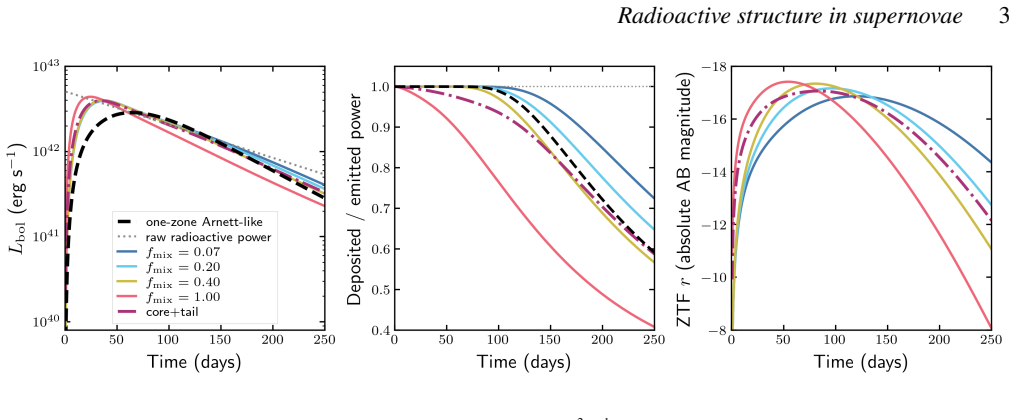
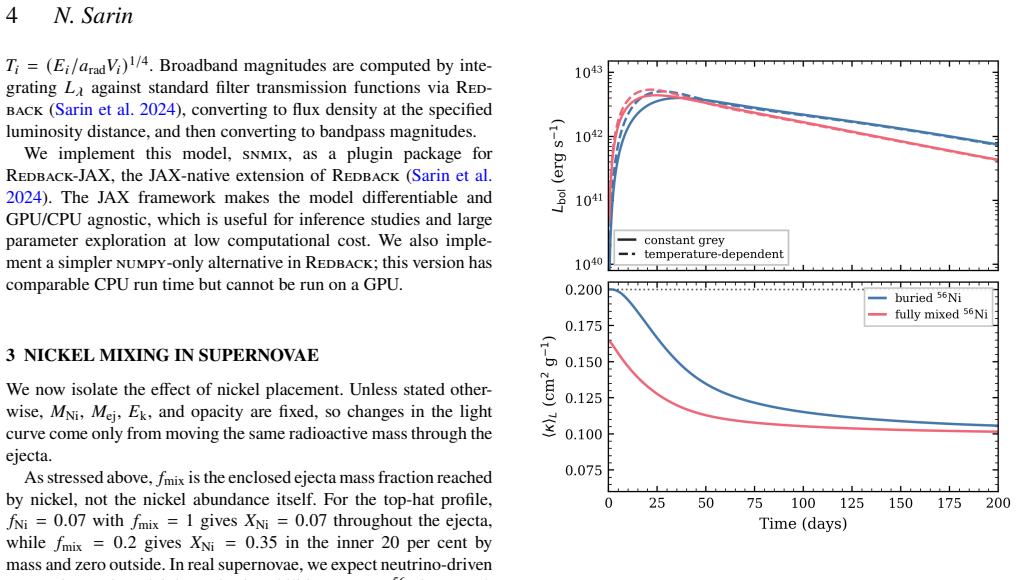
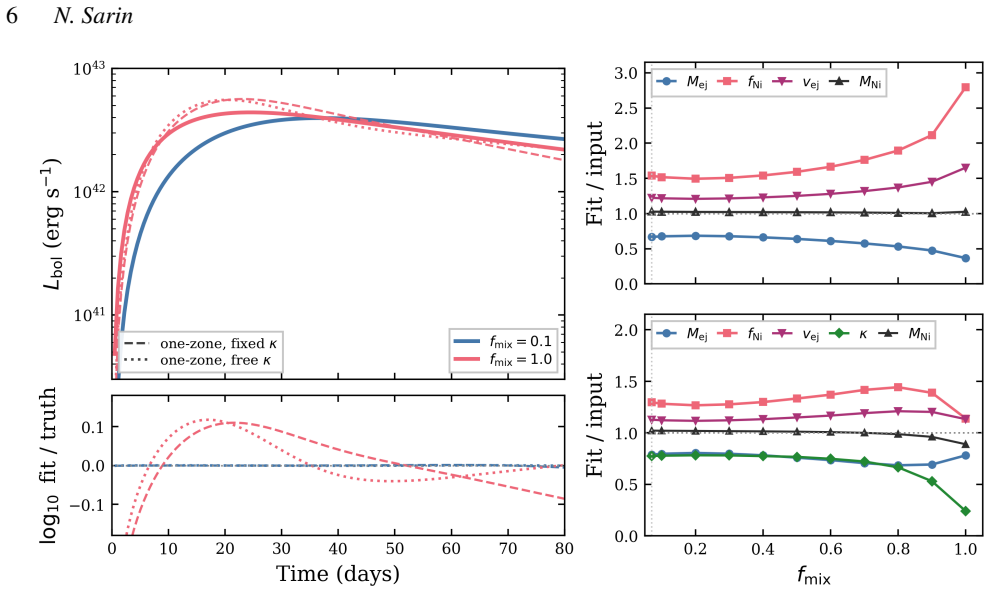
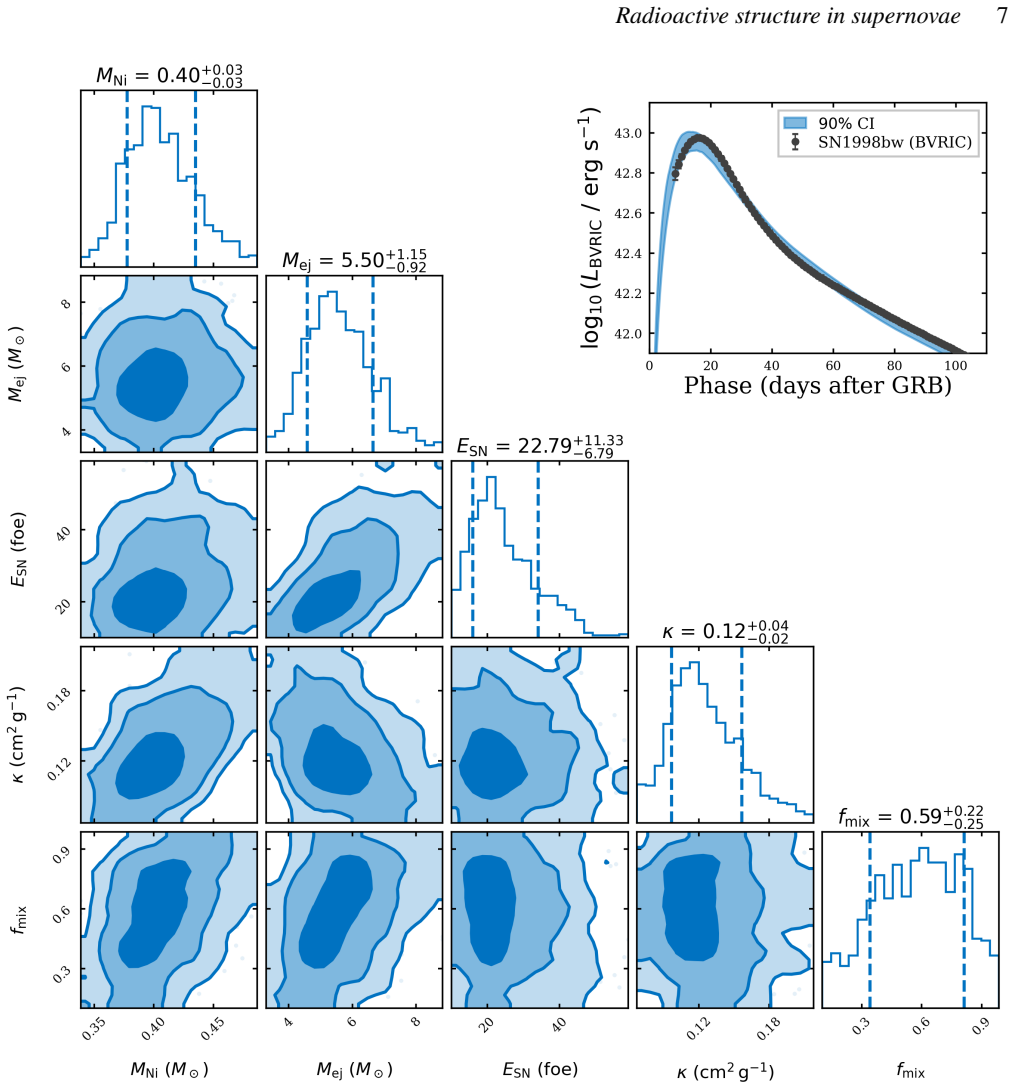
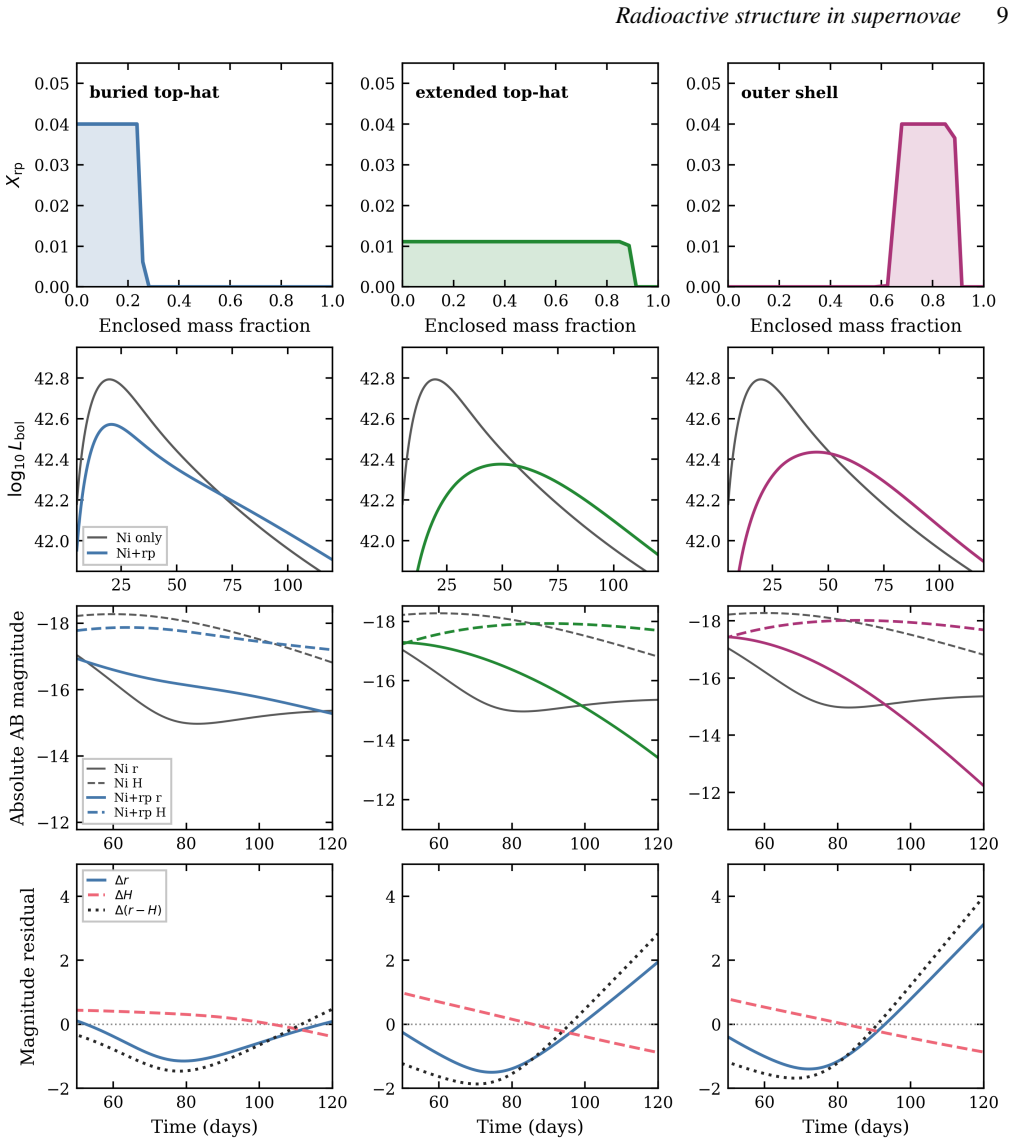
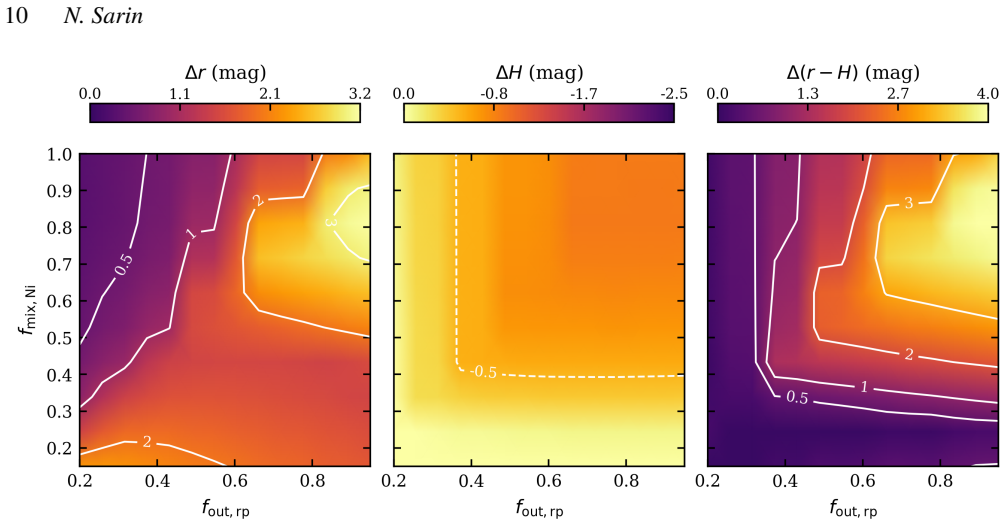
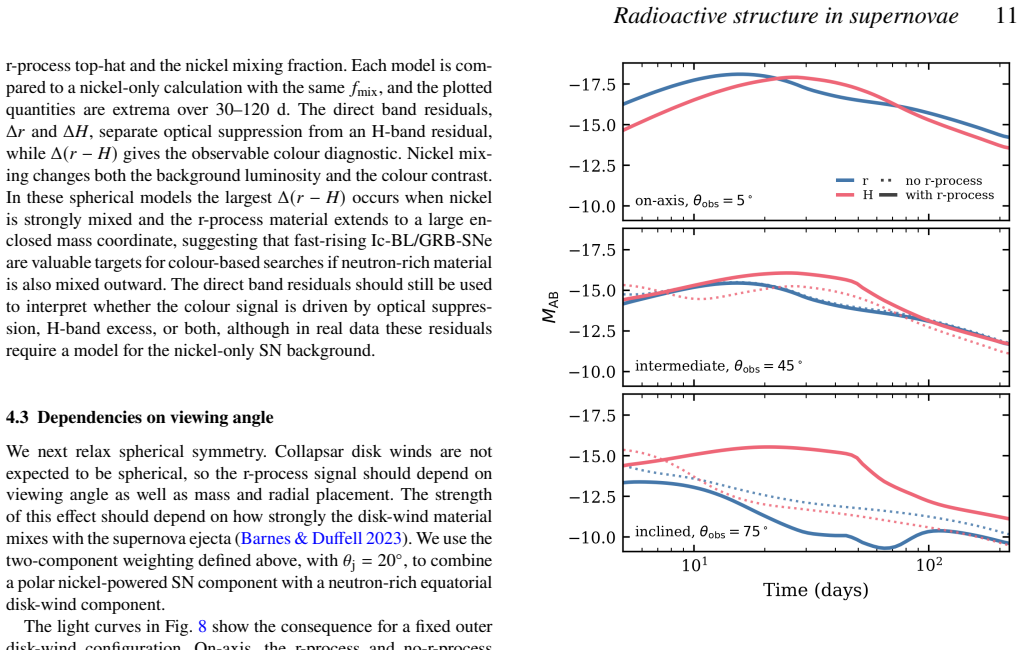
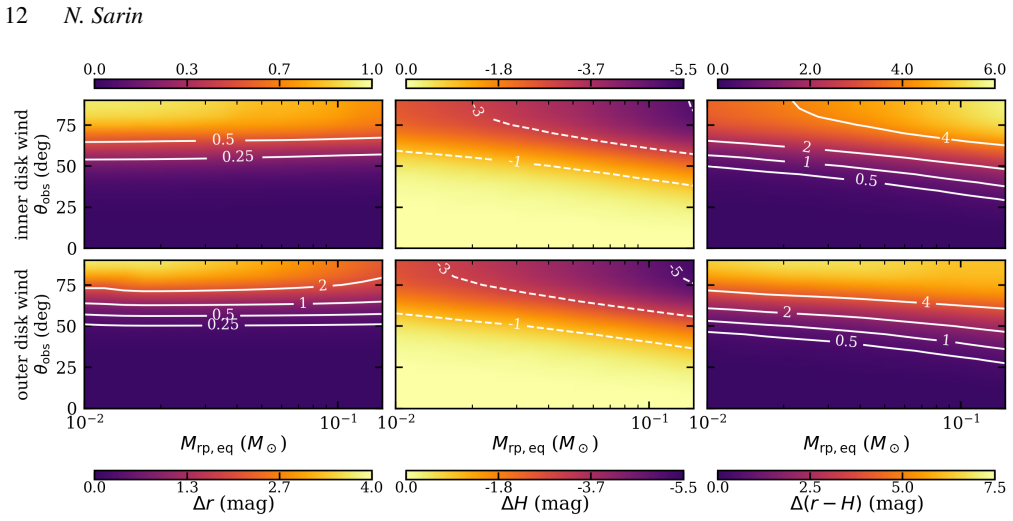
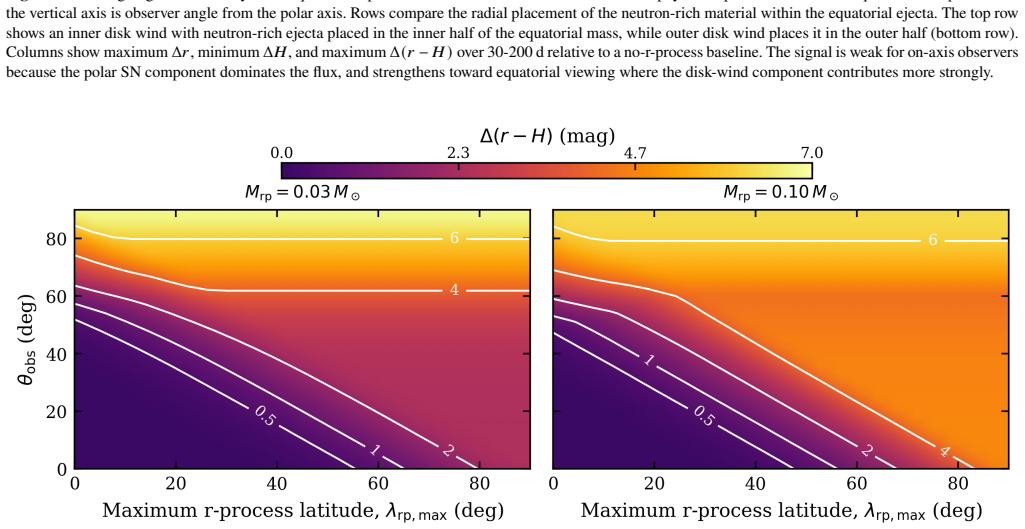
Using a multi-shell model, outward mixing of 56Ni reduces the overlying diffusion column, producing faster and brighter rises at fixed M_Ni, M_ej, and E_k, and changes the tail through local gamma-ray leakage. One-zone fits to mixed bolometric light curves produce visually good fits but biased parameters, absorbed mainly by low inferred M_ej and high inferred f_Ni at fixed opacity. For collapsar r-process enrichment, the signature is not always a NIR excess and depends sensitively on the nickel-powered background, radial placement, angular distribution, and viewing angle, with spherical models often showing optical suppression and delayed colour evolution.
What carries the argument
Multi-shell radiative transfer model that varies the radial distribution of 56Ni and neutron-rich material to compute diffusion time and gamma-ray leakage in bolometric lightcurves.
If this is right
- A fast bright rise does not by itself indicate low ejecta mass or require engine power.
- Inferred explosion energies and progenitor mappings shift when mixing is ignored.
- Photometric fits amplify the parameter biases from unaccounted mixing.
- Fast-rising on-axis GRB-SNe are poor r-process targets for equatorially confined winds unless material reaches latitudes above 30 degrees.
Where Pith is reading between the lines
- Catalogs of supernova parameters derived from one-zone models may carry systematic underestimates of ejecta mass.
- Comparisons between one-zone and multi-shell fits on the same simulated data with known inputs could quantify the size of the bias.
- Angular distributions in full 3D simulations may strengthen or weaken the optical suppression signals for r-process material.
- R-process searches in GRB-SNe may need explicit modeling of viewing angle and nickel background to avoid false negatives.
Load-bearing premise
The multi-shell model with fixed or free opacity accurately captures the radiative transfer and mixing effects without requiring full 3D hydrodynamics or detailed angular distributions.
What would settle it
A supernova with independently determined ejecta mass and nickel mass that exhibits a fast rise; one-zone models would attribute it to low mass, but the multi-shell mixed model reproduces the same rise with the true higher mass.
Figures
read the original abstract
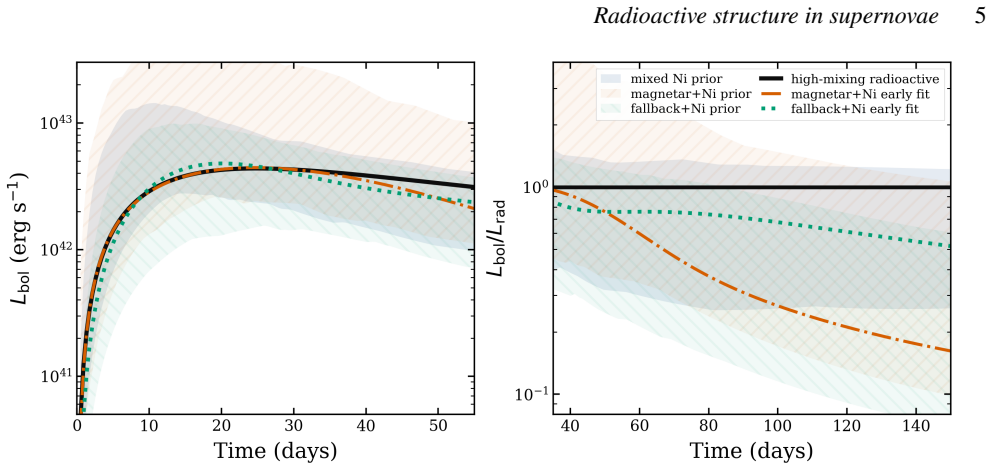
Supernova lightcurves are often interpreted with one-zone radioactive-decay models that ignore a key variable that can affect interpretation and inferred parameters: the distribution of radioactive material. Using a multi-shell model, we explore the impact of $^{56}$Ni mixing in supernovae and r-process material in collapsars. Moving $^{56}$Ni outward reduces the overlying diffusion column, producing faster and brighter rises at fixed $M_{\rm Ni}$, $M_{\rm ej}$, and $E_{\rm k}$, and changes the tail through local gamma-ray leakage. A fast, bright rise is not, by itself, evidence for low ejecta mass or a requirement for engine power, with significant overlap between highly mixed and engine-powered lightcurves. One-zone fits to mixed bolometric light curves produce visually good fits but biased parameters. At fixed opacity, outward mixing is absorbed mainly by low inferred $M_{\rm ej}$ and high inferred $f_{\rm Ni}$, while $M_{\rm Ni}$ remains stable. If opacity is free, the fully mixed case is recovered with $\kappa^{\rm fit}/\kappa^{\rm input}\simeq0.24$. These shifts affect inferred explosion energies and progenitor mappings, and amplified in photometric fits. Exploring collapsar r-process enrichment, we find that the signature is not always a NIR excess and depends sensitively on the nickel-powered background, radial placement, angular distribution, and viewing angle of neutron-rich ejecta. In our setup, spherical models often show optical suppression and delayed colour evolution. Our disk-wind models suggest that fast-rising on-axis GRB-SNe are poor r-process targets for equatorially confined neutron-rich winds, and become constraining only if the r-process material reaches latitudes $\gtrsim 30^\circ$ from the equatorial plane.
Editorial analysis
A structured set of objections, weighed in public.
Referee Report
Summary. The paper uses a multi-shell model to demonstrate that outward mixing of 56Ni in supernovae reduces the overlying diffusion column, yielding faster and brighter light-curve rises and altered tails via local gamma-ray leakage at fixed M_Ni, M_ej, and E_k. One-zone fits to these mixed bolometric curves produce visually acceptable but biased parameters (primarily low M_ej and high f_Ni at fixed opacity; kappa_fit/kappa_input ~0.24 when opacity is free). For collapsars, r-process signatures are shown to depend on radial placement, angular distribution, and viewing angle rather than always producing a NIR excess; spherical models exhibit optical suppression and delayed color evolution, while equatorially confined disk winds make on-axis GRB-SNe poor targets unless material reaches latitudes ≳30°.
Significance. If the multi-shell treatment is adequate, the results would caution against interpreting fast rises as direct evidence for low ejecta mass or engine power and would supply viewing-angle-dependent criteria for identifying r-process material in collapsar events. The work directly addresses a variable (radioactive-material distribution) routinely omitted from one-zone modeling and could affect progenitor mappings and explosion-energy inferences.
major comments (2)
- [multi-shell model description] The multi-shell model (abstract and methods) is load-bearing for every quantitative claim about rise-time changes, tail leakage, and parameter biases. The description provides no explicit validation or resolution study against Monte Carlo radiative-transfer codes or 3D hydrodynamics for the outward-mixing or equatorial-wind regimes; if non-local transport or clumping is under-resolved, the reported shifts in inferred M_ej, f_Ni, and the r-process viewing-angle conclusions would not hold.
- [one-zone fit results] One-zone fit bias results (abstract): the statement that M_Ni remains stable while M_ej is underestimated and f_Ni overestimated at fixed opacity, or that the fully mixed case is recovered only with kappa_fit/kappa_input ≃ 0.24, rests on the multi-shell light curves being representative. Without a resolution or opacity-variation test, it is unclear whether the bias magnitudes are robust or artifacts of the diffusion/leakage approximation.
minor comments (1)
- [abstract] The abstract refers to 'our disk-wind models' without stating the number of models, the range of wind latitudes, or the specific opacity treatment used; adding these details would improve reproducibility.
Simulated Author's Rebuttal
We thank the referee for the thorough review and constructive feedback on our manuscript. Below we provide point-by-point responses to the major comments, clarifying the model's scope and agreeing to strengthen the presentation of its limitations and tests.
read point-by-point responses
-
Referee: [multi-shell model description] The multi-shell model (abstract and methods) is load-bearing for every quantitative claim about rise-time changes, tail leakage, and parameter biases. The description provides no explicit validation or resolution study against Monte Carlo radiative-transfer codes or 3D hydrodynamics for the outward-mixing or equatorial-wind regimes; if non-local transport or clumping is under-resolved, the reported shifts in inferred M_ej, f_Ni, and the r-process viewing-angle conclusions would not hold.
Authors: The multi-shell model is a 1D diffusion approximation with local gamma-ray leakage, chosen to efficiently explore mixing effects across parameter space while capturing the key geometric reduction in diffusion column. We performed internal convergence tests by increasing shell number (from 10 to 50), which stabilize the rise-time and leakage trends; these will be documented in a new methods subsection. We agree that direct benchmarks against full Monte Carlo RT or 3D hydro would be valuable and will add an explicit limitations paragraph discussing the diffusion approximation's regime of validity, noting that non-local effects and clumping are not resolved here. The qualitative conclusions on mixing-induced biases remain robust within this framework, but we will revise the text to make these caveats prominent. revision: partial
-
Referee: [one-zone fit results] One-zone fit bias results (abstract): the statement that M_Ni remains stable while M_ej is underestimated and f_Ni overestimated at fixed opacity, or that the fully mixed case is recovered only with kappa_fit/kappa_input ≃ 0.24, rests on the multi-shell light curves being representative. Without a resolution or opacity-variation test, it is unclear whether the bias magnitudes are robust or artifacts of the diffusion/leakage approximation.
Authors: The reported biases are obtained by fitting the multi-shell light curves directly; we have already varied input opacity across a factor of two and confirmed that the direction and approximate magnitude of the M_ej underestimation and f_Ni overestimation persist, with the kappa_fit/kappa_input ratio remaining near 0.24 for the fully mixed case. These tests will be added to the results section. While the exact numerical values are tied to the diffusion treatment, the core finding—that mixing mimics low-M_ej, high-f_Ni solutions—is a direct consequence of the reduced overlying column and is not an artifact. We will include the opacity-variation results and a brief resolution discussion to address this concern. revision: partial
Circularity Check
No significant circularity
full rationale
The paper generates synthetic light curves via a multi-shell diffusion model under varied 56Ni distributions, then applies one-zone fits to the resulting curves to quantify parameter biases. These steps constitute forward physical modeling followed by an independent inverse fit; the reported biases (e.g., low M_ej, high f_Ni at fixed opacity) are outputs of that procedure rather than presupposed inputs. No equations reduce a claimed result to a fitted parameter by construction, no self-citations serve as load-bearing uniqueness theorems, and no ansatz is smuggled in. The derivation therefore remains self-contained against external radiative-transfer assumptions.
Axiom & Free-Parameter Ledger
axioms (1)
- domain assumption Multi-shell model with specified radial placement captures essential diffusion column and gamma-ray leakage effects
Reference graph
Works this paper leans on
-
[1]
Hydrodynamic Mixing of Accretion Disk Outflows in Collapsars: Implications for r-process Signatures. , keywords =. doi:10.3847/1538-4357/acdb67 , archivePrefix =. 2305.00056 , primaryClass =
-
[2]
REDBACK: a Bayesian inference software package for electromagnetic transients. , keywords =. doi:10.1093/mnras/stae1238 , archivePrefix =. 2308.12806 , primaryClass =
-
[3]
Computing in Science and Engineering , keywords =
Matplotlib: A 2D Graphics Environment. Computing in Science and Engineering , keywords =. doi:10.1109/MCSE.2007.55 , adsurl =
-
[4]
Array programming with NumPy. , keywords =. doi:10.1038/s41586-020-2649-2 , archivePrefix =. 2006.10256 , primaryClass =
work page internal anchor Pith review Pith/arXiv arXiv doi:10.1038/s41586-020-2649-2 2006
-
[5]
The Astropy Project: Sustaining and Growing a Community-oriented Open-source Project and the Latest Major Release (v5.0) of the Core Package. , keywords =. doi:10.3847/1538-4357/ac7c74 , archivePrefix =. 2206.14220 , primaryClass =
work page internal anchor Pith review Pith/arXiv arXiv doi:10.3847/1538-4357/ac7c74
-
[6]
Leeney, Samuel Alan Kossoff , title =. 2026 , publisher =. doi:10.21105/joss.09441 , url =
-
[7]
Composable Effects for Flexible and Accelerated Probabilistic Programming in NumPyro
Composable Effects for Flexible and Accelerated Probabilistic Programming in NumPyro. arXiv e-prints , keywords =. doi:10.48550/arXiv.1912.11554 , archivePrefix =. 1912.11554 , primaryClass =
work page internal anchor Pith review Pith/arXiv arXiv doi:10.48550/arxiv.1912.11554 1912
-
[8]
James Bradbury and Roy Frostig and Peter Hawkins and Matthew James Johnson and Yash Katariya and Chris Leary and Dougal Maclaurin and George Necula and Adam Paszke and Jake Vander
-
[9]
and Haberland, Matt and Reddy, Tyler and Cournapeau, David and Burovski, Evgeni and Peterson, Pearu and Weckesser, Warren and Bright, Jonathan and
Virtanen, Pauli and Gommers, Ralf and Oliphant, Travis E. and Haberland, Matt and Reddy, Tyler and Cournapeau, David and Burovski, Evgeni and Peterson, Pearu and Weckesser, Warren and Bright, Jonathan and. Nature Methods , year =
-
[10]
Signatures of r-process Enrichment in Supernovae from Collapsars. , keywords =. doi:10.3847/2041-8213/ac9b41 , archivePrefix =. 2205.10421 , primaryClass =
-
[11]
Type Ib/Ic Supernovae: Effect of Nickel Mixing on the Early-time Color Evolution and Implications for the Progenitors. , keywords =. doi:10.3847/1538-4357/ab0020 , archivePrefix =. 1810.03108 , primaryClass =
work page internal anchor Pith review Pith/arXiv arXiv doi:10.3847/1538-4357/ab0020
-
[12]
The Observer's Guide to the Gamma-Ray Burst-Supernova Connection
The Observer's Guide to the Gamma-Ray Burst Supernova Connection. Advances in Astronomy , keywords =. doi:10.1155/2017/8929054 , archivePrefix =. 1604.03549 , primaryClass =
work page internal anchor Pith review Pith/arXiv arXiv doi:10.1155/2017/8929054 2017
-
[13]
The Expulsion of Stellar Envelopes in Core-Collapse Supernovae
The Expulsion of Stellar Envelopes in Core-Collapse Supernovae. , keywords =. doi:10.1086/306571 , archivePrefix =. astro-ph/9807046 , primaryClass =
work page internal anchor Pith review Pith/arXiv arXiv doi:10.1086/306571
-
[14]
Studying the Power Sources behind Type Ic Supernovae. , keywords =. doi:10.3847/1538-4357/ae1582 , archivePrefix =. 2501.15702 , primaryClass =
-
[15]
Magnetorotational supernovae: a nucleosynthetic analysis of sophisticated 3D models. , keywords =. doi:10.1093/mnras/stac3185 , archivePrefix =. 2206.11914 , primaryClass =
-
[16]
Average opacity calculation for core-collapse supernovae
Average Opacity Calculation for Core-collapse Supernovae. , keywords =. doi:10.3847/1538-4357/aace56 , archivePrefix =. 1806.07188 , primaryClass =
work page internal anchor Pith review Pith/arXiv arXiv doi:10.3847/1538-4357/aace56
-
[17]
Supernova Environmental Impacts , year = 2014, editor =
Early Emission of Core-Collapse Supernovae. Supernova Environmental Impacts , year = 2014, editor =. doi:10.1017/S174392131300923X , adsurl =
-
[18]
EP 250108a/SN 2025kg: Observations of the Most Nearby Broad-line Type Ic Supernova Following an Einstein Probe Fast X-Ray Transient. , keywords =. doi:10.3847/2041-8213/ade7f9 , archivePrefix =. 2504.08889 , primaryClass =
-
[19]
arXiv e-prints , keywords =
A Multi-Wavelength View of the First Type Ic-BL Supernova with an Einstein Probe X-ray Shock Breakout. arXiv e-prints , keywords =
-
[20]
arXiv e-prints , keywords =
Failed jet breakout in the metal-poor broad-lined type Ic supernova 2026gzf. arXiv e-prints , keywords =
-
[21]
The ejected mass distribution of Type Ia supernovae: a significant rate of non-Chandrasekhar-mass progenitors. , keywords =. doi:10.1093/mnras/stu1808 , archivePrefix =. 1408.6601 , primaryClass =
work page internal anchor Pith review Pith/arXiv arXiv doi:10.1093/mnras/stu1808
-
[22]
arXiv e-prints , keywords =
Thermal X-rays breaking out from pre-explosion ejecta of a dying massive star. arXiv e-prints , keywords =
-
[23]
A two-component model for fitting light-curves of core-collapse supernovae
A two-component model for fitting light curves of core-collapse supernovae. , keywords =. doi:10.1051/0004-6361/201527931 , archivePrefix =. 1602.04001 , primaryClass =
work page internal anchor Pith review Pith/arXiv arXiv doi:10.1051/0004-6361/201527931
-
[24]
Optical and Radio Analysis of Systematically Classified Broad-lined Type Ic Supernovae from the Zwicky Transient Facility. , keywords =. doi:10.3847/1538-4357/ad7fde , archivePrefix =. 2408.14586 , primaryClass =
-
[25]
Large-scale Evolution of Seconds-long Relativistic Jets from Black Hole-Neutron Star Mergers[J/OL]
Large-scale Evolution of Seconds-long Relativistic Jets from Black Hole-Neutron Star Mergers. , keywords =. doi:10.3847/2041-8213/aceeff , archivePrefix =. 2306.14947 , primaryClass =
-
[26]
M., Barnes , J., and Metzger , B
Collapsars as a major source of r-process elements. , keywords =. doi:10.1038/s41586-019-1136-0 , archivePrefix =. 1810.00098 , primaryClass =
-
[27]
``Super-kilonovae'' from Massive Collapsars as Signatures of Black Hole Birth in the Pair-instability Mass Gap. , keywords =. doi:10.3847/1538-4357/ac8d04 , archivePrefix =. 2111.03094 , primaryClass =
-
[28]
Systematic opacity calculations for kilonovae. , keywords =. doi:10.1093/mnras/staa1576 , archivePrefix =. 1906.08914 , primaryClass =
-
[29]
Cautionary Tales on Heating-rate Prescriptions in Kilonovae. , keywords =. doi:10.3847/2041-8213/ad739d , archivePrefix =. 2404.07271 , primaryClass =
-
[30]
Annalen der Physik , keywords =
Heavy Elements and Electromagnetic Transients from Neutron Star Mergers. Annalen der Physik , keywords =. doi:10.1002/andp.202200306 , archivePrefix =. 2208.14026 , primaryClass =
-
[31]
On the astrophysical robustness of the neutron star merger r-process. , keywords =. doi:10.1111/j.1365-2966.2012.21859.x , archivePrefix =. 1206.2379 , primaryClass =
-
[32]
On the diversity of magnetar-driven kilonovae. , keywords =. doi:10.1093/mnras/stac2609 , archivePrefix =. 2205.14159 , primaryClass =
-
[33]
From mass-loss histories to lightcurves: a generalised framework for interaction-powered transients
From mass-loss histories to lightcurves: a generalised framework for interaction-powered transients. arXiv e-prints , keywords =. doi:10.48550/arXiv.2605.19571 , archivePrefix =. 2605.19571 , primaryClass =
work page internal anchor Pith review Pith/arXiv arXiv doi:10.48550/arxiv.2605.19571
-
[34]
Lightcurve Modelling of 2,205 ZTF DR2 Type -0.5ex Supernovae: Implications for SN Ia Physics and Cosmology. arXiv e-prints , keywords =. doi:10.48550/arXiv.2602.02677 , archivePrefix =. 2602.02677 , primaryClass =
-
[35]
Radioactivity and Thermalization in the Ejecta of Compact Object Mergers and Their Impact on Kilonova Light Curves. , keywords =. doi:10.3847/0004-637X/829/2/110 , archivePrefix =. 1605.07218 , primaryClass =
work page internal anchor Pith review Pith/arXiv arXiv doi:10.3847/0004-637x/829/2/110
-
[36]
Kilonovae Across the Nuclear Physics Landscape: The Impact of Nuclear Physics Uncertainties on r-process-powered Emission. , keywords =. doi:10.3847/1538-4357/ac0aec , archivePrefix =. 2010.11182 , primaryClass =
-
[37]
Radioactive Heating and Late Time Kilonova Light Curves
Radioactive Heating and Late Time Kilonova Light Curves. , keywords =. doi:10.3847/1538-4357/ab06c2 , archivePrefix =. 1807.03319 , primaryClass =
work page internal anchor Pith review Pith/arXiv arXiv doi:10.3847/1538-4357/ab06c2
-
[38]
The First Systematic Study of Type Ibc Supernova Multi-band Light Curves
The First Systematic Study of Type Ibc Supernova Multi-band Light Curves. , keywords =. doi:10.1088/0004-637X/741/2/97 , archivePrefix =. 1011.4959 , primaryClass =
work page internal anchor Pith review Pith/arXiv arXiv doi:10.1088/0004-637x/741/2/97
-
[39]
Analysis of broad-lined Type Ic supernovae from the (intermediate) Palomar Transient Factory
Analysis of broad-lined Type Ic supernovae from the (intermediate) Palomar Transient Factory. , keywords =. doi:10.1051/0004-6361/201834429 , archivePrefix =. 1811.09544 , primaryClass =
work page internal anchor Pith review Pith/arXiv arXiv doi:10.1051/0004-6361/201834429
-
[40]
Type Ic supernovae from the (intermediate) Palomar Transient Factory. , keywords =. doi:10.1051/0004-6361/202038890 , archivePrefix =. 2010.08392 , primaryClass =
-
[41]
Reviews of Modern Physics , keywords =
The evolution and explosion of massive stars. Reviews of Modern Physics , keywords =. doi:10.1103/RevModPhys.74.1015 , adsurl =
-
[42]
New Two-dimensional Models of Supernova Explosions by the Neutrino-heating Mechanism: Evidence for Different Instability Regimes in Collapsing Stellar Cores. , keywords =. doi:10.1088/0004-637X/761/1/72 , archivePrefix =. 1205.7078 , primaryClass =
work page internal anchor Pith review Pith/arXiv arXiv doi:10.1088/0004-637x/761/1/72
-
[43]
Three-Dimensional Simulations of Mixing Instabilities in Supernova Explosions
Three-dimensional Simulations of Mixing Instabilities in Supernova Explosions. , keywords =. doi:10.1088/0004-637X/714/2/1371 , archivePrefix =. 0908.3474 , primaryClass =
work page internal anchor Pith review Pith/arXiv arXiv doi:10.1088/0004-637x/714/2/1371
-
[44]
Discovery of the peculiar supernova 1998bw in the error box of GRB980425
An unusual supernova in the error box of the -ray burst of 25 April 1998. , keywords =. doi:10.1038/27150 , archivePrefix =. astro-ph/9806175 , primaryClass =
work page internal anchor Pith review Pith/arXiv arXiv doi:10.1038/27150 1998
-
[45]
A very energetic supernova associated with the gamma-ray burst of 29 March 2003
A very energetic supernova associated with the -ray burst of 29 March 2003. , keywords =. doi:10.1038/nature01750 , archivePrefix =. astro-ph/0306347 , primaryClass =
work page internal anchor Pith review Pith/arXiv arXiv doi:10.1038/nature01750 2003
-
[46]
Signatures of a jet cocoon in early spectra of a supernova associated with a $\gamma$-ray burst
Signatures of a jet cocoon in early spectra of a supernova associated with a -ray burst. , keywords =. doi:10.1038/s41586-018-0826-3 , archivePrefix =. 1901.05500 , primaryClass =
work page internal anchor Pith review Pith/arXiv arXiv doi:10.1038/s41586-018-0826-3 1901
-
[47]
Supernova Light Curves Powered by Young Magnetars
Supernova Light Curves Powered by Young Magnetars. , keywords =. doi:10.1088/0004-637X/717/1/245 , archivePrefix =. 0911.0680 , primaryClass =
work page internal anchor Pith review Pith/arXiv arXiv doi:10.1088/0004-637x/717/1/245
-
[48]
Bright Supernovae from Magnetar Birth
Bright Supernovae from Magnetar Birth. , keywords =. doi:10.1088/2041-8205/719/2/L204 , archivePrefix =. 0911.0698 , primaryClass =
work page internal anchor Pith review Pith/arXiv arXiv doi:10.1088/2041-8205/719/2/l204 2041
-
[49]
Supernova Light Curves Powered by Fallback Accretion
Supernova Light Curves Powered by Fallback Accretion. , keywords =. doi:10.1088/0004-637X/772/1/30 , archivePrefix =. 1210.7240 , primaryClass =
work page internal anchor Pith review Pith/arXiv arXiv doi:10.1088/0004-637x/772/1/30
-
[50]
Dynamics and observational signatures of core-collapse supernovae with central engines: hydrodynamics simulations with Monte Carlo post-processing. , keywords =. doi:10.1093/mnras/stag306 , archivePrefix =. 2510.13741 , primaryClass =
work page internal anchor Pith review Pith/arXiv arXiv doi:10.1093/mnras/stag306
-
[51]
Electromagnetic counterparts of compact object mergers powered by the radioactive decay of r-process nuclei. , keywords =. doi:10.1111/j.1365-2966.2010.16864.x , archivePrefix =. 1001.5029 , primaryClass =
-
[52]
The luminosity of type I supernovae. , keywords =. doi:10.1086/183239 , adsurl =
-
[53]
2025, Nature Astronomy, 9, 1073, doi: 10.1038/s41550-025-02571-1
A fast X-ray transient from a weak relativistic jet associated with a type Ic-BL supernova. Nature Astronomy , keywords =. doi:10.1038/s41550-025-02571-1 , archivePrefix =. 2410.02315 , primaryClass =
-
[54]
The Einstein Probe Transient EP240414a: Linking Fast X-Ray Transients, Gamma-Ray Bursts, and Luminous Fast Blue Optical Transients. , keywords =. doi:10.3847/2041-8213/adbc7e , archivePrefix =. 2409.19056 , primaryClass =
-
[55]
I - Analytic solutions for the early part of the light curve
Type I supernovae. I - Analytic solutions for the early part of the light curve. , keywords =. doi:10.1086/159681 , adsurl =
-
[56]
Analytic solutions for light curves of supernovae of Type II. , keywords =. doi:10.1086/157898 , adsurl =
-
[57]
The Most Luminous Supernovae. , keywords =. doi:10.1146/annurev-astro-081817-051819 , archivePrefix =. 1812.01428 , primaryClass =
-
[58]
Einstein Probe - a small mission to monitor and explore the dynamic X-ray Universe
Einstein Probe - a small mission to monitor and explore the dynamic X-ray Universe. arXiv e-prints , keywords =. doi:10.48550/arXiv.1506.07735 , archivePrefix =. 1506.07735 , primaryClass =
work page internal anchor Pith review Pith/arXiv arXiv doi:10.48550/arxiv.1506.07735
-
[59]
LSST: from Science Drivers to Reference Design and Anticipated Data Products
LSST: From Science Drivers to Reference Design and Anticipated Data Products. , keywords =. doi:10.3847/1538-4357/ab042c , archivePrefix =. 0805.2366 , primaryClass =
work page internal anchor Pith review Pith/arXiv arXiv doi:10.3847/1538-4357/ab042c
-
[60]
Surrogate models for light curves and photosphere properties of Type II supernovae. , keywords =. doi:10.1093/mnras/staf1808 , archivePrefix =. 2506.02107 , primaryClass =
-
[61]
The La Silla Schmidt Southern Survey. , keywords =. doi:10.1088/1538-3873/ae02c5 , archivePrefix =. 2503.14579 , primaryClass =
-
[62]
The Zwicky Transient Facility: System Overview, Performance, and First Results
The Zwicky Transient Facility: System Overview, Performance, and First Results. , keywords =. doi:10.1088/1538-3873/aaecbe , archivePrefix =. 1902.01932 , primaryClass =
work page internal anchor Pith review Pith/arXiv arXiv doi:10.1088/1538-3873/aaecbe 1902
-
[63]
The Ultimate Light Curve of SN 1998bw/GRB 980425
The Ultimate Light Curve of SN 1998bw/GRB 980425. , keywords =. doi:10.1088/0004-6256/141/5/163 , archivePrefix =. 1106.1695 , primaryClass =
work page internal anchor Pith review Pith/arXiv arXiv doi:10.1088/0004-6256/141/5/163
-
[64]
Radioactive Heating Rate of r-process Elements and Macronova Light Curve. , keywords =. doi:10.3847/1538-4357/ab6a98 , archivePrefix =. 1909.02581 , primaryClass =
-
[65]
Velocity evolution of broad-lined type-Ic supernovae with and without gamma-ray bursts. , keywords =. doi:10.1051/0004-6361/202453047 , archivePrefix =. 2411.11503 , primaryClass =
-
[66]
The Spectral SN-GRB Connection: Systematic Spectral Comparisons between Type Ic Supernovae and Broad-lined Type Ic Supernovae with and without Gamma-Ray Bursts. , keywords =. doi:10.3847/0004-637X/832/2/108 , archivePrefix =. 1509.07124 , primaryClass =
work page internal anchor Pith review Pith/arXiv arXiv doi:10.3847/0004-637x/832/2/108
-
[67]
Collapsars as Sites of r-process Nucleosynthesis: Systematic Photometric Near-infrared Follow-up of Type Ic-BL Supernovae. , keywords =. doi:10.3847/1538-4357/ad11df , archivePrefix =. 2302.09226 , primaryClass =
-
[68]
A `Hypernova' model for SN 1998bw associated with gamma-ray burst of 25 April 1998
A hypernova model for the supernova associated with the -ray burst of 25 April 1998. , keywords =. doi:10.1038/27155 , archivePrefix =. astro-ph/9806382 , primaryClass =
work page internal anchor Pith review Pith/arXiv arXiv doi:10.1038/27155 1998
-
[69]
Light Curve and Spectral Models for the Hypernova SN 1998bw associated with GRB980425
Light Curve and Spectral Models for the Hypernova SN 1998BW Associated with GRB 980425. , keywords =. doi:10.1086/319784 , archivePrefix =. astro-ph/0007010 , primaryClass =
work page internal anchor Pith review Pith/arXiv arXiv doi:10.1086/319784
-
[70]
Living Reviews in Relativity , keywords =
Kilonovae. Living Reviews in Relativity , keywords =. doi:10.1007/s41114-019-0024-0 , archivePrefix =. 1910.01617 , primaryClass =
-
[71]
EP250108a/SN 2025kg: A Jet-driven Stellar Explosion Interacting with Circumstellar Material. , keywords =. doi:10.3847/2041-8213/ade870 , archivePrefix =. 2504.17516 , primaryClass =
-
[72]
EP 250108a/SN 2025kg: a magnetar-powered gamma-ray burst supernova originating from a close helium-star binary via isolated binary evolution. , keywords =. doi:10.1093/mnrasl/slaf114 , archivePrefix =. 2507.18544 , primaryClass =
-
[73]
Encyclopedia of Astrophysics, Volume 2 , year = 2026, volume =
Superluminous supernovae. Encyclopedia of Astrophysics, Volume 2 , year = 2026, volume =. doi:10.1016/B978-0-443-21439-4.00017-1 , archivePrefix =. 2407.12302 , primaryClass =
-
[74]
The Magnetar Model for Type I Superluminous Supernovae. I. Bayesian Analysis of the Full Multicolor Light-curve Sample with MOSFiT. , keywords =. doi:10.3847/1538-4357/aa9334 , archivePrefix =. 1706.00825 , primaryClass =
work page internal anchor Pith review Pith/arXiv arXiv doi:10.3847/1538-4357/aa9334
-
[75]
A generalized semi-analytic model for magnetar-driven supernovae. , keywords =. doi:10.1093/mnras/stad3645 , archivePrefix =. 2308.12997 , primaryClass =
-
[76]
J., M¨ uller, B., Chan, C., Heger, A., & Blinnikov, S
Fallback Accretion-powered Supernova Light Curves Based on a Neutrino-driven Explosion Simulation of a 40 M _ ☉ Star. , keywords =. doi:10.3847/1538-4357/ab2643 , archivePrefix =. 1906.00153 , primaryClass =
-
[77]
Annual Review of Statistics and Its Application , keywords =
Bayesian Inference for Misspecified Generative Models. Annual Review of Statistics and Its Application , keywords =. doi:10.1146/annurev-statistics-040522-015915 , archivePrefix =. 2305.08429 , primaryClass =
-
[78]
Line Expansion Opacity in Relativistically Expanding Media. , keywords =. doi:10.3847/1538-4357/ab5306 , archivePrefix =. 1910.13619 , primaryClass =
-
[79]
Opacities and Spectra of the r-process Ejecta from Neutron Star Mergers
Opacities and Spectra of the r-process Ejecta from Neutron Star Mergers. , keywords =. doi:10.1088/0004-637X/774/1/25 , archivePrefix =. 1303.5788 , primaryClass =
work page internal anchor Pith review Pith/arXiv arXiv doi:10.1088/0004-637x/774/1/25
-
[80]
arXiv e-prints , keywords =
Decadal pre-explosion activity and circumstellar interaction in a supernova. arXiv e-prints , keywords =
discussion (0)
Sign in with ORCID, Apple, or X to comment. Anyone can read and Pith papers without signing in.