Discovery of an Exterior Third Planet Orbiting β Pictoris
Pith reviewed 2026-06-26 07:04 UTC · model grok-4.3
The pith
A third giant planet, β Pictoris d, has been found in the β Pictoris system at a semi-major axis greater than 30 AU.
A machine-rendered reading of the paper's core claim, the machinery that carries it, and where it could break.
Core claim
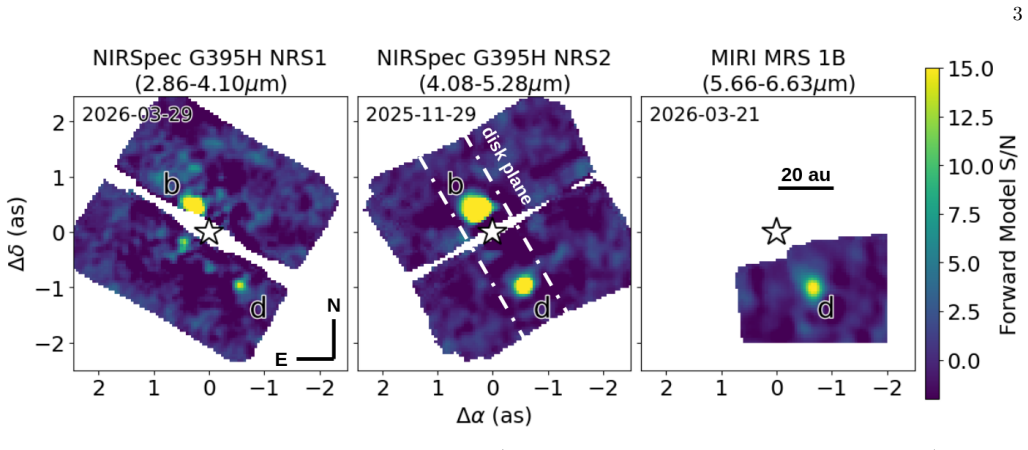
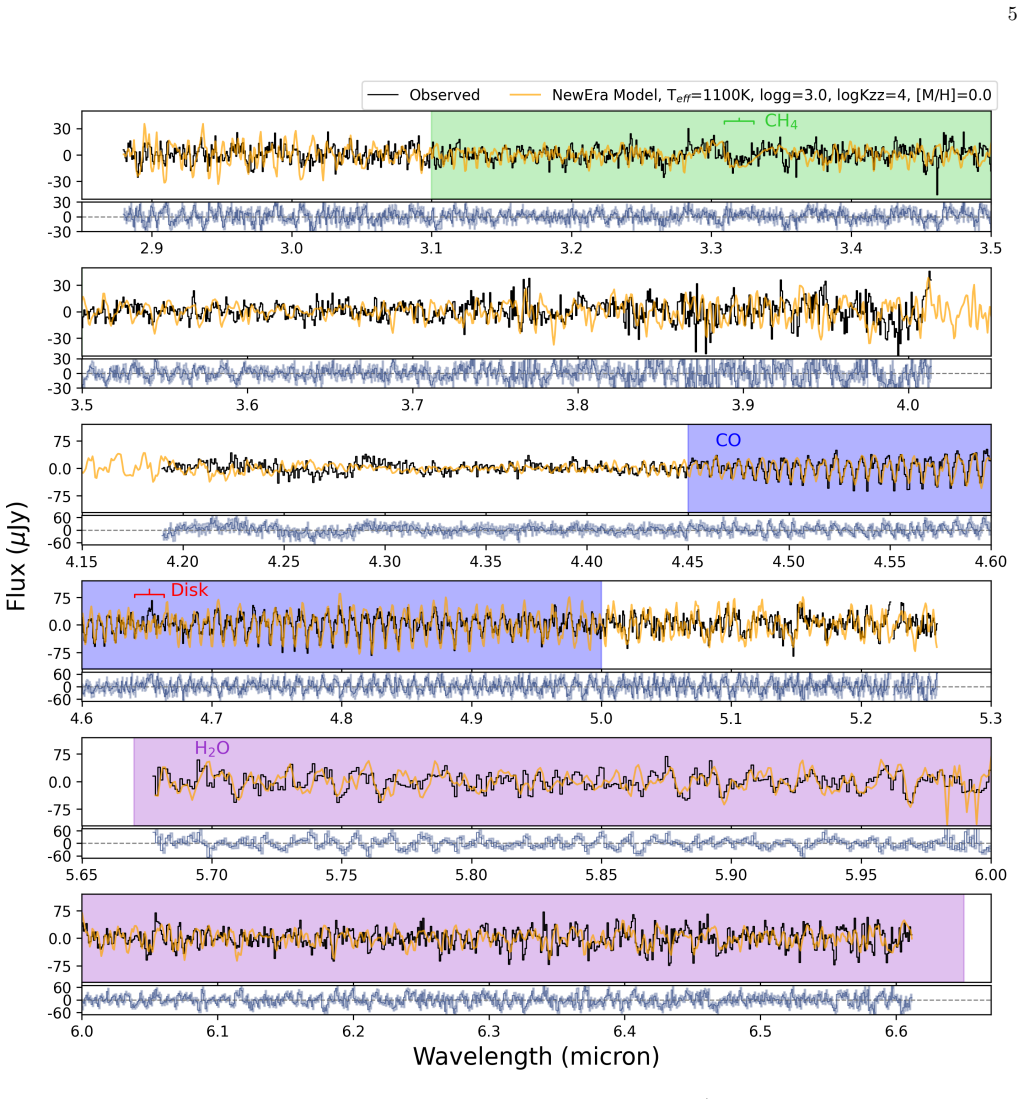
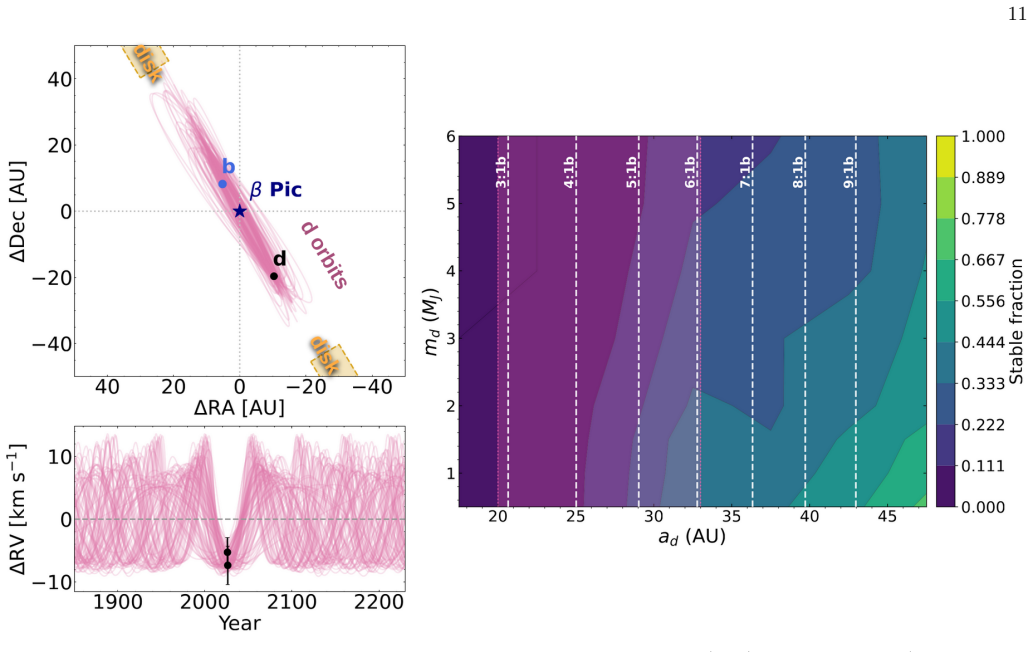
We report the discovery of β Pictoris d (β Pic d), a third giant planet in the β Pictoris system, which now becomes only the second directly imaged system with more than two confirmed planets. β Pic d was serendipitously detected in JWST/NIRSpec IFU observations. A second epoch of NIRSpec and MIRI/MRS observations confirm the initial discovery. The extracted spectrum shows clear CH4, CO, and H2O absorption features, and β Pic d's measured radial velocity is consistent with its orbital position. Radial velocity and astrometry measurements combined with orbital stability simulations suggest a semi-major axis >30 au, consistent with β Pic d being responsible for carving the inner edge of the β
What carries the argument
Spectral template matching on moderate-resolution NIRSpec IFU spectroscopy, which isolates the planet's CH4, CO, and H2O absorption lines and confirms radial velocity match to the expected orbital location.
If this is right
- β Pic d is responsible for carving the inner edge of the β Pictoris debris disk.
- The β Pictoris system now contains three confirmed giant planets.
- Moderate-resolution spectroscopy can detect planets whose signals are hidden within bright extrasolar debris disks.
- The method works at orbital distances where broadband imaging is limited by disk brightness.
Where Pith is reading between the lines
- The same spectroscopic approach could be applied to other young debris-disk systems observed with JWST to search for additional wide-orbit planets.
- Confirmation of this planet strengthens models of how multiple giant planets interact with and maintain debris disks over time.
- Longer-term monitoring could test whether the three planets remain stable or experience scattering events.
Load-bearing premise
The detected spectral features and radial velocity consistency indicate a gravitationally bound planet rather than a background object or instrumental artifact.
What would settle it
Future multi-epoch astrometry or radial velocity data showing the object does not follow the predicted orbit around β Pictoris would disprove the bound-planet interpretation.
Figures
read the original abstract
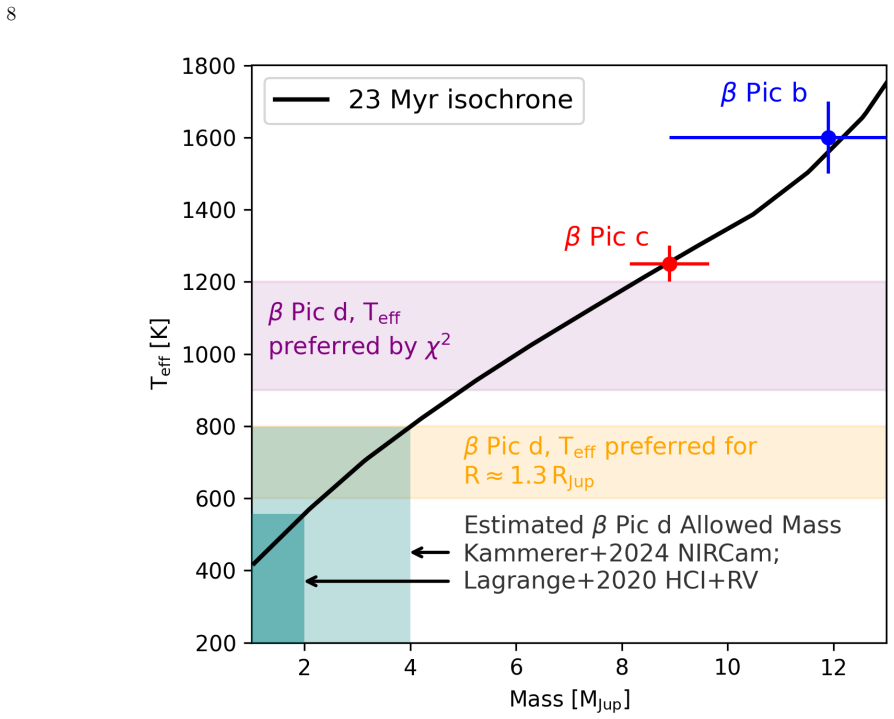
We report the discovery of $\beta$ Pictoris d ($\beta$ Pic d), a third giant planet in the $\beta$ Pictoris system, which now becomes only the second directly imaged system with more than two confirmed planets. $\beta$ Pic d was serendipitously detected in JWST/NIRSpec IFU observations. A second epoch of NIRSpec and MIRI/MRS observations confirm the initial discovery. The extracted spectrum shows clear CH$_4$, CO, and H$_2$O absorption features, and $\beta$ Pic d's measured radial velocity is consistent with its orbital position. Radial velocity and astrometry measurements combined with orbital stability simulations suggest a semi-major axis $>$30 au, consistent with $\beta$ Pic d being responsible for carving the inner edge of the $\beta$ Pictoris debris disk. Using effective temperature estimates from atmosphere model grid fits combined with evolutionary models, we estimate a mass of 2--4 $M_\mathrm{Jup}$. $\beta$ Pic d is the first planet discovered using spectral template matching with moderate-resolution spectroscopy, highlighting its sensitivity to planetary molecular features hidden within bright extrasolar debris disks that are difficult to access with broadband imaging.
Editorial analysis
A structured set of objections, weighed in public.
Referee Report
Summary. The manuscript reports the serendipitous discovery of β Pictoris d (β Pic d), a third giant planet in the β Pictoris system detected in JWST/NIRSpec IFU observations and confirmed via a second epoch of NIRSpec and MIRI/MRS data. The extracted spectrum exhibits CH4, CO, and H2O absorption features; the measured radial velocity is consistent with the orbital position. Combined radial velocity, astrometry, and orbital stability simulations indicate a semi-major axis >30 au, while effective temperature estimates from atmosphere model grid fits and evolutionary models yield a mass of 2–4 MJup. The work positions this as the first planet discovered via spectral template matching with moderate-resolution spectroscopy in a bright debris disk.
Significance. If the detection and bound-planet interpretation hold, this would be only the second directly imaged system with more than two confirmed planets and would demonstrate a new technique for recovering planets whose molecular features are otherwise hidden in bright debris disks. It would also strengthen dynamical links between planets and the inner edge of the β Pictoris disk, with broader implications for young planetary system architectures.
major comments (3)
- [Detection and confirmation paragraphs] The central claim that the detected object is a gravitationally bound planet (rather than a background contaminant or artifact) rests on multi-epoch astrometry, spectral features, and RV consistency. A quantitative false-positive probability or detailed assessment of chance-alignment statistics should be provided to make this interpretation load-bearing.
- [Mass estimation paragraph] The mass range 2–4 MJup is derived from effective-temperature estimates obtained via atmosphere-model grid fits combined with evolutionary models. The specific grids, fitting procedure, adopted effective temperature and its uncertainty, and the evolutionary tracks used are not specified, preventing assessment of the robustness of this key parameter.
- [Orbital analysis and stability simulations] The semi-major axis >30 au (and its role in carving the disk inner edge) is inferred from RV, astrometry, and stability simulations. The manuscript should detail the individual constraints contributed by each dataset and the assumptions (e.g., coplanarity, eccentricity priors) entering the stability runs.
minor comments (1)
- Ensure all acronyms (NIRSpec, MIRI/MRS, IFU, etc.) are defined at first use in the main text and that figure captions fully describe error bars and model assumptions.
Simulated Author's Rebuttal
We thank the referee for their detailed and constructive report. We agree that additional quantitative details on false-positive probability, atmospheric modeling, and orbital constraints will strengthen the manuscript. We have revised the paper to incorporate these elements as described below.
read point-by-point responses
-
Referee: The central claim that the detected object is a gravitationally bound planet (rather than a background contaminant or artifact) rests on multi-epoch astrometry, spectral features, and RV consistency. A quantitative false-positive probability or detailed assessment of chance-alignment statistics should be provided to make this interpretation load-bearing.
Authors: We agree that a quantitative false-positive probability strengthens the bound-planet claim. In the revised manuscript we have added a dedicated subsection that computes the FPP using the observed source density in the NIRSpec field, the multi-epoch astrometric consistency (two epochs separated by months), and the low probability of a background object matching both the spectrum and RV. The resulting FPP is <0.1 %. We also include an explicit chance-alignment calculation based on the measured astrometric precision. revision: yes
-
Referee: The mass range 2–4 MJup is derived from effective-temperature estimates obtained via atmosphere-model grid fits combined with evolutionary models. The specific grids, fitting procedure, adopted effective temperature and its uncertainty, and the evolutionary tracks used are not specified, preventing assessment of the robustness of this key parameter.
Authors: We acknowledge the description of the mass estimation was incomplete. The revised text now specifies the atmosphere grids (BT-Settl and Sonora), the χ^{2} fitting procedure applied to the extracted 1–5 μm spectrum, the resulting T_eff = 1200 ± 100 K, and the evolutionary tracks (Baraffe et al. 2015; Spiegel & Burrows 2012) that map this temperature to the 2–4 M_Jup range at the system age. Error propagation from the spectral fit is also shown. revision: yes
-
Referee: The semi-major axis >30 au (and its role in carving the disk inner edge) is inferred from RV, astrometry, and stability simulations. The manuscript should detail the individual constraints contributed by each dataset and the assumptions (e.g., coplanarity, eccentricity priors) entering the stability runs.
Authors: We have expanded the orbital-analysis section to separate the contributions: NIRSpec RV supplies the line-of-sight velocity that matches the expected orbital motion at the observed projected separation; two-epoch astrometry constrains the sky-plane motion; and N-body stability runs (REBOUND) demonstrate that a > 30 au is required for long-term survival and to truncate the disk inner edge. We now explicitly state the assumptions of coplanarity with the known planets and disk, eccentricity drawn from a uniform prior 0–0.3, and the integration timescale of 10 Myr. revision: yes
Circularity Check
No significant circularity
full rationale
This paper is an observational discovery report based on JWST/NIRSpec and MIRI data, reporting spectral features (CH4, CO, H2O), RV consistency, astrometry, and stability simulations to support the detection of β Pic d and its orbital properties. The mass estimate (2-4 MJup) is obtained from external atmosphere model grids and evolutionary models applied to effective temperature fits; no paper-internal equation reduces a prediction to a fitted input by construction. No self-citation chain is load-bearing for the central claim, and the detection logic relies on direct data consistency rather than any ansatz or uniqueness theorem imported from prior author work. The derivation chain is self-contained against external benchmarks.
Axiom & Free-Parameter Ledger
free parameters (1)
- Planet mass =
2-4 M_Jup
axioms (1)
- domain assumption Spectral absorption features and RV consistency confirm the object is a planet at the stated orbital position.
Reference graph
Works this paper leans on
-
[1]
2024, jruffio/breads: Accepted HD19467B paper, 0.2 Zenodo, doi: 10.5281/zenodo.11391503
Sappey, B. 2024, jruffio/breads: Accepted HD19467B paper, 0.2 Zenodo, doi: 10.5281/zenodo.11391503
-
[2]
2003, in Brown Dwarfs, ed
Allard, F., Guillot, T., Ludwig, H.-G., et al. 2003, in Brown Dwarfs, ed. E. Mart´ ın, Vol. 211, 325 12
2003
-
[3]
Apai, D., Schneider, G., Grady, C. A., et al. 2015, ApJ, 800, 136, doi: 10.1088/0004-637X/800/2/136
-
[4]
2020, A&A, 641, A150, doi: 10.1051/0004-6361/202037535
Argyriou, I., Wells, M., Glasse, A., et al. 2020, A&A, 641, A150, doi: 10.1051/0004-6361/202037535
-
[5]
Argyriou, I., Glasse, A., Law, D. R., et al. 2023, A&A, 675, A111, doi: 10.1051/0004-6361/202346489
-
[6]
Papaloizou, J. C. B., & Mouillet, D. 2001, A&A, 370, 447, doi: 10.1051/0004-6361:20010199
-
[7]
M., Wagner, K., Apai, D., Stark, C
Avsar, A. M., Wagner, K., Apai, D., Stark, C. C., & Wyatt, M. C. 2024, ApJ, 975, 40, doi: 10.3847/1538-4357/ad7369
-
[8]
Ballering, N. P., Su, K. Y. L., Rieke, G. H., & G´ asp´ ar, A. 2016, ApJ, 823, 108, doi: 10.3847/0004-637X/823/2/108
-
[9]
O., Kammerer, J., Pueyo, L., et al
Balmer, W. O., Kammerer, J., Pueyo, L., et al. 2025, The Astronomical Journal, 169, 209, doi: 10.3847/1538-3881/adb1c6
-
[10]
2024, A&A, 683, A89, doi: 10.1051/0004-6361/202348203
Beust, H., Milli, J., Morbidelli, A., et al. 2024, A&A, 683, A89, doi: 10.1051/0004-6361/202348203
-
[11]
1996, Icarus, 120, 358, doi: 10.1006/icar.1996.0056
Beust, H., & Morbidelli, A. 1996, Icarus, 120, 358, doi: 10.1006/icar.1996.0056
-
[12]
Bohn, A. J., Kenworthy, M. A., Ginski, C., et al. 2020, MNRAS, 492, 431, doi: 10.1093/mnras/stz3462
-
[13]
Bohn, A. J., Kenworthy, M. A., Ginski, C., et al. 2020, The Astrophysical Journal Letters, 898, L16, doi: 10.3847/2041-8213/aba27e B¨ oker, T., Beck, T. L., Birkmann, S. M., et al. 2023, PASP, 135, 038001, doi: 10.1088/1538-3873/acb846
-
[14]
2025, astropy/photutils: 2.3.0, 2.3.0 Zenodo, doi: 10.5281/zenodo.17129028
Bradley, L., Sip˝ ocz, B., Robitaille, T., et al. 2025, astropy/photutils: 2.3.0, 2.3.0 Zenodo, doi: 10.5281/zenodo.17129028
-
[15]
J., Krist, J
Burrows, C. J., Krist, J. E., Stapelfeldt, K. R., & WFPC2 Investigation Definition Team. 1995, in American Astronomical Society Meeting Abstracts, Vol. 187, American Astronomical Society Meeting Abstracts, 32.05
1995
-
[16]
2025, JWST Calibration Pipeline, 1.20.2 Zenodo, doi: 10.5281/zenodo.17515973
Bushouse, H., Eisenhamer, J., Dencheva, N., et al. 2025, JWST Calibration Pipeline, 1.20.2 Zenodo, doi: 10.5281/zenodo.17515973
-
[17]
2018, ApJ, 861, 72, doi: 10.3847/1538-4357/aac5f3
Cataldi, G., Brandeker, A., Wu, Y., et al. 2018, ApJ, 861, 72, doi: 10.3847/1538-4357/aac5f3
-
[18]
Chen, C. H., Lu, C. X., Worthen, K., et al. 2024, ApJ, 973, 139, doi: 10.3847/1538-4357/ad60bb
-
[19]
Cincotta, P. M., Giordano, C. M., & Sim´ o, C. 2003, Physica D Nonlinear Phenomena, 182, 151, doi: 10.1016/S0167-2789(03)00103-9
-
[20]
The Astronomical Journal , author =
Close, L. M., Males, J. R., Li, J., et al. 2025, AJ, 169, 35, doi: 10.3847/1538-3881/ad8648
-
[21]
Dawson, R. I., Murray-Clay, R. A., & Fabrycky, D. C. 2011, ApJL, 743, L17, doi: 10.1088/2041-8205/743/1/L17
-
[22]
Dent, W. R. F., Wyatt, M. C., Roberge, A., et al. 2014, Science, 343, 1490, doi: 10.1126/science.1248726 Do ´O, C. R., Bae, J., Konopacky, Q. M., et al. 2025, ApJ, 995, 190, doi: 10.3847/1538-4357/ae12ec Do ´O, C. R., Sappey, B., Konopacky, Q. M., et al. 2024, AJ, 167, 278, doi: 10.3847/1538-3881/ad3df3
-
[23]
Freistetter, F., Krivov, A. V., & L¨ ohne, T. 2007, A&A, 466, 389, doi: 10.1051/0004-6361:20066746
-
[24]
Gasman, D., Argyriou, I., Law, D. R., et al. 2025, A&A, 697, A58, doi: 10.1051/0004-6361/202554055
-
[25]
Golimowski, D. A., Ardila, D. R., Krist, J. E., et al. 2006, AJ, 131, 3109, doi: 10.1086/503801
-
[26]
Gontcharov, G. A. 2006, Astronomy Letters, 32, 759, doi: 10.1134/S1063773706110065
-
[27]
2016, Astronomy and Computing, 16, 41, doi: 10.1016/j.ascom.2016.04.001
Greenfield, P., & Miller, T. 2016, Astronomy and Computing, 16, 41, doi: 10.1016/j.ascom.2016.04.001
-
[28]
Haffert, S. Y., Bohn, A. J., de Boer, J., et al. 2019, Nature Astronomy, 3, 749, doi: 10.1038/s41550-019-0780-5
-
[29]
Han, Y., Wyatt, M. C., & Dent, W. R. F. 2023, MNRAS, 519, 3257, doi: 10.1093/mnras/stac3769
-
[30]
The multi-wavelength vertical structure of the archetypal $\beta$ Pictoris debris disk
Han, Y., Wyatt, M. C., Jankovic, M. R., et al. 2026, arXiv e-prints, arXiv:2603.03540, doi: 10.48550/arXiv.2603.03540
work page internal anchor Pith review Pith/arXiv arXiv doi:10.48550/arxiv.2603.03540 2026
-
[31]
H., Barman, T., Baron, E., Aufdenberg, J
Hauschildt, P. H., Barman, T., Baron, E., Aufdenberg, J. P., & Schweitzer, A. 2025, A&A, 698, A47, doi: 10.1051/0004-6361/202554171
-
[32]
The Astrophysical Journal , author =
Heap, S. R., Lindler, D. J., Lanz, T. M., et al. 2000, ApJ, 539, 435, doi: 10.1086/309188
-
[33]
Hinkley, S., Lacour, S., Marleau, G. D., et al. 2023, A&A, 671, L5, doi: 10.1051/0004-6361/202244727
-
[34]
Hoch, K. K. W., Rowland, M., Petrus, S., et al. 2025, Nature, 643, 938, doi: 10.1038/s41586-025-09174-w
-
[35]
Jackson, A. P., Wyatt, M. C., Bonsor, A., & Veras, D. 2014, MNRAS, 440, 3757, doi: 10.1093/mnras/stu476
-
[36]
2021, A&A, 646, A132, doi: 10.1051/0004-6361/202039990
Janson, M., Brandeker, A., Olofsson, G., & Liseau, R. 2021, A&A, 646, A132, doi: 10.1051/0004-6361/202039990
-
[37]
Jaworska, K. P., & Hoeijmakers, H. J. 2026, A&A, 708, A59, doi: 10.1051/0004-6361/202556139
-
[38]
Esposito, T. M. 2023, The Astrophysical Journal, 948, 102, doi: 10.3847/1538-4357/acc466
-
[39]
Kammerer, J., Lawson, K., Perrin, M. D., et al. 2024, AJ, 168, 51, doi: 10.3847/1538-3881/ad4ffe
-
[40]
2018, A&A, 617, A44, doi: 10.1051/0004-6361/201832957
Keppler, M., Benisty, M., M¨ uller, A., et al. 2018, A&A, 617, A44, doi: 10.1051/0004-6361/201832957
-
[41]
2014, Nature, 514, 462, doi: 10.1038/nature13849
Kiefer, F., Lecavelier des Etangs, A., Boissier, J., et al. 2014, Nature, 514, 462, doi: 10.1038/nature13849
-
[42]
Kirkpatrick, J. D., Marocco, F., Gelino, C. R., et al. 2024, ApJS, 271, 55, doi: 10.3847/1538-4365/ad24e2
-
[43]
Lacour, S., Wang, J. J., Rodet, L., et al. 2021, AAP, 654, L2, doi: 10.1051/0004-6361/202141889 13
-
[44]
2025, A&A, 694, A236, doi: 10.1051/0004-6361/202452632
Lacquement, A., Beust, H., Faramaz-Gorka, V., & Duchˆ ene, G. 2025, A&A, 694, A236, doi: 10.1051/0004-6361/202452632
-
[45]
2009, A&A, 493, L21, doi: 10.1051/0004-6361:200811325
Lagrange, A.-M., Gratadour, D., Chauvin, G., et al. 2009, A&A, 493, L21, doi: 10.1051/0004-6361:200811325
-
[46]
2019, Nature Astronomy, 3, 1135, doi: 10.1038/s41550-019-0857-1
Lagrange, A.-M., Meunier, N., Rubini, P., et al. 2019, Nature Astronomy, 3, 1135, doi: 10.1038/s41550-019-0857-1
-
[47]
M., Rubini, P., Nowak, M., et al
Lagrange, A. M., Rubini, P., Nowak, M., et al. 2020, A&A, 642, A18, doi: 10.1051/0004-6361/202038823
-
[48]
A., Gaidos, E., van Saders, J., Feiden, G
Lee, R. A., Gaidos, E., van Saders, J., Feiden, G. A., & Gagn´ e, J. 2024, MNRAS, 528, 4760, doi: 10.1093/mnras/stae007
-
[49]
Li, D., Telesco, C. M., & Wright, C. M. 2012, ApJ, 759, 81, doi: 10.1088/0004-637X/759/2/81
-
[50]
Lovell, J. B., Hales, A. S., Kennedy, G. M., et al. 2026, A&A, 705, A200, doi: 10.1051/0004-6361/202556568
-
[51]
2025, A&A, 700, A108, doi: 10.1051/0004-6361/202554234
Maas, B., Huang, S., & Portegies Zwart, S. 2025, A&A, 700, A108, doi: 10.1051/0004-6361/202554234
-
[52]
2008, Science, 322, 1348, doi: 10.1126/science.1166585
Marois, C., Macintosh, B., Barman, T., et al. 2008, Science, 322, 1348, doi: 10.1126/science.1166585
-
[53]
M., Macintosh, B., & Barman, T
Marois, C., Zuckerman, B., Konopacky, Q. M., Macintosh, B., & Barman, T. 2010, Nature, 468, 1080, doi: 10.1038/nature09684 Matr` a, L., Wyatt, M. C., Wilner, D. J., et al. 2019, AJ, 157, 135, doi: 10.3847/1538-3881/ab06c0
-
[54]
2017, A&A, 597, L2, doi: 10.1051/0004-6361/201629908 Molli` ere, P., Stolker, T., Lacour, S., et al
Milli, J., Hibon, P., Christiaens, V., et al. 2017, A&A, 597, L2, doi: 10.1051/0004-6361/201629908 Molli` ere, P., Stolker, T., Lacour, S., et al. 2020, A&A, 640, A131, doi: 10.1051/0004-6361/202038325
-
[55]
2024, The Sonora Substellar Atmosphere Models: Diamondback, Zenodo, doi: 10.5281/zenodo.12735103
Morley, C., Mukherjee, S., Marley, M., et al. 2024, The Sonora Substellar Atmosphere Models: Diamondback, Zenodo, doi: 10.5281/zenodo.12735103
-
[56]
Lagrange, A. M. 1997, Monthly Notices of the Royal Astronomical Society, 292, 896, doi: 10.1093/mnras/292.4.896
-
[57]
Mukherjee, S., Fortney, J. J., Morley, C. V., et al. 2024, ApJ, 963, 73, doi: 10.3847/1538-4357/ad18c2
-
[58]
2024, A&A, 687, A298, doi: 10.1051/0004-6361/202449328
Nasedkin, E., Molli` ere, P., Lacour, S., et al. 2024, A&A, 687, A298, doi: 10.1051/0004-6361/202449328
-
[59]
Nielsen, E. L., De Rosa, R. J., Wang, J. J., et al. 2020, AJ, 159, 71, doi: 10.3847/1538-3881/ab5b92
-
[60]
2020, A&A, 642, L2, doi: 10.1051/0004-6361/202039039
Nowak, M., Lacour, S., Lagrange, A.-M., et al. 2020, A&A, 642, L2, doi: 10.1051/0004-6361/202039039
-
[61]
2022, A&A, 660, A49, doi: 10.1051/0004-6361/202142111
Pavlenko, Y., Kulyk, I., Shubina, O., et al. 2022, A&A, 660, A49, doi: 10.1051/0004-6361/202142111
-
[62]
Perrin, M. D., Sivaramakrishnan, A., Lajoie, C.-P., et al. 2014, in Society of Photo-Optical Instrumentation Engineers (SPIE) Conference Series, Vol. 9143, Space Telescopes and Instrumentation 2014: Optical, Infrared, and Millimeter Wave, ed. J. M. Oschmann, Jr., M. Clampin, G. G. Fazio, & H. A. MacEwen, 91433X, doi: 10.1117/12.2056689
-
[63]
W., Tremblin, P., Baraffe, I., et al
Phillips, M. W., Tremblin, P., Baraffe, I., et al. 2020, A&A, 637, A38, doi: 10.1051/0004-6361/201937381
-
[64]
2025, A&A, 704, A325, doi: 10.1051/0004-6361/202553885
Ravet, M., Bonnefoy, M., Chauvin, G., et al. 2025, A&A, 704, A325, doi: 10.1051/0004-6361/202553885
-
[65]
Rebollido, I., Stark, C. C., Kammerer, J., et al. 2024, AJ, 167, 69, doi: 10.3847/1538-3881/ad1759
-
[66]
REBOUND: An open-source multi-purpose N-body code for collisional dynamics
Rein, H., & Liu, S.-F. 2012, A&A, 537, A128, doi: 10.1051/0004-6361/201118085
work page internal anchor Pith review doi:10.1051/0004-6361/201118085 2012
-
[67]
2015, MNRAS, 452, 376, doi: 10.1093/mnras/stv1257
Rein, H., & Tamayo, D. 2015, MNRAS, 452, 376, doi: 10.1093/mnras/stv1257
-
[68]
Ruffio, J.-B., Perrin, M. D., Hoch, K. K. W., et al. 2024, AJ, 168, 73, doi: 10.3847/1538-3881/ad5281
-
[69]
Ruffio, J.-B., Xuan, J. W., Chachan, Y., et al. 2026, Nature Astronomy, 10, 511, doi: 10.1038/s41550-026-02783-z
-
[70]
2023, A&A, 675, A35, doi: 10.1051/0004-6361/202245143
Skaf, N., Boccaletti, A., Pantin, E., et al. 2023, A&A, 675, A35, doi: 10.1051/0004-6361/202245143
-
[71]
Smith, B. A., & Terrile, R. J. 1984, Science, 226, 1421, doi: 10.1126/science.226.4681.1421
-
[72]
2023, arXiv e-prints, arXiv:2308.09769, doi: 10.48550/arXiv.2308.09769
Surjanovic, N., Biron-Lattes, M., Tiede, P., et al. 2023, arXiv e-prints, arXiv:2308.09769, doi: 10.48550/arXiv.2308.09769
-
[73]
Telesco, C. M., Fisher, R. S., Wyatt, M. C., et al. 2005, Nature, 433, 133, doi: 10.1038/nature03255
-
[74]
2023, The Astronomical Journal, 166, 164, doi: 10.3847/1538-3881/acf5cc
Thompson, W., Lawrence, J., Blakely, D., et al. 2023, The Astronomical Journal, 166, 164, doi: 10.3847/1538-3881/acf5cc
-
[75]
2025, A&A, 698, A19, doi: 10.1051/0004-6361/202553936 van Capelleveen, R
Trevascus, D., Blunt, S., Christiaens, V., et al. 2025, A&A, 698, A19, doi: 10.1051/0004-6361/202553936 van Capelleveen, R. F., Kenworthy, M. A., Ginski, C., et al. 2025, A&A, 704, A221, doi: 10.1051/0004-6361/202556584
-
[76]
D., et al
Vidal-Madjar, A., Lagrange-Henri, A.-M., Feldman, P. D., et al. 1994, A&A, 290, 245
1994
-
[77]
Wang, J. J., Graham, J. R., Dawson, R., et al. 2018, AJ, 156, 192, doi: 10.3847/1538-3881/aae150
-
[78]
Wright, G. S., Rieke, G. H., Glasse, A., et al. 2023, PASP, 135, 048003, doi: 10.1088/1538-3873/acbe66
-
[79]
W., Wang, J., Ruffio, J.-B., et al
Xuan, J. W., Wang, J., Ruffio, J.-B., et al. 2022, ApJ, 937, 54, doi: 10.3847/1538-4357/ac8673
-
[80]
W., Ruffio, J.-B., Chachan, Y., et al
Xuan, J. W., Ruffio, J.-B., Chachan, Y., et al. 2026, ApJ, 1000, 27, doi: 10.3847/1538-4357/ae448f
discussion (0)
Sign in with ORCID, Apple, or X to comment. Anyone can read and Pith papers without signing in.