Discovery of a Barred-Spiral Galaxy at z_(spec) = 3.16 II. The Star Formation History
Pith reviewed 2026-06-26 07:54 UTC · model grok-4.3
The pith
A barred galaxy at z=3.16 shows its central bar holding 30 percent of the mass but only 8 percent of recent star formation.
A machine-rendered reading of the paper's core claim, the machinery that carries it, and where it could break.
Core claim
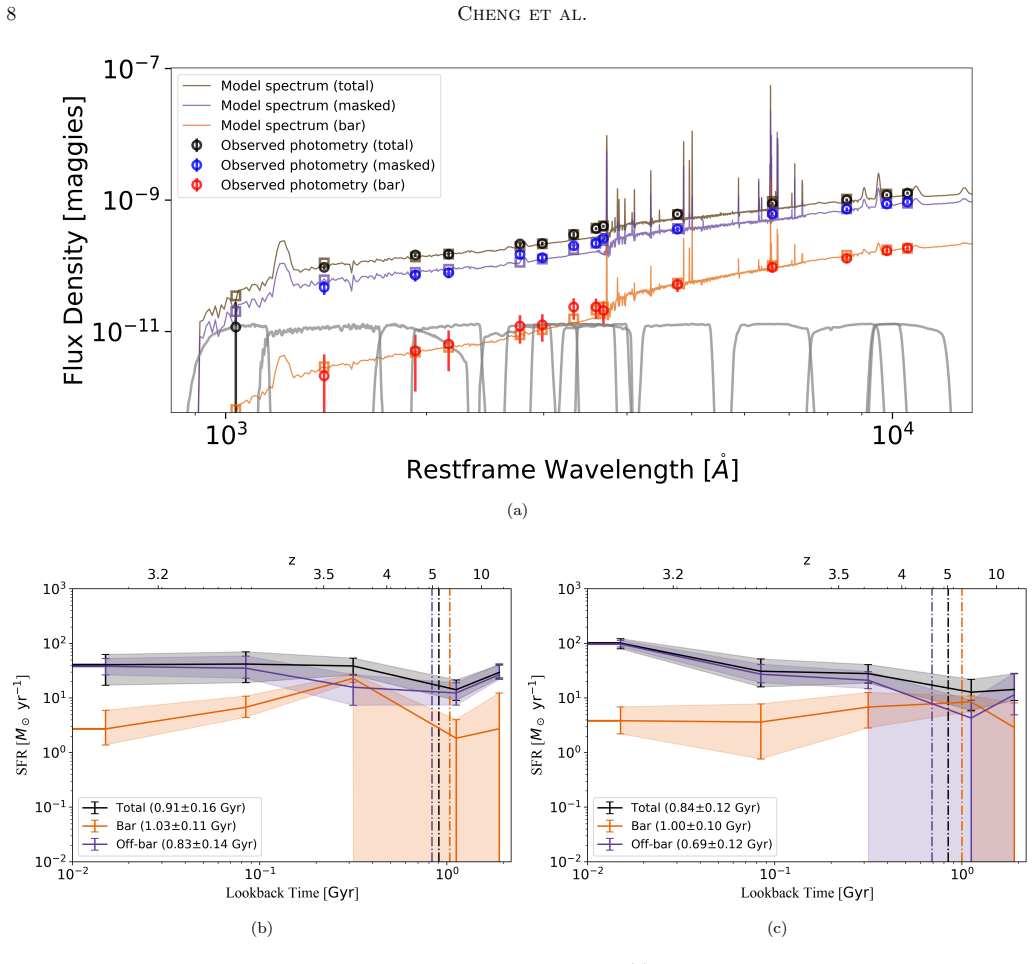
The bar region contains around 30% of the total stellar mass, but only accounts for around 8% of the recent star formation rate. The region containing the potential bar shows a significantly older mass-weighted stellar age, supporting the inside-out scenario for galaxy formation, and providing tentative evidence for bar quenching in the early stage.
What carries the argument
Spatially resolved spectral energy distribution modeling with Prospector applied to JWST/NIRCam photometry after image decomposition and masking to isolate bar and disk components.
If this is right
- The total stellar mass is log(M*/M⊙) = 10.63 ± 0.13.
- The quick onset of a stellar bar at this redshift requires a low dark matter fraction.
- High-z massive galaxies are baryon-dominated.
- Bar quenching may occur in the early stage of galaxy evolution.
Where Pith is reading between the lines
- If the bar identification holds, it implies bars can form and influence star formation within 2 billion years after the Big Bang.
- This could connect to models where disk instabilities drive early bar formation in gas-rich environments.
- Future observations might test if similar age gradients appear in other high-redshift barred candidates.
Load-bearing premise
The image decomposition and masking accurately isolate the flux from the bar without significant contamination or misidentification of the structure.
What would settle it
If deeper imaging or kinematic data show the bar region has similar or younger ages than the disk, or if the mass fraction in the bar is much lower than 30%.
Figures
read the original abstract
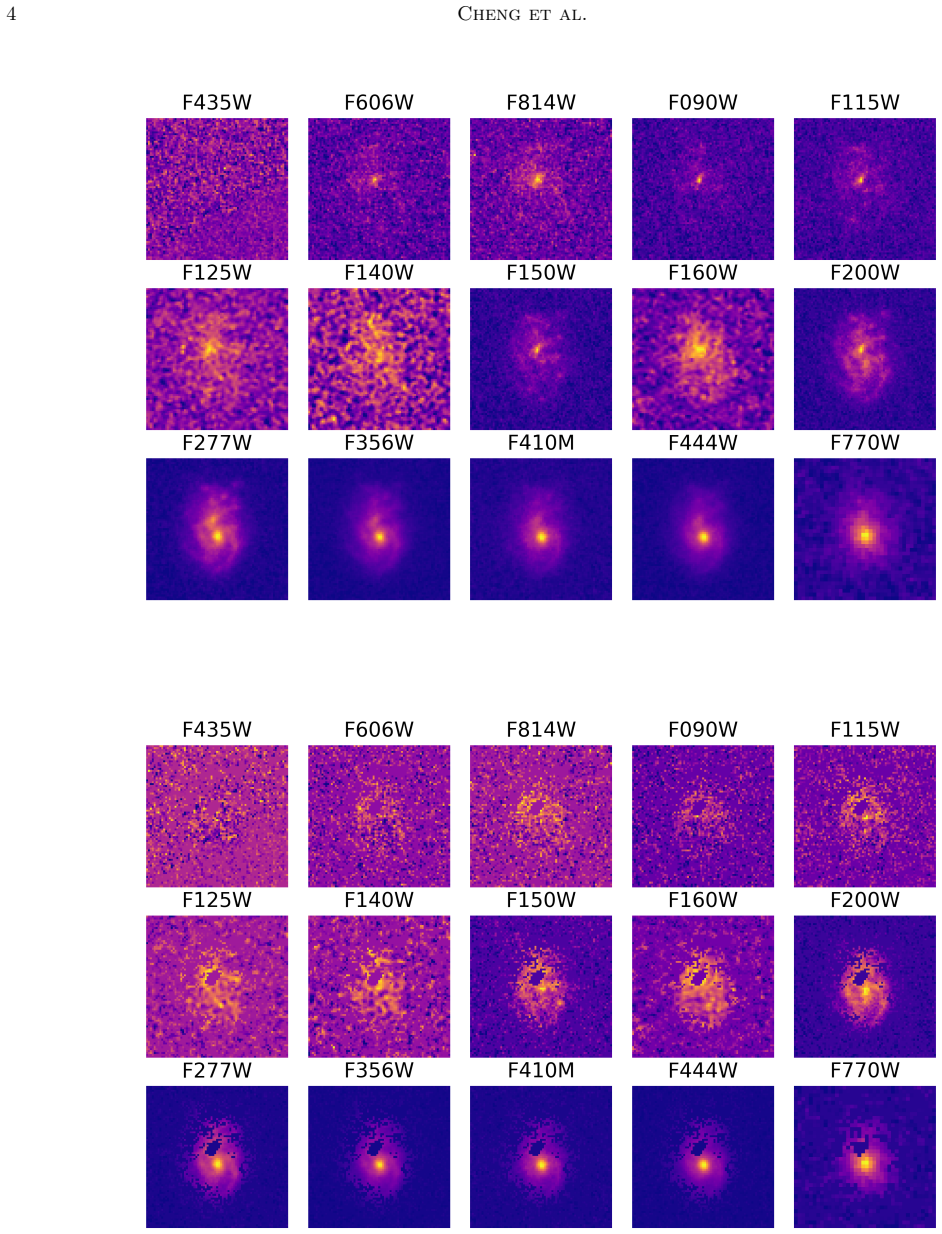
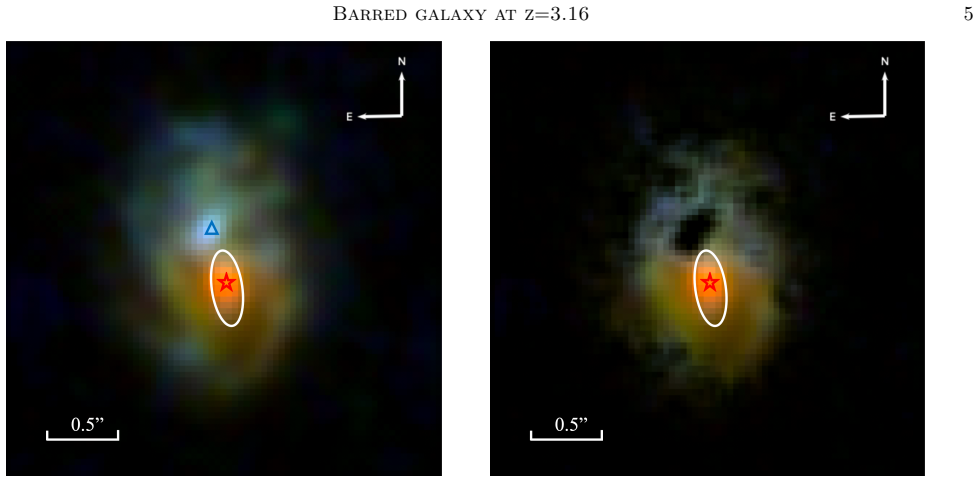
We present a detailed analysis of a massive barred galaxy at $z_{spec}=3.1591$ using deep multi-band imaging from HST and JWST. For the first time, we resolve its morphology and stellar structures thanks to the JWST/NIRCam NIR and MIR photometry. The galaxy possesses two distinct components with significantly different colors. Through careful image decomposition and masking, we isolate and characterize the flux contribution from each component. The galaxy exhibits a clear spiral morphology, and in a separate companion paper, we present evidence suggesting the presence of a stellar bar. Based on spatially resolved spectral energy distribution modeling with Prospector, we derive the star formation history and other physical properties of the bar and the surrounding regions. The total stellar mass of the galaxy is constrained as $\log(M_*/M_{\odot}) = 10.63\pm0.13$. We find that the bar region contains around 30% of the total stellar mass, but only accounts for around 8% of the recent star formation rate. The region containing the potential bar shows a significantly older mass-weighted stellar age, supporting the inside-out scenario for galaxy formation, and providing tentative evidence for bar quenching in the early stage. The quick onset of a stellar bar at this redshift requires a low dark matter fraction, suggesting the baryon-dominated nature of high-$z$ massive galaxies, and offering rare insight into galaxy evolution at around two billion years after the Big Bang.
Editorial analysis
A structured set of objections, weighed in public.
Referee Report
Summary. The paper analyzes a massive galaxy at z_spec=3.1591 with JWST/NIRCam and HST imaging, claiming a barred-spiral morphology. Image decomposition and masking isolate a bar region that contains ~30% of the total stellar mass (log M*/M⊙=10.63±0.13) but only ~8% of the recent SFR; the bar region also shows a significantly older mass-weighted stellar age. Spatially resolved Prospector SED fits are used to derive these quantities and interpret them as support for inside-out formation plus tentative early bar quenching, with the rapid bar onset implying a low dark-matter fraction and baryon-dominated high-z galaxies.
Significance. If the bar identification and region isolation hold, the result supplies one of the earliest direct constraints on bar-driven effects on star formation, with implications for inside-out growth and the baryonic structure of z~3 massive galaxies.
major comments (2)
- [Image decomposition and masking (companion paper referenced for bar identification)] The headline mass fraction (~30%), recent-SFR fraction (~8%), and mass-weighted age contrast are obtained exclusively from Prospector fits to flux extracted from the masked 'bar region' versus the remainder. Because these quantities are the sole basis for the inside-out and bar-quenching claims, the manuscript must quantify how the fractions and age difference change under plausible variations in mask geometry (bar length, position angle, or width) or under alternative decompositions that allow for spiral-arm contamination inside the mask.
- [Spatially resolved SED modeling with Prospector] The abstract states that the bar region was isolated 'through careful image decomposition and masking,' yet no quantitative assessment of residual disk light, arm contamination, or uniqueness of the adopted mask is provided. Without such tests the reported 30%/8% split and the age contrast cannot be shown to be robust rather than artifacts of the particular mask choice.
minor comments (1)
- The abstract and main text should explicitly state the wavelength range and number of bands used in the Prospector fits, as well as the adopted SFH parameterization and any priors that could influence the recent-SFR and mass-weighted-age results.
Simulated Author's Rebuttal
We thank the referee for their constructive and detailed report. The two major comments both concern the robustness of the bar-region masking and the resulting mass/SFR/age fractions. We address each point below and agree that additional quantitative tests are warranted.
read point-by-point responses
-
Referee: [Image decomposition and masking (companion paper referenced for bar identification)] The headline mass fraction (~30%), recent-SFR fraction (~8%), and mass-weighted age contrast are obtained exclusively from Prospector fits to flux extracted from the masked 'bar region' versus the remainder. Because these quantities are the sole basis for the inside-out and bar-quenching claims, the manuscript must quantify how the fractions and age difference change under plausible variations in mask geometry (bar length, position angle, or width) or under alternative decompositions that allow for spiral-arm contamination inside the mask.
Authors: We agree that the robustness of the reported fractions to mask choice must be demonstrated explicitly in this paper. The bar identification and fiducial decomposition are presented in the companion Paper I; the present work (Paper II) adopts that mask for the Prospector analysis. In the revised manuscript we will add a dedicated subsection (or appendix) that systematically varies the mask parameters (bar length, position angle, and width) within the uncertainties reported in Paper I, recomputes the stellar-mass, recent-SFR, and mass-weighted-age fractions for each realization, and quantifies the resulting scatter. We will also test an alternative mask that deliberately includes a larger fraction of the inner spiral arms to assess possible contamination. These tests will be shown to leave the qualitative conclusions (bar region contains ~30 % of the mass but only ~8 % of recent SFR and is older) unchanged within the reported uncertainties. revision: yes
-
Referee: [Spatially resolved SED modeling with Prospector] The abstract states that the bar region was isolated 'through careful image decomposition and masking,' yet no quantitative assessment of residual disk light, arm contamination, or uniqueness of the adopted mask is provided. Without such tests the reported 30%/8% split and the age contrast cannot be shown to be robust rather than artifacts of the particular mask choice.
Authors: We acknowledge that the current manuscript does not supply the requested quantitative assessment of residual disk light or arm contamination. In the revision we will add a quantitative comparison between the flux inside the adopted bar mask and the disk+arm components returned by the decomposition in Paper I. We will also report the fractional contribution of any residual disk light that remains after masking and will present results from an ensemble of masks (generated by perturbing the decomposition parameters) to demonstrate uniqueness. These additions will be placed in the methods or results section so that the 30 %/8 % split and age contrast can be evaluated in the context of the mask uncertainties. revision: yes
Circularity Check
No significant circularity detected
full rationale
The paper derives stellar mass fractions (~30%), recent SFR fractions (~8%), and mass-weighted ages via Prospector SED fits applied to fluxes isolated by image decomposition and masking, with bar identification referenced to a companion paper. These steps constitute direct observational measurements from data rather than any reduction by construction (no fitted parameter renamed as prediction, no self-definitional loop in equations, no ansatz smuggled via self-citation, and no renaming of known results). The companion paper citation is a standard multi-paper series reference and does not serve as the sole justification for a uniqueness theorem or load-bearing premise within this manuscript's own derivation chain; the central claims remain independently falsifiable against the photometry and modeling assumptions.
Axiom & Free-Parameter Ledger
Reference graph
Works this paper leans on
-
[1]
, year = 2013, month = oct, volume = 558, pages =
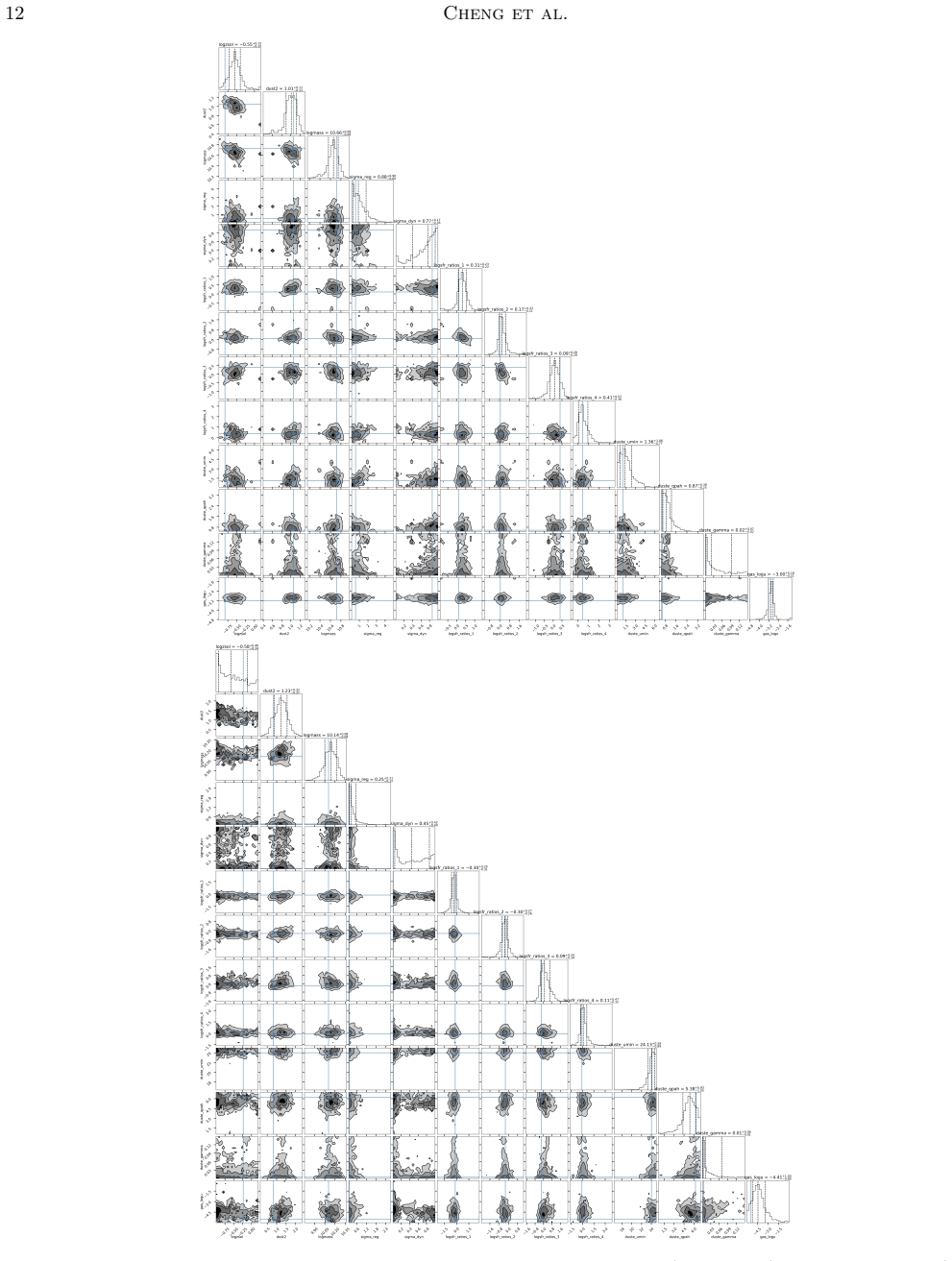
Astropy Collaboration, Robitaille, T. P., Tollerud, E. J., et al. 2013, A&A, 558, A33, doi: 10.1051/0004-6361/201322068 Astropy Collaboration, Price-Whelan, A. M., Sip˝ ocz, B. M., et al. 2018, AJ, 156, 123, doi: 10.3847/1538-3881/aabc4f 12Cheng et al. Figure 4.The corner plots fromProspectorSED modeling for the entire galaxy (upper panel) and the bar reg...
-
[2]
2022, ApJ, 934, 52, doi: 10.3847/1538-4357/ac779b
Bi, D., Shlosman, I., & Romano-D´ ıaz, E. 2022, ApJ, 934, 52, doi: 10.3847/1538-4357/ac779b
-
[3]
2024, ApJ, 968, 86, doi: 10.3847/1538-4357/ad4118
Federrath, C. 2024, ApJ, 968, 86, doi: 10.3847/1538-4357/ad4118
-
[4]
2023, The Astrophysical Journal, 947, 80, doi: 10.3847/1538-4357/acc469
Freeman, K. 2023, ApJ, 947, 80, doi: 10.3847/1538-4357/acc469
-
[5]
Byler, N., Dalcanton, J. J., Conroy, C., & Johnson, B. D. 2017, ApJ, 840, 44, doi: 10.3847/1538-4357/aa6c66
-
[6]
Calzetti, D., Armus, L., Bohlin, R. C., et al. 2000, ApJ, 533, 682, doi: 10.1086/308692 Cervantes Sodi, B. 2017, ApJ, 835, 80, doi: 10.3847/1538-4357/835/1/80
work page internal anchor Pith review doi:10.1086/308692 2000
-
[7]
Galactic Stellar and Substellar Initial Mass Function
Chabrier, G. 2003, PASP, 115, 763, doi: 10.1086/376392
work page internal anchor Pith review doi:10.1086/376392 2003
-
[8]
Conroy, C., Gunn, J. E., & White, M. 2009, ApJ, 699, 486, doi: 10.1088/0004-637X/699/1/486
work page internal anchor Pith review doi:10.1088/0004-637x/699/1/486 2009
-
[9]
Cooke, K. C., Kartaltepe, J. S., Rose, C., et al. 2023, ApJ, 942, 49, doi: 10.3847/1538-4357/aca40f
-
[10]
Costantin, L., P´ erez-Gonz´ alez, P. G., Guo, Y., et al. 2023, Nature, 623, 499, doi: 10.1038/s41586-023-06636-x
-
[11]
Costantin, L., Gillman, S., Boogaard, L. A., et al. 2025, A&A, 699, A360, doi: 10.1051/0004-6361/202451330
-
[12]
Debattista, V. P., Mayer, L., Carollo, C. M., et al. 2006, ApJ, 645, 209, doi: 10.1086/504147
-
[13]
S., Abraham, R
Dunlop, J. S., Abraham, R. G., Ashby, M. L. N., et al. 2021, PRIMER: Public Release IMaging for Extragalactic
2021
-
[14]
Elmegreen, B. G., Elmegreen, D. M., & Hirst, A. C. 2004, ApJ, 612, 191, doi: 10.1086/422407
-
[15]
Ferreira, L., Conselice, C. J., Sazonova, E., et al. 2023, ApJ, 955, 94, doi: 10.3847/1538-4357/acec76
-
[16]
Finlator, K., Prescott, M. K. M., Oppenheimer, B. D., et al. 2017, MNRAS, 464, 1633, doi: 10.1093/mnras/stw2433
-
[17]
Fragkoudi, F., Grand, R. J. J., Pakmor, R., et al. 2025, MNRAS, 538, 1587, doi: 10.1093/mnras/staf389
-
[18]
S., B´ edorf, J., Baba, J., & Portegies Zwart, S
Fujii, M. S., B´ edorf, J., Baba, J., & Portegies Zwart, S. 2018, MNRAS, 477, 1451, doi: 10.1093/mnras/sty711
-
[19]
Gadotti, D. A. 2011, MNRAS, 415, 3308, doi: 10.1111/j.1365-2966.2011.18945.x Garcia-G´ omez, C., Athanassoula, E., Barber` a, C., &
-
[20]
2017, A&A, 601, A132, doi: 10.1051/0004-6361/201628830
Bosma, A. 2017, A&A, 601, A132, doi: 10.1051/0004-6361/201628830
-
[21]
Genzel, R., F¨ orster Schreiber, N. M.,¨Ubler, H., et al. 2017, Nature, 543, 397, doi: 10.1038/nature21685
-
[22]
Genzel, R., Price, S. H., ¨Ubler, H., et al. 2020, ApJ, 902, 98, doi: 10.3847/1538-4357/abb0ea
-
[23]
2019, A&A, 621, L4, doi: 10.1051/0004-6361/201834500
George, K., Joseph, P., Mondal, C., et al. 2019, A&A, 621, L4, doi: 10.1051/0004-6361/201834500
-
[24]
2021, A&A, 651, A107, doi: 10.1051/0004-6361/202140697 G´ eron, T., Smethurst, R
George, K., & Subramanian, S. 2021, A&A, 651, A107, doi: 10.1051/0004-6361/202140697 G´ eron, T., Smethurst, R. J., Lintott, C., et al. 2024, ApJ, 973, 129, doi: 10.3847/1538-4357/ad66b7 G´ eron, T., Smethurst, R. J., Dickinson, H., et al. 2025, ApJ, 987, 74, doi: 10.3847/1538-4357/add7d0
-
[25]
Guo, Y., Jogee, S., Finkelstein, S. L., et al. 2023, ApJL, 945, L10, doi: 10.3847/2041-8213/acacfb
-
[26]
2025, ApJ, 985, 181, doi: 10.3847/1538-4357/adc8a7 G´ eron, T., Smethurst, R
Guo, Y., Jogee, S., Wise, E., et al. 2025, ApJ, 985, 181, doi: 10.3847/1538-4357/adc8a7
-
[27]
Haywood, M., Lehnert, M. D., Di Matteo, P., et al. 2016, A&A, 589, A66, doi: 10.1051/0004-6361/201527567
-
[28]
Huertas-Company, M., Iyer, K. G., Angeloudi, E., et al. 2024, A&A, 685, A48, doi: 10.1051/0004-6361/202346800
-
[29]
2023, ApJL, 948, L13, doi: 10.3847/2041-8213/accd6d
Jacobs, C., Glazebrook, K., Calabr` o, A., et al. 2023, ApJL, 948, L13, doi: 10.3847/2041-8213/accd6d
-
[30]
Jogee, S., Scoville, N., & Kenney, J. D. P. 2005, ApJ, 630, 837, doi: 10.1086/432106
-
[31]
2023, dfm/python-fsps: v0.4.6, v0.4.6, Zenodo, doi: 10.5281/zenodo.10026684
Johnson, B., Foreman-Mackey, D., Sick, J., et al. 2023, dfm/python-fsps: v0.4.6, v0.4.6, Zenodo, doi: 10.5281/zenodo.10026684
-
[32]
D., Leja, J., Conroy, C., & Speagle, J
Johnson, B. D., Leja, J., Conroy, C., & Speagle, J. S. 2021, ApJS, 254, 22, doi: 10.3847/1538-4365/abef67
work page internal anchor Pith review doi:10.3847/1538-4365/abef67 2021
-
[33]
Kartaltepe, J. S., Rose, C., Vanderhoof, B. N., et al. 2023, ApJL, 946, L15, doi: 10.3847/2041-8213/acad01
-
[34]
Khoperskov, S., Haywood, M., Di Matteo, P., Lehnert, M. D., & Combes, F. 2018, A&A, 609, A60, doi: 10.1051/0004-6361/201731211
-
[35]
Kormendy, J., & Kennicutt, Jr., R. C. 2004, ARA&A, 42, 603, doi: 10.1146/annurev.astro.42.053102.134024
-
[36]
Kriek, M., Shapley, A. E., Reddy, N. A., et al. 2015, ApJS, 218, 15, doi: 10.1088/0067-0049/218/2/15
-
[37]
Lang, P., F¨ orster Schreiber, N. M., Genzel, R., et al. 2017, ApJ, 840, 92, doi: 10.3847/1538-4357/aa6d82
-
[38]
Lawrence, A., Warren, S. J., Almaini, O., et al. 2007, MNRAS, 379, 1599, doi: 10.1111/j.1365-2966.2007.12040.x Le Conte, Z. A., Gadotti, D. A., Ferreira, L., et al. 2024, MNRAS, 530, 1984, doi: 10.1093/mnras/stae921 —. 2025, MNRAS, doi: 10.1093/mnras/staf2010
-
[39]
Speagle, J. S. 2019, ApJ, 876, 3, doi: 10.3847/1538-4357/ab133c
work page internal anchor Pith review doi:10.3847/1538-4357/ab133c 2019
-
[40]
K., Schinnerer, E., Liu, D., et al
Leslie, S. K., Schinnerer, E., Liu, D., et al. 2020, ApJ, 899, 58, doi: 10.3847/1538-4357/aba044
-
[41]
2007, ApJ, 659, 1176, doi: 10.1086/512355
Marinova, I., & Jogee, S. 2007, ApJ, 659, 1176, doi: 10.1086/512355 Men´ endez-Delmestre, K., Cavalcante-Coelho, Y., Cortesi, A., et al. 2023, in Galactic Bars: Driving and Decoding Galaxy Evolution, 38, doi: 10.5281/zenodo.8135058 14Cheng et al. Men´ endez-Delmestre, K., Sheth, K., Schinnerer, E., Jarrett, T. H., & Scoville, N. Z. 2007, ApJ, 657, 790, do...
-
[42]
Newnham, L., Hess, K. M., Masters, K. L., et al. 2020, MNRAS, 492, 4697, doi: 10.1093/mnras/staa064
-
[43]
P., Dupke, R., Coelho, P., et al
Nogueira-Cavalcante, J. P., Dupke, R., Coelho, P., et al. 2019, A&A, 630, A88, doi: 10.1051/0004-6361/201935138
-
[44]
Oke, J. B., & Gunn, J. E. 1983, ApJ, 266, 713, doi: 10.1086/160817
-
[45]
Pastras, S., Genzel, R., Tacconi, L. J., et al. 2025, arXiv e-prints, arXiv:2505.07925, doi: 10.48550/arXiv.2505.07925
-
[46]
Peng, C. Y., Ho, L. C., Impey, C. D., & Rix, H.-W. 2010, AJ, 139, 2097, doi: 10.1088/0004-6256/139/6/2097
work page internal anchor Pith review doi:10.1088/0004-6256/139/6/2097 2010
-
[47]
1996, MNRAS, 281, 27, doi: 10.1093/mnras/278.1.27
Persic, M., Salucci, P., & Stel, F. 1996, MNRAS, 281, 27, doi: 10.1093/mnras/278.1.27
-
[48]
Price, S. H., Shimizu, T. T., Genzel, R., et al. 2021, ApJ, 922, 143, doi: 10.3847/1538-4357/ac22ad
-
[49]
Reed, D., Gardner, J., Quinn, T., et al. 2003, MNRAS, 346, 565, doi: 10.1046/j.1365-2966.2003.07113.x
-
[50]
Robertson, B. E., Tacchella, S., Johnson, B. D., et al. 2023, ApJL, 942, L42, doi: 10.3847/2041-8213/aca086
-
[51]
Rosas-Guevara, Y., Bonoli, S., Dotti, M., et al. 2022, MNRAS, 512, 5339, doi: 10.1093/mnras/stac816
-
[52]
2007, ApJS, 172, 1, doi: 10.1086/516585
Scoville, N., Aussel, H., Brusa, M., et al. 2007, ApJS, 172, 1, doi: 10.1086/516585
-
[53]
Sellwood, J. A. 2014, Reviews of Modern Physics, 86, 1, doi: 10.1103/RevModPhys.86.1
-
[54]
2023, arXiv e-prints, arXiv:2309.04541, doi: 10.48550/arXiv.2309.04541
Sharma, G., van de Ven, G., Salucci, P., & Martorano, M. 2023, arXiv e-prints, arXiv:2309.04541, doi: 10.48550/arXiv.2309.04541
-
[55]
Sheth, K., Elmegreen, D. M., Elmegreen, B. G., et al. 2008, ApJ, 675, 1141, doi: 10.1086/524980
-
[56]
Speagle, J. S. 2020, MNRAS, 493, 3132, doi: 10.1093/mnras/staa278
-
[57]
2017, MNRAS, 465, 3729, doi: 10.1093/mnras/stw2934
Spinoso, D., Bonoli, S., Dotti, M., et al. 2017, MNRAS, 465, 3729, doi: 10.1093/mnras/stw2934
-
[58]
Toomre, A. 1977, ARA&A, 15, 437, doi: 10.1146/annurev.aa.15.090177.002253 van der Wel, A., Rix, H.-W., Wuyts, S., et al. 2011, ApJ, 730, 38, doi: 10.1088/0004-637X/730/1/38 van der Wel, A., Chang, Y.-Y., Bell, E. F., et al. 2014, ApJL, 792, L6, doi: 10.1088/2041-8205/792/1/L6
-
[59]
Wan, J. T., Tacchella, S., Johnson, B. D., et al. 2024, MNRAS, 532, 4002, doi: 10.1093/mnras/stae1734
-
[60]
2023, astrowhit/aperpy: v1.0.1, v1.0.1, Zenodo, doi: 10.5281/zenodo.8339191
Weaver, J., & Cutler, S. 2023, astrowhit/aperpy: v1.0.1, v1.0.1, Zenodo, doi: 10.5281/zenodo.8339191
-
[61]
Weaver, J. R., Cutler, S. E., Pan, R., et al. 2024, ApJS, 270, 7, doi: 10.3847/1538-4365/ad07e0
-
[62]
Weinberg, M. D. 2025, The Open Journal of Astrophysics, 8, 70, doi: 10.33232/001c.138494
-
[63]
2009, ApJ, 696, 411, doi: 10.1088/0004-637X/696/1/411
Kormendy, J. 2009, ApJ, 696, 411, doi: 10.1088/0004-637X/696/1/411
-
[64]
2012, ApJL, 750, L41, doi: 10.1088/2041-8205/750/2/L41
Chen, H.-Y. 2012, ApJL, 750, L41, doi: 10.1088/2041-8205/750/2/L41
discussion (0)
Sign in with ORCID, Apple, or X to comment. Anyone can read and Pith papers without signing in.