How Many RF Chains Does a Microwave Linear Analog Computer (MiLAC) Need to Match the Fully-Digital Cram\'er-Rao Bound?
Pith reviewed 2026-06-26 06:16 UTC · model grok-4.3
The pith
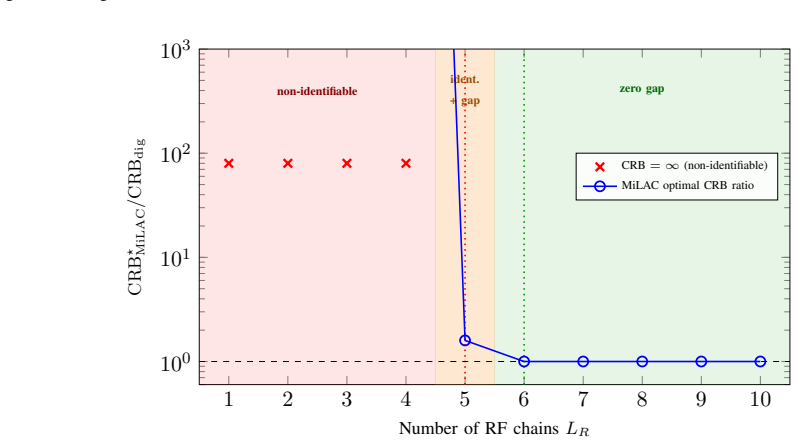
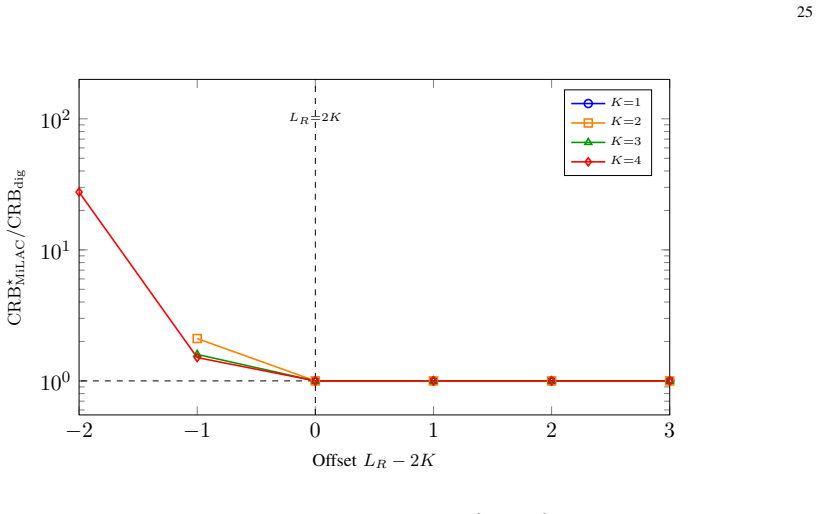
A lossless reciprocal MiLAC matches the fully digital Cramér-Rao bound for direction-of-arrival estimation once its row space contains the 2K-dimensional steering-derivative subspace for K targets.
A machine-rendered reading of the paper's core claim, the machinery that carries it, and where it could break.
Core claim
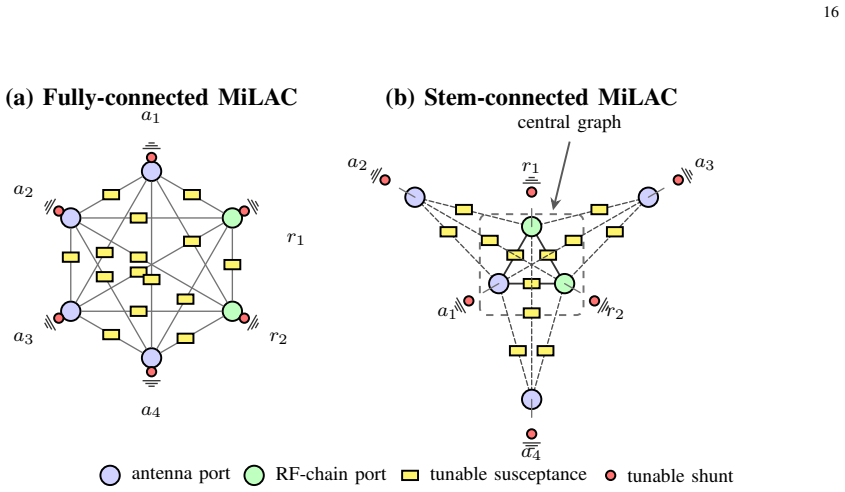
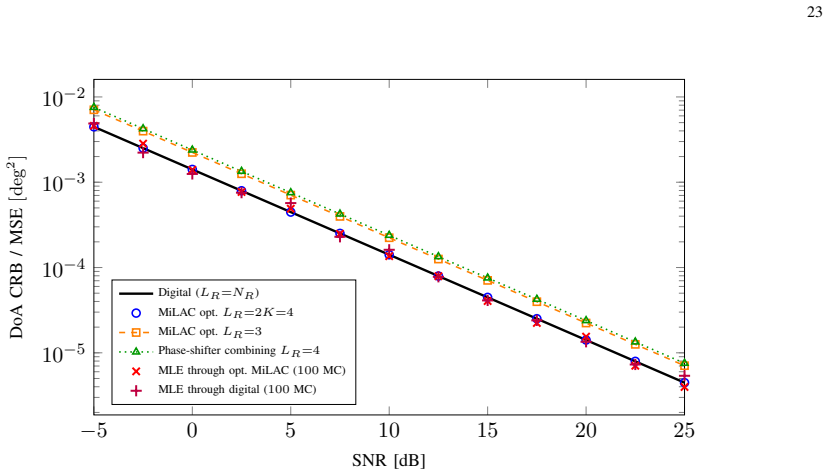
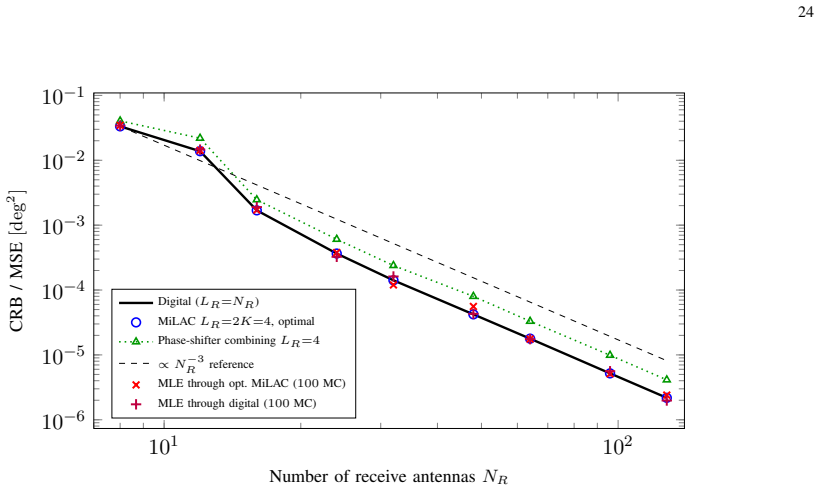
For a tunable receive-side lossless reciprocal MiLAC combiner, the Fisher information matrix depends on the combiner only through the orthogonal projector onto its row space. This matrix never exceeds that of a fully digital receiver. Equality holds if and only if the row space contains the 2K-dimensional joint steering-derivative subspace. The stem-connected MiLAC attains the digital Cramér-Rao bound asymptotically, up to an antenna-count-independent additive overhead, while scaling linearly with the antenna and target counts. Unlike a phase-shifter front end with the same number of RF chains, the MiLAC can exactly attain the fully digital bound.
What carries the argument
The orthogonal projector onto the row space of the MiLAC combiner, which alone determines the Fisher information matrix.
If this is right
- Two RF chains per target are necessary and sufficient for zero performance gap with the fully digital receiver.
- A lower bound on the number of tunable components follows from a dimension-counting argument on the required row space.
- The stem-connected MiLAC topology achieves the bound with linear scaling in the number of antennas and targets, plus a fixed overhead.
- Phase-shifter networks with the same number of RF chains cannot attain the digital bound, while MiLAC can.
- The result applies to every target configuration once the row-space condition is met.
Where Pith is reading between the lines
- The same projector argument could be applied to other array processing tasks such as beamforming or parameter estimation beyond angles.
- Hardware verification would need to confirm that real microwave networks satisfy the lossless reciprocal model closely enough for the bound to be reached.
- The linear scaling suggests MiLAC architectures could remain practical even as antenna counts grow into the hundreds.
- The 2K-dimensional subspace requirement may generalize to other manifold-based estimation problems where both position and slope information matter.
Load-bearing premise
The MiLAC is perfectly lossless and reciprocal, so its effect reduces exactly to an orthogonal projector onto its row space under the standard far-field point-target array model.
What would settle it
Compute the empirical Fisher information for a concrete MiLAC whose row space misses one derivative vector of a target; the resulting matrix must be strictly smaller than the fully digital matrix if the claim holds.
Figures
read the original abstract
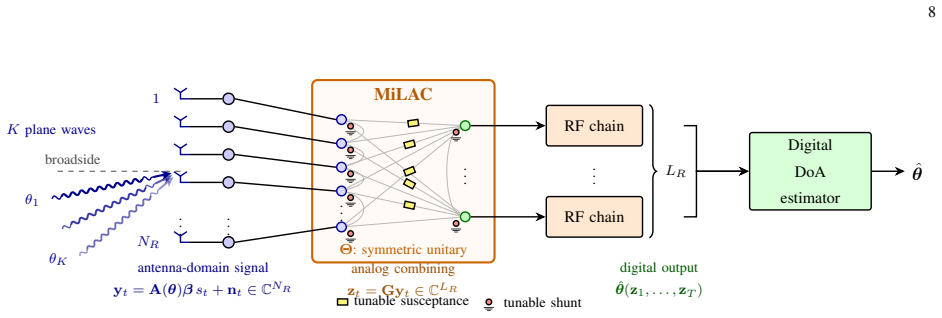
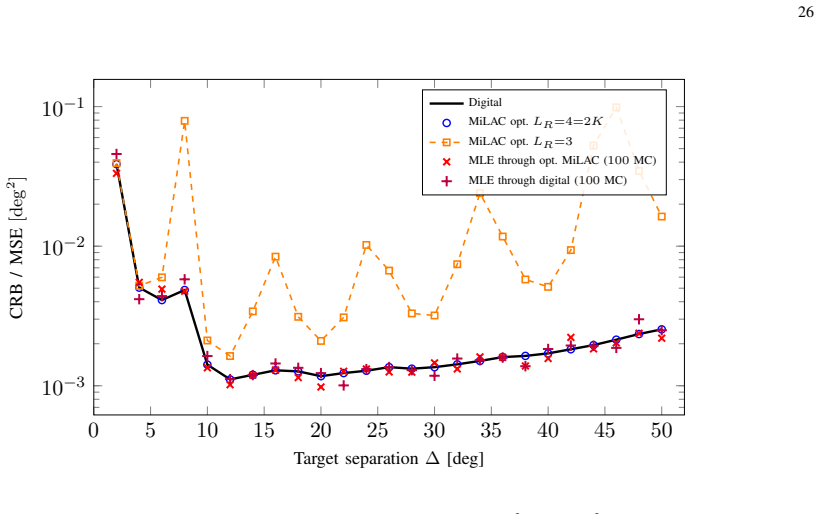
A microwave linear analog computer (MiLAC) is a tunable microwave network that performs linear operations directly on radio-frequency signals through wave propagation. Used as an antenna-array front end, it can map many antenna signals to a small number of active RF chains. While lossless reciprocal MiLACs have been shown to provide flexible or capacity-achieving beamforming for wireless communications, their sensing performance remains largely unexplored. We analyze direction-of-arrival estimation for $K$ far-field targets using a tunable receive-side lossless reciprocal MiLAC combiner. We show that the Fisher information matrix depends on the combiner only through the orthogonal projector onto its row space and never exceeds that of a fully digital receiver. Equality holds when the row space contains the $2K$-dimensional joint steering--derivative subspace, establishing a zero-gap threshold of two RF chains per target. A dimension-counting argument lower-bounds the number of tunable components required to achieve the digital Cram\'er--Rao bound for every target configuration. The stem-connected MiLAC attains this bound asymptotically, up to an antenna-count-independent additive overhead, while scaling linearly with the antenna and target counts. Unlike a phase-shifter front end with the same number of RF chains, MiLAC can exactly attain the fully digital bound. Numerical results validate the analysis.
Editorial analysis
A structured set of objections, weighed in public.
Referee Report
Summary. The manuscript analyzes direction-of-arrival estimation for K far-field targets using a tunable lossless reciprocal MiLAC combiner as an antenna-array front end. It shows that the Fisher information matrix depends on the combiner only through the orthogonal projector onto its row space and is upper-bounded by the fully digital receiver's FIM, with equality when the row space contains the 2K-dimensional joint steering-derivative subspace. This yields a zero-gap threshold of two RF chains per target, a dimension-counting lower bound on tunable components, and an asymptotic attainment result for the stem-connected MiLAC architecture (linear scaling in antennas and targets) that exactly matches the digital CRB, unlike phase-shifter networks.
Significance. If the central claims hold, the paper supplies a precise geometric characterization of when analog combiners can achieve fully digital sensing performance in multi-target DOA estimation, together with an explicit architecture that meets the derived bound. Strengths include the direct application of standard linear-algebra facts on the FIM under the semi-unitary projector induced by losslessness, the dimension-counting argument, and the explicit contrast with phase-shifter front ends. The result is falsifiable via the stated subspace condition and supplies a concrete scaling law for hardware design.
minor comments (2)
- [dimension-counting argument] The dimension-counting lower bound would benefit from an explicit statement of the manifold dimension and the precise count of free parameters in the stem-connected topology (e.g., in the section deriving the asymptotic attainment).
- [model and FIM derivation] Notation for the joint steering-derivative subspace should be introduced once with a clear definition before its repeated use in the equality condition.
Simulated Author's Rebuttal
We thank the referee for the positive review, accurate summary of our contributions, and recommendation to accept. No major comments were raised that require point-by-point response.
Circularity Check
No significant circularity; derivation is self-contained linear algebra
full rationale
The central result follows directly from the standard expression for the Fisher information matrix of a linear Gaussian observation model y = W H( heta) s + n, where the lossless reciprocal combiner W satisfies W^H W = I and thus acts exactly as the orthogonal projector P onto its row space. Substituting yields that the FIM is a non-increasing function of P and saturates at the fully-digital value precisely when the row space of W contains the 2K-dimensional joint steering-derivative subspace; both the saturation condition and the dimension-counting lower bound on tunable elements are immediate consequences of linear algebra and the rank of that manifold. No parameter is fitted to data and then re-used as a prediction, no uniqueness theorem is imported from the authors' prior work, and the MiLAC projector property is taken as an external modeling assumption rather than derived from the present FIM claim. The argument is therefore independent of its own outputs.
Axiom & Free-Parameter Ledger
axioms (2)
- standard math Standard array signal model for far-field targets with the Fisher information matrix formula involving steering vectors and their derivatives.
- domain assumption The MiLAC is lossless and reciprocal so that its effect is captured by the orthogonal projector onto the row space.
Reference graph
Works this paper leans on
-
[1]
Integrated sensing and communications: Toward dual-functional wireless networks for 6G and beyond,
F. Liu, Y . Cui, C. Masouros, J. Xu, T. X. Han, Y . C. Eldar, and S. Buzzi, “Integrated sensing and communications: Toward dual-functional wireless networks for 6G and beyond,”IEEE Journal on Selected Areas in Communications, vol. 40, no. 6, pp. 1728–1767, 2022
2022
-
[2]
On the fundamental tradeoff of integrated sensing and communications under Gaussian channels,
Y . Xiong, F. Liu, Y . Cui, W. Yuan, T. X. Han, and G. Caire, “On the fundamental tradeoff of integrated sensing and communications under Gaussian channels,”IEEE Transactions on Information Theory, vol. 69, no. 9, pp. 5723–5751, 2023
2023
-
[3]
Cram ´er–Rao bound optimization for joint radar-communication beamforming,
F. Liu, Y .-F. Liu, A. Li, C. Masouros, and Y . C. Eldar, “Cram ´er–Rao bound optimization for joint radar-communication beamforming,”IEEE Transactions on Signal Processing, vol. 70, pp. 240–253, 2022
2022
-
[4]
Beyond-diagonal RIS in multiuser MIMO: Graph theoretic modeling and optimal architectures with low complexity,
Z. Wu and B. Clerckx, “Beyond-diagonal RIS in multiuser MIMO: Graph theoretic modeling and optimal architectures with low complexity,”IEEE Transactions on Information Theory, vol. 71, no. 11, pp. 8506–8523, 2025
2025
-
[5]
Integrated sensing and communication for 6G: Ten key machine learning roles,
U. Demirhan and A. Alkhateeb, “Integrated sensing and communication for 6G: Ten key machine learning roles,”IEEE Communications Magazine, vol. 61, no. 5, pp. 113–119, 2023
2023
-
[6]
Enabling 6G performance in the upper mid-band by transitioning from massive to gigantic MIMO,
E. Bj ¨ornson, F. Kara, N. Kolomvakis, A. Kosasih, P. Ramezani, and M. B. Salman, “Enabling 6G performance in the upper mid-band by transitioning from massive to gigantic MIMO,”IEEE Open Journal of the Communications Society, vol. 6, pp. 5450–5463, 2025
2025
-
[7]
Massive MIMO for next generation wireless systems,
E. G. Larsson, O. Edfors, F. Tufvesson, and T. L. Marzetta, “Massive MIMO for next generation wireless systems,”IEEE Communications Magazine, vol. 52, no. 2, pp. 186–195, 2014
2014
-
[8]
An overview of signal processing techniques for millimeter wave MIMO systems,
R. W. Heath, N. Gonz ´alez-Prelcic, S. Rangan, W. Roh, and A. M. Sayeed, “An overview of signal processing techniques for millimeter wave MIMO systems,”IEEE Journal of Selected Topics in Signal Processing, vol. 10, no. 3, pp. 436–453, 2016
2016
-
[9]
Spatially sparse precoding in millimeter wave MIMO systems,
O. E. Ayach, S. Rajagopal, S. Abu-Surra, Z. Pi, and R. W. Heath, “Spatially sparse precoding in millimeter wave MIMO systems,”IEEE Transactions on Wireless Communications, vol. 13, no. 3, pp. 1499–1513, 2014
2014
-
[10]
Dynamic metasurface antennas for 6g extreme massive MIMO communications,
N. Shlezinger, G. C. Alexandropoulos, M. F. Imani, Y . C. Eldar, and D. R. Smith, “Dynamic metasurface antennas for 6g extreme massive MIMO communications,”IEEE Wireless Communications, vol. 28, no. 2, pp. 106–113, 2021
2021
-
[11]
Sum-rate maximization for DMA-based wideband near-field systems with Lorentzian responses,
R. Zhang, H. Zhang, Y . Zhang, H. Ruan, H. Chen, and Y . C. Eldar, “Sum-rate maximization for DMA-based wideband near-field systems with Lorentzian responses,” inICASSP 2026–2026 IEEE International Conference on Acoustics, Speech and Signal Processing (ICASSP), 2026, pp. 21 461–21 465
2026
-
[12]
Holographic intelligence surface assisted integrated sensing and communication,
Z. Liu, Y . Zhang, H. Zhang, F. Xu, and Y . C. Eldar, “Holographic intelligence surface assisted integrated sensing and communication,”IEEE Transactions on Signal Processing, vol. 74, pp. 1942–1957, 2026
1942
-
[13]
Hybrid codebook design for localization using electromagnetically reconfigurable fluid antenna system,
A. Fadakar, Y . Zhang, H. Chen, M. F. Keskin, H. Wymeersch, and A. F. Molisch, “Hybrid codebook design for localization using electromagnetically reconfigurable fluid antenna system,”IEEE Journal of Selected Topics in Signal Processing, vol. 20, no. 3, pp. 371–388, 2026
2026
-
[14]
A survey on reconfigurable and movable antennas for wireless communications and sensing,
W. Ma, L. Zhu, Y . Tan, B. Zheng, Y . Zhang, Y . Zhang, K. Ying, Z. Gao, H. Sun, X. Shao, Z. Xiao, D. Niyato, and R. Zhang, “A survey on reconfigurable and movable antennas for wireless communications and sensing,”IEEE Communications Surveys & Tutorials, vol. 28, pp. 4842–4882, 2026
2026
-
[15]
Embracing reconfigurable antennas in the tri-hybrid MIMO architecture for 6g and beyond,
M. R. Castellanos, S. Yang, C.-B. Chae, and R. W. Heath, “Embracing reconfigurable antennas in the tri-hybrid MIMO architecture for 6g and beyond,”IEEE Transactions on Communications, vol. 74, pp. 381–401, 2026
2026
-
[16]
P. Zheng, Y . Zhang, T. Y . Al-Naffouri, M. J. Hossain, and A. Chaaban, “Tri-hybrid multi-user precoding using pattern-reconfigurable antennas: Fundamental models and practical algorithms,” arXiv:2505.08938, 2025, preprint. [Online]. Available: https://arxiv.org/abs/2505.08938 35
arXiv 2025
-
[17]
Tri-hybrid beamforming design for ISAC systems with reconfigurable antennas,
J. Chen, X. Lei, Y . Zhang, K. Meng, and C. Masouros, “Tri-hybrid beamforming design for ISAC systems with reconfigurable antennas,” arXiv:2604.20676, 2026, preprint. [Online]. Available: https://arxiv.org/abs/2604.20676
Pith/arXiv arXiv 2026
-
[18]
Analog computing for signal processing and communications – part I: Computing with microwave networks,
M. Nerini and B. Clerckx, “Analog computing for signal processing and communications – part I: Computing with microwave networks,”IEEE Transactions on Signal Processing, vol. 73, pp. 5183–5197, 2025
2025
-
[19]
Analog computing for signal processing and communications – part II: Toward gigantic MIMO beamforming,
——, “Analog computing for signal processing and communications – part II: Toward gigantic MIMO beamforming,” IEEE Transactions on Signal Processing, vol. 73, pp. 5198–5212, 2025
2025
-
[20]
Quantization-aware EE optimization and SE-EE tradeoff for MiLAC-aided MU-MISO beamforming,
Y . Zhang, P. Zheng, and T. Y . Al-Naffouri, “Quantization-aware EE optimization and SE-EE tradeoff for MiLAC-aided MU-MISO beamforming,” arXiv:2604.24538, 2026, preprint. [Online]. Available: https://arxiv.org/abs/2604.24538
Pith/arXiv arXiv 2026
-
[21]
Z. Wu, M. Nerini, and B. Clerckx, “Microwave linear analog computer (MiLAC)-aided multiuser MISO: Fundamental limits and beamforming design,” arXiv:2601.10060, 2026, preprint. [Online]. Available: https://arxiv.org/abs/2601.10060
arXiv 2026
-
[22]
MIMO systems aided by microwave linear analog computers: Capacity-achieving architectures with reduced circuit complexity,
M. Nerini and B. Clerckx, “MIMO systems aided by microwave linear analog computers: Capacity-achieving architectures with reduced circuit complexity,”IEEE Transactions on Wireless Communications, vol. 25, pp. 14 597–14 610, 2026
2026
-
[23]
Capacity of MIMO systems aided by microwave linear analog computers (MiLACs),
——, “Capacity of MIMO systems aided by microwave linear analog computers (MiLACs),” arXiv:2506.05983, 2025, preprint. [Online]. Available: https://arxiv.org/abs/2506.05983
arXiv 2025
-
[24]
Y . Zhang, Z. Wu, B. Clerckx, and T. Y . Al-Naffouri, “Beamforming design for stem-connected microwave linear analog computer (MiLAC)-aided multiuser MISO downlinks,” arXiv:2606.14499, 2026, preprint. [Online]. Available: https://arxiv.org/abs/2606.14499
arXiv 2026
-
[25]
On the performance of lossless reciprocal MiLAC architectures in multi-user networks,
T. Fang, X. Zhou, and Y . Mao, “On the performance of lossless reciprocal MiLAC architectures in multi-user networks,” IEEE Wireless Communications Letters, vol. 15, pp. 2609–2613, 2026
2026
-
[26]
Channel estimation in MIMO systems aided by microwave linear analog computers (MiLACs),
Q. Zhang, M. Nerini, and B. Clerckx, “Channel estimation in MIMO systems aided by microwave linear analog computers (MiLACs),” arXiv:2601.11438, 2026, preprint. [Online]. Available: https://arxiv.org/abs/2601.11438
arXiv 2026
-
[27]
M. Nerini and B. Clerckx, “Physics-compliant modeling and optimization of MIMO systems aided by microwave linear analog computers,” arXiv:2602.19379, 2026, preprint. [Online]. Available: https://arxiv.org/abs/2602.19379
arXiv 2026
-
[28]
Y . Peng, Z. Wu, and B. Clerckx, “Hybrid digital and microwave linear analog computer (MiLAC)-aided beamforming for multiuser MIMO-OFDM systems,” arXiv:2604.26532, 2026, preprint. [Online]. Available: https://arxiv.org/abs/2604.26532
Pith/arXiv arXiv 2026
-
[29]
Two-layer microwave linear analog computer (MiLAC)-aided multi-user MISO networks,
X. Zhou, T. Fang, Y . Mao, and B. Clerckx, “Two-layer microwave linear analog computer (MiLAC)-aided multi-user MISO networks,” arXiv:2604.24303, 2026, preprint. [Online]. Available: https://arxiv.org/abs/2604.24303
Pith/arXiv arXiv 2026
-
[30]
Microwave linear analog computer (MiLAC) for simultaneous active and passive beamforming,
M. Nerini and B. Clerckx, “Microwave linear analog computer (MiLAC) for simultaneous active and passive beamforming,” arXiv:2605.31549, 2026, preprint. [Online]. Available: https://arxiv.org/abs/2605.31549
Pith/arXiv arXiv 2026
-
[31]
B. Zhou and B. Clerckx, “Lossy microwave linear analog computer (MiLAC) for future MIMO: Learning-based architecture designs for spectral and energy efficiency maximization,” arXiv:2606.02369, 2026, preprint. [Online]. Available: https://arxiv.org/abs/2606.02369
Pith/arXiv arXiv 2026
-
[32]
Analog computing with hybrid couplers and phase shifters,
M. Nerini, X. Liu, and B. Clerckx, “Analog computing with hybrid couplers and phase shifters,” arXiv:2603.24604, 2026, preprint. [Online]. Available: https://arxiv.org/abs/2603.24604
arXiv 2026
-
[33]
Z. Liu, Z. Wu, and B. Clerckx, “Microwave linear analog computer (MiLAC)-aided MIMO radar sensing: Transmit beamforming design and DoA estimation,” arXiv:2605.21020, 2026, preprint. [Online]. Available: https://arxiv.org/abs/2605.21020
Pith/arXiv arXiv 2026
-
[34]
MIMO radar with colocated antennas,
J. Li and P. Stoica, “MIMO radar with colocated antennas,”IEEE Signal Processing Magazine, vol. 24, no. 5, pp. 106–114, 2007
2007
-
[35]
Stoica and R
P. Stoica and R. L. Moses,Spectral Analysis of Signals. Upper Saddle River, NJ, USA: Prentice-Hall, 2005. 36
2005
-
[36]
Multiple emitter location and signal parameter estimation,
R. O. Schmidt, “Multiple emitter location and signal parameter estimation,”IEEE Transactions on Antennas and Propagation, vol. 34, no. 3, pp. 276–280, 1986
1986
-
[37]
R. A. Horn and C. R. Johnson,Matrix Analysis, 2nd ed. Cambridge, U.K.: Cambridge University Press, 2012
2012
-
[38]
The geometry of algorithms with orthogonality constraints,
A. Edelman, T. A. Arias, and S. T. Smith, “The geometry of algorithms with orthogonality constraints,”SIAM Journal on Matrix Analysis and Applications, vol. 20, no. 2, pp. 303–353, 1998
1998
-
[39]
The measure of the critical values of differentiable maps,
A. Sard, “The measure of the critical values of differentiable maps,”Bulletin of the American Mathematical Society, vol. 48, no. 12, pp. 883–890, 1942
1942
discussion (0)
Sign in with ORCID, Apple, or X to comment. Anyone can read and Pith papers without signing in.