Lossy Microwave Linear Analog Computer (MiLAC) for Future MIMO: Learning-based Architecture Designs for Spectral and Energy Efficiency Maximization
Pith reviewed 2026-06-28 12:54 UTC · model grok-4.3
The pith
A learning framework jointly designs lossy MiLAC architectures and beamforming to maximize MIMO spectral and energy efficiency by balancing interference against hardware losses.
A machine-rendered reading of the paper's core claim, the machinery that carries it, and where it could break.
Core claim
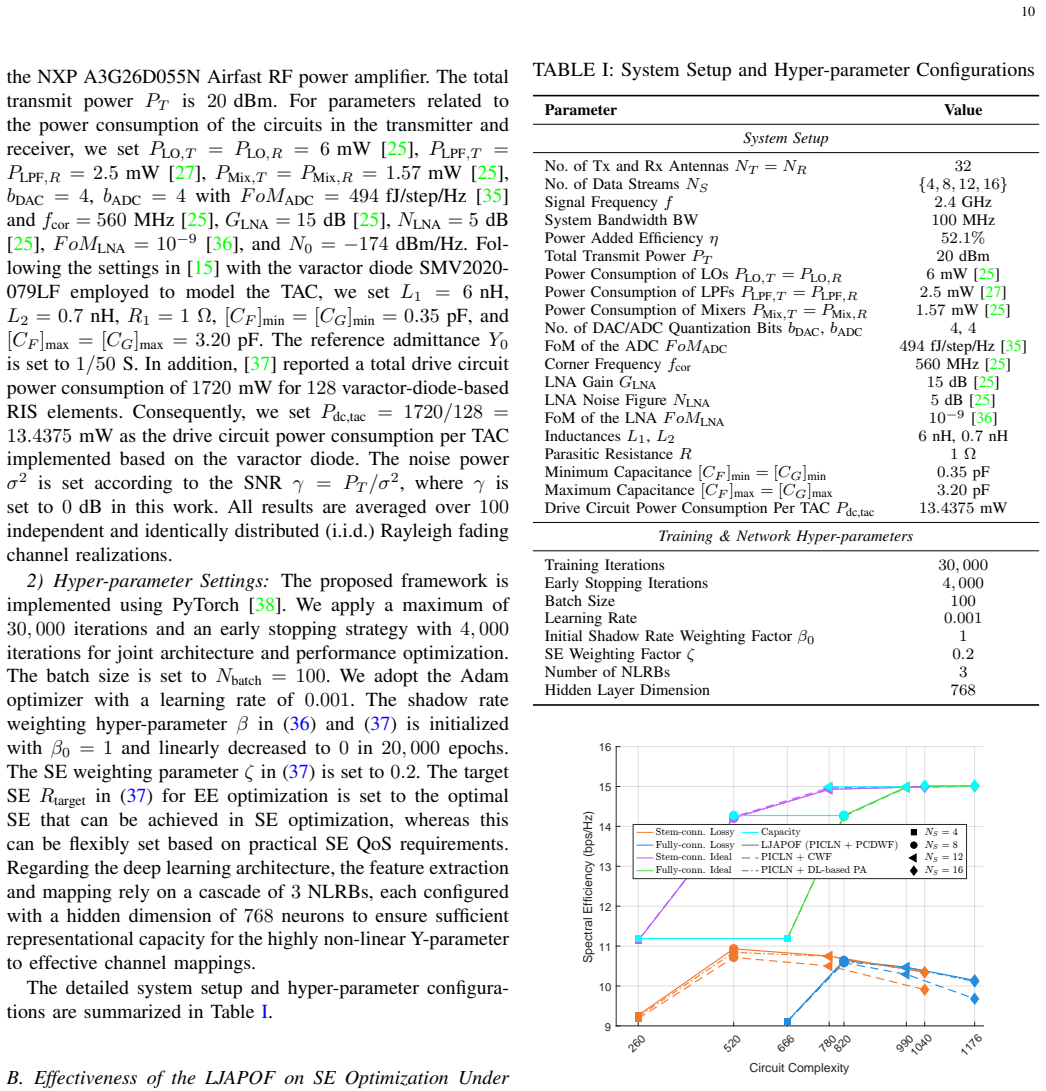
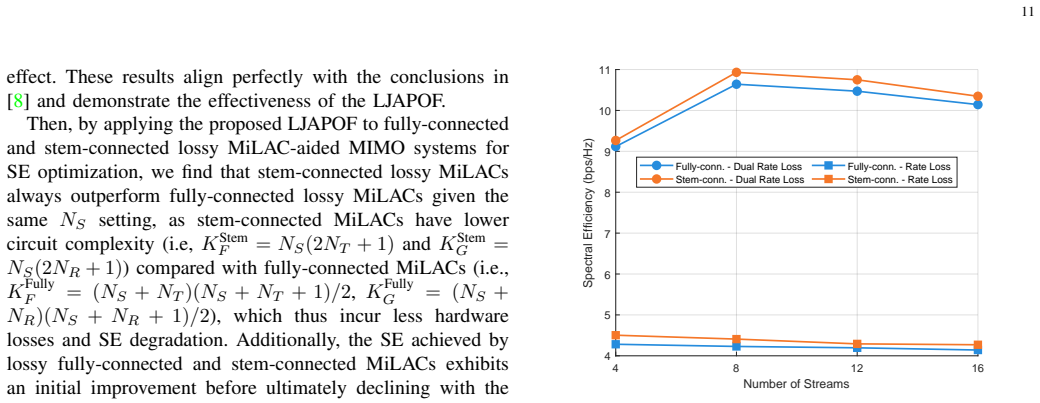
The central claim is that the proposed LJAPOF unifies MiLAC architecture design and analog beamforming configuration under SE- and EE-oriented objectives, allowing lossy MiLACs to navigate the tradeoff between interference suppression and cumulative hardware losses or power consumption and thereby consistently outperform stem-connected and fully-connected MiLACs.
What carries the argument
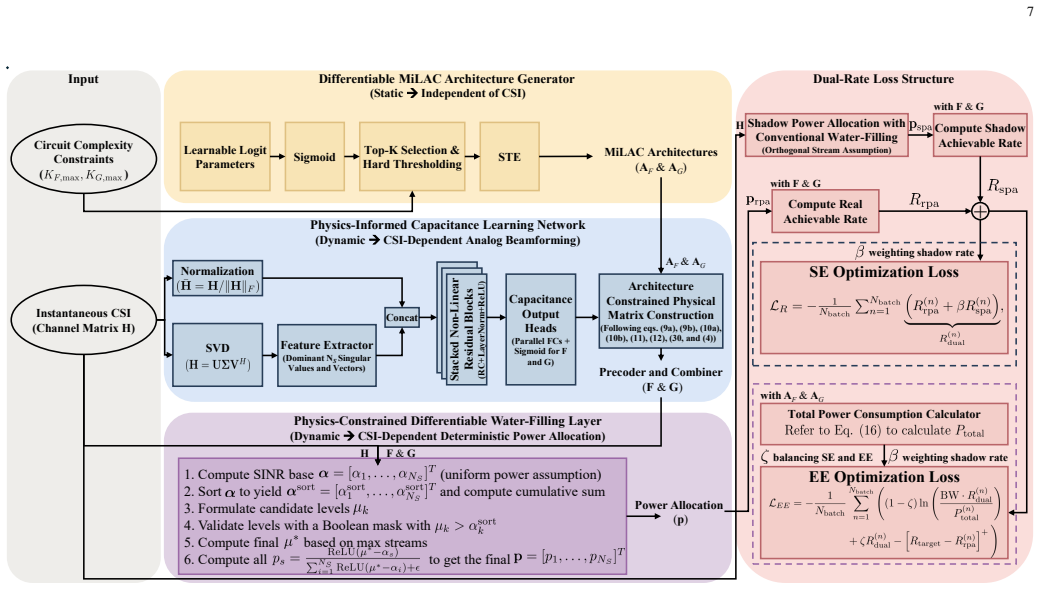
The LJAPOF, a learning-based joint architecture and performance optimization framework that selects MiLAC port interconnections together with analog beamforming weights for either spectral-efficiency or energy-efficiency goals.
If this is right
- Optimal MiLAC architectures use fewer tunable admittance components than fully-connected versions yet suppress inter-stream interference more effectively than stem-connected versions.
- The same learning framework produces competitive designs whether the objective is spectral efficiency or energy efficiency.
- The performance advantage appears across the numerical evaluations presented for lossy MiLAC-aided MIMO systems.
Where Pith is reading between the lines
- The joint-design idea could be tested on other analog signal-processing hardware where losses and power scale with component count.
- Incorporating measured non-idealities from a fabricated device back into the learning loop might further improve the selected architectures.
- The resulting connection patterns could serve as starting points for hybrid analog-digital MIMO transmitters that aim to reduce RF-chain counts.
Load-bearing premise
The simulated loss models used during learning accurately capture the behavior of actual fabricated tunable admittance components so that the discovered architectures deliver the predicted gains in real hardware.
What would settle it
Build a hardware prototype using an architecture chosen by the LJAPOF and measure its achieved spectral efficiency and energy efficiency against identical measurements on stem-connected and fully-connected MiLAC prototypes under the same MIMO channel conditions.
Figures
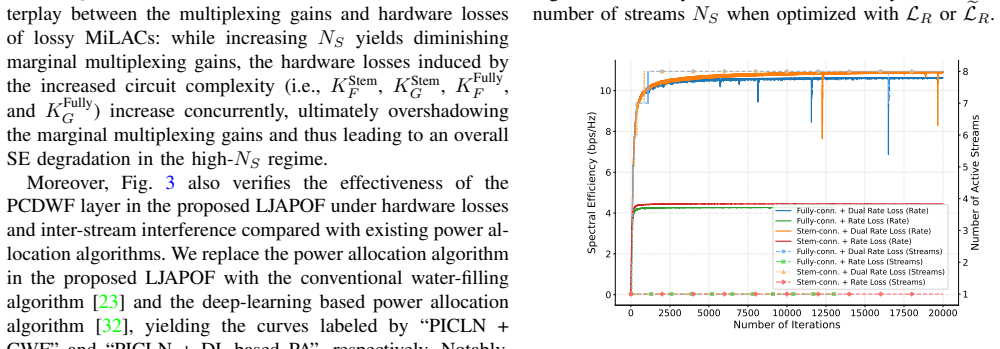
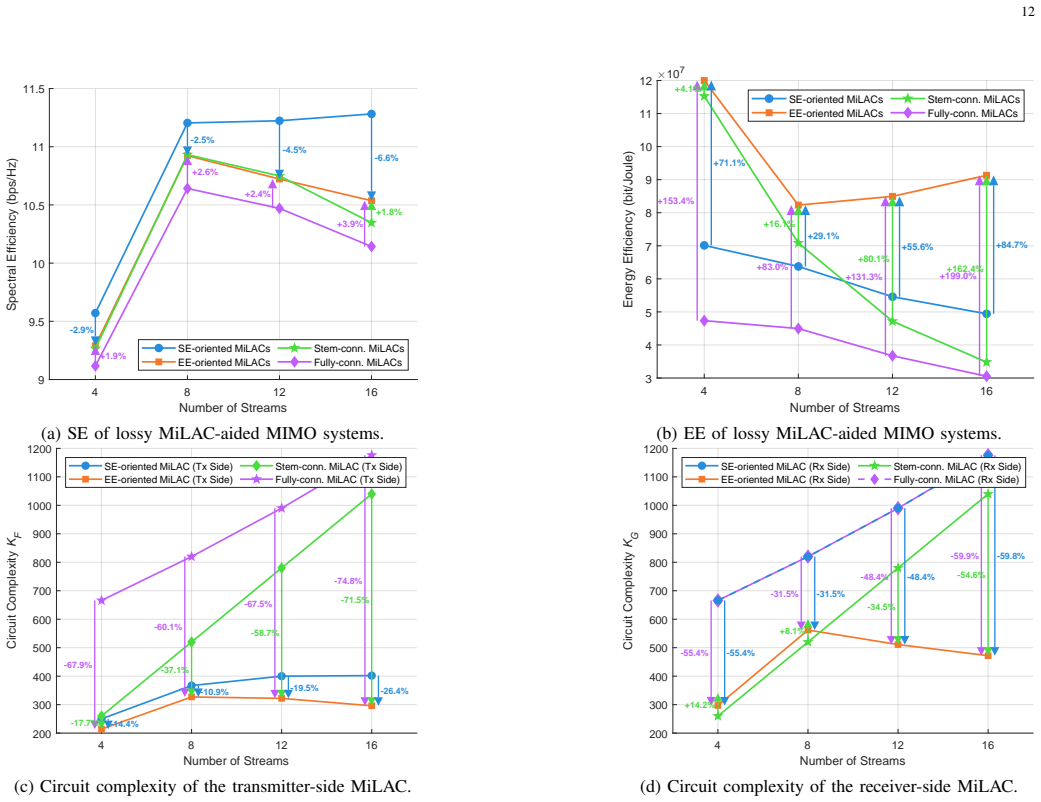
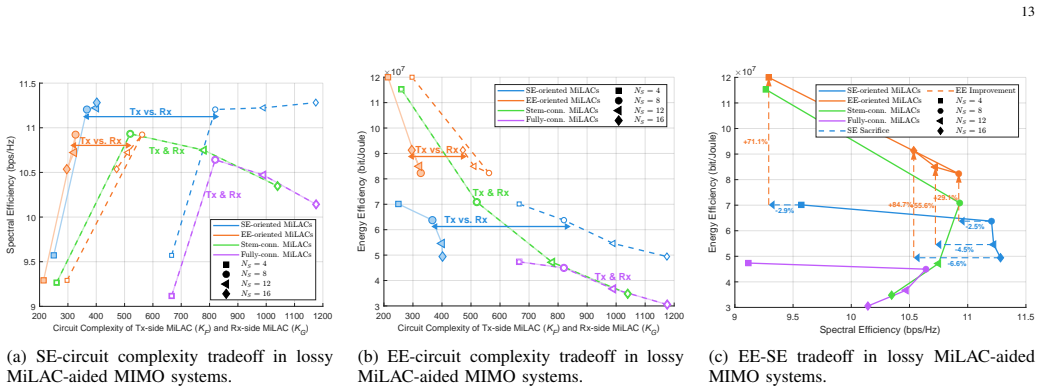
read the original abstract
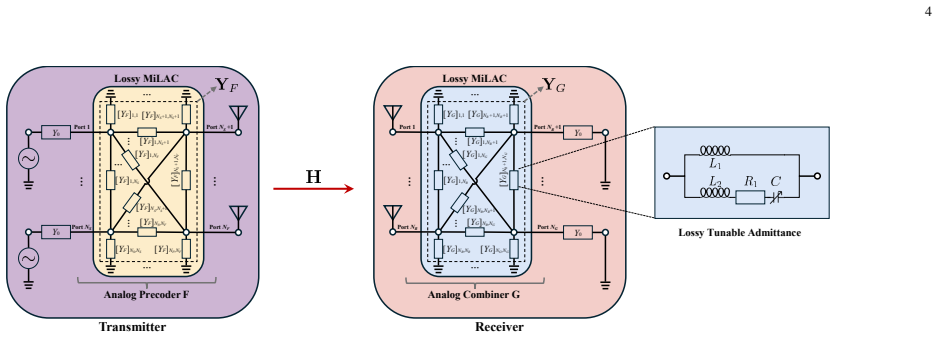
Microwave linear analog computers (MiLACs) offer a transformative paradigm for future multiple-input multiple-output (MIMO) systems by shifting complex signal processing into the analog domain, thereby significantly reducing computational complexity, radio-frequency chains, and analog-digital converters, while speeding up computation. However, the practical deployment of MiLACs is severely constrained by the inherent hardware losses of the tunable admittance components (TACs) interconnecting MiLAC ports, which introduce severe inter-stream interference and fundamentally limit the spectral efficiency (SE) of the system. In addition, while denser architectures offer greater spatial degrees of freedom to mitigate inter-stream interference, the cumulative hardware losses and power consumption of massive TACs severely degrade the system's energy efficiency (EE). Consequently, designing architectures for lossy MiLACs emerges as a critical yet unresolved challenge, as it necessitates striking a delicate tradeoff between interference suppression and cumulative hardware losses/power consumption. To address this challenge, this paper investigates the joint MiLAC architecture design and performance (SE/EE) maximization in lossy MiLAC-aided MIMO systems. We propose a novel learning-based joint architecture and performance optimization framework (LJAPOF) that unifies the design of MiLAC architectures and analog beamforming configurations for lossy MiLACs under both SE- and EE-oriented objectives. Numerical results demonstrate that by intelligently navigating the fundamental tradeoff between interference suppression and hardware/power consumption, the proposed LJAPOF can design optimal MiLAC architectures that consistently outperform stem-connected and fully-connected MiLACs in maximizing the system's SE and EE.
Editorial analysis
A structured set of objections, weighed in public.
Referee Report
Summary. The manuscript proposes a learning-based joint architecture and performance optimization framework (LJAPOF) for lossy microwave linear analog computers (MiLACs) in MIMO systems. It jointly optimizes MiLAC architectures and analog beamforming under SE- and EE-oriented objectives to navigate the tradeoff between inter-stream interference suppression and cumulative TAC hardware losses/power consumption. Numerical results are presented to claim that the resulting architectures consistently outperform stem-connected and fully-connected baselines.
Significance. If the numerical gains prove robust, the work would address a practically relevant constraint on analog-domain MIMO processing and demonstrate a learning-based route to architecture selection. The explicit framing of the interference-vs-loss tradeoff is a clear contribution.
major comments (1)
- [Numerical Results] Numerical Results section: the central claim of consistent outperformance rests entirely on optimization over a specific simulated TAC loss model. No sensitivity study or hardware-in-the-loop validation is described to test whether the discovered architectures remain superior when the loss model is perturbed by frequency dependence, mutual coupling, or fabrication variance; this directly undermines the claim that the gains arise from intelligent navigation of the tradeoff rather than simulator overfitting.
Simulated Author's Rebuttal
We thank the referee for the constructive feedback. Below we address the major comment point-by-point and indicate planned revisions.
read point-by-point responses
-
Referee: [Numerical Results] Numerical Results section: the central claim of consistent outperformance rests entirely on optimization over a specific simulated TAC loss model. No sensitivity study or hardware-in-the-loop validation is described to test whether the discovered architectures remain superior when the loss model is perturbed by frequency dependence, mutual coupling, or fabrication variance; this directly undermines the claim that the gains arise from intelligent navigation of the tradeoff rather than simulator overfitting.
Authors: We acknowledge that the presented results rely on a fixed simulated TAC loss model. The model parameters are drawn from established TAC characterizations in the literature, and all results are averaged over a large number of independent channel realizations. Nevertheless, we agree that explicit sensitivity analysis is needed to strengthen the claim of robust architecture selection. In the revision we will add a dedicated subsection that perturbs the loss model (frequency dependence, mutual coupling, and fabrication variance) and verifies that the learned architectures retain their SE/EE advantage over the baselines. Hardware-in-the-loop validation lies outside the scope of this theoretical/simulation study. revision: partial
- Hardware-in-the-loop validation (the manuscript is purely simulation-based)
Circularity Check
No significant circularity in derivation chain
full rationale
The paper proposes an explicit learning-based optimization framework (LJAPOF) for joint MiLAC architecture and beamforming design under SE/EE objectives, then reports numerical comparisons against stem- and fully-connected baselines. No first-principles derivation, uniqueness theorem, or ansatz is invoked. The results are obtained by direct optimization over the stated TAC loss model; this is not a hidden reduction of outputs to inputs by construction, nor does any load-bearing step rely on self-citation. The work is self-contained as an engineering design study whose validity rests on the fidelity of the simulator rather than on any circular mathematical step.
Axiom & Free-Parameter Ledger
Forward citations
Cited by 1 Pith paper
-
How Many RF Chains Does a Microwave Linear Analog Computer (MiLAC) Need to Match the Fully-Digital Cram\'er-Rao Bound?
MiLAC combiner matches fully digital CRB for DOA estimation of K targets with 2 RF chains per target when row space spans the 2K-dimensional steering-derivative subspace.
Reference graph
Works this paper leans on
-
[1]
Analog signal process- ing: A possible alternative or complement to dominantly digital radio schemes,
C. Caloz, S. Gupta, Q. Zhang, and B. Nikfal, “Analog signal process- ing: A possible alternative or complement to dominantly digital radio schemes,”IEEE Microw. Mag., vol. 14, no. 6, pp. 87–103, Sep. 2013
2013
-
[2]
Analog computing for signal processing and communications – part I: Computing with microwave networks,
M. Nerini and B. Clerckx, “Analog computing for signal processing and communications – part I: Computing with microwave networks,”IEEE Trans. Signal Process., vol. 73, pp. 5183–5197, 2025
2025
-
[3]
Analog computing for signal processing and communications – part II: Toward gigantic MIMO beamforming,
——, “Analog computing for signal processing and communications – part II: Toward gigantic MIMO beamforming,”IEEE Trans. Signal Process., vol. 73, pp. 5198–5212, 2025
2025
-
[4]
Capacity of MIMO systems aided by microwave linear analog computers (MiLACs),
——, “Capacity of MIMO systems aided by microwave linear analog computers (MiLACs),”arXiv preprint arXiv:2506.05983, Jun. 2025
-
[5]
Z. Wu, M. Nerini, and B. Clerckx, “Microwave linear analog computer (MiLAC)-aided multiuser MISO: Fundamental limits and beamforming design,”arXiv preprint arXiv:2601.10060, Jan. 2026
-
[6]
M. Nerini and B. Clerckx, “Physics-compliant modeling and optimiza- tion of mimo systems aided by microwave linear analog computers,” arXiv preprint arXiv:2602.19379, 2026
-
[7]
Channel estimation in MIMO systems aided by microwave linear analog computers (MiLACs),
Q. Zhang, M. Nerini, and B. Clerckx, “Channel estimation in mimo systems aided by microwave linear analog computers (milacs),”arXiv preprint arXiv:2601.11438, 2026
-
[8]
MIMO systems aided by microwave linear analog computers: Capacity-achieving architectures with reduced circuit complexity,
M. Nerini and B. Clerckx, “MIMO systems aided by microwave linear analog computers: Capacity-achieving architectures with reduced circuit complexity,”IEEE Trans. Wireless Commun., pp. 1–15, 2026
2026
-
[9]
Modeling and architecture design of reconfigurable intelligent surfaces using scattering parameter network analysis,
S. Shen, B. Clerckx, and R. Murch, “Modeling and architecture design of reconfigurable intelligent surfaces using scattering parameter network analysis,”IEEE Trans. Wireless Commun., vol. 21, no. 2, pp. 1229–1243, Feb. 2022
2022
-
[10]
Reconfigurable intelligent surfaces 2.0: Beyond diagonal phase shift matrices,
H. Li, S. Shen, M. Nerini, and B. Clerckx, “Reconfigurable intelligent surfaces 2.0: Beyond diagonal phase shift matrices,”IEEE Commun. Mag., vol. 62, no. 3, pp. 102–108, Mar. 2024
2024
-
[11]
A tutorial on beyond- diagonal reconfigurable intelligent surfaces: Modeling, architectures, system design and optimization, and applications,
H. Li, M. Nerini, S. Shen, and B. Clerckx, “A tutorial on beyond- diagonal reconfigurable intelligent surfaces: Modeling, architectures, system design and optimization, and applications,”IEEE Commun. Surveys Tuts., vol. 28, pp. 4086–4126, 2026
2026
-
[12]
Beyond-diagonal RIS in multiuser MIMO: Graph theoretic modeling and optimal architectures with low complex- ity,
Z. Wu and B. Clerckx, “Beyond-diagonal RIS in multiuser MIMO: Graph theoretic modeling and optimal architectures with low complex- ity,”IEEE Trans. Inf. Theory, vol. 71, no. 11, pp. 8506–8523, Nov. 2025
2025
-
[13]
Beyond-diagonal RIS architecture design and optimization under physics-consistent models,
Z. Wu, M. Nerini, and B. Clerckx, “Beyond-diagonal RIS architecture design and optimization under physics-consistent models,”IEEE Trans. Wireless Commun., vol. 25, pp. 14 086–14 100, 2026
2026
-
[15]
Lossy beyond diagonal reconfigurable intelligent surfaces: Modeling and optimization,
Y . Peng, H. Li, Z. Wu, and B. Clerckx, “Lossy beyond diagonal reconfigurable intelligent surfaces: Modeling and optimization,”IEEE Trans. Wireless Commun., vol. 25, pp. 7365–7380, 2026
2026
-
[16]
Quantization-Aware EE Optimization and SE-EE Tradeoff for MiLAC-Aided MU-MISO Beamforming
Y . Zhang, P. Zheng, and T. Y . Al-Naffouri, “Quantization-aware EE optimization and SE-EE tradeoff for MiLAC-aided MU-MISO beam- forming,”arXiv preprint arXiv:2604.24538, 2026
work page internal anchor Pith review Pith/arXiv arXiv 2026
-
[17]
Mixed-integer nonlinear programming 2018,
N. V . Sahinidis, “Mixed-integer nonlinear programming 2018,”Optim. Eng., vol. 20, no. 2, pp. 301–306, Jun. 2019
2018
-
[18]
A low-overhead incorporation-extrapolation based few-shot CSI feedback framework for massive MIMO systems,
B. Zhou, X. Yang, J. Wang, S. Ma, F. Gao, and G. Yang, “A low-overhead incorporation-extrapolation based few-shot CSI feedback framework for massive MIMO systems,”IEEE Trans. Wireless Com- mun., vol. 23, no. 10, pp. 14 743–14 758, Oct. 2024. 15
2024
-
[19]
Y . Peng, B. Zhou, Y . Zheng, D. Mandic, and B. Clerckx, “Joint training scattering matrix learning and channel estimation for beyond-diagonal reconfigurable intelligent surfaces,”arXiv preprint arXiv:2603.25299, 2026
-
[20]
Deep learning-based channel extrapolation for dual-band massive MIMO systems,
Q. Xiao, K. Li, B. Zhou, and S. Ma, “Deep learning-based channel extrapolation for dual-band massive MIMO systems,”IEEE Wireless Commun. Lett., vol. 15, pp. 2994–2998, 2026
2026
-
[21]
Beyond-diagonal ris under non-idealities: Learning-based architecture discovery and optimization,
B. Zhou and B. Clerckx, “Beyond-diagonal ris under non-idealities: Learning-based architecture discovery and optimization,”arXiv preprint arXiv:2510.15701, 2025
-
[22]
D. M. Pozar,Microwave Engineering, 4th ed. Hoboken, NJ, USA: John Wiley & Sons, 2011
2011
-
[23]
Clerckx and C
B. Clerckx and C. Oestges,MIMO Wireless Networks: Channels, Techniques and Standards for Multi-Antenna, Multi-User and Multi-Cell Systems. Academic Press, 2013
2013
-
[24]
Sleep modes for enhanced battery life of 5G mobile terminals,
M. Lauridsen, G. Berardinelli, F. M. L. Tavares, F. Frederiksen, and P. Mogensen, “Sleep modes for enhanced battery life of 5G mobile terminals,” inProc. IEEE VTC Spring, May 2016, pp. 1–6
2016
-
[25]
Hardware-aware energy efficiency optimization in wireless communi- cations using a gearbox-PHY,
F. Gast, M. D ¨orpinghaus, P. Sen, A. Nimr, and G. P. Fettweis, “Hardware-aware energy efficiency optimization in wireless communi- cations using a gearbox-PHY,”IEEE Commun. Lett., vol. 28, no. 7, pp. 1584–1588, Jul. 2024
2024
-
[26]
Millimeter wave receiver efficiency: A comprehensive comparison of beamforming schemes with low resolution adcs,
W. B. Abbas, F. Gomez-Cuba, and M. Zorzi, “Millimeter wave receiver efficiency: A comprehensive comparison of beamforming schemes with low resolution adcs,”IEEE Trans. Wireless Commun., vol. 16, no. 12, pp. 8131–8146, Dec. 2017
2017
-
[27]
Mixed-ADC/DAC multipair massive MIMO relaying systems: Performance analysis and power optimization,
J. Zhang, L. Dai, Z. He, B. Ai, and O. A. Dobre, “Mixed-ADC/DAC multipair massive MIMO relaying systems: Performance analysis and power optimization,”IEEE Trans. Commun., vol. 67, no. 1, pp. 141– 153, Jan. 2019
2019
-
[28]
Estimating or Propagating Gradients Through Stochastic Neurons for Conditional Computation
Y . Bengio, N. L ´eonard, and A. Courville, “Estimating or propagating gradients through stochastic neurons for conditional computation,”arXiv preprint arXiv:1308.3432, Aug. 2013
work page internal anchor Pith review Pith/arXiv arXiv 2013
-
[29]
Deep residual learning for image recognition,
K. He, X. Zhang, S. Ren, and J. Sun, “Deep residual learning for image recognition,” inProc. IEEE/CVF CVPR, Jun. 2016, pp. 770–778
2016
-
[30]
J. L. Ba, J. R. Kiros, and G. E. Hinton, “Layer normalization,”arXiv preprint arXiv:1607.06450, Jul. 2016
work page internal anchor Pith review Pith/arXiv arXiv 2016
-
[31]
Deep learning-based power allocation for cell-free massive MIMO networks with adaptive access point power control,
Y .-J. Choi, J.-H. Yu, H.-Y . Jeong, J.-E. Kim, and H.-K. Song, “Deep learning-based power allocation for cell-free massive MIMO networks with adaptive access point power control,” inProc. ICUFN, Jul. 2025, pp. 744–749
2025
-
[32]
Deep learning-based power allocation in massive MIMO systems with SLNR and SINR criterions,
R. H. Y . Perdana, T.-V . Nguyen, and B. An, “Deep learning-based power allocation in massive MIMO systems with SLNR and SINR criterions,” inProc. ICUFN, Aug. 2021, pp. 87–92
2021
-
[33]
Deep learning power allocation in massive MIMO,
L. Sanguinetti, A. Zappone, and M. Debbah, “Deep learning power allocation in massive MIMO,” inProc. ACSSC, Oct. 2018, pp. 1257– 1261
2018
-
[34]
Shortcut learning in deep neural networks,
R. Geirhos, J.-H. Jacobsen, C. Michaelis, R. Zemel, W. Brendel, M. Bethge, and F. A. Wichmann, “Shortcut learning in deep neural networks,”Nat Mach Intell, vol. 2, no. 11, pp. 665–673, Nov. 2020
2020
-
[35]
A 7.5-GS/s 3.8-ENOB 52-mW flash ADC with clock duty cycle control in 65nm CMOS,
H. Chung, A. Rylyakov, Z. T. Deniz, J. Bulzacchelli, G.-Y . Wei, and D. Friedman, “A 7.5-GS/s 3.8-ENOB 52-mW flash ADC with clock duty cycle control in 65nm CMOS,” inProc. Symp. VLSI Circuits, Jun. 2009, pp. 268–269
2009
-
[36]
Modeling and minimization of transceiver power consumption in wireless networks,
A. Mezghani and J. A. Nossek, “Modeling and minimization of transceiver power consumption in wireless networks,” inProc. 2011 Int. ITG Workshop Smart Antennas, Feb. 2011, pp. 1–8
2011
-
[37]
Reconfigurable intelligent surface: Power consumption modeling and practical measurement validation,
J. Wang, W. Tang, J. C. Liang, L. Zhang, J. Y . Dai, X. Li, S. Jin, Q. Cheng, and T. J. Cui, “Reconfigurable intelligent surface: Power consumption modeling and practical measurement validation,”IEEE Trans. Commun., vol. 72, no. 9, pp. 5720–5734, Sep. 2024
2024
-
[38]
PyTorch: An imperative style, high- performance deep learning library,
A. Paszke, S. Gross, F. Massa, A. Lerer, J. Bradbury, G. Chanan, T. Killeen, Z. Lin, N. Gimelshein, L. Antiga, A. Desmaison, A. Kopf, E. Yang, Z. DeVito, M. Raison, A. Tejani, S. Chilamkurthy, B. Steiner, L. Fang, J. Bai, and S. Chintala, “PyTorch: An imperative style, high- performance deep learning library,” inProc. NeurIPS, vol. 32, 2019
2019
discussion (0)
Sign in with ORCID, Apple, or X to comment. Anyone can read and Pith papers without signing in.