Microwave Linear Analog Computer (MiLAC) for Simultaneous Active and Passive Beamforming
Pith reviewed 2026-06-28 20:51 UTC · model grok-4.3
The pith
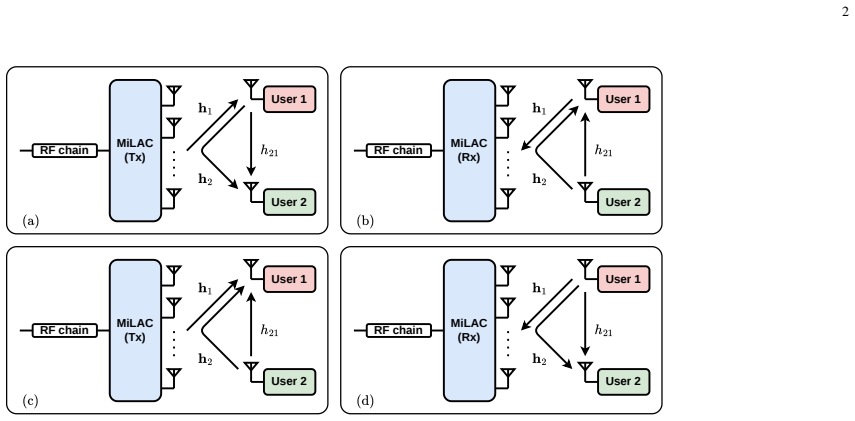
A MiLAC can simultaneously execute its own active beamforming and reflect external signals as a passive surface.
A machine-rendered reading of the paper's core claim, the machinery that carries it, and where it could break.
Core claim
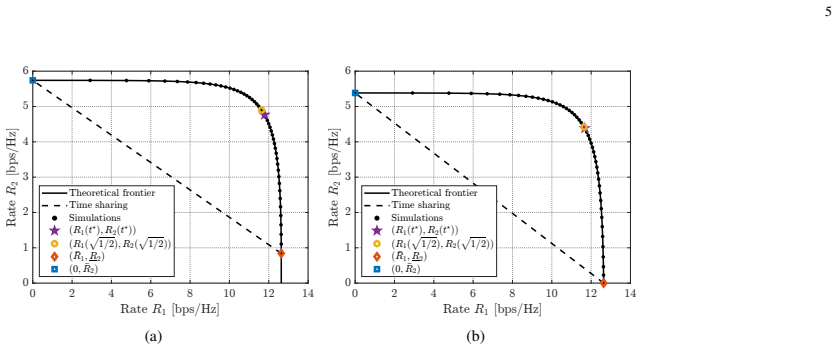
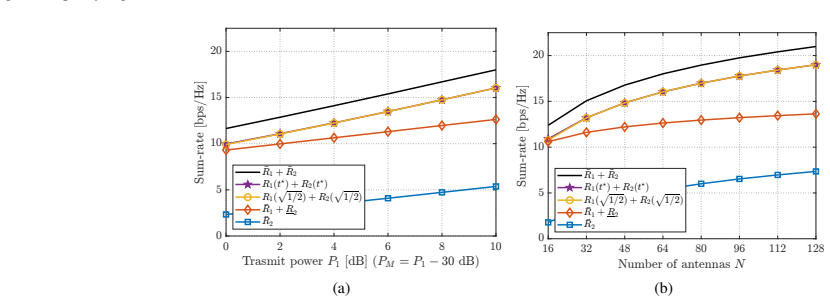
The MiLAC and its antenna array can simultaneously execute beamforming for transmission/reception while reflecting external incident signals. An optimal reconfiguration strategy achieves the fundamental limits on the trade-off, given by the capacity region bounds and the sum-rate capacity between the active and passive rates.
What carries the argument
The dual-functional reconfiguration strategy that sets the MiLAC parameters to support both active precoding/combining and passive reflection without separate hardware.
If this is right
- The optimal reconfiguration strategy enables the MiLAC to reach any point inside the capacity region for active and passive rates.
- The capacity region bounds give the precise limits on pairs of active rate and passive rate that can be achieved together.
- The sum-rate capacity identifies the maximum total rate obtainable when active and passive functions run simultaneously.
Where Pith is reading between the lines
- The dual-function approach could reduce overall hardware count in systems that already deploy both beamformers and reflectors.
- Real deployments would need to check whether the theoretical rates hold when external signals arrive from multiple angles or users.
- The same reconfiguration idea might extend to multi-antenna arrays serving several active links at once.
Load-bearing premise
The MiLAC hardware and antenna array can be reconfigured for simultaneous active and passive operation without prohibitive mutual interference.
What would settle it
An experiment that measures active and passive rates under the proposed reconfiguration and finds achievable pairs outside the derived capacity region bounds.
Figures
read the original abstract
Microwave linear analog computers (MiLACs) have recently emerged to enable high-performance and efficient beamforming in the analog domain. In this paper, we introduce a dual-functionality framework for MiLAC-aided transceivers. Beyond analog-domain precoding/combining (active beamforming), a MiLAC and its antenna array can simultaneously act as a reconfigurable intelligent surface (RIS) (passive beamforming). This allows the MiLAC to execute beamforming for transmission/reception while reflecting external incident signals. We provide an optimal reconfiguration strategy for this dual-functional MiLAC, and characterize the fundamental limits on the trade-off between active and passive rate, namely the capacity region bounds and the sum-rate capacity.
Editorial analysis
A structured set of objections, weighed in public.
Referee Report
Summary. The paper introduces a dual-functional Microwave Linear Analog Computer (MiLAC) transceiver that performs active beamforming (analog precoding/combining for its own signals) while simultaneously acting as a reconfigurable intelligent surface (RIS) for passive reflection of external incident signals. It claims to derive an optimal reconfiguration strategy for this dual operation and to characterize the fundamental limits via capacity region bounds and sum-rate capacity for the active-passive rate trade-off.
Significance. If the modeling assumptions hold and the bounds are rigorously derived without unaccounted hardware impairments, the work could enable more efficient hardware reuse in wireless systems by integrating active and passive beamforming functions. The explicit capacity-region characterization would be a useful contribution to the literature on hybrid active-passive systems, provided it is supported by verifiable derivations.
major comments (1)
- [System model] System model (likely §II or equivalent): The central claim of simultaneous active/passive operation and the resulting capacity bounds rest on the assumption that the shared antenna array can be reconfigured without prohibitive mutual coupling, self-interference, or hardware constraints between the active transmission/reception and passive reflection modes. The abstract provides no indication that these effects are incorporated into the joint electromagnetic-information-theoretic model or the derived bounds; this is load-bearing for the optimality and capacity claims.
minor comments (1)
- [Abstract] Abstract: The phrasing 'we provide an optimal reconfiguration strategy' would benefit from a one-sentence qualifier on the objective (e.g., sum-rate maximization under power or hardware constraints) to clarify the optimization target.
Simulated Author's Rebuttal
We thank the referee for the constructive feedback on the system model. We address the major comment point by point below.
read point-by-point responses
-
Referee: [System model] System model (likely §II or equivalent): The central claim of simultaneous active/passive operation and the resulting capacity bounds rest on the assumption that the shared antenna array can be reconfigured without prohibitive mutual coupling, self-interference, or hardware constraints between the active transmission/reception and passive reflection modes. The abstract provides no indication that these effects are incorporated into the joint electromagnetic-information-theoretic model or the derived bounds; this is load-bearing for the optimality and capacity claims.
Authors: We agree that the system model in Section II assumes an idealized shared antenna array capable of simultaneous active beamforming (analog precoding/combining) and passive reflection (as an RIS) without incorporating mutual coupling, self-interference, or other hardware impairments. The capacity region bounds and sum-rate capacity are derived under these ideal conditions to establish the fundamental limits of the dual-functional MiLAC architecture. This is a standard first step in information-theoretic studies of novel transceiver designs. We will revise the manuscript to explicitly state these modeling assumptions in the abstract and add a discussion of their implications (including potential practical limitations) in the system model section. revision: yes
Circularity Check
No circularity: capacity bounds derived from standard information theory on new dual-function model
full rationale
The abstract and claims introduce a dual-functional MiLAC framework and state that an optimal reconfiguration strategy and capacity region bounds are provided. No equations, fitted parameters, or self-citations are visible in the provided text that would make any 'prediction' or bound equivalent to its inputs by construction. The capacity region is a standard information-theoretic object applied to the described active/passive trade-off; nothing indicates the bounds reduce to a fit or to a self-citation chain. This is the expected non-finding for a modeling paper whose central results rest on external information-theoretic definitions rather than internal redefinition.
Axiom & Free-Parameter Ledger
Forward citations
Cited by 1 Pith paper
-
How Many RF Chains Does a Microwave Linear Analog Computer (MiLAC) Need to Match the Fully-Digital Cram\'er-Rao Bound?
MiLAC combiner matches fully digital CRB for DOA estimation of K targets with 2 RF chains per target when row space spans the 2K-dimensional steering-derivative subspace.
Reference graph
Works this paper leans on
-
[1]
Analog computing for signal processing and communications – Part II: Toward gigantic MIMO beamforming,
M. Nerini and B. Clerckx, “Analog computing for signal processing and communications – Part II: Toward gigantic MIMO beamforming,”IEEE Trans. Signal Process., vol. 73, pp. 5198–5212, 2025
2025
-
[2]
Capacity of MIMO systems aided by microwave linear analog computers (MiLACs),
M. Nerini and B. Clerckx, “Capacity of MIMO systems aided by microwave linear analog computers (MiLACs),”arXiv preprint arXiv:2506.05983, 2025
-
[3]
On the performance of lossless reciprocal MiLAC architectures in multi-user networks,
T. Fang, X. Zhou, and Y . Mao, “On the performance of lossless reciprocal MiLAC architectures in multi-user networks,”IEEE Wireless Commun. Lett., vol. 15, pp. 2609–2613, 2026
2026
-
[4]
Z. Wu, M. Nerini, and B. Clerckx, “Microwave linear analog computer (MiLAC)-aided multiuser MISO: Fundamental limits and beamforming design,”arXiv preprint arXiv:2601.10060, 2026
-
[5]
Two-Layer Microwave Linear Analog Computer (MiLAC)-aided Multi-user MISO Networks
X. Zhou, T. Fang, Y . Mao, and B. Clerckx, “Two-layer microwave linear analog computer (MiLAC)-aided multi-user MISO networks,”arXiv preprint arXiv:2604.24303, 2026
work page internal anchor Pith review Pith/arXiv arXiv 2026
-
[6]
Quantization-Aware EE Optimization and SE-EE Tradeoff for MiLAC-Aided MU-MISO Beamforming
Y . Zhang, P. Zheng, and T. Y . Al-Naffouri, “Quantization-aware EE opti- mization and SE-EE tradeoff for milac-aided MU-MISO beamforming,” arXiv preprint arXiv:2604.24538, 2026
work page internal anchor Pith review Pith/arXiv arXiv 2026
-
[7]
Z. Liu, Z. Wu, and B. Clerckx, “Microwave linear analog computer (MiLAC)-aided MIMO radar sensing: Transmit beamforming design and DoA estimation,”arXiv preprint arXiv:2605.21020, 2026
work page internal anchor Pith review Pith/arXiv arXiv 2026
-
[8]
Intelligent reflecting surface enhanced wireless network via joint active and passive beamforming,
Q. Wu and R. Zhang, “Intelligent reflecting surface enhanced wireless network via joint active and passive beamforming,”IEEE Trans. Wireless Commun., vol. 18, no. 11, pp. 5394–5409, 2019
2019
-
[9]
Intelligent reflecting surface-aided wireless communications: A tutorial,
Q. Wu, S. Zhang, B. Zheng, C. You, and R. Zhang, “Intelligent reflecting surface-aided wireless communications: A tutorial,”IEEE Trans. Commun., vol. 69, no. 5, pp. 3313–3351, 2021
2021
-
[10]
Simultaneously transmitting and reflecting (STAR) RIS aided wireless communications,
X. Mu, Y . Liu, L. Guo, J. Lin, and R. Schober, “Simultaneously transmitting and reflecting (STAR) RIS aided wireless communications,” IEEE Trans. Wireless Commun., vol. 21, no. 5, pp. 3083–3098, 2022
2022
-
[11]
Modeling and architecture design of reconfigurable intelligent surfaces using scattering parameter network analysis,
S. Shen, B. Clerckx, and R. Murch, “Modeling and architecture design of reconfigurable intelligent surfaces using scattering parameter network analysis,”IEEE Trans. Wireless Commun., vol. 21, no. 2, pp. 1229–1243, 2022
2022
-
[12]
Non-reciprocal beyond diagonal RIS: Multiport network models and performance benefits in full-duplex systems,
H. Li and B. Clerckx, “Non-reciprocal beyond diagonal RIS: Multiport network models and performance benefits in full-duplex systems,”IEEE Trans. Commun., vol. 73, no. 11, pp. 12 221–12 234, 2025
2025
-
[13]
D. M. Pozar,Microwave engineering. John Wiley & Sons, 2011
2011
-
[14]
Closed-form global optimization of beyond diagonal reconfigurable intelligent surfaces,
M. Nerini, S. Shen, and B. Clerckx, “Closed-form global optimization of beyond diagonal reconfigurable intelligent surfaces,”IEEE Trans. Wireless Commun., vol. 23, no. 2, pp. 1037–1051, 2024
2024
discussion (0)
Sign in with ORCID, Apple, or X to comment. Anyone can read and Pith papers without signing in.