Radial gradients revealed by mutliscale outflows from down-the-barrel spectroscopy toward a quasar at redshift 3.4
Pith reviewed 2026-06-26 00:13 UTC · model grok-4.3
The pith
Quasar at z=3.4 shows radial N/C gradient in multiscale outflows
A machine-rendered reading of the paper's core claim, the machinery that carries it, and where it could break.
Core claim
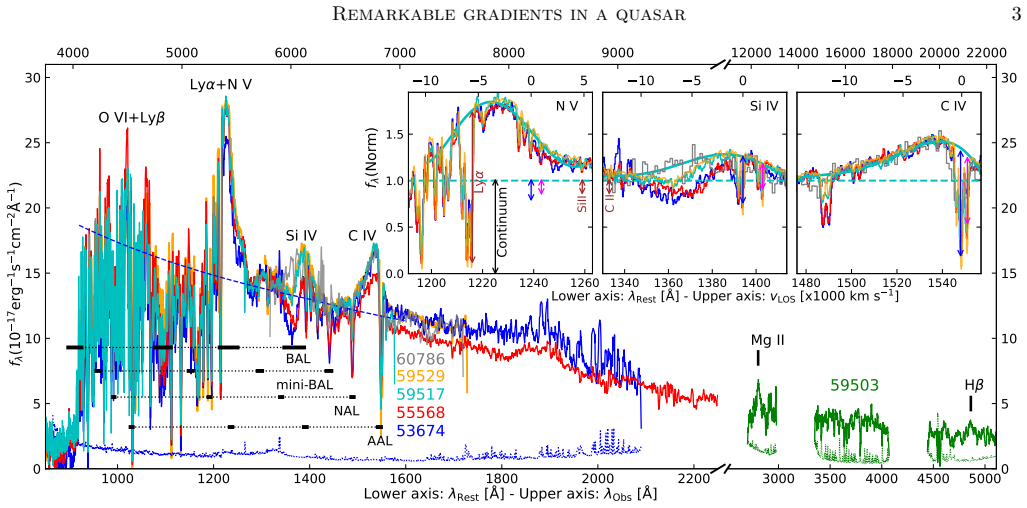
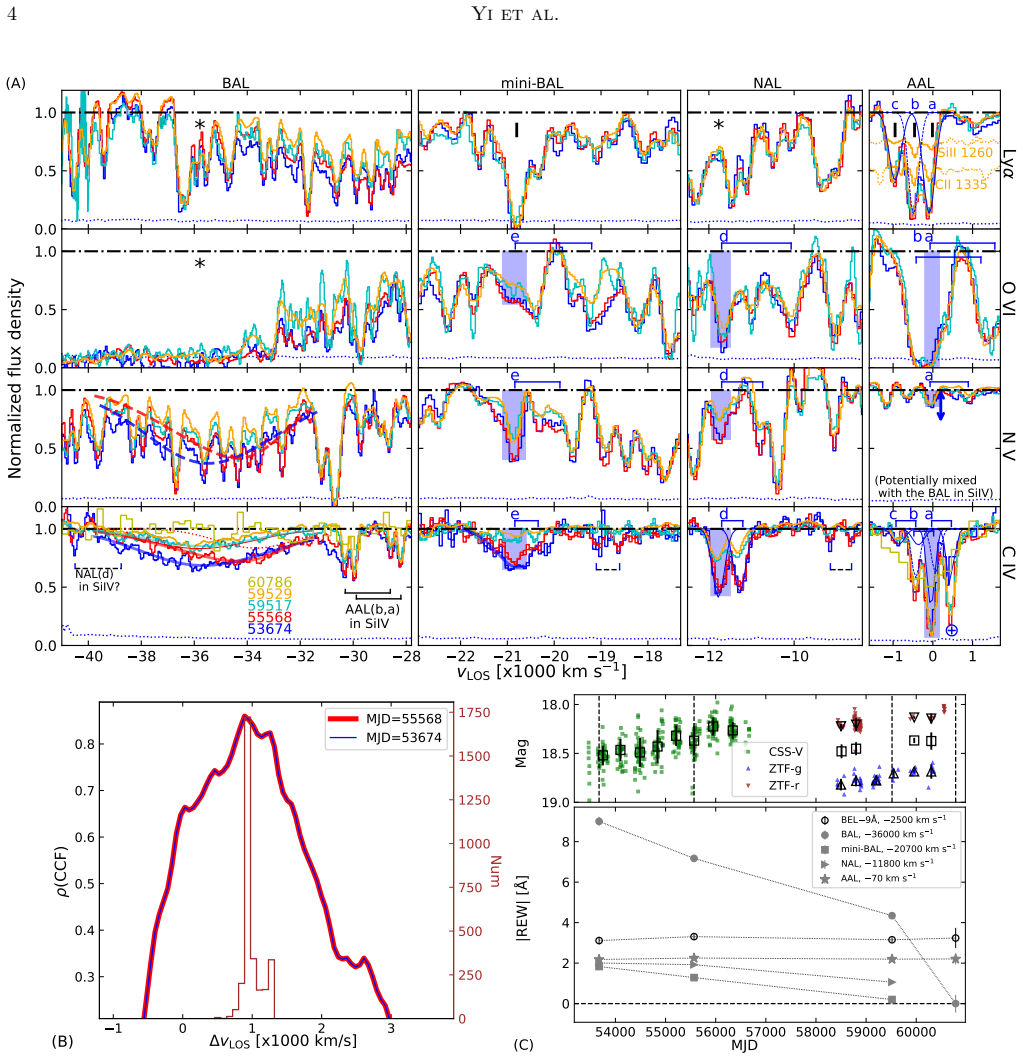
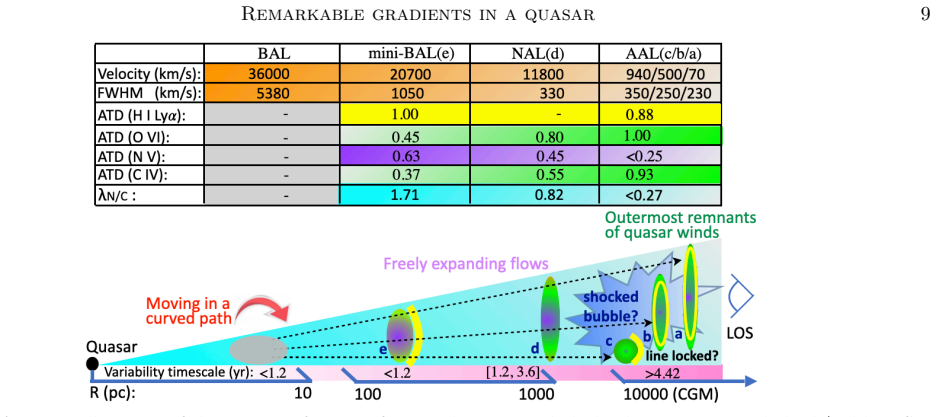
Multi-epoch spectroscopy toward the quasar reveals multiscale outflows with radial gradients. Most strikingly, the trends of trough depth across three different-scale, freely expanding outflows are opposite between N V and C IV, regardless of the spectral normalization and short-term variability, leading to a tenable gradient of N/C and signaling a critical transition from ejective feedback on small scales to regulative feedback on large scales.
What carries the argument
The opposite trends in trough depth between N V and C IV across three different-scale outflows, interpreted as evidence for a radial N/C gradient.
If this is right
- AGN feedback couples to the ISM and CGM differently at nuclear versus CGM scales.
- The observed scale marks a shift from driving material outward to regulating galaxy evolution.
- The data provide direct diagnostics for wind-ISM/CGM coupling in galaxy formation simulations.
- The gradient is robust to choices of spectral normalization and short-term variability.
- Such multiscale observations help close the gap between nuclear and large-scale feedback processes.
Where Pith is reading between the lines
- Similar radial abundance gradients may appear in other luminous quasars at comparable redshifts.
- The transition in feedback mode could influence how AGN suppress or trigger star formation at different radii.
- Future integral-field spectroscopy could map whether the N/C change correlates with outflow velocity or density.
- This pattern offers a concrete test for whether simulations produce the same scale-dependent abundance shift.
Load-bearing premise
That the opposite trough-depth trends between N V and C IV across the three scales arise from a genuine radial N/C gradient rather than from ionization variations, line blending, or differential saturation effects.
What would settle it
New spectra or models that reproduce the observed opposite trough-depth trends between N V and C IV without any change in N/C ratio, for instance by ionization or saturation effects alone.
Figures
read the original abstract
Active galactic nucleus(AGN) feedback is a key ingredient in galaxy formation models and simulations. From an observational point of view, however, the channels of AGN feedback coupling to the interstellar medium (ISM) and circumgalactic medium (CGM) and hence the impact on galaxy evolution, are largely uncertain and remain fiercely debated, due primarily to the huge gap from nuclear to CGM scales. Here we present multi-epoch, down-the-barrel spectroscopy toward a luminous quasar at $z=3.409$ over two decades, which reveals multiscale outflows expanding from nuclear to CGM scales along with characteristic radial gradients. Most strikingly, the trends of trough depth across three different-scale, freely expanding outflows are opposite between N V and C IV, regardless of the spectral normalization and short-term variability, leading to a tenable gradient of N/C and signaling a critical transition from ejective feedback on small scales to regulative feedback on large scales. Our observations of this quasar offer valuable diagnostics to explore the realistic wind-ISM/CGM coupling, one of the most challenging tasks in state-of-the-art simulations of feedback.
Editorial analysis
A structured set of objections, weighed in public.
Referee Report
Summary. The manuscript presents multi-epoch down-the-barrel spectroscopy of a luminous quasar at z=3.409, identifying three freely expanding outflows spanning nuclear to CGM scales. It reports that trough-depth trends with outflow scale are opposite between N V and C IV (independent of normalization and short-term variability), which is interpreted as evidence for a radial N/C abundance gradient and a transition from ejective feedback on small scales to regulative feedback on large scales.
Significance. If the abundance-gradient interpretation is robust, the result would provide rare observational diagnostics of scale-dependent AGN feedback coupling to the ISM/CGM, directly addressing a key uncertainty in galaxy-formation simulations. The multi-scale, multi-epoch dataset itself is a valuable resource even if the gradient claim requires further substantiation.
major comments (2)
- [Abstract] Abstract: The central claim that the opposite N V and C IV trough-depth trends indicate a genuine radial N/C gradient (rather than ionization-parameter, density, or saturation variations with radius) is load-bearing for the ejective-to-regulative feedback transition. The abstract asserts the trends hold 'regardless of the spectral normalization and short-term variability' but provides no reference to photoionization modeling, curve-of-growth analysis, or blending corrections that would quantitatively exclude the alternatives raised in the skeptic note.
- [Abstract] Abstract: No spectra, error bars, or quantitative trough-depth measurements are shown, so the reported trends and their claimed independence from normalization/variability cannot be evaluated. This absence prevents assessment of whether the opposite trends between the two ions are statistically significant or could arise from differential saturation or line-blending effects.
minor comments (2)
- [Title] Title: 'mutliscale' is a typographical error.
- [Abstract] Abstract, first sentence: missing space in 'nucleus(AGN)'.
Simulated Author's Rebuttal
We thank the referee for their careful reading and for recognizing the value of the multi-scale, multi-epoch dataset. We address the two abstract-related comments point by point below.
read point-by-point responses
-
Referee: [Abstract] Abstract: The central claim that the opposite N V and C IV trough-depth trends indicate a genuine radial N/C gradient (rather than ionization-parameter, density, or saturation variations with radius) is load-bearing for the ejective-to-regulative feedback transition. The abstract asserts the trends hold 'regardless of the spectral normalization and short-term variability' but provides no reference to photoionization modeling, curve-of-growth analysis, or blending corrections that would quantitatively exclude the alternatives raised in the skeptic note.
Authors: The full manuscript (Section 4 and Appendix B) presents CLOUDY photoionization grids and curve-of-growth analysis that quantitatively demonstrate the observed opposite trough-depth trends cannot be reproduced by plausible radial changes in ionization parameter, density, or saturation alone; the data are best matched by a radial N/C abundance gradient. The abstract is a concise summary and therefore omits these methodological citations. We will add a brief parenthetical reference to the modeling in a revised abstract. revision: partial
-
Referee: [Abstract] Abstract: No spectra, error bars, or quantitative trough-depth measurements are shown, so the reported trends and their claimed independence from normalization/variability cannot be evaluated. This absence prevents assessment of whether the opposite trends between the two ions are statistically significant or could arise from differential saturation or line-blending effects.
Authors: Abstracts are space-limited and conventionally omit figures and tables. The complete manuscript supplies the multi-epoch spectra (Figure 1), measured trough depths with 1-sigma error bars (Table 2), and a statistical assessment of trend significance and normalization independence (Section 3). Differential saturation and blending are addressed via multi-epoch profile decomposition and are shown not to invert the N V versus C IV behavior. revision: no
Circularity Check
No circularity: purely observational result with no derivation chain
full rationale
The paper reports direct measurements of absorption trough depths from multi-epoch down-the-barrel spectroscopy of a quasar at z=3.409. The central claim identifies opposite trends in N V versus C IV trough depths across three outflow scales, presented as an observational finding that holds regardless of normalization and variability. No equations, fitted parameters, predictions derived from models, or self-citations appear in the abstract or described claims. No load-bearing step reduces to a self-definition, fitted input renamed as prediction, or ansatz smuggled via citation. The analysis is self-contained against external benchmarks as raw spectroscopic data interpretation.
Axiom & Free-Parameter Ledger
axioms (1)
- domain assumption Absorption trough depths in N V and C IV can be directly compared to infer radial gradients in N/C without dominant ionization or saturation effects
Reference graph
Works this paper leans on
-
[1]
Adelberger, K. L., Steidel, C. C., Shapley, A. E., et al.\ 2003, , 584, 1, 45. doi:10.1086/345660
-
[2]
Arav N., Liu G., Xu X., Stidham J., Benn C., Chamberlain C., 2018, ApJ, 857, 60. doi:10.3847/1538-4357/aab494
-
[3]
Aromal P., Srianand R., Petitjean P., 2021, MNRAS, 504, 5975. doi:10.1093/mnras/stab1299
-
[4]
Byun D., Arav N., Hall P. B., 2022, ApJ, 927, 176. doi:10.3847/1538-4357/ac503d
-
[5]
Capellupo, D. M., Hamann, F., Shields, J. C., et al.\ 2011, , 413, 908. doi:10.1111/j.1365-2966.2010.18185.x
-
[6]
Chatzikos, M., Bianchi, S., Camilloni, F., et al.\ 2023, RMxAA, 59, 327. doi:10.22201/ia.01851101p.2023.59.02.12
-
[7]
Chen C., Hamann F., Simon L., Barlow T., 2018, MNRAS, 481, 3865. doi:10.1093/mnras/sty2534
-
[8]
Chen C., Hamann F., Ma B., Lundgren B., York D., Nestor D., AlSayyad Y., 2020, ApJ, 902, 57. doi:10.3847/1538-4357/abb401
-
[9]
Chen, C., Yi, W., He, Z., et al.\ 2024, , 975, 2, 233. doi:10.3847/1538-4357/ad7e14
-
[10]
Chen, C., He, Z., Yi, W., et al.\ 2025, , 980, 1, 28. doi:10.3847/1538-4357/ada933
-
[11]
Chen Z.-F., Li M.-S., Huang W.-R., Pan C.-J., Li Y.-B., 2013, MNRAS, 434, 3275. doi:10.1093/mnras/stt1247
-
[12]
S., Hill G
Chonis T. S., Hill G. J., Lee H., Tuttle S. E., Vattiat B. L., , Drory, N., Indahl, B.L., Peterson, T.W., and Ramsey, J., 2016, SPIE, 9908, 99084C
2016
-
[13]
Chisholm, J., Bordoloi, R., Rigby, J. R., et al.\ 2018, , 474, 1688. doi:10.1093/mnras/stx2848
-
[14]
Costa T., Pakmor R., Springel V., 2020, MNRAS, 497, 5229. doi:10.1093/mnras/staa2321
-
[15]
Culliton, C., Charlton, J., Eracleous, M., et al.\ 2019, , 488, 4690. doi:10.1093/mnras/stz1642
-
[16]
DESI Collaboration, Abareshi, B., Aguilar, J., et al.\ 2022, , 164, 5, 207. doi:10.3847/1538-3881/ac882b
-
[17]
Drake A. J., Djorgovski S. G., Mahabal A., Beshore E., Larson S., Graham M. J., Williams R., et al., 2009, ApJ, 696, 870. doi:10.1088/0004-637X/696/1/870
-
[18]
Eisenstein D. J., Weinberg D. H., Agol E., Aihara H., Allende Prieto C., Anderson S. F., Arns J. A., et al., 2011, AJ, 142, 72. doi:10.1088/0004-6256/142/3/72
-
[19]
2012, MNRAS, 427, 1344, doi: 10.1111/j.1365-2966.2012.22008.x
Faucher-Gigu \`e re C.-A., Quataert E., 2012, MNRAS, 425, 605. doi:10.1111/j.1365-2966.2012.21512.x
-
[20]
Faucher-Gigu \`e re, C.-A. & Oh, S. P.\ 2023, , 61, 131. doi:10.1146/annurev-astro-052920-125203
-
[21]
Fielding, D. B. & Bryan, G. L.\ 2022, , 924, 82. doi:10.3847/1538-4357/ac2f41
-
[22]
Filiz Ak N., Brandt W. N., Hall P. B., Schneider D. P., Anderson S. F., Hamann F., Lundgren B. F., et al., 2013, ApJ, 777, 168. doi:10.1088/0004-637X/777/2/168
-
[23]
Foltz C. B., Weymann R. J., Peterson B. M., Sun L., Malkan M. A., Chaffee F. H., 1986, ApJ, 307, 504. doi:10.1086/164440
-
[24]
F \"o rster Schreiber N. M., \"U bler H., Davies R. L., Genzel R., Wisnioski E., Belli S., Shimizu T., et al., 2019, ApJ, 875, 21. doi:10.3847/1538-4357/ab0ca2
-
[25]
Fu, X.-D., Wang, J., Xu, X., et al.\ 2023, , 942, 2, 64. doi:10.3847/1538-4357/aca58c
-
[26]
Gabel, J. R., Crenshaw, D. M., Kraemer, S. B., et al.\ 2003, , 595, 1, 120. doi:10.1086/377342
-
[27]
Gabel, J. R., Kraemer, S. B., Crenshaw, D. M., et al.\ 2005, , 631, 2, 741. doi:10.1086/432682
-
[28]
Hall, P. B., Weiss, E., Brandt, W. N., et al.\ 2024, , 528, 6496. doi:10.1093/mnras/stae330
-
[29]
Hamann F. W., Barlow T. A., Chaffee F. C., Foltz C. B., Weymann R. J., 2001, ApJ, 550, 142. doi:10.1086/319733
-
[30]
Hamann, F., Kanekar, N., Prochaska, J. X., et al.\ 2011, , 410, 3, 1957. doi:10.1111/j.1365-2966.2010.17575.x
-
[31]
Hamann F., Chartas G., McGraw S., Rodriguez Hidalgo P., Shields J., Capellupo D., Charlton J., et al., 2013, MNRAS, 435, 133. doi:10.1093/mnras/stt1231
-
[32]
& Ferland, G.\ 1999, , 37, 487
Hamann, F. & Ferland, G.\ 1999, , 37, 487. doi:10.1146/annurev.astro.37.1.487
-
[33]
Harrison, C. M. & Ramos Almeida, C.\ 2024, Galaxies, 12, 17. doi:10.3390/galaxies12020017
-
[34]
He Z., Wang T., Liu G., Wang H., Bian W., Tchernyshyov K., Mou G., et al., 2019, NatAs, 3, 265. doi:10.1038/s41550-018-0669-8
-
[35]
Hill G. J., Lee H., MacQueen P. J., Kelz A., Drory N., Vattiat B. L., Good J. M., et al., 2021, AJ, 162, 298. doi:10.3847/1538-3881/ac2c02
-
[36]
Hopkins P. F., Elvis M., 2010, MNRAS, 401, 7. doi:10.1111/j.1365-2966.2009.15643.x
-
[37]
Itoh D., Misawa T., Horiuchi T., Aoki K., 2020, MNRAS, 499, 3094. doi:10.1093/mnras/staa2793
-
[38]
Jannuzi B. T., Hartig G. F., Kirhakos S., Sargent W. L. W., Turnshek D. A., Weymann R. J., Bahcall J. N., et al., 1996, ApJL, 470, L11. doi:10.1086/310301
-
[39]
Jester S., Schneider D. P., Richards G. T., Green R. F., Schmidt M., Hall P. B., Strauss M. A., et al., 2005, AJ, 130, 873. doi:10.1086/432466
-
[40]
A., et al.\ 2021, , 922, 2, 151
Kara, E., Mehdipour, M., Kriss, G. A., et al.\ 2021, , 922, 2, 151. doi:10.3847/1538-4357/ac2159
-
[41]
Kaspi S., Brandt W. N., George I. M., Netzer H., Crenshaw D. M., Gabel J. R., Hamann F. W., et al., 2002, ApJ, 574, 643. doi:10.1086/341113
-
[42]
King A. R., Zubovas K., Power C., 2011, MNRAS, 415, L6. doi:10.1111/j.1745-3933.2011.01067.x
-
[43]
A., De Rosa G., Ely J., Peterson B
Kriss G. A., De Rosa G., Ely J., Peterson B. M., Kaastra J., Mehdipour M., Ferland G. J., et al., 2019, ApJ, 881, 153. doi:10.3847/1538-4357/ab3049
-
[44]
Kuraszkiewicz, J. K. & Green, P. J.\ 2002, , 581, L77. doi:10.1086/346017
-
[45]
Lau, M. W., Prochaska, J. X., & Hennawi, J. F.\ 2016, , 226, 25. doi:10.3847/0067-0049/226/2/25
-
[46]
Liu W., Veilleux S., Rupke D. S. N., Tripp T. M., Hamann F., Martin C., 2022, ApJ, 934, 160. doi:10.3847/1538-4357/ac7a46
-
[47]
Lewis, T. R. & Chelouche, D.\ 2023, , 945, 110. doi:10.3847/1538-4357/acb541
-
[48]
Li, J.-T. \ 2026, arXiv:2603.21306v1. https://doi.org/10.48550/arXiv.2603.21306
-
[49]
& Lin, Y.-R.\ 2025, , 985, 1, 93
Lu, W.-J. & Lin, Y.-R.\ 2025, , 985, 1, 93. doi:10.3847/1538-4357/adce08
-
[50]
A., Quataert, E., et al.\ 2018, , 481, 1873
Lochhaas, C., Thompson, T. A., Quataert, E., et al.\ 2018, , 481, 1873. doi:10.1093/mnras/sty2421
-
[51]
Mao, H., Li, J.-T., Yu, X., et al.\ 2025, , 994, 1, 18. doi:10.3847/1538-4357/ae0a0f
-
[52]
doi:10.1051/0004-6361/201629878
Matsuoka, K., Nagao, T., Maiolino, R., et al.\ 2017, , 608, A90. doi:10.1051/0004-6361/201629878
-
[53]
Masci F. J., Laher R. R., Rusholme B., Shupe D. L., Groom S., Surace J., Jackson E., et al., 2019, PASP, 131, 018003. doi:10.1088/1538-3873/aae8ac
work page internal anchor Pith review doi:10.1088/1538-3873/aae8ac 2019
-
[54]
C., Eracleous M., Ganguly R., Tytler D., Kirkman D., Suzuki N., et al., 2007, ApJS, 171, 1
Misawa T., Charlton J. C., Eracleous M., Ganguly R., Tytler D., Kirkman D., Suzuki N., et al., 2007, ApJS, 171, 1. doi:10.1086/513713
-
[55]
C., Eracleous M., 2014, ApJ, 792, 77
Misawa T., Charlton J. C., Eracleous M., 2014, ApJ, 792, 77. doi:10.1088/0004-637X/792/1/77
-
[56]
Murray N., Chiang J., Grossman S. A., Voit G. M., 1995, ApJ, 451, 498. doi:10.1086/176238
-
[57]
Nelson, D., Pillepich, A., Springel, V., et al.\ 2019, , 490, 3234. doi:10.1093/mnras/stz2306
work page internal anchor Pith review doi:10.1093/mnras/stz2306 2019
-
[58]
Perrotta, S., D'Odorico, V., Prochaska, J. X., et al.\ 2016, , 462, 3285. doi:10.1093/mnras/stw1703
-
[59]
Perrotta, S., D'Odorico, V., Hamann, F., et al.\ 2018, , 481, 105. doi:10.1093/mnras/sty2205
-
[60]
Prochaska, J. X., Lau, M. W., & Hennawi, J. F.\ 2014, , 796, 140. doi:10.1088/0004-637X/796/2/140
-
[61]
Proga D., Stone J. M., Kallman T. R., 2000, ApJ, 543, 686. doi:10.1086/317154
-
[62]
doi:10.1051/0004-6361/202453090
Perna, M., Arribas, S., Ji, X., et al.\ 2025, , 694, A170. doi:10.1051/0004-6361/202453090
-
[63]
Qu, Z., Chen, H.-W., Schiller, E., et al.\ 2025, , arXiv:2512.12958. doi:10.48550/arXiv.2512.12958
-
[64]
W., Adams, M
Ramsey, L. W., Adams, M. T., Barnes, T. G., et al.\ 1998, , 3352, 34
1998
-
[65]
A., Hall, P
Rogerson, J. A., Hall, P. B., Rodr \' guez Hidalgo, P., et al.\ 2016, , 457, 405
2016
-
[66]
T., Nestor D., 2013, ApJ, 775, 14
Rodr \' guez Hidalgo P., Eracleous M., Charlton J., Hamann F., Murphy M. T., Nestor D., 2013, ApJ, 775, 14. doi:10.1088/0004-637X/775/1/14
-
[67]
Rodr \' guez Hidalgo P., Khatri A. M., Hall P. B., Haas S., Quintero C., Khatu V., Kowash G., et al., 2020, ApJ, 896, 151. doi:10.3847/1538-4357/ab9198
-
[68]
B., et al.\ 2025, , 990, 2, 152
Rodr \' guez Hidalgo, P., Choi, H., Hall, P. B., et al.\ 2025, , 990, 2, 152. doi:10.3847/1538-4357/adef0d
-
[69]
Rudie, G. C., Steidel, C. C., Pettini, M., et al.\ 2019, , 885, 1, 61. doi:10.3847/1538-4357/ab4255
-
[70]
Sameer, Charlton, J. C., Wakker, B. P., et al.\ 2024, , 530, 4, 3827. doi:10.1093/mnras/stae962
-
[71]
Simcoe, R. A., Sargent, W. L. W., Rauch, M., et al.\ 2006, , 637, 2, 648. doi:10.1086/498441
-
[72]
Simon, L. E. & Hamann, F.\ 2010, , 409, 269. doi:10.1111/j.1365-2966.2010.17306.x
-
[73]
Schneider, D. P., Richards, G. T., Hall, P. B., et al.\ 2010, , 139, 2360. doi:10.1088/0004-6256/139/6/2360
-
[74]
Stone R. B., Richards G. T., 2019, MNRAS, 488, 5916. doi:10.1093/mnras/stz2111
-
[75]
The Discovery of 1000 km/s Outflows in Massive Post-starburst Galaxies at z=0.6
Tremonti, C. A., Moustakas, J., & Diamond-Stanic, A. M.\ 2007, , 663, L77. doi:10.1086/520083
-
[76]
Tripp, T. M., Lu, L., & Savage, B. D.\ 1996, , 102, 239. doi:10.1086/192258
-
[77]
Tumlinson, J., Peeples, M. S., & Werk, J. K.\ 2017, , 55, 1, 389. doi:10.1146/annurev-astro-091916-055240
work page internal anchor Pith review doi:10.1146/annurev-astro-091916-055240 2017
-
[78]
Vestergaard M., 2003, ApJ, 599, 116. doi:10.1086/379159
-
[79]
Veilleux S., Rupke D. S. N., Liu W., To A., Trippe M., Tripp T. M., Hamann F., et al., 2022, ApJ, 926, 60. doi:10.3847/1538-4357/ac3cbb
-
[80]
doi:10.1051/0004-6361/202243285
Vietri G., Misawa T., Piconcelli E., Franzetti P., Luminari A., Travascio A., Bischetti M., et al., 2022, A&A, 668, A87. doi:10.1051/0004-6361/202243285
discussion (0)
Sign in with ORCID, Apple, or X to comment. Anyone can read and Pith papers without signing in.