Nonlinear Stability of Kerr-Sen Black Holes in Merging Binaries
Pith reviewed 2026-06-25 23:09 UTC · model grok-4.3
The pith
Kerr-Sen black holes keep dilaton and axion fields after head-on mergers in Einstein-Maxwell-dilaton-axion theory.
A machine-rendered reading of the paper's core claim, the machinery that carries it, and where it could break.
Core claim
Head-on binary black hole simulations in Einstein-Maxwell-dilaton-axion theory show that Kerr-Sen solutions with nontrivial electric charge preserve a dilaton field through merger while spinning remnants preserve an axion field. Black holes immersed in a scalar background retain scalar hair, and initially unscalarized Kerr-Newman black holes scalarize and stay scalarized throughout the evolution.
What carries the argument
Numerical relativity evolution of head-on binary collisions that tracks the survival of dilaton and axion fields after merger.
Load-bearing premise
Simulations that use approximate initial data for head-on collisions over a limited parameter space are sufficient to establish long-term nonlinear stability.
What would settle it
A longer simulation in which the dilaton or axion field amplitude falls to zero after merger would show the claimed stability does not hold.
Figures
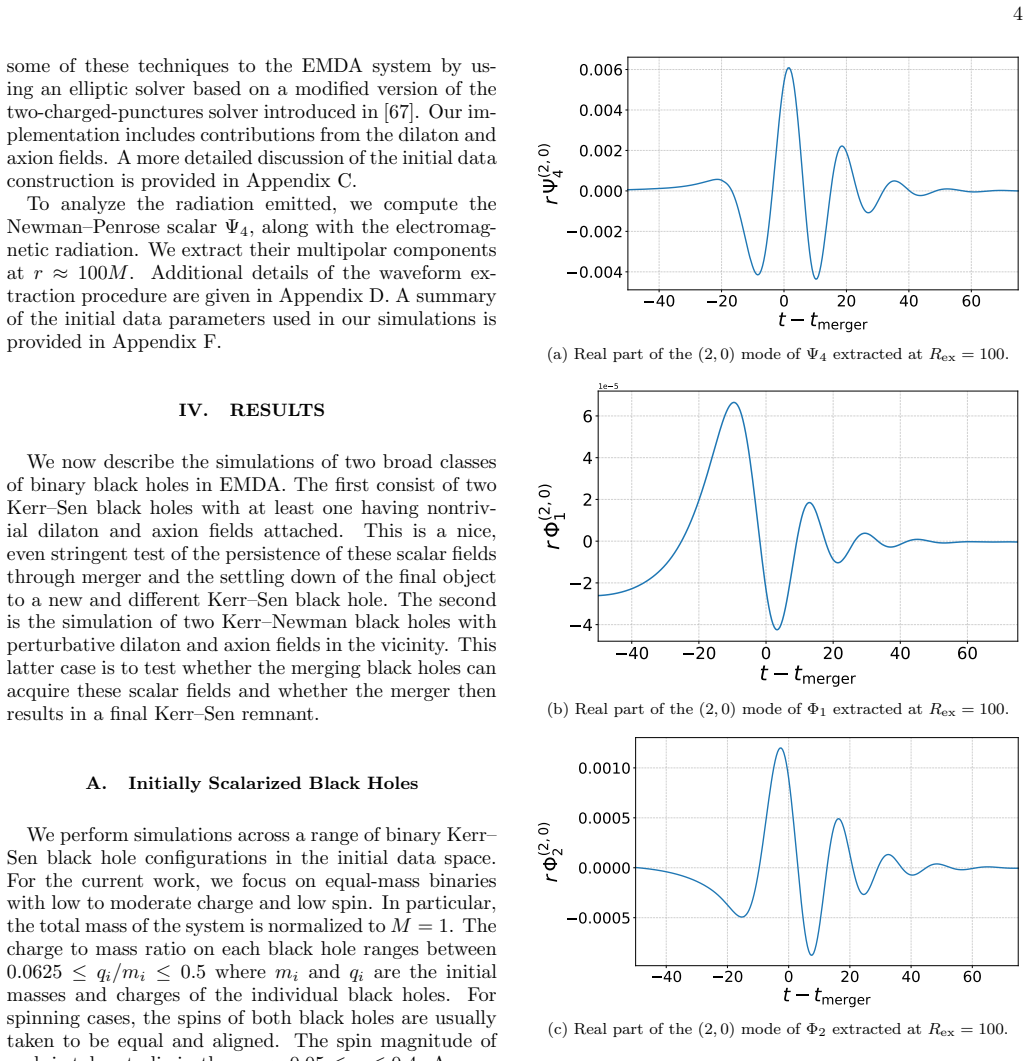
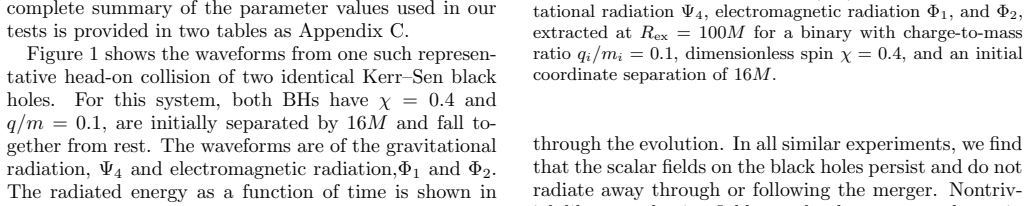
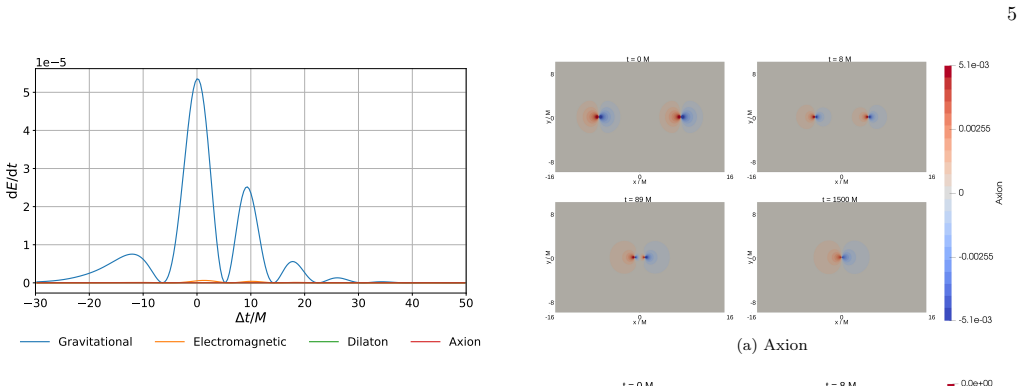
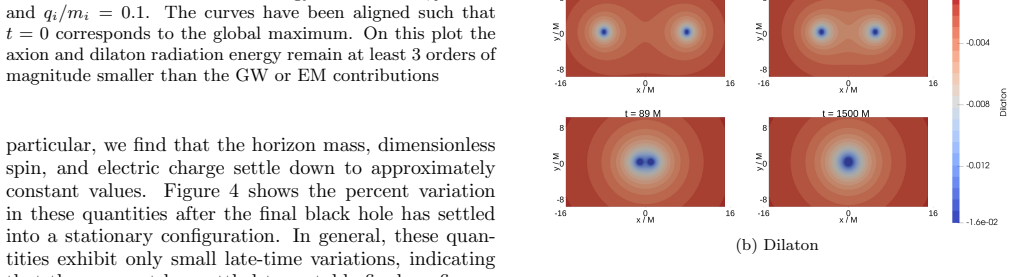
read the original abstract
We investigate the stability of Kerr-Sen black holes, which arise in Einstein-Maxwell-dilaton-axion theory. Within a numerical relativity framework, we perform head-on binary black hole simulations with approximate initial data across a portion of the parameter space. We find that for nontrivial electric charge, a dilaton field persists through merger and that in the presence of spin, the remnant will also retain an axion field. The persistence of these fields for long times after merger strongly suggests the stability of these black holes within this alternative gravity theory. We further test whether initially unscalarized black holes will acquire hair in the presence of a scalar background. We find that black holes immersed in such a background retain scalar hair. Furthermore, we find that even initially unscalarized Kerr-Newman black holes will scalarize and remain scalarized throughout the evolution.
Editorial analysis
A structured set of objections, weighed in public.
Referee Report
Summary. The paper investigates nonlinear stability of Kerr-Sen black holes in Einstein-Maxwell-dilaton-axion theory via numerical relativity simulations of head-on binary mergers using approximate initial data over a limited parameter space. It reports persistence of dilaton fields for charged cases and axion fields for spinning cases after merger, interprets this as evidence of stability, and additionally finds that initially unscalarized black holes acquire and retain scalar hair when immersed in a scalar background or via scalarization of Kerr-Newman solutions.
Significance. Numerical tests of stability for charged, spinning black holes in modified gravity via binary mergers could provide useful evidence if the simulations are shown to be robust; the persistence results, if confirmed, would support the viability of Kerr-Sen solutions as end states and motivate further study of scalar hair in dynamical settings.
major comments (3)
- [Abstract] Abstract and concluding section: the claim that 'persistence of these fields for long times after merger strongly suggests the stability' is not justified by the reported setup, as head-on collisions with approximate initial data exclude orbital angular momentum and generic perturbation directions that could excite unstable modes.
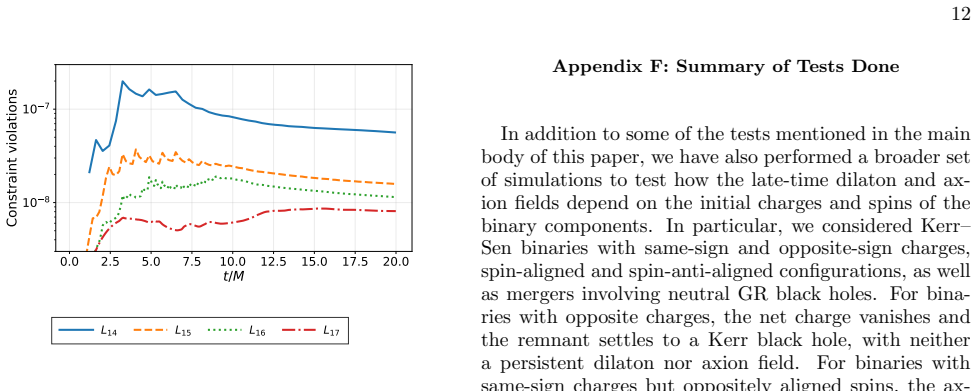
- [Numerical Methods] Numerical setup section: no convergence tests, resolution studies, or error bars are described, leaving the reliability of late-time field persistence unverified and open to contamination from constraint violations in the approximate initial data.
- [Results] Results section: the restricted parameter scan (head-on only, portion of charge/spin/mass-ratio space) does not rule out instabilities for other configurations, undermining the inference from observed persistence to general nonlinear stability.
minor comments (2)
- [Introduction] Notation for the dilaton and axion fields should be defined explicitly at first use to aid readability.
- [Figures] Figure captions could include more detail on the plotted quantities and simulation parameters for clarity.
Simulated Author's Rebuttal
We thank the referee for the careful review and constructive feedback. We address each major comment below, agreeing where revisions are needed to better reflect the scope of our work and proposing changes to the abstract, numerical methods, and results sections.
read point-by-point responses
-
Referee: [Abstract] Abstract and concluding section: the claim that 'persistence of these fields for long times after merger strongly suggests the stability' is not justified by the reported setup, as head-on collisions with approximate initial data exclude orbital angular momentum and generic perturbation directions that could excite unstable modes.
Authors: We agree that the original phrasing overstates the generality of the conclusion. Head-on mergers with approximate initial data do not include orbital angular momentum and cannot excite all possible perturbation modes. We will revise the abstract and concluding section to state that the observed persistence provides supporting evidence for stability against the perturbations realized in these specific head-on simulations, rather than claiming it strongly suggests general nonlinear stability. revision: yes
-
Referee: [Numerical Methods] Numerical setup section: no convergence tests, resolution studies, or error bars are described, leaving the reliability of late-time field persistence unverified and open to contamination from constraint violations in the approximate initial data.
Authors: This point is correct and represents a clear gap in the current manuscript. We will add convergence tests at multiple resolutions, resolution studies for the scalar fields, and error estimates in a revised numerical methods section to demonstrate that the late-time persistence is robust and not an artifact of constraint violations or numerical errors. revision: yes
-
Referee: [Results] Results section: the restricted parameter scan (head-on only, portion of charge/spin/mass-ratio space) does not rule out instabilities for other configurations, undermining the inference from observed persistence to general nonlinear stability.
Authors: The manuscript already notes that only a portion of parameter space is explored with head-on mergers. We do not claim to have ruled out instabilities in unexamined regimes. We will revise the results section to emphasize these restrictions and qualify the interpretation as applying to the simulated configurations, avoiding any implication of comprehensive nonlinear stability. revision: partial
Circularity Check
No circularity in numerical simulation results
full rationale
The paper's conclusions rest on direct numerical relativity evolutions of head-on mergers with approximate initial data, where observed persistence of dilaton and axion fields after merger is taken to suggest stability. No analytical derivation chain, self-definitional equations, fitted parameters renamed as predictions, or load-bearing self-citations are present; the results are generated by evolving the underlying field equations rather than reducing to the inputs by construction.
Axiom & Free-Parameter Ledger
axioms (2)
- domain assumption Einstein-Maxwell-dilaton-axion theory field equations govern the dynamics
- domain assumption Approximate initial data can be used to evolve head-on binary mergers
Reference graph
Works this paper leans on
-
[1]
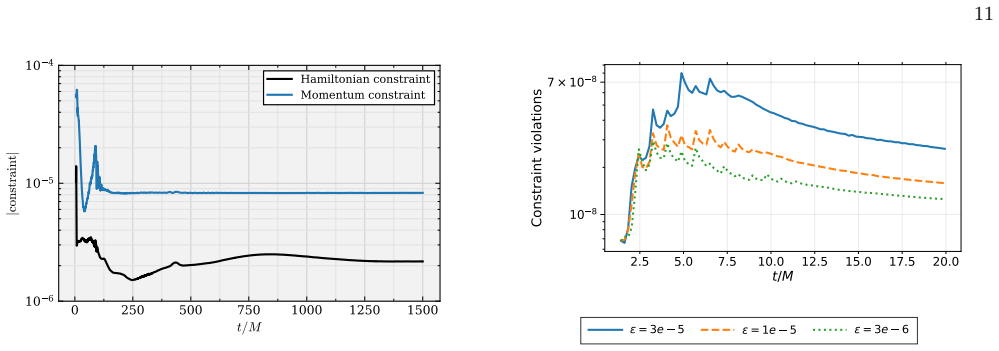
In particular, we compute theL 2 norms of the 11 0 250 500 750 1000 1250 1500 t/M 10 6 10 5 10 4 |constraint| Hamiltonian constraint Momentum constraint FIG
Constraint quantities We monitor the constraint violations throughout the evolution. In particular, we compute theL 2 norms of the 11 0 250 500 750 1000 1250 1500 t/M 10 6 10 5 10 4 |constraint| Hamiltonian constraint Momentum constraint FIG. 6. The Hamiltonian constraintHand summed momen- tum constraint violation measured over the full simulation. TheL 2...
-
[2]
Abbott, others (LIGO Scientific Collaboration, V
R. Abbott, others (LIGO Scientific Collaboration, V. Collaboration, and K. Collaboration), Tests of general relativity with gwtc-3, Physical Review D112, 084080 (2025), arXiv:2112.06861 [gr-qc]
Pith/arXiv arXiv 2025
- [3]
-
[4]
A. G. Abacet al.(LIGO Scientific Collaboration, Virgo Collaboration, and KAGRA Collaboration), Black hole spectroscopy and tests of general relativity with gw250114, Phys. Rev. Lett.136, 041403 (2026), arXiv:2509.08099 [gr-qc]
Pith/arXiv arXiv 2026
-
[5]
S. Giri, U. Danielsson, L. Lehner, and F. Pretorius, Ex- ploring black hole mimickers: Electromagnetic and grav- itational signatures of ads black shells, Physical Review D111, 024007 (2025), arXiv:2405.08062 [gr-qc]
arXiv 2025
-
[6]
K. Clough, T. Dietrich, and S. Khan, What no one 13 has seen before: gravitational waveforms from warp drive collapse, The Open Journal of Astrophysics7, 10.33232/001c.121868 (2024), arXiv:2406.02466 [gr-qc]
-
[8]
N. Yunes and X. Siemens, Gravitational-wave tests of general relativity with ground-based detectors and pulsar-timing arrays, Living Rev. Relativ.16, 9 (2013), arXiv:1304.3473 [gr-qc]
Pith/arXiv arXiv 2013
-
[9]
K. Yagi and L. C. Stein, Black hole based tests of gen- eral relativity, Class. Quant. Grav.33, 054001 (2016), arXiv:1602.02413 [gr-qc]
Pith/arXiv arXiv 2016
-
[10]
J. Meidam, M. Agathos, C. Van Den Broeck, J. Veitch, and B. S. Sathyaprakash, Testing the no-hair theorem with black hole ringdowns using tiger, Phys. Rev. D90, 064009 (2014), arXiv:1406.3201 [gr-qc]
Pith/arXiv arXiv 2014
-
[11]
Bertiet al., Testing general relativity with present and future astrophysical observations, Class
E. Bertiet al., Testing general relativity with present and future astrophysical observations, Class. Quant. Grav. 32, 243001 (2015), arXiv:1501.07274 [gr-qc]
Pith/arXiv arXiv 2015
-
[12]
H. Yang, K. Yagi, J. Blackman, L. Lehner, V. Paschalidis, F. Pretorius, and N. Yunes, Black hole spectroscopy with coherent mode stacking, Phys. Rev. Lett.118, 161101 (2017), arXiv:1701.05808 [gr-qc]
Pith/arXiv arXiv 2017
-
[13]
B. P. Abbottet al., Gwtc-1: A gravitational-wave tran- sient catalog of compact binary mergers observed by ligo and virgo during the first and second observing runs, Phys. Rev. X9, 031040 (2019), arXiv:1811.12907 [gr-qc]
Pith/arXiv arXiv 2019
-
[14]
R. Abbottet al.(LIGO Scientific Collaboration and Virgo Collaboration), Gwtc-2: Compact binary coales- cences observed by ligo and virgo during the first half of the third observing run, Phys. Rev. X11, 021053 (2021), arXiv:2010.14527 [gr-qc]
Pith/arXiv arXiv 2021
-
[15]
R. Abbottet al.(LIGO Scientific Collaboration, Virgo Collaboration, and KAGRA Collaboration), Gwtc-3: Compact binary coalescences observed by ligo and virgo during the second part of the third observing run, Phys. Rev. X13, 041039 (2023), arXiv:2111.03606 [gr-qc]
Pith/arXiv arXiv 2023
-
[16]
A. G. Abacet al., GWTC-4.0: Updating the gravitational-wave transient catalog with observations from the first part of the fourth ligo-virgo-kagra observ- ing run (2025), arXiv:2508.18082 [gr-qc]
Pith/arXiv arXiv 2025
-
[17]
B. P. Abbott, others (LIGO Scientific Collabora- tion, and V. Collaboration), Tests of general relativity with gw150914, Phys. Rev. Lett.116, 221101 (2016), arXiv:1602.03841 [gr-qc]
Pith/arXiv arXiv 2016
-
[18]
B. P. Abbottet al., Observation of gravitational waves from a binary black hole merger, Phys. Rev. Lett.116, 061102 (2016), arXiv:1602.03837 [gr-qc]
Pith/arXiv arXiv 2016
-
[19]
V. Cardoso, L. Gualtieri, C. Herdeiro, U. Sperhake, P. M. Chesler, L. Lehner, S. C. Park, H. S. Reall, C. F. Sopuerta,et al., NR/HEP: roadmap for the fu- ture, Classical and Quantum Gravity29, 244001 (2012), arXiv:1201.5118
Pith/arXiv arXiv 2012
- [20]
-
[21]
N. Afshordi, A. Ashtekar, E. Barausse, E. Berti, R. Brito, L. Buoninfante, R. Carballo-Rubio, V. Car- doso, G. Carullo, M. Dafermos, M. De Laurentis, A. del Rio, F. Di Filippo, A. Eichhorn, R. Emparan, R. Gre- gory, C. A. R. Herdeiro, J. Kunz, L. Lehner, S. Liberati, S. D. Mathur, S. Nissanke, P. Pani, A. Platania, F. Pre- torius, M. Sasaki, P. Tiede, W. ...
arXiv 2024
-
[22]
C. Bambi, R. Brustein, V. Cardoso, A. Chael, U. Daniels- son, S. Giri, A. Gupta, P. Heidmann, L. Lehner, S. Liebling, A. Maselli, E. Maggio, S. Mathur, L. Medeiros, A. B. Nielsen, H. R. Olivares-S´ anchez, P. Pani, N. Siemonsen, and G. N. Wong, Black hole mimickers: from theory to observation (2025), arXiv:2505.09014 [gr-qc]
arXiv 2025
-
[23]
L. Bernard, S. Giri, L. Lehner, and R. Sturani, Generic eft-motivated beyond general relativity gravitational wave tests and their curvature dependence: from obser- vation to interpretation, Physical Review D112, 124013 (2025), arXiv:2507.17143 [gr-qc]
arXiv 2025
-
[24]
Alexander and N
S. Alexander and N. Yunes, Chern–simons modified gen- eral relativity, Physics Reports480, 1 (2009)
2009
-
[25]
Okounkova, L
M. Okounkova, L. C. Stein, M. A. Scheel, and S. A. Teukolsky, Numerical binary black hole collisions in dy- namical chern-simons gravity, Phys. Rev. D100, 104026 (2019)
2019
-
[26]
M. Okounkova, Numerical relativity simulation of GW150914 in Einstein dilaton Gauss-Bonnet gravity, Phys. Rev. D102, 084046 (2020), arXiv:2001.03571 [gr- qc]
arXiv 2020
-
[27]
Okounkova, L
M. Okounkova, L. C. Stein, J. Moxon, M. A. Scheel, and S. A. Teukolsky, Numerical relativity simulation of gw150914 beyond general relativity, Phys. Rev. D101, 104016 (2020)
2020
-
[28]
J. L. Ripley and F. Pretorius, Dynamics of a ${\mathbb{z}} {2}$symmetric EdGB gravity in spher- ical symmetry, Classical and Quantum Gravity37, 155003 (2020)
2020
-
[29]
J. L. Ripley and F. Pretorius, Scalarized black hole dy- namics in einstein-dilaton-gauss-bonnet gravity, Phys. Rev. D101, 044015 (2020)
2020
-
[30]
Cayuso and L
R. Cayuso and L. Lehner, Nonlinear, noniterative treat- ment of eft-motivated gravity, Phys. Rev. D102, 084008 (2020)
2020
-
[31]
Held and H
A. Held and H. Lim, Nonlinear dynamics of quadratic gravity in spherical symmetry, Phys. Rev. D104, 084075 (2021)
2021
-
[32]
Held and H
A. Held and H. Lim, Nonlinear evolution of quadratic gravity in 3 + 1 dimensions, Phys. Rev. D108, 104025 (2023)
2023
-
[33]
A. Held and H. Lim, Black-hole binaries and waveforms in quadratic gravity (2025), arXiv:2503.13428 [gr-qc]
arXiv 2025
-
[34]
W. E. East and N. Siemonsen, Instability and backre- action of massive spin-2 fields around black holes, Phys. Rev. D108, 124048 (2023)
2023
- [35]
-
[36]
Corman, L
M. Corman, L. Lehner, W. E. East, and G. Dideron, Non- linear studies of modifications to general relativity: Com- paring different approaches, Phys. Rev. D110, 084048 (2024)
2024
-
[37]
Sen, Rotating charged black hole solution in het- erotic string theory, Phys
A. Sen, Rotating charged black hole solution in het- erotic string theory, Phys. Rev. Lett.69, 1006 (1992), 14 arXiv:hep-th/9204046
Pith/arXiv arXiv 1992
-
[38]
Sen, Black hole solutions in heterotic string theory on a torus, Nucl
A. Sen, Black hole solutions in heterotic string theory on a torus, Nucl. Phys. B440, 421 (1995), arXiv:hep- th/9411187
arXiv 1995
-
[39]
Israel, Event horizons in static vacuum space-times, Phys
W. Israel, Event horizons in static vacuum space-times, Phys. Rev.164, 1776 (1967)
1967
-
[40]
Carter, Axisymmetric black hole has only two degrees of freedom, Phys
B. Carter, Axisymmetric black hole has only two degrees of freedom, Phys. Rev. Lett.26, 331 (1971)
1971
- [41]
-
[42]
H. O. Silva, H. Witek, M. Elley, and N. Yunes, Dynamical descalarization in binary black hole mergers, Phys. Rev. Lett.127, 031101 (2021), arXiv:2012.10436 [gr-qc]
arXiv 2021
-
[43]
F.-L. Juli´ e, On the motion of hairy black holes in einstein-maxwell-dilaton theories, JCAP01, 026, arXiv:1711.10769 [gr-qc]
-
[44]
E. W. Hirschmann, L. Lehner, S. L. Liebling, and C. Palenzuela, Black hole dynamics in einstein-maxwell- dilaton theory, Phys. Rev. D97, 064032 (2018)
2018
-
[45]
C. N. Pope, D. O. Rohrer, and B. F. Whiting, Pertur- bations of black holes in einstein-maxwell-dilaton-axion (emda) theories (2025), arXiv:2508.04589 [gr-qc]
arXiv 2025
-
[46]
S. K. Sahoo, N. Yadav, and I. Banerjee, Imprints of einstein–maxwell–dilaton–axion gravity in the observed shadows of sgr a* and m87*, Phys. Rev. D109, 044008 (2024)
2024
-
[47]
S. K. Sahoo and I. Banerjee, Deciphering signatures of kerr–sen black holes in presence of plasma from the event horizon telescope data, JCAP10, 100, arXiv:2504.09443 [gr-qc]
-
[48]
S. Gasparotto, J. Zosso, L. Arest´ e Sal´ o, D. D. Doneva, and S. S. Yazadjiev, Gravitational memory from hairy binary black hole mergers (2026), arXiv:2604.09350 [gr- qc]
Pith/arXiv arXiv 2026
-
[49]
M. Agathos, W. Del Pozzo, T. G. F. Li, C. Van Den Broeck, J. Veitch, and S. Vitale, TIGER: A data analysis pipeline for testing the strong-field dynamics of general relativity with gravitational wave signals from coalescing compact binaries, Phys. Rev. D89, 082001 (2014), arXiv:1311.0420 [gr-qc]
Pith/arXiv arXiv 2014
-
[50]
D. D. Doneva, L. Arest´ e Sal´ o, K. Clough, P. Figueras, and S. S. Yazadjiev, Testing the limits of scalar-gauss- bonnet gravity through nonlinear evolutions of spin- induced scalarization, Physical Review D108, 084017 (2023), arXiv:2307.06474 [gr-qc]
arXiv 2023
-
[51]
Shibata and T
M. Shibata and T. Nakamura, Evolution of three- dimensional gravitational waves: Harmonic slicing case, Phys. Rev. D52, 5428 (1995)
1995
-
[52]
T. W. Baumgarte and S. L. Shapiro, Numerical integra- tion of einstein’s field equations, Phys. Rev. D59, 024007 (1998), arXiv:gr-qc/9810065 [gr-qc]
Pith/arXiv arXiv 1998
-
[53]
T. W. Baumgarte and S. L. Shapiro,Numerical Relativ- ity: Solving Einstein ’s Equations on the Computer(Cam- bridge University Press, Cambridge, UK, 2010)
2010
-
[54]
M. Campanelli, C. O. Lousto, P. Marronetti, and Y. Zlo- chower, Accurate evolutions of orbiting black-hole bina- ries without excision, Phys. Rev. Lett.96, 111101 (2006), arXiv:gr-qc/0511048
Pith/arXiv arXiv 2006
-
[55]
J. G. Baker, J. Centrella, D.-I. Choi, M. Koppitz, and J. van Meter, Gravitational wave extraction from an in- spiraling configuration of merging black holes, Phys. Rev. Lett.96, 111102 (2006), arXiv:gr-qc/0511103
Pith/arXiv arXiv 2006
-
[56]
Fernando, D
M. Fernando, D. Neilsen, E. Hirschmann, and H. Sundar, A scalable framework for adaptive computational general relativity on heterogeneous clusters, inProceedings of the ACM International Conference on Supercomputing, ICS ’19 (Association for Computing Machinery, New York, NY, USA, 2019)
2019
-
[57]
M. Fernando, D. Neilsen, H. Lim, E. Hirschmann, and H. Sundar, Massively parallel simulations of binary black hole intermediate-mass-ratio inspirals, SIAM Journal on Scientific Computing41, C97 (2019), arXiv:1807.06128 [cs.DC]
Pith/arXiv arXiv 2019
-
[58]
Fernando, D
M. Fernando, D. Neilsen, Y. Zlochower, E. W. Hirschmann, and H. Sundar, Massively parallel simula- tions of binary black holes with adaptive wavelet mul- tiresolution, Phys. Rev. D107, 064035 (2023)
2023
-
[59]
J. DeBuhr, B. Zhang, M. Anderson, D. Neilsen, E. W. Hirschmann, T. Grenga, and S. Paolucci, Relativistic hy- drodynamics with wavelets, The Astrophysical Journal 867, 112 (2018), arXiv:1512.00386 [astro-ph.IM]
Pith/arXiv arXiv 2018
-
[60]
M. Anderson, E. W. Hirschmann, S. L. Liebling, and D. Neilsen, Relativistic mhd with adaptive mesh refine- ment, Classical and Quantum Gravity23, 6503 (2006), arXiv:gr-qc/0605102 [gr-qc]
Pith/arXiv arXiv 2006
-
[61]
Kreiss and J
H.-O. Kreiss and J. Oliger,Methods for the Approxi- mate Solution of Time Dependent Problems, Global At- mospheric Research Programme (GARP): GARP Publi- cation Series, Vol. 10 (GARP Publication, 1973)
1973
-
[62]
W. K. Black, D. Neilsen, E. W. Hirschmann, D. F. Van Komen, and M. Fernando, Nyquist-resolving grav- itational waves via orbital frequency-based refinement, Phys. Rev. D111, 124001 (2025), arXiv:2502.20282 [gr- qc]
arXiv 2025
-
[63]
Z. B. Etienne, T. Assump¸ c˜ ao, L. R. Werneck, and S. D. Tootle, BHaHAHA: A fast, robust apparent hori- zon finder library for numerical relativity, Classical and Quantum Gravity43, 075007 (2026), arXiv:2505.15912 [gr-qc]
Pith/arXiv arXiv 2026
-
[64]
M. Alcubierre, J. C. Degollado, and M. Salgado, The einstein–maxwell system in 3+1 form and initial data for multiple charged black holes, Phys. Rev. D80, 104022 (2009), arXiv:0907.1151 [gr-qc]
Pith/arXiv arXiv 2009
-
[65]
S. Mukherjee, N. K. Johnson-McDaniel, W. Tichy, and S. L. Liebling, Conformally curved initial data for charged, spinning black hole binaries on arbitrary orbits (2022), arXiv:2202.12133 [gr-qc]
arXiv 2022
-
[66]
Zilh˜ ao, V
M. Zilh˜ ao, V. Cardoso, C. Herdeiro, L. Lehner, and U. Sperhake, Collisions of oppositely charged black holes, Phys. Rev. D89, 044008 (2014)
2014
-
[67]
Zilh˜ ao, V
M. Zilh˜ ao, V. Cardoso, C. Herdeiro, L. Lehner, and U. Sperhake, Collisions of charged black holes, Phys. Rev. D85, 124062 (2012)
2012
-
[68]
G. Bozzola and V. Paschalidis, Initial data for general rel- ativistic simulations of multiple electrically charged black holes with linear and angular momenta, Phys. Rev. D99, 104044 (2019), arXiv:1903.01036 [gr-qc]
Pith/arXiv arXiv 2019
-
[69]
Note that in this Appendix only,χrepresents the con- formal factor and not the dimensionless spin parameter
-
[70]
Z. B. Etienne, Improved moving-puncture techniques for compact binary simulations, Phys. Rev. D110, 064045 (2024), arXiv:2404.01137 [gr-qc]
arXiv 2024
-
[71]
J. Ferreira, G. Bozzola, C. A. R. Herdeiro, V. Paschalidis, and M. Zilh˜ ao, Electromagnetic duality degeneracy in dynamical black hole mergers (2026), arXiv:2605.20493 15 [gr-qc]
Pith/arXiv arXiv 2026
-
[72]
J. A. Valiente Kroon, Nonexistence of conformally flat slices in kerr and other stationary spacetimes, Phys. Rev. Lett.92, 041101 (2004)
2004
-
[73]
Garat and R
A. Garat and R. H. Price, Nonexistence of conformally flat slices of the kerr spacetime, Phys. Rev. D61, 124011 (2000)
2000
-
[74]
S. Dain, C. O. Lousto, and R. Takahashi, New confor- mally flat initial data for spinning black holes, Phys. Rev. D65, 104038 (2002), arXiv:gr-qc/0201062
Pith/arXiv arXiv 2002
-
[75]
G. Bozzola and V. Paschalidis, General relativistic sim- ulations of the quasi-circular inspiral and merger of charged black holes: Gw150914 and fundamental physics implications, Phys. Rev. Lett.126, 041103 (2021), arXiv:2006.15764 [gr-qc]
arXiv 2021
-
[76]
J. M. Bowen and J. York, James W., Time-asymmetric initial data for black holes and black-hole collisions, Phys. Rev. D21, 2047 (1980)
2047
-
[77]
Newman and R
E. Newman and R. Penrose, An approach to gravitational radiation by a method of spin coefficients, J. Math. Phys. 3, 566 (1962)
1962
discussion (0)
Sign in with ORCID, Apple, or X to comment. Anyone can read and Pith papers without signing in.