REVIEW 2 major objections 1 minor 42 references
Solving biquadratic equations determines local normal forms for every p-adic analytic integrable system in dimension 4.
Reviewed by Pith at T0; open to challenge. T0 means a machine referee read the full paper against a public rubric. the ladder, T0–T4 →
T0 review · grok-4.3
2026-06-25 21:49 UTC pith:TS67I7HI
load-bearing objection The paper gives concrete methods to compute 4D p-adic normal forms by reducing to biquadratic equations plus two new auxiliary notions, but the coverage claim rests on the authors' prior classification without re-checking it here. the 2 major comments →
p-adic integrable systems: from biquadratic equations to local models
The pith
A machine-rendered reading of the paper's core claim, the machinery that carries it, and where it could break.
Core claim
The central claim is that the local normal forms of p-adic analytic integrable systems in dimension 4 can be determined in all cases by solving biquadratic equations, using the prior classification of those forms together with analytic estimates and Galois theory of p-adic extensions; the new notions of almost eigenvectors and aligned symplectic coordinates support the computations and are of independent interest.
What carries the argument
Reduction of the normal-form problem to the solution of biquadratic equations, supported by the auxiliary notions of almost eigenvectors and aligned symplectic coordinates.
Load-bearing premise
The existing classification of normal forms in dimension 4 is correct and applies without exception to the integrable systems considered here.
What would settle it
An explicit integrable system in dimension 4 whose local normal form, computed via the biquadratic-equation procedure, fails to match the actual local behavior obtained from the p-adic classification would falsify the claim.
If this is right
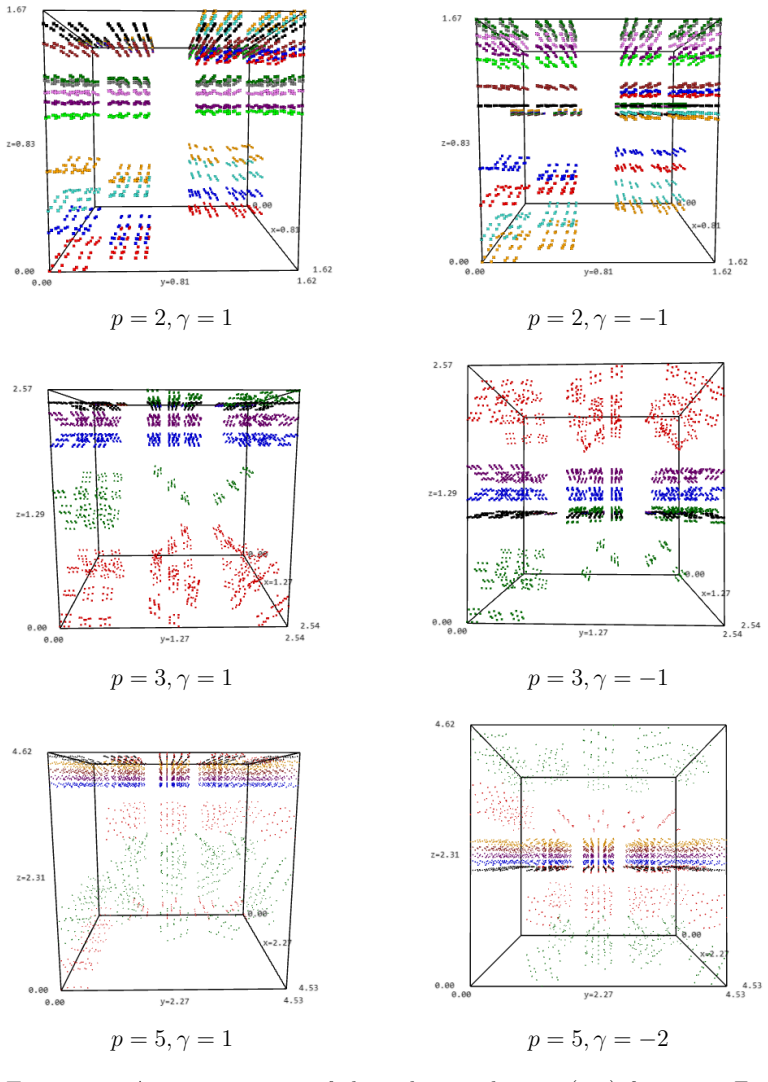
- Normal forms of the p-coupled angular momentum system become computable by direct solution of biquadratic equations.
- All cases in dimension 4 are covered by the same reduction procedure.
- Geometrical and dynamical properties encoded in the normal forms can be read off once the biquadratic equations are solved.
- The auxiliary notions of almost eigenvectors and aligned symplectic coordinates can be applied to other questions in p-adic symplectic geometry.
Where Pith is reading between the lines
- The same biquadratic reduction might extend to higher dimensions once a classification of normal forms becomes available there.
- The method could be tested numerically on concrete p-adic examples to produce explicit coordinate changes that align the system with the classified models.
- If the biquadratic equations admit closed-form solutions in many cases, the approach would yield fully explicit local models rather than merely existence statements.
Editorial analysis
A structured set of objections, weighed in public.
Referee Report
Summary. The paper introduces techniques based on almost eigenvectors, aligned symplectic coordinates, and solving biquadratic equations to compute explicit information about local normal forms of p-adic analytic integrable systems F:(M,ω)→(Q_p)^n. It claims these methods cover all cases in dimension 4, building on the authors' prior classification of normal forms, and illustrates their use for the p-coupled angular momentum system. Proofs combine analytic estimates with Galois theory over p-adic extensions, while main statements are presented as self-contained.
Significance. If the coverage claim holds, the work would make determination of normal forms in dimension 4 more algorithmic and practical, aiding geometric and dynamical analysis of p-adic integrable systems. The new notions of almost eigenvectors and aligned symplectic coordinates could have independent value in p-adic symplectic geometry.
major comments (2)
- [Introduction / abstract] Introduction and abstract: The central claim that the new techniques 'cover all cases in dimension 4' is stated to rely explicitly on the authors' previous classification of local normal forms. No independent verification, exhaustive check, or summary of that classification's completeness for p-adic analytic systems appears in the manuscript; if the prior classification misses cases or does not apply to examples such as p-coupled angular momentum, the coverage assertion fails.
- [Proofs] Proofs section (on analytic estimates and Galois theory steps): The dependence on the prior classification is load-bearing for the 'all cases' result, yet the manuscript presents main results as self-contained without re-deriving or citing specific theorems from the previous work that establish the normal-form list used here.
minor comments (1)
- [Abstract] Abstract: The phrasing 'the statements of the main results are essentially self-contained' could be clarified to distinguish between the statements themselves and the proofs, which rely on prior work.
Simulated Author's Rebuttal
We thank the referee for the detailed report and the opportunity to clarify the manuscript's scope and dependencies. We address the two major comments point by point. The central claim of coverage in dimension 4 is explicitly conditional on our prior classification, as already stated in the abstract; we will strengthen the presentation by adding a concise summary of that classification and explicit theorem citations.
read point-by-point responses
-
Referee: [Introduction / abstract] The central claim that the new techniques 'cover all cases in dimension 4' is stated to rely explicitly on the authors' previous classification of local normal forms. No independent verification, exhaustive check, or summary of that classification's completeness for p-adic analytic systems appears in the manuscript; if the prior classification misses cases or does not apply to examples such as p-coupled angular momentum, the coverage assertion fails.
Authors: We agree that the coverage assertion is conditional on the completeness of the prior classification (arXiv reference to be added). The manuscript already notes this dependence in the abstract and introduction. To make the dependence transparent, we will insert a short paragraph summarizing the cases from the previous classification (the four normal-form types in 4D) together with explicit citations to the theorems establishing that list. This will also confirm applicability to the p-coupled angular momentum example treated in Section 5. No independent re-derivation of the classification is feasible within the present paper, as that would duplicate the earlier work. revision: yes
-
Referee: [Proofs] Proofs section (on analytic estimates and Galois theory steps): The dependence on the prior classification is load-bearing for the 'all cases' result, yet the manuscript presents main results as self-contained without re-deriving or citing specific theorems from the previous work that establish the normal-form list used here.
Authors: The phrase 'essentially self-contained' in the abstract refers to the statements of the main theorems, which are formulated without assuming prior knowledge of p-adic symplectic geometry. The proofs, however, do invoke the classification. We will revise the proofs section to include precise citations (e.g., Theorem X and Corollary Y of the prior paper) at each step where a normal-form case is invoked. This will clarify the logical structure without altering the analytic or Galois-theoretic arguments. revision: yes
Circularity Check
Reliance on authors' prior classification of dim-4 normal forms for coverage claim
specific steps
-
self citation load bearing
[Abstract]
"The proofs use our previous classification of normal forms and rely on a combination of analytic estimates and Galois theory of p-adic extension fields. However, the statements of the main results are essentially self-contained and do not require prior knowledge of p-adic integrable systems or p-adic symplectic geometry."
The assertion that the new techniques cover all cases in dimension 4 is justified by invoking the authors' prior classification of local normal forms; without independent re-derivation or external verification of that classification within this paper, the coverage claim rests on self-cited prior work by the same authors.
full rationale
The paper's main results introduce original techniques (almost eigenvectors, aligned symplectic coordinates, biquadratic solving) that are presented as self-contained. However, the proofs of coverage for all dim-4 cases explicitly depend on the authors' own previous classification of normal forms, which is not re-established here. This matches self-citation load-bearing but does not reduce the central claims to a definition or fit by construction. No other circular patterns are present.
Axiom & Free-Parameter Ledger
read the original abstract
Let $p$ be a prime number and $n$ a positive integer. The study of normal forms of $p$-adic analytic integrable systems $F=(f_1,\ldots,f_n):(M,\omega)\to(\mathbb{Q}_p)^n$ is essential to understand their geometrical and dynamical properties. Even though in some cases, such as dimension $4$, there is a classification of the local normal forms, it can be a challenge to determine them explicitly. Our goal in this paper is to introduce techniques to compute information about these local normal forms. We then explain how this is useful for instance to study the $p$-coupled angular momentum. The techniques we introduce cover all cases in dimension $4$ and require solving biquadratic equations. Along the way we define two new notions: almost eigenvectors and aligned symplectic coordinates. They are useful to prove our results but also of independent interest. The proofs use our previous classification of normal forms and rely on a combination of analytic estimates and Galois theory of $p$-adic extension fields. However, the statements of the main results are essentially self-contained and do not require prior knowledge of $p$-adic integrable systems or $p$-adic symplectic geometry.
Figures




Reference graph
Works this paper leans on
-
[1]
Atiyah: Convexity and commuting Hamiltonians,Bull
M. Atiyah: Convexity and commuting Hamiltonians,Bull. Lond. Math. Soc.14(1982), 1–15
1982
-
[2]
Brekke, P
L. Brekke, P. G. O. Freund:p-adic numbers in physics.Phys. Rep.233(1) (1993), 1–66
1993
-
[3]
Brekke, P
L. Brekke, P. G. O. Freund, M. Olson, E. Witten: Nonarchimedean string dynamics.Nucl. Phys. B 302(1988), 365–402
1988
-
[4]
L. Chen, X. Liu, L.-Y. Hung: Bending the Bruhat-Tits tree. Part II. Thep-adic BTZ black hole and local diffeomorphism on the Bruhat-Tits tree.Journal of High Energy Physics(2021), article number 97
2021
-
[5]
J. I. Cirac, D. P´ erez-Garc´ ıa, N. Schuch, F. Verstraete: Matrix product states and projected entangled pair states: Concepts, symmetries, theorems.Rev. Mod. Phys.93(4) (2021), 045003
2021
-
[6]
Crespo, ´A
L. Crespo, ´A. Pelayo: Thep-adic Jaynes-Cummings model in symplectic geometry.J. Nonlinear Sci.35(2025), article number 66
2025
-
[7]
L. Crespo, ´A Pelayo: Rigidity and flexibility inp-adic symplectic geometry,Revista Matem´ atica Complutense, 2026. https://doi.org/10.1007/s13163-026-00566-8
-
[8]
L. Crespo, ´A. Pelayo:p-adic symplectic geometry of integrable systems and Weierstrass-Williamson theory I, preprint, arXiv:2501.14444
-
[9]
L. Crespo, ´A. Pelayo:p-adic symplectic geometry of integrable systems and Weierstrass-Williamson theory II, preprint, arXiv:2602.09898
-
[10]
Darboux's Theorem in $p$-adic symplectic geometry
L. Crespo, ´A. Pelayo: Darboux’s theorem inp-adic symplectic geometry. Preprint, arXiv:2508.15443
work page internal anchor Pith review Pith/arXiv arXiv
-
[11]
L. Crespo, ´A. Pelayo:p-adic angular momentum coupling in symplectic geometry, preprint, arXiv:2510.13415
-
[12]
M. A. de Gosson: Gaussian quantum states can be disentangled using symplectic rotations.Lect. Math. Phys.111(2021), article 73
2021
-
[13]
Delzant: Hamiltoniens p´ eriodiques et images convexes de l’application moment.Bull
T. Delzant: Hamiltoniens p´ eriodiques et images convexes de l’application moment.Bull. Soc. Math. France116(3) (1988), 315–339
1988
-
[14]
Dragovich: p-Adic and Adelic Quantum Mechanics
B. Dragovich: p-Adic and Adelic Quantum Mechanics. Proceedings of the First Int. Conf. on p-Adic Mathematical Physics, 1-5 October 2003, Moscow
2003
-
[15]
Dragovich, A
B. Dragovich, A. Yu. Khrennikov, S. V. Kozyrev, I. V. Volovich: On p-adic mathematical physics. P-Adic Numbers, Ultrametric Analysis, and Applications1(2009), 1–17
2009
-
[16]
Dragovich, A
B. Dragovich, A. Yu. Khrennikov, S. V. Kozyrev, I. V. Volovich, E. I. Zelenov:p-adic mathematical physics: the first 30 years.P-Adic Numbers, Ultrametric Analysis, and Applications9(2017), 87– 121
2017
-
[17]
P. G. O. Freund, M. Olson, Non-archimedean strings.Phys. Lett. B199(2) (1987), 186–190
1987
-
[18]
P. G. O. Freund, E. Witten: Adelic string amplitudes.Phys. Lett. B199(2) (1987), 191–194
1987
-
[19]
A. R. Fuquen-Tibat´ a, H. Garc´ ıa-Compe´ an, W. A. Z´ u˜ niga-Galindo: Euclidean quantum field formu- lation ofp-adic open string amplitudes.Nucl. Phys. B975(2022), 115684
2022
-
[20]
Garc´ ıa-Compe´ an, E
H. Garc´ ıa-Compe´ an, E. Y. L´ opez, Towards non-archimedean superstrings.Nucl. Phys. B984(2022), 115941
2022
-
[21]
F. Q. Gouvea:p-adic Numbers, Springer-Verlag 1993
1993
-
[22]
Guillemin, S
V. Guillemin, S. Sternberg: Convexity properties of the moment mapping.Invent. Math.67(1982), 491–513
1982
-
[23]
G. H. Hardy, S. Ramanujan: Asymptotic formulae in combinatory analysis.Proc. LMS, Second Series,17, 75–115. Reprinted in Collected papers of Srinivasa Ramanujan,Amer. Math. Soc.(2000), 276–309
2000
-
[24]
Heydeman, M
M. Heydeman, M. Marcolli, I. A. Saberi, B. Stoica: Tensor networks,p-adic fields, and algebraic curves: Arithmetic and the ADS 3/CFT2 correspondence.Adv. Theor. Math. Phys.22(1) (2018), 93–176
2018
-
[25]
Z. Hu, S. Hu: Symplectic group and Heisenberg group inp-adic quantum mechanics. Preprint, arXiv:1502.01789
work page internal anchor Pith review Pith/arXiv arXiv
-
[26]
Le Floch, ´A
Y. Le Floch, ´A. Pelayo: Symplectic geometry and spectral properties of classical and quantum coupled angular momenta.J. Nonlinear Sci.29(2016), 655–708
2016
-
[27]
J. E. Marsden, T. S. Ratiu:Introduction to Mechanics and Symmetry.Texts in Applied Mathemat- ics, 17, Springer 1999. 30
1999
-
[28]
Ortega, T
J.-P. Ortega, T. S. Ratiu:Momentum Maps and Hamiltonian Reduction, Progress in Mathematics, 222, Springer 2004
2004
-
[29]
Palmer, ´A
J. Palmer, ´A. Pelayo, X. Tang: Semitoric systems of non-simple type,Revista de la Real Academia de Ciencias Exactas, F´ ısicas y Naturales. Serie A. Matem´ aticas118, 161 (2024)
2024
-
[30]
Pelayo, V
´A. Pelayo, V. Voevodsky, M. A. Warren: A univalent formalization of thep-adic numbers.Math. Struct. in Comp. Science25(2015), 1147–1171
2015
-
[31]
Pelayo, S
´A. Pelayo, S. V˜ u Ngo.c: Semitoric integrable systems on symplectic 4-manifolds.Invent. Math.177 (2009), 571–597
2009
-
[32]
Pelayo, S
´A. Pelayo, S. V˜ u Ngo.c: Constructing integrable systems of semitoric type.Acta Math.206(2011), 93–125
2011
-
[33]
Pelayo, S
´A. Pelayo, S. V˜ u Ngo.c: Symplectic theory of completely integrable Hamiltonian systems.Bull. Amer. Math. Soc.48(3) (2011), 409–455
2011
-
[34]
Ratiu, C
T. Ratiu, C. Wacheux, N. T. Zung: Convexity of singular affine structures and toric-focus integrable Hamiltonian systems, Memoirs Amer. Math. Soc.1424(2017)
2017
-
[35]
Ruelle, E
P. Ruelle, E. Thiran, D. Verstegen, J. Weyers: Quantum mechanics onp-adic fields.J. Math. Phys. 30(1989), 2854–2861
1989
-
[36]
Schneider:p-adic Lie Groups, Springer-Verlag 2011
P. Schneider:p-adic Lie Groups, Springer-Verlag 2011
2011
-
[37]
J. P. Serre: Classification des vari´ et´ es analytiquesp-adiques compactes.Topology3(1965) 409–412
1965
-
[38]
V. S. Vladimirov, I. V. Volovich:p-Adic quantum mechanics.Commun. Math. Phys.123(1989), 659–676
1989
-
[39]
I. V. Volovich:p-Adic strings.Class. Quant. Grav.4(1987), L83–L87
1987
-
[40]
Weierstrass:Mathematische Werke, 1858, Berlin, Band I: 233–246, Band II: 19–44, Nachtrag: 139–148
K. Weierstrass:Mathematische Werke, 1858, Berlin, Band I: 233–246, Band II: 19–44, Nachtrag: 139–148
-
[41]
Williamson: On the algebraic problem concerning the normal forms of linear dynamical systems
J. Williamson: On the algebraic problem concerning the normal forms of linear dynamical systems. American Journal of Mathematics58(1) (1936), 141–163
1936
-
[42]
Zelenov: p-adic Heisenberg group and Maslov index,Comm
E.I. Zelenov: p-adic Heisenberg group and Maslov index,Comm. Math. Phys.155(1993) 489–502. Luis Crespo, Departamento de Matem´aticas, Estad´ıstica y Computaci´on, Universidad de Cantabria, Av. de Los Castros 48, 39005 Santander, Spain Email address:luis.cresporuiz@unican.es ´Alvaro Pelayo, Facultad de Ciencias Matem´aticas, Universidad Complutense de Madr...
1993
discussion (0)
Sign in with ORCID, Apple, or X to comment. Anyone can read and Pith papers without signing in.