Coupled atmospHere Interior modeL Intercomparison (CHILI). I. Evolutionary Modelling -- Primordial Magma Oceans of Earth and Venus
Pith reviewed 2026-06-25 22:11 UTC · model grok-4.3
The pith
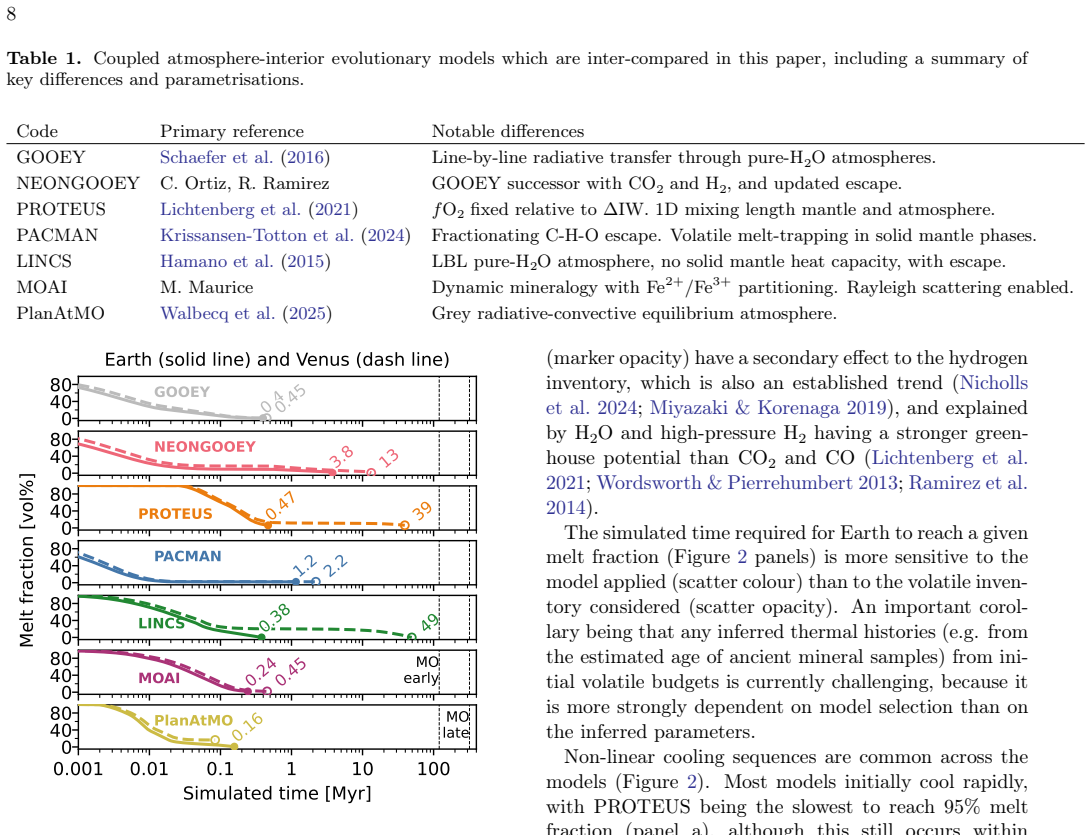
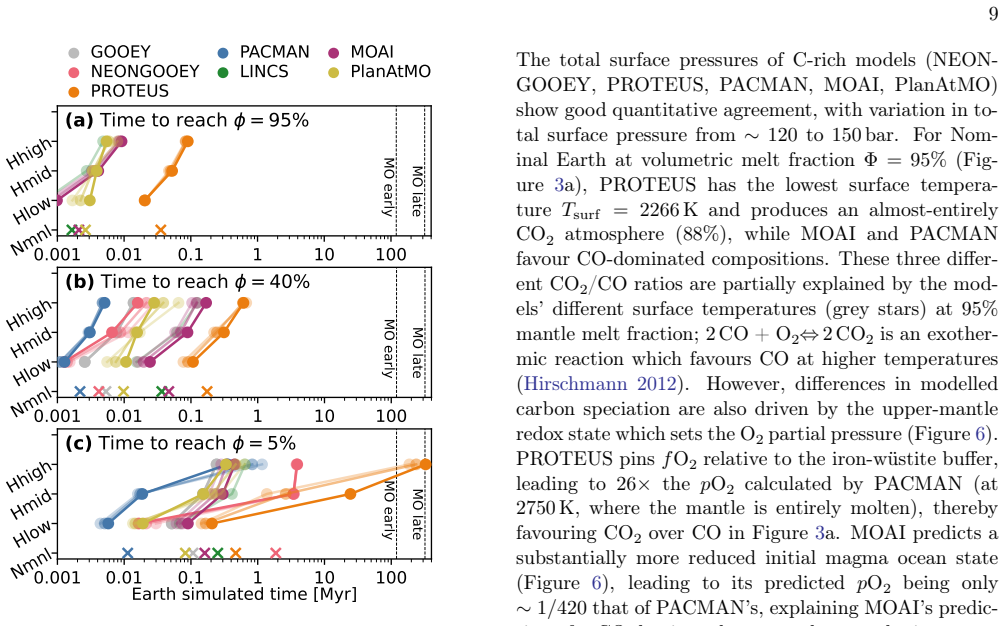
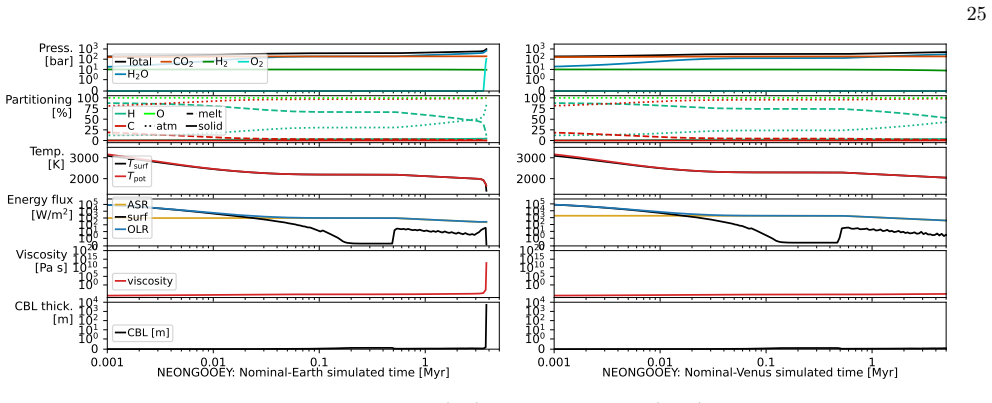
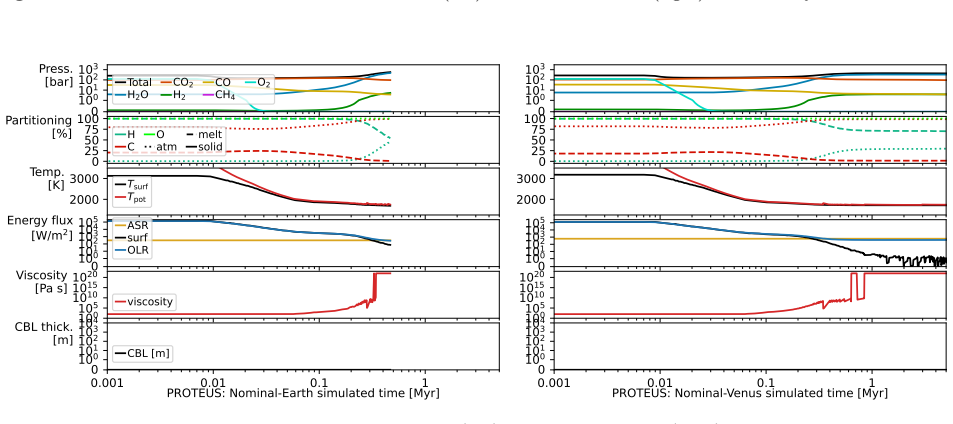
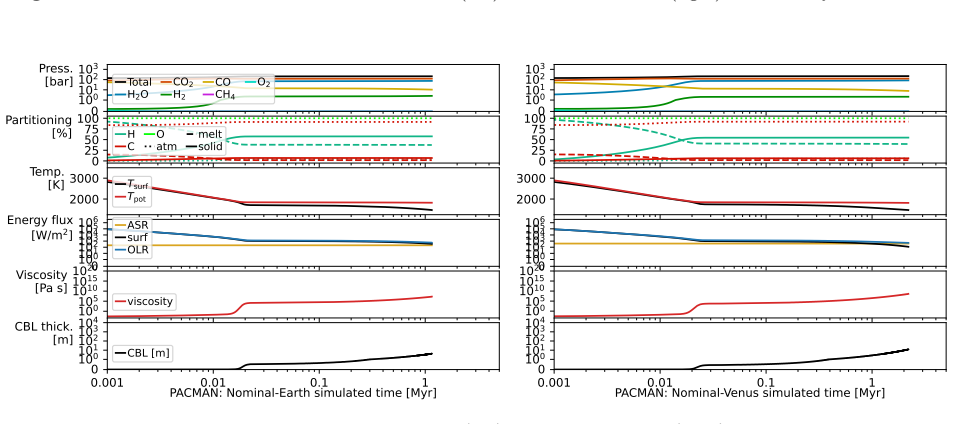
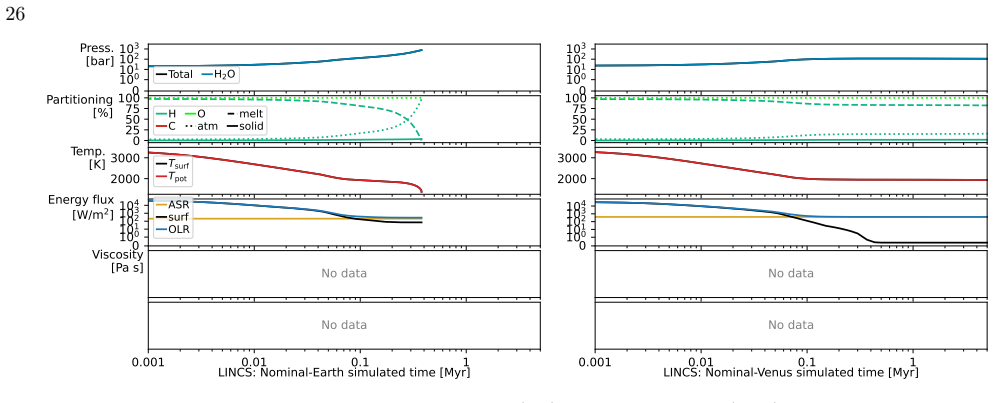
Intercomparison of coupled models shows Earth's magma ocean solidifies in under 4 million years while Venus scenarios allow for up to 50 million years.
A machine-rendered reading of the paper's core claim, the machinery that carries it, and where it could break.
Core claim
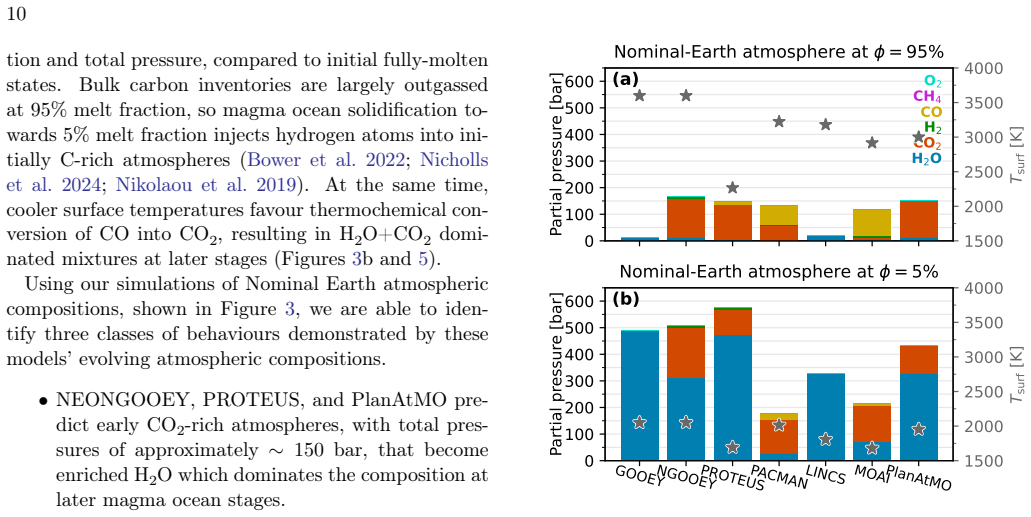
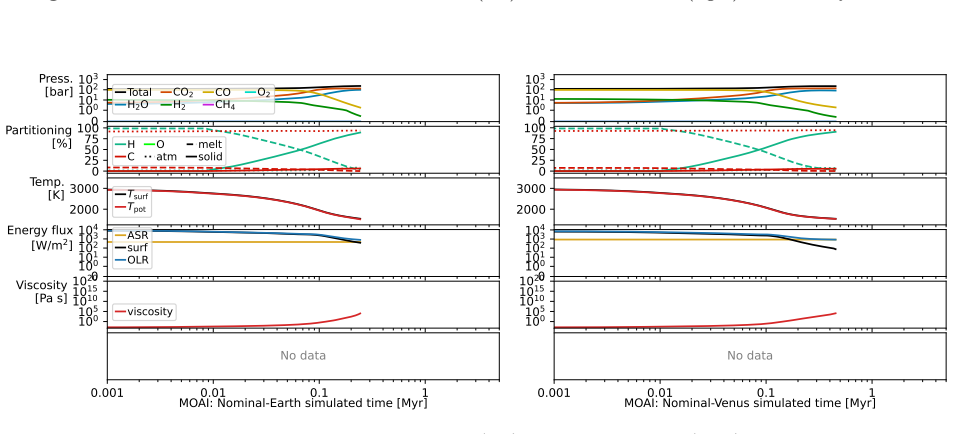
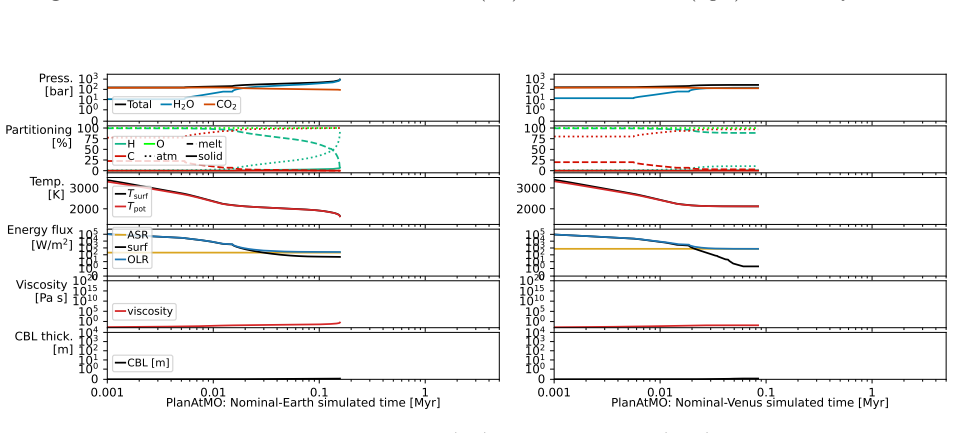
The paper establishes that when several coupled atmosphere-interior evolution codes are applied to identical Earth and Venus initial conditions, they produce short and consistent magma ocean lifetimes for Earth but longer and more divergent lifetimes for Venus, with cooling rates correlating to initial hydrogen and carbon inventories and generated atmospheres commonly exceeding 100 bar surface pressure in C-H-O compositions.
What carries the argument
The CHILI intercomparison of multiple coupled atmosphere-interior codes, where differences in volatile partitioning, mantle geodynamics, convection, and radiative transfer produce the observed spread in solidification timescales and atmospheric outcomes.
If this is right
- Earth's magma ocean phase ends rapidly and consistently across models within 4 Myr of thermal evolution.
- Venus can maintain prolonged magma ocean stages for up to 50 Myr under certain initial conditions and model assumptions.
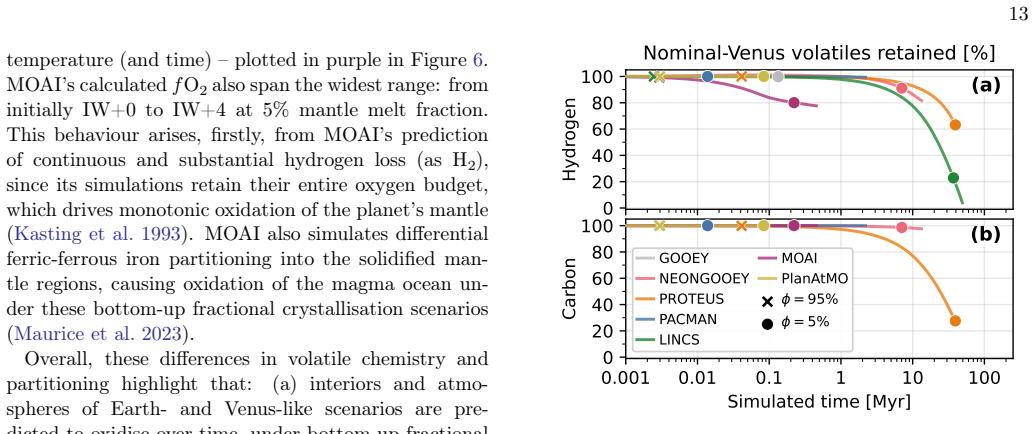
- Cooling timescales scale with the initial budgets of hydrogen and carbon.
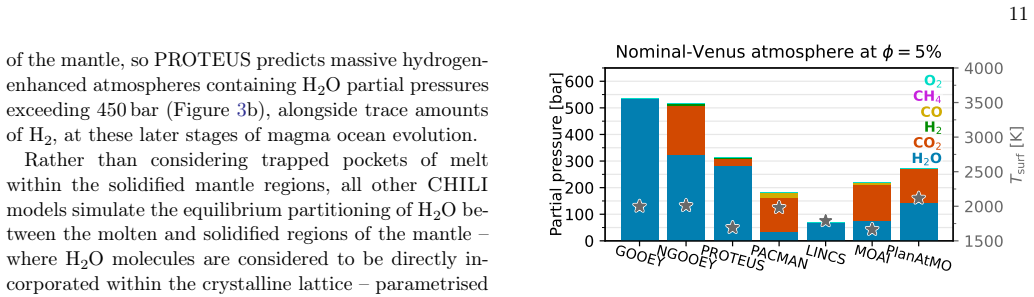
- Outgassed atmospheres from these stages tend to reach surface pressures above 100 bar with C-H-O compositions.
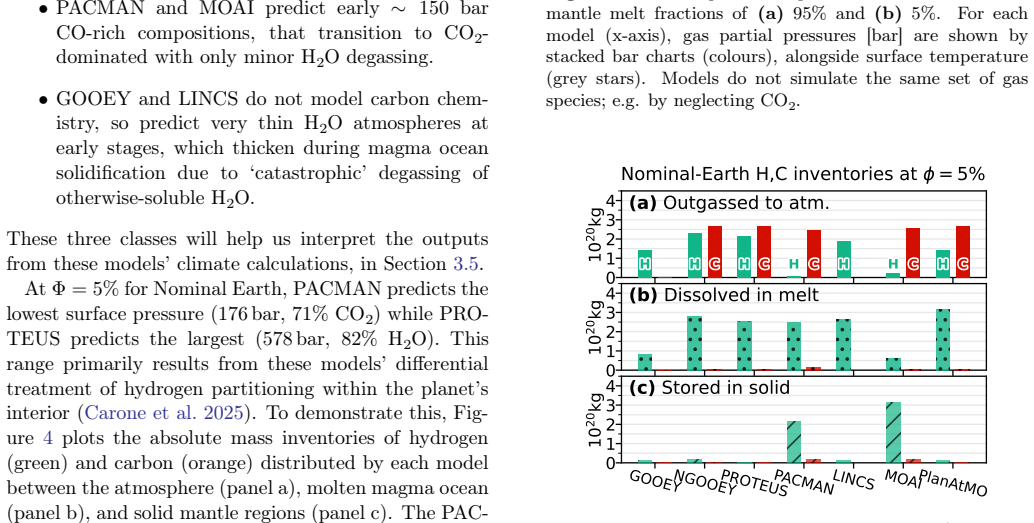
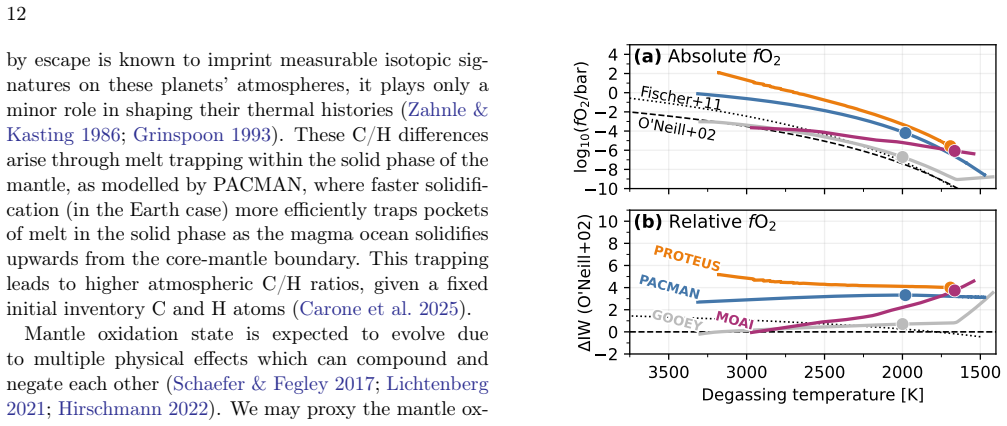
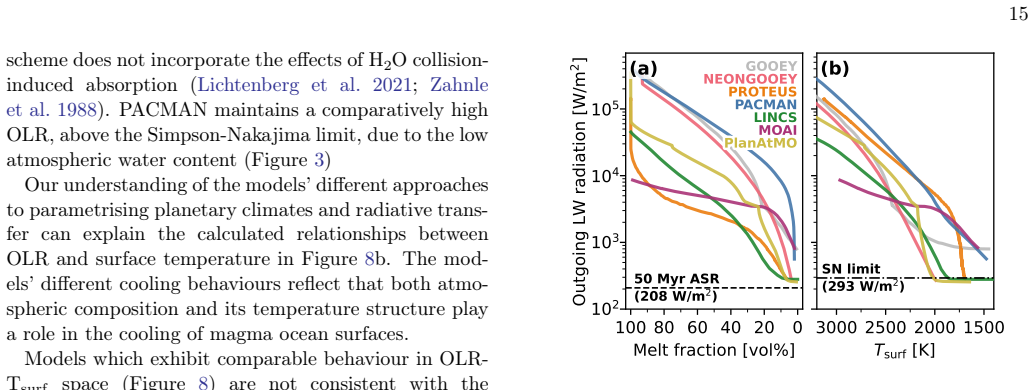
- Model variance is driven by choices in volatile partitioning, mantle viscosity, melting curves, and radiative transfer.
Where Pith is reading between the lines
- Standardizing the identified sensitive treatments across codes could narrow uncertainty ranges when applying the same models to exoplanets.
- The reported sensitivities point to specific laboratory experiments on volatile solubility and mantle rheology that would most reduce model spread.
- These timescale differences could help explain the divergent water histories of Earth and Venus if linked to escape processes.
- Extending the intercomparison to other terrestrial planet scenarios would test whether the Earth-Venus contrast generalizes.
Load-bearing premise
The observed differences between models arise mainly from their distinct treatments of volatile partitioning, energy transport, and mantle properties rather than from any shared approximations or input choices common to all codes.
What would settle it
New geological or geochemical evidence showing that Earth's magma ocean lasted substantially longer than 4 Myr or that Venus never sustained one beyond a few Myr would directly test the nominal model predictions.
Figures
read the original abstract
Earth and Venus represent two evolutionary outcomes arising from initially molten 'magma ocean' periods, followed by lifetimes of chemical and geophysical divergence. Their physics is common to all rocky planets and is accessible to simulations that adopt coupled interior-atmosphere modelling approaches. Our understanding of planet histories and interpretation of current states is dependent on this modelling, yet existing codes vary in their approximations. Here, we present the first results from the Coupled atmospHere Interior modeL Intercomparison (CHILI) project; benchmarking planetary evolution codes in the context of Earth and Venus to identify key model sensitivities. Our 'nominal' Earth models predict magma ocean solidification timescales within 4 Myr of thermal evolution, and are consistent with empirical constraints on Earth's early history. Venus scenarios exhibit more diverse behaviours where prolonged magma ocean stages can be conditionally sustained for 50 Myr. Cooling timescales correlate with initial hydrogen and carbon budgets, but model-specific treatments of volatile partitioning and vertical energy transport introduce substantial inter-model variance. Different parametrisations of mantle geodynamics, convection, melting curves, rheological properties, and radiative transfer give rise to divergent evolutionary behaviours. Discrepancies in atmospheres generated by magma ocean outgassing underscore these differences, although C-H-O compositions with surface pressures exceeding 100 bar are favoured. This intercomparison identifies critical sensitivities in volatile partitioning, escape processes, mantle viscosity, and melting. Validating these treatments is essential for enabling deep insight into the early histories of the Solar System's terrestrial planets, and for drawing meaningful interpretations from ongoing observational exoplanet campaigns.
Editorial analysis
A structured set of objections, weighed in public.
Referee Report
Summary. The manuscript presents the first results from the CHILI intercomparison project, in which multiple independent coupled atmosphere-interior evolution codes are benchmarked on the primordial magma-ocean solidification phase for Earth and Venus. Nominal Earth models are reported to solidify within 4 Myr and to be consistent with empirical constraints on early Earth; Venus models exhibit greater diversity, with some cases sustaining magma oceans for up to 50 Myr. Cooling timescales are stated to correlate with initial hydrogen and carbon budgets, while substantial inter-model variance is attributed to differences in volatile partitioning, vertical energy transport, mantle geodynamics, convection, melting curves, rheological properties, and radiative transfer. High-pressure (>100 bar) C-H-O atmospheres are favored across the ensemble.
Significance. If the reported ranges and attribution of variance hold, the work is significant because it systematically identifies key sensitivities in volatile handling, escape, and radiative transfer that affect interpretations of terrestrial-planet early histories and exoplanet observations. The participation of multiple independent modeling groups constitutes a clear methodological strength that lowers circularity risk relative to single-code studies.
major comments (2)
- [Abstract] Abstract: the central claims that Earth models solidify 'within 4 Myr' and are 'consistent with empirical constraints,' and that Venus models can sustain magma oceans for '50 Myr,' are presented without the individual model outputs, standard deviations, or quantitative error bars needed to assess robustness or the magnitude of inter-model spread.
- [Results/Discussion] Results/Discussion: the attribution of inter-model variance primarily to differences in volatile partitioning, vertical energy transport, mantle geodynamics, convection, melting curves, rheology, and radiative transfer is stated without quantitative sensitivity tests or isolation of these effects from possible shared approximations (e.g., common initial-condition choices or equation-of-state assumptions) across the participating codes.
minor comments (2)
- The term 'nominal' models is used repeatedly but never explicitly defined with respect to the exact parameter values or selection criteria applied by each group.
- The manuscript would benefit from a table or figure that tabulates the initial H and C budgets adopted by each participating code alongside the resulting solidification times.
Simulated Author's Rebuttal
We thank the referee for their constructive comments on our CHILI intercomparison manuscript. The points raised highlight opportunities to improve the clarity of our summary claims and the discussion of model differences. We address each major comment below and indicate planned revisions.
read point-by-point responses
-
Referee: [Abstract] Abstract: the central claims that Earth models solidify 'within 4 Myr' and are 'consistent with empirical constraints,' and that Venus models can sustain magma oceans for '50 Myr,' are presented without the individual model outputs, standard deviations, or quantitative error bars needed to assess robustness or the magnitude of inter-model spread.
Authors: The abstract is intended as a concise summary of the primary outcomes from the ensemble of models. Individual model results, including the spread in solidification timescales, are presented in the results section with accompanying figures and tables. To better convey robustness, we will revise the abstract to explicitly note the range of outcomes across participating codes and the presence of inter-model variability. revision: yes
-
Referee: [Results/Discussion] Results/Discussion: the attribution of inter-model variance primarily to differences in volatile partitioning, vertical energy transport, mantle geodynamics, convection, melting curves, rheology, and radiative transfer is stated without quantitative sensitivity tests or isolation of these effects from possible shared approximations (e.g., common initial-condition choices or equation-of-state assumptions) across the participating codes.
Authors: The variance attribution follows directly from the documented differences in physical treatments and parameterizations among the independent codes. This initial intercomparison phase did not include dedicated one-at-a-time sensitivity experiments to isolate every factor. We will add a dedicated paragraph in the discussion that explicitly lists shared assumptions (initial conditions, EOS choices) across the ensemble and flags the need for targeted sensitivity studies in future CHILI phases. revision: partial
Circularity Check
No significant circularity; results are simulation outputs from independent codes
full rationale
The paper reports outcomes of an intercomparison project (CHILI) involving multiple independent modeling groups running their own codes on Earth and Venus magma ocean scenarios. The central claims—Earth solidification within 4 Myr and Venus up to 50 Myr under some conditions—are direct simulation results from nominal runs, not a derivation that reduces to fitted parameters or self-defined quantities within this manuscript. No equations, ansatzes, or uniqueness theorems are presented that could exhibit self-definitional, fitted-input, or self-citation circularity. The attribution of inter-model variance to differences in volatile partitioning, energy transport, and other treatments is consistent with the benchmarking purpose and does not rely on any load-bearing self-citation chain. The work is self-contained as a report of cross-code empirical outputs.
Axiom & Free-Parameter Ledger
free parameters (1)
- initial hydrogen and carbon budgets
axioms (1)
- domain assumption Different parametrisations of mantle geodynamics, convection, melting curves, rheological properties, and radiative transfer are the primary sources of divergent evolutionary behaviours
Reference graph
Works this paper leans on
-
[1]
Abe, Y. 1997, Phys. Earth Planet. Inter., 100, 27, 10.1016/S0031-9201(96)03229-3
-
[2]
1985, Journal of Geophysical Research, 90, C545, 10.1029/jb090is02p0c545
Abe, Y., & Matsui, T. 1985, Journal of Geophysical Research, 90, C545, 10.1029/jb090is02p0c545
-
[3]
2013, Canadian Journal of Physics, 91, 857, https://doi.org/10.1139/cjp-2012-0532
Abel, M., & Frommhold, L. 2013, Canadian Journal of Physics, 91, 857, https://doi.org/10.1139/cjp-2012-0532
-
[4]
The Planetary Science Journal , keywords =
Agol , E., Dorn , C., Grimm , S. L., et al. 2021, , 2, 1, 10.3847/PSJ/abd022
-
[5]
PALEOS: Multiphase Equations of State and Mass-Radius Relations for Exoplanet Interiors
Attia, M., Lichtenberg, T., Jungov a \' a , E., & Sastre, M. 2026, arXiv, 10.48550/arXiv.2605.03741
work page internal anchor Pith review Pith/arXiv arXiv doi:10.48550/arxiv.2605.03741 2026
-
[6]
2005, Nature, 436, 1127, 10.1038/nature03882
Baker, J., Bizzarro, M., Wittig, N., Connelly, J., & Haack, H. 2005, Nature, 436, 1127, 10.1038/nature03882
-
[7]
Baraffe, I., Homeier, D., Allard, F., & Chabrier, G. 2015, Astronomy & Astrophysics, 577, A42, 10.1051/0004-6361/201425481
work page internal anchor Pith review doi:10.1051/0004-6361/201425481 2015
-
[8]
Barboni, M., Boehnke, P., Keller, B., et al. 2017, Sci. Adv., 3, 10.1126/sciadv.1602365
-
[9]
Barnes, R. 2017, Celest. Mech. Dyn. Astr., 129, 509, 10.1007/s10569-017-9783-7
-
[10]
2021, Astrobiology, 21, 1325
Barth, P., Carone, L., Barnes, R., et al. 2021, Astrobiology, 21, 1325
2021
-
[11]
Baumeister, P., Miozzi, F., Guimond, C. M., et al. 2025, Space Sci. Rev., 221, 123, 10.1007/s11214-025-01248-5
-
[12]
Journal of Geophysical Research (Planets) , keywords =
Bean, J. L., Raymond, S. N., & Owen, J. E. 2021, J. Geophys. Res. Planets, 126, e2020JE006639, 10.1029/2020JE006639
-
[13]
Bergin, E. A., Hirschmann, M. M., & Izidoro, A. 2026, Carbon from Interstellar Clouds to Habitable Worlds , arXiv, 10.48550/arXiv.2602.10308
-
[14]
Bezanson, J., Edelman, A., Karpinski, S., & Shah, V. B. 2017, SIAM R eview, 59, 65, 10.1137/141000671
-
[15]
Borg, L. E., Gaffney, A. M., & Shearer, C. K. 2014, Meteorit. Planet. Sci., 50, 715, 10.1111/maps.12373
-
[16]
Bottinga, Y., & Weill, D. F. 1972, American Journal of Science, 272, 438, 10.2475/ajs.272.5.438
-
[17]
Boukar e \' e , C.-E., Parmentier, E. M., & Parman, S. W. 2018, Earth Planet. Sci. Lett., 491, 216, 10.1016/j.epsl.2018.03.037
-
[18]
2025, Nature, 640, 114, 10.1038/s41586-025-08701-z
Boukar e \' e , C.- E \' E ., Badro, J., & Samuel, H. 2025, Nature, 640, 114, 10.1038/s41586-025-08701-z
-
[19]
Bower, D. J., Hakim, K., Sossi, P. A., & Sanan, P. 2022, Planet. Sci. J., 3, 93, 10.3847/PSJ/ac5fb1
-
[20]
Physics of the Earth and Planetary Interiors , author =
Bower, D. J., Sanan, P., & Wolf, A. S. 2018, Physics of the Earth and Planetary Interiors, 274, 49, 10.1016/j.pepi.2017.11.004
-
[21]
Bower , D. J., Thompson , M. A., Hakim , K., Tian , M., & Sossi , P. A. 2025, , 995, 59, 10.3847/1538-4357/ae1479
-
[22]
Box, G. E. P. 1976, Journal of the American Statistical Association, 71, 791, 10.1080/01621459.1976.10480949
-
[23]
A., Bagenal, F., Ma, Y.-J., Nilsson, H., & Wieser, G
Brain, D. A., Bagenal, F., Ma, Y.-J., Nilsson, H., & Wieser, G. S. 2016, J. Geophys. Res. Planets, 121, 2364, 10.1002/2016JE005162
-
[24]
Byrne , P. K., Ghail , R. C., S eng \"o r , A. M. C., et al. 2021, Proceedings of the National Academy of Science, 118, e2025919118, 10.1073/pnas.2025919118
-
[25]
Cameron, A. G. W., & Ward, W. R. 1976, Lunar and Planetary Science Conference, 7, 120. https://ui.adsabs.harvard.edu/abs/1976LPI.....7..120C/abstract
1976
-
[26]
Canup, R. M., & Asphaug, E. 2001, Nature, 412, 708, 10.1038/35089010
-
[27]
2025, , 693, A303, 10.1051/0004-6361/202450307
Carone , L., Barnes , R., Noack , L., et al. 2025, , 693, A303, 10.1051/0004-6361/202450307
-
[28]
Cavosie, A. J., Valley, J. W., Wilde, S. A., & F., E. I. M. 2005, Earth Planet. Sci. Lett., 235, 663, 10.1016/j.epsl.2005.04.028
-
[29]
L., et al
Chaverot, G. L., et al. In prep., Planet. Sci. J
-
[30]
Chen, E. M. A., & Nimmo, F. 2016, Icarus, 275, 132, 10.1016/j.icarus.2016.04.012
-
[31]
J., et al
Cherubim, C., Wordsworth, R., Bower, D. J., et al. 2025, The Astrophysical Journal, 983, 97
2025
-
[32]
Citron, R. I., Perets, H. B., & Aharonson, O. 2018, Astrophys. J., 862, 5, 10.3847/1538-4357/aaca2d
-
[33]
Clark , W. C. 1982, Carbon Dioxide Review (New York: Oxford University Press), 469
1982
-
[34]
Cmiel , J., Wordsworth , R., & Seeley , J. T. 2025, , 6, 123, 10.3847/PSJ/adcd5f
-
[35]
Constantinou, T., Shorttle, O., & Nicholls, H. 2026, Mon. Not. R. Astron. Soc., 548, stag823, 10.1093/mnras/stag823
-
[36]
Constantinou, T., Shorttle, O., & Rimmer, P. B. 2025, Nat. Astron., 9, 189, 10.1038/s41550-024-02414-5
-
[37]
Costa, A., Caricchi, L., & Bagdassarov, N. 2009, Geochem. Geophys. Geosyst., 10, 10.1029/2008GC002138
-
[38]
Cronin, T. W. 2014, J. Atmos. Sci., 71, 2994, 10.1175/JAS-D-13-0392.1
-
[39]
Dalrymple, G. B. 2001, Geological Society, London, Special Publications, 190, 205, 10.1144/GSL.SP.2001.190.01.14
-
[40]
Dasgupta, R. 2013, Rev. Mineral. Geochem., 75, 183, 10.2138/rmg.2013.75.7
-
[41]
2017, Nature, 541, 521, 10.1038/nature20830
Dauphas, N. 2017, Nature, 541, 521, 10.1038/nature20830
-
[42]
2016, Nature, 532, 207, 10.1038/nature17169
Demory, B.-O., Gillon, M., de Wit, J., et al. 2016, Nature, 532, 207, 10.1038/nature17169
-
[43]
Protostars and Planets VII , year = 2023, editor =
Dr a \.z kowska, J., Bitsch, B., Lambrechts, M., et al. 2023, in Astronomical Society of the Pacific Conference Series , Vol. 534, Protostars and Planets VII , ed. S. Inutsuka, Y. Aikawa, T. Muto, K. Tomida, & M. Tamura, 717, 10.48550/arXiv.2203.09759
-
[44]
Drilleau, M., Samuel, H., Verhoeven, O., et al. 2026, J. Geophys. Res. Planets, 131, e2025JE009303, 10.1029/2025JE009303
-
[45]
Elkins-Tanton, L. T. 2008, Earth Planet. Sci. Lett., 271, 181, 10.1016/j.epsl.2008.03.062
-
[46]
2012, Annual review of Earth and Planetary Sciences, 40, 113, 10.1146/annurev-earth-042711-105503
---. 2012, Annual review of Earth and Planetary Sciences, 40, 113, 10.1146/annurev-earth-042711-105503
-
[47]
Farhat, M., Auclair-Desrotour, P., Bou e \' e , G., & Laskar, J. 2022, Astron. Astrophys., 665, L1, 10.1051/0004-6361/202243445
-
[48]
Farhat, M., Auclair-Desrotour, P., Bou e \' e , G., Lichtenberg, T., & Laskar, J. 2025, Astrophys. J., 979, 133, 10.3847/1538-4357/ad9b93
-
[49]
Fischer, R. A., Campbell, A. J., Shofner, G. A., et al. 2011, Earth Planet. Sci. Lett., 304, 496, 10.1016/j.epsl.2011.02.025
-
[50]
Foley, B. J. 2015, Astrophys. J., 812, 36, 10.1088/0004-637X/812/1/36
-
[51]
Fromont, E. F., Ahlers, J. P., do Amaral, L. N. R., et al. 2024, Astrophys. J., 961, 115, 10.3847/1538-4357/ad0e0e
-
[52]
Frost, B. R. 1991, Chapter 1.INTRODUCTION TO OXYGEN FUGACITY AND ITS PETROLOGIC IMPORTANCE (Berlin, Boston: De Gruyter), 1--10, doi:10.1515/9781501508684-004
-
[53]
Frost, D. J., & McCammon, C. A. 2008, Annu. Rev. Earth Planet. Sci., 36, 389, 10.1146/annurev.earth.36.031207.124322
-
[54]
Garcia, R., Barnes, R., Driscoll, P. E., Meadows, V. S., & Gialluca, M. 2026, Planet. Sci. J., 7, 120, 10.3847/PSJ/ae5248
-
[55]
Garvin, J. B., Getty, S. A., Arney, G. N., et al. 2022, Planet. Sci. J., 3, 117, 10.3847/PSJ/ac63c2
-
[56]
Genda, H. 2016, Geochem. J., 50, 27, 10.2343/geochemj.2.0398
-
[57]
Ghail , R. C., Smrekar , S. E., Widemann , T., et al. 2024, , 220, 36, 10.1007/s11214-024-01065-2
-
[58]
Ghiorso, M. S., Hirschmann, M. M., Reiners, P. W., & Kress, V. C. 2002, Geochem. Geophys. Geosyst., 3, 1, 10.1029/2001GC000217
-
[59]
Gilbert-Janizek, S., Barnes, R. K., Driscoll, P. E., et al. 2026, arXiv, 10.48550/arXiv.2602.02267
-
[60]
Gillmann, C., & Tackley, P. 2014, J. Geophys. Res. Planets, 119, 1189, 10.1002/2013JE004505
-
[61]
Gillmann, C., Way, M. J., Avice, G., et al. 2022, Space Sci. Rev., 218, 56, 10.1007/s11214-022-00924-0
-
[62]
Gilmore, M., Treiman, A., Helbert, J., & Smrekar, S. 2017, Space Sci. Rev., 212, 1511, 10.1007/s11214-017-0370-8
-
[63]
Grinspoon, D. H. 1993, Nature, 363, 428, 10.1038/363428a0
-
[64]
Gueymard, C. A., Myers, D., & Emery, K. 2002, Sol. Energy, 73, 443, 10.1016/S0038-092X(03)00005-7
-
[65]
G \"u lcher , A. J. P., Gerya , T. V., Mont \'e si , L. G. J., & Munch , J. 2020, Nature Geoscience, 13, 547, 10.1038/s41561-020-0606-110.31223/x5jk88
-
[66]
Halliday, A. N., & Canup, R. M. 2023, Nat. Rev. Earth Environ., 4, 19, 10.1038/s43017-022-00370-0
-
[67]
2013, Nature, 497, 607, 10.1038/nature12163
Hamano, K., Abe, Y., & Genda, H. 2013, Nature, 497, 607, 10.1038/nature12163
-
[68]
J., Lourenco, D., & Westall, F
Hamano, K., Gillmann, C., Golabek, G. J., Lourenco, D., & Westall, F. 2025, in Treatise on Geochemistry (Third edition), third edition edn., ed. A. Anbar & D. Weis (Oxford: Elsevier), 541--574, https://doi.org/10.1016/B978-0-323-99762-1.00104-2
-
[69]
Hamano , K., Kawahara , H., Abe , Y., Onishi , M., & Hashimoto , G. L. 2015, , 806, 216, 10.1088/0004-637X/806/2/216
-
[70]
Hammond, M., Guimond, C. M., Lichtenberg, T., et al. 2025, Astrophys. J. Lett., 978, L40, 10.3847/2041-8213/ada0bc
-
[71]
Harris, C. R., Millman, K. J., van der Walt, S. J., et al. 2020, Nature, 585, 357, 10.1038/s41586-020-2649-2
-
[72]
Hay, H. C. F. C., & Matsuyama, I. 2019, Astrophys. J., 875, 22, 10.3847/1538-4357/ab0c21
-
[73]
Helling, C. 2019, Annu. Rev. Earth Planet. Sci., 47, 583, 10.1146/annurev-earth-053018-060401
-
[74]
Herath , M., Boukar \'e , C.- \'E ., & Cowan , N. B. 2024, , 535, 2404, 10.1093/mnras/stae2431
-
[75]
Hier-Majumder, S., & Hirschmann, M. M. 2017, Geochem. Geophys. Geosyst., 18, 3078, 10.1002/2017GC006937
-
[76]
2013, Annual Review of Earth and Planetary Sciences, 41, 657, 10.1146/annurev-earth-050212-124007
Hirose, K., Labrosse, S., & Hernlund, J. 2013, Annual Review of Earth and Planetary Sciences, 41, 657, 10.1146/annurev-earth-050212-124007
-
[77]
2022, Geochimica et Cosmochimica Acta, 328, 221
Hirschmann, M. 2022, Geochimica et Cosmochimica Acta, 328, 221
2022
-
[78]
Hirschmann, M. M. 2000, Geochem. Geophys. Geosyst., 1, 10.1029/2000GC000070
-
[79]
---. 2012, Earth Planet. Sci. Lett., 341-344, 48, 10.1016/j.epsl.2012.06.015
-
[80]
2025, arXiv, 10.48550/arXiv.2511.01231
Huang, D., & Dorn, C. 2025, arXiv, 10.48550/arXiv.2511.01231
discussion (0)
Sign in with ORCID, Apple, or X to comment. Anyone can read and Pith papers without signing in.